 Скачать презентацию ty A Tool for Collaborative Research James Miller
a07862b8911dbad5e2a4228f2e808915.ppt
- Количество слайдов: 25



ty A Tool for Collaborative Research James Miller UC Berkeley School of Information May 2009
What is Slants? • “Standardsland Tagging Service” – A research tool – Focused on a specific domain: Public policy and ICT standards – But any domain is possible • Requests Delicious RSS feeds from many users • Harvests bookmarks and tags • Organizes them for retrieval
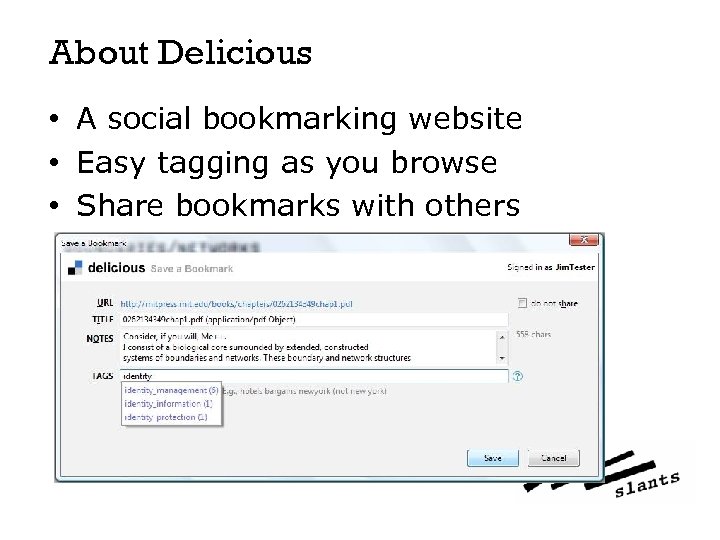
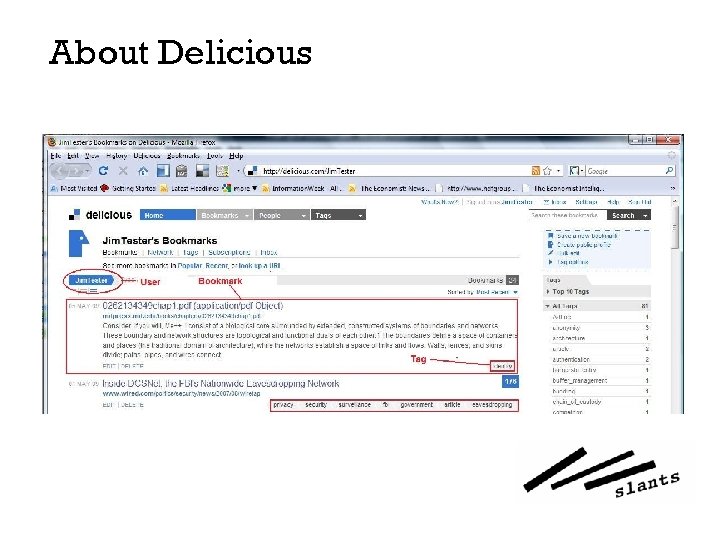
About Delicious • A social bookmarking website • Easy tagging as you browse • Share bookmarks with others
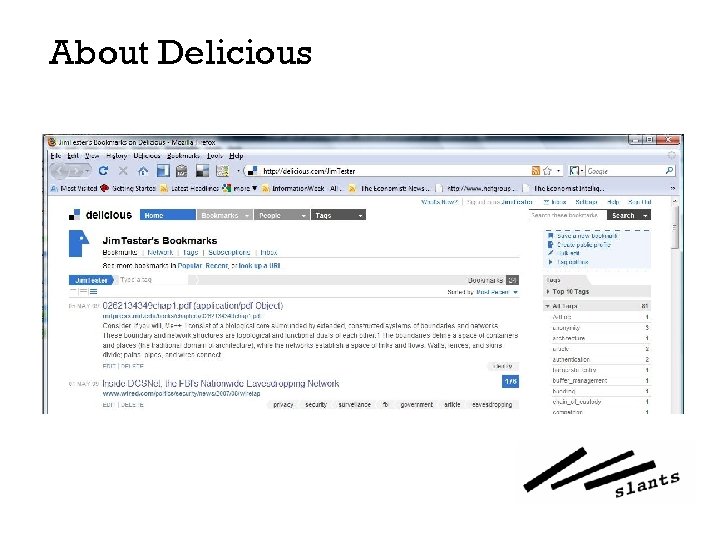
About Delicious
About Delicious
How Slants Uses Delicious
How Slants Uses Delicious
The Problem That Slants Addresses • Technical standards have public policy consequences 1: – Identity – User/content discrimination – Content censorship and control – User consent, etc • Often unaddressed in standards • Best to find out early in the standards process 1 Morris, J, A. Davidson. "Public Policy Considerations for Internet Design Decisions, " Center for Democracy and Technology, 2003.
More Easily Said Than Done • There are now more than 400 ICT standards consortia active globally • Thousands of standards • Consumer and watchdog groups are unlikely to be represented • Therefore, specifications may not take due account of their needs

Semantic Gap
Semantic Gap: IPv 6 (RFC-2464) “Under IPv 4, the predecessor to IPv 6, Internet addressing allowed a reasonable amount of privacy and anonymity, because a numeric address was typically not tied to any particular machine or user. With IPv 6, however, the standard provided that in many cases a user’s address would be derived from the unique MAC (Medium Access Control) address embedded in the user’s Ethernet network card. ” 2 2 Davidson, Alan, John Morris, Rob Courtney. “Strangers in a Strange Land: Public Interest Advocacy and Internet Standards. : Washington, D. C. : Center for Democracy and Technology, 2002. <www. cdt. org/publications/piais. pdf>
Focus on Identity • • • Information privacy Information security Authentication Access Online tracking Datamining Profiling Third-party use Anonymous speech Etc.
The Slants Approach • Recruit or select Delicious users interested in ICT/public policy issues • Harvest their Delicious bookmarks, based on their tagging • Harvest other bookmarks from the wider Delicious network • Aggregate and organize the bookmarks on the Slants website
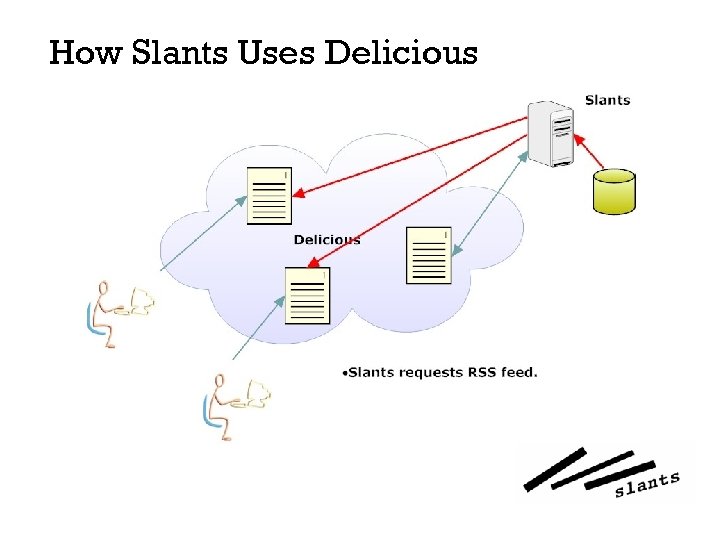
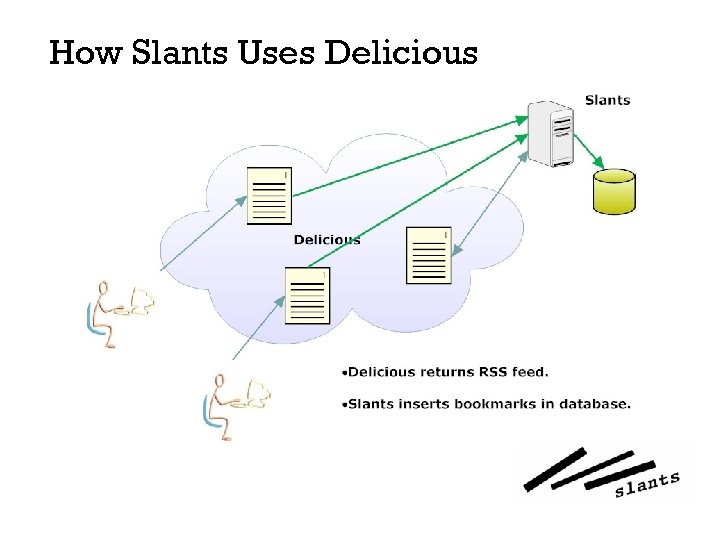
Tag Harvesting • Slants requests bookmarks from Delicious – For specific users – For specific resources – With specific sets of tags • Delicious returns an RSS feed of bookmarks
Tag Harvesting • An automated process • Search terms are based on thesaurus relationships: – BT/NT : identity + authentication + Open. ID – SA: RFID_tags + vicinity_cards – UF: surveillance + eavesdropping – RT: key_generation + key_distribution – Expansive: smart card OR chip card
Expansive Searches GSM one smartph …or… Find bookmarks tagged: …or… e cellphone smart cell_phone CDMA e i. Phon id ndro a mobile + surveillance eavesdropping locatio n_trac king interc e track trac eavesdrop king monitor cove rt mon Intercep itorin tion g pt
Normalized Results one smartph e cellphone smart cell_phone Organize tags under: GSM CDMA e i. Phon id ndro a mobile + surveillance eavesdropping locatio n_trac king track trac interc eavesdrop king ept monitor cove rt mon Intercep itorin tion g
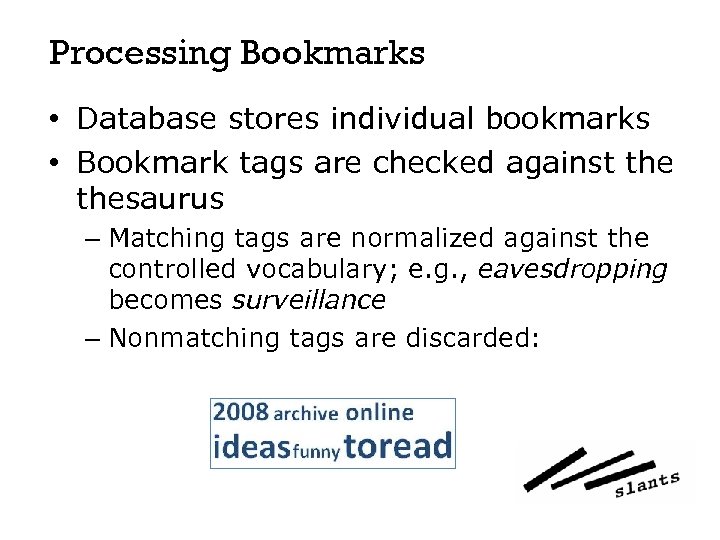
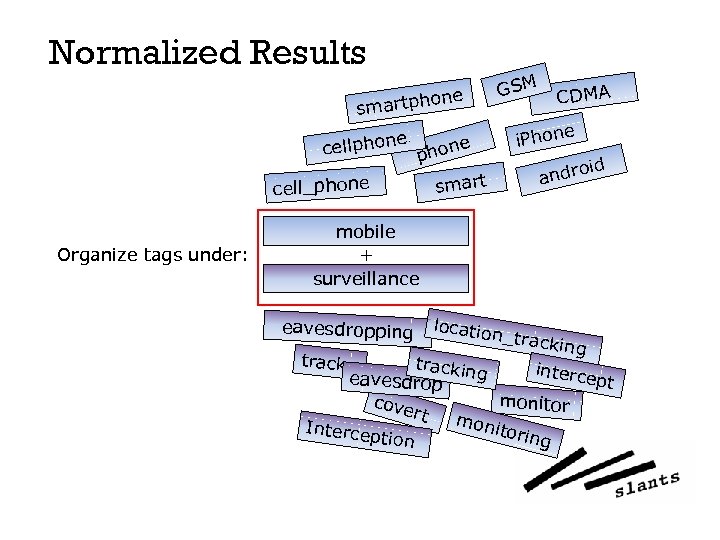
Processing Bookmarks • Database stores individual bookmarks • Bookmark tags are checked against thesaurus – Matching tags are normalized against the controlled vocabulary; e. g. , eavesdropping becomes surveillance – Nonmatching tags are discarded:
Accessing Bookmarks • Tags are organized to create an index according to rules in thesaurus • Index is refreshed whenever new bookmarks are harvested • The index allows users to sort bookmarks by topic
Why Use Slants? • Leverages the researching skills of many users in a single area of interest • Automatically searches the entire Delicious network (over 5 million users) • Normalizes disparate tagging into a consistent system • Organizes bookmarks by topic
Low Cognitive Cost • No extra work involved, just tagging as usual • Gathers domain-relevant resources in one place • Provides easy browsing and finding
Additional Features • Identifies Delicious users that have the same interest • Scores resources by times bookmarked • Enables users to create custom searches
Future Work • Term recommender system • Thesaurus building tool
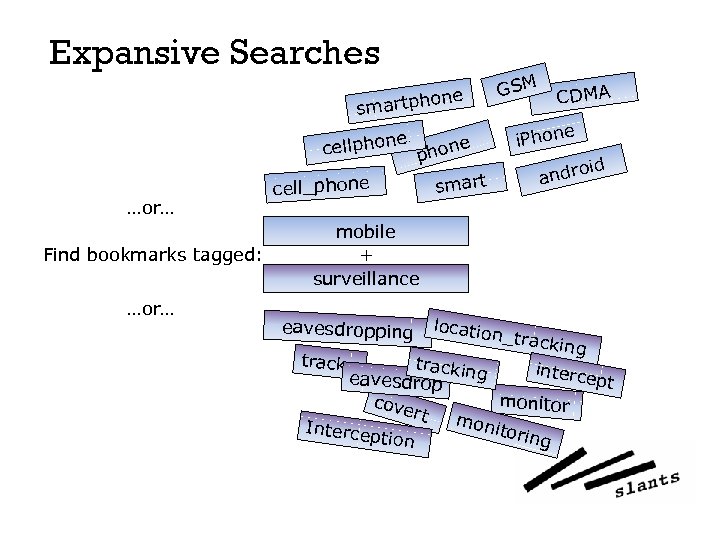
Summary • A collaborative research tool • Leverages social bookmarking that users would do anyway • Performs expansive searches • Normalizes search results for easy retrieval • Built for the public policy domain but can be applied to any domain

?
Скачать презентацию ty A Tool for Collaborative Research James Miller
a07862b8911dbad5e2a4228f2e808915.ppt