 Скачать презентацию Two-Body Photodisintegration of 3 He 2 He and
48098fdebd2b81a3d2305a200d6a80e9.ppt
- Количество слайдов: 23



Two-Body Photodisintegration of 3 He, 2 He, and 4 He up to 1. 5 Ge. V B. L. Berman Department of Physics The George Washington University Washington, DC 20052, USA For the CLAS Collaboration Particles And Nuclei International Conference Eilat, Israel November 10, 2008 PANIC 2008 / November 10, 2008 1
Three-Body Forces/Mechanisms • At low energies, two mesons are exchanged between three nucleons: one meson is exchanged from a nucleon while it is off-shell from the exchange of the other. • At high energies, can we speak the same language? [Quarks are confined. ] • The 3 N force is shorter-range than the 2 N force. Therefore, the three nucleons must be in close proximity. How close? • Is there a hierarchy of many-body forces? [à la Friar] How close is too close? PANIC 2008 / November 10, 2008 2
Analyses of the GW Group on JLab 3, 4 He Data 3 He( , pp)n (three-body breakup)*—Silvia Niccolai**(Ph. D. thesis) · 3 He( , dp) (two-body breakup)—Yordanka Ilieva*** · 3 He( , pp)n (helicities)—Tilan Ukwatta, Steffen Strauch*** · 4 He( , tp) (two-body breakup)—Nawal Benmouna****, Rakhsha Nasseripour · 3 He( , pp) (hard/two-body, Hall B)—Steffen Strauch, Silvia Niccolai · 3 He( , pp) (hard/two-body, Hall A)—Ishai Pomerantz*****, Eli Piasetzsky***** 4 He( , dd) (two-deuteron breakup)—Steffen Strauch 3 He( , p +)nn (Δ++ knockout)—Yordanka Ilieva 3 He( , t +) (coherent)—Yordanka Ilieva, Rakhsha Nasseripour 3, 4 He( , + ) (ρ production)—Nawal Benmouna *Published in Phys Rev C **Now at Orsay ***Now at South Carolina ****Now at Montgomery College *****Tel Aviv University PANIC 2008 / November 10, 2008 3
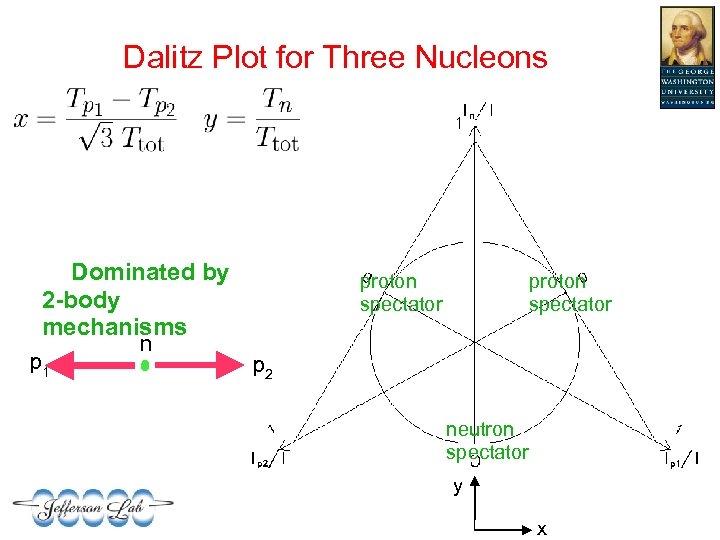
Dalitz Plot for Three Nucleons Dominated by 2 -body mechanisms p 1 n proton spectator p 2 neutron spectator y PANIC 2008 / November 10, 2008 4 x
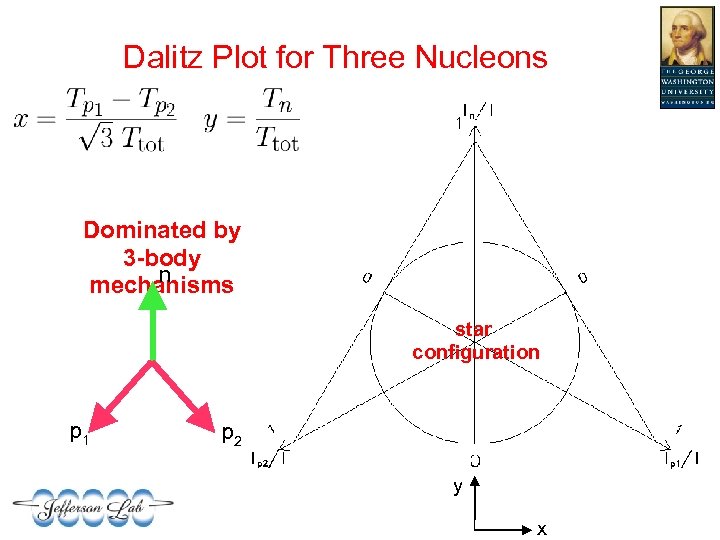
Dalitz Plot for Three Nucleons Dominated by 3 -body n mechanisms star configuration p 1 p 2 y PANIC 2008 / November 10, 2008 5 x
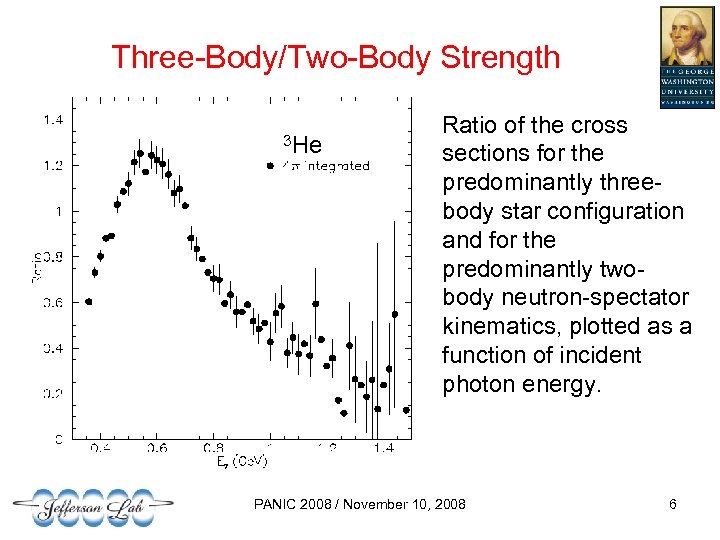
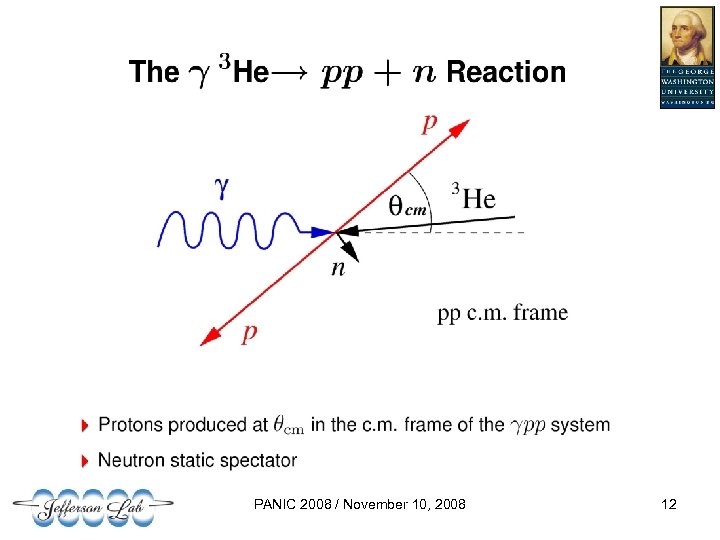
Three-Body/Two-Body Strength 3 He Ratio of the cross sections for the predominantly threebody star configuration and for the predominantly twobody neutron-spectator kinematics, plotted as a function of incident photon energy. PANIC 2008 / November 10, 2008 6
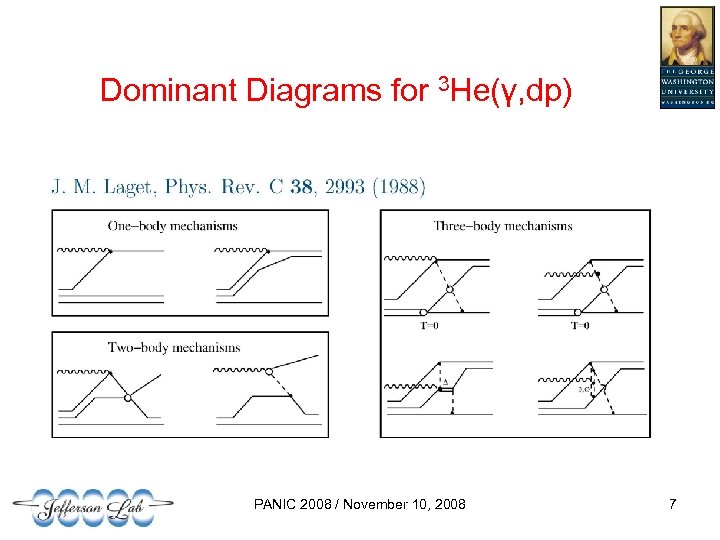
Dominant Diagrams for 3 He(γ, dp) PANIC 2008 / November 10, 2008 7
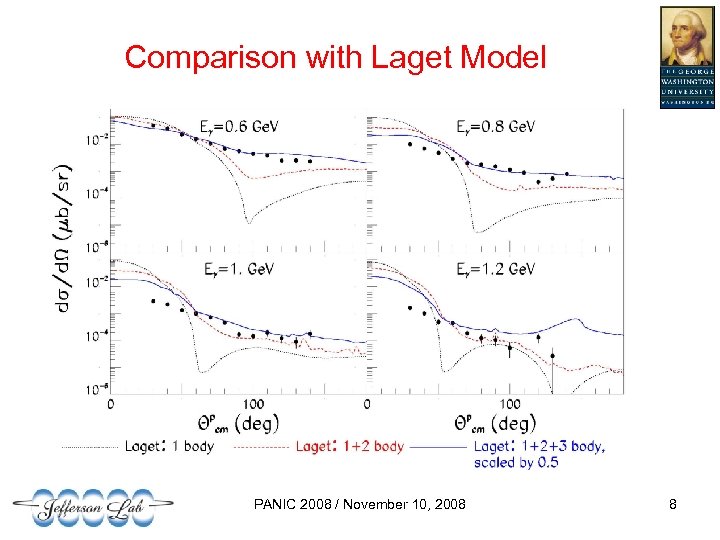
Comparison with Laget Model PANIC 2008 / November 10, 2008 8
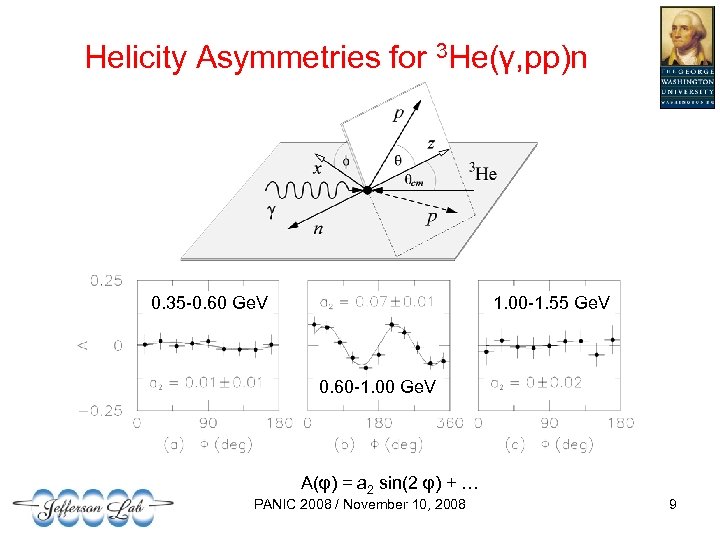
Helicity Asymmetries for 3 He(γ, pp)n 0. 35 -0. 60 Ge. V 1. 00 -1. 55 Ge. V 0. 60 -1. 00 Ge. V A(φ) = a 2 sin(2 φ) + … PANIC 2008 / November 10, 2008 9
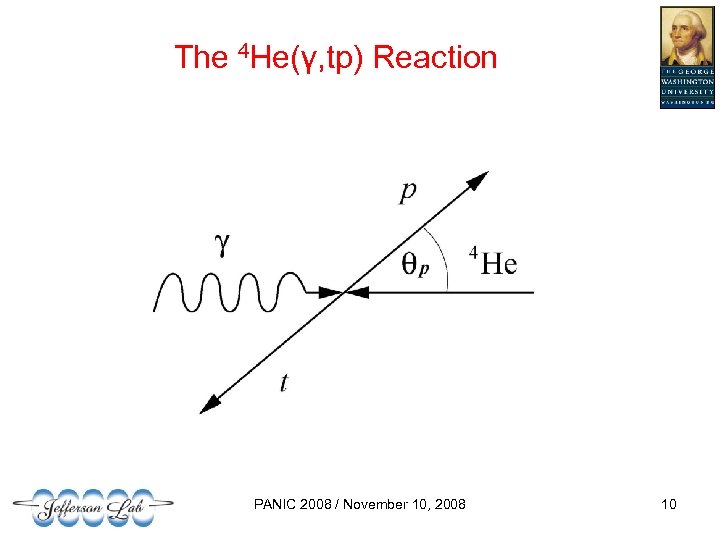
The 4 He(γ, tp) Reaction PANIC 2008 / November 10, 2008 10
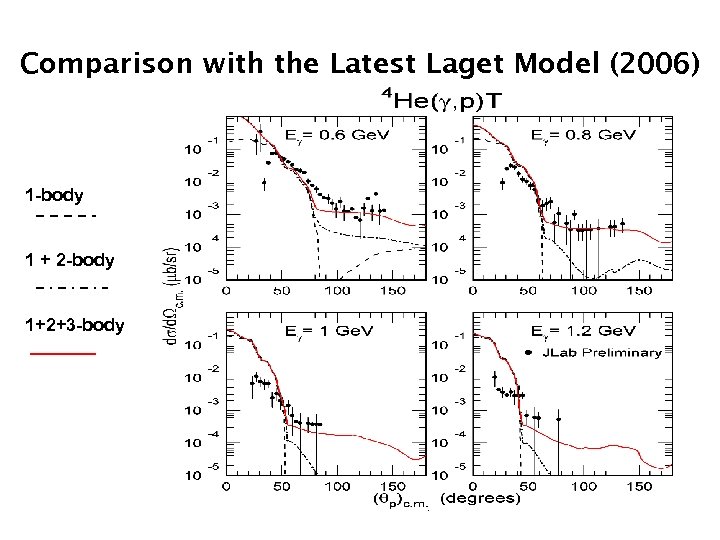
Comparison with the Latest Laget Model (2006) 1 -body 1 + 2 -body 1+2+3 -body PANIC 2008 / November 10, 2008 11
PANIC 2008 / November 10, 2008 12
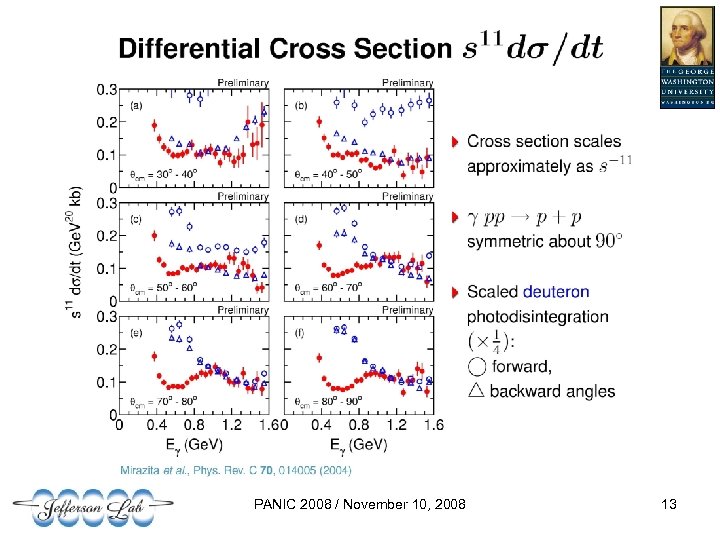
PANIC 2008 / November 10, 2008 13
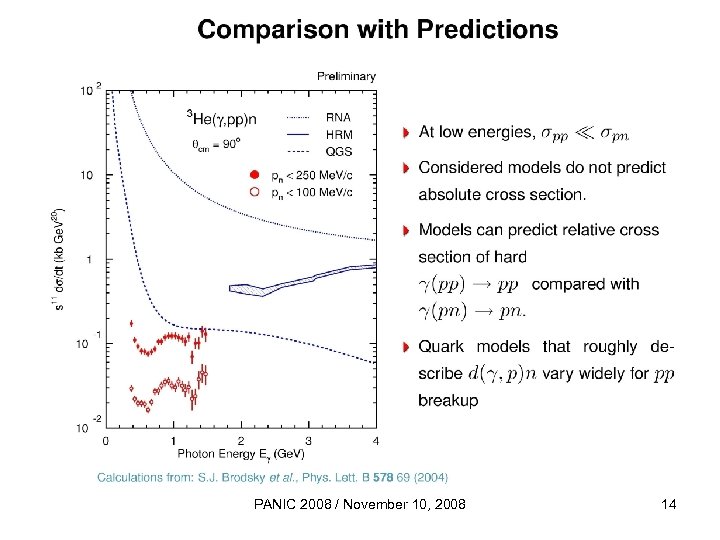
PANIC 2008 / November 10, 2008 14
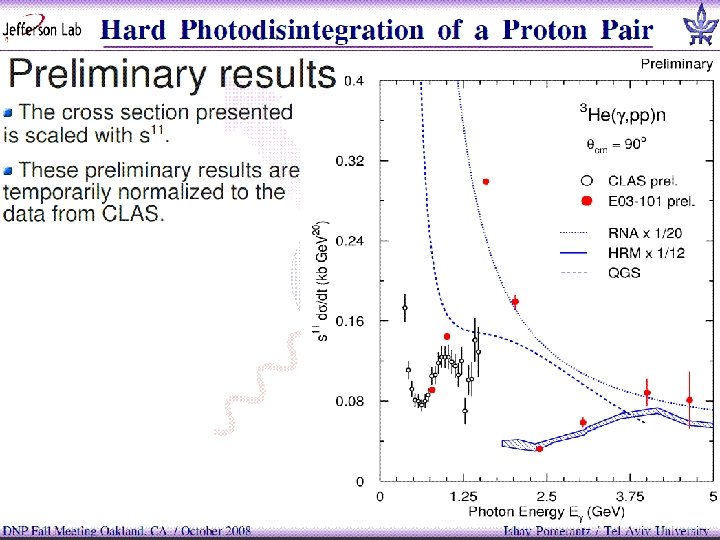
PANIC 2008 / November 10, 2008 15
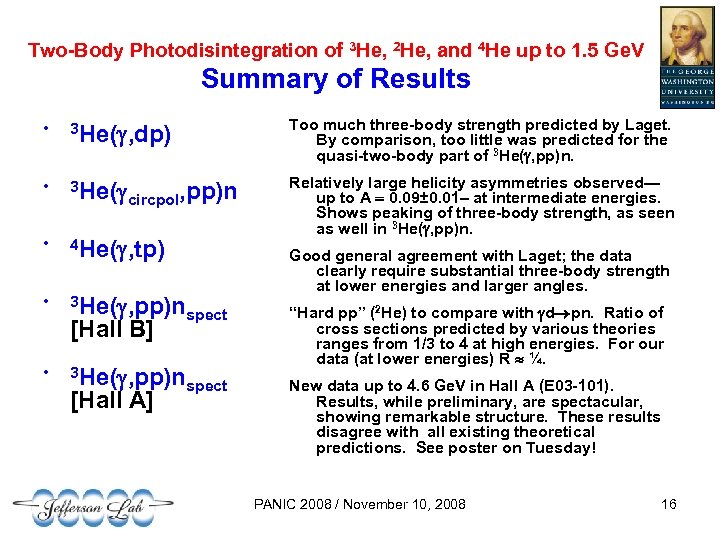
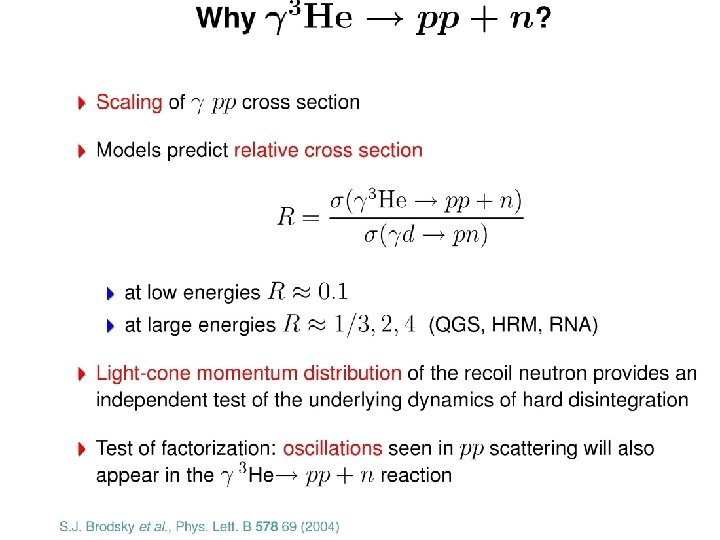
Two-Body Photodisintegration of 3 He, 2 He, and 4 He up to 1. 5 Ge. V Summary of Results • 3 He( , dp) Too much three-body strength predicted by Laget. By comparison, too little was predicted for the quasi-two-body part of 3 He( , pp)n. • 3 He( • 4 He( , tp) Relatively large helicity asymmetries observed— up to A 0. 09± 0. 01– at intermediate energies. Shows peaking of three-body strength, as seen as well in 3 He( , pp)n. • 3 He( , pp)n spect circpol, pp)n [Hall B] • [Hall A] Good general agreement with Laget; the data clearly require substantial three-body strength at lower energies and larger angles. “Hard pp” (2 He) to compare with d pn. Ratio of cross sections predicted by various theories ranges from 1/3 to 4 at high energies. For our data (at lower energies) R ¼. New data up to 4. 6 Ge. V in Hall A (E 03 -101). Results, while preliminary, are spectacular, showing remarkable structure. These results disagree with all existing theoretical predictions. See poster on Tuesday! PANIC 2008 / November 10, 2008 16
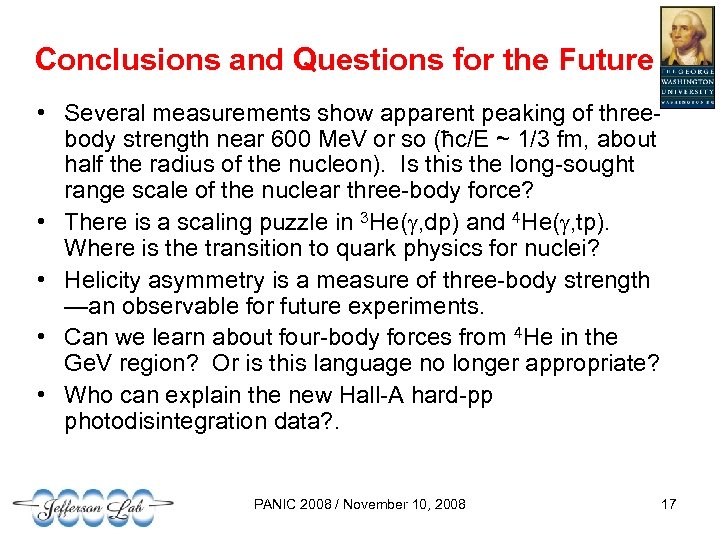
Conclusions and Questions for the Future • Several measurements show apparent peaking of threebody strength near 600 Me. V or so (ħc/E ~ 1/3 fm, about half the radius of the nucleon). Is this the long-sought range scale of the nuclear three-body force? • There is a scaling puzzle in 3 He( , dp) and 4 He( , tp). Where is the transition to quark physics for nuclei? • Helicity asymmetry is a measure of three-body strength —an observable for future experiments. • Can we learn about four-body forces from 4 He in the Ge. V region? Or is this language no longer appropriate? • Who can explain the new Hall-A hard-pp photodisintegration data? . PANIC 2008 / November 10, 2008 17
–To be continued… PANIC 2008 / November 10, 2008 18
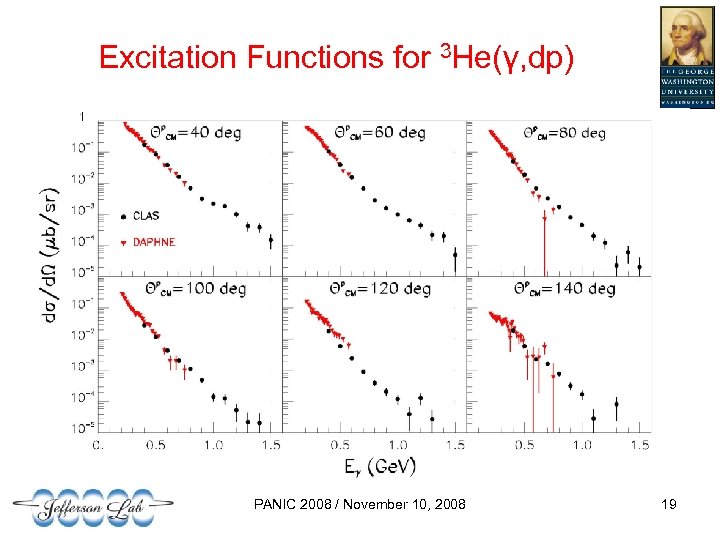
Excitation Functions for 3 He(γ, dp) PANIC 2008 / November 10, 2008 19
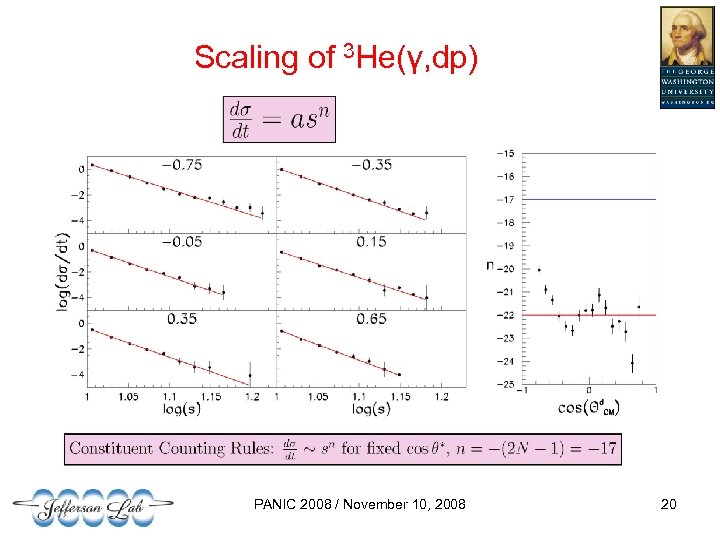
Scaling of 3 He(γ, dp) PANIC 2008 / November 10, 2008 20
PANIC 2008 / November 10, 2008 21
PANIC 2008 / November 10, 2008 22
PANIC 2008 / November 10, 2008 23
Скачать презентацию Two-Body Photodisintegration of 3 He 2 He and
48098fdebd2b81a3d2305a200d6a80e9.ppt