 Скачать презентацию tw BB tw AAA tw AA Bumpy Road
02cd64189508724b710809cee8b4d4f5.ppt
- Количество слайдов: 26



tw. BB tw. AAA tw. AA Bumpy Road Ahead For Taiwan's TFT-LCD Manufacturers By Raymond Hsu Sep. 2005
tw. BB Methodology tw. AAA tw. AA • Industry Analysis – Identify opportunities and risks in the industry – Identify key success factors • • Market position/market share Low cost position Diverse product and application mix Technology leadership • Business Profile Comparison • Financial Profile Comparison – – Profitability Cash flow protection measures Liquidity Capital Structure & Financial flexibility • Conclusion
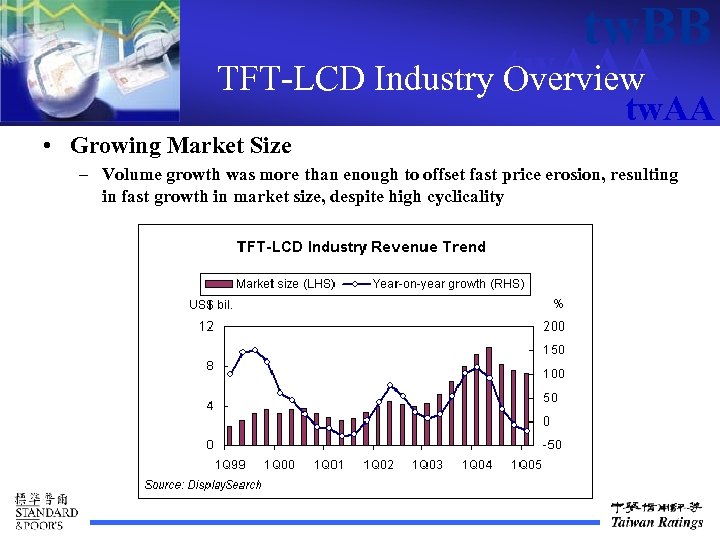
tw. BB tw. AAA TFT-LCD Industry Overview tw. AA • Growing Market Size – Volume growth was more than enough to offset fast price erosion, resulting in fast growth in market size, despite high cyclicality
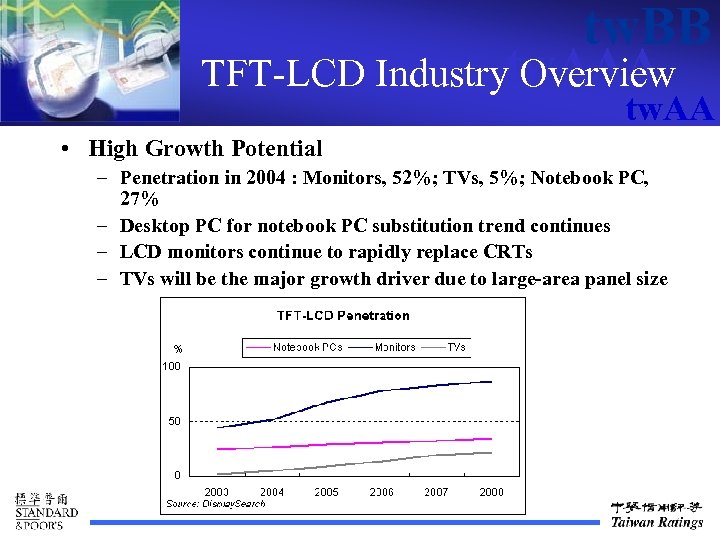
tw. BB TFT-LCD Industrytw. AAA Overview tw. AA • High Growth Potential – Penetration in 2004 : Monitors, 52%; TVs, 5%; Notebook PC, 27% – Desktop PC for notebook PC substitution trend continues – LCD monitors continue to rapidly replace CRTs – TVs will be the major growth driver due to large-area panel size
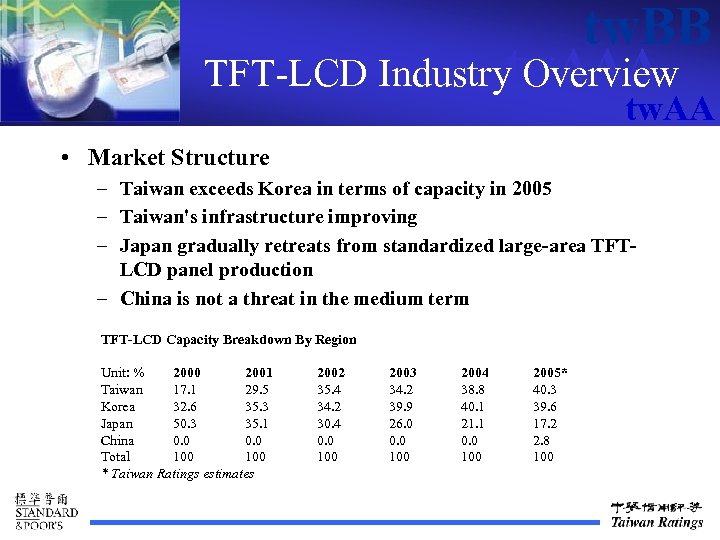
tw. BB TFT-LCD Industrytw. AAA Overview tw. AA • Market Structure – Taiwan exceeds Korea in terms of capacity in 2005 – Taiwan's infrastructure improving – Japan gradually retreats from standardized large-area TFTLCD panel production – China is not a threat in the medium term TFT-LCD Capacity Breakdown By Region Unit: % 2000 2001 Taiwan 17. 1 29. 5 Korea 32. 6 35. 3 Japan 50. 3 35. 1 China 0. 0 Total 100 * Taiwan Ratings estimates 2002 35. 4 34. 2 30. 4 0. 0 100 2003 34. 2 39. 9 26. 0 0. 0 100 2004 38. 8 40. 1 21. 1 0. 0 100 2005* 40. 3 39. 6 17. 2 2. 8 100
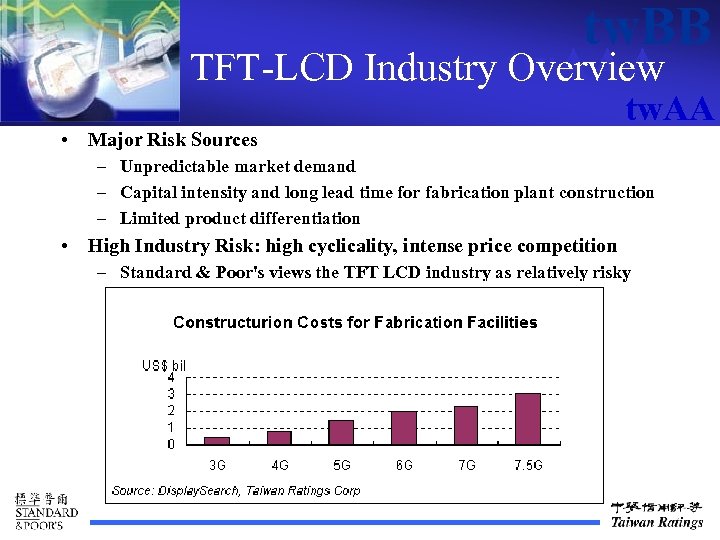
tw. BB TFT-LCD Industry tw. AAA Overview • Major Risk Sources tw. AA – Unpredictable market demand – Capital intensity and long lead time for fabrication plant construction – Limited product differentiation • High Industry Risk: high cyclicality, intense price competition – Standard & Poor's views the TFT LCD industry as relatively risky
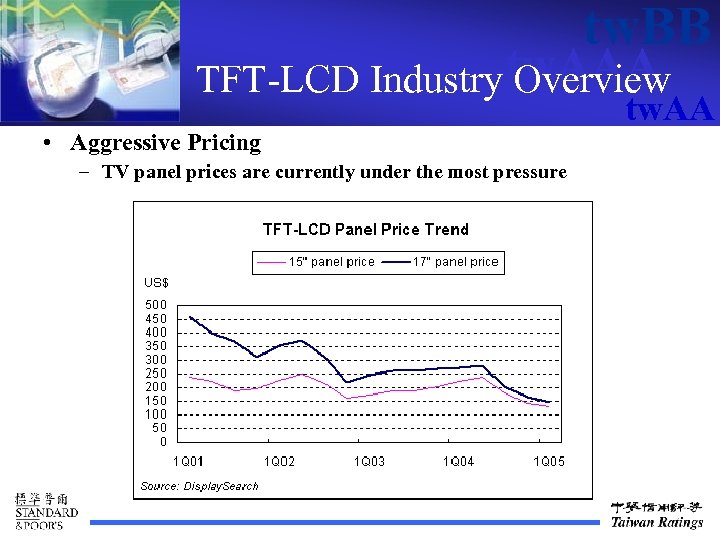
tw. BB TFT-LCD Industry tw. AAA Overview tw. AA • Aggressive Pricing – TV panel prices are currently under the most pressure
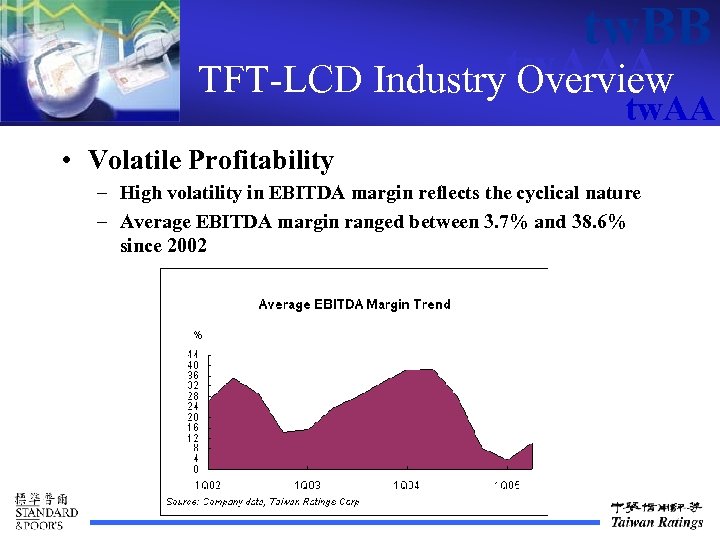
tw. BB TFT-LCD Industrytw. AAA Overview tw. AA • Volatile Profitability – High volatility in EBITDA margin reflects the cyclical nature – Average EBITDA margin ranged between 3. 7% and 38. 6% since 2002
tw. BB tw. AAA TFT-LCD Industry Overview tw. AA • Key Success Factors • · Market position, which is primarily measured by market share, determines scale benefits and the level of buyer and supplier bargaining power • · Low cost position, which is achieved through economies of scale, advanced production facilities, and vertical integration. A low cost position is a critical competitive advantage given the increasing standardization of TFT-LCD products • · Diverse product and application mix, which helps reduce business volatility • · Technology leadership, which is important for entering rapidly evolving markets, but is dependent on the company's ability to support ever increasing capital requirements
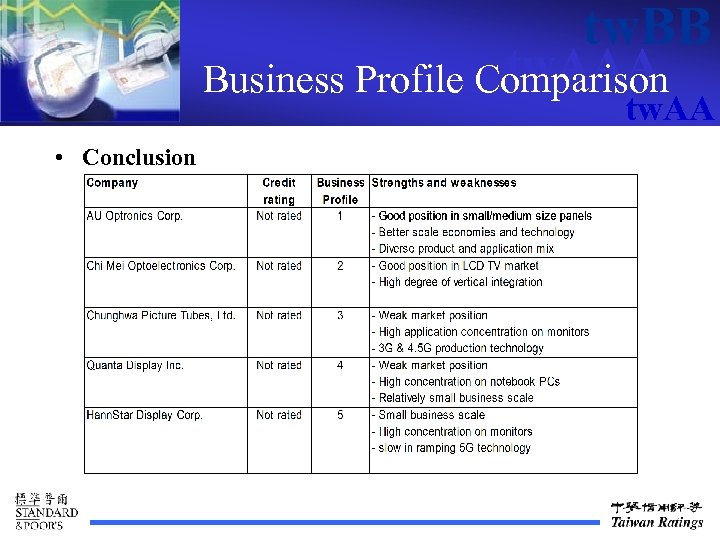
tw. BB tw. AAA Business Profile Comparison tw. AA • Conclusion
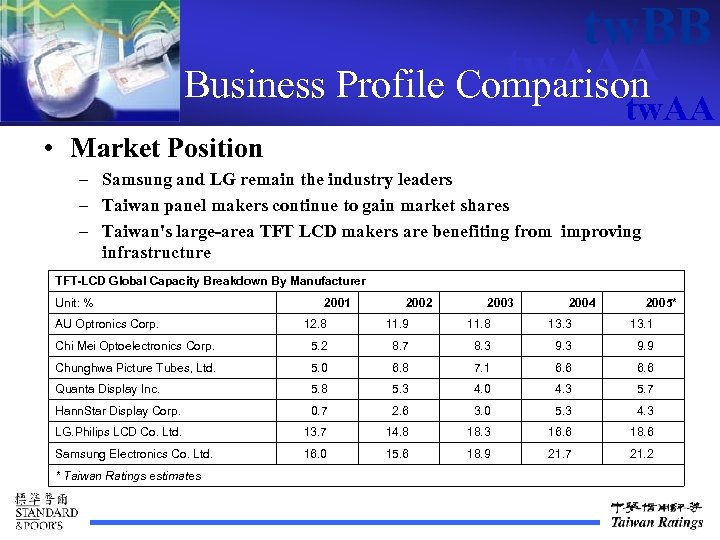
tw. BB tw. AAA Business Profile Comparison tw. AA • Market Position – Samsung and LG remain the industry leaders – Taiwan panel makers continue to gain market shares – Taiwan's large-area TFT LCD makers are benefiting from improving infrastructure TFT-LCD Global Capacity Breakdown By Manufacturer Unit: % AU Optronics Corp. 2001 2002 2003 2004 2005* 12. 8 11. 9 11. 8 13. 3 13. 1 Chi Mei Optoelectronics Corp. 5. 2 8. 7 8. 3 9. 9 Chunghwa Picture Tubes, Ltd. 5. 0 6. 8 7. 1 6. 6 Quanta Display Inc. 5. 8 5. 3 4. 0 4. 3 5. 7 Hann. Star Display Corp. 0. 7 2. 6 3. 0 5. 3 4. 3 LG. Philips LCD Co. Ltd. 13. 7 14. 8 18. 3 16. 6 18. 6 Samsung Electronics Co. Ltd. 16. 0 15. 6 18. 9 21. 7 21. 2 * Taiwan Ratings estimates
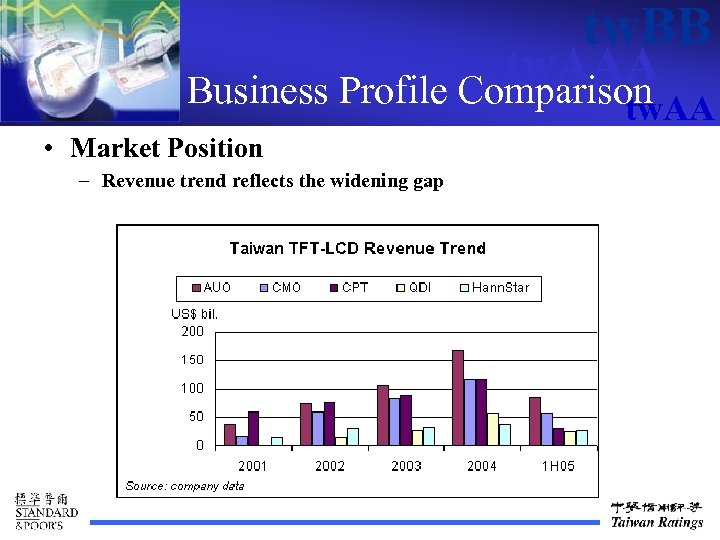
tw. BB tw. AAA Business Profile Comparison tw. AA • Market Position – Revenue trend reflects the widening gap
tw. BB tw. AAA Business Profile Comparison tw. AA • Low Cost Position & Technology Leadership – Scale economies are important due to a higher percentage of material costs for new production technology – AUO has better scale economies and the first mover advantage in new technology – CMO has better integration into in-house component production, but slower in ramping advanced facilities, including its 5 G and 5. 5 G fabs – CPT operates 3 G and 4. 5 G fabs, resulting in less favorable cost structure – QDI currently operates one 3. 5 G fab and one 5 G fab and will commission its first 6 G fab in 1 H 06 – Hann. Star was the slowest to ramp 5 G technology. Its cost position could deteriorate without a clear 6 G plan
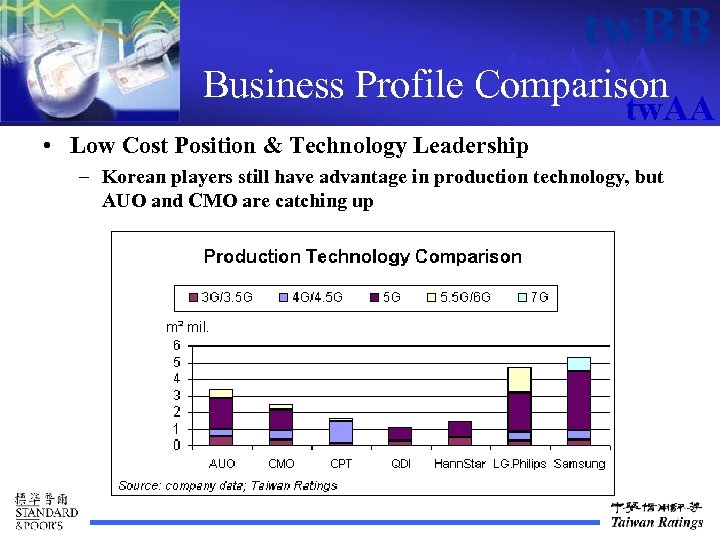
tw. BB tw. AAA Business Profile Comparison tw. AA • Low Cost Position & Technology Leadership – Korean players still have advantage in production technology, but AUO and CMO are catching up
tw. BB tw. AAA Business Profile Comparison tw. AA • Product and application mix – All are single product companies, representing high product concentration risk – AUO has a better product and application mix because of its good position in the small- to mid-size TFT-LCD sector – CMO occupies good position in the LCD TV segment: 20% global market share and 38% of its revenue in 1 H 05 – CPT, QDI, and Hann. Star all continue to focus on notebook PCs and PC monitors – CPT’s legacy CRT business and PDP investment are not considered as meaningful product diversification
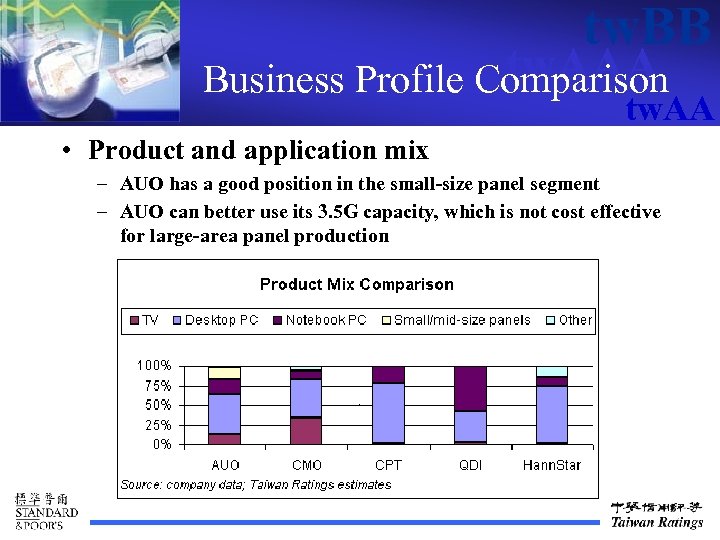
tw. BB tw. AAA Business Profile Comparison tw. AA • Product and application mix – AUO has a good position in the small-size panel segment – AUO can better use its 3. 5 G capacity, which is not cost effective for large-area panel production
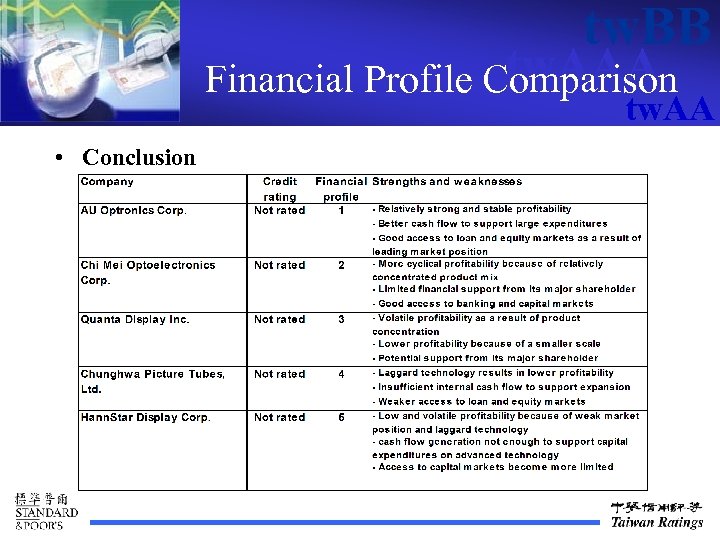
tw. BB tw. AAA Financial Profile Comparison tw. AA • Conclusion
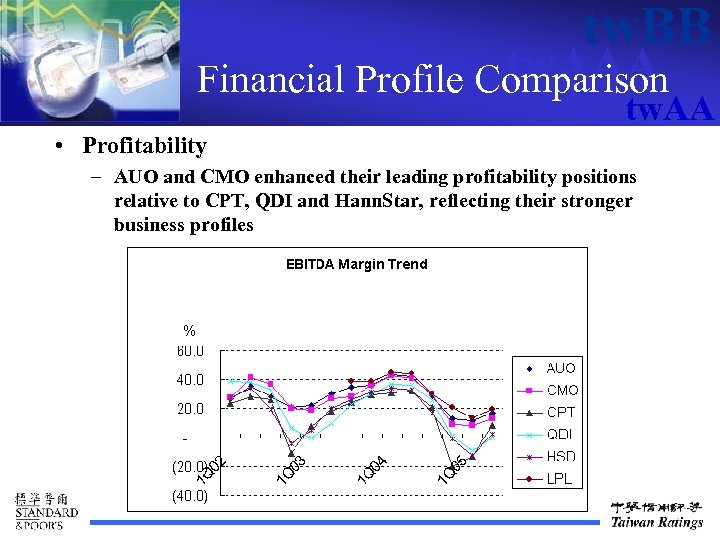
tw. BB tw. AAA Financial Profile Comparison tw. AA • Profitability – AUO and CMO enhanced their leading profitability positions relative to CPT, QDI and Hann. Star, reflecting their stronger business profiles
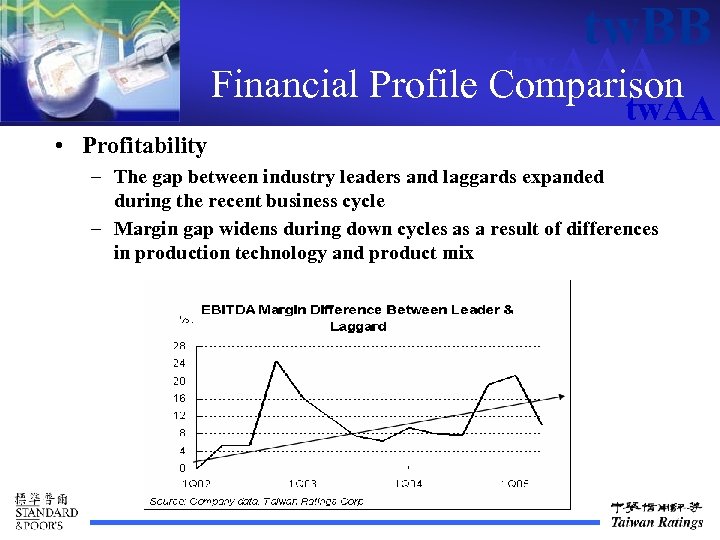
tw. BB tw. AAA Financial Profile Comparison tw. AA • Profitability – The gap between industry leaders and laggards expanded during the recent business cycle – Margin gap widens during down cycles as a result of differences in production technology and product mix
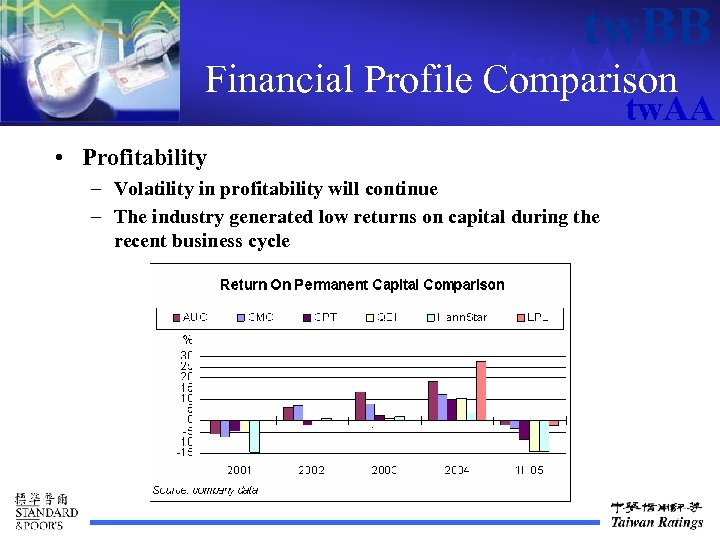
tw. BB tw. AAA Financial Profile Comparison tw. AA • Profitability – Volatility in profitability will continue – The industry generated low returns on capital during the recent business cycle
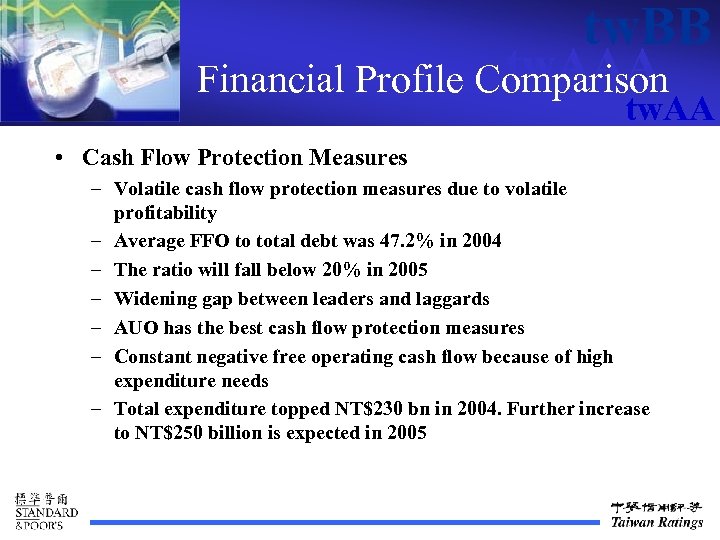
tw. BB tw. AAA Financial Profile Comparison tw. AA • Cash Flow Protection Measures – Volatile cash flow protection measures due to volatile profitability – Average FFO to total debt was 47. 2% in 2004 – The ratio will fall below 20% in 2005 – Widening gap between leaders and laggards – AUO has the best cash flow protection measures – Constant negative free operating cash flow because of high expenditure needs – Total expenditure topped NT$230 bn in 2004. Further increase to NT$250 billion is expected in 2005
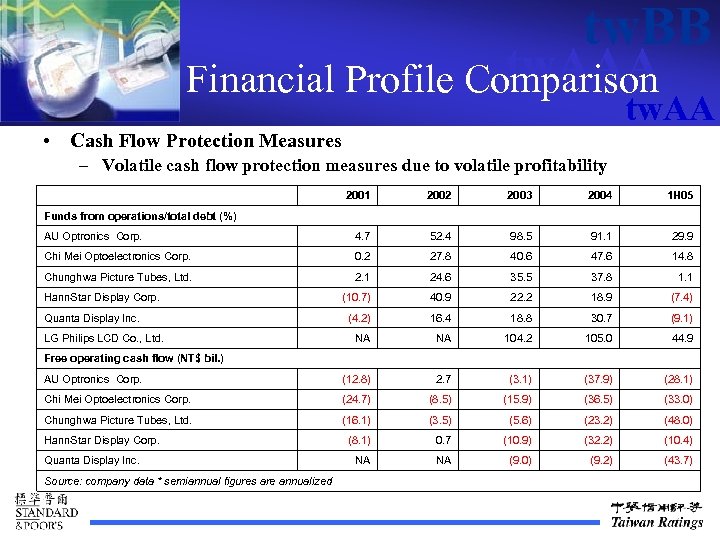
tw. BB tw. AAA Financial Profile Comparison tw. AA • Cash Flow Protection Measures – Volatile cash flow protection measures due to volatile profitability 2001 2002 2003 2004 1 H 05 AU Optronics Corp. 4. 7 52. 4 98. 5 91. 1 29. 9 Chi Mei Optoelectronics Corp. 0. 2 27. 8 40. 6 47. 6 14. 8 Chunghwa Picture Tubes, Ltd. 2. 1 24. 6 35. 5 37. 8 1. 1 (10. 7) 40. 9 22. 2 18. 9 (7. 4) (4. 2) 16. 4 18. 8 30. 7 (9. 1) NA NA 104. 2 105. 0 44. 9 Funds from operations/total debt (%) Hann. Star Display Corp. Quanta Display Inc. LG Philips LCD Co. , Ltd. Free operating cash flow (NT$ bil. ) AU Optronics Corp. (12. 8) 2. 7 (3. 1) (37. 9) (28. 1) Chi Mei Optoelectronics Corp. (24. 7) (8. 5) (15. 9) (36. 5) (33. 0) Chunghwa Picture Tubes, Ltd. (16. 1) (3. 5) (5. 6) (23. 2) (48. 0) (8. 1) 0. 7 (10. 9) (32. 2) (10. 4) NA NA (9. 0) (9. 2) (43. 7) Hann. Star Display Corp. Quanta Display Inc. Source: company data * semiannual figures are annualized
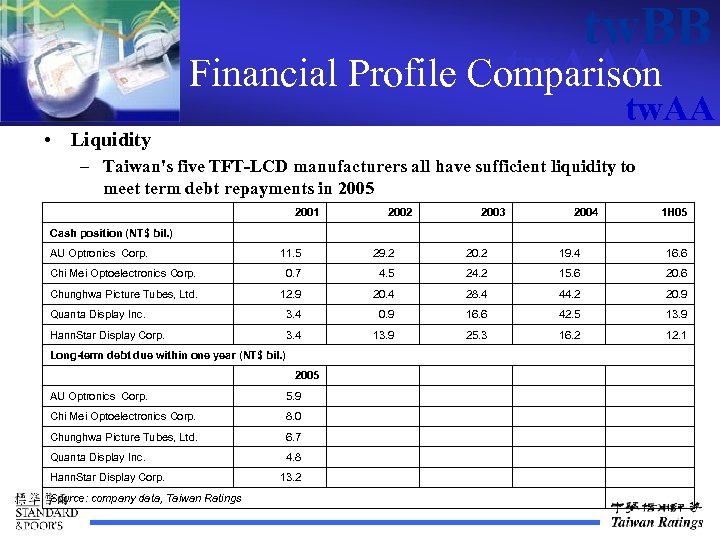
tw. BB tw. AAA Financial Profile Comparison tw. AA • Liquidity – Taiwan's five TFT-LCD manufacturers all have sufficient liquidity to meet term debt repayments in 2005 2001 Cash position (NT$ bil. ) AU Optronics Corp. 2002 2003 2004 1 H 05 11. 5 29. 2 20. 2 19. 4 16. 6 Chi Mei Optoelectronics Corp. 0. 7 4. 5 24. 2 15. 6 20. 6 Chunghwa Picture Tubes, Ltd. 12. 9 20. 4 28. 4 44. 2 20. 9 Quanta Display Inc. 3. 4 0. 9 16. 6 42. 5 13. 9 Hann. Star Display Corp. 3. 4 13. 9 25. 3 16. 2 12. 1 Long-term debt due within one year (NT$ bil. ) 2005 AU Optronics Corp. 5. 9 Chi Mei Optoelectronics Corp. 8. 0 Chunghwa Picture Tubes, Ltd. 6. 7 Quanta Display Inc. 4. 8 13. 2 Hann. Star Display Corp. Source: company data, Taiwan Ratings
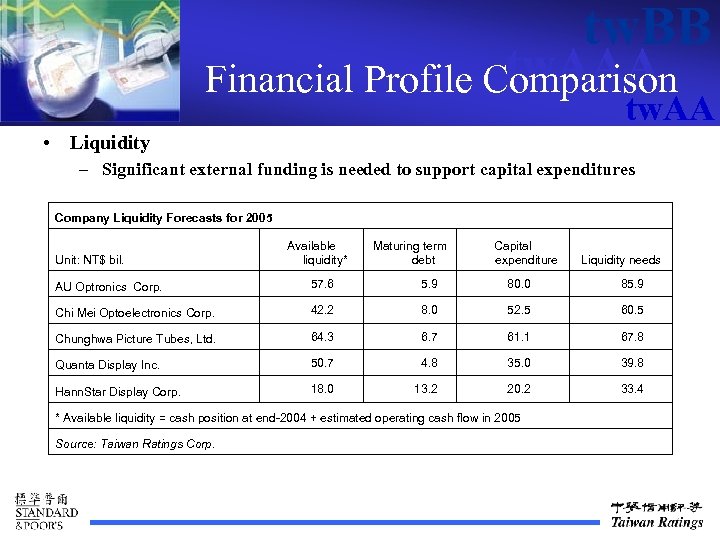
tw. BB tw. AAA Financial Profile Comparison tw. AA • Liquidity – Significant external funding is needed to support capital expenditures Company Liquidity Forecasts for 2005 Unit: NT$ bil. Available liquidity* Maturing term debt Capital expenditure Liquidity needs AU Optronics Corp. 57. 6 5. 9 80. 0 85. 9 Chi Mei Optoelectronics Corp. 42. 2 8. 0 52. 5 60. 5 Chunghwa Picture Tubes, Ltd. 64. 3 6. 7 61. 1 67. 8 Quanta Display Inc. 50. 7 4. 8 35. 0 39. 8 Hann. Star Display Corp. 18. 0 13. 2 20. 2 33. 4 * Available liquidity = cash position at end-2004 + estimated operating cash flow in 2005 Source: Taiwan Ratings Corp.
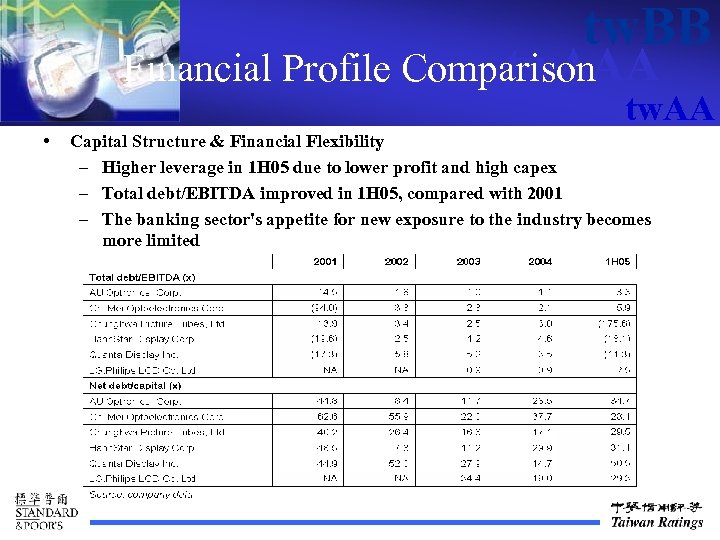
tw. BB tw. AAA Financial Profile Comparison tw. AA • Capital Structure & Financial Flexibility – Higher leverage in 1 H 05 due to lower profit and high capex – Total debt/EBITDA improved in 1 H 05, compared with 2001 – The banking sector's appetite for new exposure to the industry becomes more limited
tw. BB tw. AAA Conclusion tw. AA • Diverging credit quality among Taiwan's panel makers • Reasons behind: better scale economies, product diversification and technology lead to better profitability and cash flows • This in turn expands the gap between leaders and laggards because of leaders' more aggressive expenditures • AUO has a clear-cut leading position among Taiwan's panel makers in terms of credit quality • CMO follows closely, but needs to enhance its execution and product strategy • M&A may not happen soon because of continued access to loan and equity markets • Local banks' decreasing appetite has a negative implication, particularly for smaller players
Скачать презентацию tw BB tw AAA tw AA Bumpy Road
02cd64189508724b710809cee8b4d4f5.ppt