


 Скачать презентацию TV JARGON AND EXAMPLES TARGET AUDIENCE
451bfe5f6ecb88a424408d26bacb2f13.ppt
- Количество слайдов: 20
 TV JARGON AND EXAMPLES
 TARGET AUDIENCE • A target audience (also known as a target market) represents the people we most want to talk to • Defining the target audience enables us to tailor our message and our media buying specifically to reach and influence these people, thus avoiding ‘wastage’ (i. e. paying to reach people who are unlikely to buy our product) • For the sake of this exercise, let’s say our target audience is all people aged 25 -54. To keep things even simpler, our total population (below) consists of just 10 people, 50% of which (five people) are aged 25 -54
 PERFORMANCE METRICS • In the real world our target audience will be much larger than just 5 people, but by having just five people allows us to see a real life example of how the Performance Metrics work at a very simplistic level • We will look at the viewing habits of each person in our group of five people and show these mesh together to form the metrics we see on media schedules each day
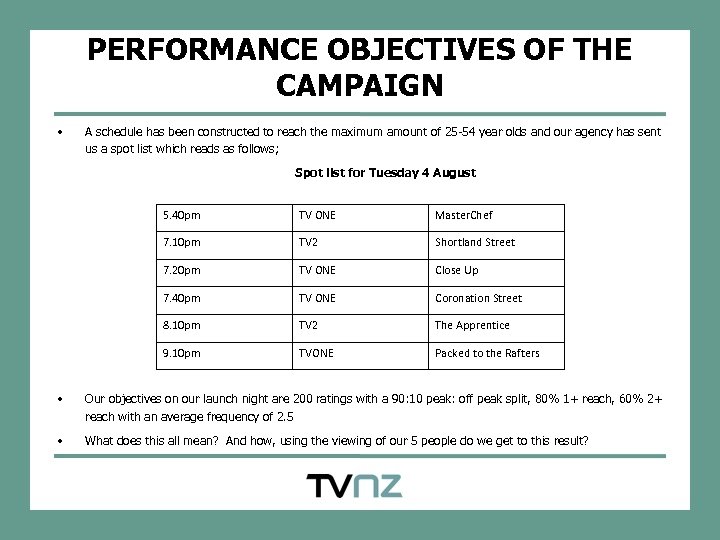 PERFORMANCE OBJECTIVES OF THE CAMPAIGN • A schedule has been constructed to reach the maximum amount of 25 -54 year olds and our agency has sent us a spot list which reads as follows; Spot list for Tuesday 4 August 5. 40 pm TV ONE Master. Chef 7. 10 pm TV 2 Shortland Street 7. 20 pm TV ONE Close Up 7. 40 pm TV ONE Coronation Street 8. 10 pm TV 2 The Apprentice 9. 10 pm TVONE Packed to the Rafters • Our objectives on our launch night are 200 ratings with a 90: 10 peak: off peak split, 80% 1+ reach, 60% 2+ reach with an average frequency of 2. 5 • What does this all mean? And how, using the viewing of our 5 people do we get to this result?
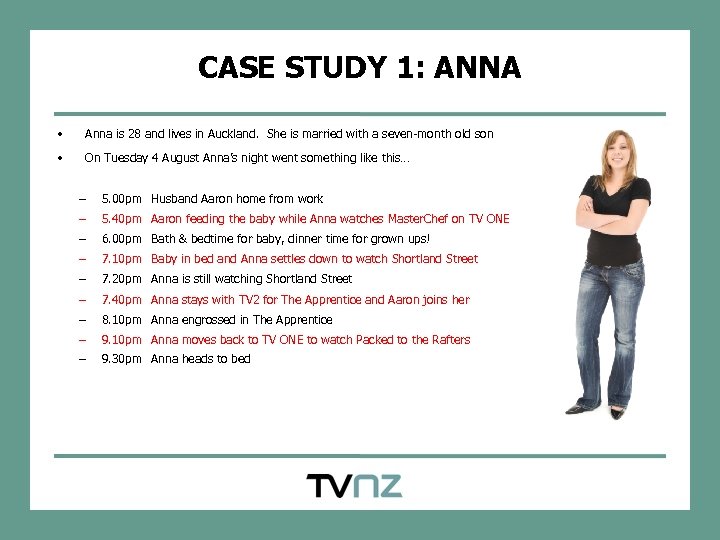 CASE STUDY 1: ANNA • Anna is 28 and lives in Auckland. She is married with a seven-month old son • On Tuesday 4 August Anna’s night went something like this… – 5. 00 pm Husband Aaron home from work – 5. 40 pm Aaron feeding the baby while Anna watches Master. Chef on TV ONE – 6. 00 pm Bath & bedtime for baby, dinner time for grown ups! – 7. 10 pm Baby in bed and Anna settles down to watch Shortland Street – 7. 20 pm Anna is still watching Shortland Street – 7. 40 pm Anna stays with TV 2 for The Apprentice and Aaron joins her – 8. 10 pm Anna engrossed in The Apprentice – 9. 10 pm Anna moves back to TV ONE to watch Packed to the Rafters – 9. 30 pm Anna heads to bed
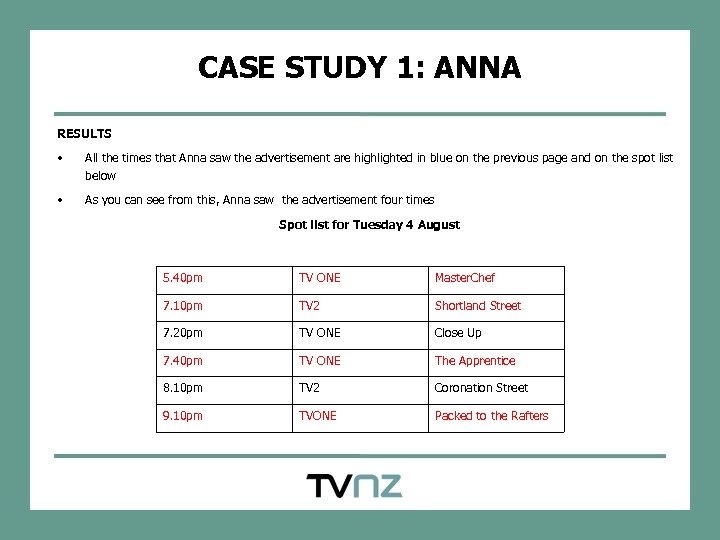 CASE STUDY 1: ANNA RESULTS • All the times that Anna saw the advertisement are highlighted in blue on the previous page and on the spot list below • As you can see from this, Anna saw the advertisement four times Spot list for Tuesday 4 August 5. 40 pm TV ONE Master. Chef 7. 10 pm TV 2 Shortland Street 7. 20 pm TV ONE Close Up 7. 40 pm TV ONE The Apprentice 8. 10 pm TV 2 Coronation Street 9. 10 pm TVONE Packed to the Rafters
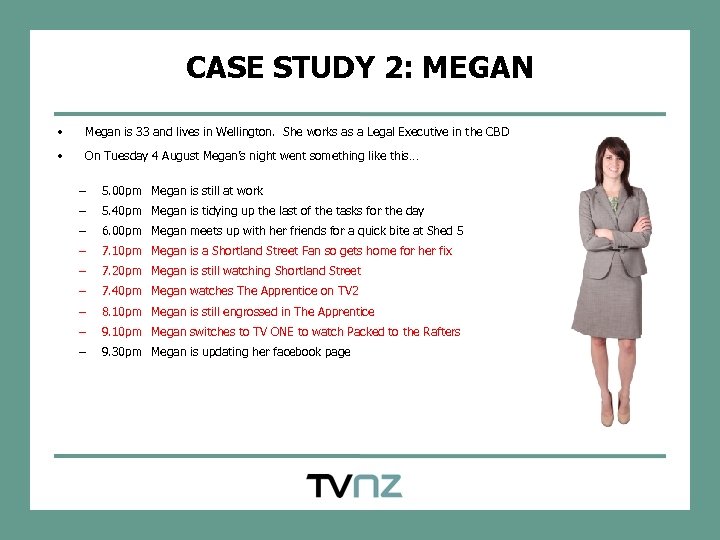 CASE STUDY 2: MEGAN • Megan is 33 and lives in Wellington. She works as a Legal Executive in the CBD • On Tuesday 4 August Megan’s night went something like this… – 5. 00 pm Megan is still at work – 5. 40 pm Megan is tidying up the last of the tasks for the day – 6. 00 pm Megan meets up with her friends for a quick bite at Shed 5 – 7. 10 pm Megan is a Shortland Street Fan so gets home for her fix – 7. 20 pm Megan is still watching Shortland Street – 7. 40 pm Megan watches The Apprentice on TV 2 – 8. 10 pm Megan is still engrossed in The Apprentice – 9. 10 pm Megan switches to TV ONE to watch Packed to the Rafters – 9. 30 pm Megan is updating her facebook page
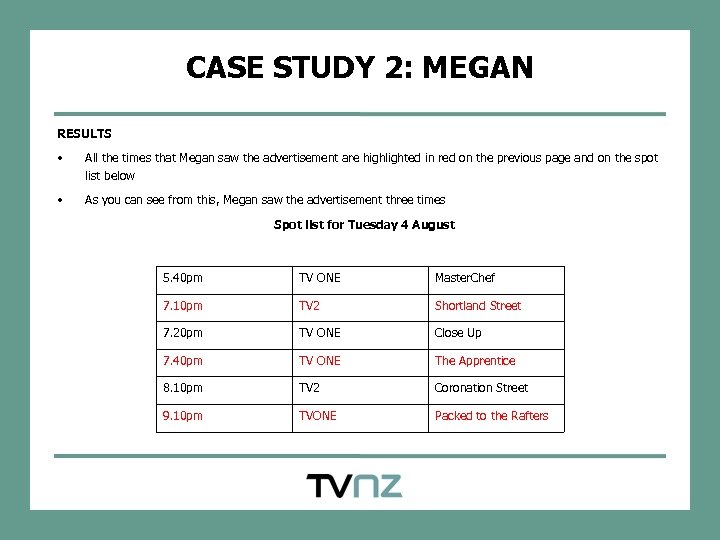 CASE STUDY 2: MEGAN RESULTS • All the times that Megan saw the advertisement are highlighted in red on the previous page and on the spot list below • As you can see from this, Megan saw the advertisement three times Spot list for Tuesday 4 August 5. 40 pm TV ONE Master. Chef 7. 10 pm TV 2 Shortland Street 7. 20 pm TV ONE Close Up 7. 40 pm TV ONE The Apprentice 8. 10 pm TV 2 Coronation Street 9. 10 pm TVONE Packed to the Rafters
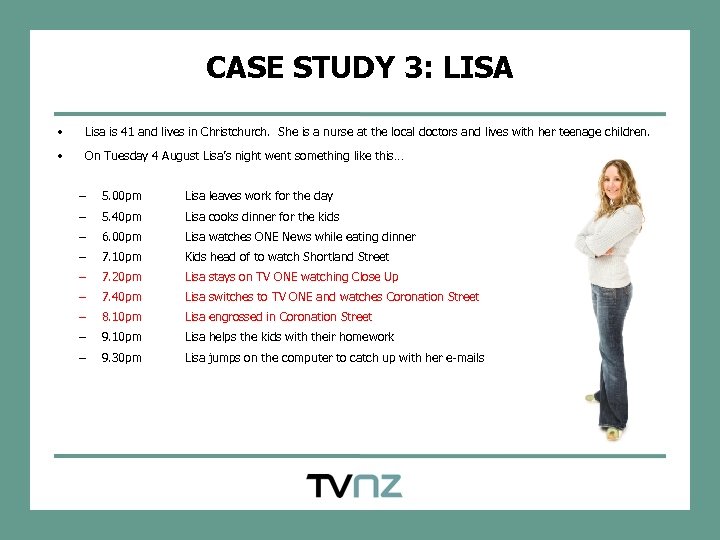 CASE STUDY 3: LISA • Lisa is 41 and lives in Christchurch. She is a nurse at the local doctors and lives with her teenage children. • On Tuesday 4 August Lisa’s night went something like this… – 5. 00 pm Lisa leaves work for the day – 5. 40 pm Lisa cooks dinner for the kids – 6. 00 pm Lisa watches ONE News while eating dinner – 7. 10 pm Kids head of to watch Shortland Street – 7. 20 pm Lisa stays on TV ONE watching Close Up – 7. 40 pm Lisa switches to TV ONE and watches Coronation Street – 8. 10 pm Lisa engrossed in Coronation Street – 9. 10 pm Lisa helps the kids with their homework – 9. 30 pm Lisa jumps on the computer to catch up with her e-mails
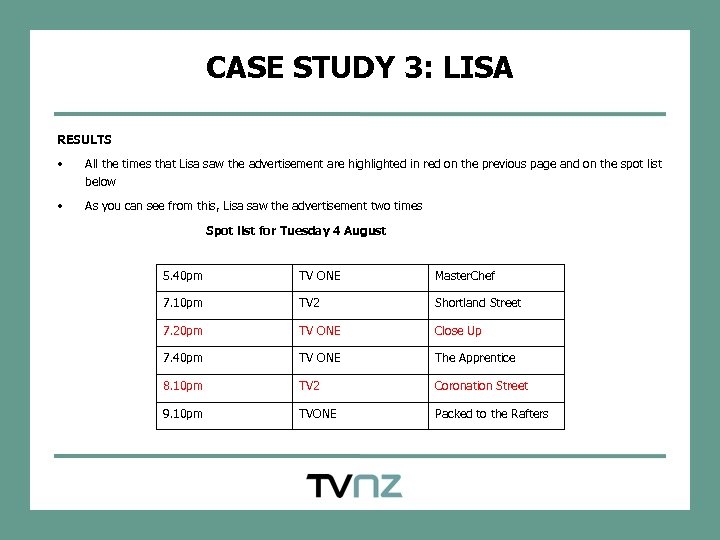 CASE STUDY 3: LISA RESULTS • All the times that Lisa saw the advertisement are highlighted in red on the previous page and on the spot list below • As you can see from this, Lisa saw the advertisement two times Spot list for Tuesday 4 August 5. 40 pm TV ONE Master. Chef 7. 10 pm TV 2 Shortland Street 7. 20 pm TV ONE Close Up 7. 40 pm TV ONE The Apprentice 8. 10 pm TV 2 Coronation Street 9. 10 pm TVONE Packed to the Rafters
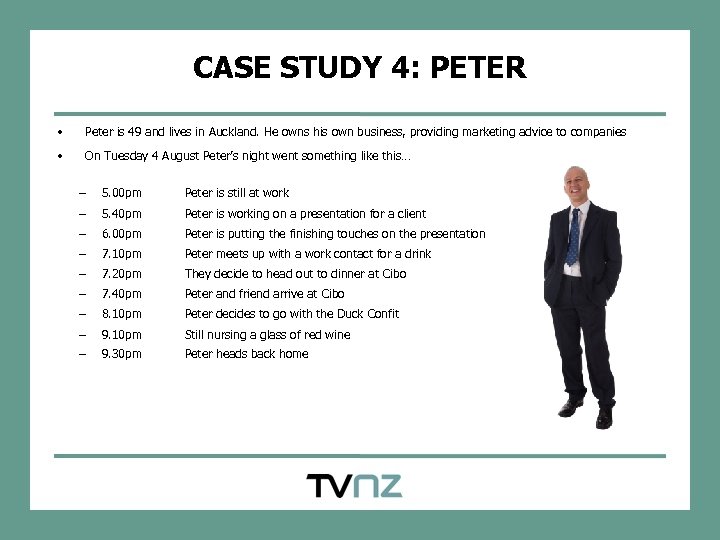 CASE STUDY 4: PETER • Peter is 49 and lives in Auckland. He owns his own business, providing marketing advice to companies • On Tuesday 4 August Peter’s night went something like this… – 5. 00 pm Peter is still at work – 5. 40 pm Peter is working on a presentation for a client – 6. 00 pm Peter is putting the finishing touches on the presentation – 7. 10 pm Peter meets up with a work contact for a drink – 7. 20 pm They decide to head out to dinner at Cibo – 7. 40 pm Peter and friend arrive at Cibo – 8. 10 pm Peter decides to go with the Duck Confit – 9. 10 pm Still nursing a glass of red wine – 9. 30 pm Peter heads back home
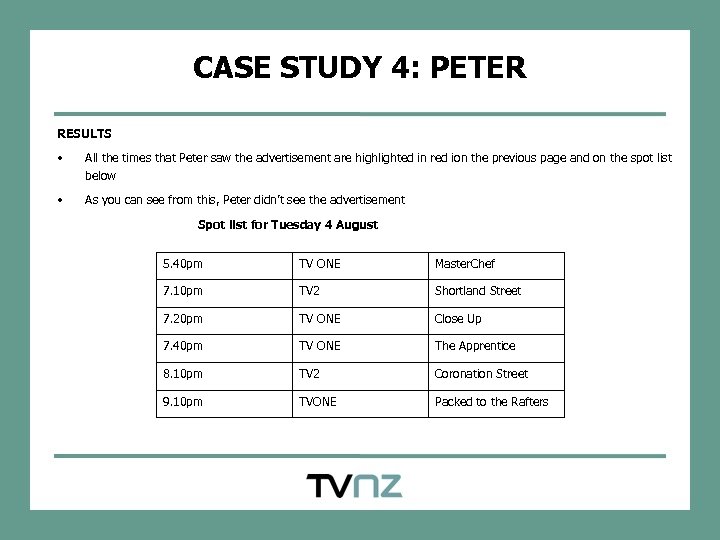 CASE STUDY 4: PETER RESULTS • All the times that Peter saw the advertisement are highlighted in red ion the previous page and on the spot list below • As you can see from this, Peter didn’t see the advertisement Spot list for Tuesday 4 August 5. 40 pm TV ONE Master. Chef 7. 10 pm TV 2 Shortland Street 7. 20 pm TV ONE Close Up 7. 40 pm TV ONE The Apprentice 8. 10 pm TV 2 Coronation Street 9. 10 pm TVONE Packed to the Rafters
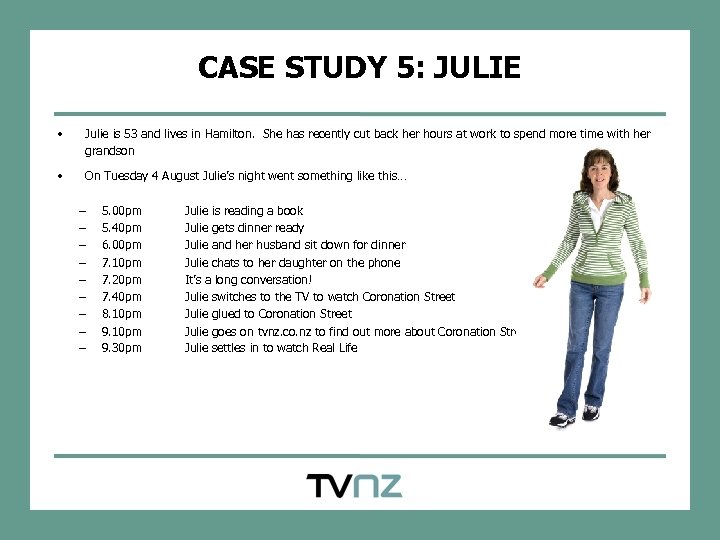 CASE STUDY 5: JULIE • Julie is 53 and lives in Hamilton. She has recently cut back her hours at work to spend more time with her grandson • On Tuesday 4 August Julie’s night went something like this… – – – – – 5. 00 pm 5. 40 pm 6. 00 pm 7. 10 pm 7. 20 pm 7. 40 pm 8. 10 pm 9. 30 pm Julie is reading a book Julie gets dinner ready Julie and her husband sit down for dinner Julie chats to her daughter on the phone It’s a long conversation! Julie switches to the TV to watch Coronation Street Julie glued to Coronation Street Julie goes on tvnz. co. nz to find out more about Coronation Street Julie settles in to watch Real Life
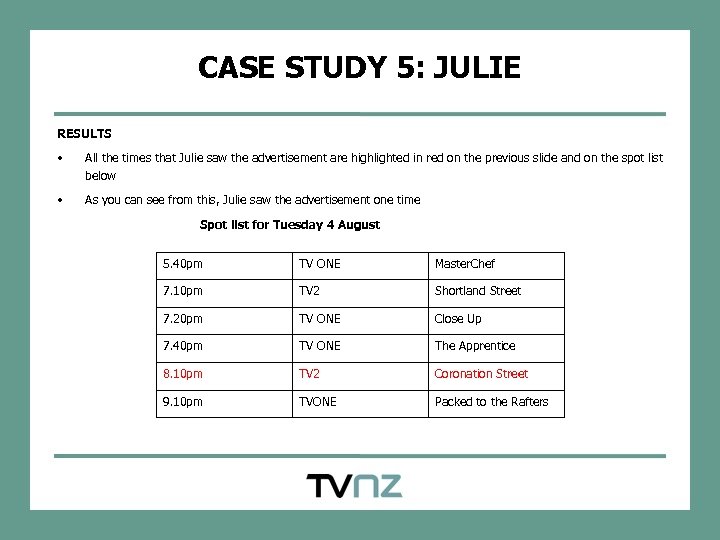 CASE STUDY 5: JULIE RESULTS • All the times that Julie saw the advertisement are highlighted in red on the previous slide and on the spot list below • As you can see from this, Julie saw the advertisement one time Spot list for Tuesday 4 August 5. 40 pm TV ONE Master. Chef 7. 10 pm TV 2 Shortland Street 7. 20 pm TV ONE Close Up 7. 40 pm TV ONE The Apprentice 8. 10 pm TV 2 Coronation Street 9. 10 pm TVONE Packed to the Rafters
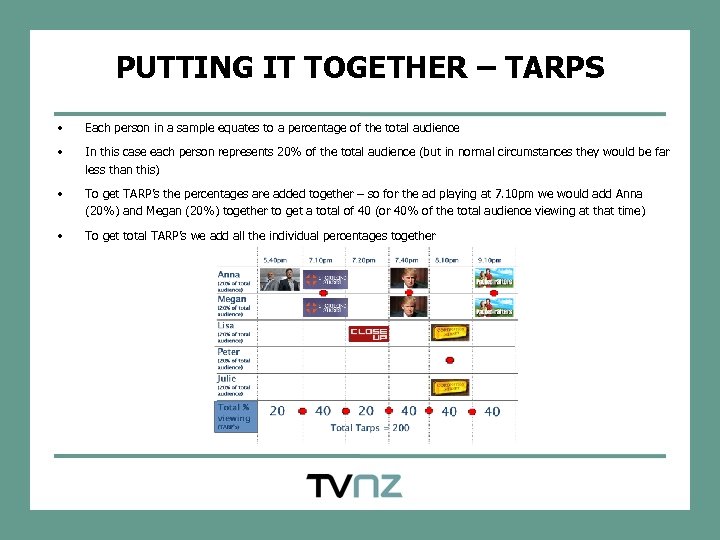 PUTTING IT TOGETHER – TARPS • Each person in a sample equates to a percentage of the total audience • In this case each person represents 20% of the total audience (but in normal circumstances they would be far less than this) • To get TARP’s the percentages are added together – so for the ad playing at 7. 10 pm we would add Anna (20%) and Megan (20%) together to get a total of 40 (or 40% of the total audience viewing at that time) • To get total TARP’s we add all the individual percentages together
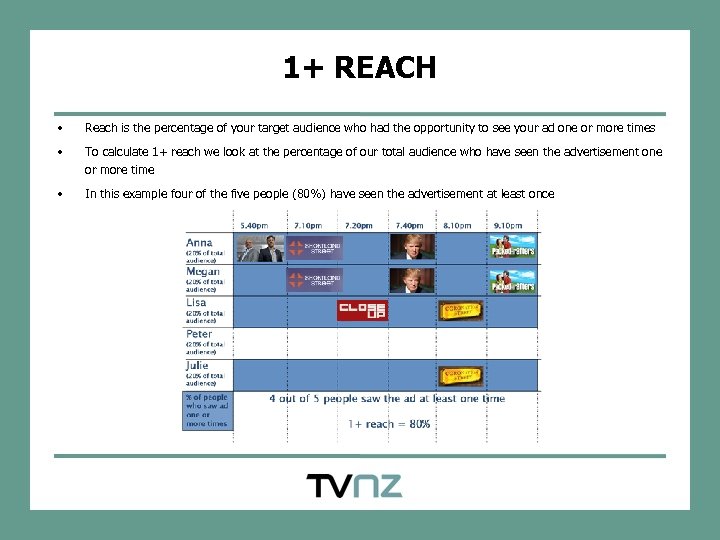 1+ REACH • Reach is the percentage of your target audience who had the opportunity to see your ad one or more times • To calculate 1+ reach we look at the percentage of our total audience who have seen the advertisement one or more time • In this example four of the five people (80%) have seen the advertisement at least once
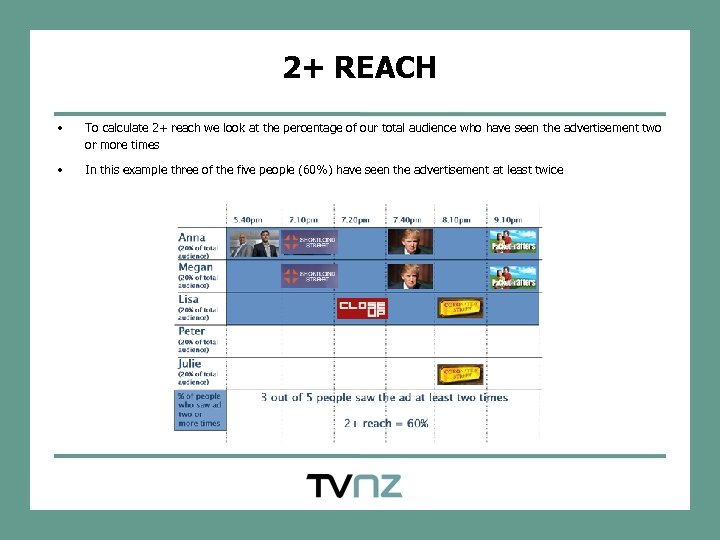 2+ REACH • To calculate 2+ reach we look at the percentage of our total audience who have seen the advertisement two or more times • In this example three of the five people (60%) have seen the advertisement at least twice
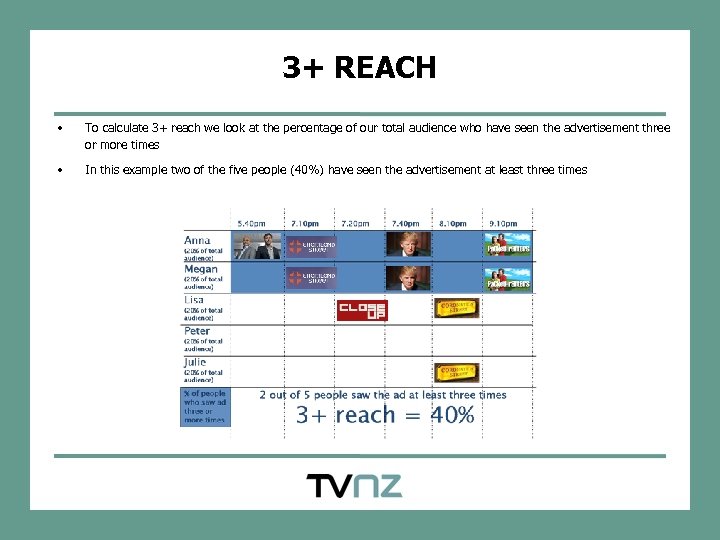 3+ REACH • To calculate 3+ reach we look at the percentage of our total audience who have seen the advertisement three or more times • In this example two of the five people (40%) have seen the advertisement at least three times
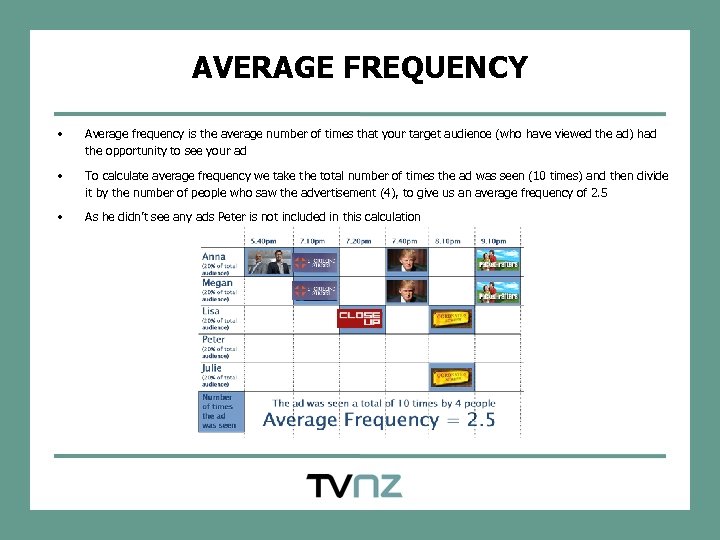 AVERAGE FREQUENCY • Average frequency is the average number of times that your target audience (who have viewed the ad) had the opportunity to see your ad • To calculate average frequency we take the total number of times the ad was seen (10 times) and then divide it by the number of people who saw the advertisement (4), to give us an average frequency of 2. 5 • As he didn’t see any ads Peter is not included in this calculation
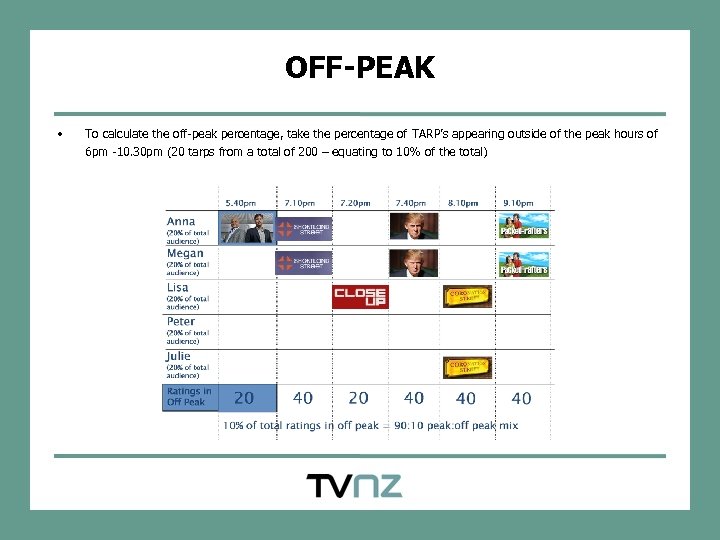 OFF-PEAK • To calculate the off-peak percentage, take the percentage of TARP’s appearing outside of the peak hours of 6 pm -10. 30 pm (20 tarps from a total of 200 – equating to 10% of the total)