


 Скачать презентацию Turnitin or Turnitoff Academic Integrity The UWS approach
713cec7971e4498a582170624e508946.ppt
- Количество слайдов: 26
 Turnitin or Turnitoff? Academic Integrity The UWS approach Liz Curach University Librarian UWS
 Plagiarism: a new phenomenon? "In comparing various authors with one another, I have discovered that some of the gravest and latest writers have transcribed, word for word, from former writers, without making acknowledgement. ” Pliny the Elder (23 AD-79 AD), Natural History http: //www. quotationspage. com/search. php 3? homesearch=pliny+the+elder
 Plagiarism defined. . § Plagiarism is the presentation of the thoughts or work of another as one’s own St James Ethics Centre § … to take and use the writings of another (from the Latin ‘plagiarus’, meaning kidnapper) Oxford English Dictionary
 Plagiarism on the rise? § 18, 000 participant study confirmed that internet plagiarism was prevalent across 23 US institutions: – 38% of participants had engaged in more than 1 instance of ‘cut and paste’; – 44% believed such behaviour trivial and not cheating; – 90% of students believe cheaters are never caught or disciplined. § Plagiarism from books and paper based materials remains slightly more popular than internet plagiarism. Rutgers University, 2003 http: //ur. rutgers. edu/medrel/view. Article. html? Article. ID=3408
 Plagiarism on the rise? (cont’d) 75% of respondents never plagiarised 9% plagiarised once 18% plagiarised more than once 3% believe that plagiarism not cheating 78% classify plagiarism as moderate to severe cheating § Detection rate is only 3% § 83% of respondents disapprove of plagiarism § § § JISC Plagiarism Advisory Service (UK), 2004
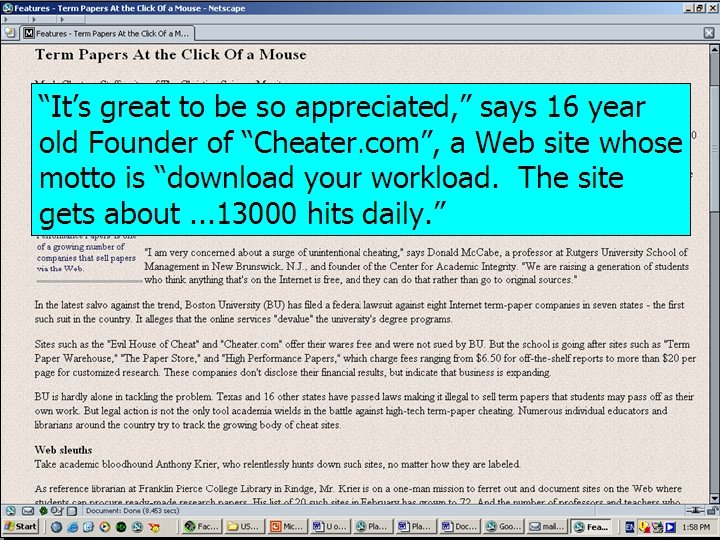
 It’s easy to cheat …. § Verbatim copying – copy / paste § Recycling: same assignment submitted more than once for different courses § Ghost writing (including mum and dad) § “Paper mills” and cheat sites (250+) offer many resources (free and fee based) for student “success”
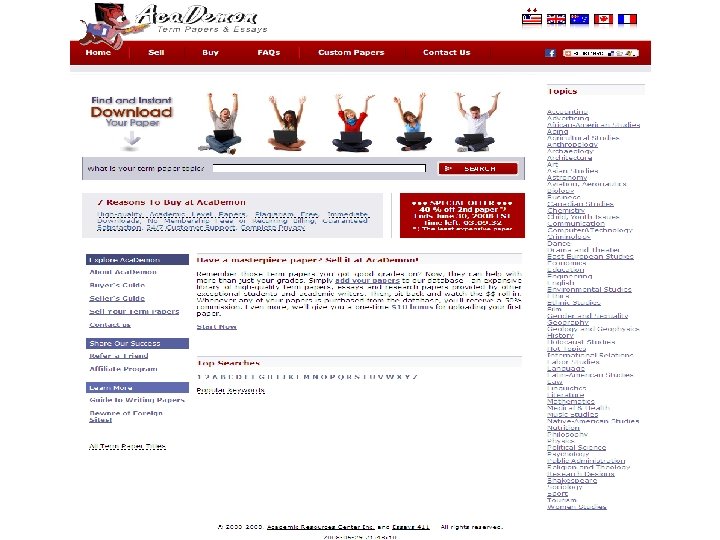

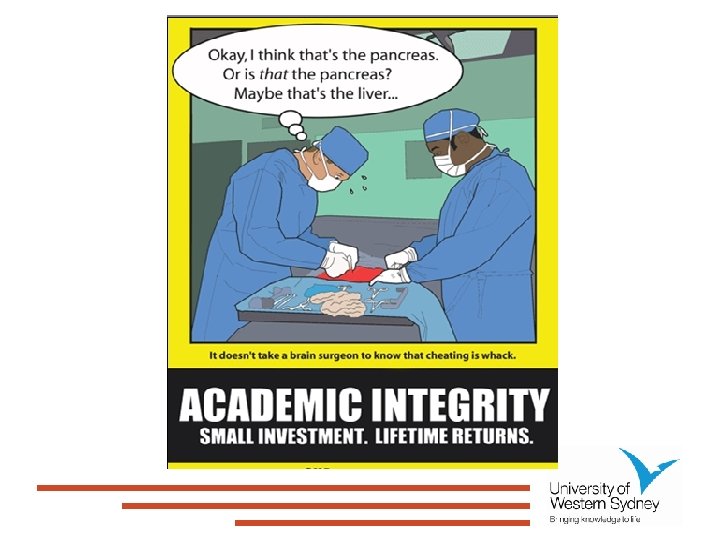
 Why do students plagiarise? § Poor time management or research skills § Lack of interest in the subject § Lack of knowledge or ability to write / research an assignment § Problems of writing in a second language § Poor citation skills § Low likelihood of detection § Ease of cut and paste from web and cheat sites § Over-emphasis on grades vs learning § Lack of knowledge of what constitutes plagiarism or academic integrity
 The UWS approach to plagiarism prevention § Clear and widely promulgated policies; § A whole of institution commitment to academic integrity; § UWS values Scholarly Rigour and Integrity § University wide support structures; § Availability of Turnitin text matching software
 Turnitin § Electronic text matching software (digital ‘fingerprinting’); § Developed in US by Prof James Barrie; § Demonstrates highest rate of detection from amongst a range of subscription checking tools; § UWS focus on prevention rather than detection.
 What text is matched? § Internet resources (4. 5 bill www pages, including archived pages; § Proprietary databases (Gale, Proquest, ebooks, newspaper collection) § Previously submitted student papers (10 mill +) § Assignments obtained from paper mills
 What is not matched. . § Print based materials; § Range of proprietary databases – e. g. Psychinfo, Ebsco …. . ; § Diagrammatic, pictorial representations, mathematical formulae; § Anything pre www
 Plagiarism detection? § NO! § Turnitin does not detect plagiarism; Matched text does not necessarily translate to plagiarism; § Turnitin cannot ‘think’ or apply qualitative judgements; § Turnitin does not differentiate between legitimate citation and unsourced secondary text used either in error or illegitimately
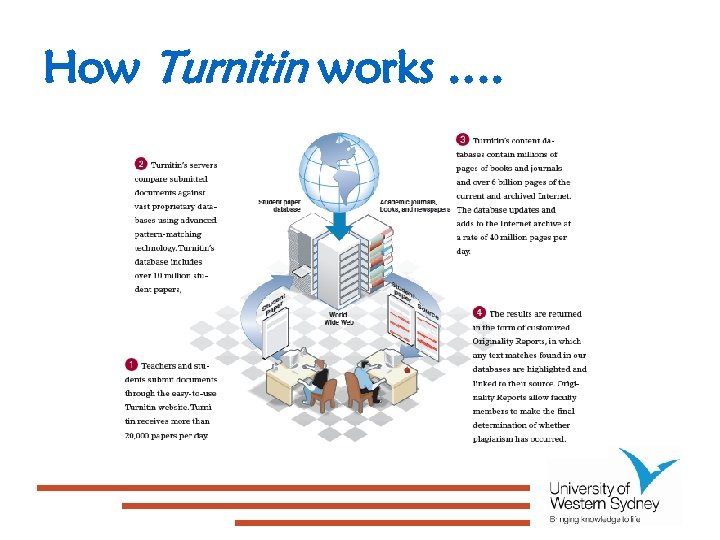 How Turnitin works ….
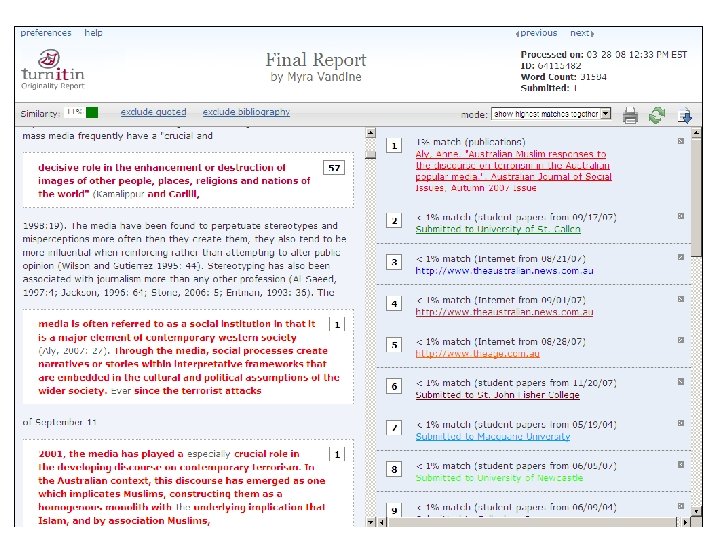
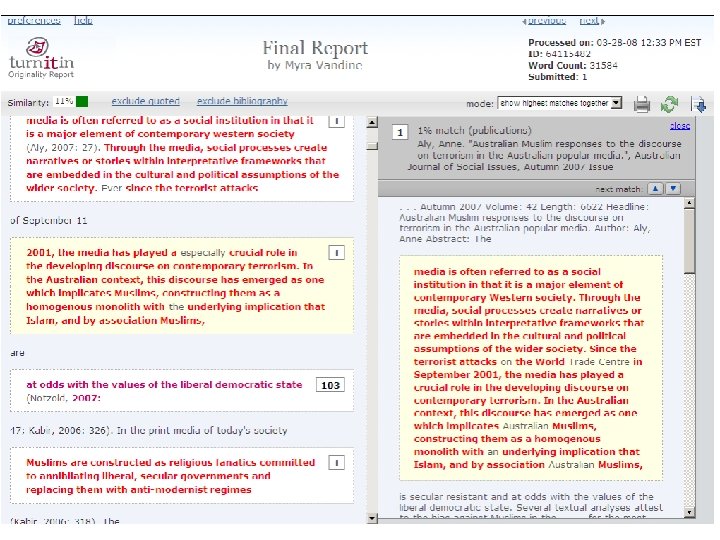
 Originality reports § Highlight matched sentences / phrases; § Provide links to original source; § Indicate overall percentage of matched text - ‘similarity index’; § Colour coding assists in interpretation; § Academic judgement must be applied in interpreting the originality reports.
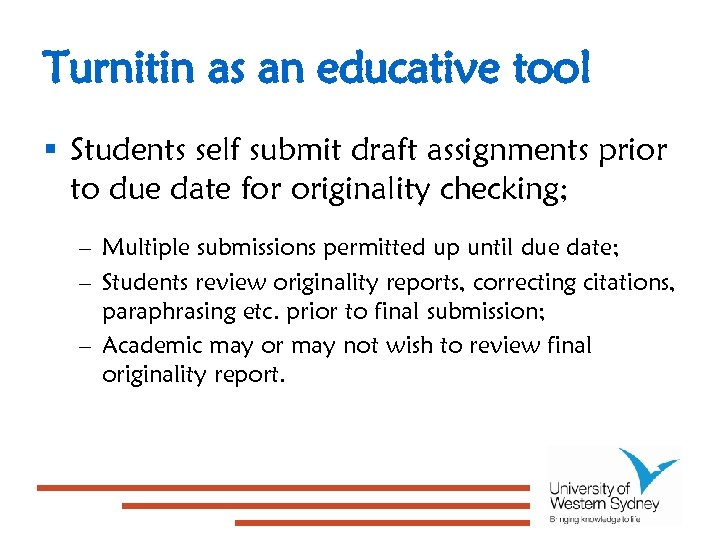 Turnitin as an educative tool § Students self submit draft assignments prior to due date for originality checking; – Multiple submissions permitted up until due date; – Students review originality reports, correcting citations, paraphrasing etc. prior to final submission; – Academic may or may not wish to review final originality report.
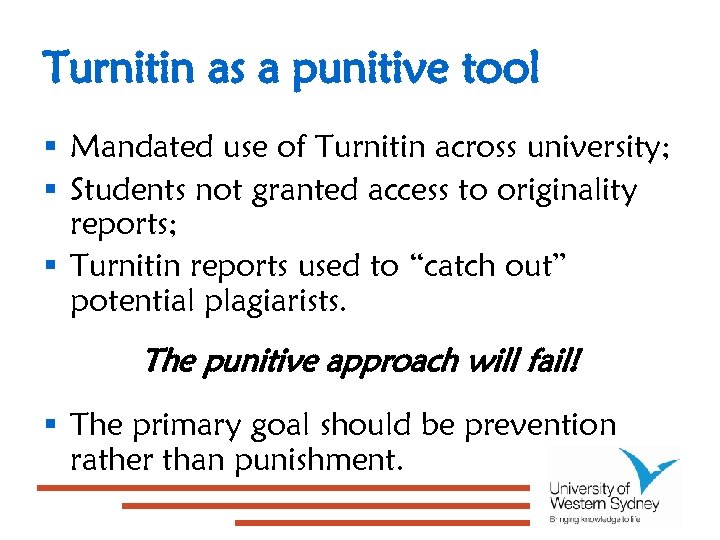 Turnitin as a punitive tool § Mandated use of Turnitin across university; § Students not granted access to originality reports; § Turnitin reports used to “catch out” potential plagiarists. The punitive approach will fail! § The primary goal should be prevention rather than punishment.
 Turnitin detractors …. § Turnitin database does not include all internet accessible materials; § Does not include print based materials; § “Matches” commonly used words and phrases; § Makes profit from student work by storing submitted material in database.
 However …. § Turnitin is but one tool in the academic integrity toolbox: – Design assessment to minimise potential plagiarism; – Make expectations clear to students; – Monitor, detect and respond to incidences of possible plagiarism; – Teach skills of summarising and paraphrasing; – Teach skills of referencing and citation; – Teach skills of critical analysis and interpretation; – etc Centre for the Study of Higher Education, 2006
 Turnitin claims … “Students will realise that they can no longer “borrow” intellectual materials without being at risk of being caught. They will submit their own work, and as a result educational quality, student morale and ethics will improve”
 Discussion and questions …. Turnitin, or Turnitoff ? ?