


 Скачать презентацию Turning the Revolving Door into the Staircase of
5225a70a24540f335b30f8d3cd4ca8e3.ppt
- Количество слайдов: 31
 Turning the Revolving Door into the Staircase of Academic Success for Basic Skills Students NACADA October 5, 2011 Presented by: § Marti Demarest Assistant Director, Student Success Center (former) Director, Gateway to College, Front Range CC § Paula Yanish Director, Student Success Center
 Program Overview: § About Aims Community College District § National (USA), Colorado & Institutional Retention Data § Institutional Strategies § Emerging Scholars § Accomplishments
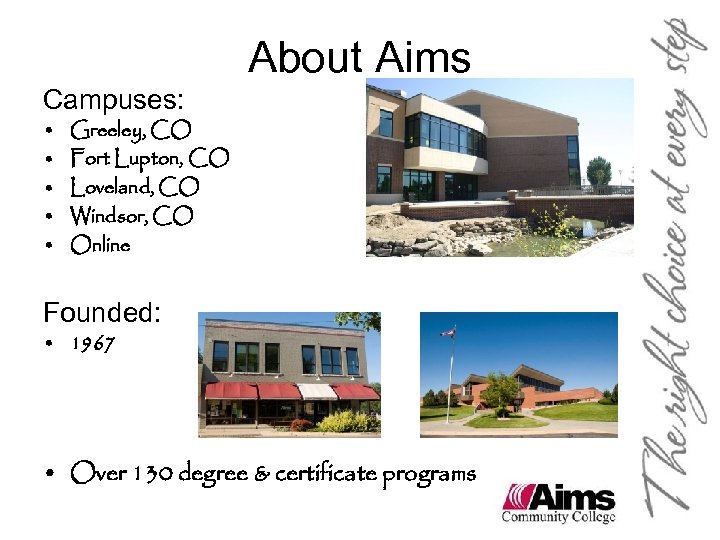 About Aims Campuses: • • • Greeley, CO Fort Lupton, CO Loveland, CO Windsor, CO Online Founded: • 1967 • Over 130 degree & certificate programs
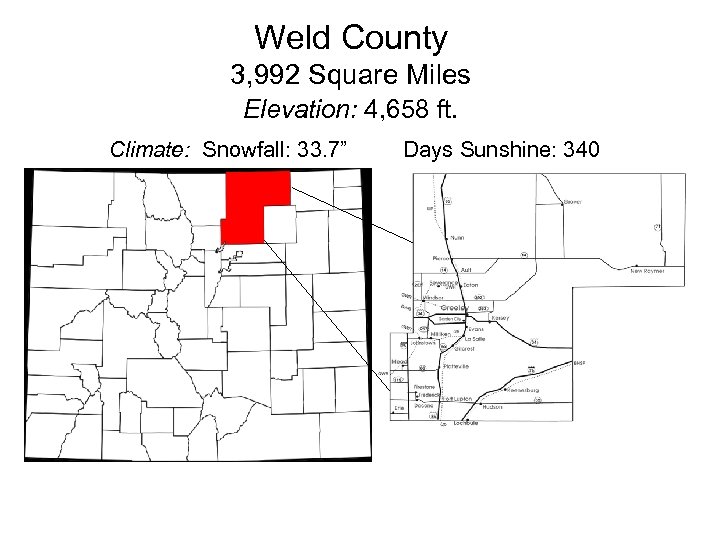 Weld County 3, 992 Square Miles Elevation: 4, 658 ft. Climate: Snowfall: 33. 7” Days Sunshine: 340
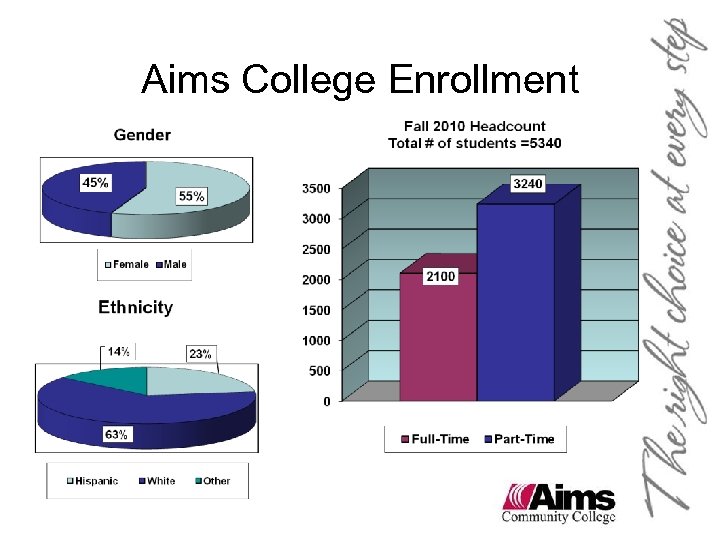 Aims College Enrollment
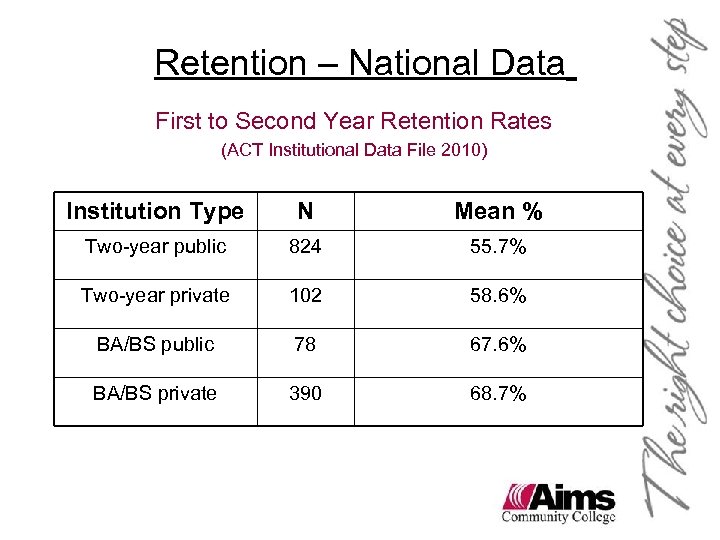 Retention – National Data First to Second Year Retention Rates (ACT Institutional Data File 2010) Institution Type N Mean % Two-year public 824 55. 7% Two-year private 102 58. 6% BA/BS public 78 67. 6% BA/BS private 390 68. 7%
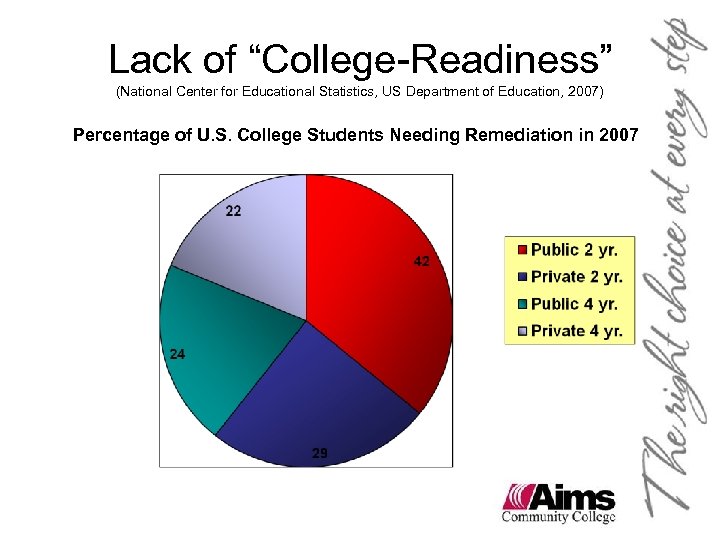 Lack of “College-Readiness” (National Center for Educational Statistics, US Department of Education, 2007) Percentage of U. S. College Students Needing Remediation in 2007
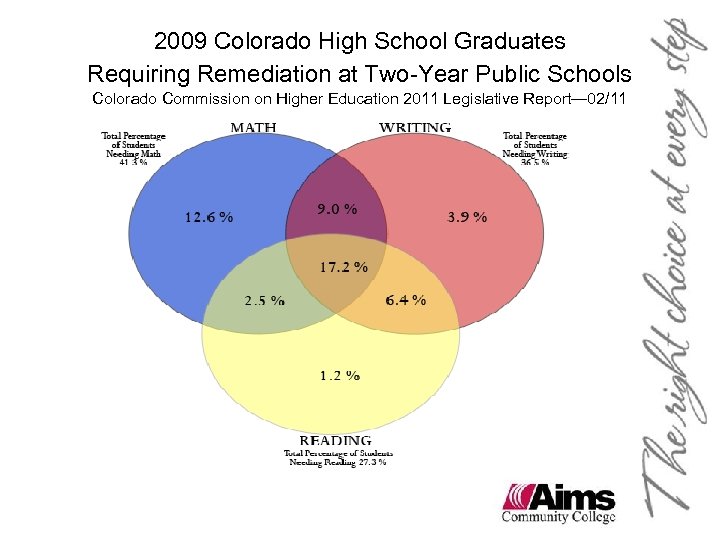 2009 Colorado High School Graduates Requiring Remediation at Two-Year Public Schools Colorado Commission on Higher Education 2011 Legislative Report— 02/11
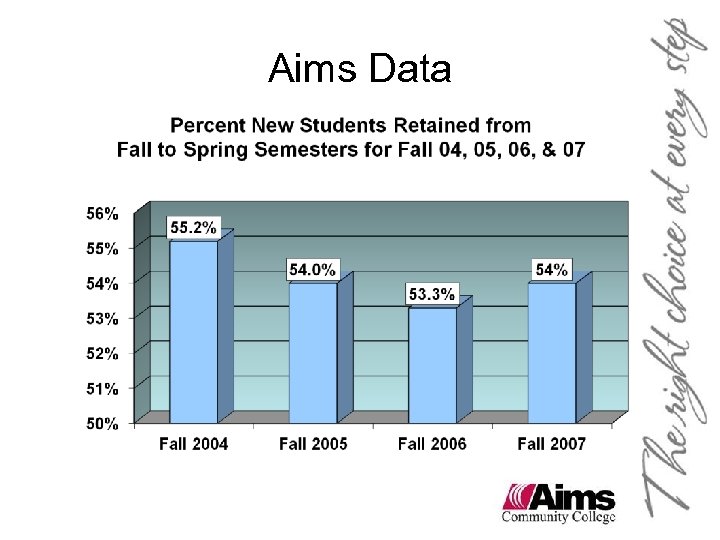 Aims Data
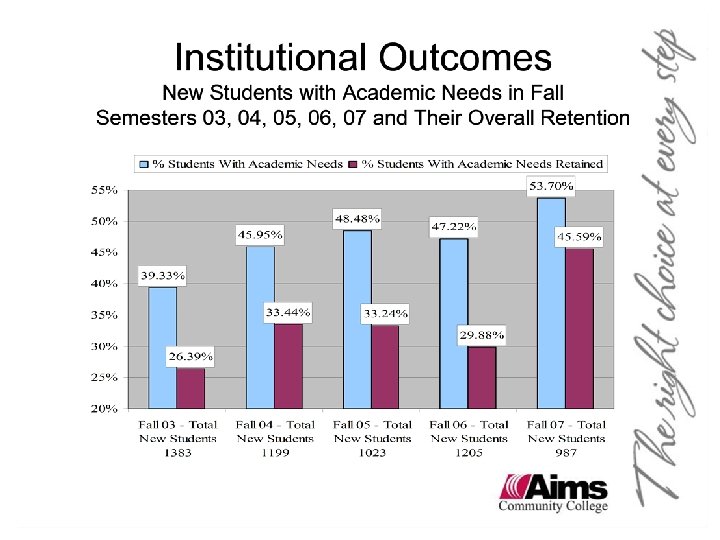
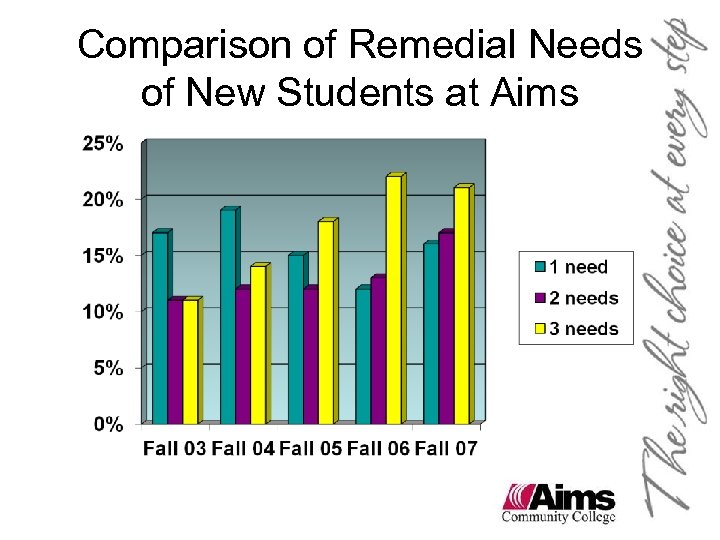 Comparison of Remedial Needs of New Students at Aims
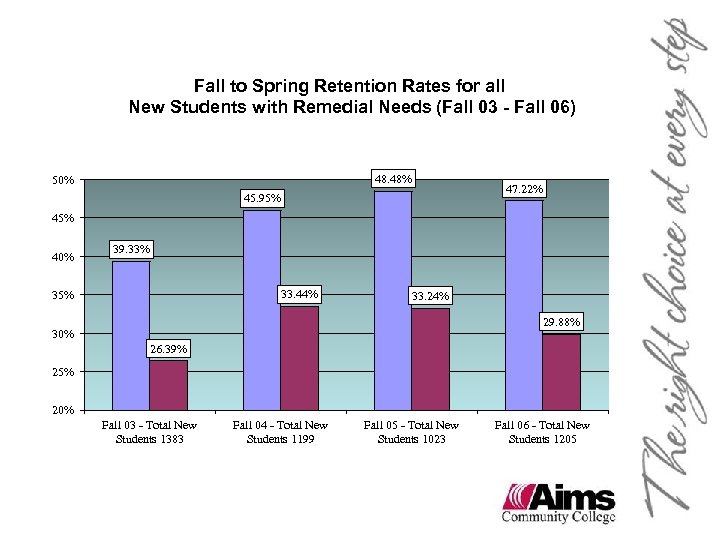 Fall to Spring Retention Rates for all New Students with Remedial Needs (Fall 03 - Fall 06) 48. 48% 50% 47. 22% 45. 95% 40% 39. 33% 33. 44% 35% 33. 24% 29. 88% 30% 26. 39% 25% 20% Fall 03 - Total New Students 1383 Fall 04 - Total New Students 1199 Fall 05 - Total New Students 1023 Fall 06 - Total New Students 1205
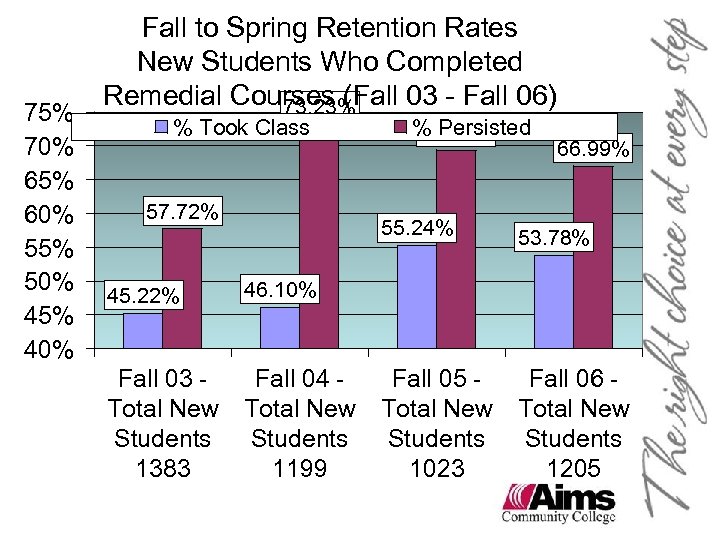 75% 70% 65% 60% 55% 50% 45% 40% Fall to Spring Retention Rates New Students Who Completed Remedial Courses (Fall 03 - Fall 06) 73. 23% % Took Class 57. 72% 45. 22% % Persisted 69. 34% 55. 24% 66. 99% 53. 78% 46. 10% Fall 03 - Fall 04 - Fall 05 - Fall 06 - Total New Students 1383 1199 1023 1205
 Institutional Strategies for Improving Student Retention • Fall 2006 – STAR pilot (STudent Achievement and Retention) – Title III grant funded (US Department of Education) § High-risk students (1 st generation, low income, undecided/undeclared, academic probation) § 74% of cohort required remediation § Services include intensive academic advising, extended orientation, early alert § 60% retention of first term cohort
 Theoretical Framework • Nevitt Sanford – Challenge & Support • Vincent Tinto – Academic/Social Integration – Goal/Institutional Commitment • Nancy Schlossberg – Mattering vs. Marginality
 Staff Working with Emerging Scholars Program • • Assistant Director Retention Advisor—full-time 3 part-time Retention Advisors at outlying campuses College Prep Faculty First-Year Experience Course Coordinator Financial Aid Director
 Emerging Scholars Admission Criteria § New to Aims Community College • Unless concurrently enrolled in high school § Degree or Certificate Seeking § Have 2 or more academic deficiencies (English, Math, Reading)—optional § Have 3 or more needs—highly recommended § Cohort Goal – 300 students
 Emerging Scholars Program Requirements § Fill out an ES application during first registration period § Meet 3 times each semester with the assigned advisor § Allow the institution to place a registration hold on his/her account requiring an approval for any changes § Enroll in and complete college prep courses with a “C” or better and limit enrollment on other academic courses § Enroll in and complete a college success (FYE) course— 1 st semester § Attend a minimum of 2 student success workshops during each semester after 1 st term § Financial incentive
 College Success Class (AAA 101) • Topics include: § § § § Welcome, class overview, college jargon Time management Reading your textbook Note-taking from a textbook Campus resources on the web Note-taking from a lecture Stress free math Students rights and responsibilities Memory and concentration Wellness and health issues Mastering self-management (setting priorities and goals) Paying for college Test taking strategies and final exam preparation Career exploration College pathways – transferring and career
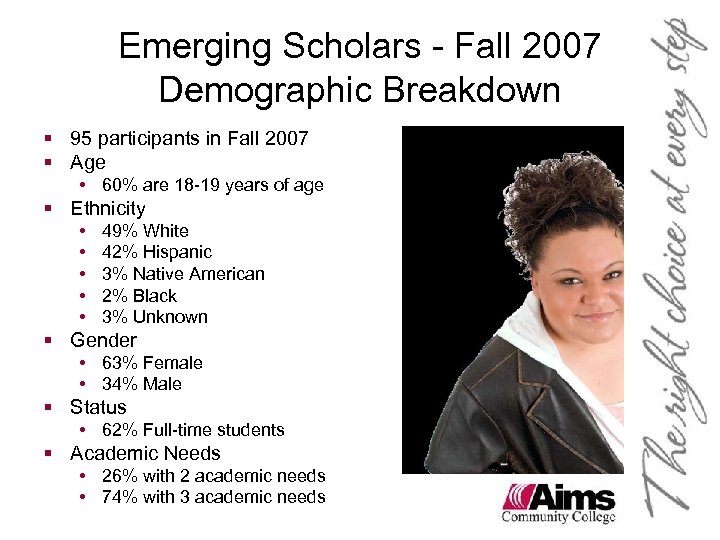 Emerging Scholars - Fall 2007 Demographic Breakdown § 95 participants in Fall 2007 § Age • 60% are 18 -19 years of age § Ethnicity • • • 49% White 42% Hispanic 3% Native American 2% Black 3% Unknown § Gender • 63% Female • 34% Male § Status • 62% Full-time students § Academic Needs • 26% with 2 academic needs • 74% with 3 academic needs
 Emerging Scholars Outcomes
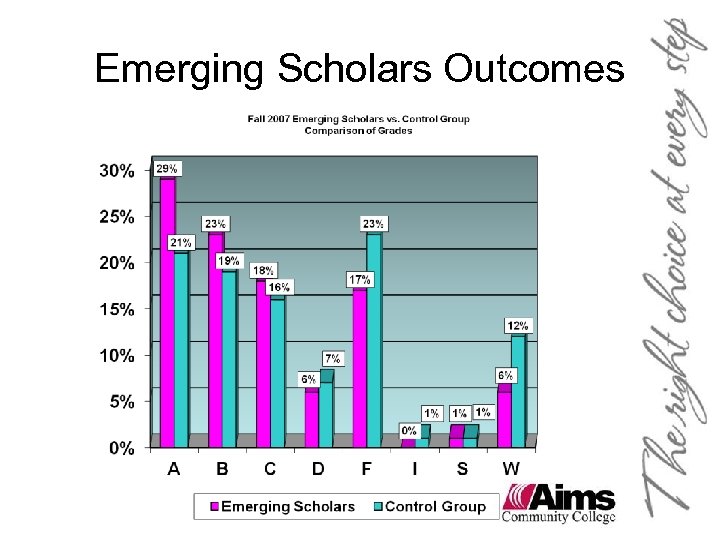 Emerging Scholars Outcomes
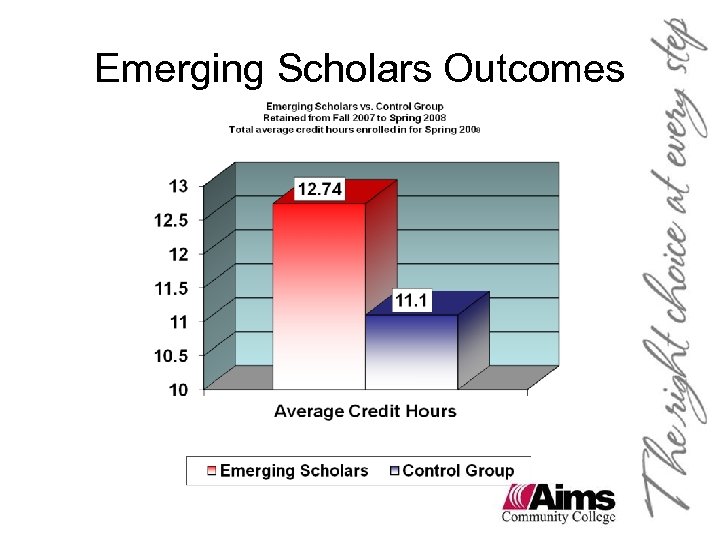 Emerging Scholars Outcomes
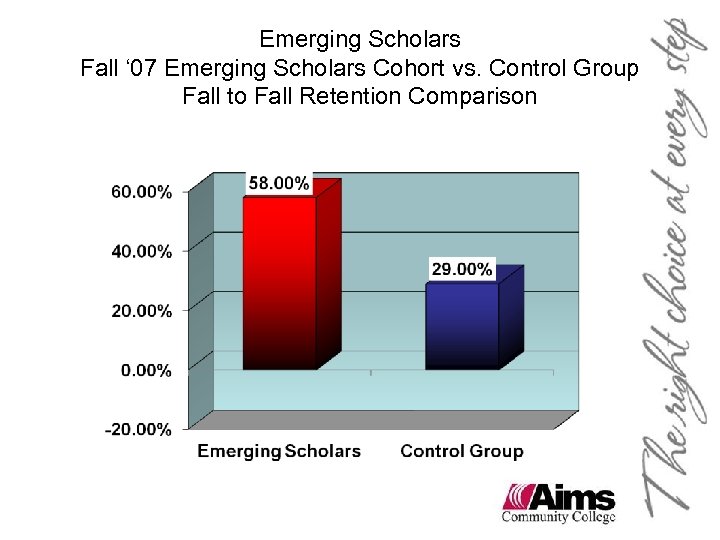 Emerging Scholars Fall ‘ 07 Emerging Scholars Cohort vs. Control Group Fall to Fall Retention Comparison
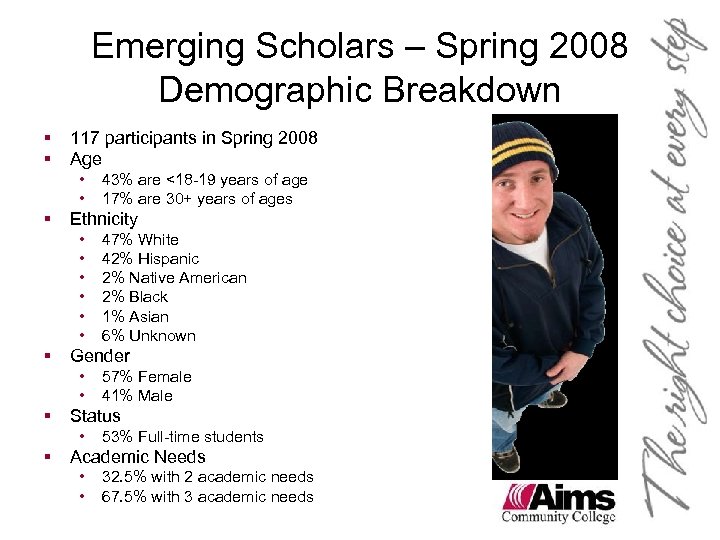 Emerging Scholars – Spring 2008 Demographic Breakdown § § 117 participants in Spring 2008 Age • • § Ethnicity • • • § 57% Female 41% Male Status • § 47% White 42% Hispanic 2% Native American 2% Black 1% Asian 6% Unknown Gender • • § 43% are <18 -19 years of age 17% are 30+ years of ages 53% Full-time students Academic Needs • • 32. 5% with 2 academic needs 67. 5% with 3 academic needs
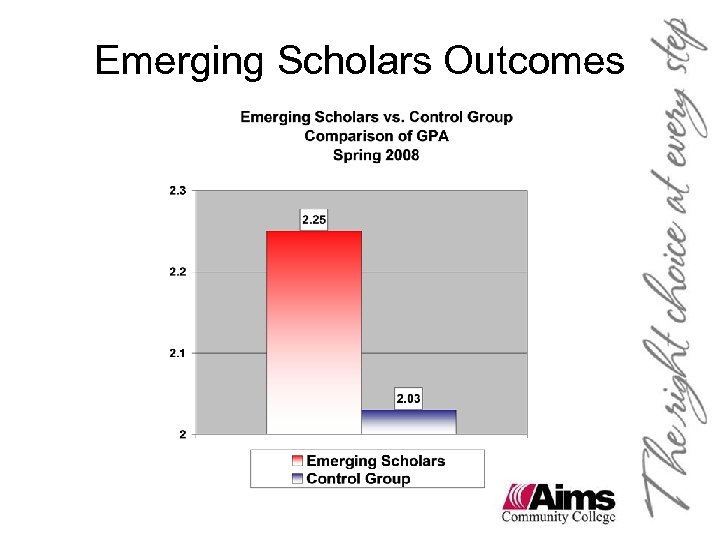 Emerging Scholars Outcomes
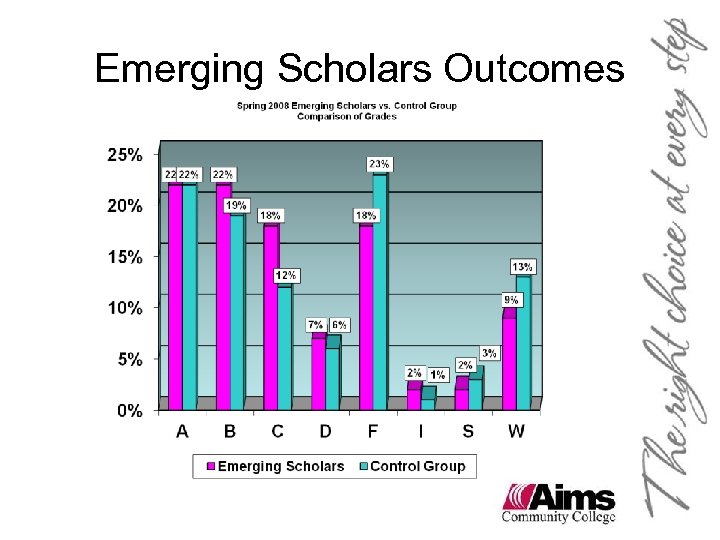 Emerging Scholars Outcomes
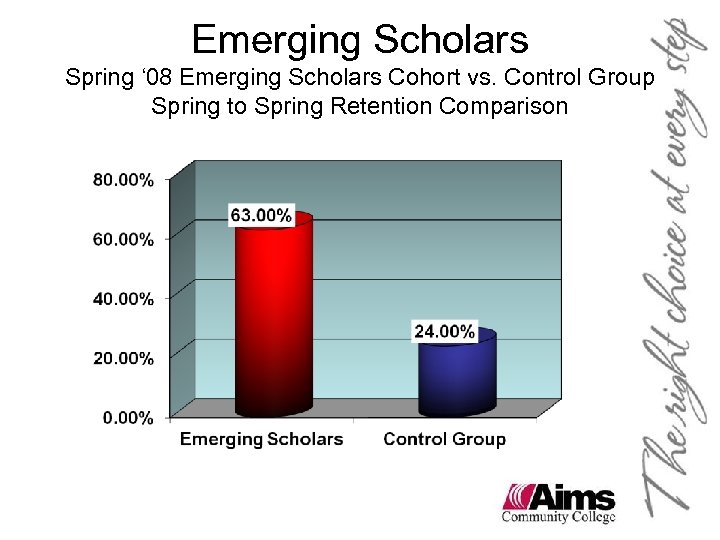 Emerging Scholars Spring ‘ 08 Emerging Scholars Cohort vs. Control Group Spring to Spring Retention Comparison
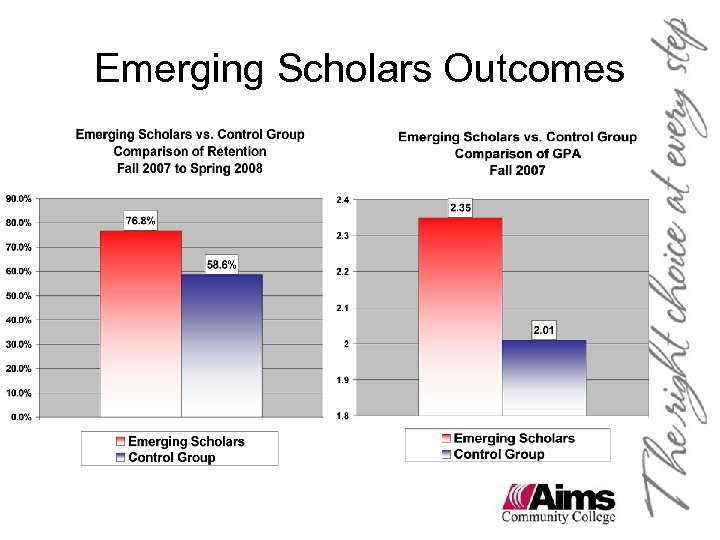
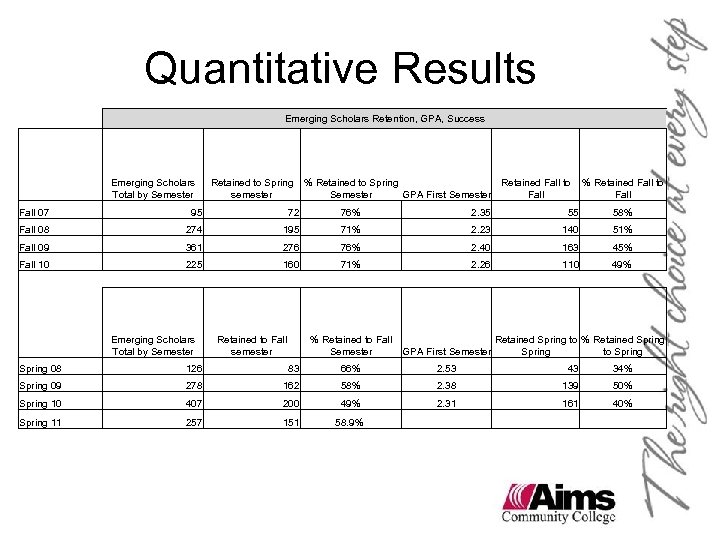 Quantitative Results Emerging Scholars Retention, GPA, Success Emerging Scholars Total by Semester Retained to Spring % Retained to Spring Retained Fall to % Retained Fall to semester Semester GPA First Semester Fall 07 95 72 76% 2. 35 55 58% Fall 08 274 195 71% 2. 23 140 51% Fall 09 361 276 76% 2. 40 163 45% Fall 10 225 160 71% 2. 26 110 49% Emerging Scholars Total by Semester Retained to Fall semester % Retained to Fall Retained Spring to % Retained Spring Semester GPA First Semester Spring to Spring 08 126 83 66% 2. 53 43 34% Spring 09 278 162 58% 2. 38 139 50% Spring 10 407 200 49% 2. 31 161 40% Spring 11 257 151 58. 9%
 Some Key Accomplishments § Served over 1, 185 students since Fall 2007 § Moved to a new location within Learning Commons (STAR Center) § Established a Peer Mentoring Program § Received TG Grant Program ($115, 750) § Instrumental in developing and implementing the institutional “Mandatory Course Placement Chart” and procedure § Modified financial incentive model from grant to scholarship with support of Financial Aid Director
 Contact Information Dr. Patricia A. Matijevic Paula Yanish Dean for Student Services Director, Student Success Center 970 -339 -6374 patricia. matijevic@aims. edu 970 -339 -6537 paula. yanish@aims. edu Marti Demarest Director, Gateway to College Marti. Demarest@frontrange. edu 303 -404 -5167 Shannon Mc. Casland Assistant Director, Student Life 970 -339 -6563 shannon. mccasland@aims. edu