


 Скачать презентацию TURKISH ELECTRICITY MARKETS MARKET REGULATION AND INVESTMENT OPPORTUNITIES
2ca287ff332eeeee0b7d0b9993a7f320.ppt
- Количество слайдов: 75
 TURKISH ELECTRICITY MARKETS: MARKET, REGULATION AND INVESTMENT OPPORTUNITIES 10 th Anniversary Tolga TURAN Energy Specialist, EMRA Istanbul, May 2012
 WHY REFORM? 10. Yıl Strong belief in the benefits of competitive markets and the greater change in the overall economy, v v Rapid growth in electricity demand the need for substantial amounts of investment, v Planning and operational inefficiencies of the public sector, v Prevent possible monopoly abuse, v Need for compliance with EU regulations. 2
 MAJOR THEMES IN ELECTRICITY MARKET REFORM PROCESS 10. Yıl Unbundling the generation, transmission and wholesale activities by restructuring state-owned electricity company (TEAS) into three separate public companies Establishing an independent regulatory authority to regulate and monitor the market and independent system operator in addition to financial settlement system. Introducing a well-defined licensing framework in the electricity market i. e. Generation, transmission, distribution, wholesale, retail sales, and auto-producer licenses granted for maximum 49 years. Introducing a well-defined tariff scheme based on revenue and price caps which reflects true costs. Establishing a truly non-discriminatory third-part access framework. Privatization of distribution and generation assets.
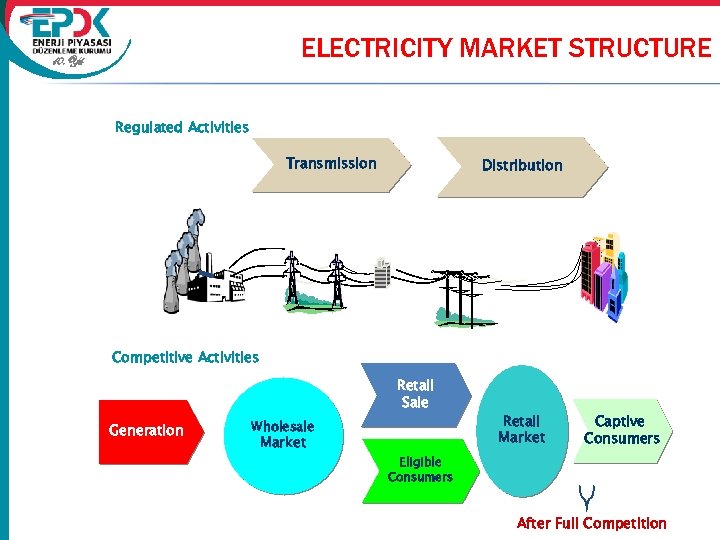 ELECTRICITY MARKET STRUCTURE 10. Yıl Regulated Activities Transmission Distribution Competitive Activities Retail Sale Generation Wholesale Market Retail Market Captive Consumers Eligible Consumers After Full Competition
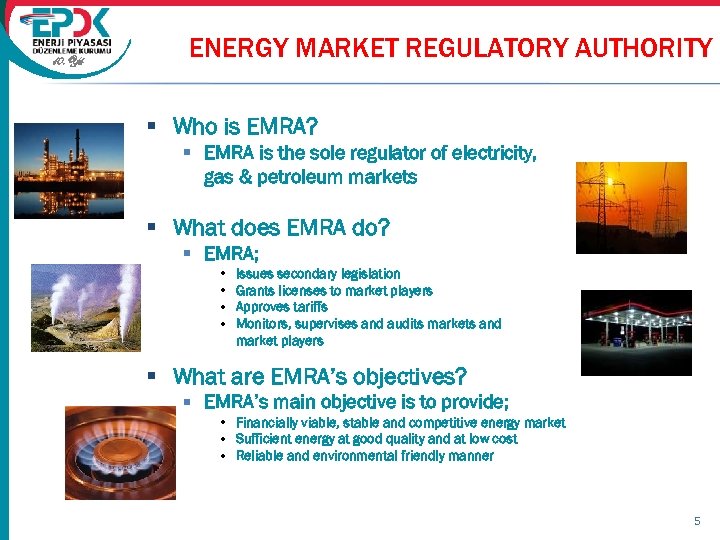 10. Yıl ENERGY MARKET REGULATORY AUTHORITY § Who is EMRA? § EMRA is the sole regulator of electricity, gas & petroleum markets § What does EMRA do? § EMRA; • • Issues secondary legislation Grants licenses to market players Approves tariffs Monitors, supervises and audits markets and market players § What are EMRA’s objectives? § EMRA’s main objective is to provide; • Financially viable, stable and competitive energy market • Sufficient energy at good quality and at low cost • Reliable and environmental friendly manner 5
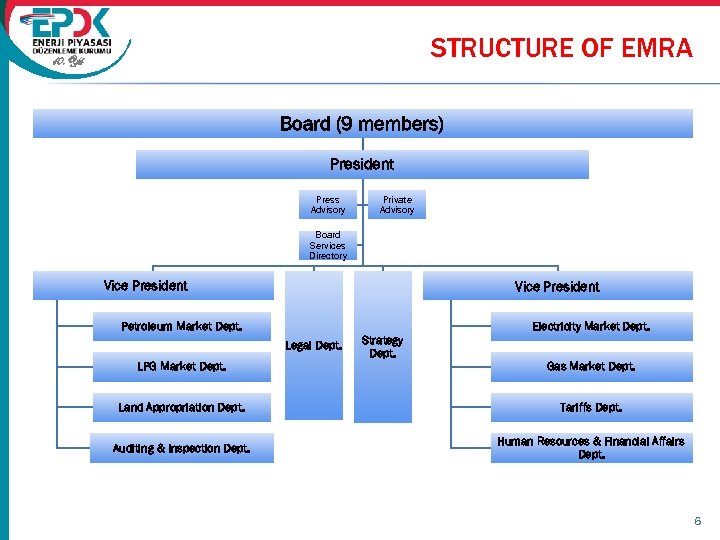 STRUCTURE OF EMRA 10. Yıl Board (9 members) President Press Advisory Private Advisory Board Services Directory Vice President Petroleum Market Dept. Electricity Market Dept. Legal Dept. LPG Market Dept. Strategy Dept. Gas Market Dept. Land Appropriation Dept. Tariffs Dept. Auditing & Inspection Dept. Human Resources & Financial Affairs Dept. 6
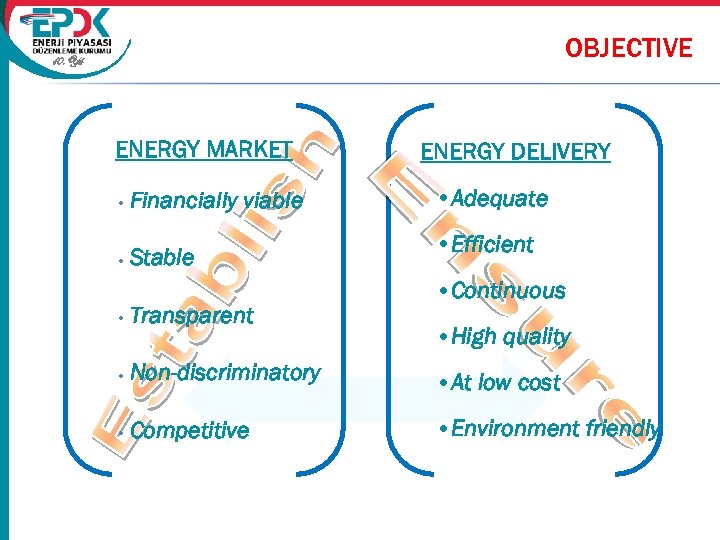 OBJECTIVE 10. Yıl ENERGY MARKET • Financially viable • Stable ENERGY DELIVERY • Adequate • Efficient • Continuous • Transparent • Non-discriminatory • At low cost • Competitive • Environment friendly • High quality
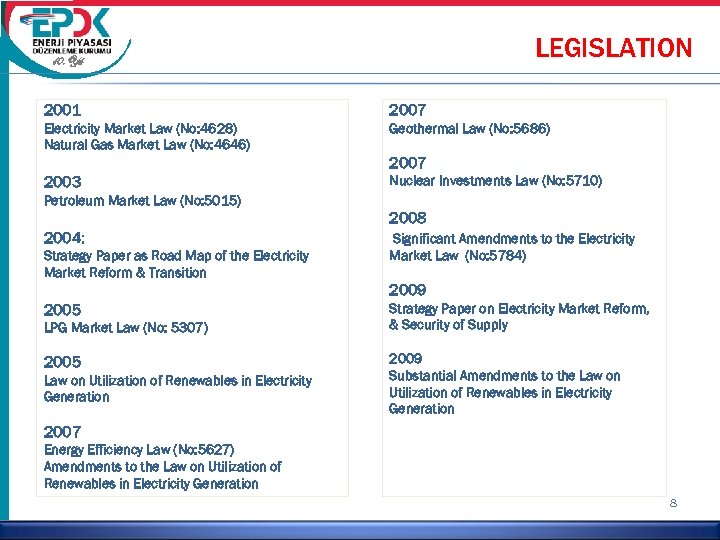 LEGISLATION 10. Yıl 2001 2007 Electricity Market Law (No: 4628) Natural Gas Market Law (No: 4646) Geothermal Law (No: 5686) 2007 2003 Nuclear Investments Law (No: 5710) Petroleum Market Law (No: 5015) 2008 2004: Strategy Paper as Road Map of the Electricity Market Reform & Transition Significant Amendments to the Electricity Market Law (No: 5784) 2009 2005 LPG Market Law (No: 5307) 2005 Law on Utilization of Renewables in Electricity Generation Strategy Paper on Electricity Market Reform, & Security of Supply 2009 Substantial Amendments to the Law on Utilization of Renewables in Electricity Generation 2007 Energy Efficiency Law (No: 5627) Amendments to the Law on Utilization of Renewables in Electricity Generation 8
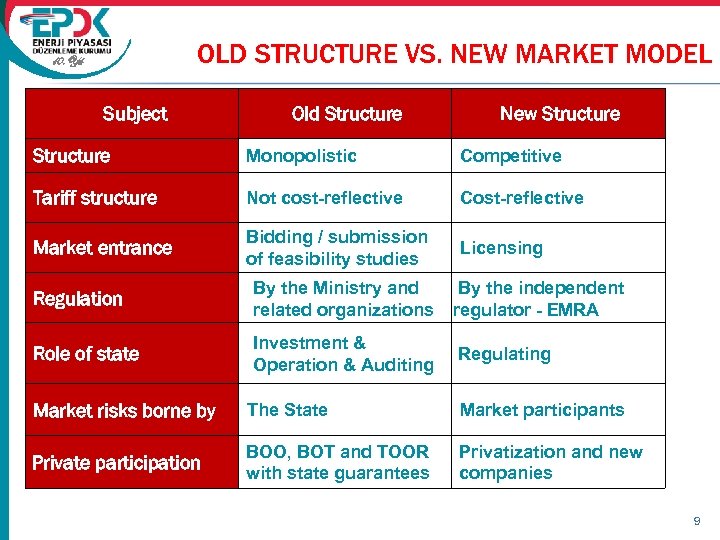 OLD STRUCTURE VS. NEW MARKET MODEL 10. Yıl Subject Old Structure New Structure Monopolistic Competitive Tariff structure Not cost-reflective Cost-reflective Market entrance Bidding / submission of feasibility studies Licensing Regulation By the Ministry and related organizations By the independent regulator - EMRA Role of state Investment & Operation & Auditing Regulating Market risks borne by The State Market participants Private participation BOO, BOT and TOOR with state guarantees Privatization and new companies 9
 10. Yıl 10
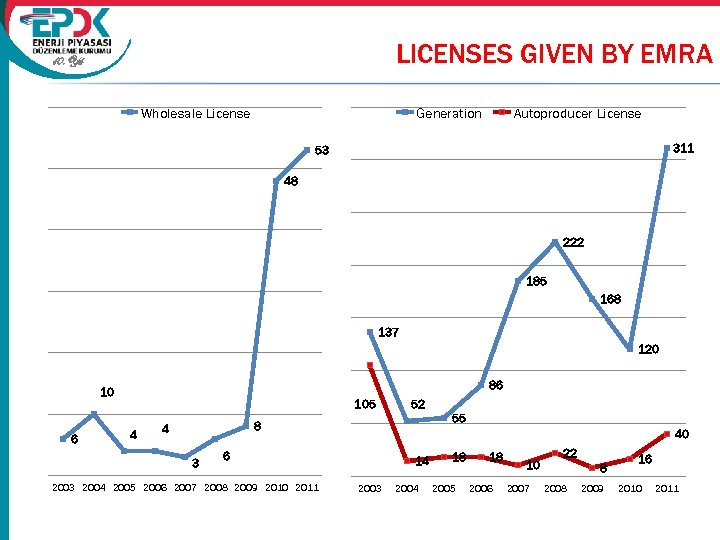 LICENSES GIVEN BY EMRA 10. Yıl Wholesale License Generation Autoproducer License 311 53 48 222 185 168 137 120 86 105 4 52 55 8 4 3 40 6 2003 2004 2005 2006 2007 2008 2009 2010 2011 14 2003 2004 18 2005 18 2006 10 2007 22 8 2009 16 2010 2011
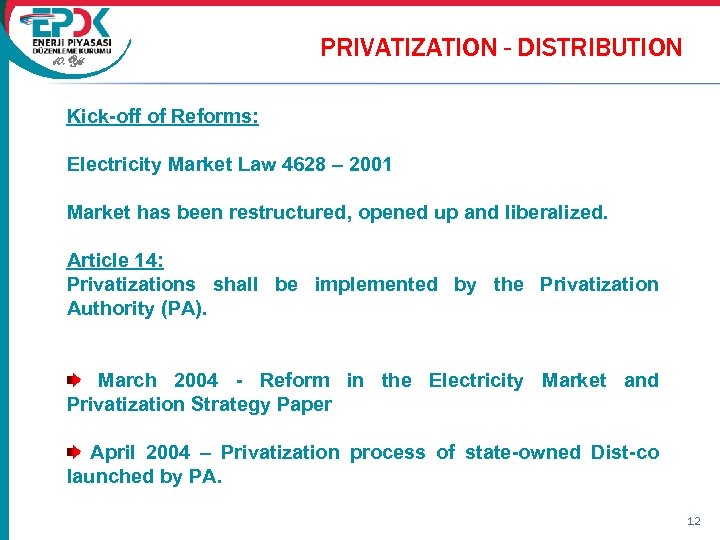 10. Yıl PRIVATIZATION - DISTRIBUTION Kick-off of Reforms: Electricity Market Law 4628 – 2001 Market has been restructured, opened up and liberalized. Article 14: Privatizations shall be implemented by the Privatization Authority (PA). March 2004 - Reform in the Electricity Market and Privatization Strategy Paper April 2004 – Privatization process of state-owned Dist-co launched by PA. 12
 10. Yıl PRIVATIZATION STRATEGY PAPER It was the first time in 2004 that a governmental consensus has been established to demonstrate a common will and commitment towards the privatization of the state-owned assets in the electricity sector. Strategy Paper (2004): Aim is to maintain a soft and stable transition period Sets the timeline for distribution and generation privatizations Determines the responsibilities of the relevant institutions Envisages implementation of Balancing and Settlement Regulation 13
 10. Yıl PRIVATIZATION STRATEGY PAPER Strategy Paper (2004) key points: The country will be divided into 21 distribution regions and privatization will be carried out together with retail sale branch. On the generation side, it is planned that portfolio generation companies will be formed by grouping power plants owned by state-owned Gen-co and its subsidiaries. Privatization of power plants will begin after Market Management System is established within Trans-co and the bulk of privatization of distribution is completed. Vesting contracts will be signed among discos and portfolio generation companies. The discos will buy %85 of their consumption from state-owned wholesale company. 14
 10. Yıl PRIVATIZATION STRATEGY PAPER Major differences from the initial Electricity Market Law (EML) framework: Allows cross subsidization between both regions and consumer groups contrary to the cost-based tariffs envisaged in EML. A tariff equalization mechanism would be created to remove price differentiations among distribution regions caused by different loss and theft ratios. 15
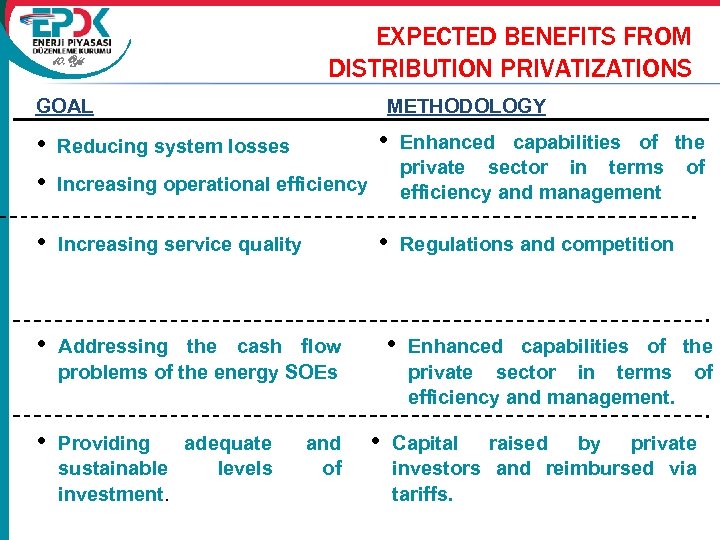 10. Yıl EXPECTED BENEFITS FROM DISTRIBUTION PRIVATIZATIONS GOAL METHODOLOGY • Reducing system losses • Increasing service quality • Providing adequate sustainable levels investment. Regulations and competition Addressing the cash flow problems of the energy SOEs • Enhanced capabilities of the private sector in terms of efficiency and management • • • Increasing operational efficiency and of • • Enhanced capabilities of the private sector in terms of efficiency and management. Capital raised by private investors and reimbursed via tariffs.
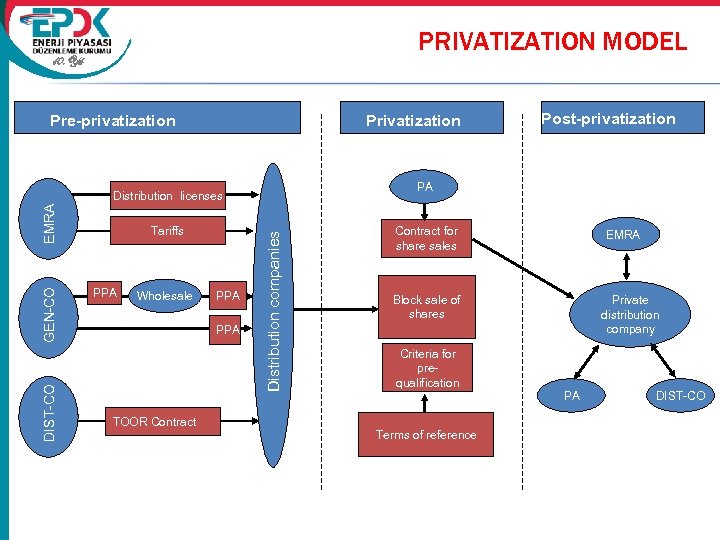 PRIVATIZATION MODEL 10. Yıl Pre-privatization PA PPA Wholesale PPA TOOR Contract Distribution companies DIST-CO GEN-CO EMRA Distribution licenses Tariffs Post-privatization Contract for share sales EMRA Block sale of shares Criteria for prequalification Terms of reference Private distribution company PA DIST-CO
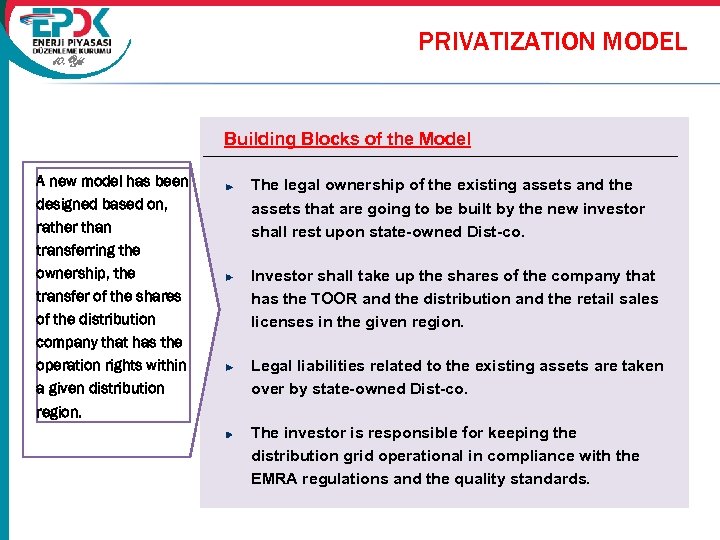 10. Yıl PRIVATIZATION MODEL Building Blocks of the Model A new model has been designed based on, rather than transferring the ownership, the transfer of the shares of the distribution company that has the operation rights within a given distribution region. The legal ownership of the existing assets and the assets that are going to be built by the new investor shall rest upon state-owned Dist-co. Investor shall take up the shares of the company that has the TOOR and the distribution and the retail sales licenses in the given region. Legal liabilities related to the existing assets are taken over by state-owned Dist-co. The investor is responsible for keeping the distribution grid operational in compliance with the EMRA regulations and the quality standards.
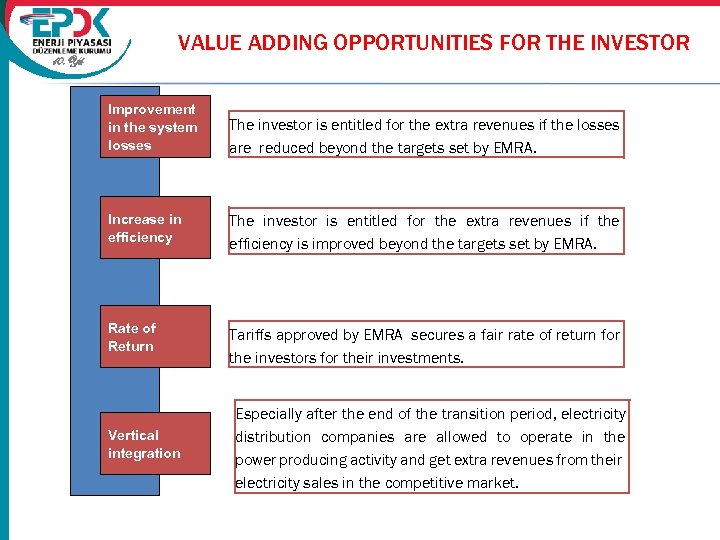 VALUE ADDING OPPORTUNITIES FOR THE INVESTOR 10. Yıl Improvement in the system losses The investor is entitled for the extra revenues if the losses are reduced beyond the targets set by EMRA. Increase in efficiency The investor is entitled for the extra revenues if the efficiency is improved beyond the targets set by EMRA. Rate of Return Tariffs approved by EMRA secures a fair rate of return for the investors for their investments. Vertical integration Especially after the end of the transition period, electricity distribution companies are allowed to operate in the power producing activity and get extra revenues from their electricity sales in the competitive market.
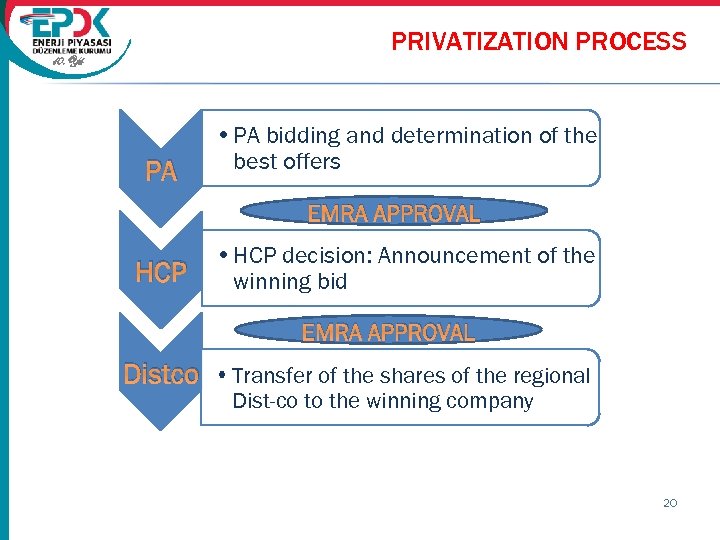 PRIVATIZATION PROCESS 10. Yıl PA • PA bidding and determination of the best offers EMRA APPROVAL HCP • HCP decision: Announcement of the winning bid EMRA APPROVAL Distco • Transfer of the shares of the regional Dist-co to the winning company 20
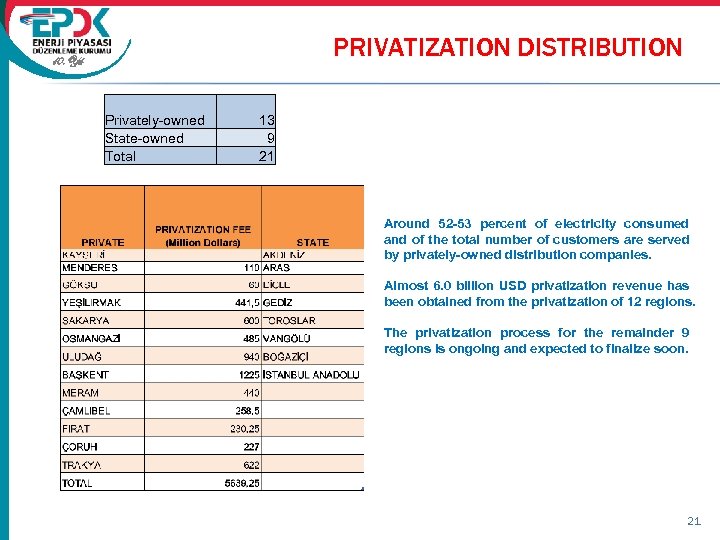 PRIVATIZATION DISTRIBUTION 10. Yıl Privately-owned State-owned Total 13 9 21 Around 52 -53 percent of electricity consumed and of the total number of customers are served by privately-owned distribution companies. Almost 6. 0 billion USD privatization revenue has been obtained from the privatization of 12 regions. The privatization process for the remainder 9 regions is ongoing and expected to finalize soon. 21
 10. Yıl MEDIUM TERM TARGETS In 2015: It is objected to create an electricity market in which; Qualified and sustainable electricity service is made Operating in competition rules High technology and information systems are used, The loss rates are reduced to OECD figures, There is an effective network. It is obvious that, to reach this target other regions should also be privatized immediately. 22
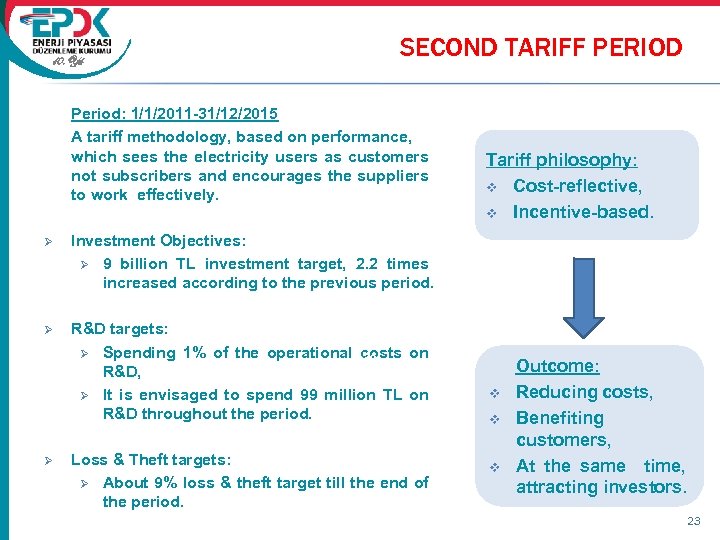 10. Yıl SECOND TARIFF PERIOD Period: 1/1/2011 -31/12/2015 A tariff methodology, based on performance, which sees the electricity users as customers not subscribers and encourages the suppliers to work effectively. Ø Investment Objectives: Ø 9 billion TL investment target, 2. 2 times increased according to the previous period. Ø R&D targets: Ø Spending 1% of the operational costs on 18 R&D, Ø It is envisaged to spend 99 million TL on R&D throughout the period. Tariff philosophy: v Cost-reflective, v Incentive-based. Ø Loss & Theft targets: Ø About 9% loss & theft target till the end of the period. v v v Outcome: Reducing costs, Benefiting customers, At the same time, attracting investors. 23
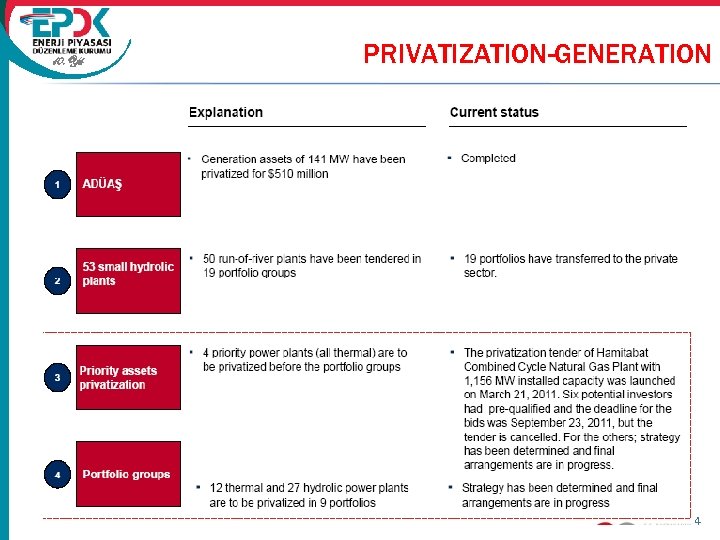 10. Yıl PRIVATIZATION-GENERATION 24
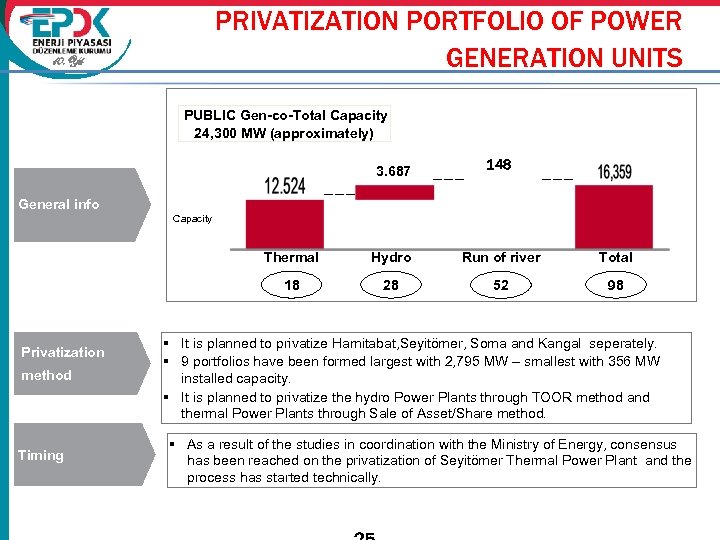 PRIVATIZATION PORTFOLIO OF POWER GENERATION UNITS 10. Yıl PUBLIC Gen-co-Total Capacity 24, 300 MW (approximately) 3. 687 148 Thermal Hydro Run of river Total 18 28 52 98 General info Capacity Privatization method Timing § It is planned to privatize Hamitabat, Seyitömer, Soma and Kangal seperately. § 9 portfolios have been formed largest with 2, 795 MW – smallest with 356 MW installed capacity. § It is planned to privatize the hydro Power Plants through TOOR method and thermal Power Plants through Sale of Asset/Share method. § As a result of the studies in coordination with the Ministry of Energy, consensus has been reached on the privatization of Seyitömer Thermal Power Plant and the process has started technically.
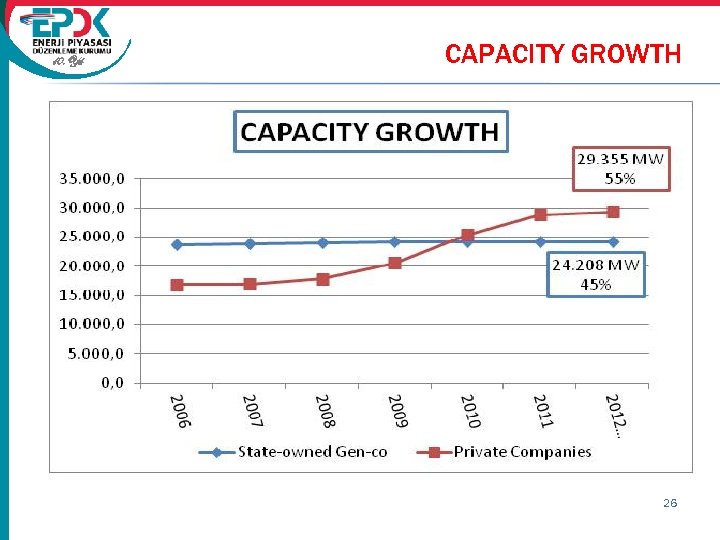 10. Yıl CAPACITY GROWTH 26
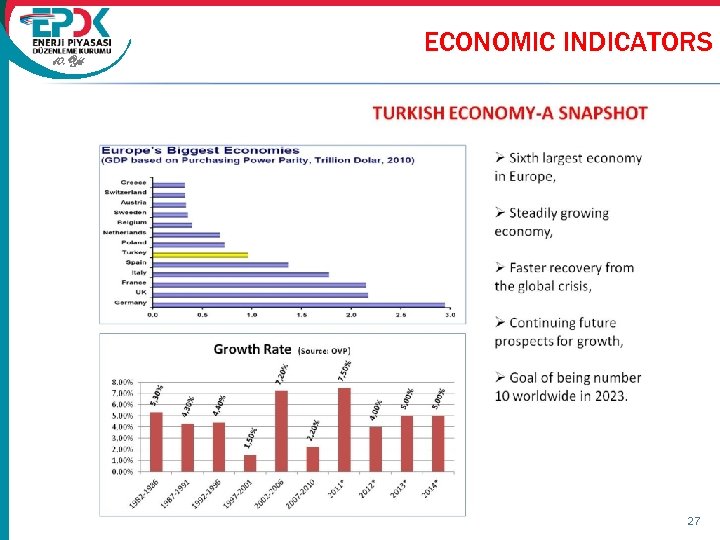 10. Yıl ECONOMIC INDICATORS 27
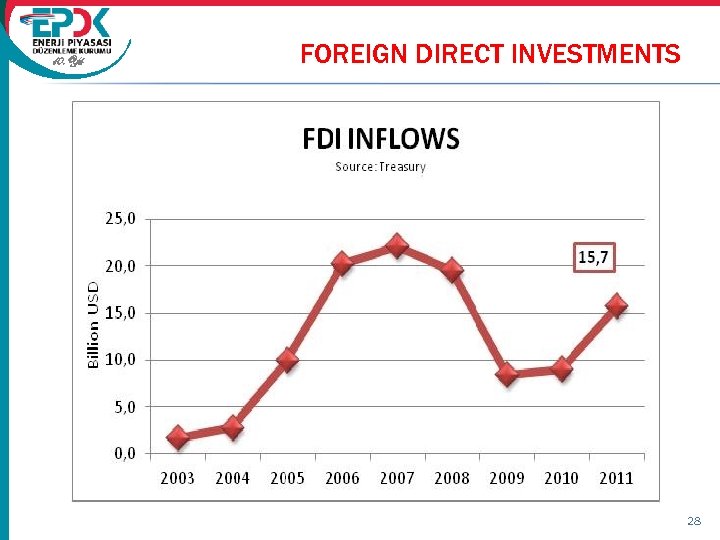 10. Yıl FOREIGN DIRECT INVESTMENTS 28
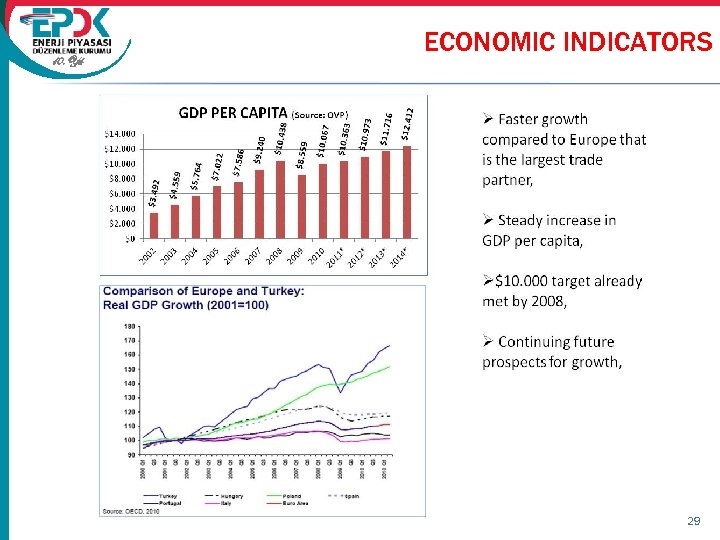 10. Yıl ECONOMIC INDICATORS 29
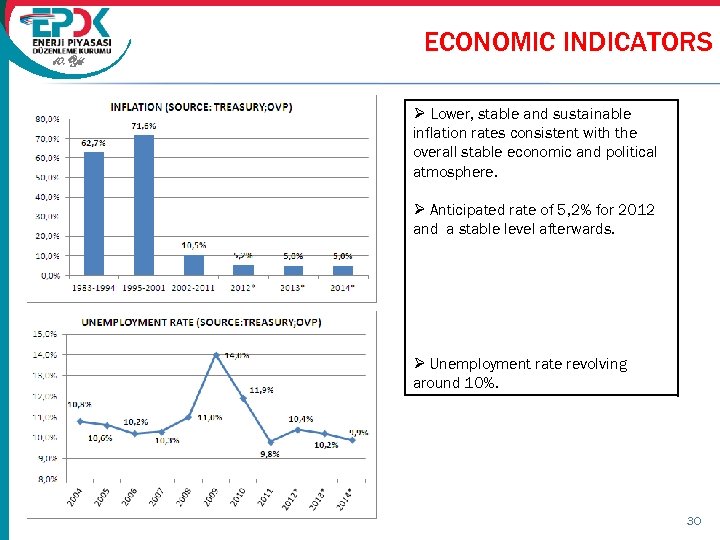 10. Yıl ECONOMIC INDICATORS Ø Lower, stable and sustainable inflation rates consistent with the overall stable economic and political atmosphere. Ø Anticipated rate of 5, 2% for 2012 and a stable level afterwards. Ø Unemployment rate revolving around 10%. 30
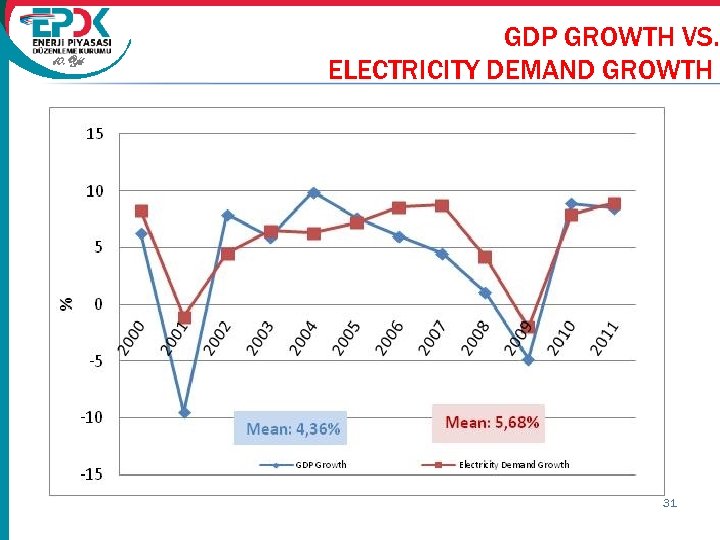 10. Yıl GDP GROWTH VS. ELECTRICITY DEMAND GROWTH 31
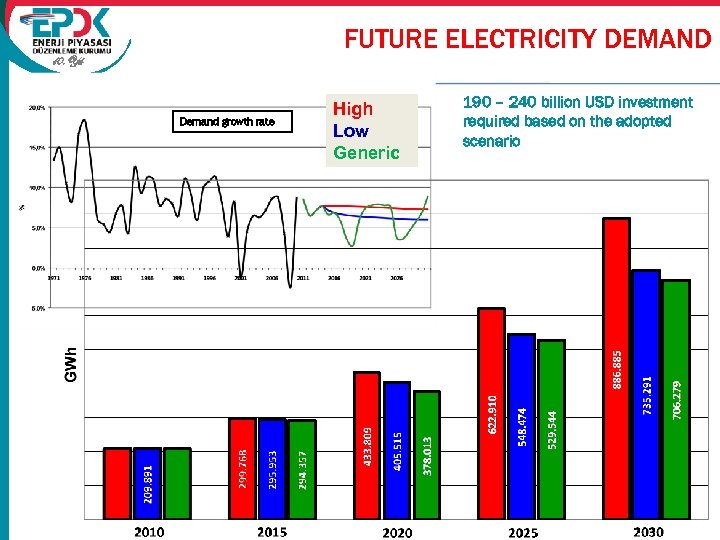 FUTURE ELECTRICITY DEMAND 10. Yıl Demand growth rate High Low Generic 190 – 240 billion USD investment required based on the adopted scenario
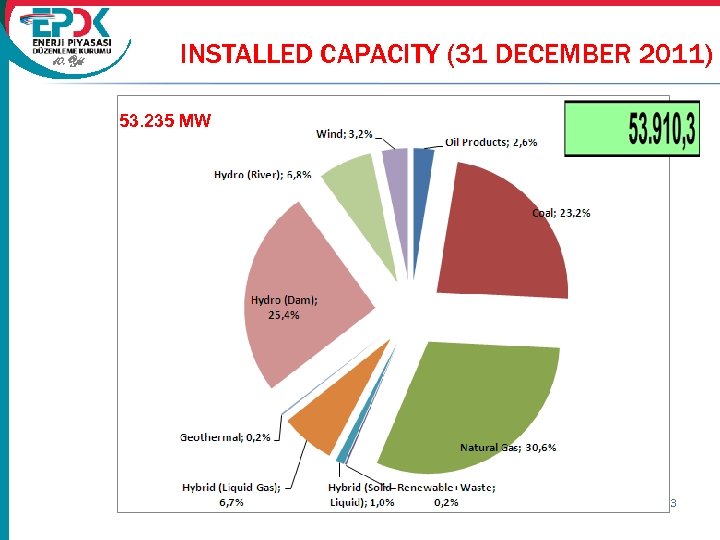 10. Yıl INSTALLED CAPACITY (31 DECEMBER 2011) 53. 235 MW 33
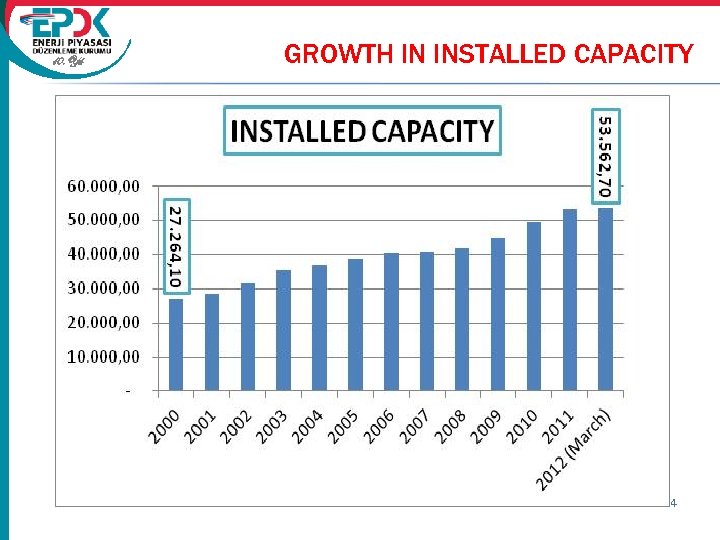 10. Yıl GROWTH IN INSTALLED CAPACITY 34
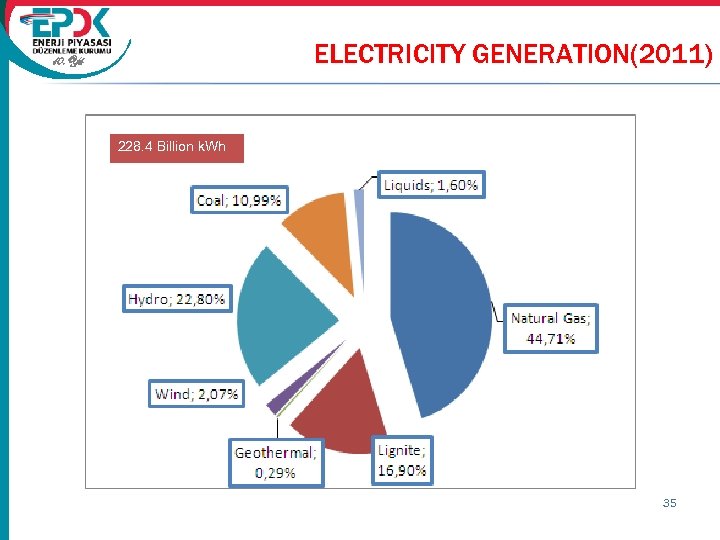 ELECTRICITY GENERATION(2011) 10. Yıl 228. 4 Billion k. Wh 35
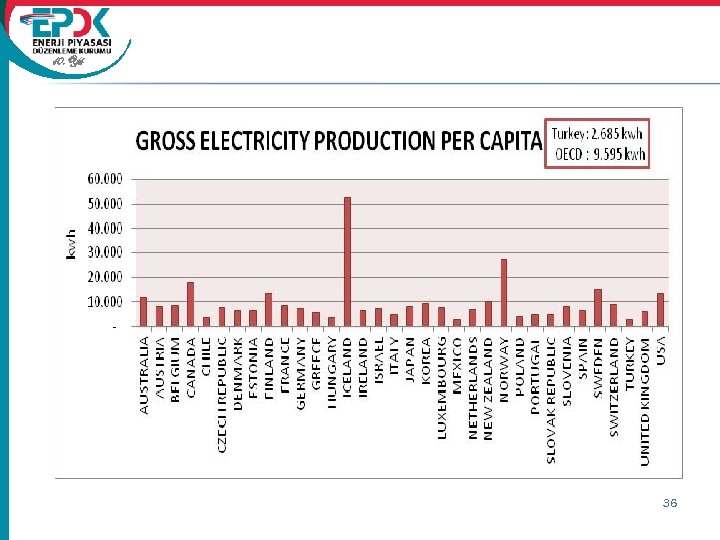 10. Yıl 36
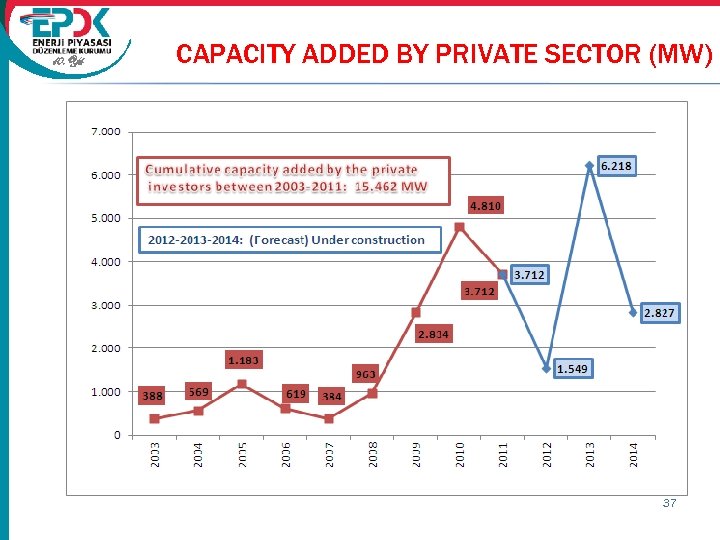 10. Yıl CAPACITY ADDED BY PRIVATE SECTOR (MW) 37
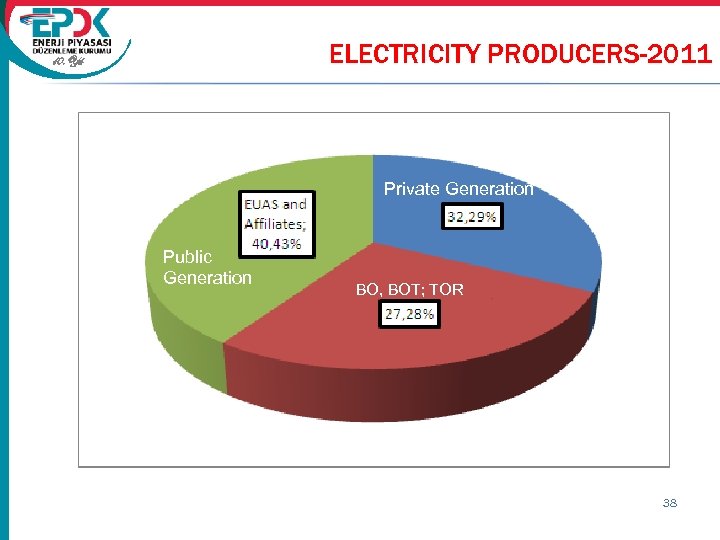 ELECTRICITY PRODUCERS-2011 10. Yıl Private Generation Public Generation BO, BOT; TOR 38
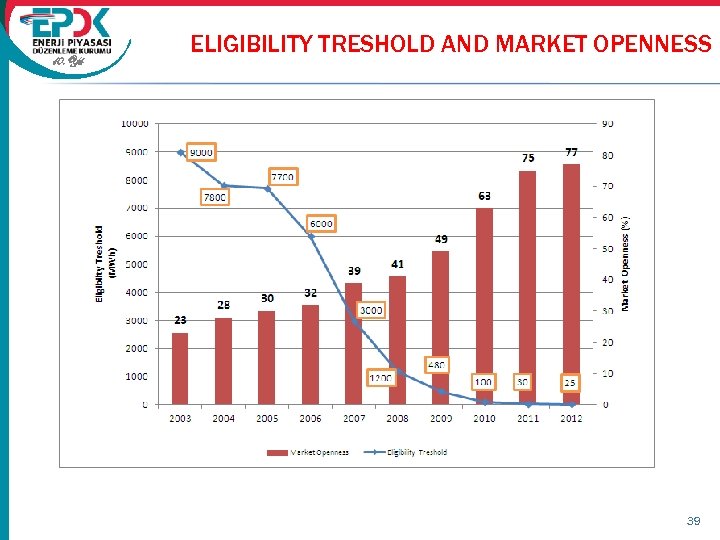 10. Yıl ELIGIBILITY TRESHOLD AND MARKET OPENNESS 39
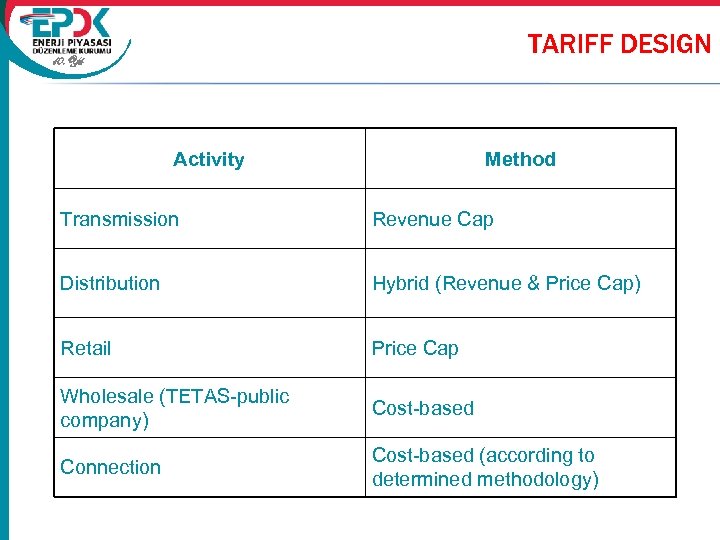 TARIFF DESIGN 10. Yıl Activity Method Transmission Revenue Cap Distribution Hybrid (Revenue & Price Cap) Retail Price Cap Wholesale (TETAS-public company) Cost-based Connection Cost-based (according to determined methodology)
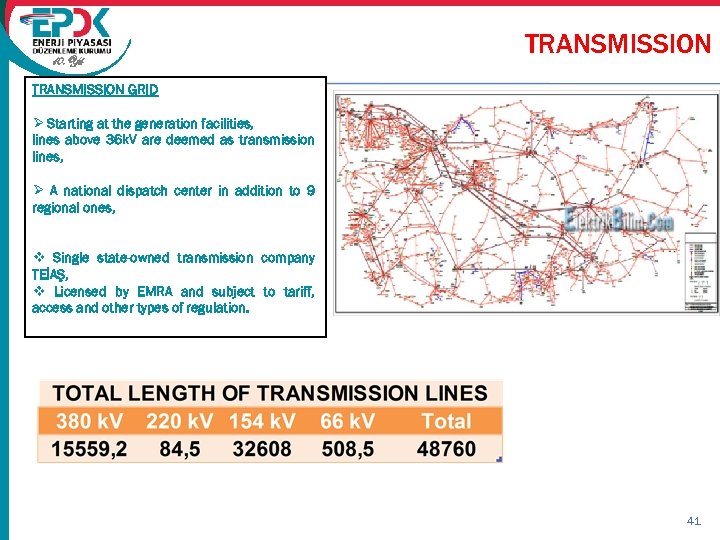 10. Yıl TRANSMISSION GRID Ø Starting at the generation facilities, lines above 36 k. V are deemed as transmission lines, Ø A national dispatch center in addition to 9 regional ones, v Single state-owned transmission company TEİAŞ, v Licensed by EMRA and subject to tariff, access and other types of regulation. 41
 10. Yıl DISTRIBUTION Ø Lines above 36 k. V are deemed as distribution lines, Ø Almost 1 million km total length of distribution lines, Ø The country has been divided into 21 distribution regions and separate companies carry out distribution functions in their respective regions. Ø Licensed by EMRA and subject to tariff, access and other types of regulation. Allowed Activities: 1 - Distribution, 2 - Retail sales, and, 3 - Generation. 42
 10. Yıl 43
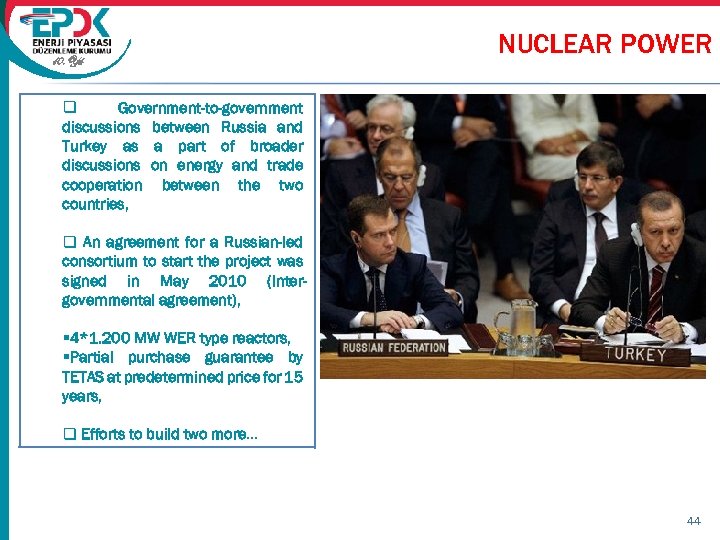 10. Yıl NUCLEAR POWER q Government-to-government discussions between Russia and Turkey as a part of broader discussions on energy and trade cooperation between the two countries, q An agreement for a Russian-led consortium to start the project was signed in May 2010 (Intergovernmental agreement), § 4*1. 200 MW WER type reactors, §Partial purchase guarantee by TETAS at predetermined price for 15 years, q Efforts to build two more… 44
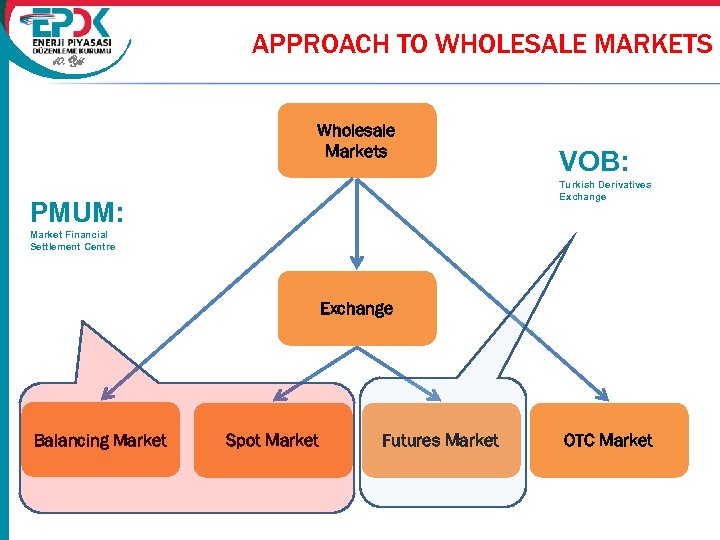 10. Yıl APPROACH TO WHOLESALE MARKETS Wholesale Markets VOB: Turkish Derivatives Exchange PMUM: Market Financial Settlement Centre Exchange Balancing Market Spot Market Ref: Challenges in Pricing of Electricity Risk, Juri Hinz Futures Market OTC Market
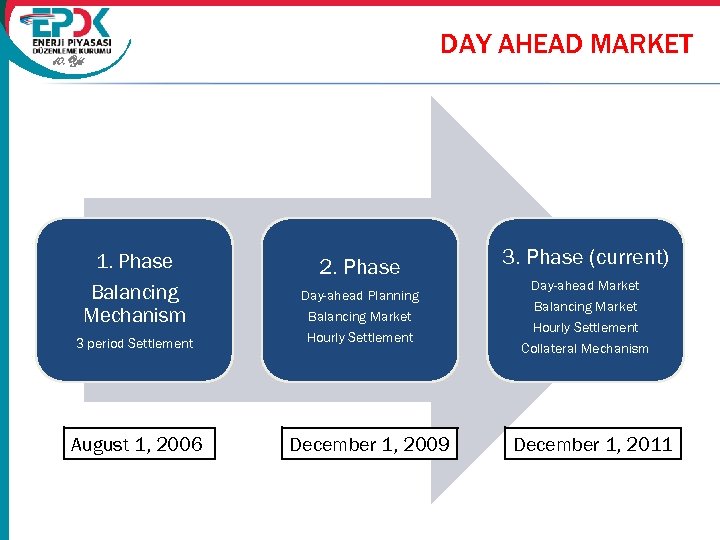 DAY AHEAD MARKET 10. Yıl 1. Phase Balancing Mechanism 3 period Settlement August 1, 2006 2. Phase Day-ahead Planning Balancing Market Hourly Settlement December 1, 2009 3. Phase (current) Day-ahead Market Balancing Market Hourly Settlement Collateral Mechanism December 1, 2011
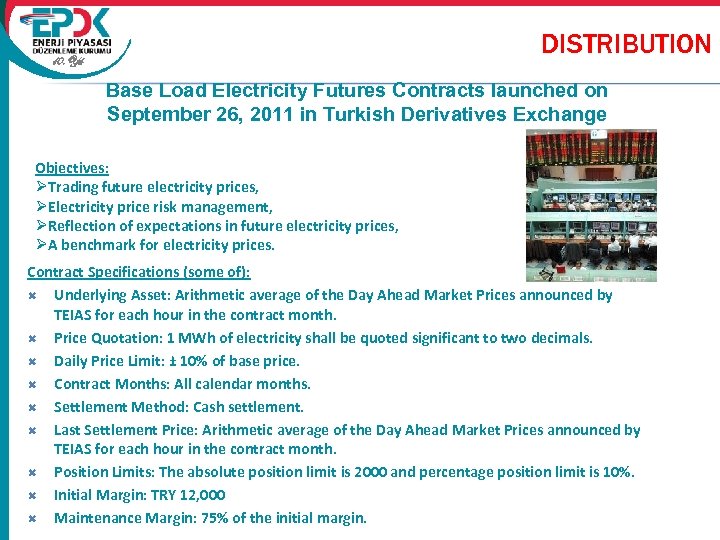 DISTRIBUTION 10. Yıl Base Load Electricity Futures Contracts launched on September 26, 2011 in Turkish Derivatives Exchange Objectives: ØTrading future electricity prices, ØElectricity price risk management, ØReflection of expectations in future electricity prices, ØA benchmark for electricity prices. Contract Specifications (some of): Underlying Asset: Arithmetic average of the Day Ahead Market Prices announced by TEIAS for each hour in the contract month. Price Quotation: 1 MWh of electricity shall be quoted significant to two decimals. Daily Price Limit: ± 10% of base price. Contract Months: All calendar months. Settlement Method: Cash settlement. Last Settlement Price: Arithmetic average of the Day Ahead Market Prices announced by TEIAS for each hour in the contract month. Position Limits: The absolute position limit is 2000 and percentage position limit is 10%. Initial Margin: TRY 12, 000 Maintenance Margin: 75% of the initial margin.
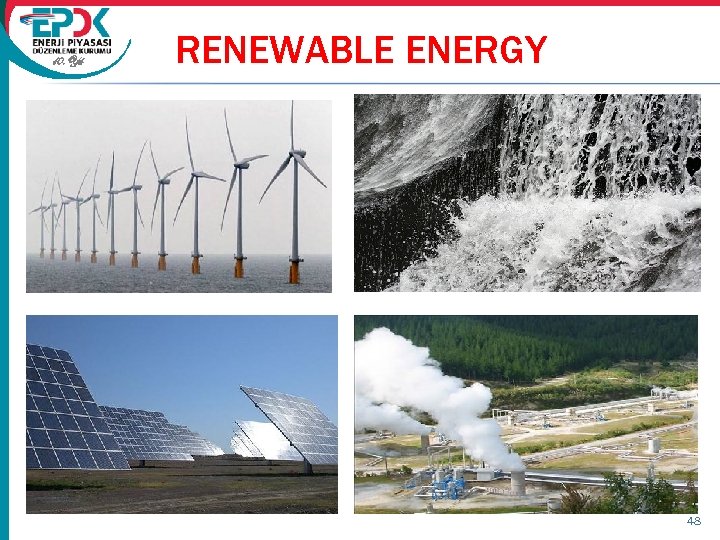 10. Yıl RENEWABLE ENERGY 48
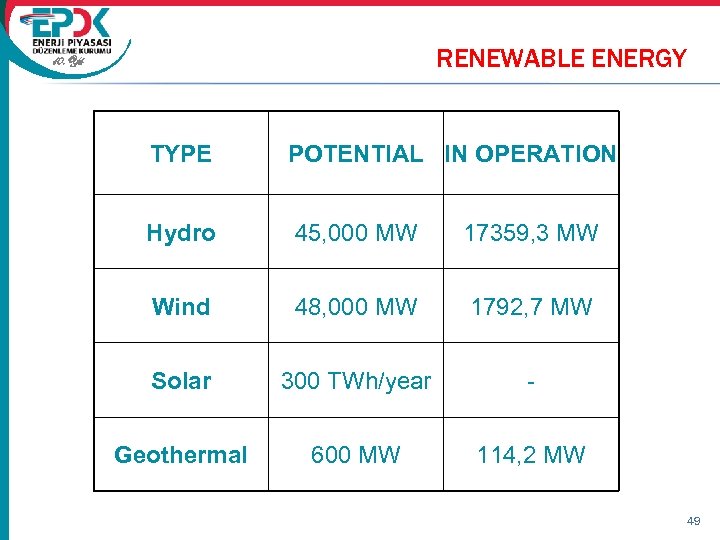 RENEWABLE ENERGY 10. Yıl TYPE POTENTIAL IN OPERATION Hydro 45, 000 MW 17359, 3 MW Wind 48, 000 MW 1792, 7 MW Solar 300 TWh/year - Geothermal 600 MW 114, 2 MW 49
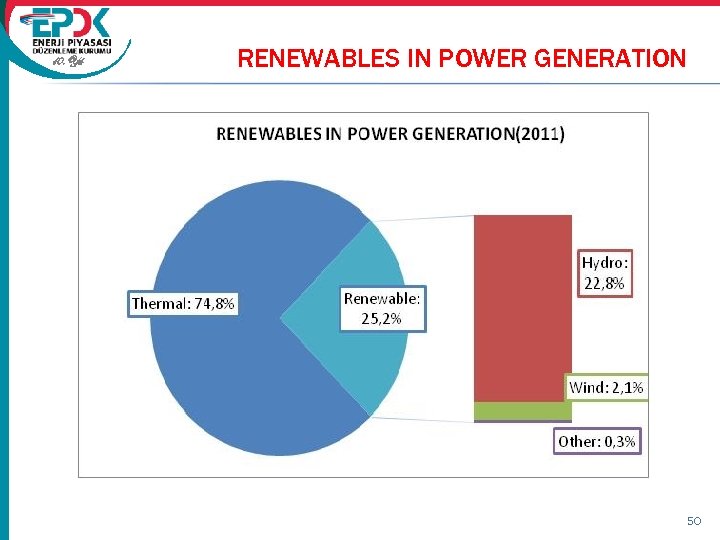 10. Yıl RENEWABLES IN POWER GENERATION 50
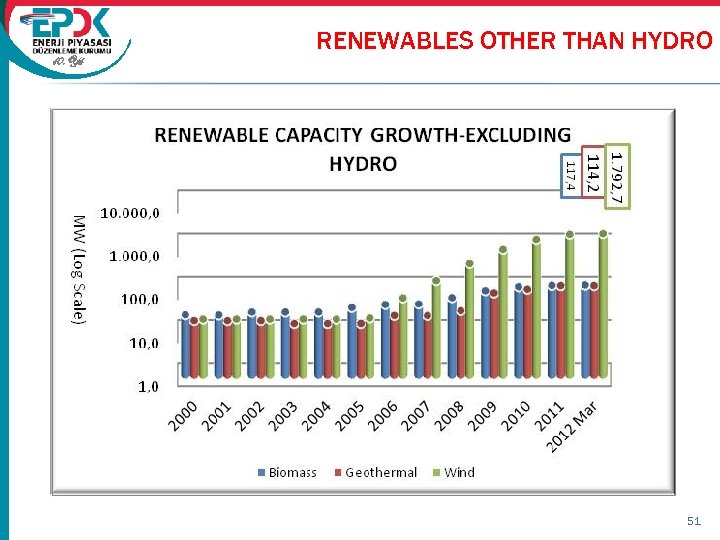 10. Yıl RENEWABLES OTHER THAN HYDRO 51
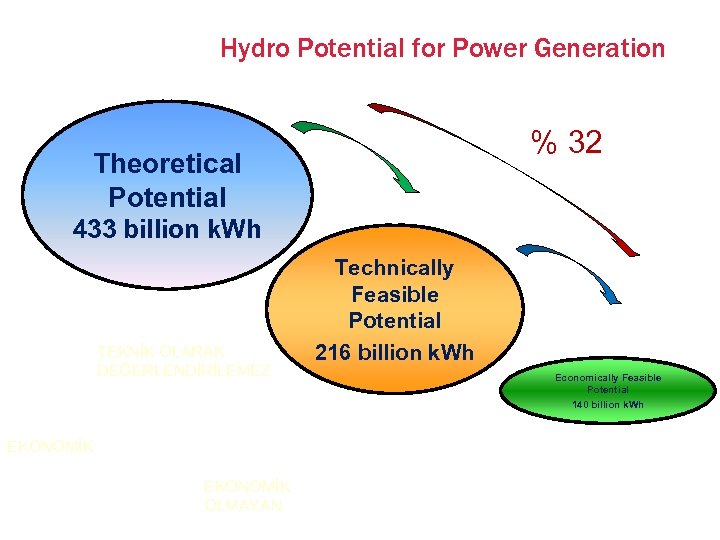 Hydro Potential for Power Generation % 32 Theoretical Potential 433 billion k. Wh TEKNİK OLARAK DEĞERLENDİRİLEMEZ EKONOMİK OLMAYAN Technically Feasible Potential 216 billion k. Wh Economically Feasible Potential 140 billion k. Wh
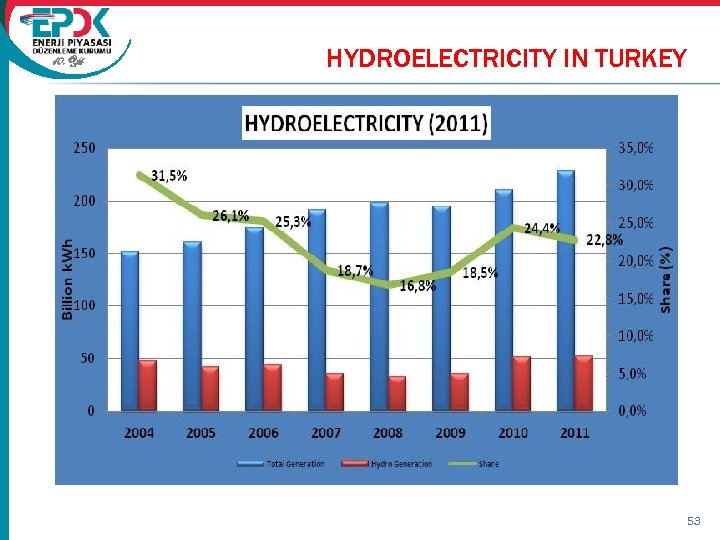 10. Yıl HYDROELECTRICITY IN TURKEY 53
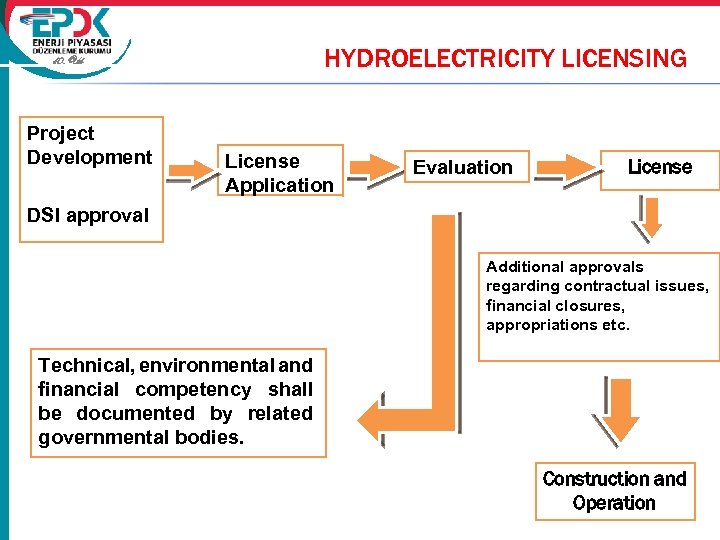 HYDROELECTRICITY LICENSING 10. Yıl Project Development License Application Evaluation License DSI approval Additional approvals regarding contractual issues, financial closures, appropriations etc. Technical, environmental and financial competency shall be documented by related governmental bodies. Construction and Operation
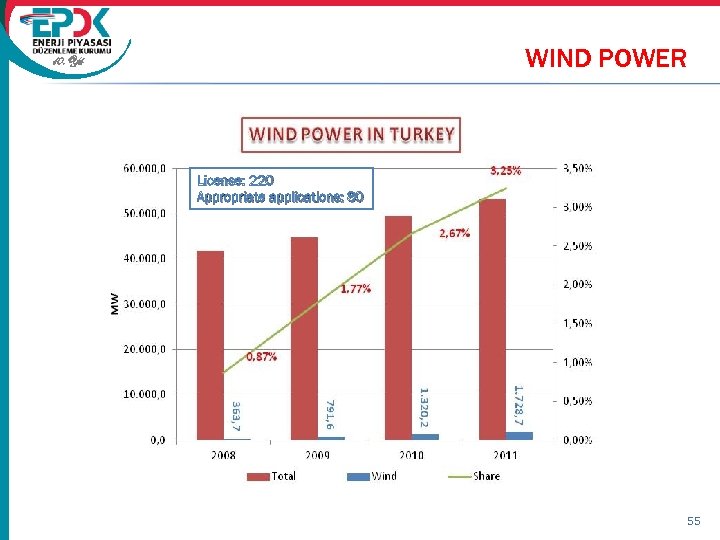 WIND POWER 10. Yıl License: 220 Appropriate applications: 80 55
 10. Yıl WIND LICENSING Ø 752 applications was received on 1 November 2007 corresponding to 78. 023 MW capacity, Ø 50 applications were pending before 1 November 2007, Ø Hence, after 1 November 2007, 802 applications in total (80. 700 MW) evaluated by EMRA. 56
 WIND LICENSING 10. Yıl Ø 144 out of 802 were rejected due to technical reasons or due to the claim of the applicants, Ø 62 was single applications (2. 050 MW): Ø 53 of them were licensed, Ø 9 pending, Ø 596 has been subject to contesting implemented by TEIAS HENCE: q 253 licenses are in place, q. Almost 9. 000 MW licenses, q. Almost 1. 800 MW in operation. 57
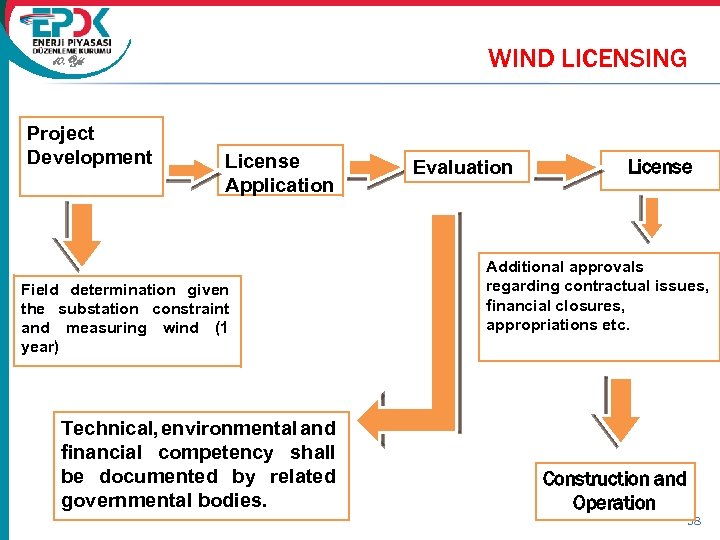 WIND LICENSING 10. Yıl Project Development License Application Field determination given the substation constraint and measuring wind (1 year) Technical, environmental and financial competency shall be documented by related governmental bodies. Evaluation License Additional approvals regarding contractual issues, financial closures, appropriations etc. Construction and Operation 58
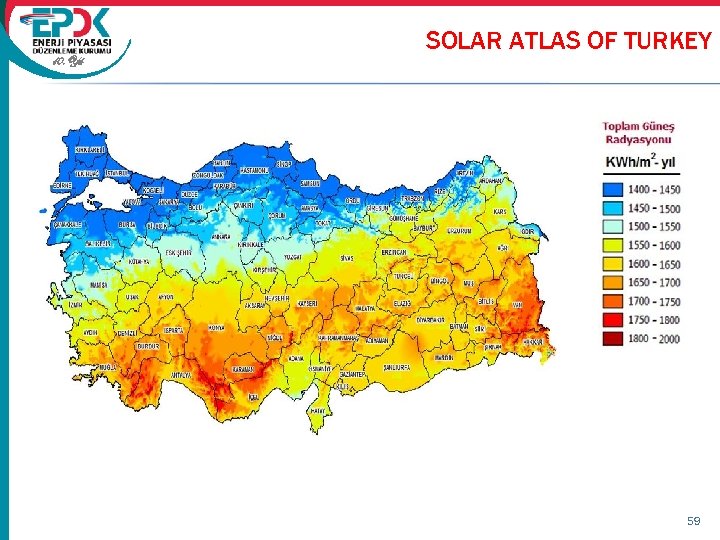 10. Yıl SOLAR ATLAS OF TURKEY 59
 10. Yıl SOLAR POWER Steps Taken: Ø Feed-in-tariffs for solar energy has been introduced, Ø Amendments in Electricity Licensing Regulation, Ø Regulation on Wind and Solar Measurement, Ø The substations that the solar power plants can be connected until 31 December 2012 (27 substations) which takes into consideration the 600 MW upper limit have been announced by the MENR in August 2011. 60
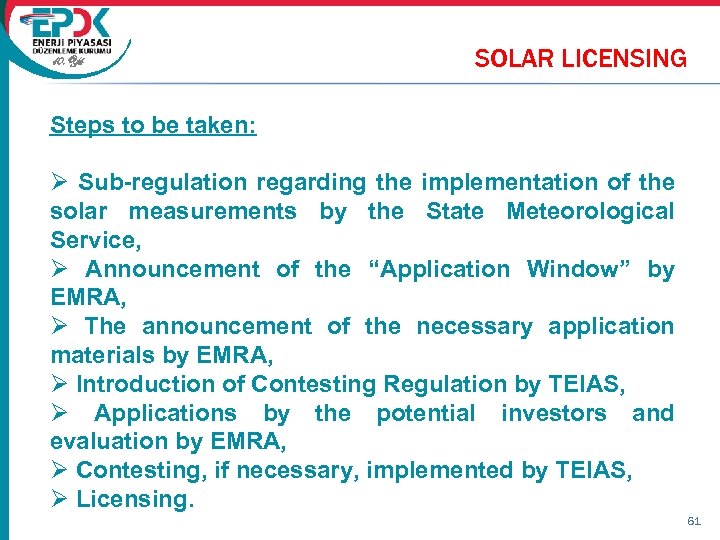 10. Yıl SOLAR LICENSING Steps to be taken: Ø Sub-regulation regarding the implementation of the solar measurements by the State Meteorological Service, Ø Announcement of the “Application Window” by EMRA, Ø The announcement of the necessary application materials by EMRA, Ø Introduction of Contesting Regulation by TEIAS, Ø Applications by the potential investors and evaluation by EMRA, Ø Contesting, if necessary, implemented by TEIAS, Ø Licensing. 61
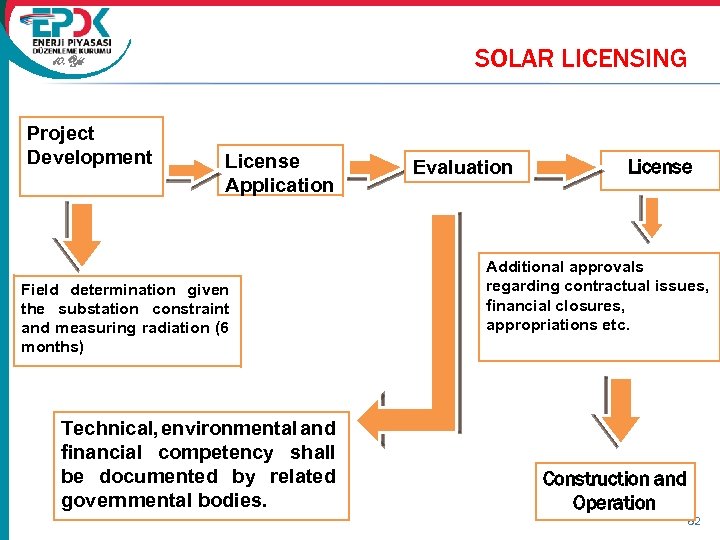 SOLAR LICENSING 10. Yıl Project Development License Application Field determination given the substation constraint and measuring radiation (6 months) Technical, environmental and financial competency shall be documented by related governmental bodies. Evaluation License Additional approvals regarding contractual issues, financial closures, appropriations etc. Construction and Operation 62
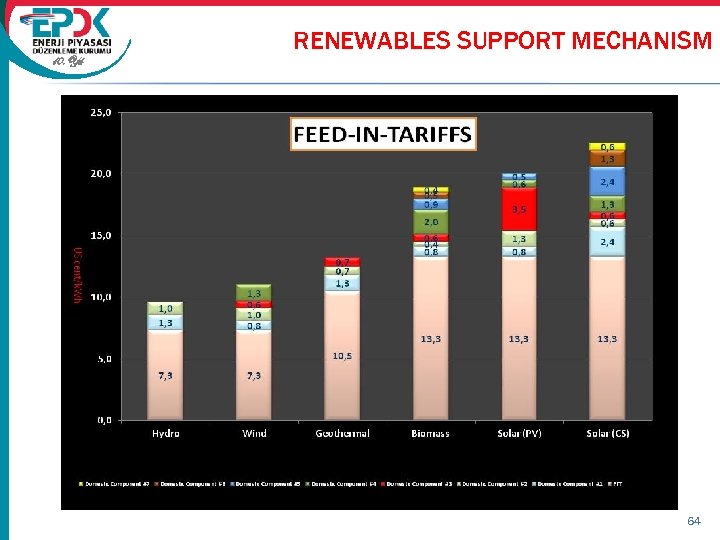
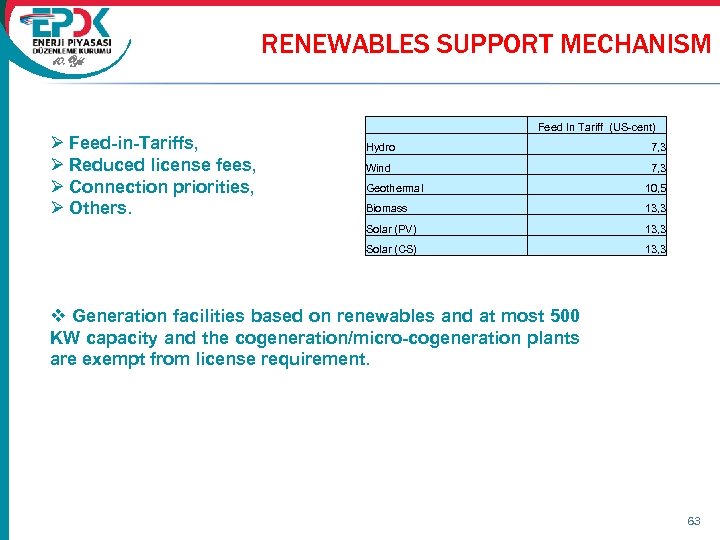 10. Yıl Ø Feed-in-Tariffs, Ø Reduced license fees, Ø Connection priorities, Ø Others. RENEWABLES SUPPORT MECHANISM Feed In Tariff (US-cent) Hydro 7, 3 Wind 7, 3 Geothermal 10, 5 Biomass 13, 3 Solar (PV) 13, 3 Solar (CS) 13, 3 v Generation facilities based on renewables and at most 500 KW capacity and the cogeneration/micro-cogeneration plants are exempt from license requirement. 63
 10. Yıl RENEWABLES SUPPORT MECHANISM 64
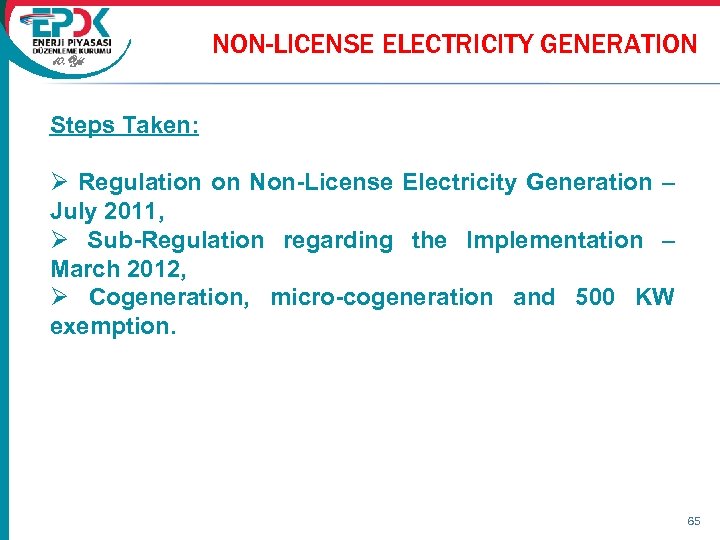 10. Yıl NON-LICENSE ELECTRICITY GENERATION Steps Taken: Ø Regulation on Non-License Electricity Generation – July 2011, Ø Sub-Regulation regarding the Implementation – March 2012, Ø Cogeneration, micro-cogeneration and 500 KW exemption. 65
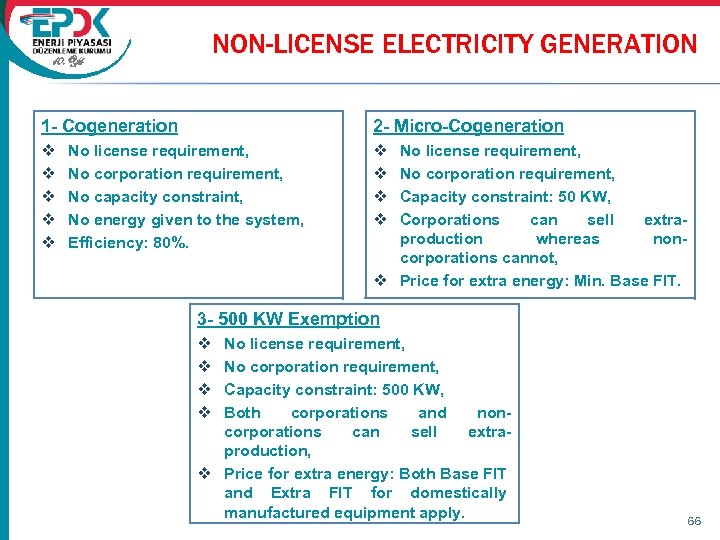 10. Yıl NON-LICENSE ELECTRICITY GENERATION 1 - Cogeneration 2 - Micro-Cogeneration v v v v v No license requirement, No corporation requirement, No capacity constraint, No energy given to the system, Efficiency: 80%. No license requirement, No corporation requirement, Capacity constraint: 50 KW, Corporations can sell extraproduction whereas noncorporations cannot, v Price for extra energy: Min. Base FIT. 3 - 500 KW Exemption v v No license requirement, No corporation requirement, Capacity constraint: 500 KW, Both corporations and noncorporations can sell extraproduction, v Price for extra energy: Both Base FIT and Extra FIT for domestically manufactured equipment apply. 66
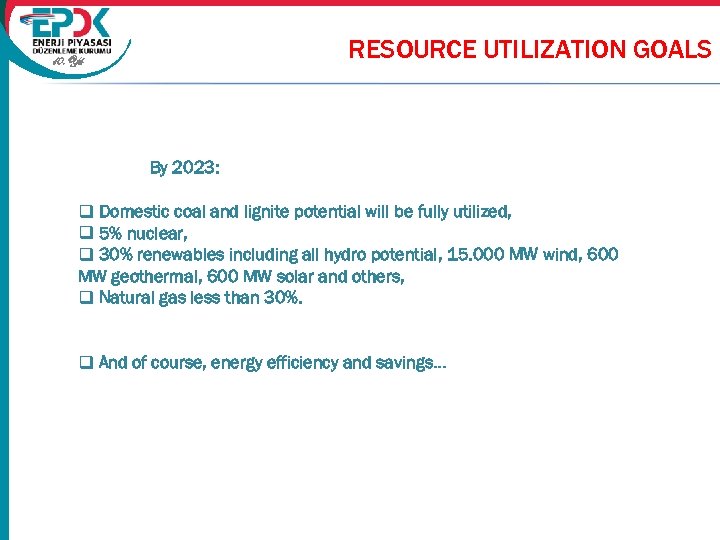 RESOURCE UTILIZATION GOALS 10. Yıl By 2023: q Domestic coal and lignite potential will be fully utilized, q 5% nuclear, q 30% renewables including all hydro potential, 15. 000 MW wind, 600 MW geothermal, 600 MW solar and others, q Natural gas less than 30%. q And of course, energy efficiency and savings…
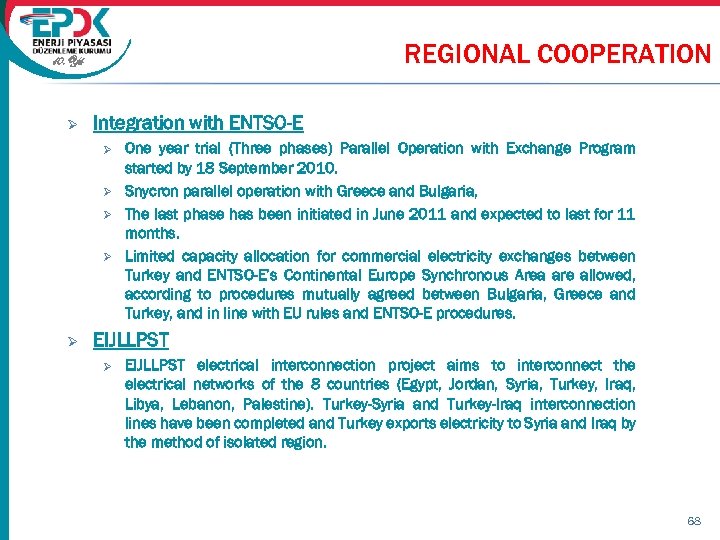 REGIONAL COOPERATION 10. Yıl Ø Integration with ENTSO-E Ø Ø Ø One year trial (Three phases) Parallel Operation with Exchange Program started by 18 September 2010. Snycron parallel operation with Greece and Bulgaria, The last phase has been initiated in June 2011 and expected to last for 11 months. Limited capacity allocation for commercial electricity exchanges between Turkey and ENTSO-E’s Continental Europe Synchronous Area are allowed, according to procedures mutually agreed between Bulgaria, Greece and Turkey, and in line with EU rules and ENTSO-E procedures. EIJLLPST Ø EIJLLPST electrical interconnection project aims to interconnect the electrical networks of the 8 countries (Egypt, Jordan, Syria, Turkey, Iraq, Libya, Lebanon, Palestine). Turkey-Syria and Turkey-Iraq interconnection lines have been completed and Turkey exports electricity to Syria and Iraq by the method of isolated region. 68
 10. Yıl Ø REGIONAL COOPERATION INSTITUTIONAL EU Process and the Chapter 15 Satisfactory progress in energy chapter Blocked by political reasons. Ø Cooperation with European Energy Community Observer status Ø Participation in the Energy Charter Treaty Ratified in 1998 - actively contributing its functioning, Incorporated the ECT dispute settlement mechanism. Ø Ø Ø ACER ? ERRA MEDREG NARUC WFER 2015 Candidacy 69
 10. Yıl WRAP - UP q. Growing and stable economy, q Rapidly and constantly increasing electricity demand, q Ambitious targets for further market reforms and policies regarding the power mix, q Huge volumes of investment required, q Commitment to liberalized electricity market and competition, q Investor-friendly economic and political structure, q And finally, a fully transparent and highly predictable regulatory framework, q Turkey has embraced almost all of the international and regional initiatives that is related with the security of supply of not only itself but of Europe as well, q Turkey proved to be reliable partner of the international community in almost every international platform, 70
 WRAP-UP 10. Yıl To wrap up: q Turkey has a concrete objective to increase the share of renewables in electricity generation, q Solid policy measures are adopted to this end, q A new FIT mechanism supplemented by additional incentives has been introduced, q Licenses for renewable-based power generation are given by EMRA and most of the necessary rules and regulations have already been announced, q The capacity based on renewables both for hydro and non-hydro is increasing, q We expect to receive more applications in the upcoming months and years…
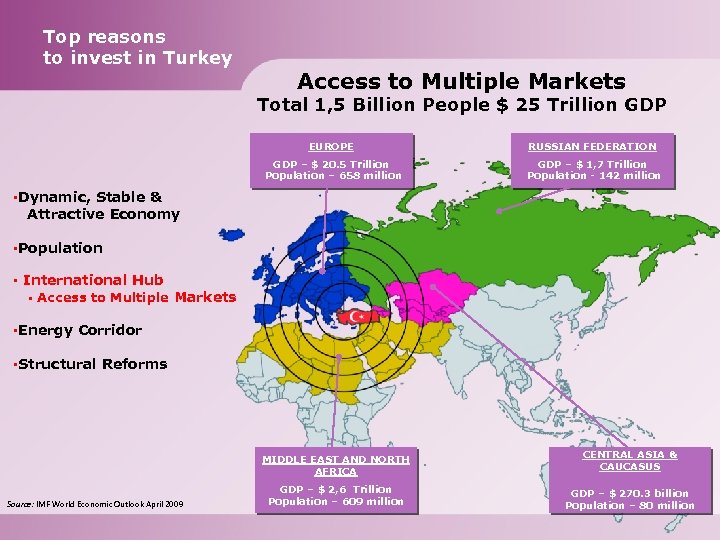 Top reasons to invest in Turkey Access to Multiple Markets Total 1, 5 Billion People $ 25 Trillion GDP EUROPE RUSSIAN FEDERATION GDP – $ 20. 5 Trillion Population – 658 million GDP – $ 1, 7 Trillion Population - 142 million §Dynamic, Stable & Attractive Economy §Population § International Hub § Access to Multiple Markets §Energy Corridor §Structural Reforms MIDDLE EAST AND NORTH AFRICA Source: IMF World Economic Outlook April 2009 CENTRAL ASIA & CAUCASUS GDP – $ 2, 6 Trillion Population – 609 million GDP – $ 270. 3 billion Population – 80 million
 10. Yıl SOME FOREIGN ENERGY COMPANIES INVEST AND INTEREST IN TURKEY
 10. Yıl Doğal Gaz Piyasası Raporu 74
 10. Yıl Thank you very much. . Q&A www. epdk. org. tr tturan@epdk. org. tr 75