


 Скачать презентацию Turkish Economy in the 1946 -1962 Period
5e8db0dd7c63b9e1b61237a2ba8fe7e4.ppt
- Количество слайдов: 34
 Turkish Economy in the 1946 -1962 Period • External Factors: ▫ ▫ ▫ The end of World War II New political order in the world economy The deterioration of relations with USSR Marshall Plan (a set of recommendations) IMF & IBRD
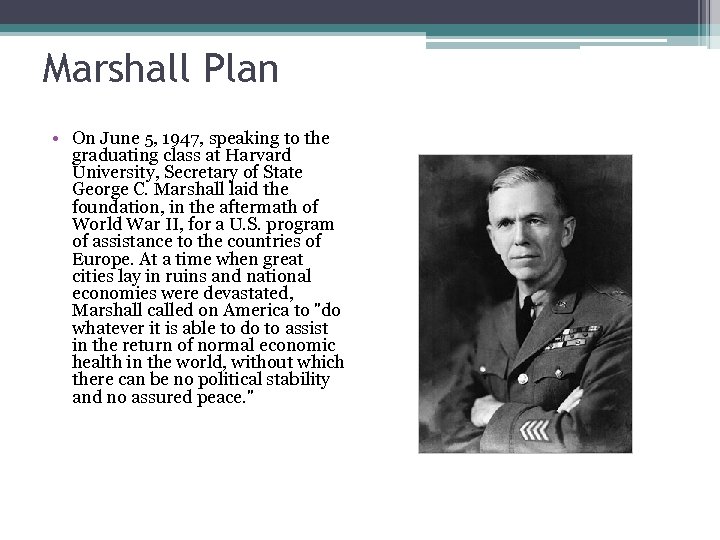 Marshall Plan • On June 5, 1947, speaking to the graduating class at Harvard University, Secretary of State George C. Marshall laid the foundation, in the aftermath of World War II, for a U. S. program of assistance to the countries of Europe. At a time when great cities lay in ruins and national economies were devastated, Marshall called on America to "do whatever it is able to do to assist in the return of normal economic health in the world, without which there can be no political stability and no assured peace. "
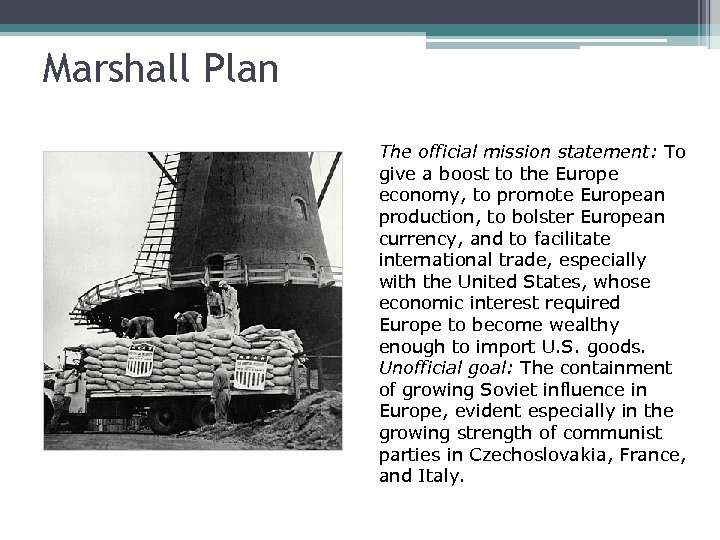 Marshall Plan The official mission statement: To give a boost to the Europe economy, to promote European production, to bolster European currency, and to facilitate international trade, especially with the United States, whose economic interest required Europe to become wealthy enough to import U. S. goods. Unofficial goal: The containment of growing Soviet influence in Europe, evident especially in the growing strength of communist parties in Czechoslovakia, France, and Italy.
 Marshall Plan • The first substantial aid went to Greece and Turkey in January 1947, which were seen as being on the front lines of the battle against communist expansion and were already being aided under the Truman Doctrine.
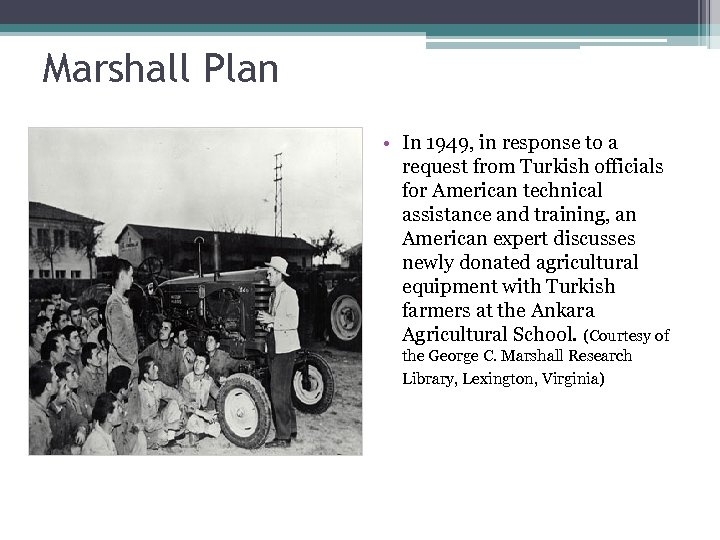 Marshall Plan • In 1949, in response to a request from Turkish officials for American technical assistance and training, an American expert discusses newly donated agricultural equipment with Turkish farmers at the Ankara Agricultural School. (Courtesy of the George C. Marshall Research Library, Lexington, Virginia)
 Marshall Plan • Conditions laid down to make use of the plan: ▫ Public entrepreneurship should be constricted ▫ Private entrepreneurship should be encouraged ▫ Heavy industry (iron steel, heavy chemical etc. ) should not be established in Turkey. ▫ Industrialization must be based on processed agricultural products, construction materials, leather, forest products etc. ▫ Increased tractor usage and highway construction.
 Turkish Economy in 1946 -1962 Period • External Factors: ▫ ▫ ▫ The end of World War II New political order in the world economy The deterioration of relations with USSR Marshall Plan IMF & IBRD
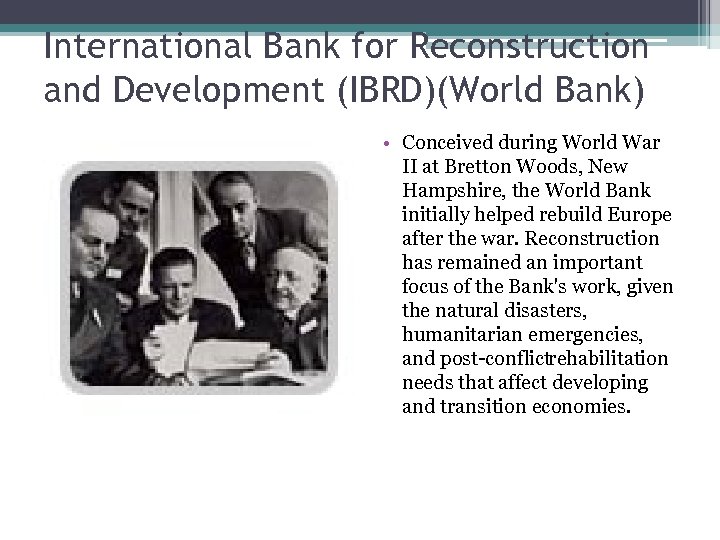 International Bank for Reconstruction and Development (IBRD)(World Bank) • Conceived during World War II at Bretton Woods, New Hampshire, the World Bank initially helped rebuild Europe after the war. Reconstruction has remained an important focus of the Bank's work, given the natural disasters, humanitarian emergencies, and post conflictrehabilitation needs that affect developing and transition economies.
 International Bank for Reconstruction and Development (IBRD)(World Bank) • During the 1980 s, the Bank was pushed in many directions: early in the decade, the Bank was brought face to face with macroeconomic and debt rescheduling issues; later in the decade, social and environmental issues assumed center stage.
 International Monetary Fund • The International Monetary Fund was conceived at a United Nations conference convened in Bretton Woods, New Hampshire, U. S. in July 1944. The 45 governments represented at that conference sought to build a framework for economic cooperation that would avoid a repetition of the disastrous economic policies that had contributed to the Great Depression of the 1930 s. • It was established to promote international monetary cooperation, exchange stability, and orderly exchange arrangements; to foster economic growth and high levels of employment; and to provide temporary financial assistance to countries to help ease balance of payments adjustment.
 International Monetary Fund • The IMF's resources are provided by its member countries, primarily through payment of quotas, which broadly reflect each country's economic size. The total amount of quotas is the most important factor determining the IMF's lending capacity. • Current membership: 185 countries • Staff: approximately 2, 716 from 165 countries • Total Quotas: $317 billion)
 Turkish Economy in 1946 -1962 Period • Internal Factors: ▫ 1944: İvedili Plan ▫ 1947: Türkiye İktisadi Kalkınma Planı Prepared under the control of foreigners Transportation (highway), agriculture, energy Private sector based industrialization Privatization (except mining, iron steel and railroad construction) 49% of expenditures will be financed by external resources (foreign aid or credits)
 Turkish Economy in 1946 -1962 Period • Internal Factors: ▫ 1950: Multi party system ▫ 1950: Elections (Democrat Party)
 Turkish Economy in 1946 -1962 Period: General Principles • • • Liberal trade Private entrepreneurship End of etatism Mechanization in agriculture Highway construction Encouragement of foreign capital
 Capital Resources • Internal resources: ▫ ▫ Increase in money supply Increased credit volume Budget deficits (Duty losses) Resource transfer from public sector to private sector
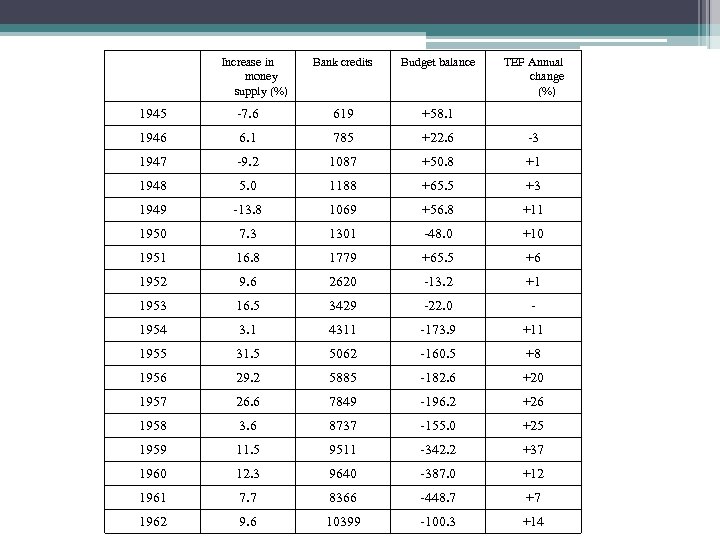 Increase in money supply (%) Bank credits Budget balance TEF Annual change (%) 1945 -7. 6 619 +58. 1 1946 6. 1 785 +22. 6 -3 1947 -9. 2 1087 +50. 8 +1 1948 5. 0 1188 +65. 5 +3 1949 -13. 8 1069 +56. 8 +11 1950 7. 3 1301 -48. 0 +10 1951 16. 8 1779 +65. 5 +6 1952 9. 6 2620 -13. 2 +1 1953 16. 5 3429 -22. 0 - 1954 3. 1 4311 -173. 9 +11 1955 31. 5 5062 -160. 5 +8 1956 29. 2 5885 -182. 6 +20 1957 26. 6 7849 -196. 2 +26 1958 3. 6 8737 -155. 0 +25 1959 11. 5 9511 -342. 2 +37 1960 12. 3 9640 -387. 0 +12 1961 7. 7 8366 -448. 7 +7 1962 9. 6 10399 -100. 3 +14
 Capital Resources • External resources: ▫ Borrowing from USA (1945 1949) ▫ Aids from USA (1950 1960) ▫ Foreign investments 95 % in industry (high profits) Partnership with domestic capital Small scale production (not efficient) Usage of imported inputs ▫ Petroleum Law (1954)
 Agriculture • • 1945: Çiftçiyi Topraklandırma Yasası Increase in tractor usage Tractor production Expansion in agricultural credits Price supports for agriculture Agricultural output increased 1952: Et ve Balık Kurumu Increase in fertilizer usage
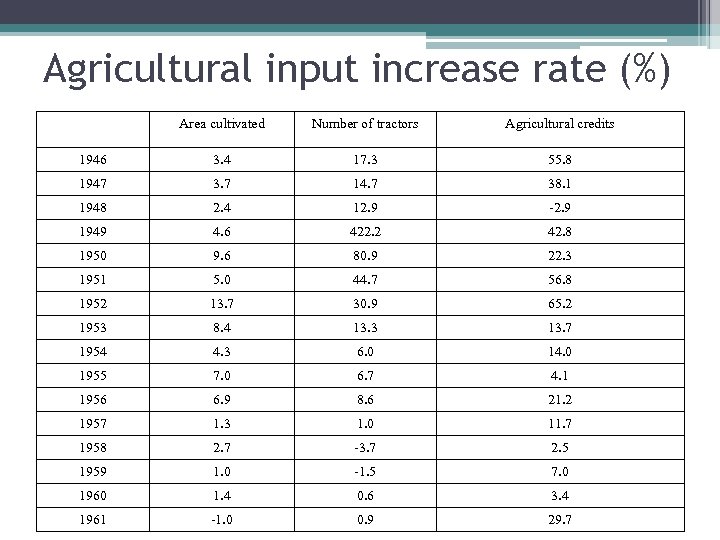 Agricultural input increase rate (%) Area cultivated Number of tractors Agricultural credits 1946 3. 4 17. 3 55. 8 1947 3. 7 14. 7 38. 1 1948 2. 4 12. 9 -2. 9 1949 4. 6 422. 2 42. 8 1950 9. 6 80. 9 22. 3 1951 5. 0 44. 7 56. 8 1952 13. 7 30. 9 65. 2 1953 8. 4 13. 3 13. 7 1954 4. 3 6. 0 14. 0 1955 7. 0 6. 7 4. 1 1956 6. 9 8. 6 21. 2 1957 1. 3 1. 0 11. 7 1958 2. 7 -3. 7 2. 5 1959 1. 0 -1. 5 7. 0 1960 1. 4 0. 6 3. 4 1961 -1. 0 0. 9 29. 7
 Industry • Domestic market expanded • Import substitution policies were completed (consumption goods) • Private industrialization • No new legal arrangements to support industry • 1950: Türkiye Sinai Kalkınma Bankası (IBRD) • Intermediate and investment good production started
 Mining and Energy • 1954: Petroleum Law • 1954: Mining Law • Turkish Petroleum Corporation (Türkiye Petrolleri Anonim Ortaklığı) • Energy: ▫ Hydraulic Energy ▫ 350% increase from 1950 to 1960
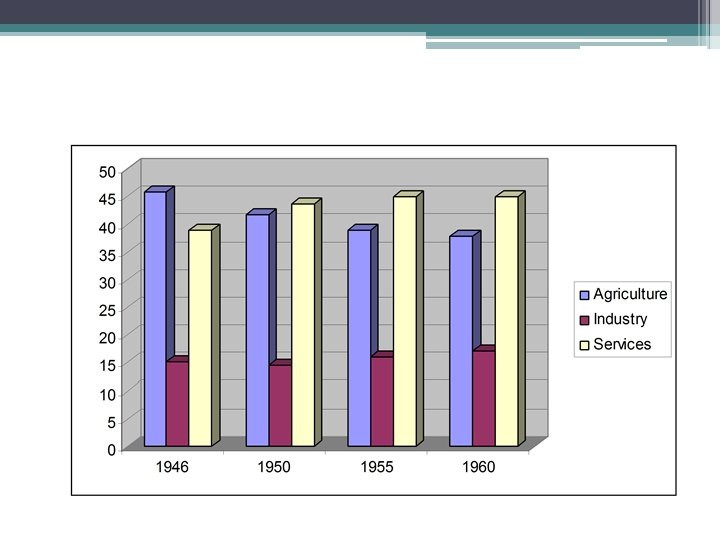
 Services • • Rapid expansion Migration from rural areas to urban areas Highest share in national income: 46% Trade, transportation, construction
 Labor Force • Number of workers increased • Population increase (from 19 million to 27, 5 million) • Urbanization ▫ Increased tractor usage ▫ Housing (squatter’s house; shanty) ▫ Transportation (dolmuş) • Ministry of Labour • İş ve İşçi Bulma Kurumu
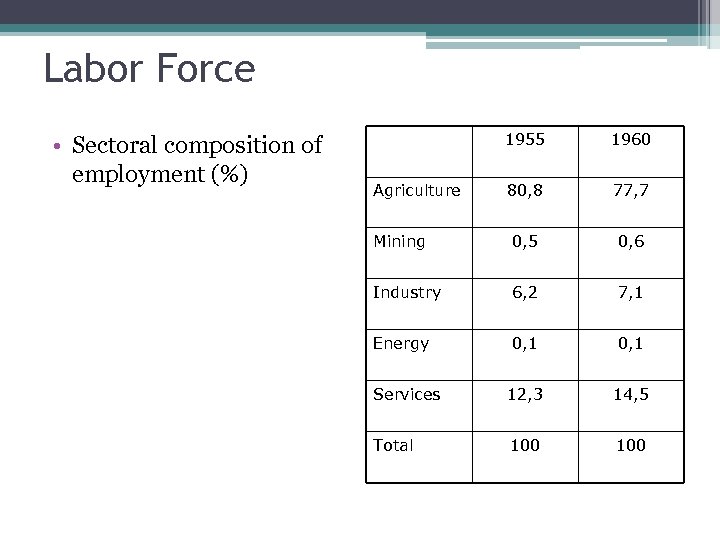 Labor Force • Sectoral composition of employment (%) 1955 1960 80, 8 77, 7 Mining 0, 5 0, 6 Industry 6, 2 7, 1 Energy 0, 1 Services 12, 3 14, 5 Total 100 Agriculture
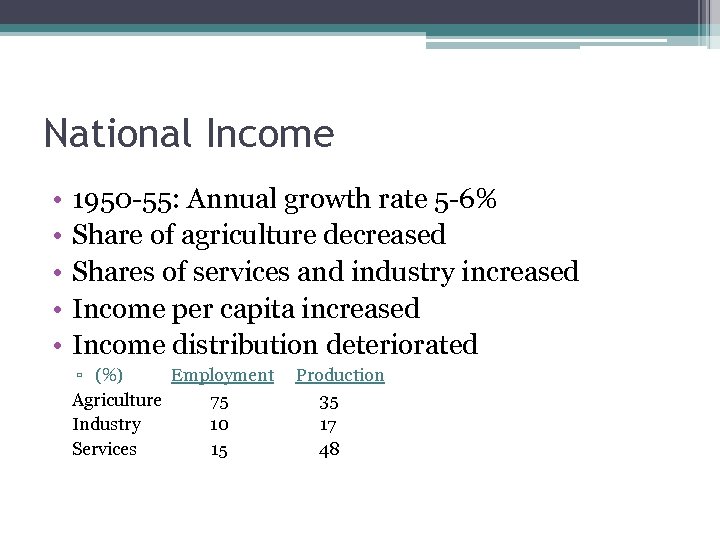 National Income • • • 1950 55: Annual growth rate 5 6% Share of agriculture decreased Shares of services and industry increased Income per capita increased Income distribution deteriorated ▫ (%) Employment Production Agriculture 75 35 Industry 10 17 Services 15 48
 National Income • Consumption increased and consumption patterns changed ▫ Demand shifted from non durable consumption goods to durable consumption goods ▫ Conspicuous consumption • Black markets
 Thorstein Veblen (1857 -1929) (Ekelund, R. And R. Hebert, A History of Economic Theory and Method, Mc. Graw-Hill International Editions, 1990. ) ▫ Theory of the Leisure Class (1899) ▫ American Institutional Economics ▫ Conspicuous Consumption: A person’s status is determined by how well his or her holdings square with those of an immediate peer group and with the group immediately above the person PRODUCTIVE WORK becomes a mark of infirmity and LEISURE becomes evidence of pecuniary strenght. Thus a leisure class emerges in all stages of culture, but its ultimate expression takes place in a quasi peaceable stage of society.
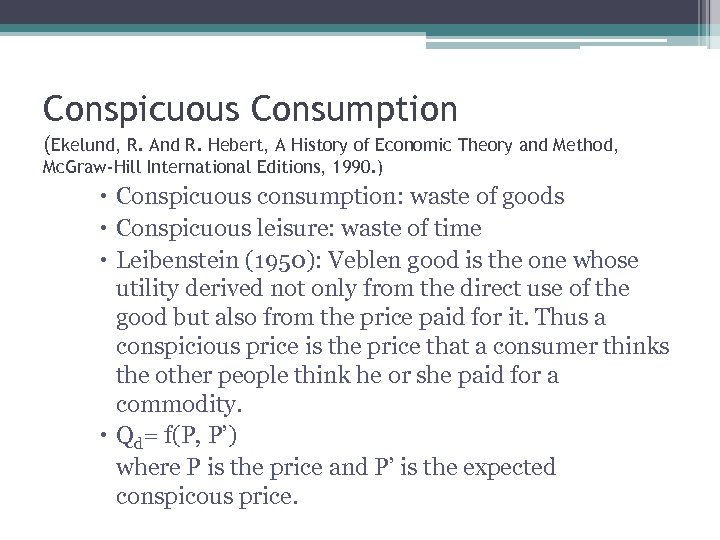 Conspicuous Consumption (Ekelund, R. And R. Hebert, A History of Economic Theory and Method, Mc. Graw-Hill International Editions, 1990. ) Conspicuous consumption: waste of goods Conspicuous leisure: waste of time Leibenstein (1950): Veblen good is the one whose utility derived not only from the direct use of the good but also from the price paid for it. Thus a conspicious price is the price that a consumer thinks the other people think he or she paid for a commodity. Qd= f(P, P’) where P is the price and P’ is the expected conspicous price.
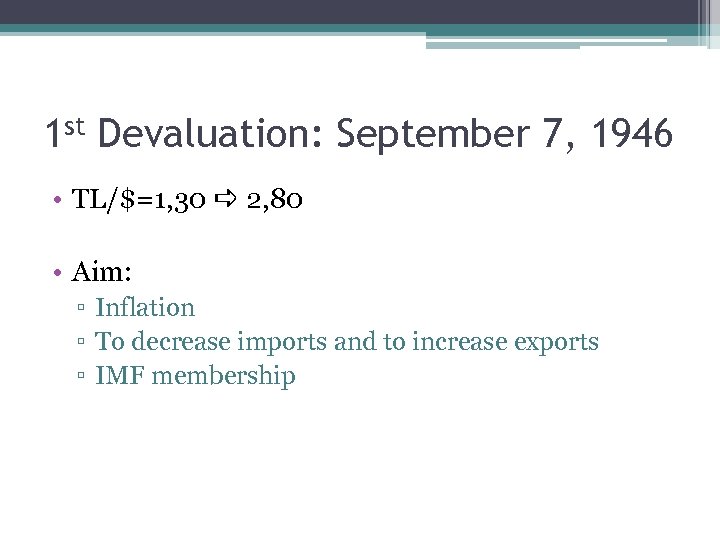 1 st Devaluation: September 7, 1946 • TL/$=1, 30 2, 80 • Aim: ▫ Inflation ▫ To decrease imports and to increase exports ▫ IMF membership
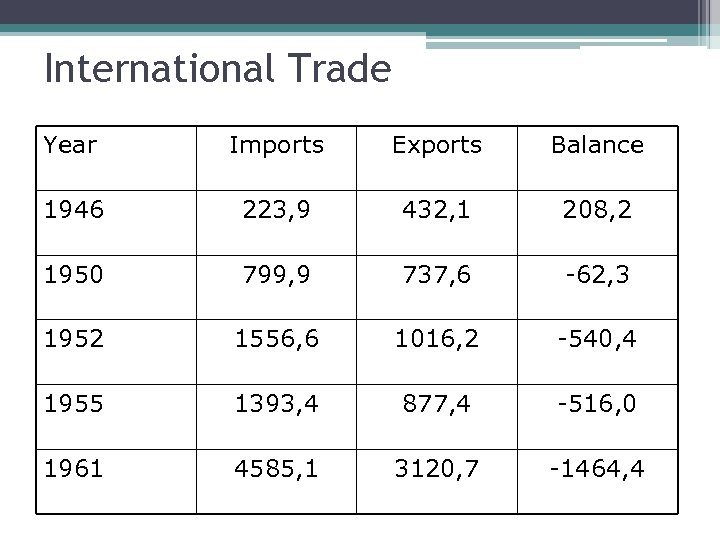 International Trade Year Imports Exports Balance 1946 223, 9 432, 1 208, 2 1950 799, 9 737, 6 -62, 3 1952 1556, 6 1016, 2 -540, 4 1955 1393, 4 877, 4 -516, 0 1961 4585, 1 3120, 7 -1464, 4
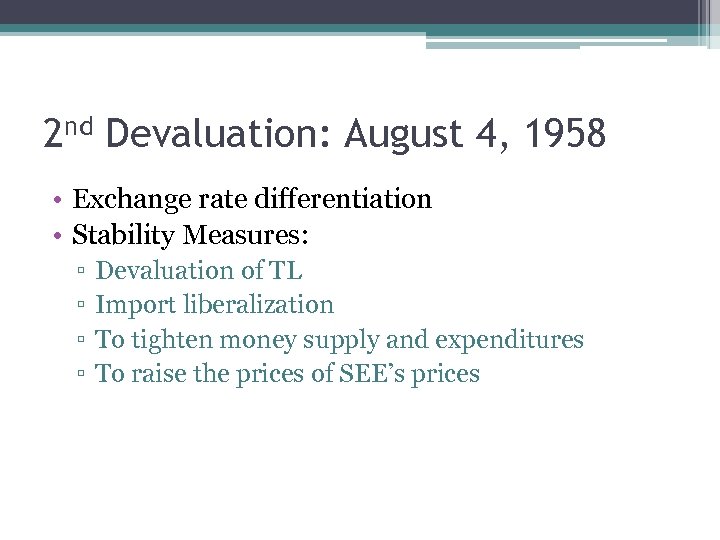 2 nd Devaluation: August 4, 1958 • Exchange rate differentiation • Stability Measures: ▫ ▫ Devaluation of TL Import liberalization To tighten money supply and expenditures To raise the prices of SEE’s prices
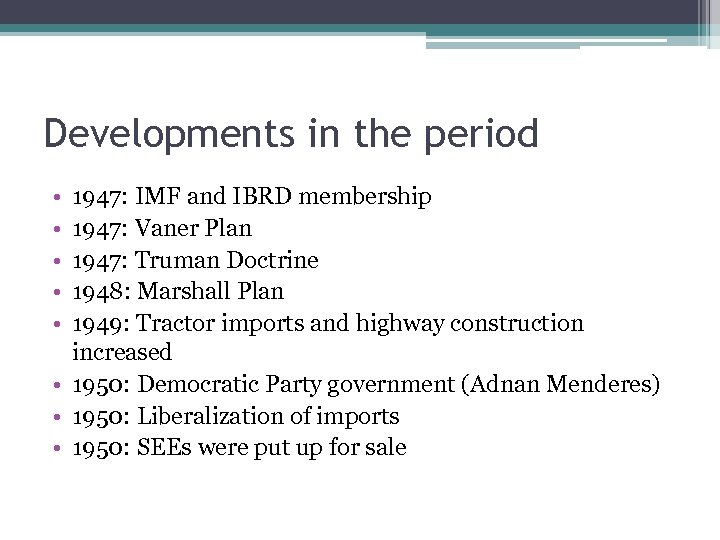 Developments in the period • • • 1947: IMF and IBRD membership 1947: Vaner Plan 1947: Truman Doctrine 1948: Marshall Plan 1949: Tractor imports and highway construction increased • 1950: Democratic Party government (Adnan Menderes) • 1950: Liberalization of imports • 1950: SEEs were put up for sale
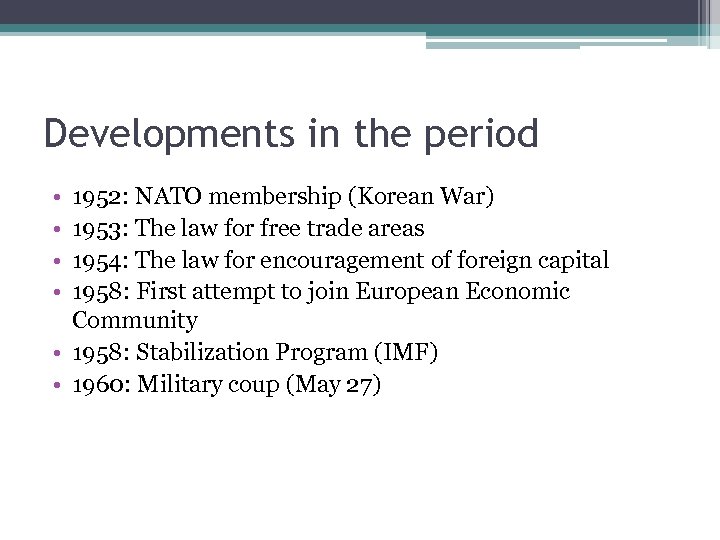 Developments in the period • • 1952: NATO membership (Korean War) 1953: The law for free trade areas 1954: The law for encouragement of foreign capital 1958: First attempt to join European Economic Community • 1958: Stabilization Program (IMF) • 1960: Military coup (May 27)