


 Скачать презентацию TURCK RFID for industrial Applications 1 -Team Walter
7341ac9467055e3256b6468149d23d83.ppt
- Количество слайдов: 44
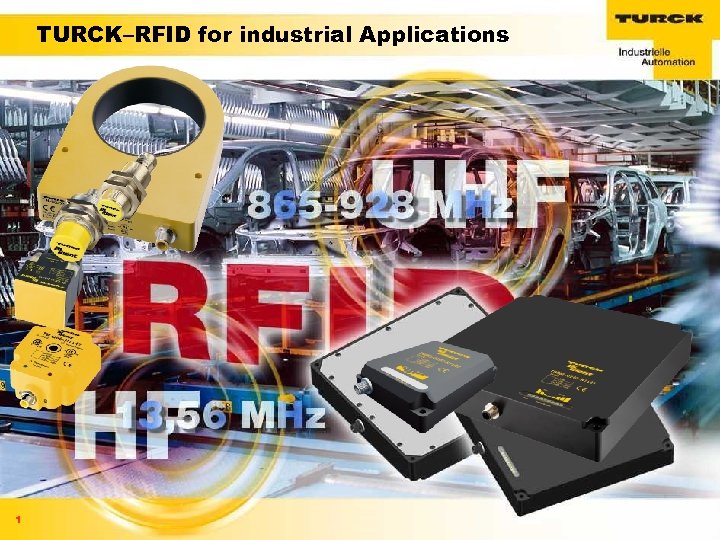 TURCK–RFID for industrial Applications 1
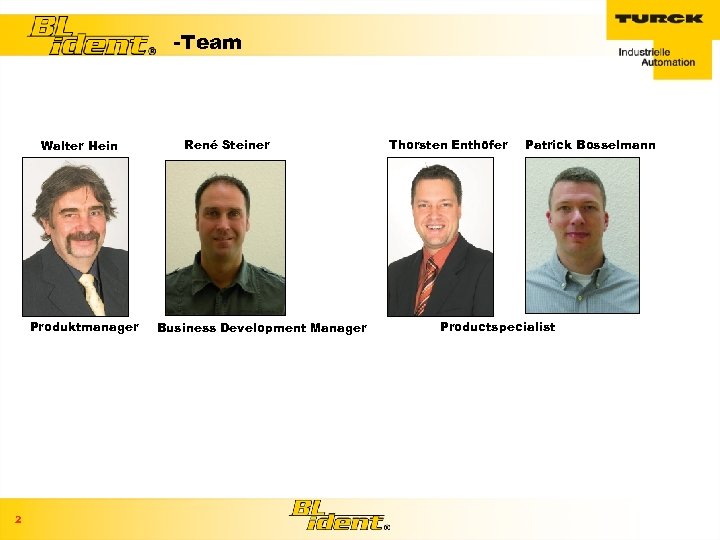 -Team Walter Hein Produktmanager 2 René Steiner Business Development Manager Thorsten Enthöfer Patrick Bosselmann Productspecialist
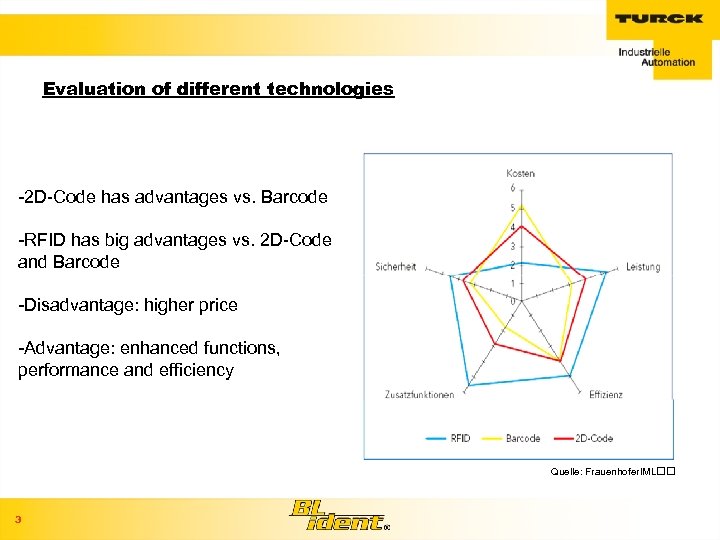 Evaluation of different technologies -2 D-Code has advantages vs. Barcode -RFID has big advantages vs. 2 D-Code and Barcode -Disadvantage: higher price -Advantage: enhanced functions, performance and efficiency Quelle: Frauenhofer. IML 3
 General advantages of RFID • Long life span in continous use and almost maintenance-free readers and/or tags • transponders can be used also into rough environments (water, dirt, dust)/ depending to frequency • Line of sight connection is not necessary, the identification is working also through doors, walls, glass and such a thing. With metallic articles special conditions have to be considered • The identification system can hardly be manipulated • RFID systems can be rewritten and reprogrammed, in order to the new application 4
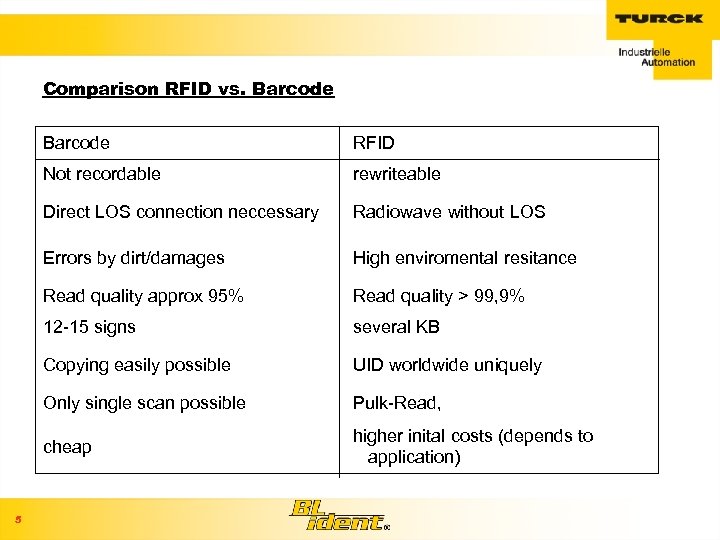 Comparison RFID vs. Barcode Not recordable rewriteable Direct LOS connection neccessary Radiowave without LOS Errors by dirt/damages High enviromental resitance Read quality approx 95% Read quality > 99, 9% 12 -15 signs several KB Copying easily possible UID worldwide uniquely Only single scan possible Pulk-Read, cheap 5 RFID higher inital costs (depends to application)
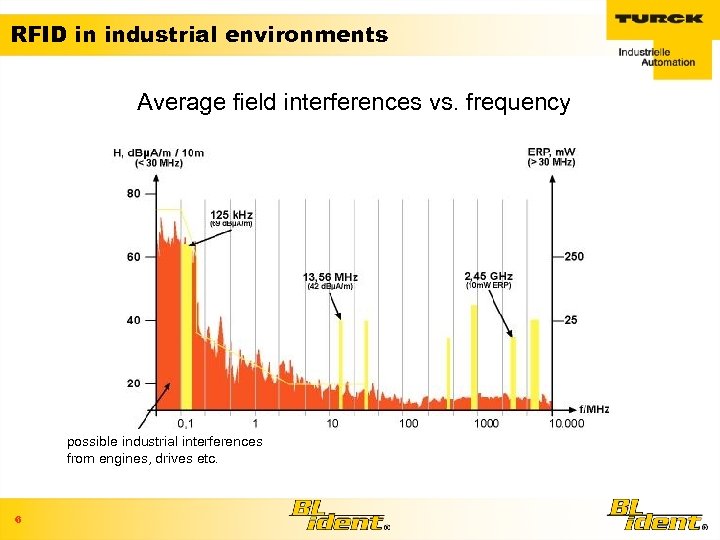 RFID in industrial environments Average field interferences vs. frequency possible industrial interferences from engines, drives etc. 6
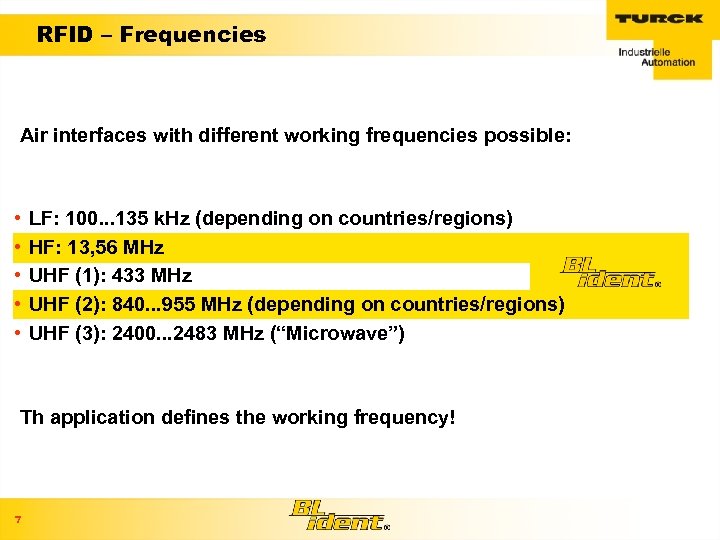 RFID – Frequencies Air interfaces with different working frequencies possible: • • • LF: 100. . . 135 k. Hz (depending on countries/regions) HF: 13, 56 MHz UHF (1): 433 MHz UHF (2): 840. . . 955 MHz (depending on countries/regions) UHF (3): 2400. . . 2483 MHz (“Microwave”) Th application defines the working frequency! 7
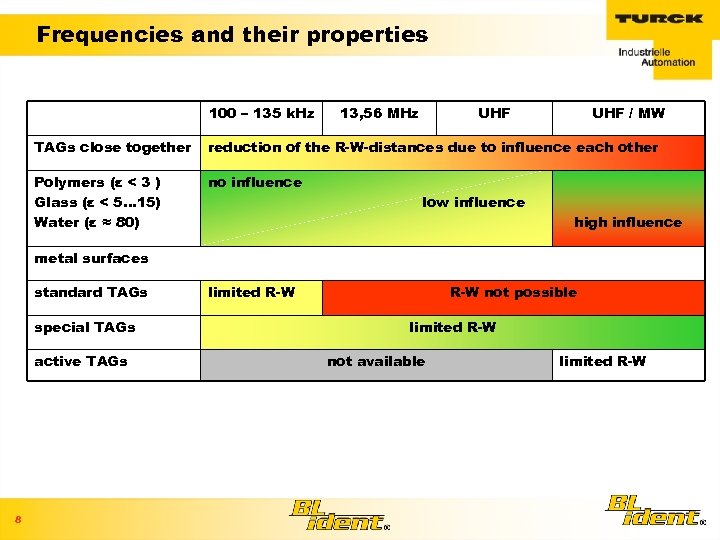 Frequencies and their properties 100 – 135 k. Hz 13, 56 MHz UHF / MW TAGs close together reduction of the R-W-distances due to influence each other Polymers (ε < 3 ) Glass (ε < 5… 15) Water (ε ≈ 80) no influence low influence high influence metal surfaces standard TAGs special TAGs active TAGs 8 limited R-W not possible limited R-W not available limited R-W
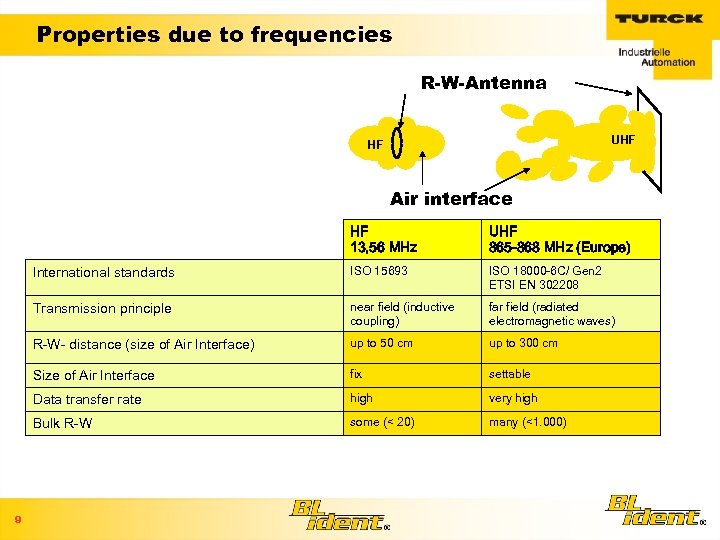 Properties due to frequencies R-W-Antenna UHF HF Air interface HF 13, 56 MHz International standards ISO 15693 ISO 18000 -6 C/ Gen 2 ETSI EN 302208 Transmission principle near field (inductive coupling) far field (radiated electromagnetic waves) R-W- distance (size of Air Interface) up to 50 cm up to 300 cm Size of Air Interface fix settable Data transfer rate high very high Bulk R-W 9 UHF 865 -868 MHz (Europe) some (< 20) many (<1. 000)
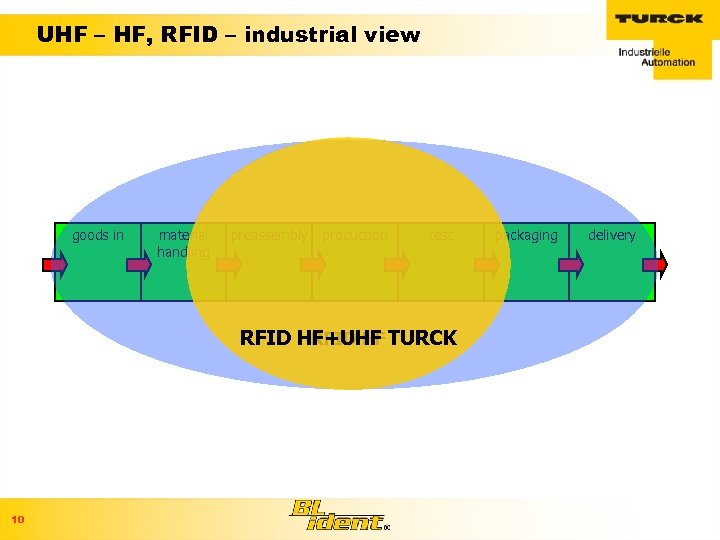 UHF – HF, RFID – industrial view goods in material handling preassembly production test RFID HF+UHF TURCK RFID HF 10 packaging delivery
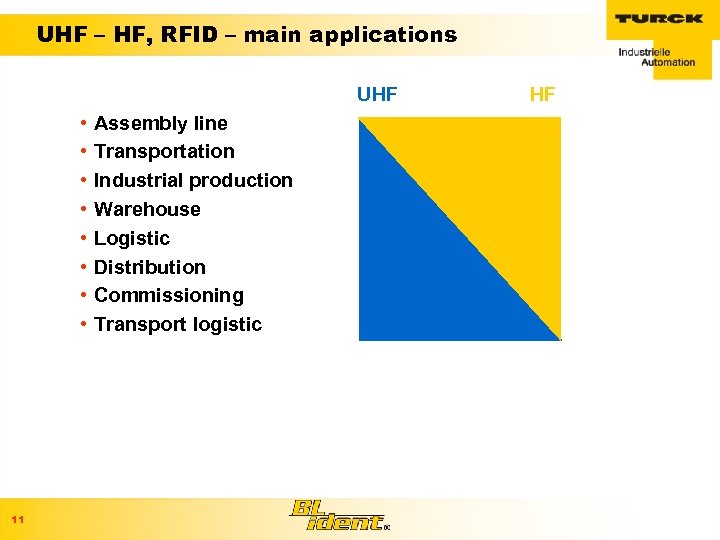 UHF – HF, RFID – main applications UHF • • 11 Assembly line Transportation Industrial production Warehouse Logistic Distribution Commissioning Transport logistic HF
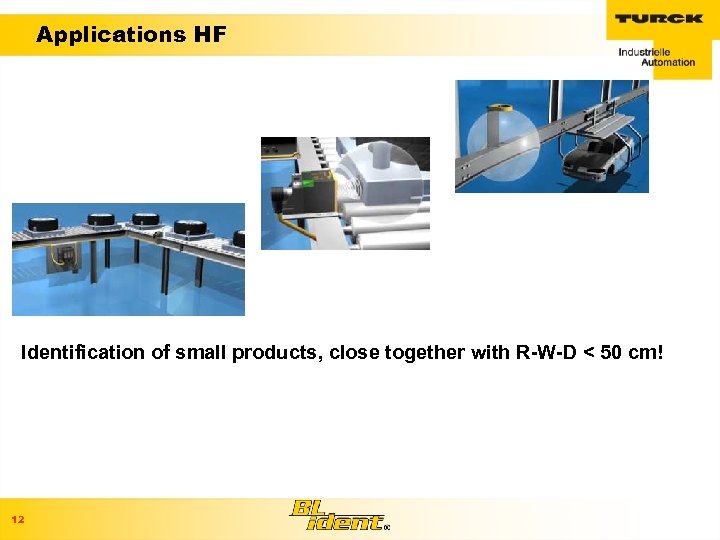 Applications HF Identification of small products, close together with R-W-D < 50 cm! 12
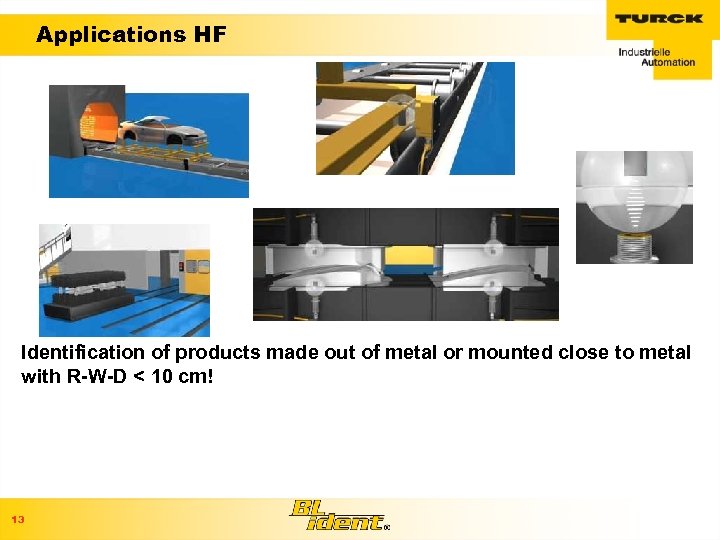 Applications HF Identification of products made out of metal or mounted close to metal with R-W-D < 10 cm! 13
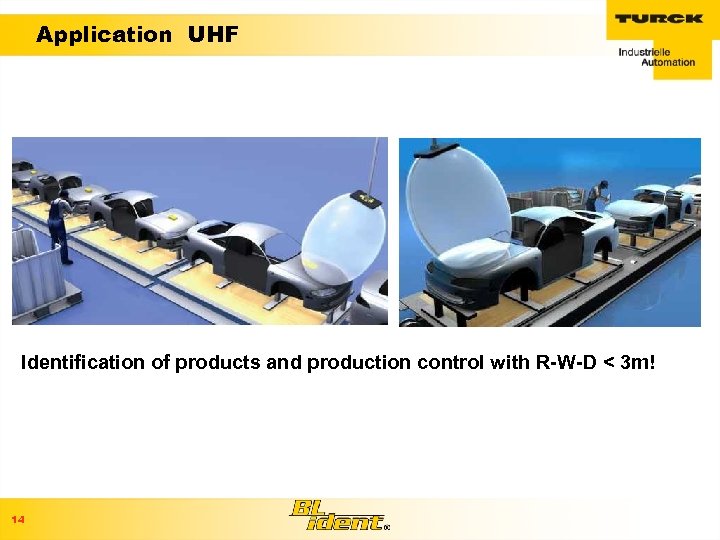 Application UHF Identification of products and production control with R-W-D < 3 m! 14
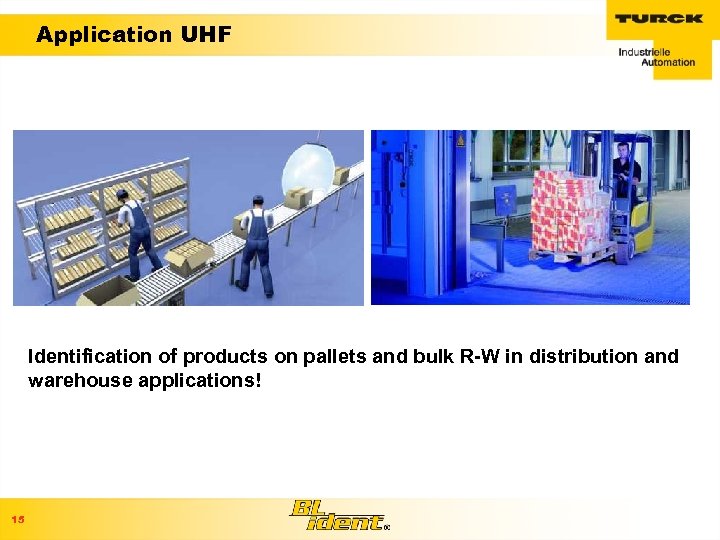 Application UHF Identification of products on pallets and bulk R-W in distribution and warehouse applications! 15
 Target markets of BL-Ident • Industrial automation • Automotive • Transport & Handling • Machine builders • Process automation • Food & Beverage • Pharmacy • Chemistry • Petrochemie 16
 Applications for BL-Ident Divisions: • • 17 Assembly & Handling Transportation Industrial production Commissioning Logistic Distribution Warehouse Goals: • Order controlling • Production controlling • Traceability of products • Marking of tools and carrier • Preventive maintenance • Qualitymanagement • Authentification • Plagiarism protection
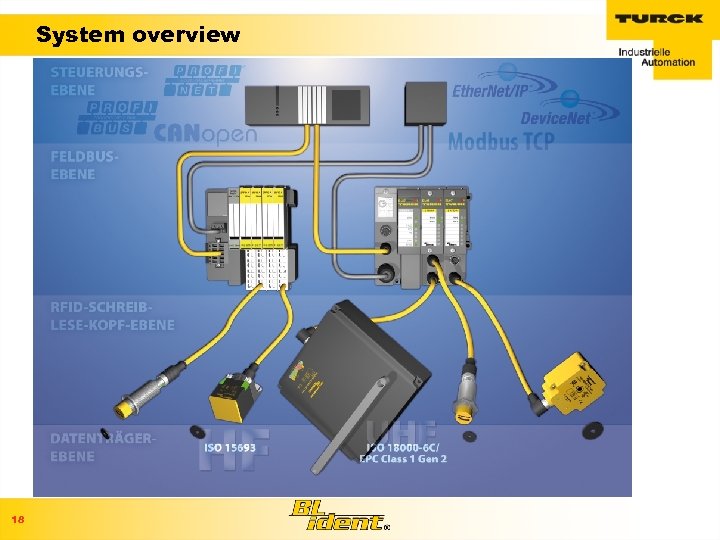 System overview 18
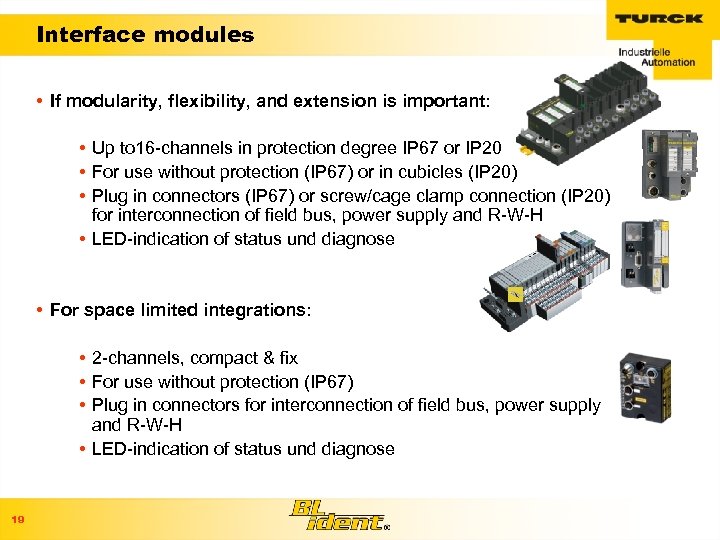 Interface modules • If modularity, flexibility, and extension is important: • Up to 16 -channels in protection degree IP 67 or IP 20 • For use without protection (IP 67) or in cubicles (IP 20) • Plug in connectors (IP 67) or screw/cage clamp connection (IP 20) for interconnection of field bus, power supply and R-W-H • LED-indication of status und diagnose • For space limited integrations: • 2 -channels, compact & fix • For use without protection (IP 67) • Plug in connectors for interconnection of field bus, power supply and R-W-H • LED-indication of status und diagnose 19
 Interface modules • A-Module • 16 k. Byte memory/channel for managing high amount of data • Storage of R-W-Commands in the module to reduce processing time • Use of the by the PNO standardized PIB (Proxy- Ident - Function block) for easy integration in PROFIBUS-DPV 1 networks • Handling of up to 32 k. Byte data • S-Module • For R-W-Commands of up to 8 Bytes / execution, e. g. if only the UID is required • Easy integration in any kind of network because the data are handled as I/O data • Fastest processing time because of minimal complexity 20
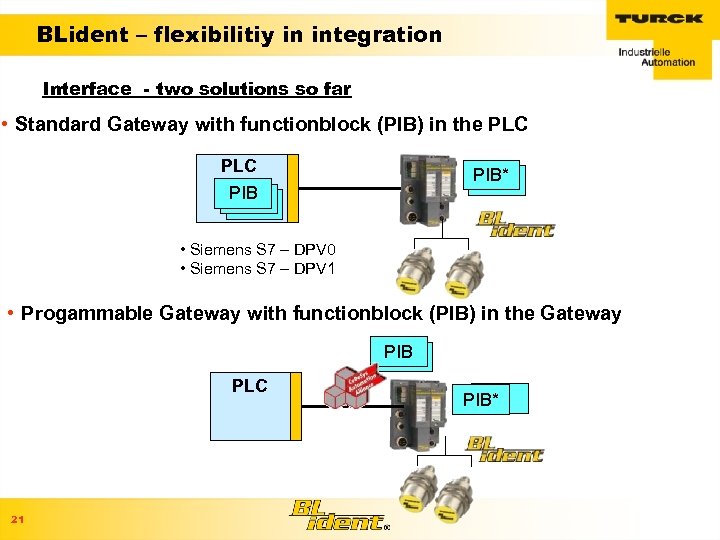 BLident – flexibilitiy in integration Interface - two solutions so far • Standard Gateway with functionblock (PIB) in the PLC PIB* PIB • Siemens S 7 – DPV 0 • Siemens S 7 – DPV 1 • Progammable Gateway with functionblock (PIB) in the Gateway PIB PLC 21 PIB*
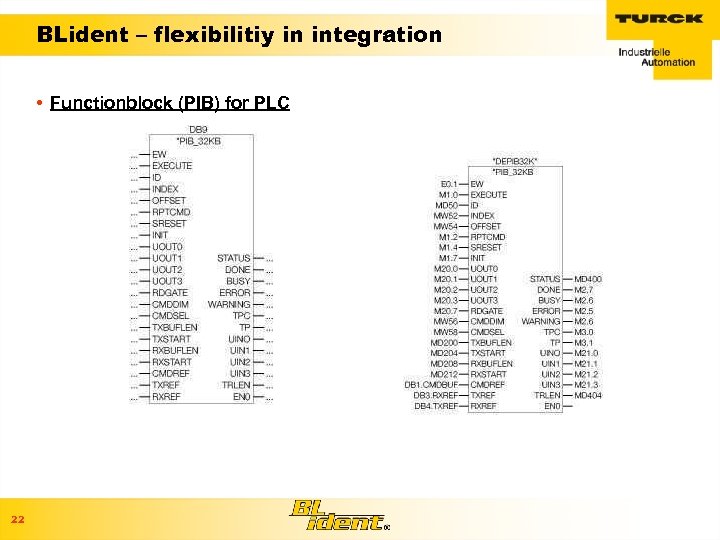 BLident – flexibilitiy in integration • Functionblock (PIB) for PLC 22
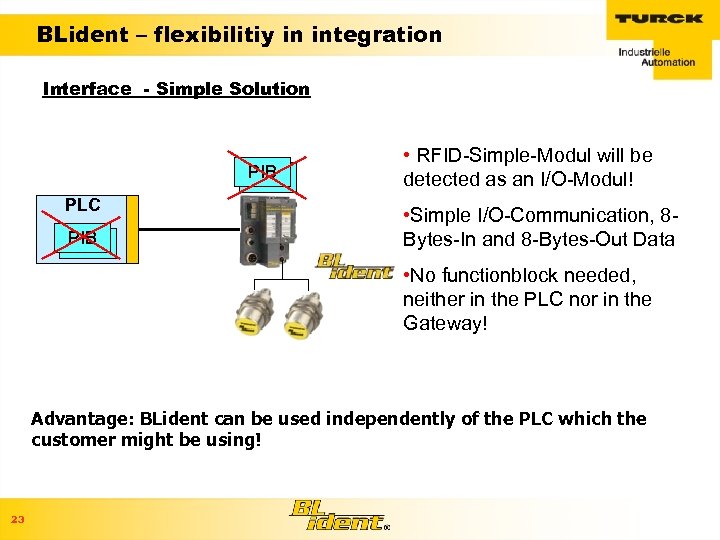 BLident – flexibilitiy in integration Interface - Simple Solution PIB PLC PIB • RFID-Simple-Modul will be detected as an I/O-Modul! • Simple I/O-Communication, 8 Bytes-In and 8 -Bytes-Out Data • No functionblock needed, neither in the PLC nor in the Gateway! Advantage: BLident can be used independently of the PLC which the customer might be using! 23
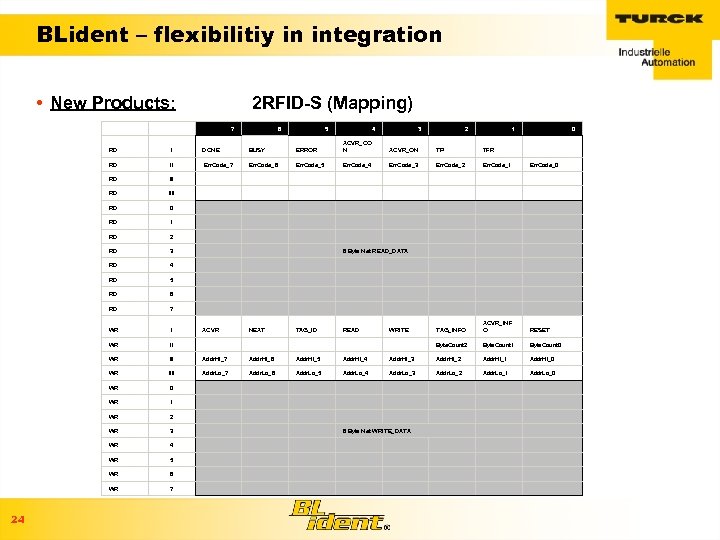 BLident – flexibilitiy in integration • New Products: 2 RFID-S (Mapping) 7 6 5 4 3 2 1 0 RD DONE BUSY ERROR XCVR_CO N XCVR_ON TP TFR RD ii Err. Code_7 Err. Code_6 Err. Code_5 Err. Code_4 Err. Code_3 Err. Code_2 Err. Code_1 RD iiii RD 0 RD 1 RD 2 RD 3 8 Byte Net READ_DATA RD 4 RD 5 RD 6 RD 7 WR i XCVR NEXT TAG_ID READ WRITE TAG_INFO XCVR_INF O RESET WR ii Byte. Count 2 Byte. Count 1 Byte. Count 0 WR iii Addr. Hi_7 Addr. Hi_6 Addr. Hi_5 Addr. Hi_4 Addr. Hi_3 Addr. Hi_2 Addr. Hi_1 Addr. Hi_0 WR iiii Addr. Lo_7 Addr. Lo_6 Addr. Lo_5 Addr. Lo_4 Addr. Lo_3 Addr. Lo_2 Addr. Lo_1 Addr. Lo_0 WR 0 WR 1 WR 2 WR 3 8 Byte Net WRITE_DATA WR 4 WR 5 WR 6 WR 24 i 7 Err. Code_0
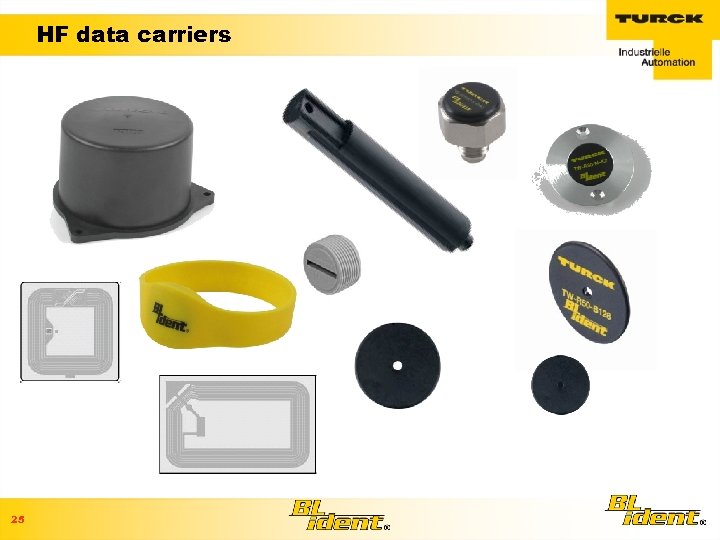 HF data carriers 25
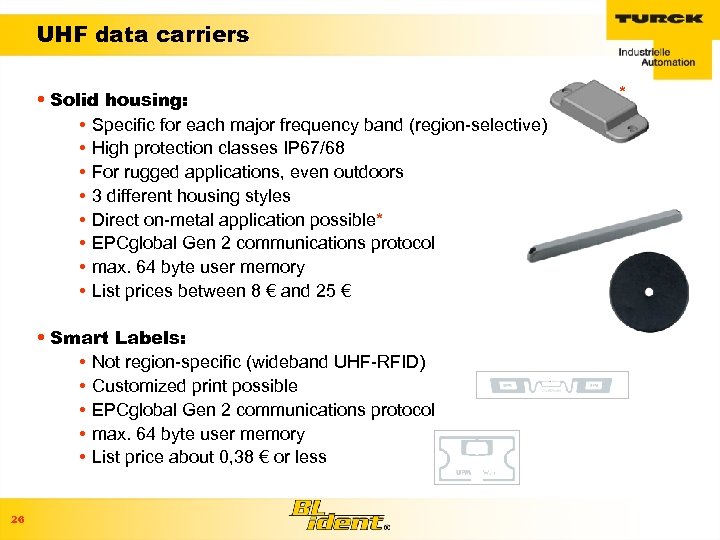 UHF data carriers • Solid housing: • Specific for each major frequency band (region-selective) • High protection classes IP 67/68 • For rugged applications, even outdoors • 3 different housing styles • Direct on-metal application possible* • EPCglobal Gen 2 communications protocol • max. 64 byte user memory • List prices between 8 € and 25 € • Smart Labels: • Not region-specific (wideband UHF-RFID) • Customized print possible • EPCglobal Gen 2 communications protocol • max. 64 byte user memory • List price about 0, 38 € or less 26 *
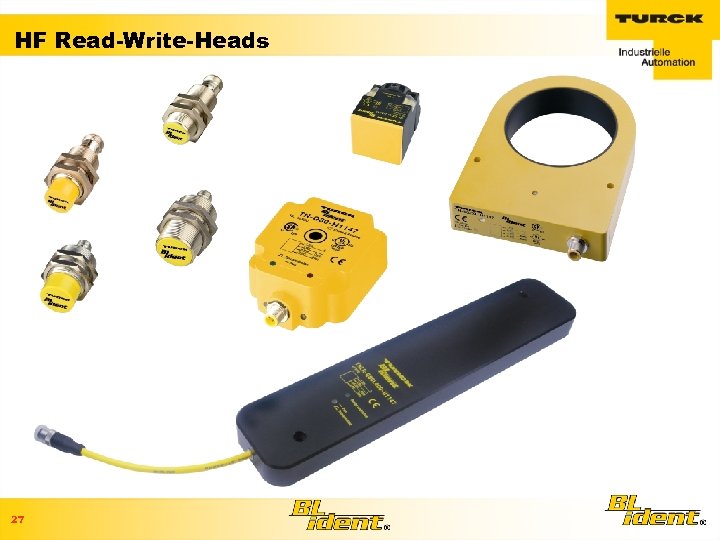 HF Read-Write-Heads 27
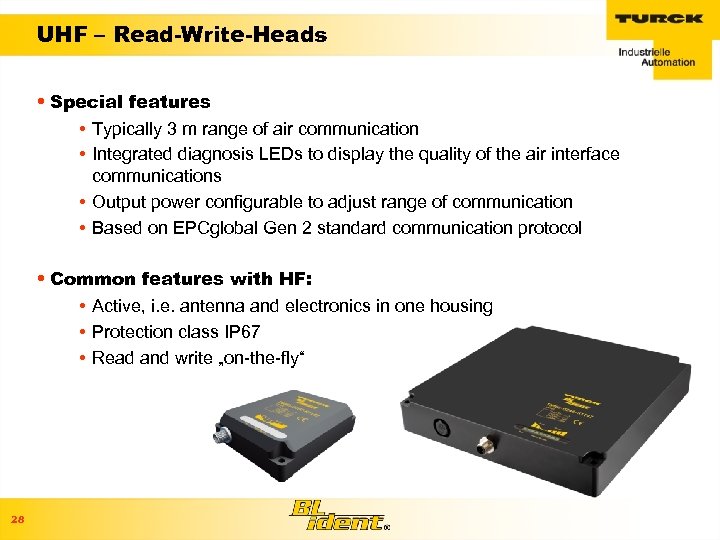 UHF – Read-Write-Heads • Special features • Typically 3 m range of air communication • Integrated diagnosis LEDs to display the quality of the air interface communications • Output power configurable to adjust range of communication • Based on EPCglobal Gen 2 standard communication protocol • Common features with HF: • Active, i. e. antenna and electronics in one housing • Protection class IP 67 • Read and write „on-the-fly“ 28
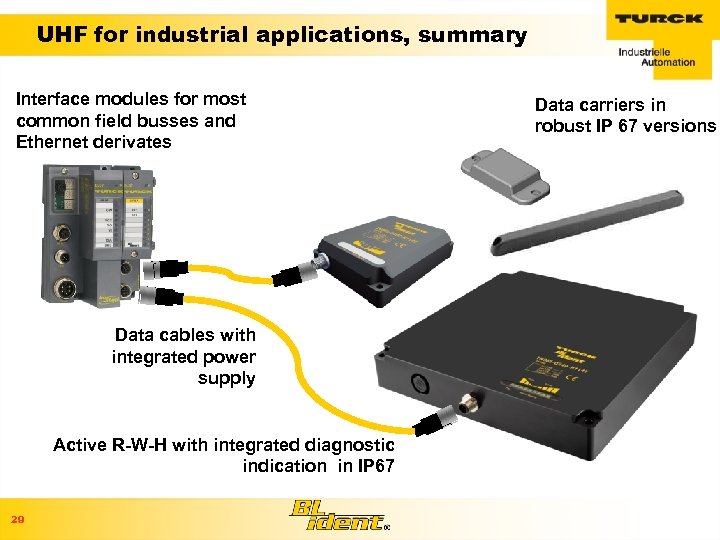 UHF for industrial applications, summary Interface modules for most common field busses and Ethernet derivates Data cables with integrated power supply Active R-W-H with integrated diagnostic indication in IP 67 29 Data carriers in robust IP 67 versions
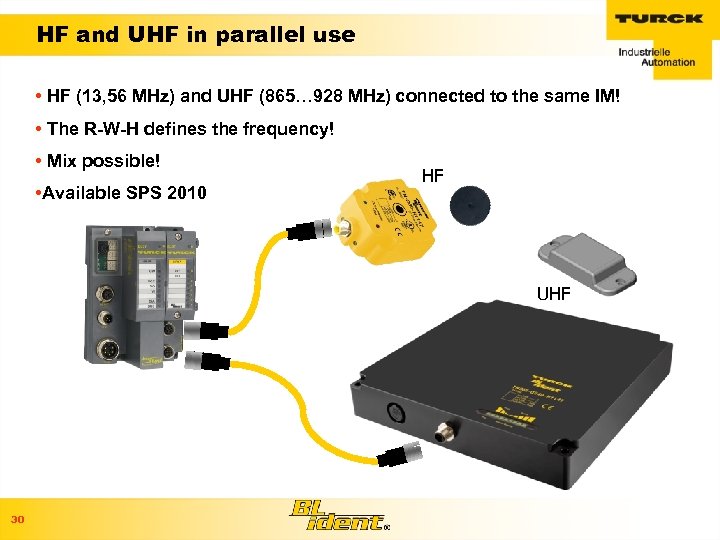 HF and UHF in parallel use • HF (13, 56 MHz) and UHF (865… 928 MHz) connected to the same IM! • The R-W-H defines the frequency! • Mix possible! • Available SPS 2010 HF UHF 30
 Summary system properties • Robust, safe, and trouble-free function • By degree of protection IP 67 and active antennas • Safe investment and interoperable • By using the Standards ISO 15693 (HF) and ISO 18000 -6 C/Gen 2 (UHF) • Simple integration and extension by modularity • Up to 16 -channel interfaces • Flexibility by mixing HF and UHF • one interface module for both frequencies • High variety of interfaces resulting in easy integration • PROFIBUS-DP, Device. Net, CANopen, Ethernet Modbus-TCP, PROFINET IO, Ether. Net/IP • Fast processing • By programmable Gateways with SPS-Funktionality • Easy extension to Remote I/O • By adding I/O and interface moduls 31
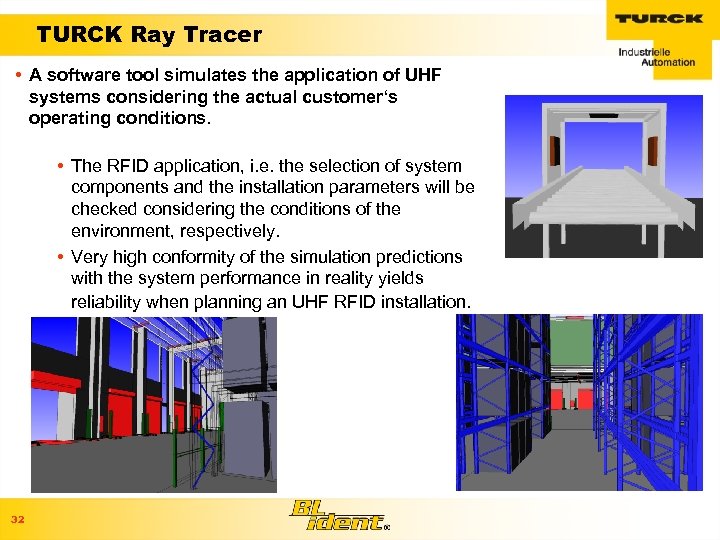 TURCK Ray Tracer • A software tool simulates the application of UHF systems considering the actual customer‘s operating conditions. • The RFID application, i. e. the selection of system components and the installation parameters will be checked considering the conditions of the environment, respectively. • Very high conformity of the simulation predictions with the system performance in reality yields reliability when planning an UHF RFID installation. 32
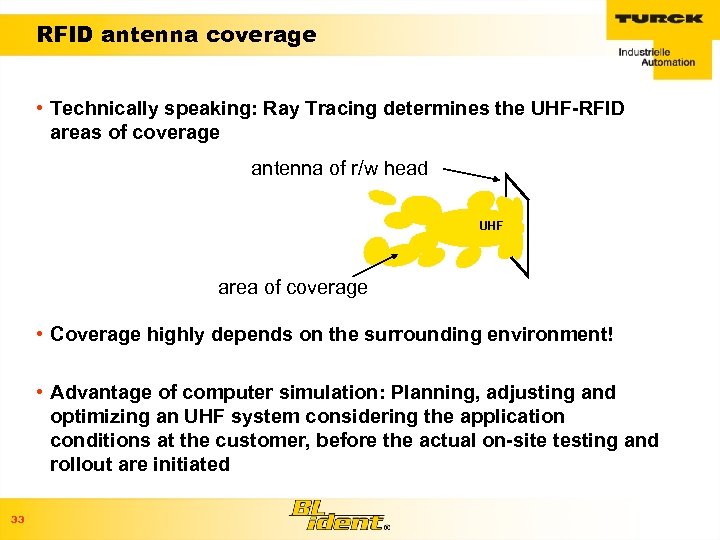 RFID antenna coverage • Technically speaking: Ray Tracing determines the UHF-RFID areas of coverage antenna of r/w head UHF area of coverage • Coverage highly depends on the surrounding environment! • Advantage of computer simulation: Planning, adjusting and optimizing an UHF system considering the application conditions at the customer, before the actual on-site testing and rollout are initiated 33
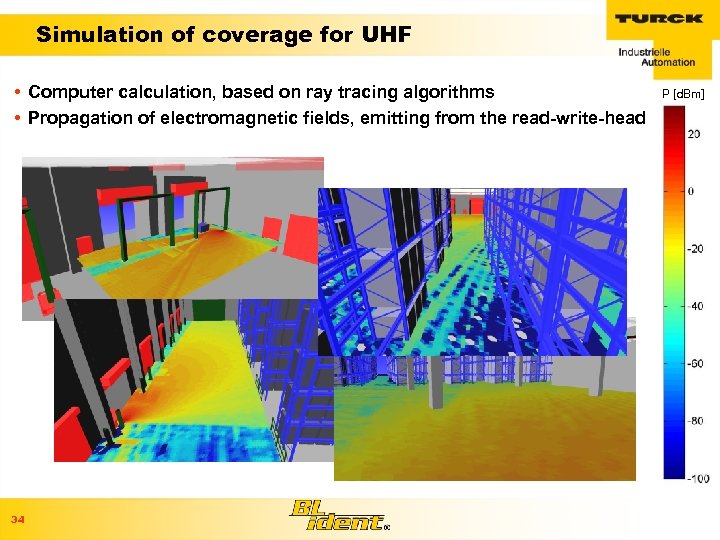 Simulation of coverage for UHF • Computer calculation, based on ray tracing algorithms • Propagation of electromagnetic fields, emitting from the read-write-head 34 P [d. Bm]
![Simulation of coverage for UHF P [d. Bm] • The size and area of](https://present5.com/presentation/7341ac9467055e3256b6468149d23d83/image-35.jpg "Simulation of coverage for UHF P [d. Bm] • The size and area of") Simulation of coverage for UHF P [d. Bm] • The size and area of coverage of the RFID transmission zone depend from obstacles in the environment and the properties of the read-write-head and the tag. • Advantage: Adjusting and configuring the UHF system to onsite application conditions prior to roll-out. 35
Simulation of coverage for UHF P [d. Bm] • The size and area of coverage of the RFID transmission zone depend from obstacles in the environment and the properties of the read-write-head and the tag. • Advantage: Adjusting and configuring the UHF system to onsite application conditions prior to roll-out. 35
 TURCK Ray Tracer • Operation of the software will be limited to trained TURCK personnel only. • Decentralized operation in different TURCK braches desired to support UHF system integrations close to on-location. • Central coordination, software maintenance and updates from TURCK Mülheim. • Plans for further development of Ray Tracer for easier use. 36
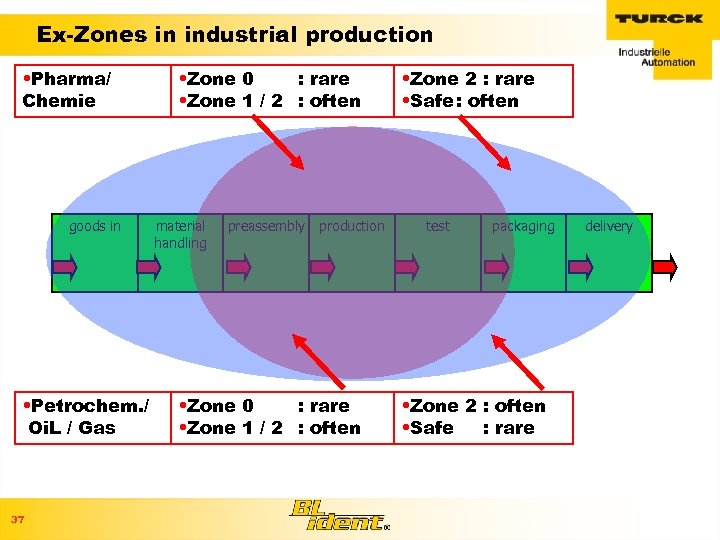 Ex-Zones in industrial production • Pharma/ Chemie goods in • Petrochem. / Oi. L / Gas 37 • Zone 0 : rare • Zone 1 / 2 : often material handling preassembly production • Zone 0 : rare • Zone 1 / 2 : often • Zone 2 : rare • Safe: often test packaging • Zone 2 : often • Safe : rare delivery
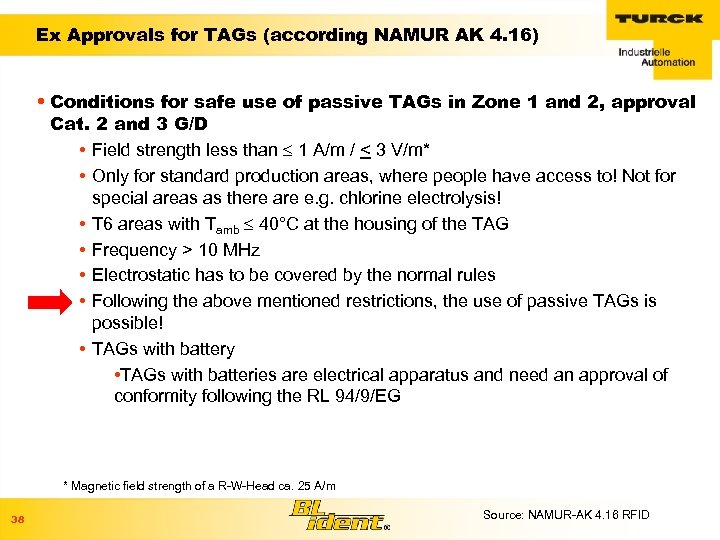 Ex Approvals for TAGs (according NAMUR AK 4. 16) • Conditions for safe use of passive TAGs in Zone 1 and 2, approval Cat. 2 and 3 G/D • Field strength less than 1 A/m / < 3 V/m* • Only for standard production areas, where people have access to! Not for special areas as there are e. g. chlorine electrolysis! • T 6 areas with Tamb 40°C at the housing of the TAG • Frequency > 10 MHz • Electrostatic has to be covered by the normal rules • Following the above mentioned restrictions, the use of passive TAGs is possible! • TAGs with battery • TAGs with batteries are electrical apparatus and need an approval of conformity following the RL 94/9/EG * Magnetic field strength of a R-W-Head ca. 25 A/m 38 Source: NAMUR-AK 4. 16 RFID
 Ex Approvals for Interface Modules & S-L-Heads • Interface Modules and R-W-Heads are electrical apparatus and need an approval of conformity following the RL 94/9/EG • This can e. g. be done by • Intrinsic safety „EEx i“ • Explosion proof „EEx d“ • Encapsulation „EEx m“, etc. 39
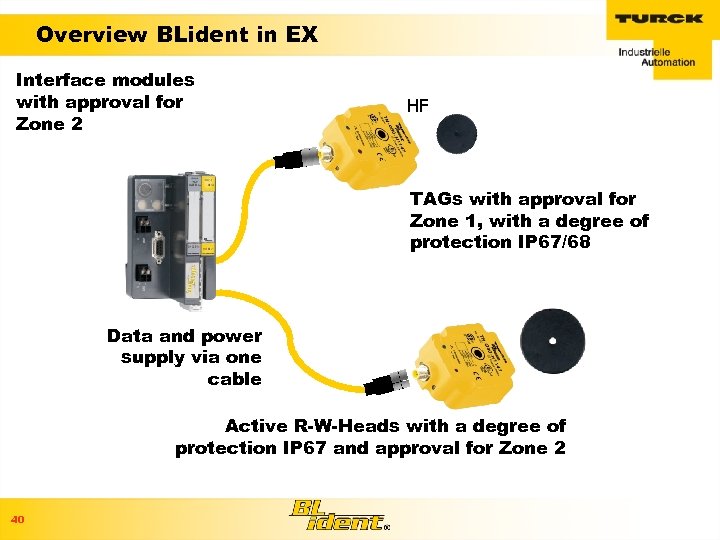 Overview BLident in EX Interface modules with approval for Zone 2 HF TAGs with approval for Zone 1, with a degree of protection IP 67/68 Data and power supply via one cable Active R-W-Heads with a degree of protection IP 67 and approval for Zone 2 40
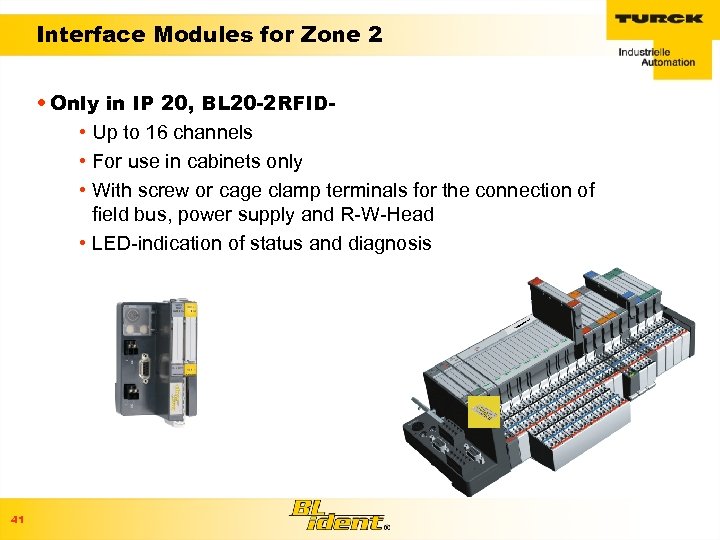 Interface Modules for Zone 2 • Only in IP 20, BL 20 -2 RFID • Up to 16 channels • For use in cabinets only • With screw or cage clamp terminals for the connection of field bus, power supply and R-W-Head • LED-indication of status and diagnosis 41
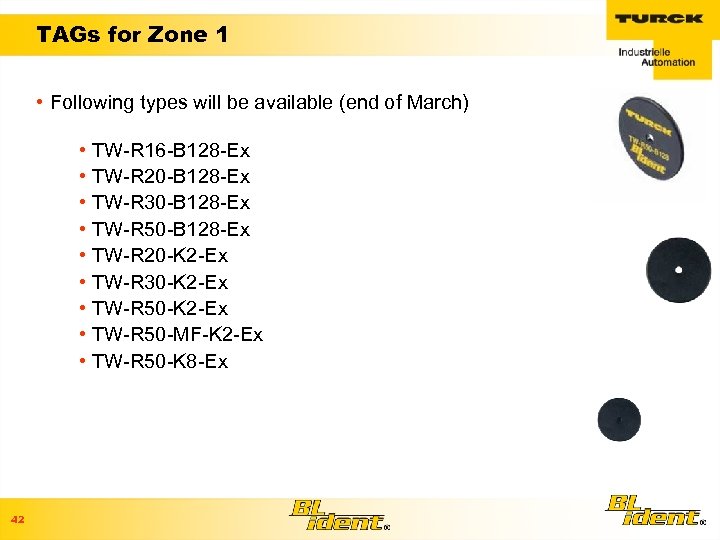 TAGs for Zone 1 • Following types will be available (end of March) • • • 42 TW-R 16 -B 128 -Ex TW-R 20 -B 128 -Ex TW-R 30 -B 128 -Ex TW-R 50 -B 128 -Ex TW-R 20 -K 2 -Ex TW-R 30 -K 2 -Ex TW-R 50 -MF-K 2 -Ex TW-R 50 -K 8 -Ex
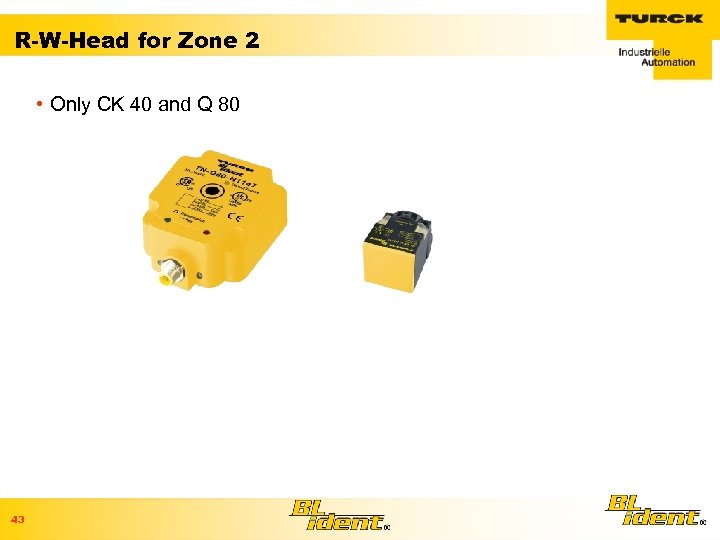 R-W-Head for Zone 2 • Only CK 40 and Q 80 43
 Thank You 44