 Скачать презентацию Turban Aronson and Liang Decision Support Systems and
364ee86b52bee63f4f81bb2d3d791a00.ppt
- Количество слайдов: 46




Turban, Aronson, and Liang Decision Support Systems and Intelligent Systems, Seventh Edition Chapter 11 Knowledge Acquisition, Representation, and Reasoning © 2005 Prentice Hall, Decision Support Systems and Intelligent Systems, 7 th Edition, Turban, Aronson, and Liang 1
Learning Objectives • Understand the nature of knowledge. • Learn the knowledge engineering processes. • Evaluate different approaches for knowledge acquisition. • Examine the pros and cons of different approaches. • Illustrate methods for knowledge verification and validation. • Examine inference strategies. • Understand certainty and uncertainty processing. © 2005 Prentice Hall, Decision Support Systems and Intelligent Systems, 7 th Edition, Turban, Aronson, and Liang 2
Development of a Real-Time Knowledge-Based System at Eli Lilly Vignette • Problems with fermentation process – Quality parameters difficult to control – Many different employees doing same task – High turnover • Expert system used to capture knowledge – Expertise available 24 hours a day • Knowledge engineers developed system by: – Knowledge elicitation • Interviewing experts and creating knowledge bases – Knowledge fusion • Fusing individual knowledge bases – Coding knowledge base – Testing and evaluation of system © 2005 Prentice Hall, Decision Support Systems and Intelligent Systems, 7 th Edition, Turban, Aronson, and Liang 3

Knowledge Engineering • Process of acquiring knowledge from experts and building knowledge base – Narrow perspective • Knowledge acquisition, representation, validation, inference, maintenance – Broad perspective • Process of developing and maintaining intelligent system © 2005 Prentice Hall, Decision Support Systems and Intelligent Systems, 7 th Edition, Turban, Aronson, and Liang 4

Knowledge Engineering Process • Acquisition of knowledge – General knowledge or metaknowledge – From experts, books, documents, sensors, files • Knowledge representation – Organized knowledge • Knowledge validation and verification • Inferences – Software designed to pass statistical sample data to generalizations • Explanation and justification capabilities © 2005 Prentice Hall, Decision Support Systems and Intelligent Systems, 7 th Edition, Turban, Aronson, and Liang 5
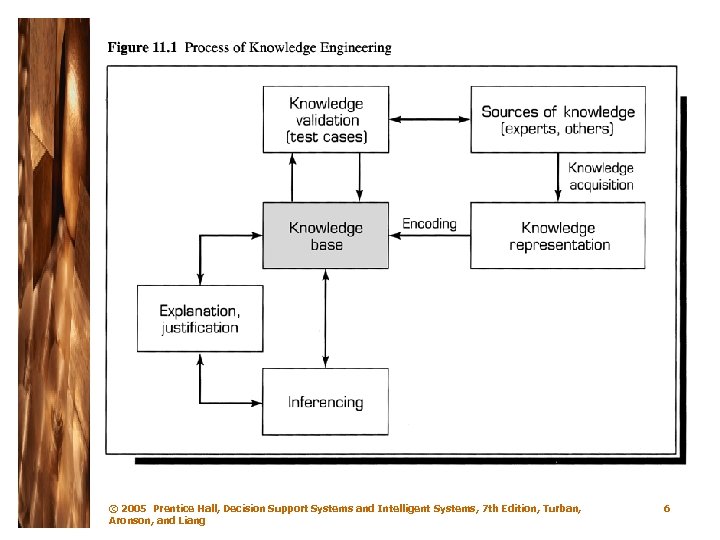
© 2005 Prentice Hall, Decision Support Systems and Intelligent Systems, 7 th Edition, Turban, Aronson, and Liang 6
Knowledge • Sources – Documented • Written, viewed, sensory, behavior – Undocumented • Memory – Acquired from • Human senses • Machines • © 2005 Prentice Hall, Decision Support Systems and Intelligent Systems, 7 th Edition, Turban, Aronson, and Liang 7
Knowledge • Levels – Shallow • Surface level • Input-output – Deep • Problem solving • Difficult to collect, validate • Interactions betwixt system components © 2005 Prentice Hall, Decision Support Systems and Intelligent Systems, 7 th Edition, Turban, Aronson, and Liang 8
Knowledge • Categories – Declarative • Descriptive representation – Procedural • How things work under different circumstances • How to use declarative knowledge – Problem solving – Metaknowledge • Knowledge about knowledge © 2005 Prentice Hall, Decision Support Systems and Intelligent Systems, 7 th Edition, Turban, Aronson, and Liang 9

Knowledge Engineers • Professionals who elicit knowledge from experts – Empathetic, patient – Broad range of understanding, capabilities • Integrate knowledge from various sources – Creates and edits code – Operates tools • Build knowledge base – Validates information – Trains users © 2005 Prentice Hall, Decision Support Systems and Intelligent Systems, 7 th Edition, Turban, Aronson, and Liang 10
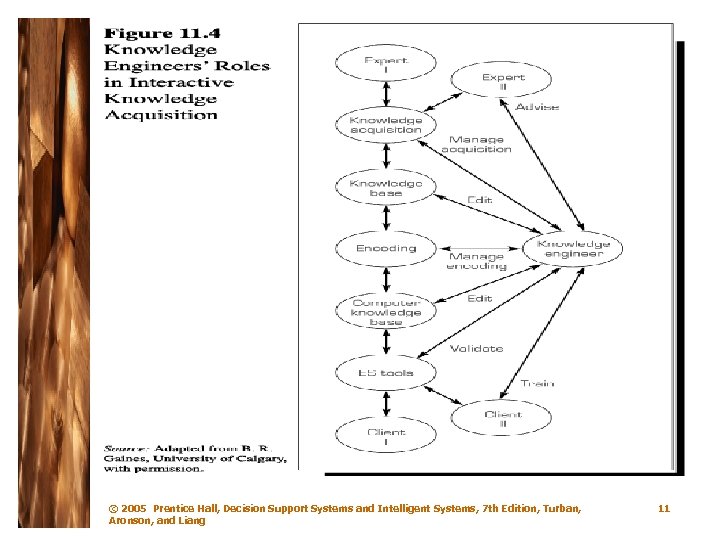
© 2005 Prentice Hall, Decision Support Systems and Intelligent Systems, 7 th Edition, Turban, Aronson, and Liang 11
Elicitation Methods • Manual – Based on interview – Track reasoning process – Observation • Semiautomatic – Build base with minimal help from knowledge engineer – Allows execution of routine tasks with minimal expert input • Automatic – Minimal input from both expert and knowledge engineer © 2005 Prentice Hall, Decision Support Systems and Intelligent Systems, 7 th Edition, Turban, Aronson, and Liang 12
Manual Methods • Interviews – Structured • Goal-oriented • Walk through – Unstructured • Complex domains • Data unrelated and difficult to integrate – Semistructured © 2005 Prentice Hall, Decision Support Systems and Intelligent Systems, 7 th Edition, Turban, Aronson, and Liang 13

Manual Methods • Process tracking – Track reasoning processes • Protocol analysis – Document expert’s decision-making – Think aloud process • Observation – Motor movements – Eye movements © 2005 Prentice Hall, Decision Support Systems and Intelligent Systems, 7 th Edition, Turban, Aronson, and Liang 14
Manual Methods • • • Case analysis Critical incident User discussions Expert commentary Graphs and conceptual models Brainstorming Prototyping Multidimensional scaling for distance matrix Clustering of elements Iterative performance review © 2005 Prentice Hall, Decision Support Systems and Intelligent Systems, 7 th Edition, Turban, Aronson, and Liang 15

Semiautomatic Methods • Repertory grid analysis – Personal construct theory • Organized, perceptual model of expert’s knowledge • Expert identifies domain objects and their attributes • Expert determines characteristics and opposites for each attribute • Expert distinguishes between objects, creating a grid • Expert transfer system – Computer program that elicits information from experts – Rapid prototyping – Used to determine sufficiency of available knowledge © 2005 Prentice Hall, Decision Support Systems and Intelligent Systems, 7 th Edition, Turban, Aronson, and Liang 16
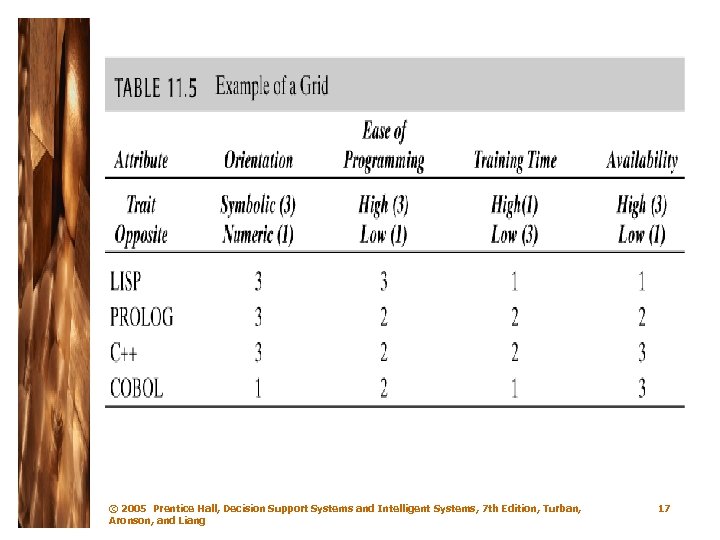
© 2005 Prentice Hall, Decision Support Systems and Intelligent Systems, 7 th Edition, Turban, Aronson, and Liang 17
Semiautomatic Methods, continued • Computer based tools features: – Ability to add knowledge to base – Ability to assess, refine knowledge – Visual modeling for construction of domain – Creation of decision trees and rules – Ability to analyze information flows – Integration tools © 2005 Prentice Hall, Decision Support Systems and Intelligent Systems, 7 th Edition, Turban, Aronson, and Liang 18
Automatic Methods • Data mining by computers • Inductive learning from existing recognized cases • Neural computing mimicking human brain • Genetic algorithms using natural selection © 2005 Prentice Hall, Decision Support Systems and Intelligent Systems, 7 th Edition, Turban, Aronson, and Liang 19
Multiple Experts • Scenarios – Experts contribute individually – Primary expert’s information reviewed by secondary experts – Small group decision – Panels for verification and validation • Approaches – – Consensus methods Analytic approaches Automation of process through software usage Decomposition © 2005 Prentice Hall, Decision Support Systems and Intelligent Systems, 7 th Edition, Turban, Aronson, and Liang 20
Automated Knowledge Acquisition • Induction – Activities • Training set with known outcomes • Creates rules for examples • Assesses new cases – Advantages • Limited application • Builder can be expert – Saves time, money © 2005 Prentice Hall, Decision Support Systems and Intelligent Systems, 7 th Edition, Turban, Aronson, and Liang 21
Automated Knowledge Acquisition – Difficulties • Rules may be difficult to understand • Experts needed to select attributes • Algorithm-based search process produces fewer questions • Rule-based classification problems • Allows few attributes • Many examples needed • Examples must be cleansed • Limited to certainties • Examples may be insufficient © 2005 Prentice Hall, Decision Support Systems and Intelligent Systems, 7 th Edition, Turban, Aronson, and Liang 22

Automated Knowledge Acquisition • Interactive induction – Incrementally induced knowledge • General models – Object Network – Based on interaction with expert • interviews – Computer supported • Induction tables • IF-THEN-ELSE rules © 2005 Prentice Hall, Decision Support Systems and Intelligent Systems, 7 th Edition, Turban, Aronson, and Liang 23

Evaluation, Validation, Verification • Dynamic activities – Evaluation • Assess system’s overall value – Validation • Compares system’s performance to expert’s • Concordance and differences – Verification • Building and implementing system correctly • Can be automated © 2005 Prentice Hall, Decision Support Systems and Intelligent Systems, 7 th Edition, Turban, Aronson, and Liang 24
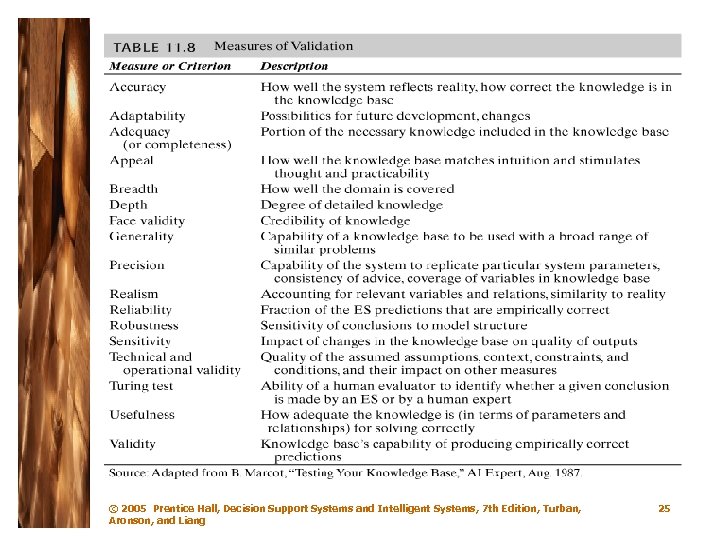
© 2005 Prentice Hall, Decision Support Systems and Intelligent Systems, 7 th Edition, Turban, Aronson, and Liang 25
Production Rules • IF-THEN • Independent part, combined with other pieces, to produce better result • Model of human behavior • Examples – IF condition, THEN conclusion – Conclusion, IF condition – If condition, THEN conclusion 1 (OR) ELSE conclusion 2 © 2005 Prentice Hall, Decision Support Systems and Intelligent Systems, 7 th Edition, Turban, Aronson, and Liang 26

Artificial Intelligence Rules • Types – Knowledge rules • Declares facts and relationships • Stored in knowledge base – Inference • Given facts, advises how to proceed • Part of inference engines • Metarules © 2005 Prentice Hall, Decision Support Systems and Intelligent Systems, 7 th Edition, Turban, Aronson, and Liang 27
Artificial Intelligence Rules • Advantages – – – Easy to understand, modify, maintain Explanations are easy to get. Rules are independent. Modification and maintenance are relatively easy. Uncertainty is easily combined with rules. • Limitations – Huge numbers may be required – Designers may force knowledge into rule-based entities – Systems may have search limitations; difficulties in evaluation © 2005 Prentice Hall, Decision Support Systems and Intelligent Systems, 7 th Edition, Turban, Aronson, and Liang 28
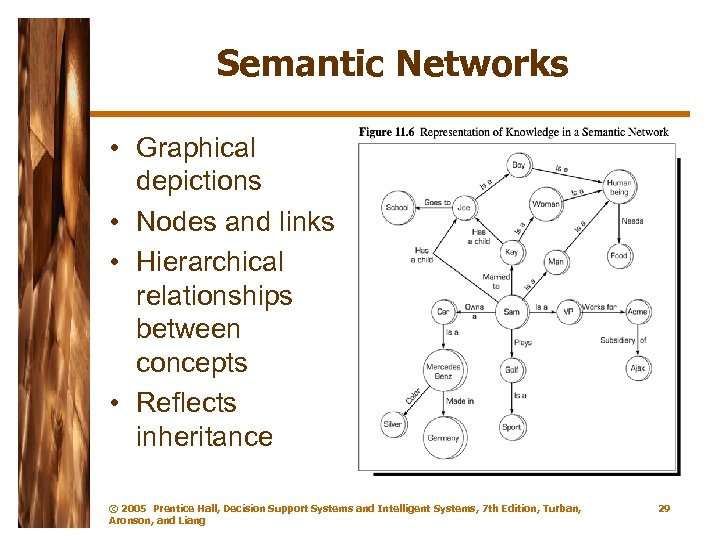
Semantic Networks • Graphical depictions • Nodes and links • Hierarchical relationships between concepts • Reflects inheritance © 2005 Prentice Hall, Decision Support Systems and Intelligent Systems, 7 th Edition, Turban, Aronson, and Liang 29
Frames • All knowledge about object • Hierarchical structure allows for inheritance • Allows for diagnosis of knowledge independence • Object-oriented programming – Knowledge organized by characteristics and attributes • Slots • Subslots/facets – Parents are general attributes – Instantiated to children • Often combined with production rules © 2005 Prentice Hall, Decision Support Systems and Intelligent Systems, 7 th Edition, Turban, Aronson, and Liang 30

Knowledge Relationship Representations • Decision tables – Spreadsheet format – All possible attributes compared to conclusions • Decision trees – Nodes and links – Knowledge diagramming • Computational logic – Propositional • True/false statement – Predicate logic • Variable functions applied to components of statements © 2005 Prentice Hall, Decision Support Systems and Intelligent Systems, 7 th Edition, Turban, Aronson, and Liang 31

© 2005 Prentice Hall, Decision Support Systems and Intelligent Systems, 7 th Edition, Turban, Aronson, and Liang 32

Reasoning Programs • Inference Engine – Algorithms – Directs search of knowledge base • Forward chaining – Data driven – Start with information, draw conclusions • Backward chaining – Goal driven – Start with expectations, seek supporting evidence – Inference/goal tree • Schematic view of inference process – AND/OR/NOT nodes – Answers why and how • Rule interpreter © 2005 Prentice Hall, Decision Support Systems and Intelligent Systems, 7 th Edition, Turban, Aronson, and Liang 33

Explanation Facility • Justifier – – – Makes system more understandable Exposes shortcomings Explains situations that the user did not anticipate Satisfies user’s psychological and social needs Clarifies underlying assumptions Conducts sensitivity analysis • Types – Why – How – Journalism based • Who, what, where, when, why, how • Why not © 2005 Prentice Hall, Decision Support Systems and Intelligent Systems, 7 th Edition, Turban, Aronson, and Liang 34

Generating Explanations • Static explanation – Preinsertion of text • Dynamic explanation – Reconstruction by rule evaluation • Tracing records or line of reasoning • Justification based on empirical associations • Strategic use of metaknowledge © 2005 Prentice Hall, Decision Support Systems and Intelligent Systems, 7 th Edition, Turban, Aronson, and Liang 35
Uncertainty • Widespread • Important component • Representation – Numeric scale • 1 to 100 – Graphical presentation • Bars, pie charts – Symbolic scales • Very likely to very unlikely © 2005 Prentice Hall, Decision Support Systems and Intelligent Systems, 7 th Edition, Turban, Aronson, and Liang 36
Uncertainty • Probability Ratio – Degree of confidence in conclusion – Chance of occurrence of event • Bayes Theory – Subjective probability for propositions • Imprecise • Combines values • Dempster-Shafer – Belief functions – Creates boundaries for assignments of probabilities • Assumes statistical independence © 2005 Prentice Hall, Decision Support Systems and Intelligent Systems, 7 th Edition, Turban, Aronson, and Liang 37

Certainty • Certainty factors – Belief in event based on evidence – Belief and disbelief independent and not combinable – Certainty factors may be combined into one rule – Rules may be combined © 2005 Prentice Hall, Decision Support Systems and Intelligent Systems, 7 th Edition, Turban, Aronson, and Liang 38
Expert System Development • Phases – Project initialization – Systems analysis and design – Prototyping – System development – Implementation – Postimplementation © 2005 Prentice Hall, Decision Support Systems and Intelligent Systems, 7 th Edition, Turban, Aronson, and Liang 39
Project Initialization • • • Identify problems Determine functional requirements Evaluate solutions Verify and justify requirements Conduct feasibility study and cost-benefit analysis • Determine management issues • Select team • Project approval © 2005 Prentice Hall, Decision Support Systems and Intelligent Systems, 7 th Edition, Turban, Aronson, and Liang 40

Systems Analysis and Design • Create conceptual system design • Determine development strategy – In house, outsource, mixed • Determine knowledge sources • Obtain cooperation of experts • Select development environment – Expert system shells – Programming languages – Hybrids with tools • General or domain specific shells • Domain specific tools © 2005 Prentice Hall, Decision Support Systems and Intelligent Systems, 7 th Edition, Turban, Aronson, and Liang 41
Prototyping • Rapid production • Demonstration prototype – Small system or part of system – Iterative – Each iteration tested by users – Additional rules applied to later iterations © 2005 Prentice Hall, Decision Support Systems and Intelligent Systems, 7 th Edition, Turban, Aronson, and Liang 42

System Development • • Development strategies formalized Knowledge base developed Interfaces created System evaluated and improved © 2005 Prentice Hall, Decision Support Systems and Intelligent Systems, 7 th Edition, Turban, Aronson, and Liang 43
Implementation • Adoption strategies formulated • System installed • All parts of system must be fully documented and security mechanisms employed • Field testing if it stands alone; otherwise, must be integrated • User approval © 2005 Prentice Hall, Decision Support Systems and Intelligent Systems, 7 th Edition, Turban, Aronson, and Liang 44
Postimplementation • Operation of system • Maintenance plans – Review, revision of rules – Data integrity checks – Linking to databases • Upgrading and expansion • Periodic evaluation and testing © 2005 Prentice Hall, Decision Support Systems and Intelligent Systems, 7 th Edition, Turban, Aronson, and Liang 45

Internet • Facilitates knowledge acquisition and distribution • Problems with use of informal knowledge • Open knowledge source © 2005 Prentice Hall, Decision Support Systems and Intelligent Systems, 7 th Edition, Turban, Aronson, and Liang 46
Скачать презентацию Turban Aronson and Liang Decision Support Systems and
364ee86b52bee63f4f81bb2d3d791a00.ppt