 Скачать презентацию TURB 32 Turbo Aero Cavity Purge Flows in
7f290ac738f895e41d6ac3b76d6468b3.ppt
- Количество слайдов: 21



TURB 32: Turbo. Aero Cavity Purge Flows in High Pressure Turbines Project Leader: Jens Fridh Supervisors: Jens Fridh, Björn Laumert Ph. D Student: Johan Dahlqvist Turbo. Power – TURB 32: Turbo. Aero 1
Project Participants • Joint Venture • • • Royal Institute of Technology Department of Energy Technology (KTH), Stockholm Siemens Industrial Turbines (SIT), Finspång GKN Aerospace, Trollhättan • University Funding • Swedish Energy Agency Turbo. Power – TURB 32: Turbo. Aero 2
Presentation Outline • Background • Objectives • Methodology • Test Turbine • Project Progress • Project Plan Turbo. Power – TURB 32: Turbo. Aero 3
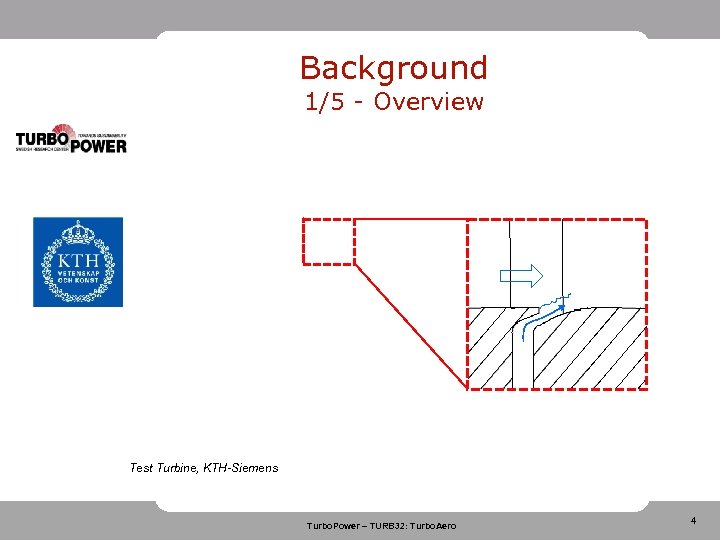
Background 1/5 - Overview Test Turbine, KTH-Siemens Turbo. Power – TURB 32: Turbo. Aero 4
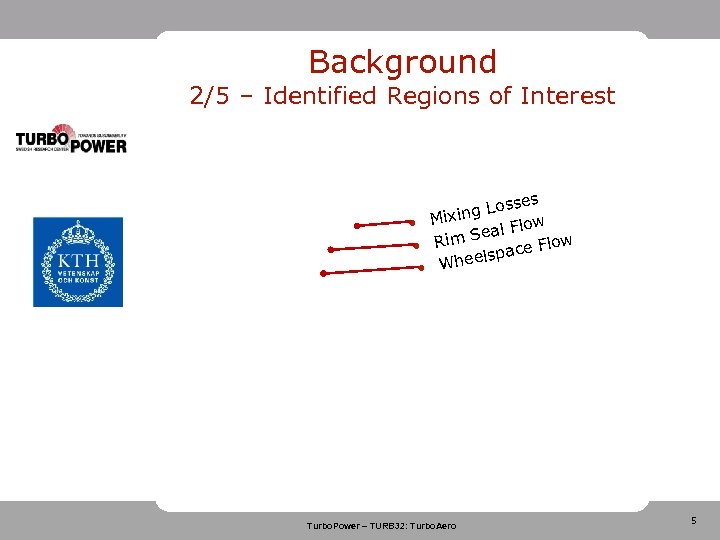
Background 2/5 – Identified Regions of Interest sses ing Lo • Mix low Seal F Flow • Rim pace eels • Wh Turbo. Power – TURB 32: Turbo. Aero 5
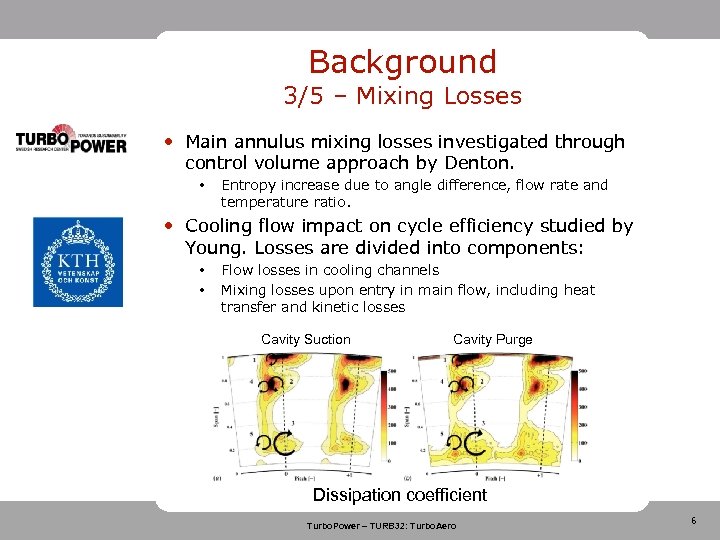
Background 3/5 – Mixing Losses • Main annulus mixing losses investigated through control volume approach by Denton. • Entropy increase due to angle difference, flow rate and temperature ratio. • Cooling flow impact on cycle efficiency studied by Young. Losses are divided into components: • • Flow losses in cooling channels Mixing losses upon entry in main flow, including heat transfer and kinetic losses Cavity Suction Cavity Purge Dissipation coefficient Turbo. Power – TURB 32: Turbo. Aero 6
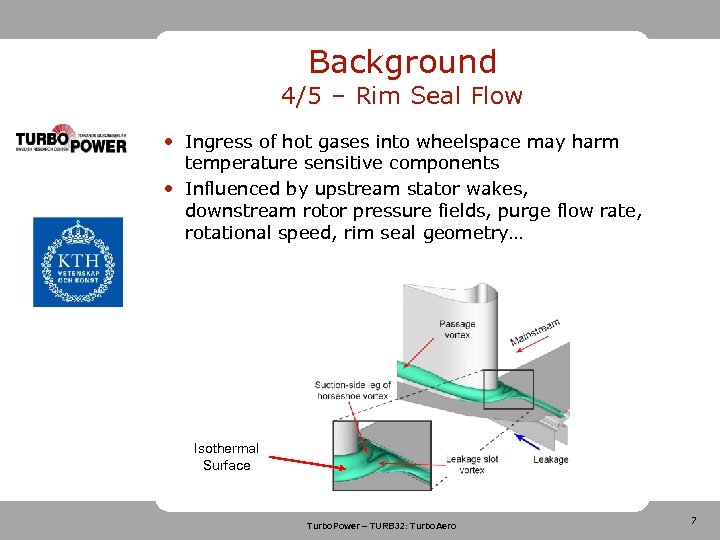
Background 4/5 – Rim Seal Flow • Ingress of hot gases into wheelspace may harm temperature sensitive components • Influenced by upstream stator wakes, downstream rotor pressure fields, purge flow rate, rotational speed, rim seal geometry… Isothermal Surface Turbo. Power – TURB 32: Turbo. Aero 7
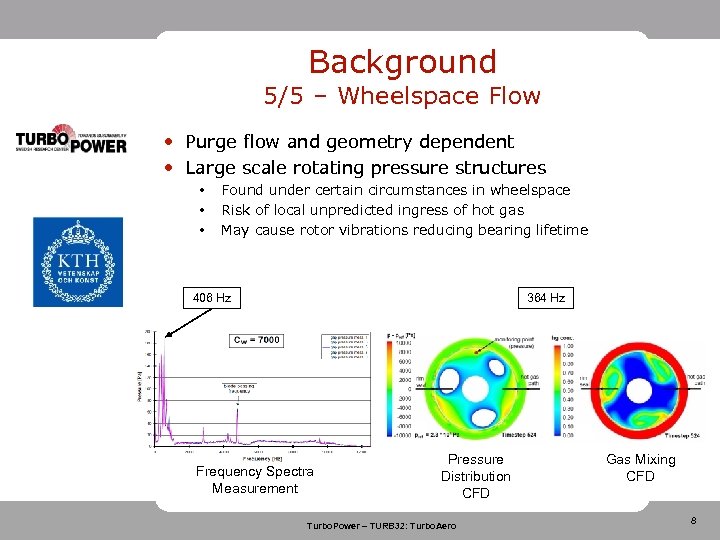
Background 5/5 – Wheelspace Flow • Purge flow and geometry dependent • Large scale rotating pressure structures • • • Found under certain circumstances in wheelspace Risk of local unpredicted ingress of hot gas May cause rotor vibrations reducing bearing lifetime 406 Hz 364 Hz Frequency Spectra Measurement Pressure Distribution CFD Turbo. Power – TURB 32: Turbo. Aero Gas Mixing CFD 8
Objectives • Determine cavity purge loss effects • • Quantitatively to provide data for development of industry loss correlation software Qualitatively for scientific understanding • Associate rim sealing effectiveness with cavity purge flow rate for given geometry • Ingress effects should be predicted to minimize the use of purge flow and avoid unnecessary efficiency penalties • Determine possibilities for investigation of rotating pressure structures • • Find design and operating criteria to minimize effects Predictability to help avoid harmful mechanical and thermal effects due to ingress and vibrations Turbo. Power – TURB 32: Turbo. Aero 9
Methodology 1/3 – Experimental Investigation • Detailed steady and unsteady measurements • • • Probe traverse in main annulus flow for flow-field investigation Seed gas (CO 2) for determination of seal effectiveness Fast pressure measurements in cavity for pressure gradients and pressure structure identification • Performance measurements • • Torque measurement, compensated for bearing losses Rotational speed measurement Flow entropy change measurement through stage with hot -wire and pressure Mass flow measurement with orifice plate • Cavity purge flow density variation • Under investigation, for replication of density ratio present in commercial machines Turbo. Power – TURB 32: Turbo. Aero 10
Methodology 2/3 – Numerical Investigations (CFD) • Validate with experimental measurements • To achieve detailed flow analysis beyond possibilities of measurements • Possibility to further alter cavity and rim seal geometry and study the influences • Initial investigation in search of rotating pressure structures in present turbine geometry Turbo. Power – TURB 32: Turbo. Aero 11
Methodology 3/3 – Rotor Blisk Commissioning • Commercially common cavity geometry • • Investigate influence of cavity change Obtain results applicable to available products • Instrumentation with slipring Turbo. Power – TURB 32: Turbo. Aero 12
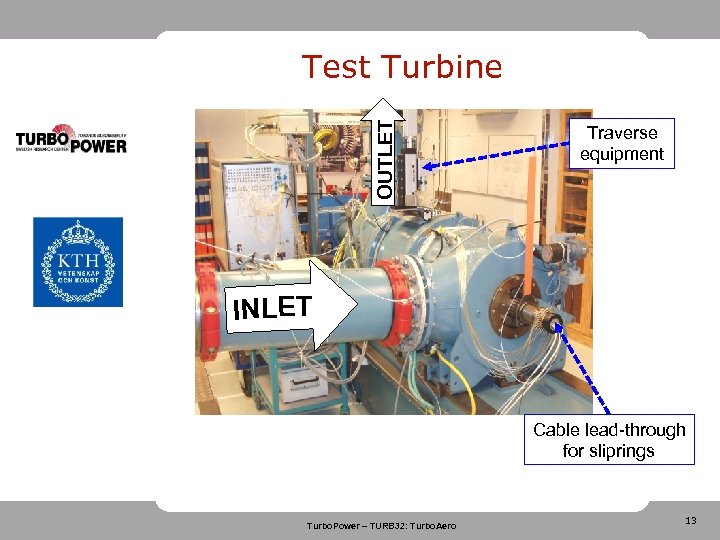
OUTLET Test Turbine Traverse equipment INLET Cable lead-through for sliprings Turbo. Power – TURB 32: Turbo. Aero 13
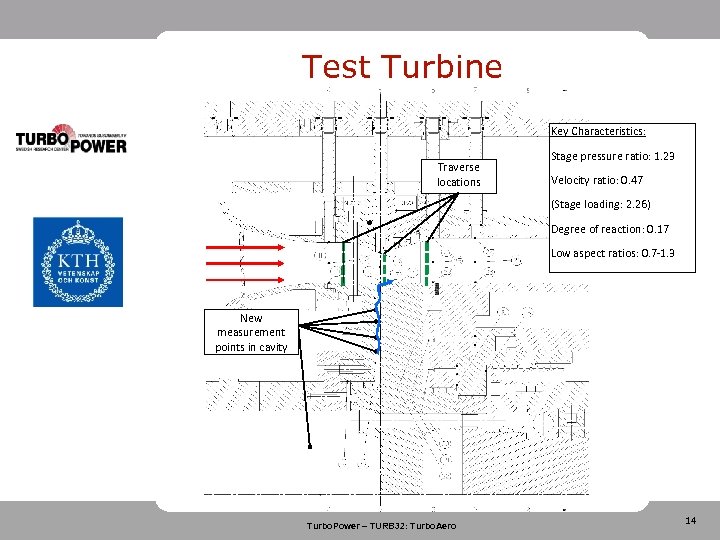
Test Turbine Key Characteristics: Traverse locations Stage pressure ratio: 1. 23 Velocity ratio: 0. 47 (Stage loading: 2. 26) Degree of reaction: 0. 17 Low aspect ratios: 0. 7 -1. 3 New measurement points in cavity Turbo. Power – TURB 32: Turbo. Aero 14
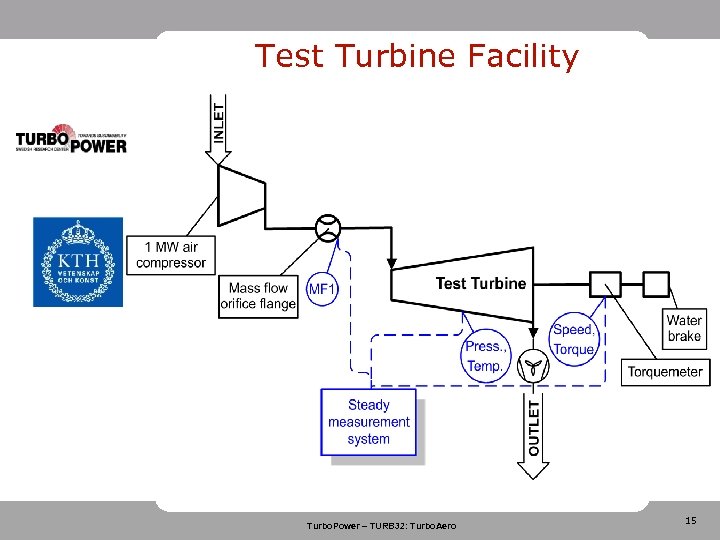
Test Turbine Facility Turbo. Power – TURB 32: Turbo. Aero 15
Project Progress 1/3 – Literature Study • The aspects of cavity, sealing and main annulus flow are investigated separately in the literature, with regard to cavity purge flows • The connection between the three regions is however not investigated thoroughly (only for simplified conditions in CFD) • The aspect of density ratio is not investigated in detail, and is interesting look further into Turbo. Power – TURB 32: Turbo. Aero 16
Project Progress 2/3 – Experiment Preparation • New load envelope investigation • • Through-flow simulations for increased pressure ratio and speed with in-house software: Done Complete test program: Under development • Turbine speed upgrade (7000 → 13000 rpm) • Bearing upgrade: Ongoing • Measurement equipment upgrade • • Torque meter overhaul: Ongoing New aerodynamic probes: Purchased New measurement points: Decided New traverse equipment: Decided • Density ratio facility • • CO 2, nitrogen, compressed air investigated CO 2 most promising Turbo. Power – TURB 32: Turbo. Aero 17
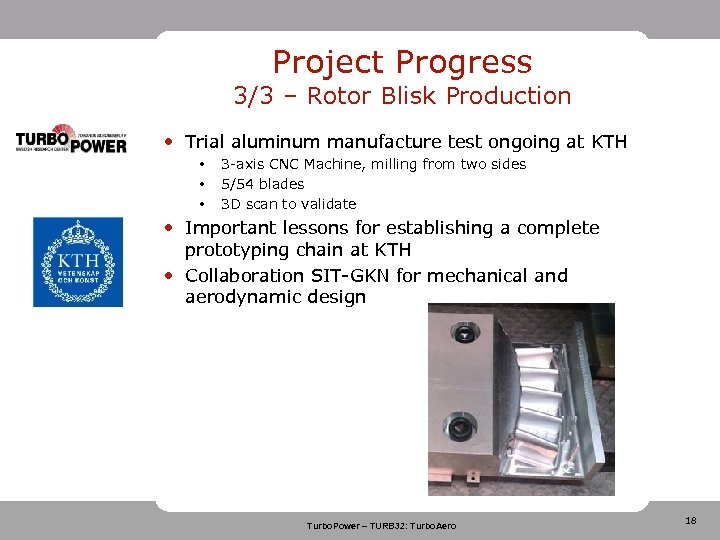
Project Progress 3/3 – Rotor Blisk Production • Trial aluminum manufacture test ongoing at KTH • • • 3 -axis CNC Machine, milling from two sides 5/54 blades 3 D scan to validate • Important lessons for establishing a complete prototyping chain at KTH • Collaboration SIT-GKN for mechanical and aerodynamic design Turbo. Power – TURB 32: Turbo. Aero 18
MSc Theses • Frist thesis scheduled to start September 2013 • • CFD Investigation of Rotating Pressure Structures in Rotor. Stator Disc Cavity Systems Project proposal published • Additional theses planned • • Further numerical investigations Possibly some experimental investigations and other aspects Turbo. Power – TURB 32: Turbo. Aero 19
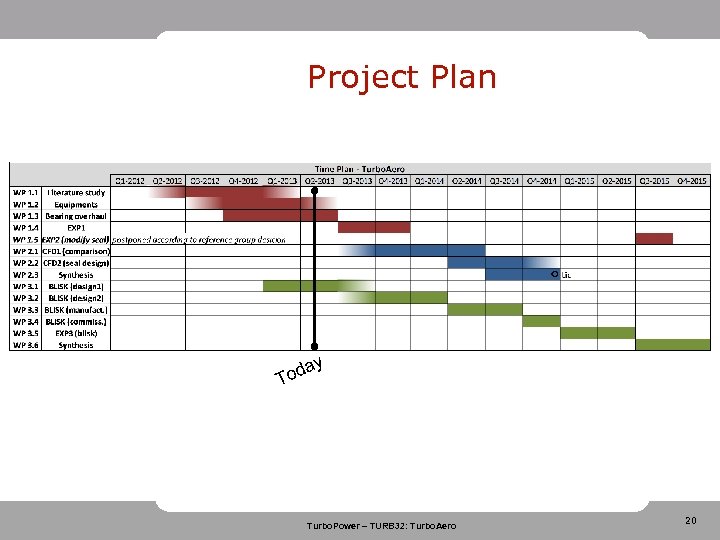
Project Plan y a Tod Turbo. Power – TURB 32: Turbo. Aero 20
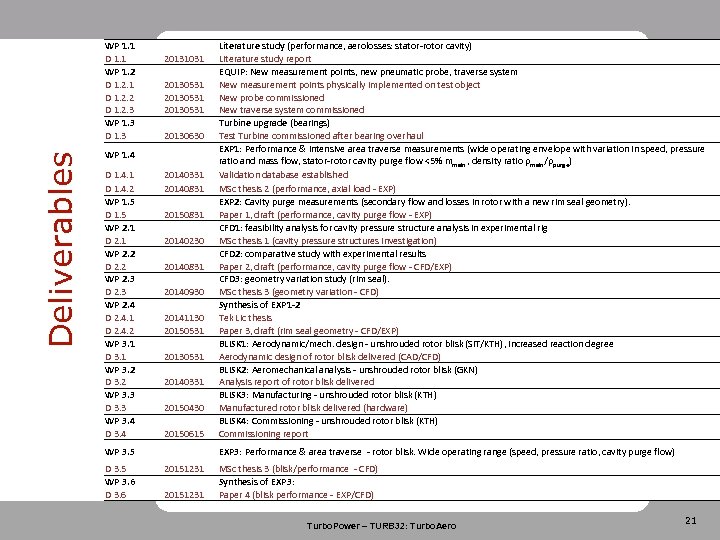
Deliverables WP 1. 1 D 1. 1 WP 1. 2 D 1. 2. 1 D 1. 2. 2 D 1. 2. 3 WP 1. 3 D 1. 3 20131031 20130531 20130630 WP 1. 4 D 1. 4. 1 D 1. 4. 2 WP 1. 5 D 1. 5 WP 2. 1 D 2. 1 WP 2. 2 D 2. 2 WP 2. 3 D 2. 3 WP 2. 4 D 2. 4. 1 D 2. 4. 2 WP 3. 1 D 3. 1 WP 3. 2 D 3. 2 WP 3. 3 D 3. 3 WP 3. 4 D 3. 4 20140331 20140831 20150831 20140230 20140831 20140930 20141130 20150531 20130531 20140331 20150430 20150615 WP 3. 5 D 3. 5 WP 3. 6 D 3. 6 Literature study (performance, aerolosses: stator-rotor cavity) Literature study report EQUIP: New measurement points, new pneumatic probe, traverse system New measurement points physically implemented on test object New probe commissioned New traverse system commissioned Turbine upgrade (bearings) Test Turbine commissioned after bearing overhaul EXP 1: Performance & intensive area traverse measurements (wide operating envelope with variation in speed, pressure ratio and mass flow, stator-rotor cavity purge flow <5% mmain , density ratio rmain/rpurge) Validation database established MSc thesis 2 (performance, axial load - EXP) EXP 2: Cavity purge measurements (secondary flow and losses in rotor with a new rim seal geometry). Paper 1, draft (performance, cavity purge flow - EXP) CFD 1: feasibility analysis for cavity pressure structure analysis in experimental rig MSc thesis 1 (cavity pressure structures investigation) CFD 2: comparative study with experimental results Paper 2, draft (performance, cavity purge flow - CFD/EXP) CFD 3: geometry variation study (rim seal). MSc thesis 3 (geometry variation - CFD) Synthesis of EXP 1 -2 Tek Lic thesis Paper 3, draft (rim seal geometry - CFD/EXP) BLISK 1: Aerodynamic/mech. design - unshrouded rotor blisk (SIT/KTH), increased reaction degree Aerodynamic design of rotor blisk delivered (CAD/CFD) BLISK 2: Aeromechanical analysis - unshrouded rotor blisk (GKN) Analysis report of rotor blisk delivered BLISK 3: Manufacturing - unshrouded rotor blisk (KTH) Manufactured rotor blisk delivered (hardware) BLISK 4: Commissioning - unshrouded rotor blisk (KTH) Commissioning report EXP 3: Performance & area traverse - rotor blisk. Wide operating range (speed, pressure ratio, cavity purge flow) 20151231 MSc thesis 3 (blisk/performance - CFD) Synthesis of EXP 3: Paper 4 (blisk performance - EXP/CFD) Turbo. Power – TURB 32: Turbo. Aero 21
Скачать презентацию TURB 32 Turbo Aero Cavity Purge Flows in
7f290ac738f895e41d6ac3b76d6468b3.ppt