 Скачать презентацию Tuning Techniques To Maximize DB 2 Performance Martin
32a9f94337bc6be29a962f992d25d620.ppt
- Количество слайдов: 44




Tuning Techniques To Maximize DB 2 Performance Martin Hubel Lightyear Consulting ® and ™ indicate USA registration or USA trademark. Other logos and product/trade names are trademarks or registered trademarks of their respective companies. Copyright© 1999, 2000, 2003 crice@lightyr. com 714 -438 -5391. , All rights reserved.
Agenda n Objectives and benefits n Types of I/O n Buffer pool tuning methodology n Index tuning n The DB 2 tuning project Copyright© 1999, 2000, 2003 Martin Hubel Consulting Inc. , All rights reserved. 2
Presentation Objectives • Describe methods to reduce the cost of DB 2 processing for existing applications • Describe ways to reduce physical &logical I/O • Describe the steps necessary to start a DB 2 tuning project Copyright© 1999, 2000, 2003 Martin Hubel Consulting Inc. , All rights reserved. 3
Presentation Background • Based on tuning experience with • EPS: People. Soft, SAP and Siebel • Data warehouses • Production and test OLTP environments • “Your mileage will vary” • Tuning opportunities will also vary • Tuning is dependent upon resources available Copyright© 1999, 2000, 2003 Martin Hubel Consulting Inc. , All rights reserved. 4
The Need For Tuning • Use hardware efficiently • Cost of hardware is lower • Can you buy enough hardware to solve your performance problem? • Productivity of business users and I/T staff • Hardware is cheaper, but people are not • Bad performance causes: • Low productivity • Need more people to do same work Copyright© 1999, 2000, 2003 Martin Hubel Consulting Inc. , All rights reserved. 5
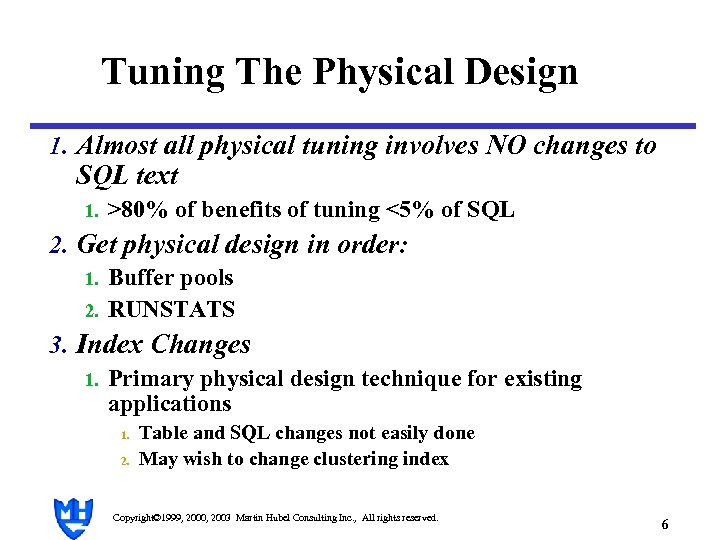
Tuning The Physical Design 1. Almost all physical tuning involves NO changes to SQL text 1. >80% of benefits of tuning <5% of SQL 2. Get physical design in order: 1. Buffer pools 2. RUNSTATS 3. Index Changes 1. Primary physical design technique for existing applications 1. 2. Table and SQL changes not easily done May wish to change clustering index Copyright© 1999, 2000, 2003 Martin Hubel Consulting Inc. , All rights reserved. 6
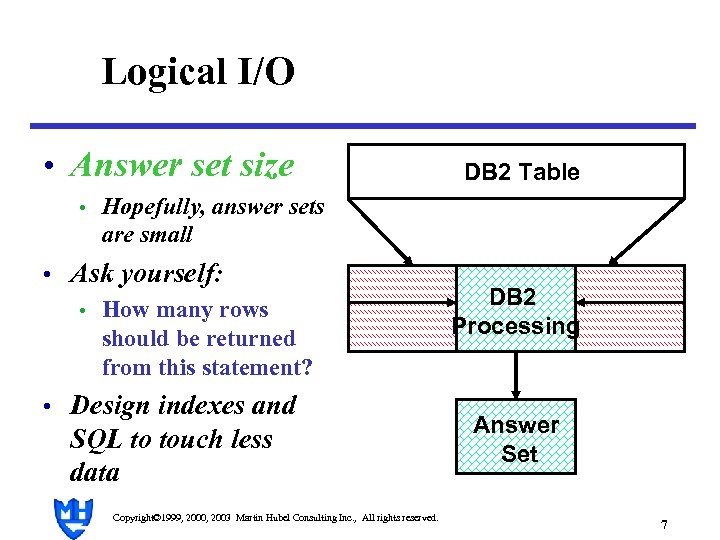
Logical I/O • Answer set size • DB 2 Table Hopefully, answer sets are small • Ask yourself: • How many rows should be returned from this statement? • Design indexes and SQL to touch less data Copyright© 1999, 2000, 2003 Martin Hubel Consulting Inc. , All rights reserved. DB 2 Processing Answer Set 7
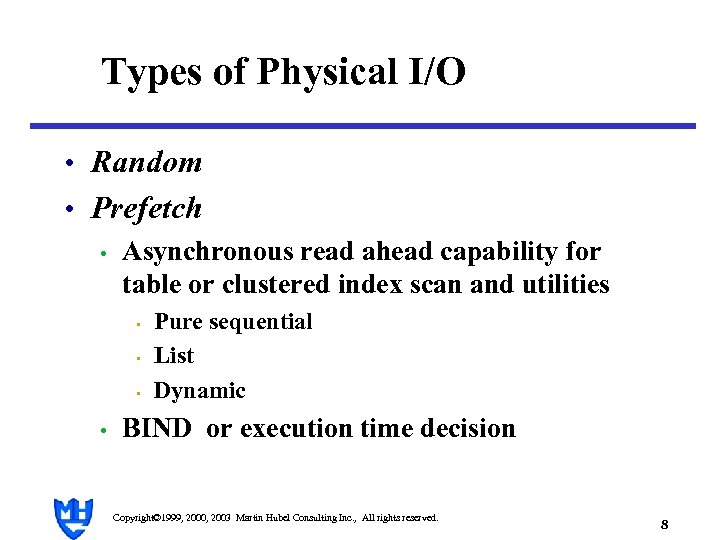
Types of Physical I/O • Random • Prefetch • Asynchronous read ahead capability for table or clustered index scan and utilities • • Pure sequential List Dynamic BIND or execution time decision Copyright© 1999, 2000, 2003 Martin Hubel Consulting Inc. , All rights reserved. 8
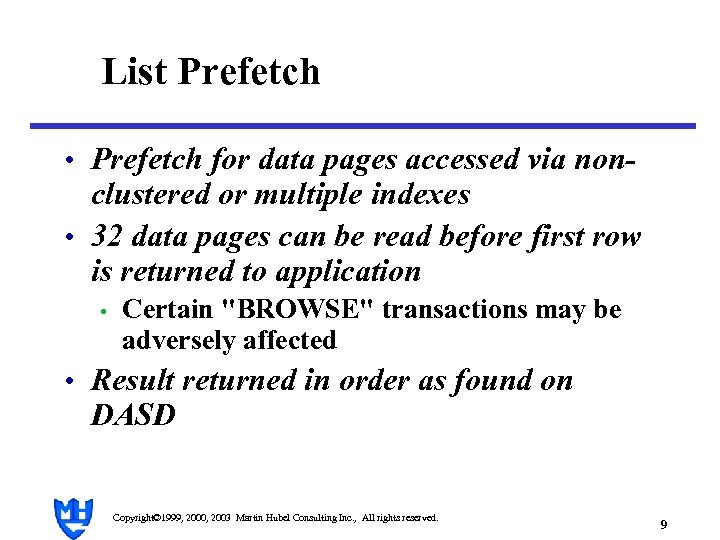
List Prefetch • Prefetch for data pages accessed via non- clustered or multiple indexes • 32 data pages can be read before first row is returned to application • Certain "BROWSE" transactions may be adversely affected • Result returned in order as found on DASD Copyright© 1999, 2000, 2003 Martin Hubel Consulting Inc. , All rights reserved. 9

Sequential Detection • Also called Dynamic Prefetch • Monitor for sequential pattern in data retrieval at execution • • Turn on if 5 of last 8 pages are within half of the prefetch quantity of each other Continue monitor to see if pattern changes back to non-sequential • Max. number of concurrent prefetch engines: • 300 in V 5, 600 in V 6 [OS/390] Copyright© 1999, 2000, 2003 Martin Hubel Consulting Inc. , All rights reserved. 10
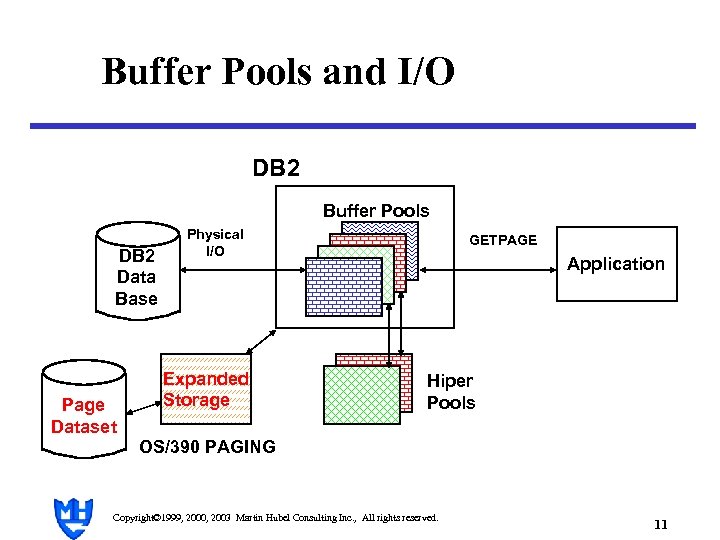
Buffer Pools and I/O DB 2 Buffer Pools DB 2 Data Base Page Dataset Physical I/O Expanded Storage GETPAGE Application Hiper Pools OS/390 PAGING Copyright© 1999, 2000, 2003 Martin Hubel Consulting Inc. , All rights reserved. 11
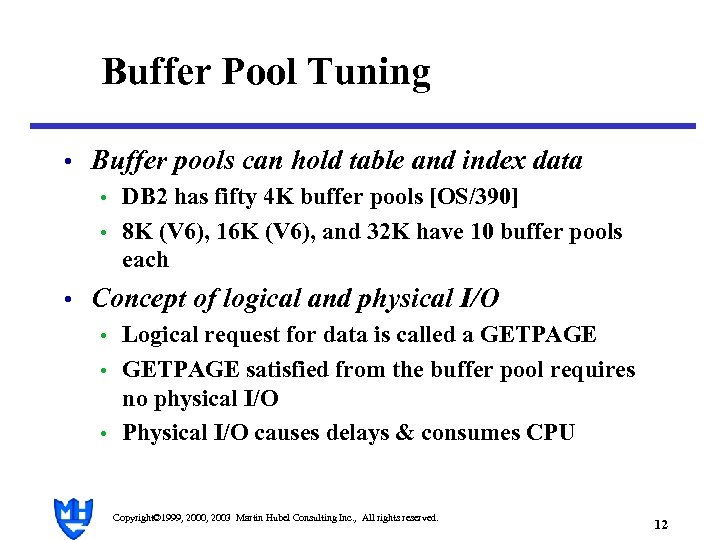
Buffer Pool Tuning • Buffer pools can hold table and index data • DB 2 has fifty 4 K buffer pools [OS/390] • 8 K (V 6), 16 K (V 6), and 32 K have 10 buffer pools each • Concept of logical and physical I/O • Logical request for data is called a GETPAGE • GETPAGE satisfied from the buffer pool requires no physical I/O • Physical I/O causes delays & consumes CPU Copyright© 1999, 2000, 2003 Martin Hubel Consulting Inc. , All rights reserved. 12
![Buffer Pool Thresholds [OS/390] Fixed Thresholds Variable Thresholds IWTH 97. 5% DMTH 95% Thresholds](https://present5.com/presentation/32a9f94337bc6be29a962f992d25d620/image-13.jpg "Buffer Pool Thresholds [OS/390] Fixed Thresholds Variable Thresholds IWTH 97. 5% DMTH 95% Thresholds")
Buffer Pool Thresholds [OS/390] Fixed Thresholds Variable Thresholds IWTH 97. 5% DMTH 95% Thresholds computed as: SPTH 90% (Updated Pages + Pages In-Use) BP Size VPSEQT (80%) VPPSEQT (50%) DWQT (50%) VDWQT (10%) Copyright© 1999, 2000, 2003 Martin Hubel Consulting Inc. , All rights reserved. 13
![Setting Variable Thresholds [OS/390] • Preferable to use VDWQT rather than DWQT to control](https://present5.com/presentation/32a9f94337bc6be29a962f992d25d620/image-14.jpg "Setting Variable Thresholds [OS/390] • Preferable to use VDWQT rather than DWQT to control")
Setting Variable Thresholds [OS/390] • Preferable to use VDWQT rather than DWQT to control asynchronous write activity • • • On most pools, set VDWQT lower than default 10% Allow a “trickle write” in background Pages written are still in buffer if referenced often • IWTH may be non-zero • Not a problem if SPTH and DMTH are both zero • DWQT and VDWQT may be set higher for sort/work BP • Set VPSEQT and VPPSEQT lower on random/ mixed pools to avoid dominance by sequential operations Copyright© 1999, 2000, 2003 Martin Hubel Consulting Inc. , All rights reserved. 14
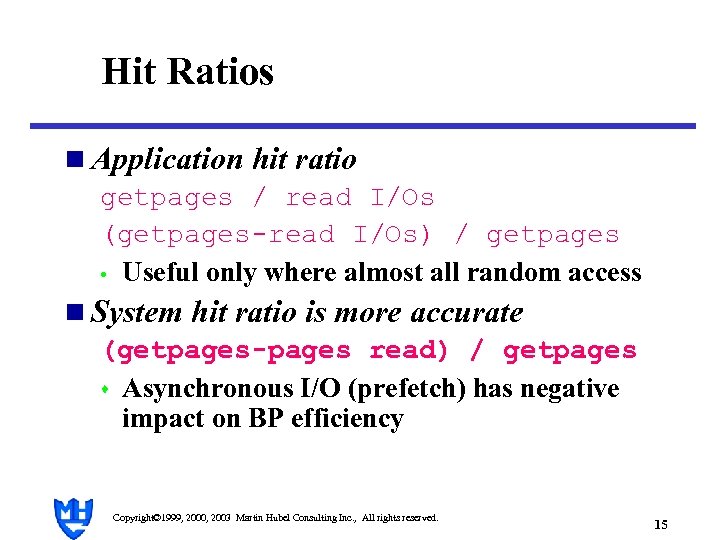
Hit Ratios n Application hit ratio getpages / read I/Os (getpages-read I/Os) / getpages • Useful only where almost all random access n System hit ratio is more accurate (getpages-pages read) / getpages s Asynchronous I/O (prefetch) has negative impact on BP efficiency Copyright© 1999, 2000, 2003 Martin Hubel Consulting Inc. , All rights reserved. 15
![Typical BP Starting Points [OS/390] • Most people have gotten this far before a](https://present5.com/presentation/32a9f94337bc6be29a962f992d25d620/image-16.jpg "Typical BP Starting Points [OS/390] • Most people have gotten this far before a")
Typical BP Starting Points [OS/390] • Most people have gotten this far before a tuning exercise is started: • • Catalog and Directory in BP 0 Temporary (work) TS in BP 1 Table spaces in BP 2 Indexes in BP 3 • Minimum size for any 4 K pool should be 1000 pages • To get maximum prefetch quantity Copyright© 1999, 2000, 2003 Martin Hubel Consulting Inc. , All rights reserved. 16
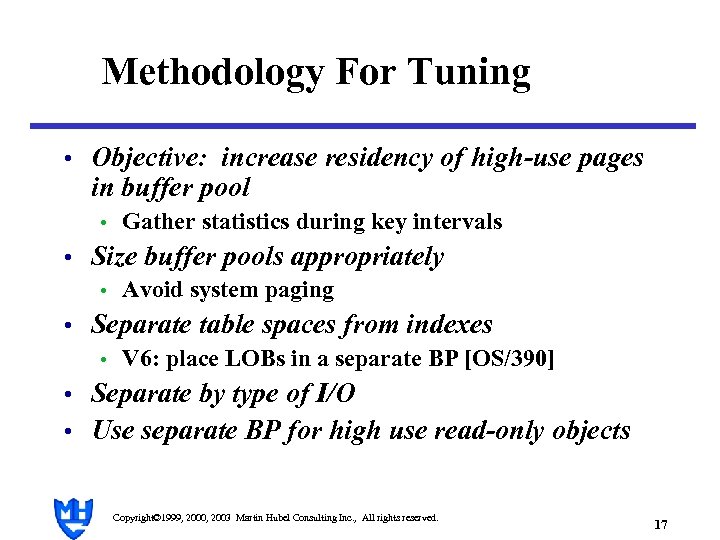
Methodology For Tuning • Objective: increase residency of high-use pages in buffer pool • Gather statistics during key intervals • Size buffer pools appropriately • Avoid system paging • Separate table spaces from indexes • V 6: place LOBs in a separate BP [OS/390] • Separate by type of I/O • Use separate BP for high use read-only objects Copyright© 1999, 2000, 2003 Martin Hubel Consulting Inc. , All rights reserved. 17
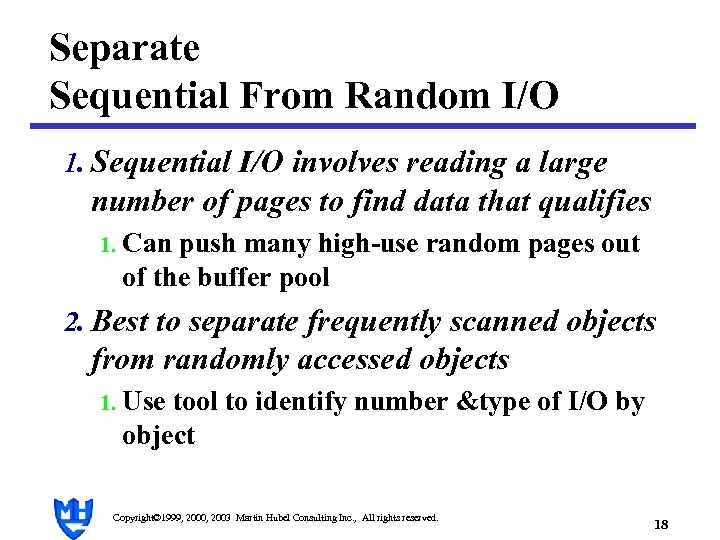
Separate Sequential From Random I/O 1. Sequential I/O involves reading a large number of pages to find data that qualifies 1. Can push many high-use random pages out of the buffer pool 2. Best to separate frequently scanned objects from randomly accessed objects 1. Use tool to identify number &type of I/O by object Copyright© 1999, 2000, 2003 Martin Hubel Consulting Inc. , All rights reserved. 18
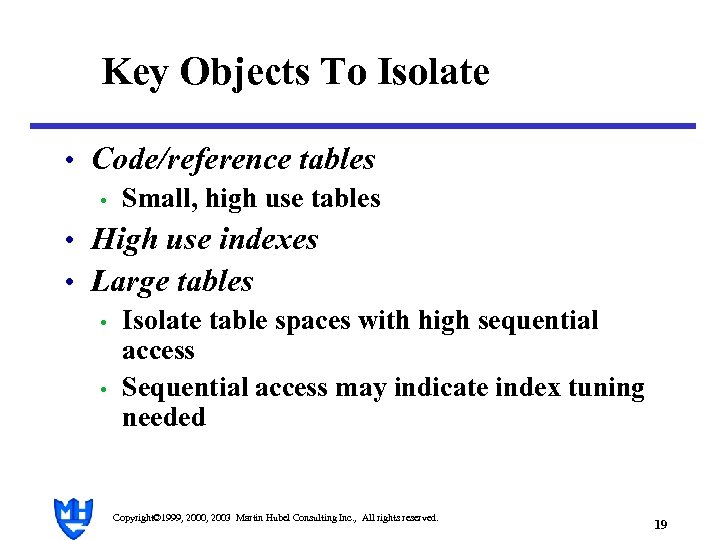
Key Objects To Isolate • Code/reference tables • Small, high use tables • High use indexes • Large tables • Isolate table spaces with high sequential access • Sequential access may indicate index tuning needed Copyright© 1999, 2000, 2003 Martin Hubel Consulting Inc. , All rights reserved. 19
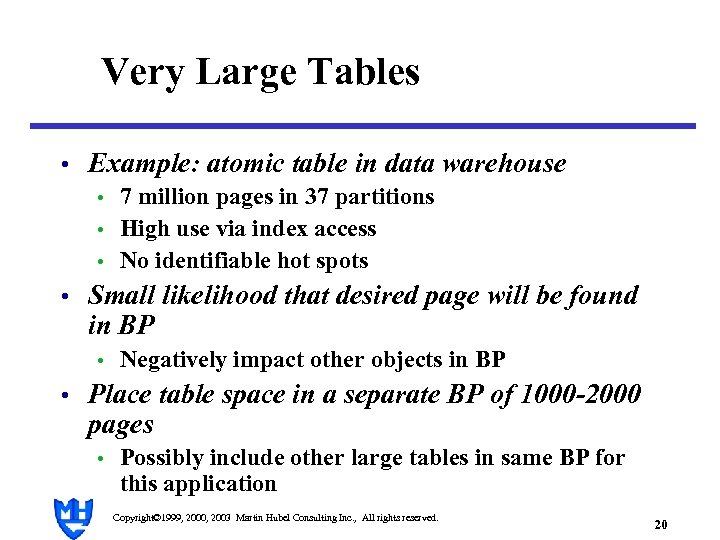
Very Large Tables • Example: atomic table in data warehouse • 7 million pages in 37 partitions • High use via index access • No identifiable hot spots • Small likelihood that desired page will be found in BP • Negatively impact other objects in BP • Place table space in a separate BP of 1000 -2000 pages • Possibly include other large tables in same BP for this application Copyright© 1999, 2000, 2003 Martin Hubel Consulting Inc. , All rights reserved. 20

Hiper Pools • Useful to alleviate DBM 1 virtual storage constraint • Up to 8 GB total • I/O saving when page is not in VP but is in HP • Caches only clean pages • Page must be moved to HP from VP when not in VP • Recommend HPsize > VP size • Aim for HP R/W ratio (HP Reads/Writes) > 10% • HP Read/Write failures indicate ES shortage • Maximize central storage before using expanded Copyright© 1999, 2000, 2003 Martin Hubel Consulting Inc. , All rights reserved. 21
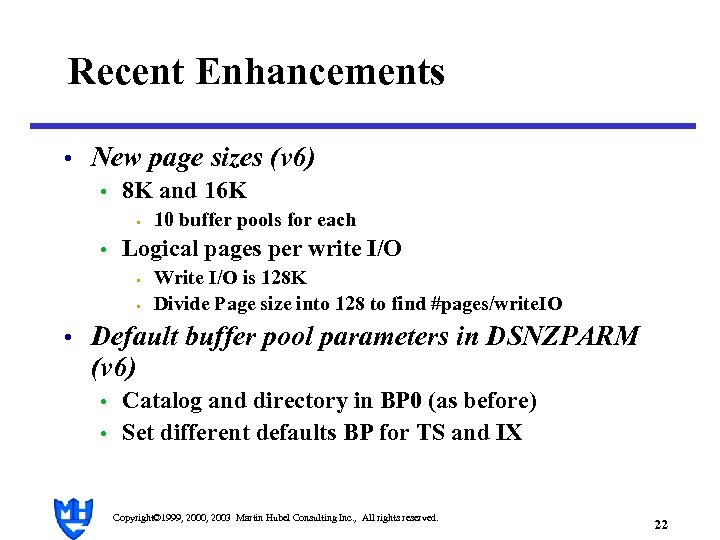
Recent Enhancements • New page sizes (v 6) • 8 K and 16 K • • 10 buffer pools for each Logical pages per write I/O • • Write I/O is 128 K Divide Page size into 128 to find #pages/write. IO • Default buffer pool parameters in DSNZPARM (v 6) • • Catalog and directory in BP 0 (as before) Set different defaults BP for TS and IX Copyright© 1999, 2000, 2003 Martin Hubel Consulting Inc. , All rights reserved. 22
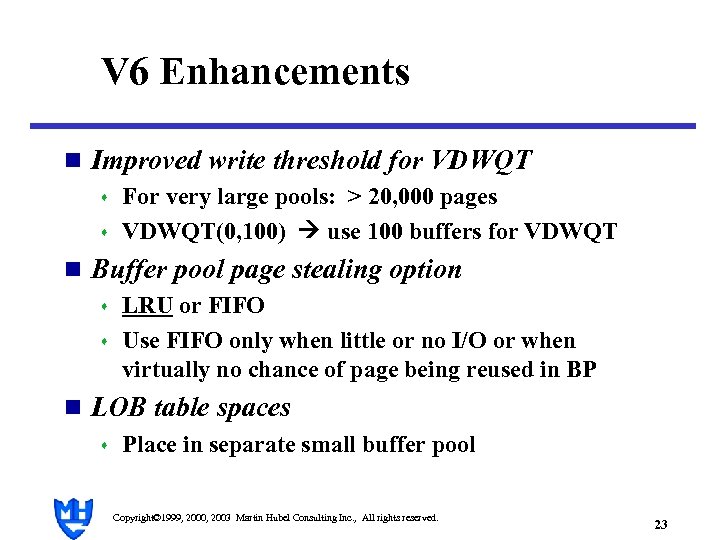
V 6 Enhancements n Improved write threshold for VDWQT s For very large pools: > 20, 000 pages s VDWQT(0, 100) use 100 buffers for VDWQT n Buffer pool page stealing option s LRU or FIFO s Use FIFO only when little or no I/O or when virtually no chance of page being reused in BP n LOB table spaces s Place in separate small buffer pool Copyright© 1999, 2000, 2003 Martin Hubel Consulting Inc. , All rights reserved. 23

V 6 -V 7 Buffer Pools in Dataspaces n Expand beyond current limit of 1. 6 GB for VBP in DBM 1 s s Max dspace size is 8 million pages (any page size) Can exploit large memory on processors before 64 -bit n Data spaces can reside in central or expanded storage s Specify VPTYPE(DATASPACE) - I/O directly against dataspace s Hiperpools cannot be used with data spaces s Shared lookaside buffer in DBM 1 for each page size l Expanded/contracted based on usage n Dataspace Buffer Pool is recommended over hiperpool for Z Series processor with OS/390 V 2 R 10 Copyright© 1999, 2000, 2003 Martin Hubel Consulting Inc. , All rights reserved. 24
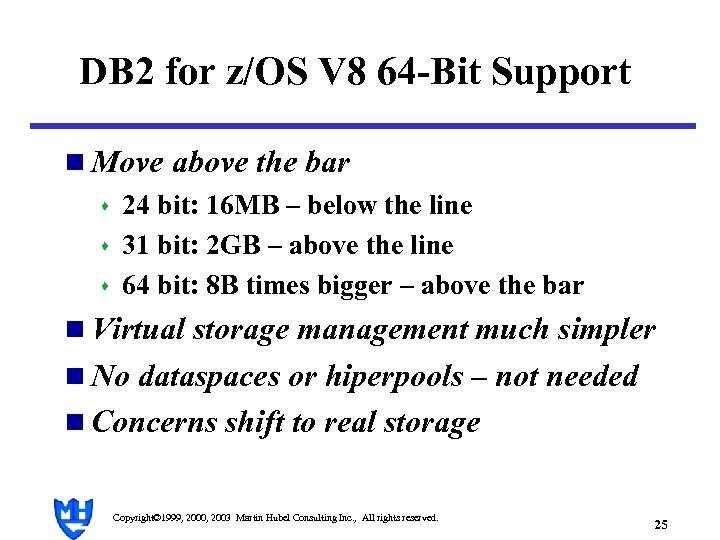
DB 2 for z/OS V 8 64 -Bit Support n Move above the bar s 24 bit: 16 MB – below the line s 31 bit: 2 GB – above the line s 64 bit: 8 B times bigger – above the bar n Virtual storage management much simpler n No dataspaces or hiperpools – not needed n Concerns shift to real storage Copyright© 1999, 2000, 2003 Martin Hubel Consulting Inc. , All rights reserved. 25
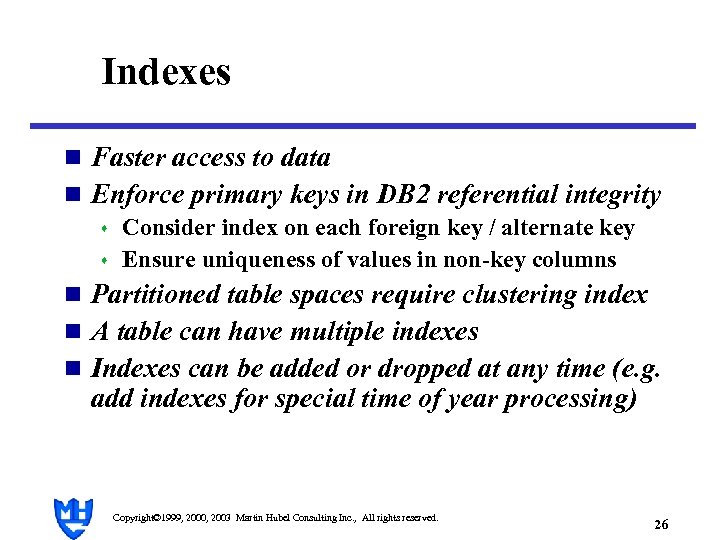
Indexes n Faster access to data n Enforce primary keys in DB 2 referential integrity s Consider index on each foreign key / alternate key s Ensure uniqueness of values in non-key columns n Partitioned table spaces require clustering index n A table can have multiple indexes n Indexes can be added or dropped at any time (e. g. add indexes for special time of year processing) Copyright© 1999, 2000, 2003 Martin Hubel Consulting Inc. , All rights reserved. 26
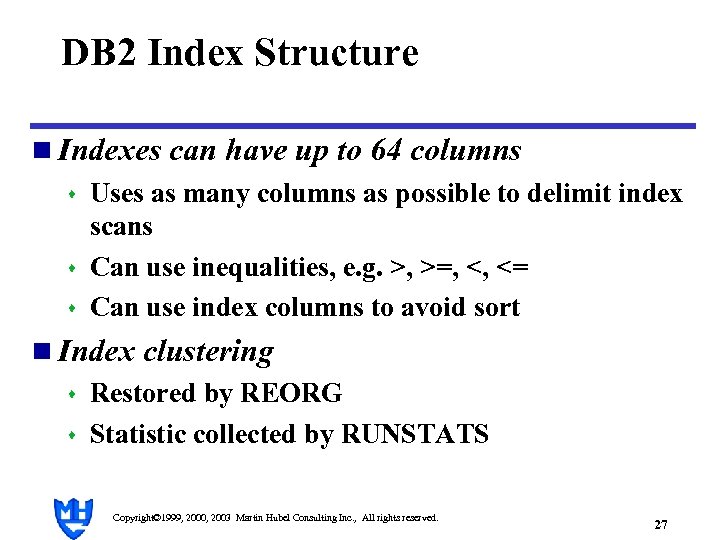
DB 2 Index Structure n Indexes can have up to 64 columns s Uses as many columns as possible to delimit index scans s Can use inequalities, e. g. >, >=, <, <= s Can use index columns to avoid sort n Index clustering s Restored by REORG s Statistic collected by RUNSTATS Copyright© 1999, 2000, 2003 Martin Hubel Consulting Inc. , All rights reserved. 27
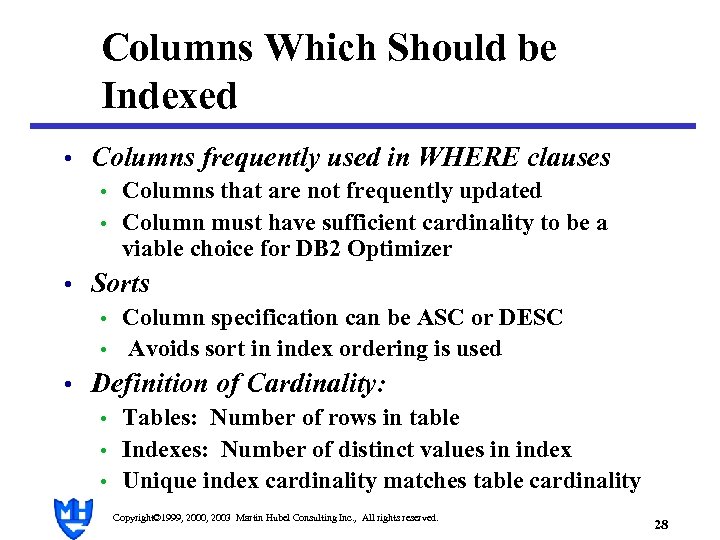
Columns Which Should be Indexed • Columns frequently used in WHERE clauses • Columns that are not frequently updated • Column must have sufficient cardinality to be a viable choice for DB 2 Optimizer • Sorts • Column specification can be ASC or DESC • Avoids sort in index ordering is used • Definition of Cardinality: • Tables: Number of rows in table • Indexes: Number of distinct values in index • Unique index cardinality matches table cardinality Copyright© 1999, 2000, 2003 Martin Hubel Consulting Inc. , All rights reserved. 28
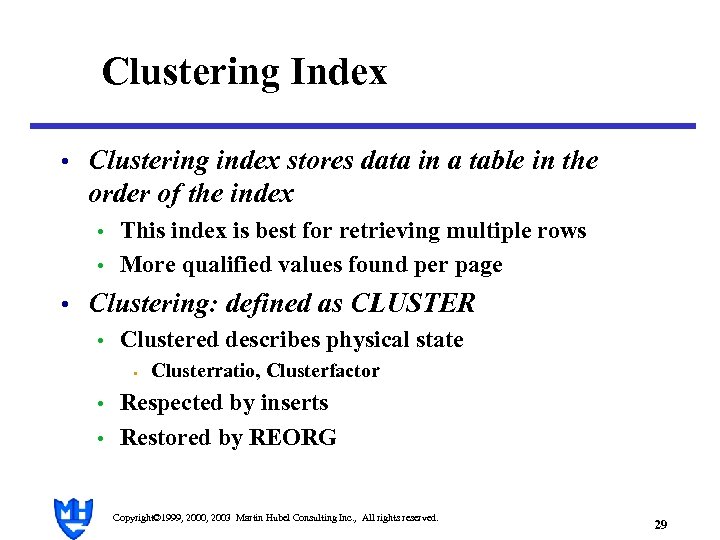
Clustering Index • Clustering index stores data in a table in the order of the index • • This index is best for retrieving multiple rows More qualified values found per page • Clustering: defined as CLUSTER • Clustered describes physical state • • • Clusterratio, Clusterfactor Respected by inserts Restored by REORG Copyright© 1999, 2000, 2003 Martin Hubel Consulting Inc. , All rights reserved. 29
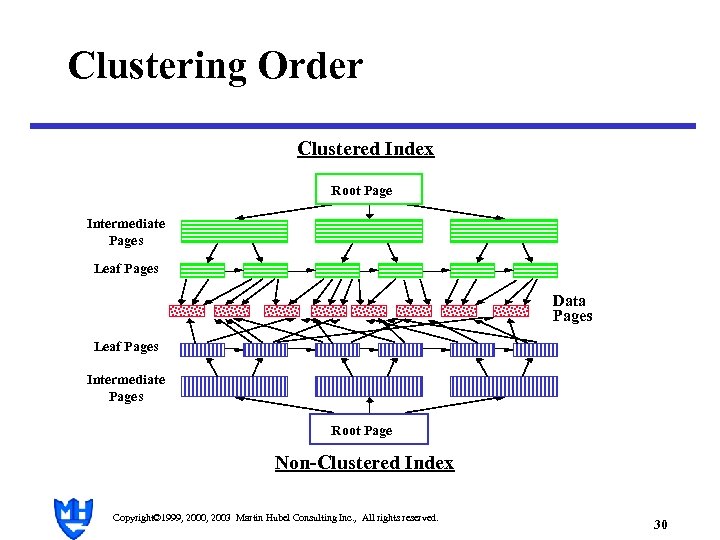
Clustering Order Clustered Index Root Page Intermediate Pages Leaf Pages Data Pages Leaf Pages Intermediate Pages Root Page Non-Clustered Index Copyright© 1999, 2000, 2003 Martin Hubel Consulting Inc. , All rights reserved. 30
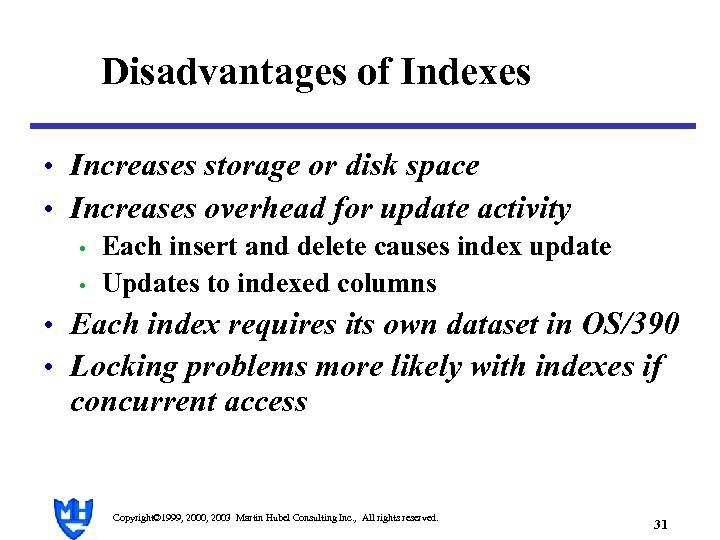
Disadvantages of Indexes • Increases storage or disk space • Increases overhead for update activity • Each insert and delete causes index update • Updates to indexed columns • Each index requires its own dataset in OS/390 • Locking problems more likely with indexes if concurrent access Copyright© 1999, 2000, 2003 Martin Hubel Consulting Inc. , All rights reserved. 31
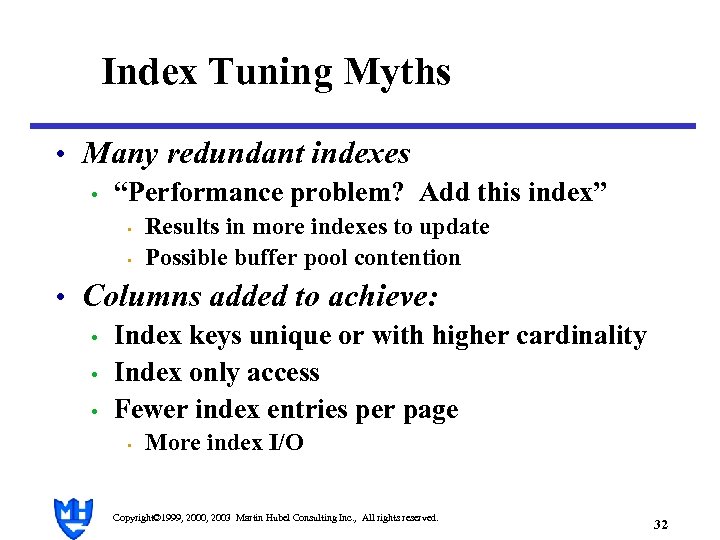
Index Tuning Myths • Many redundant indexes • “Performance problem? Add this index” • • Results in more indexes to update Possible buffer pool contention • Columns added to achieve: • Index keys unique or with higher cardinality • Index only access • Fewer index entries per page • More index I/O Copyright© 1999, 2000, 2003 Martin Hubel Consulting Inc. , All rights reserved. 32
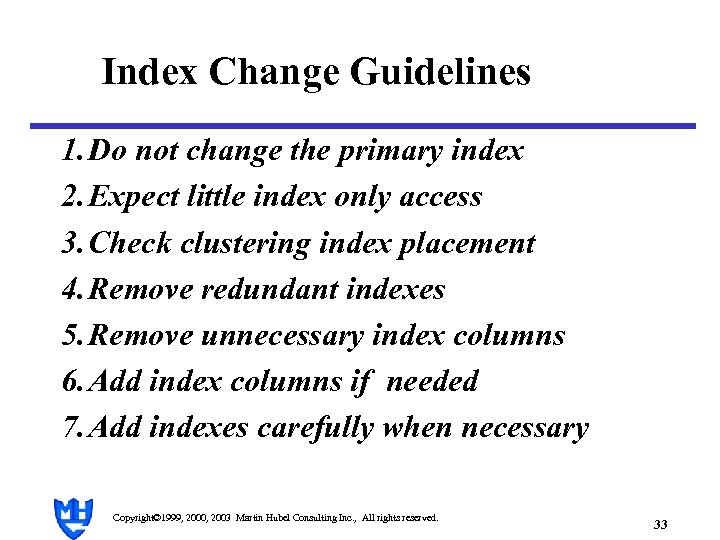
Index Change Guidelines 1. Do not change the primary index 2. Expect little index only access 3. Check clustering index placement 4. Remove redundant indexes 5. Remove unnecessary index columns 6. Add index columns if needed 7. Add indexes carefully when necessary Copyright© 1999, 2000, 2003 Martin Hubel Consulting Inc. , All rights reserved. 33
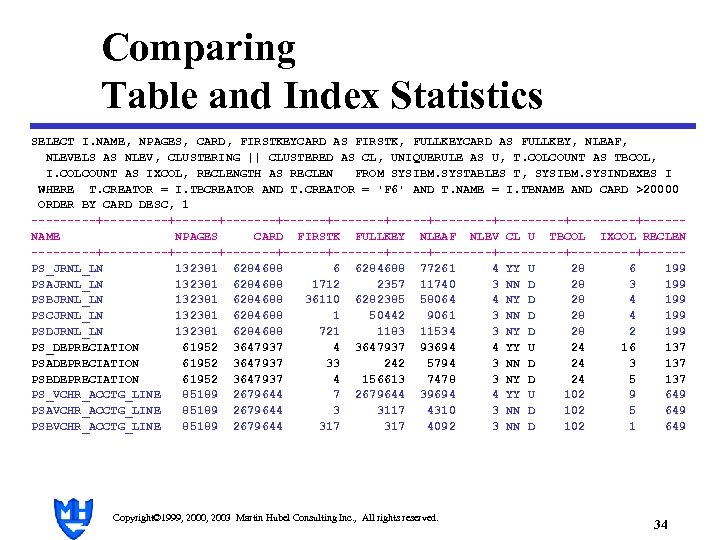
Comparing Table and Index Statistics SELECT I. NAME, NPAGES, CARD, FIRSTKEYCARD AS FIRSTK, FULLKEYCARD AS FULLKEY, NLEAF, NLEVELS AS NLEV, CLUSTERING || CLUSTERED AS CL, UNIQUERULE AS U, T. COLCOUNT AS TBCOL, I. COLCOUNT AS IXCOL, RECLENGTH AS RECLEN FROM SYSIBM. SYSTABLES T, SYSIBM. SYSINDEXES I WHERE T. CREATOR = I. TBCREATOR AND T. CREATOR = 'F 6' AND T. NAME = I. TBNAME AND CARD >20000 ORDER BY CARD DESC, 1 ---------+------+-------+-----+---------+-----NAME NPAGES CARD FIRSTK FULLKEY NLEAF NLEV CL U TBCOL IXCOL RECLEN ---------+------+-------+-----+---------+-----PS_JRNL_LN 132381 6284688 6 6284688 77261 4 YY U 28 6 199 PSAJRNL_LN 132381 6284688 1712 2357 11740 3 NN D 28 3 199 PSBJRNL_LN 132381 6284688 36110 6282385 58064 4 NY D 28 4 199 PSCJRNL_LN 132381 6284688 1 50442 9061 3 NN D 28 4 199 PSDJRNL_LN 132381 6284688 721 1183 11534 3 NY D 28 2 199 PS_DEPRECIATION 61952 3647937 4 3647937 93694 4 YY U 24 16 137 PSADEPRECIATION 61952 3647937 33 242 5794 3 NN D 24 3 137 PSBDEPRECIATION 61952 3647937 4 156613 7478 3 NY D 24 5 137 PS_VCHR_ACCTG_LINE 85189 2679644 7 2679644 39694 4 YY U 102 9 649 PSAVCHR_ACCTG_LINE 85189 2679644 3 3117 4310 3 NN D 102 5 649 PSBVCHR_ACCTG_LINE 85189 2679644 317 4092 3 NN D 102 1 649 Copyright© 1999, 2000, 2003 Martin Hubel Consulting Inc. , All rights reserved. 34
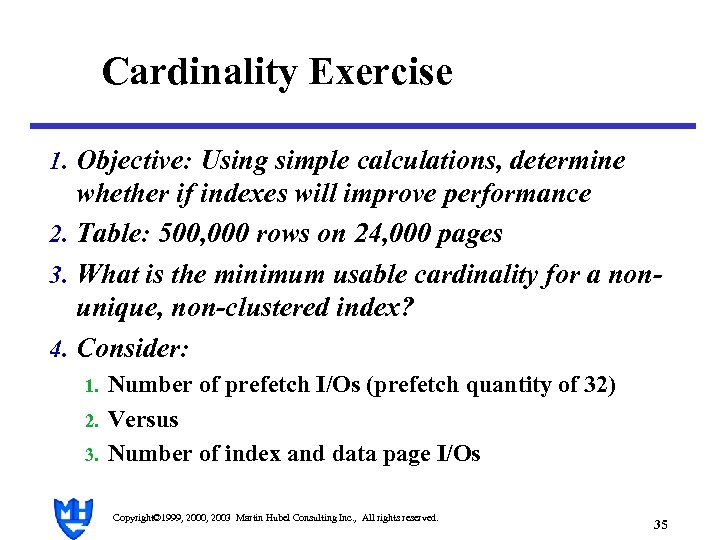
Cardinality Exercise 1. Objective: Using simple calculations, determine whether if indexes will improve performance 2. Table: 500, 000 rows on 24, 000 pages 3. What is the minimum usable cardinality for a nonunique, non-clustered index? 4. Consider: 1. 2. 3. Number of prefetch I/Os (prefetch quantity of 32) Versus Number of index and data page I/Os Copyright© 1999, 2000, 2003 Martin Hubel Consulting Inc. , All rights reserved. 35
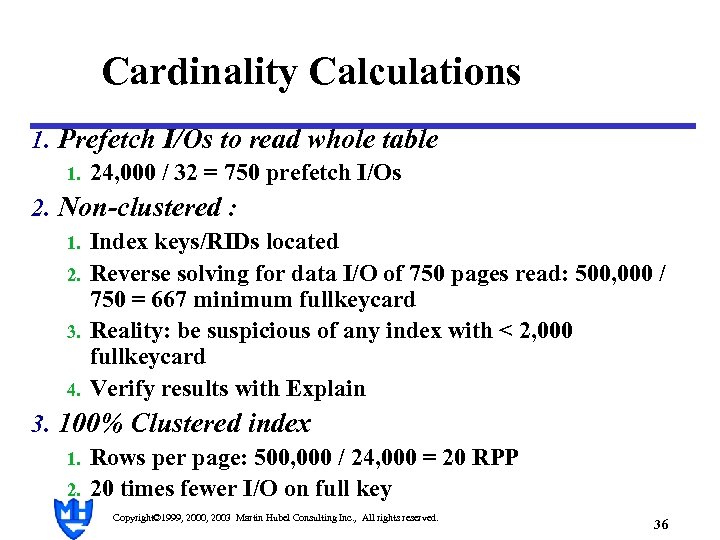
Cardinality Calculations 1. Prefetch I/Os to read whole table 1. 24, 000 / 32 = 750 prefetch I/Os 2. Non-clustered : 1. Index keys/RIDs located 2. Reverse solving for data I/O of 750 pages read: 500, 000 / 750 = 667 minimum fullkeycard 3. Reality: be suspicious of any index with < 2, 000 fullkeycard 4. Verify results with Explain 3. 100% Clustered index 1. Rows per page: 500, 000 / 24, 000 = 20 RPP 2. 20 times fewer I/O on full key Copyright© 1999, 2000, 2003 Martin Hubel Consulting Inc. , All rights reserved. 36
Hardware Data Compression • DB 2 hardware data compression • Fewer pages can mean fewer I/Os • Table spaces only, not indexes • Compression is at the row level • Effectiveness depends upon data patterns • Use DSN 1 COMP to evaluate • Savings vary between applications • Very good upside with little downside risk Copyright© 1999, 2000, 2003 Martin Hubel Consulting Inc. , All rights reserved. 37
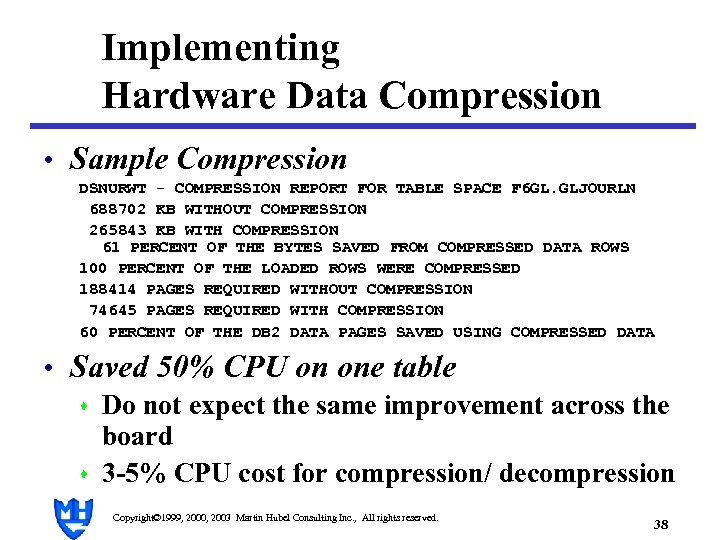
Implementing Hardware Data Compression • Sample Compression DSNURWT - COMPRESSION REPORT FOR TABLE SPACE F 6 GL. GLJOURLN 688702 KB WITHOUT COMPRESSION 265843 KB WITH COMPRESSION 61 PERCENT OF THE BYTES SAVED FROM COMPRESSED DATA ROWS 100 PERCENT OF THE LOADED ROWS WERE COMPRESSED 188414 PAGES REQUIRED WITHOUT COMPRESSION 74645 PAGES REQUIRED WITH COMPRESSION 60 PERCENT OF THE DB 2 DATA PAGES SAVED USING COMPRESSED DATA • Saved 50% CPU on one table s Do not expect the same improvement across the board s 3 -5% CPU cost for compression/ decompression Copyright© 1999, 2000, 2003 Martin Hubel Consulting Inc. , All rights reserved. 38
Physical Data Organization • Data in poor physical condition • Requires more getpages and physical I/O • Decreases buffer pool efficiency • Increases CPU usage • Schedule regular reorganizations for table spaces and indexes • Automate by threshold Copyright© 1999, 2000, 2003 Martin Hubel Consulting Inc. , All rights reserved. 39
The DB 2 Tuning Project • Driven by business need • Improve customer service • Avoid hardware upgrade • Reduce charge back costs • Often funded by business unit or application development • Tied to business benefit Copyright© 1999, 2000, 2003 Martin Hubel Consulting Inc. , All rights reserved. 40
The Project Team • Requires skills for several areas • DBA • Systems programming / capacity planning • Application development • Most resources are internal • Outside consulting help • Methodology and specific tuning expertise • Objectivity and viewpoint Copyright© 1999, 2000, 2003 Martin Hubel Consulting Inc. , All rights reserved. 41
Materials Needed • Hardware and software configuration • WLM Information • DSNZPARM • IRLM parameters • CICS attachment (RCT) parameters • Catalog information • Physical DB 2 design • Access to tool for reviewing database statistics • Historical statistics, if available Copyright© 1999, 2000, 2003 Martin Hubel Consulting Inc. , All rights reserved. 42
Materials Needed 1. Performance Monitor and System Configuration 1. Monthly subsystem statistics 2. Monthly accounting summary, or several typical days 3. Access to on-line monitor for reviewing DB 2 system configuration 2. Key programs / transactions 1. Code of one or two key programs to see the quality of SQL coding 2. SQL access patterns Copyright© 1999, 2000, 2003 Martin Hubel Consulting Inc. , All rights reserved. 43
Summary • DB 2 tuning techniques typically yield 30% improvement or more • First try techniques that avoid application coding changes • • • Buffer pools Index redesign Other areas such as data compression Copyright© 1999, 2000, 2003 Martin Hubel Consulting Inc. , All rights reserved. 44
Скачать презентацию Tuning Techniques To Maximize DB 2 Performance Martin
32a9f94337bc6be29a962f992d25d620.ppt