


 Скачать презентацию Tumour Matching N Ireland Experience Colin Fox IT
b54dba89d60302b6b6b60dabf6ebaf87.ppt
- Количество слайдов: 13
 Tumour Matching N. Ireland Experience Colin Fox (IT Manager) Richard Middleton (Data Manager)
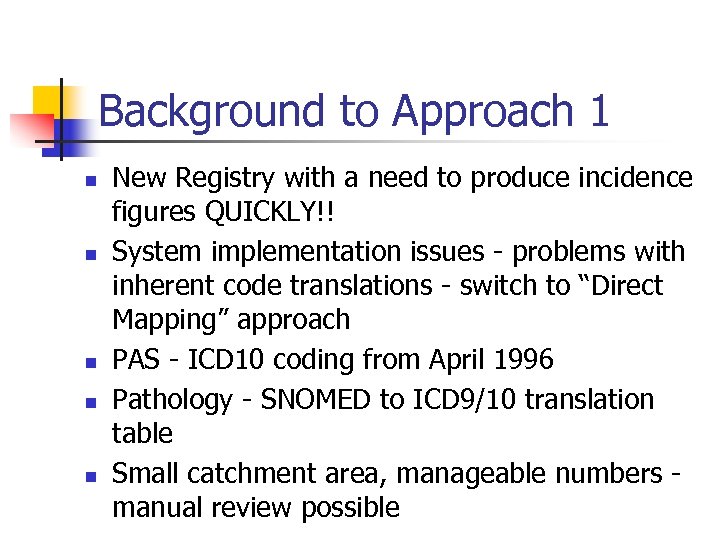 Background to Approach 1 n n n New Registry with a need to produce incidence figures QUICKLY!! System implementation issues - problems with inherent code translations - switch to “Direct Mapping” approach PAS - ICD 10 coding from April 1996 Pathology - SNOMED to ICD 9/10 translation table Small catchment area, manageable numbers manual review possible
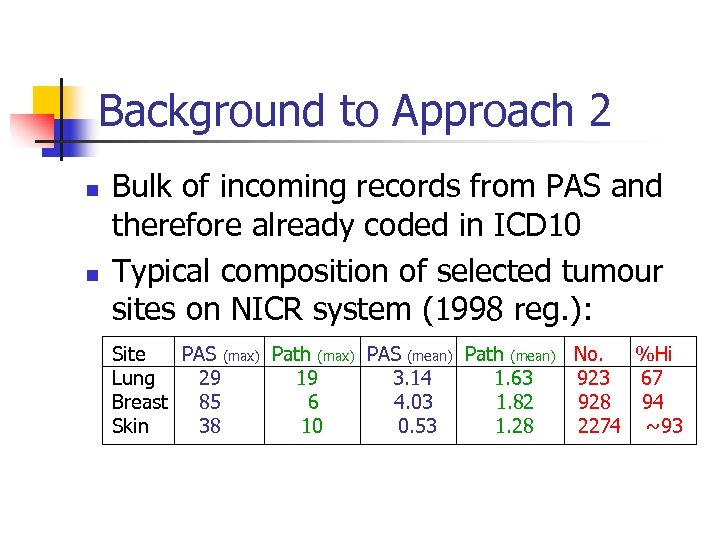 Background to Approach 2 n n Bulk of incoming records from PAS and therefore already coded in ICD 10 Typical composition of selected tumour sites on NICR system (1998 reg. ): Site PAS (max) Path (max) PAS (mean) Path (mean) No. %Hi Lung 29 19 3. 14 1. 63 923 67 Breast 85 6 4. 03 1. 82 928 94 Skin 38 10 0. 53 1. 28 2274 ~93
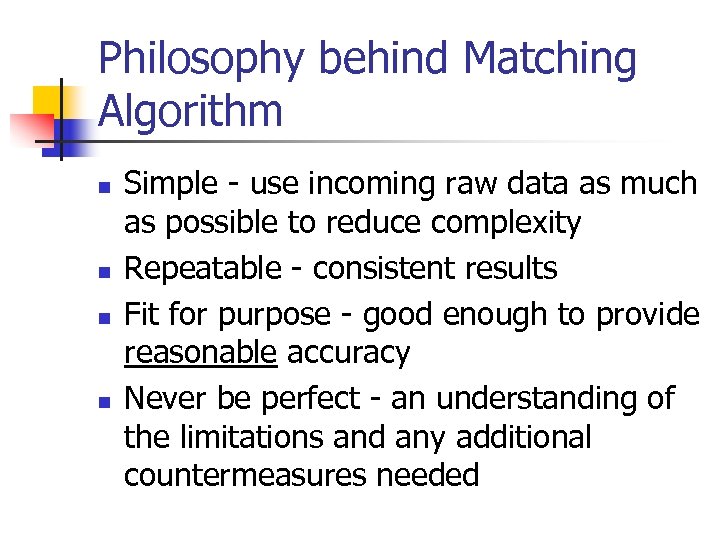 Philosophy behind Matching Algorithm n n Simple - use incoming raw data as much as possible to reduce complexity Repeatable - consistent results Fit for purpose - good enough to provide reasonable accuracy Never be perfect - an understanding of the limitations and any additional countermeasures needed
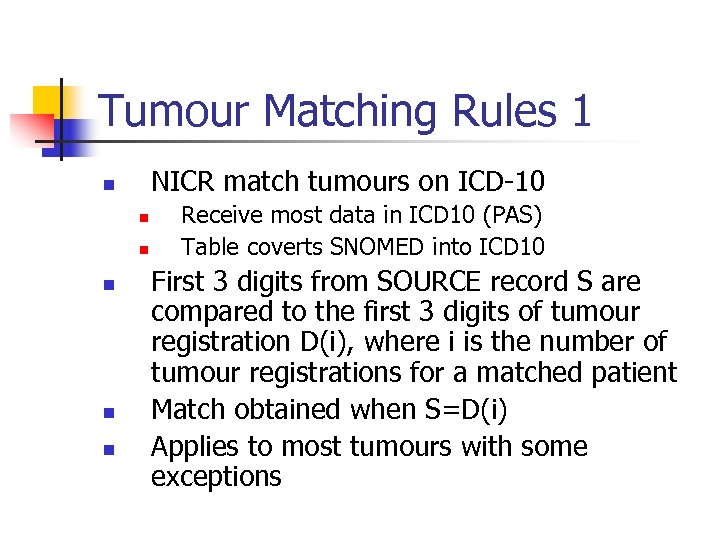 Tumour Matching Rules 1 NICR match tumours on ICD-10 n n n Receive most data in ICD 10 (PAS) Table coverts SNOMED into ICD 10 First 3 digits from SOURCE record S are compared to the first 3 digits of tumour registration D(i), where i is the number of tumour registrations for a matched patient Match obtained when S=D(i) Applies to most tumours with some exceptions
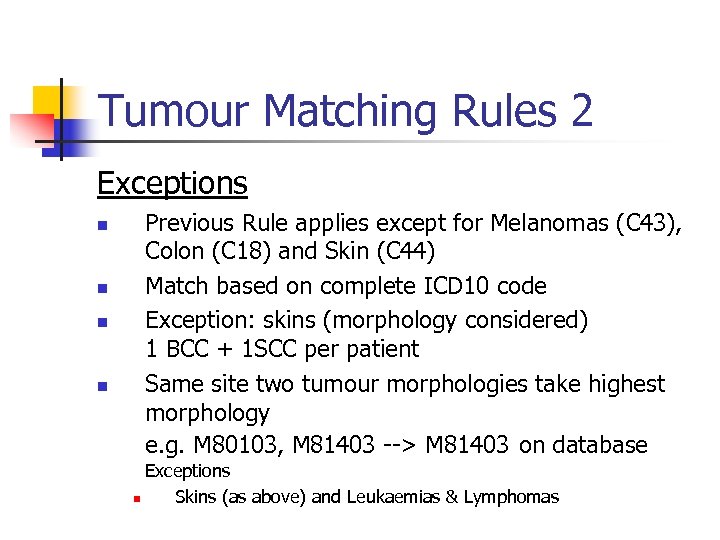 Tumour Matching Rules 2 Exceptions n n Previous Rule applies except for Melanomas (C 43), Colon (C 18) and Skin (C 44) Match based on complete ICD 10 code Exception: skins (morphology considered) 1 BCC + 1 SCC per patient Same site two tumour morphologies take highest morphology e. g. M 80103, M 81403 --> M 81403 on database Exceptions n Skins (as above) and Leukaemias & Lymphomas
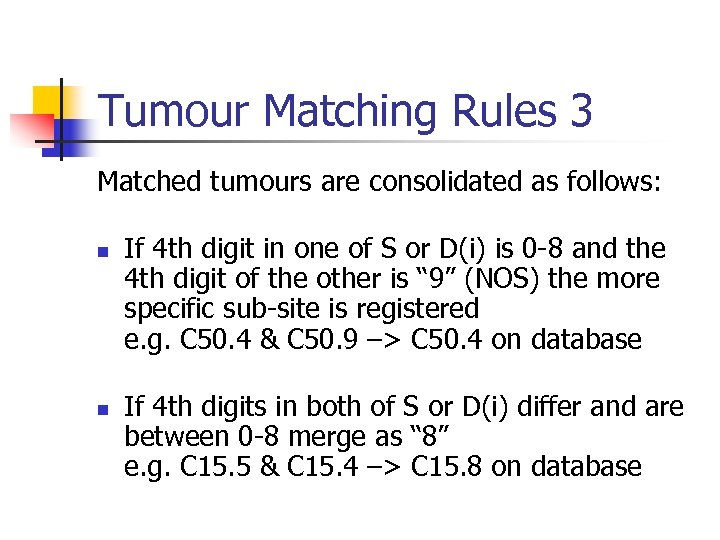 Tumour Matching Rules 3 Matched tumours are consolidated as follows: n n If 4 th digit in one of S or D(i) is 0 -8 and the 4 th digit of the other is “ 9” (NOS) the more specific sub-site is registered e. g. C 50. 4 & C 50. 9 –> C 50. 4 on database If 4 th digits in both of S or D(i) differ and are between 0 -8 merge as “ 8” e. g. C 15. 5 & C 15. 4 –> C 15. 8 on database
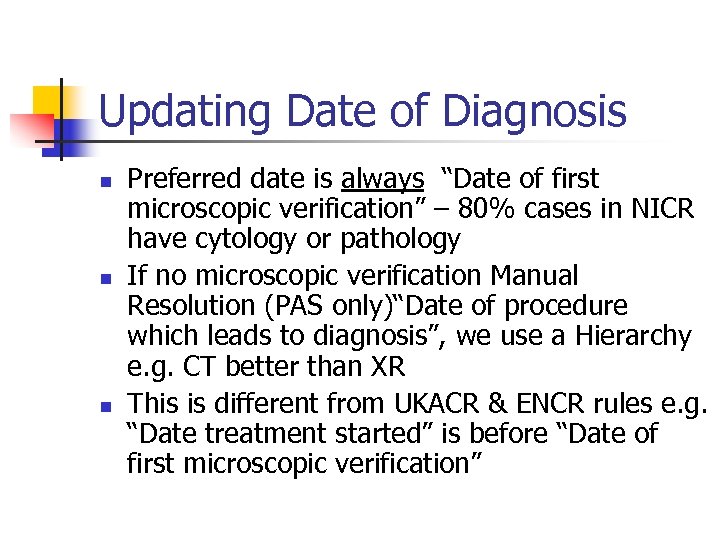 Updating Date of Diagnosis n n n Preferred date is always “Date of first microscopic verification” – 80% cases in NICR have cytology or pathology If no microscopic verification Manual Resolution (PAS only)“Date of procedure which leads to diagnosis”, we use a Hierarchy e. g. CT better than XR This is different from UKACR & ENCR rules e. g. “Date treatment started” is before “Date of first microscopic verification”
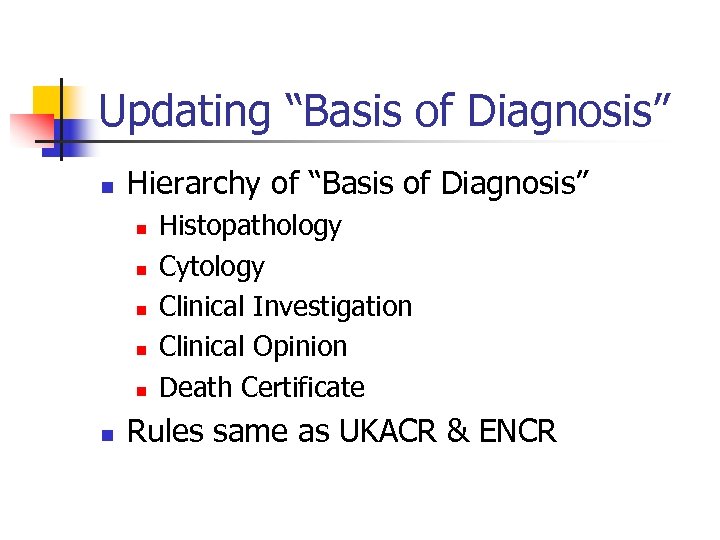 Updating “Basis of Diagnosis” n Hierarchy of “Basis of Diagnosis” n n n Histopathology Cytology Clinical Investigation Clinical Opinion Death Certificate Rules same as UKACR & ENCR
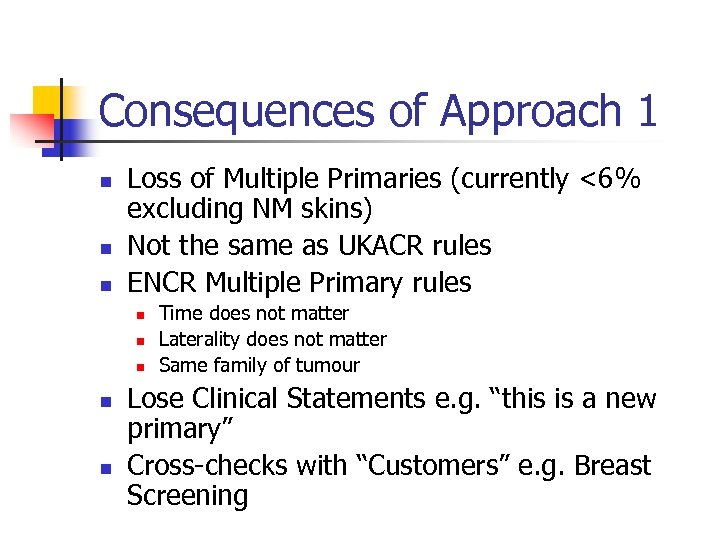 Consequences of Approach 1 n n n Loss of Multiple Primaries (currently <6% excluding NM skins) Not the same as UKACR rules ENCR Multiple Primary rules n n n Time does not matter Laterality does not matter Same family of tumour Lose Clinical Statements e. g. “this is a new primary” Cross-checks with “Customers” e. g. Breast Screening
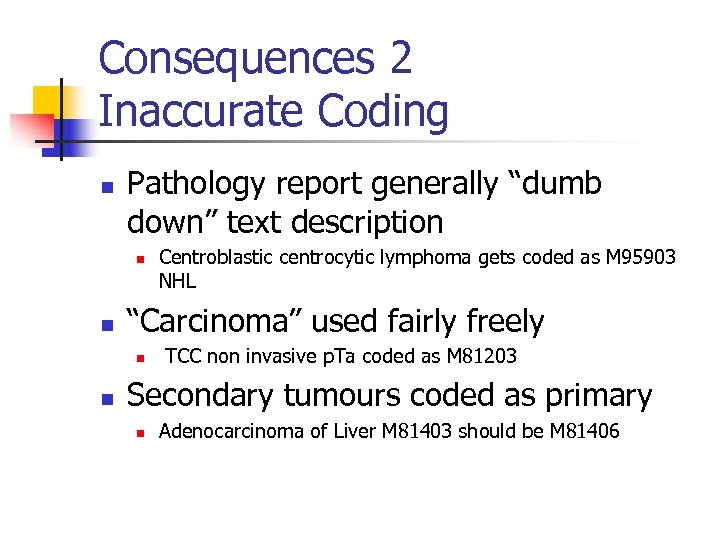 Consequences 2 Inaccurate Coding n Pathology report generally “dumb down” text description n n “Carcinoma” used fairly freely n n Centroblastic centrocytic lymphoma gets coded as M 95903 NHL TCC non invasive p. Ta coded as M 81203 Secondary tumours coded as primary n Adenocarcinoma of Liver M 81403 should be M 81406
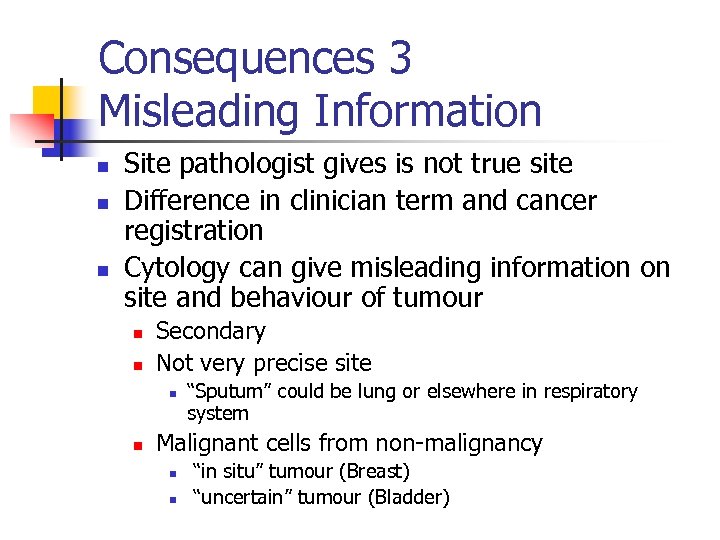 Consequences 3 Misleading Information n Site pathologist gives is not true site Difference in clinician term and cancer registration Cytology can give misleading information on site and behaviour of tumour n n Secondary Not very precise site n n “Sputum” could be lung or elsewhere in respiratory system Malignant cells from non-malignancy n n “in situ” tumour (Breast) “uncertain” tumour (Bladder)
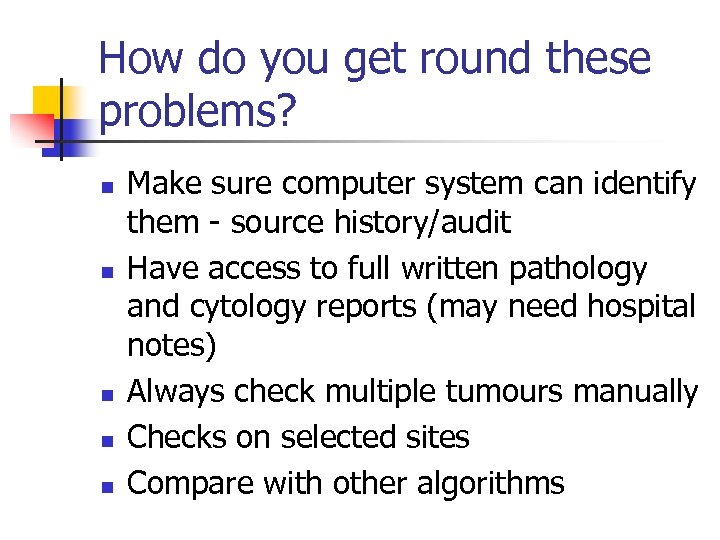 How do you get round these problems? n n n Make sure computer system can identify them - source history/audit Have access to full written pathology and cytology reports (may need hospital notes) Always check multiple tumours manually Checks on selected sites Compare with other algorithms