 Скачать презентацию Tuberculosis Disease by Konrad T Juszkiewicz MD MPH
Tuberculosis disease.ppt
- Количество слайдов: 10




Tuberculosis Disease by Konrad T Juszkiewicz, MD, MPH Donald Burgess, Ph. D DRK Biomedical Research and Development LLC Almaty, November, 2013

Tuberculosis – Clinical Features q Localized type may be asymptomatic q Low grade remittent fever, night sweats, malaise, anorexia, weight loss q Sputum at first mucoid and later purulent q q Haemoptysis in half of the patients q Pleuretic pain
Tuberculosis – Diagnosis q History, physical examination, radiological findings “consolidation & cavitation” q Identification of the acid-fast bacilli in smears and culture of sputum “ 10 weeks” q PCR amplification of M. tuberculosis DNA

Tuberculosis – Prognosis q Depends on: ü The extent of the disease and the patient immune status q Secondary amyloidosis may occur in persistent cases
Tuberculosis – Chronic Consequences 1. Pulmonary fibrosis v The lung lesions may heal with fibrosis at any stage, particularly with treatment v This ranges from minor apical scarring to extensive and severe widespread fibrosis producing localized to widespread honey-comb appearance of the lung tissue. It is particularly seen in relapsing and progressive untreated disease v This is complicated by respiratory failure & cor pulmonale 2. Pleural fibrosis v Fibrosis commonly obliterate the pleural space 3. Bronchiectasis v Damage to the bronchial walls and scarring can cause distal pulmonary collapse, secondary infection and bronchiectasis

Infection in Immunocompromised Individuals q Mycobacterial infection of all types are increased in immunocompromised individuals and is in most cases due to reactivation of latent infection q Features are similar to infection in immunocompetent individuals but disease usually progresses more rapidly due to rapidly decreased host response

Atypical Mycobacterial Infection q These infections are caused by a group of non-tuberculous mycobacteria of which the most important types are M. aviumintracellulare and M. kanasii intracellulare kanasii q The organisms are widely distributed in soil, water & domestic animals q Infection is acquired directly from the environment and not environment by case to case contact q Infection by these organisms is seen in immunocompromised patients particularly AIDS q. It can be seen also in immunocompetent individuals with chronic pulmonary disease
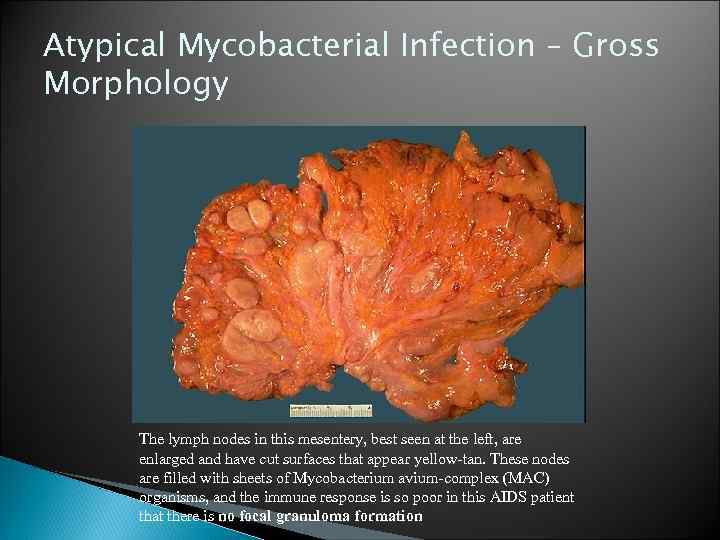
Atypical Mycobacterial Infection – Gross Morphology The lymph nodes in this mesentery, best seen at the left, are enlarged and have cut surfaces that appear yellow-tan. These nodes are filled with sheets of Mycobacterium avium-complex (MAC) organisms, and the immune response is so poor in this AIDS patient that there is no focal granuloma formation
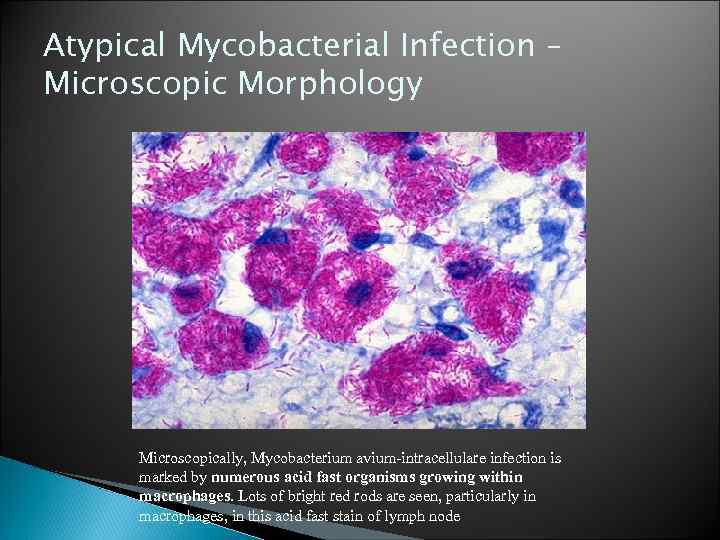
Atypical Mycobacterial Infection – Microscopic Morphology Microscopically, Mycobacterium avium-intracellulare infection is marked by numerous acid fast organisms growing within macrophages. Lots of bright red rods are seen, particularly in macrophages, in this acid fast stain of lymph node

Thanks Spasiba Rakhmet Deburgess@drkbiomed. org Kjuszkiewicz@drkbiomed. org Cell. : +7 701 218 2377
Скачать презентацию Tuberculosis Disease by Konrad T Juszkiewicz MD MPH
Tuberculosis disease.ppt