 Скачать презентацию TU e eindhovenuniversity of technology Engineering Semantic Web Information
563085f65f54774de45662455aced8cc.ppt
- Количество слайдов: 26



TU/e eindhovenuniversity of technology Engineering Semantic Web Information Systems Richard Vdovjak Flavius Frasincar Geert-Jan Houben Peter Barna Databases & Hypermedia Group Department of Computer Science /dept. of mathematics and computer science July 2003 PACIS'03 wwwis. win. tue. nl/~hera 1
TU/e eindhovenuniversity of technology Overview • • • Motivating example: Virtual art gallery Hera framework, models and technologies Hera Back-end: Integration engine Hera front-end: Presentation generation engine Summary and future work 2 July 2003 PACIS'03
TU/e eindhovenuniversity of technology Virtual art gallery WIS • Create “on-the-fly” exhibitions – painters, paintings, techniques. . . • • Many to many content delivery Triggered by the user query Exhibits (Images) are from (online) Art catalogues Descriptions are gathered from an (online) Art Encyclopedia 3 July 2003 PACIS'03
TU/e eindhovenuniversity of technology We need a framework that offers • Semantics – Express concepts and their hierarchies – Relationships among the concepts – Query language that can exploit the above • Access to several sources – Flexible source management – Flexible query mediation • User/platform adaptation – (adaptability and adaptivity) • Automated presentation design – Based on the user query, – Device profiles and the browsing history 4 July 2003 PACIS'03
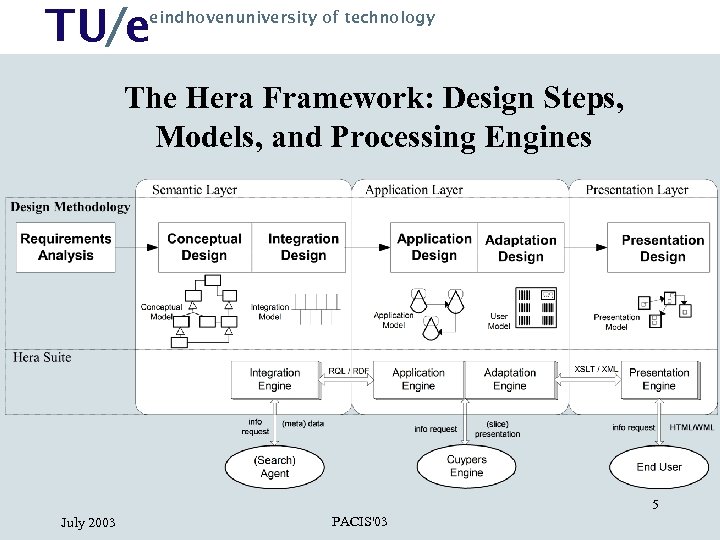
TU/e eindhovenuniversity of technology The Hera Framework: Design Steps, Models, and Processing Engines 5 July 2003 PACIS'03
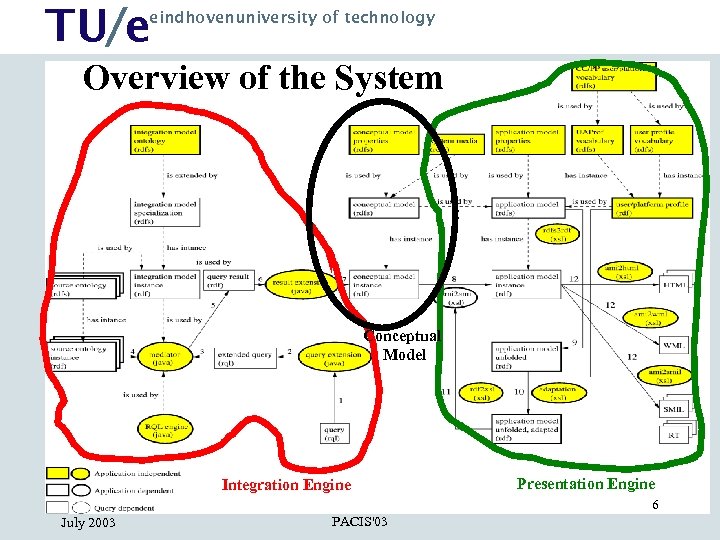
TU/e eindhovenuniversity of technology Overview of the System Conceptual Model Integration Engine Presentation Engine 6 July 2003 PACIS'03
TU/e eindhovenuniversity of technology Conceptual Model (CM) • Provides a uniform semantic view over different data sources that are integrated within a given Web application • Consists of hierarchies of concepts relevant within the given domain, their properties, and relations • Encoded in RDF(S) 7 July 2003 PACIS'03
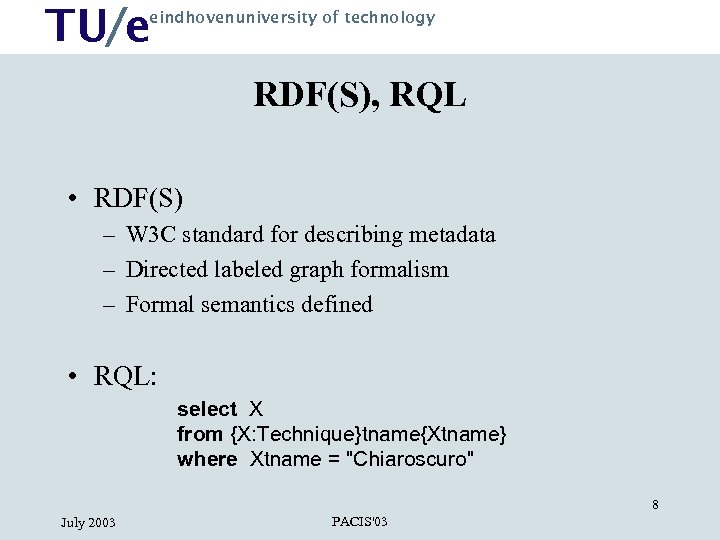
TU/e eindhovenuniversity of technology RDF(S), RQL • RDF(S) – W 3 C standard for describing metadata – Directed labeled graph formalism – Formal semantics defined • RQL: select X from {X: Technique}tname{Xtname} where Xtname = "Chiaroscuro" 8 July 2003 PACIS'03
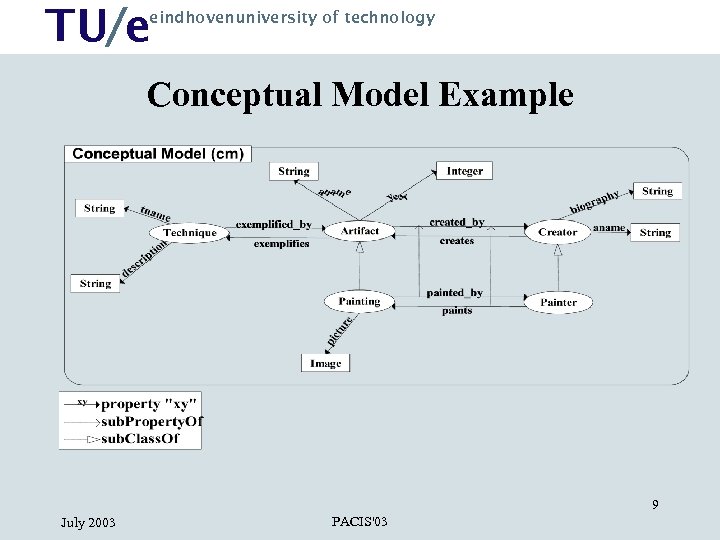
TU/e eindhovenuniversity of technology Conceptual Model Example 9 July 2003 PACIS'03
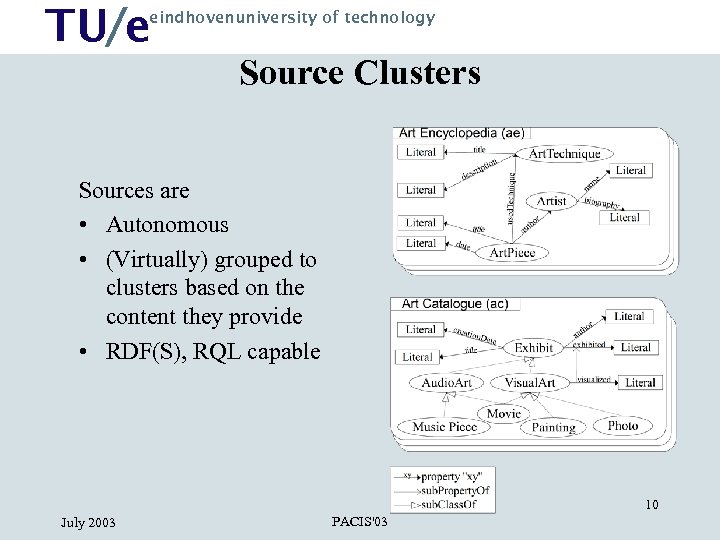
TU/e eindhovenuniversity of technology Source Clusters Sources are • Autonomous • (Virtually) grouped to clusters based on the content they provide • RDF(S), RQL capable 10 July 2003 PACIS'03
TU/e eindhovenuniversity of technology Integration Model IM decouples the CM and Sources • Articulations – actual links between the CM and the source ontologies – concept/instance uniqueness – (a part of it) serves as a query on the source side • Decorations – – offer a way to rank sources within the same cluster capture explicitly designer’s knowledge about sources the order in which the sources are consulted is flexible open possibilities for queries with constraints e. g. “I’m interested in the answer within 1 s, otherwise forget it” 11 July 2003 PACIS'03
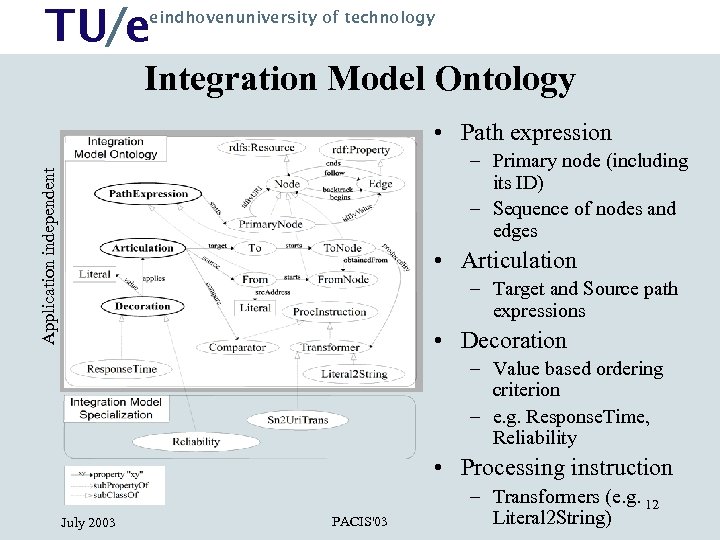
TU/e eindhovenuniversity of technology Integration Model Ontology • Path expression Application independent – Primary node (including its ID) – Sequence of nodes and edges • Articulation – Target and Source path expressions • Decoration – Value based ordering criterion – e. g. Response. Time, Reliability • Processing instruction July 2003 PACIS'03 – Transformers (e. g. 12 Literal 2 String)
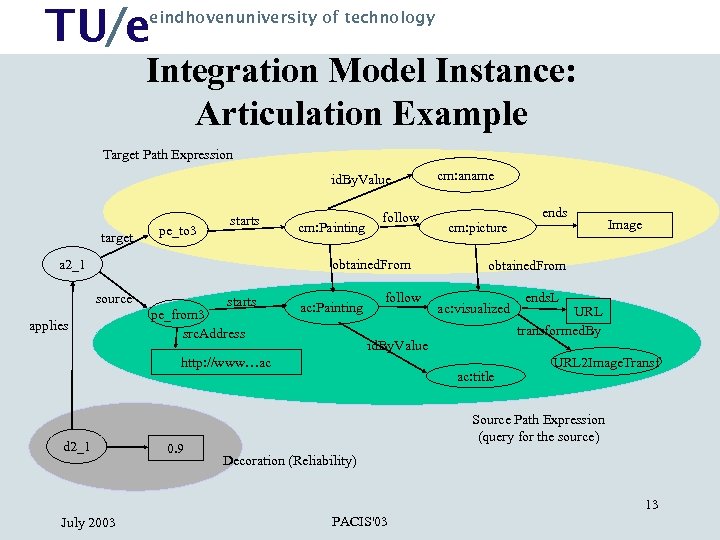
TU/e eindhovenuniversity of technology Integration Model Instance: Articulation Example Target Path Expression id. By. Value target pe_to 3 starts a 2_1 cm: Painting follow obtained. From source applies starts pe_from 3 src. Address ac: Painting follow 0. 9 cm: picture ends Image obtained. From ac: visualized id. By. Value http: //www…ac d 2_1 cm: aname ac: title ends. L URL transformed. By URL 2 Image. Transf Source Path Expression (query for the source) Decoration (Reliability) 13 July 2003 PACIS'03
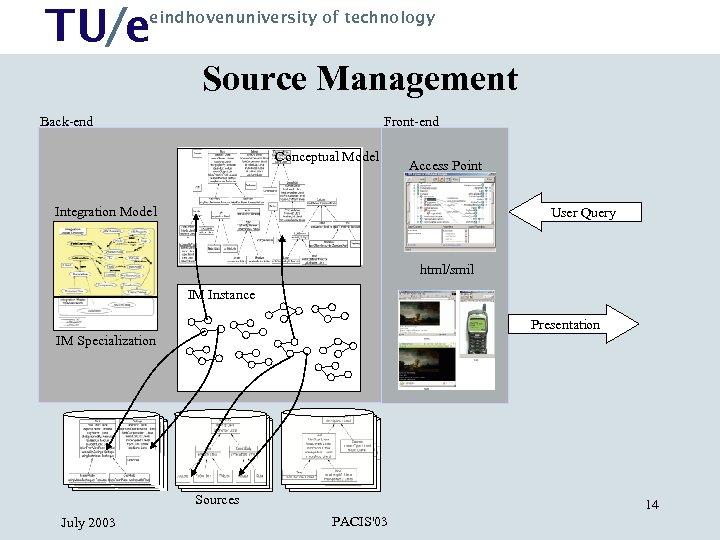
TU/e eindhovenuniversity of technology Source Management Front-end Back-end Conceptual Model Access Point Integration Model User Query html/smil IM Instance Presentation IM Specialization Sources July 2003 14 PACIS'03
TU/e eindhovenuniversity of technology Query answering • Query mediation – For every variable in the query find articulations in the IM instance pool – If there more articulations for one variable sort them based on the chosen decoration(s) – Execute the “source” path expression queries at the sources – Perform the required processing instruction/data transformations – Assemble the results 15 July 2003 PACIS'03
TU/e eindhovenuniversity of technology Application Model (AM) • AM serves as a presentation blue-print • Describes hypermedia aspects of the presentation. • Captures the navigational view over the CM • Consists of (nested) slices and slice relationships – Slices - meaningful presentation units • Associated to concepts from the CM • Contain properties and possibly other slices (nesting) – Slice relationships: • Aggregation relationships: index, tour, indexed guided tour… • Reference relationships: link with an anchor specified. • Encoded in RDF(S). 16 July 2003 PACIS'03
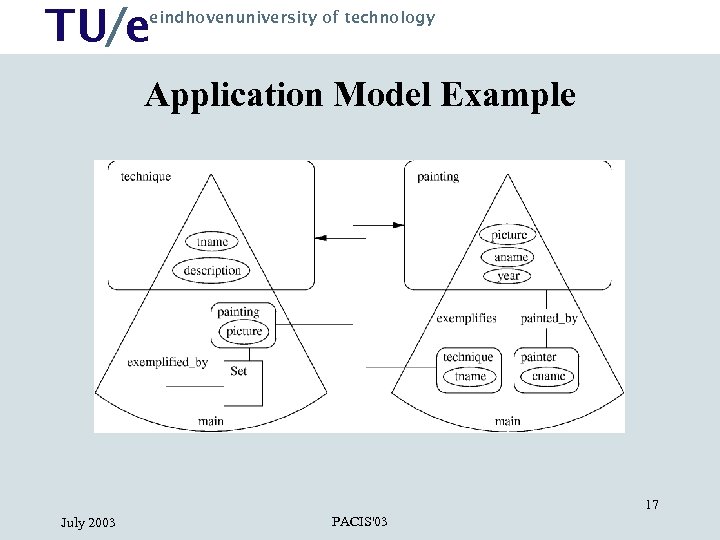
TU/e eindhovenuniversity of technology Application Model Example 17 July 2003 PACIS'03
TU/e eindhovenuniversity of technology Adaptation/User Model • Captures two kinds of adaptation – Adaptability takes into account the situation in which the user will use the presentation (e. g. the browsing platform). – Adaptivity means that the presentation changes itself according to the “state of the user’s mind” while being browsed. • Consists of – Device/User Profile captures “static” visual and platform preferences encoded in CC/PP. – User Session represents the dynamic user’s state, e. g. did the user visit (learn) this slice (concept). – Application and Update Rules describe the behavior of the presentation (e. g. conditional slices in AM) and keep the User Session up-to-date (AHAM rules). 18 July 2003 PACIS'03
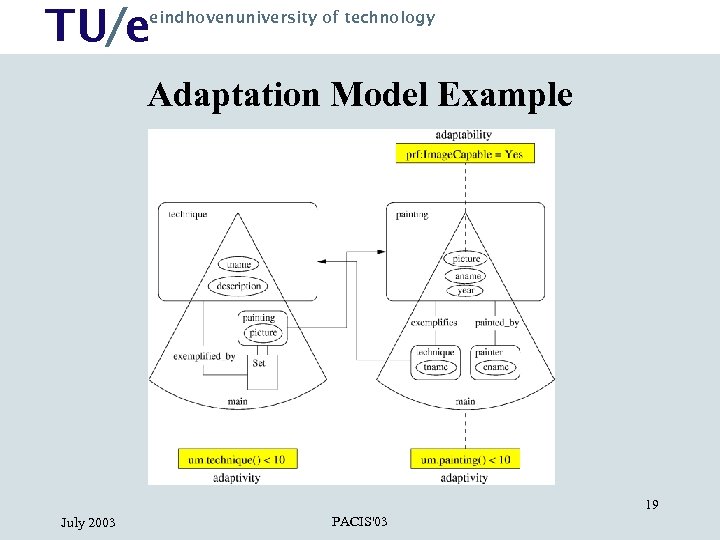
TU/e eindhovenuniversity of technology Adaptation Model Example 19 July 2003 PACIS'03
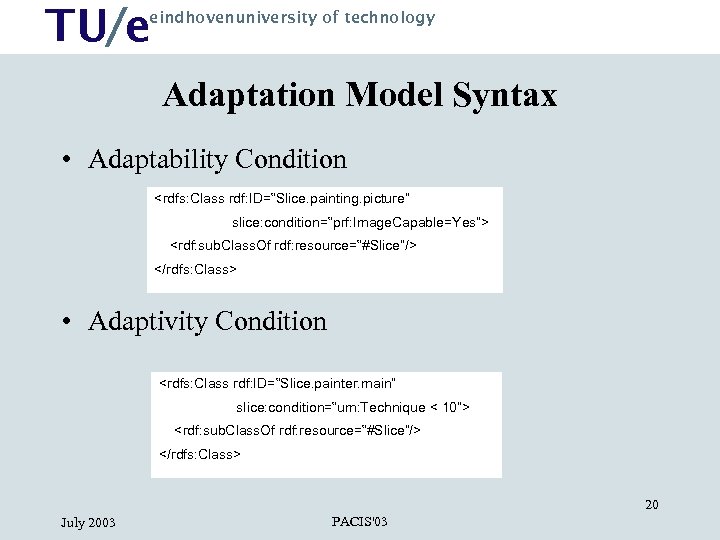
TU/e eindhovenuniversity of technology Adaptation Model Syntax • Adaptability Condition <rdfs: Class rdf: ID=“Slice. painting. picture” slice: condition=“prf: Image. Capable=Yes”> <rdf: sub. Class. Of rdf: resource=“#Slice”/> </rdfs: Class> • Adaptivity Condition <rdfs: Class rdf: ID=“Slice. painter. main” slice: condition=“um: Technique < 10”> <rdf: sub. Class. Of rdf: resource=“#Slice”/> </rdfs: Class> 20 July 2003 PACIS'03
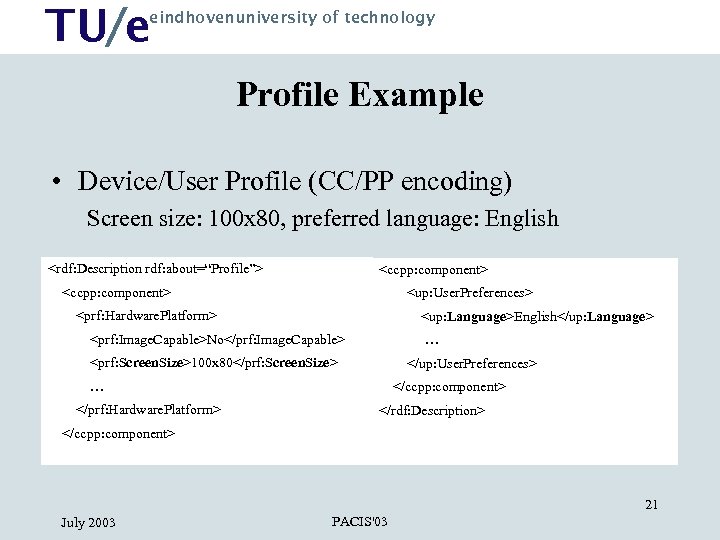
TU/e eindhovenuniversity of technology Profile Example • Device/User Profile (CC/PP encoding) Screen size: 100 x 80, preferred language: English <rdf: Description rdf: about=“Profile”> <ccpp: component> <up: User. Preferences> <prf: Hardware. Platform> <up: Language>English</up: Language> <prf: Image. Capable>No</prf: Image. Capable> … <prf: Screen. Size>100 x 80</prf: Screen. Size> </up: User. Preferences> … </prf: Hardware. Platform> </ccpp: component> </rdf: Description> </ccpp: component> 21 July 2003 PACIS'03
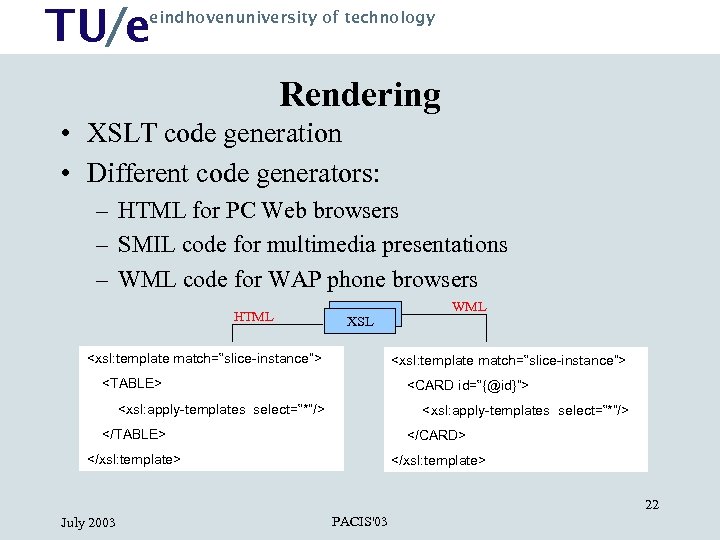
TU/e eindhovenuniversity of technology Rendering • XSLT code generation • Different code generators: – HTML for PC Web browsers – SMIL code for multimedia presentations – WML code for WAP phone browsers HTML XSL <xsl: template match=“slice-instance”> WML <xsl: template match=“slice-instance”> <TABLE> <CARD id=“{@id}”> <xsl: apply-templates select=“*”/> </TABLE> </CARD> </xsl: template> 22 July 2003 PACIS'03
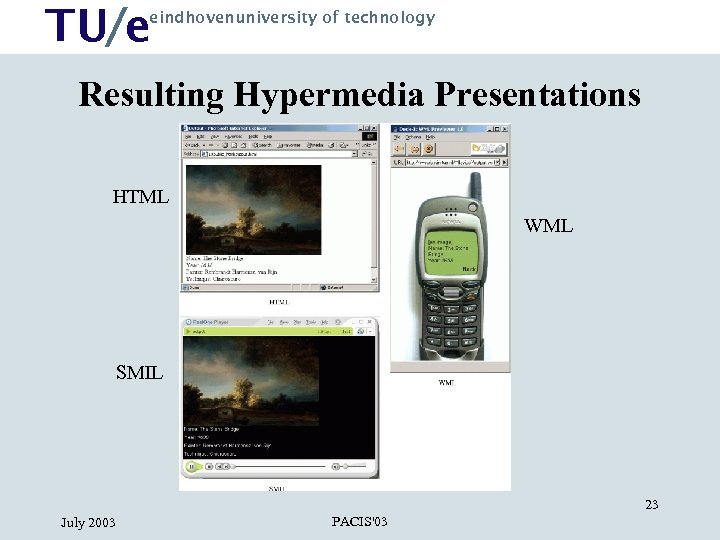
TU/e eindhovenuniversity of technology Resulting Hypermedia Presentations HTML WML SMIL 23 July 2003 PACIS'03
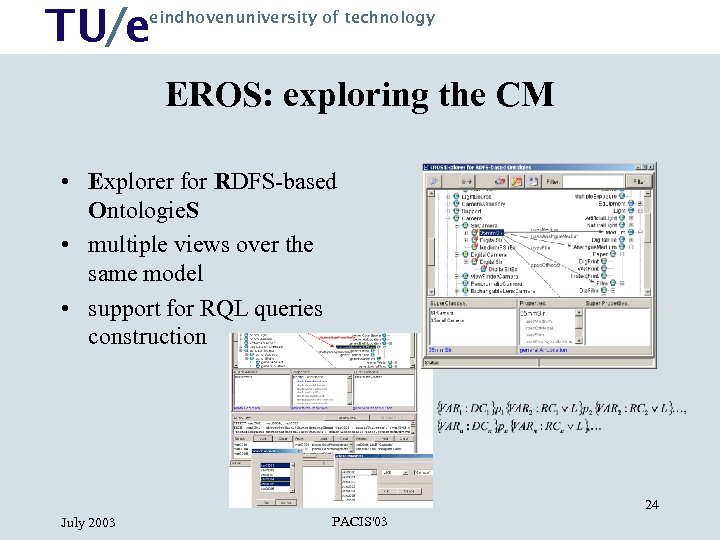
TU/e eindhovenuniversity of technology EROS: exploring the CM • Explorer for RDFS-based Ontologie. S • multiple views over the same model • support for RQL queries construction 24 July 2003 PACIS'03
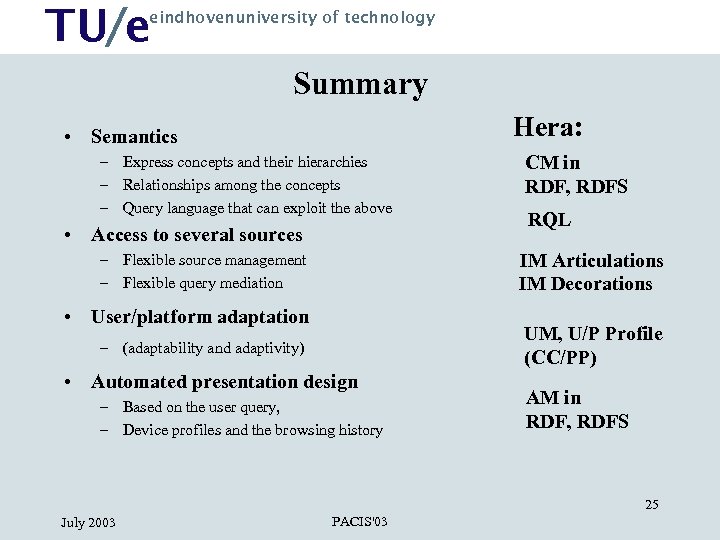
TU/e eindhovenuniversity of technology Summary Hera: • Semantics – Express concepts and their hierarchies – Relationships among the concepts – Query language that can exploit the above • Access to several sources CM in RDF, RDFS RQL IM Articulations IM Decorations – Flexible source management – Flexible query mediation • User/platform adaptation UM, U/P Profile (CC/PP) – (adaptability and adaptivity) • Automated presentation design – Based on the user query, – Device profiles and the browsing history AM in RDF, RDFS 25 July 2003 PACIS'03
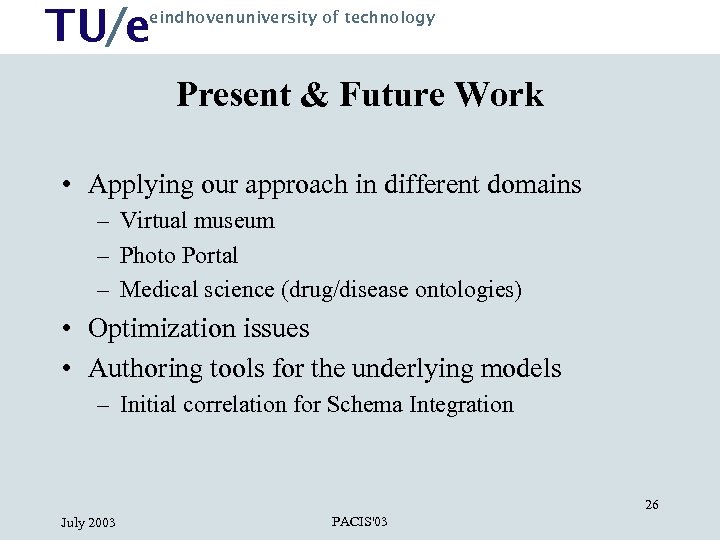
TU/e eindhovenuniversity of technology Present & Future Work • Applying our approach in different domains – Virtual museum – Photo Portal – Medical science (drug/disease ontologies) • Optimization issues • Authoring tools for the underlying models – Initial correlation for Schema Integration 26 July 2003 PACIS'03
Скачать презентацию TU e eindhovenuniversity of technology Engineering Semantic Web Information
563085f65f54774de45662455aced8cc.ppt