


 Скачать презентацию TTCN-3 Testing and Test Control Notation Version 3
674e01f7ba6e32f6a28c39a49d7b4bb7.ppt
- Количество слайдов: 17
 TTCN-3 Testing and Test Control Notation Version 3
 What is TTCN-3? TTCN-3 is a test scripting language TTCN-3 is an international standard TTCN-3's main feature is the separation of concern between Abstract Test Suites and the Adapter Layer which allows full portability of test suites and thus make them independent of any platform implementation. The test adapter handles all platform and implementation languages (java, C, C++) issues for the communication with a System Under Test and also the actual coding and decoding requirements of an application. TTCN-3 has a powerfull matching mechanism
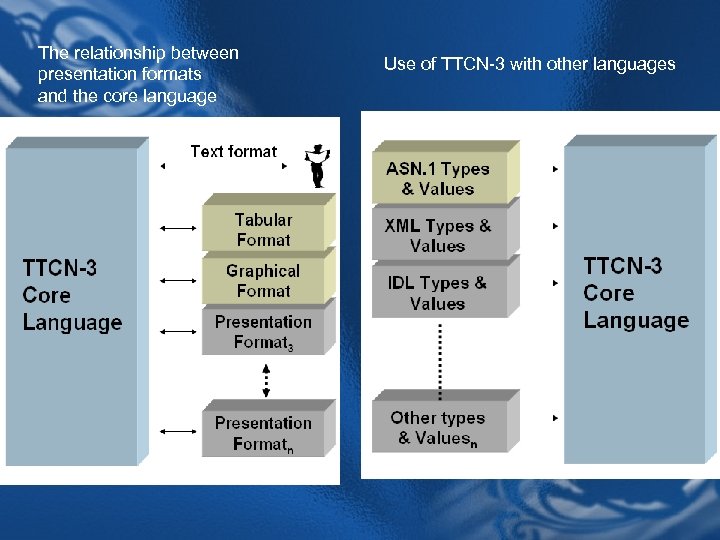 The relationship between presentation formats and the core language Use of TTCN-3 with other languages
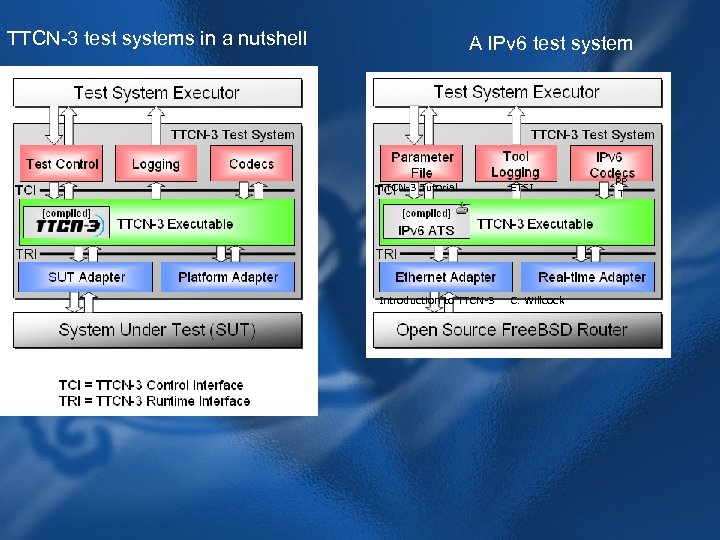
 TTCN-3 TEST SYSTEMS • Codecs. The messages defined in our tests need to be encoded into some format that is understood by the SUT before they are sent. Conversely, received messages will be decoded from their encoded form into TTCN-3 value representation. • SUT adaptation. All our message exchanges in the abstract test suite are defined as operations referring to a specific port. The mapping of what a TTCN-3 ports actually represent in the real world, and the mapping between TTCN-3’s communication mechanism and that of the SUT, need to be done in the SUT adapter. • Platform adaptation. To handle situations when messages go missing, we have introduced the use of timers. As timers are implemented differently on different platforms and in different testing scenarios. The calling of TTCN-3 external functions is also platform specific and hence also needs to be provided by the test system developer. • Test management. TTCN-3 provides the test developer with a control part to specify the order in which the tests in the test suite should be executed. This is an acceptable approach for stable test environments, where the tests and their order seldom change.
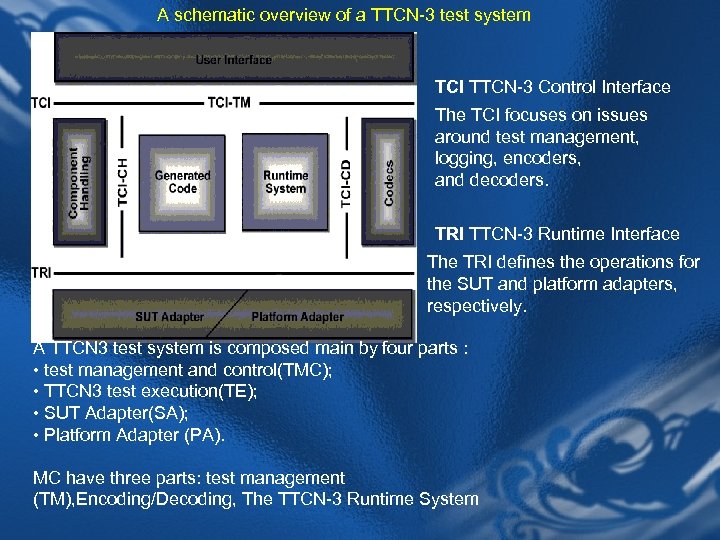 A schematic overview of a TTCN-3 test system TCI TTCN-3 Control Interface The TCI focuses on issues around test management, logging, encoders, and decoders. TRI TTCN-3 Runtime Interface The TRI defines the operations for the SUT and platform adapters, respectively. A TTCN 3 test system is composed main by four parts : • test management and control(TMC); • TTCN 3 test execution(TE); • SUT Adapter(SA); • Platform Adapter (PA). MC have three parts: test management (TM), Encoding/Decoding, The TTCN-3 Runtime System
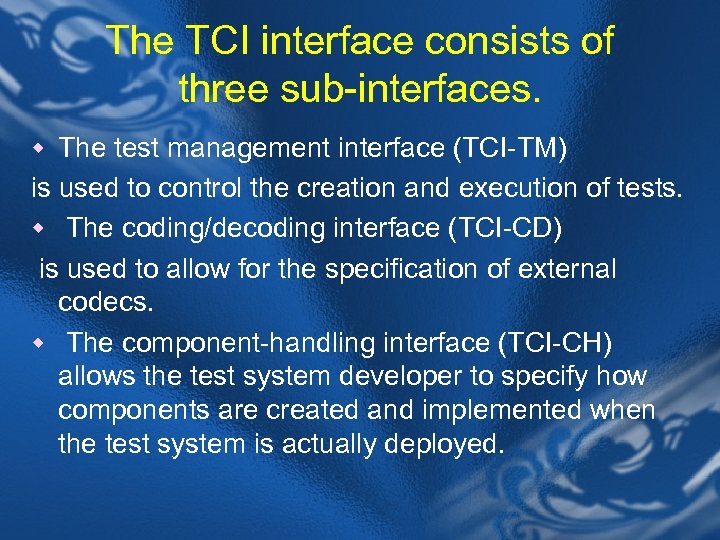 The TCI interface consists of three sub-interfaces. w The test management interface (TCI-TM) is used to control the creation and execution of tests. w The coding/decoding interface (TCI-CD) is used to allow for the specification of external codecs. w The component-handling interface (TCI-CH) allows the test system developer to specify how components are created and implemented when the test system is actually deployed.
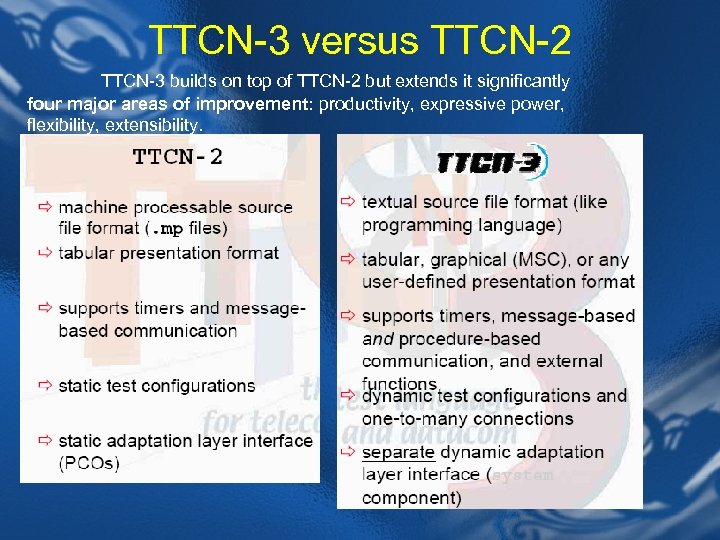 TTCN-3 versus TTCN-2 TTCN-3 builds on top of TTCN-2 but extends it significantly four major areas of improvement: productivity, expressive power, flexibility, extensibility.
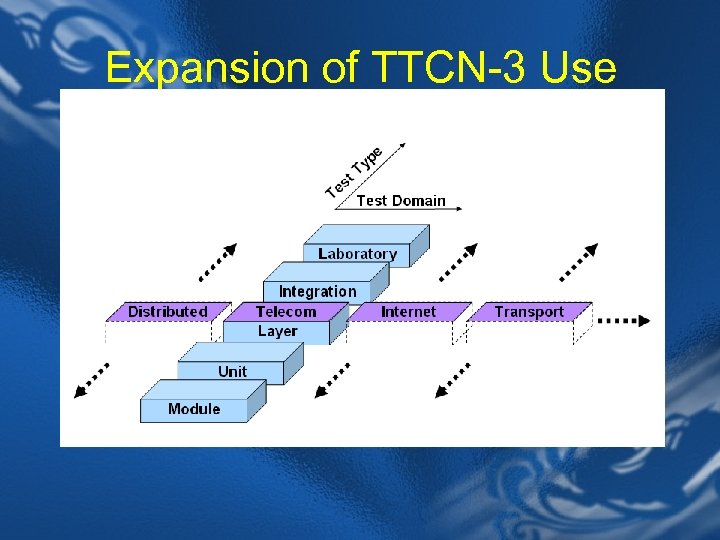
 The future of TTCN-3 TTCN from 2 to 3 is the qualitative change Form single domain to various domain TTCN-3 Advantages • Extend usability of TTCN-2 • powerful features, e. g. different communication mechanisms • intended for several application areas • presentation formats independent of core language • standardized interfaces • Do not reinvent • retain proven concepts of TTCN-2 • retain TTCN-2 expertise of developers
 TTCN-3 test systems in a nutshell A IPv 6 test system TTCN-3 Tutorial ETSI Introduction to TTCN-3 C. Willcock PP T
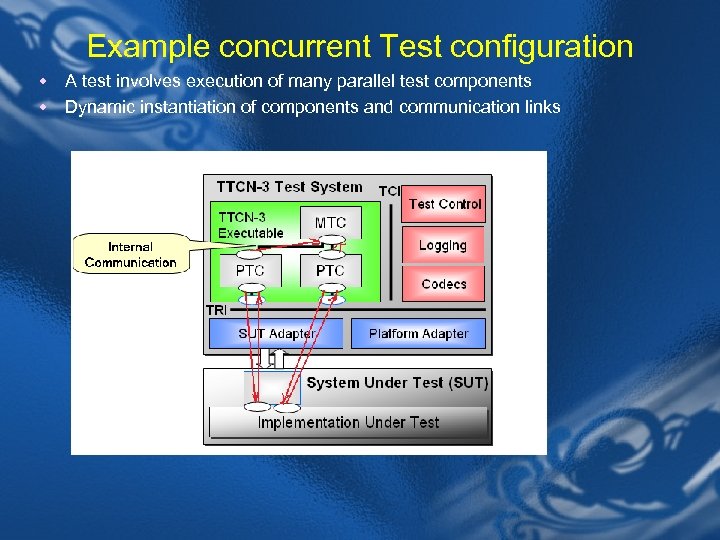 Example concurrent Test configuration A test involves execution of many parallel test components w Dynamic instantiation of components and communication links w
 Expansion of TTCN-3 Use
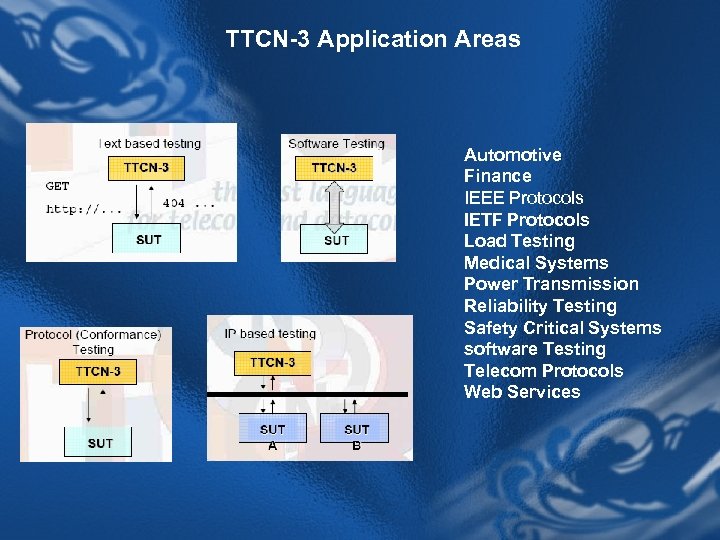 TTCN-3 Application Areas Automotive Finance IEEE Protocols IETF Protocols Load Testing Medical Systems Power Transmission Reliability Testing Safety Critical Systems software Testing Telecom Protocols Web Services
 TTCN-3’s two major strengths w Its unique and powerful testing concepts w its standardized interfaces. The advanced testing concepts in TTCN-3 such as ports for message- and procedure-based communication, timers, concurrency, test verdicts, and implicit templates matching provide an efficient and abstract way to specify the behaviour of the test systems. The standardized interfaces TCI and TRI allow adaptation of TTCN-3 test systems to virtually any kind of SUT.
 Basic TTCN-3 w TTCN-3 source code is written in modules, which are separated into w w • w w a definitions part, where data types, functions, and constants are defined, and a control part that describes the dynamic behaviour of the tests that should run. We have introduced functions as scope units that can be called from expressions, other functions, or the control part. They may compute results depending on input parameters and may return a value that is the result of this computation. We have also introduced a small number of basic types and explained how to create new subtypes and arrays. We have seen that types and subtypes can be used to declare variables or constants. We have shown that expressions in TTCN-3 can be written with different operators that combine compatible values, and they can be used to directly assign the result to variables. Lastly, we have seen that in TTCN-3 we can direct the program flow with conditional or loop statements.
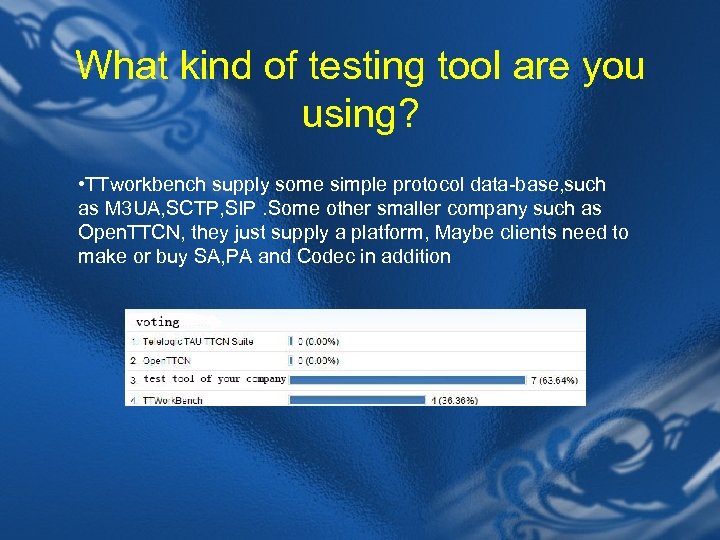 What kind of testing tool are you using? • TTworkbench supply some simple protocol data-base, such as M 3 UA, SCTP, SIP. Some other smaller company such as Open. TTCN, they just supply a platform, Maybe clients need to make or buy SA, PA and Codec in addition
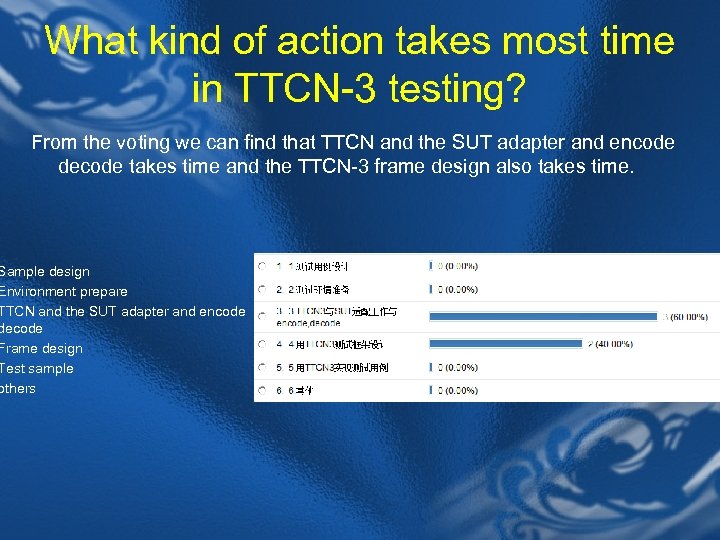 What kind of action takes most time in TTCN-3 testing? From the voting we can find that TTCN and the SUT adapter and encode decode takes time and the TTCN-3 frame design also takes time. Sample design Environment prepare TTCN and the SUT adapter and encode decode Frame design Test sample others
 reference w http: //www. ttcntest. com/forumdisplay. php? fi w w d=4 http: //www. ttcn-3. org/ TTCN-3 Tutorial ETSI PPTIntroduction to TTCN-3 C. Willcock John. Wiley. and. Sons. An. Introduction. to. TT CN. 3. Jun. 2005. e. Book-DDU. rar