


 Скачать презентацию TT Centrum för talteknologi Multi-modal expression of Swedish
2fdd21d34301350c9d5a22518a47e5fa.ppt
- Количество слайдов: 36
 TT Centrum för talteknologi Multi-modal expression of Swedish prominence Björn Granström Centre for Speech Technology, Department of Speech, Music and Hearing, KTH, Stockholm, Sweden
 Historical background • Prosody for speech synthesis at KTH, together with Rolf Carlson • The Lund intonation model – Gösta Bruce et al.
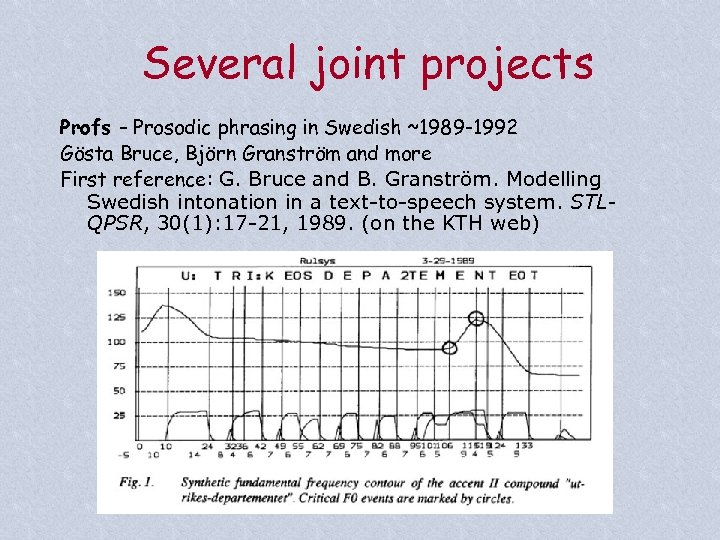 Several joint projects Profs – Prosodic phrasing in Swedish ~1989 -1992 Gösta Bruce, Björn Granström and more First reference: G. Bruce and B. Granström. Modelling Swedish intonation in a text-to-speech system. STLQPSR, 30(1): 17 -21, 1989. (on the KTH web)
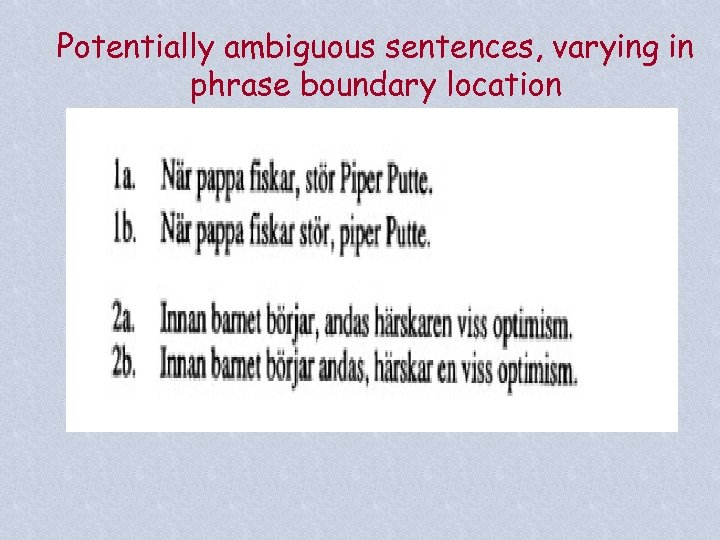 Potentially ambiguous sentences, varying in phrase boundary location
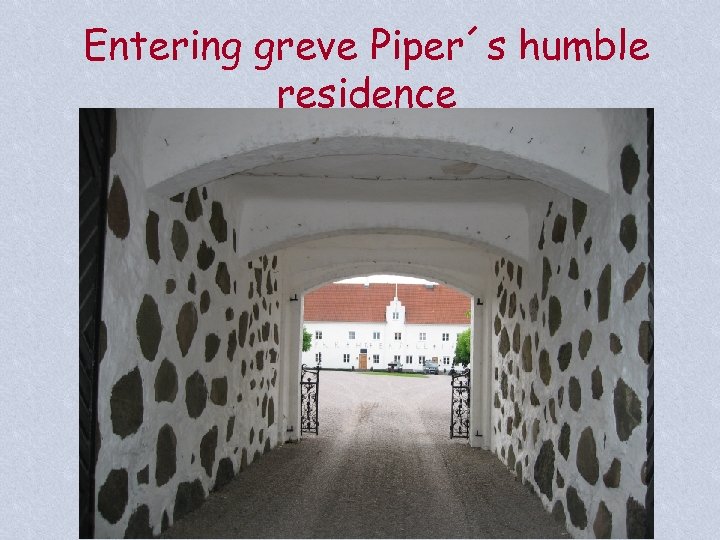 Entering greve Piper´s humble residence
 Several joint projects, cont. Prosodiag - Prosodic Segmentation and Structuring of Dialogue (HSFR + NUTEK) 1993 – 1996 Gösta Bruce, Björn Granström, Kjell Gustafson, David House, Paul Touati Project Description The object of study is the prosody of dialogue in a language technology framework. The primary goal of the project is to increase our understanding of how prosodic aspects of speech are exploited interactively in dialogue and on the basis of this increased knowledge to be able to create a more powerful prosody model. Late reference: Gösta Bruce, Johan Frid, Björn Granström, Kjell Gustafson, Merle Home, and David House. Prosodic segmentation and structuring of dialogue. TMH-QPSR, 37(3): 1 -6, 1996. More than 20 joint publications – and then?
 Much in the context of the annual phonetics meetings – next:
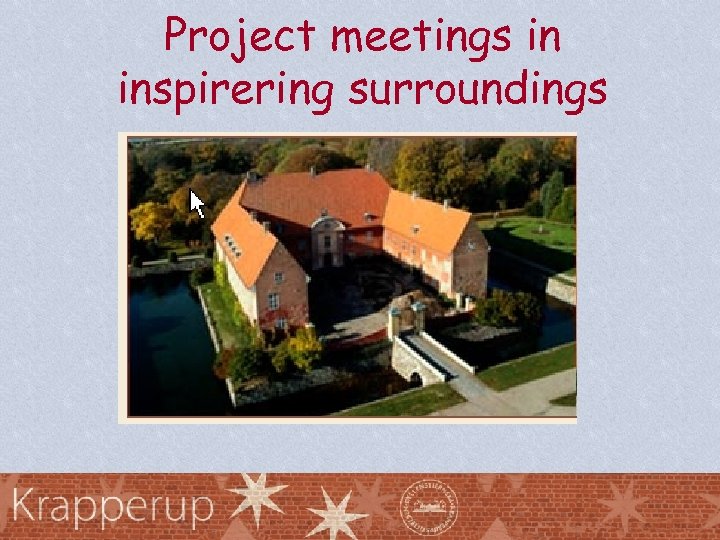 Project meetings in inspirering surroundings
 . . probing many different cultures
 Is prosody more than sound? • Our bias: communication is multi-modal • Traditionally prosodic functions are signaled by “gestures”, perceived by “eye and ear” • This concerns both body and face gestures • Preliminary hypothesis: F 0~eyebrow height - e. g. Cavé et al. (1996) • Easy to put to a test with multimodal speech synthesis
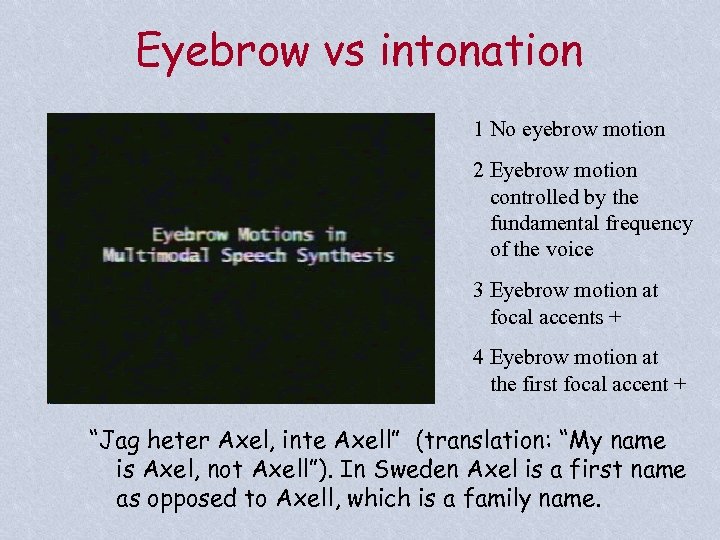 Eyebrow vs intonation 1 No eyebrow motion 2 Eyebrow motion controlled by the fundamental frequency of the voice 3 Eyebrow motion at focal accents + 4 Eyebrow motion at the first focal accent + “Jag heter Axel, inte Axell” (translation: “My name is Axel, not Axell”). In Sweden Axel is a first name as opposed to Axell, which is a family name.
 Goals and research context • How are visual expressions used to convey and strengthen prosodic functions? • Understand interactions between visual expressions, dialog functions and speech acoustics • Context: animated talking agent – Realistic communicative behavior using multimodal speech synthesis
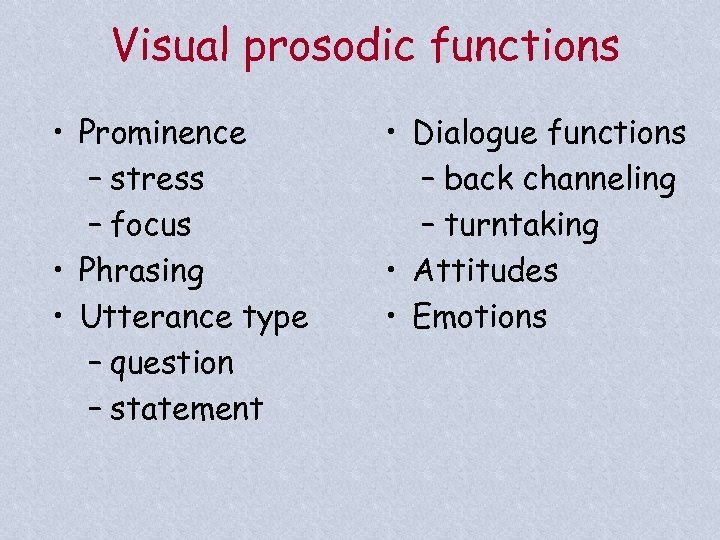 Visual prosodic functions • Prominence – stress – focus • Phrasing • Utterance type – question – statement • Dialogue functions – back channeling – turntaking • Attitudes • Emotions
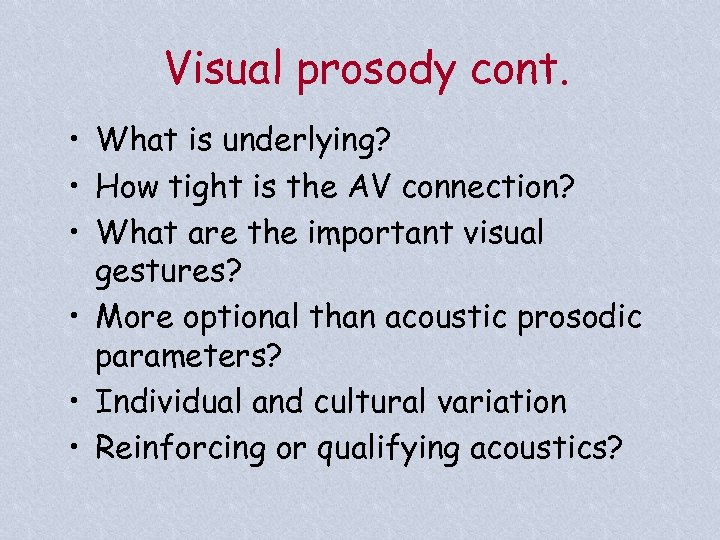 Visual prosody cont. • What is underlying? • How tight is the AV connection? • What are the important visual gestures? • More optional than acoustic prosodic parameters? • Individual and cultural variation • Reinforcing or qualifying acoustics?
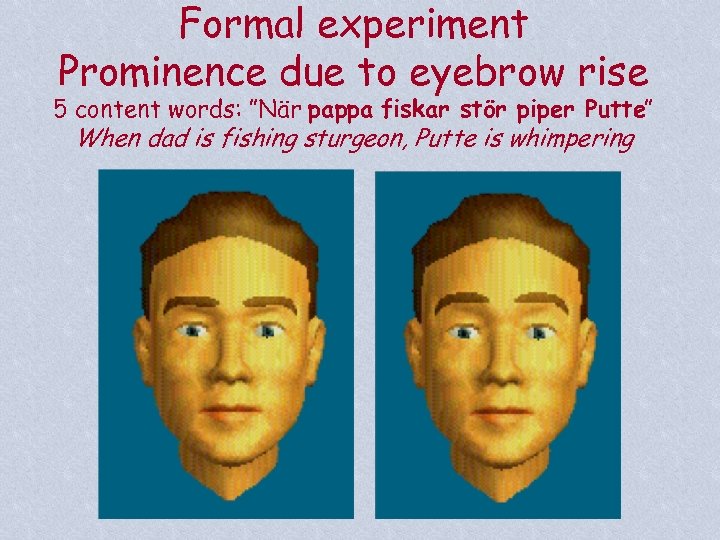 Formal experiment Prominence due to eyebrow rise 5 content words: ”När pappa fiskar stör piper Putte” When dad is fishing sturgeon, Putte is whimpering
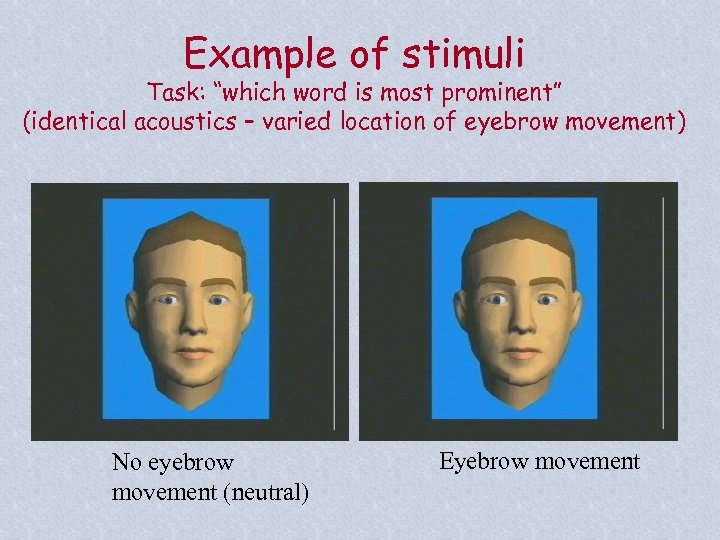 Example of stimuli Task: “which word is most prominent” (identical acoustics – varied location of eyebrow movement) No eyebrow movement (neutral) Eyebrow movement
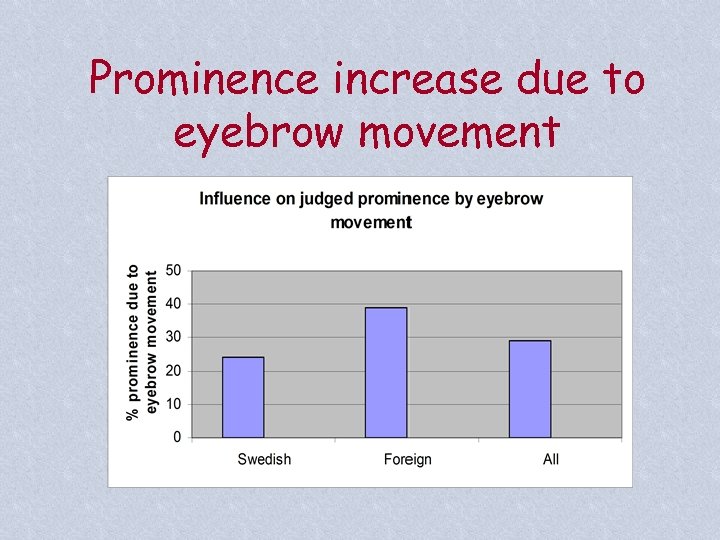 Prominence increase due to eyebrow movement
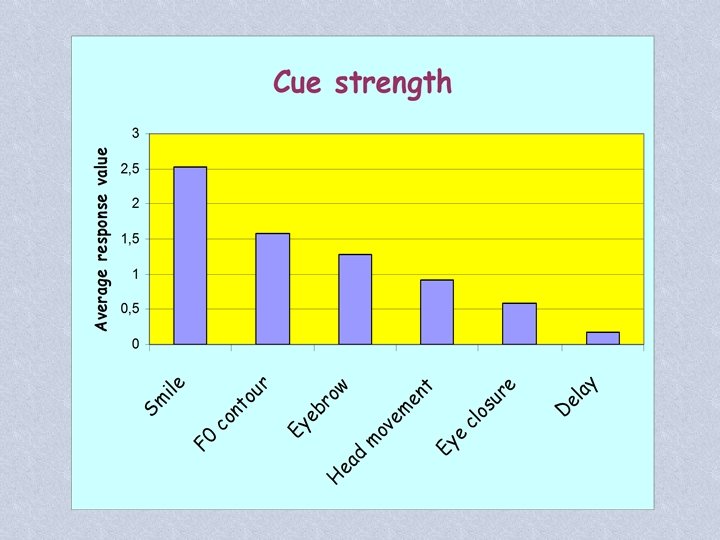
 Feedback experiment • • Mini dialogues (two turns) Travel agent application Both visual and acoustic feedback cues Affirmative cues – agent understands/accepts the request • Negative cues – agent is unsure about the request (seeks confirmation) • Six cues hypothesised Granström, House & Swerts (2002)
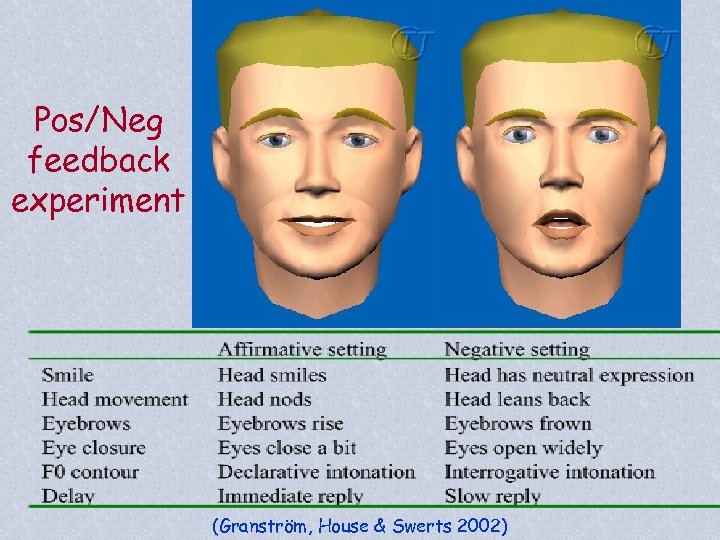 Pos/Neg feedback experiment (Granström, House & Swerts 2002)
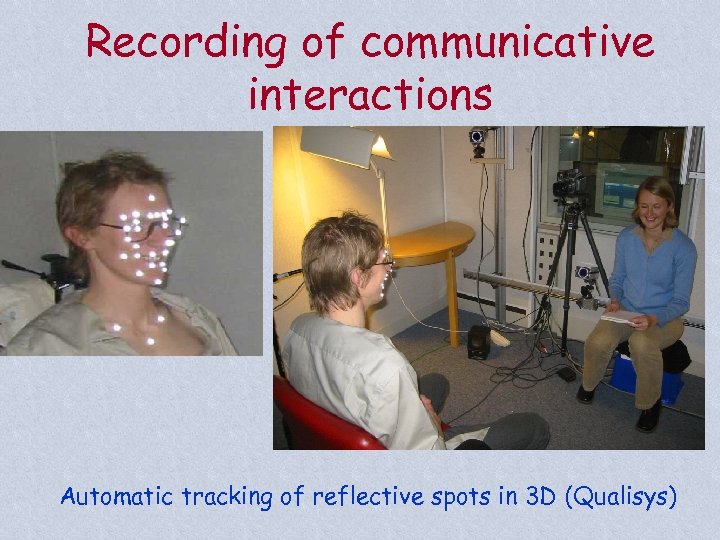 Recording of communicative interactions Automatic tracking of reflective spots in 3 D (Qualisys)
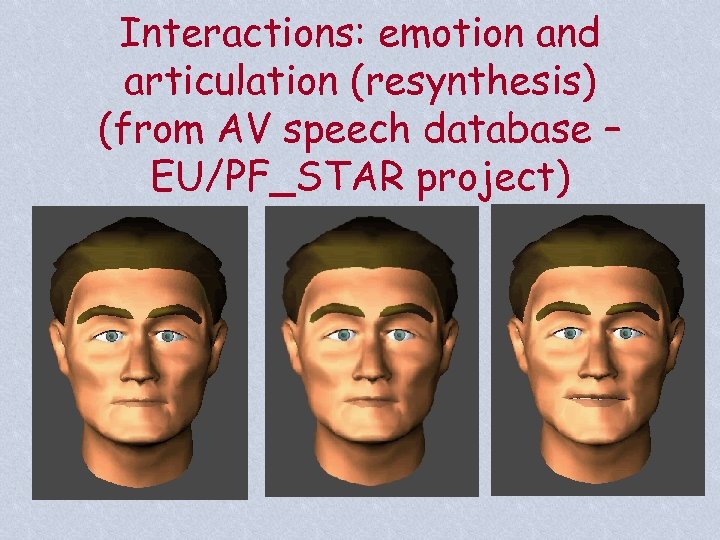 Interactions: emotion and articulation (resynthesis) (from AV speech database – EU/PF_STAR project)
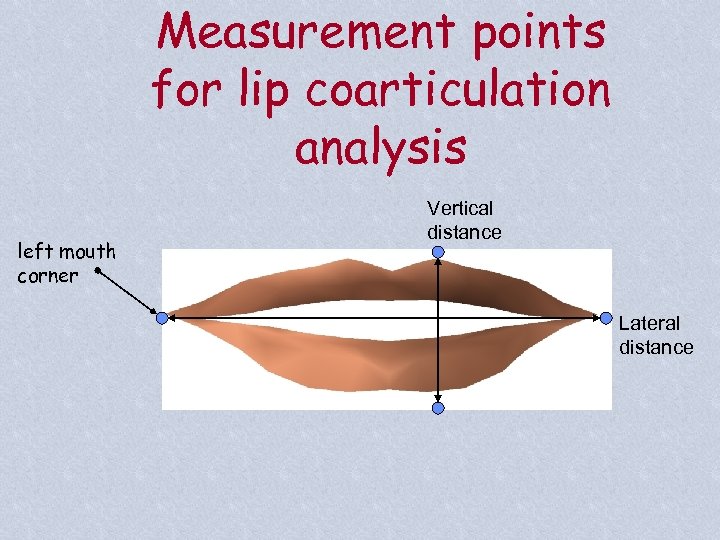 Measurement points for lip coarticulation analysis left mouth corner Vertical distance Lateral distance
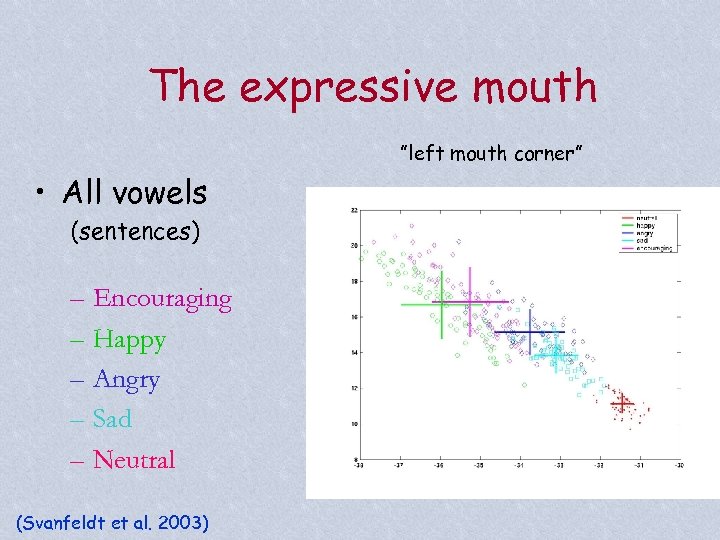 The expressive mouth ”left mouth corner” • All vowels (sentences) – Encouraging – Happy – Angry – Sad – Neutral (Svanfeldt et al. 2003)
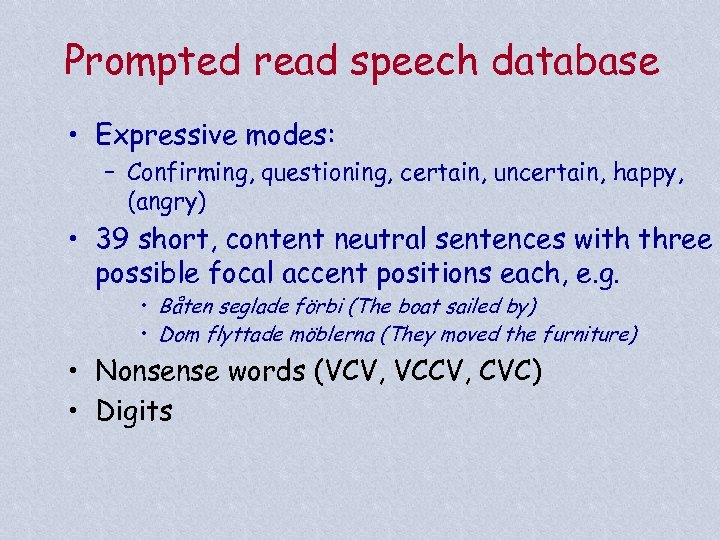 Prompted read speech database • Expressive modes: – Confirming, questioning, certain, uncertain, happy, (angry) • 39 short, content neutral sentences with three possible focal accent positions each, e. g. • Båten seglade förbi (The boat sailed by) • Dom flyttade möblerna (They moved the furniture) • Nonsense words (VCV, VCCV, CVC) • Digits
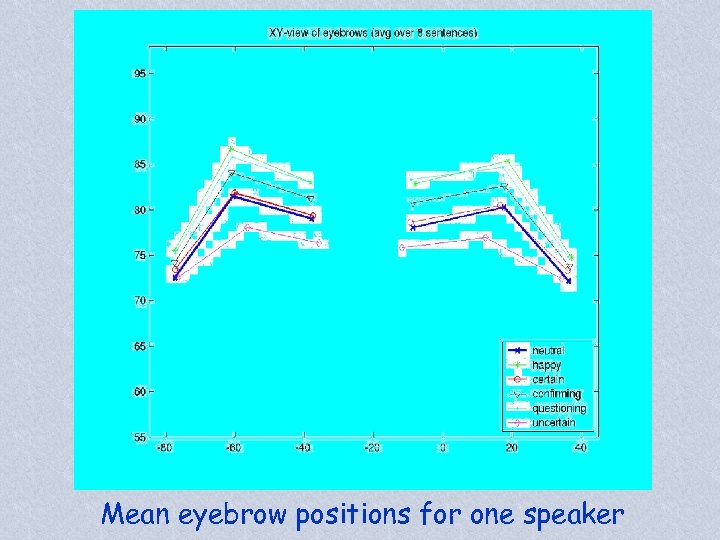 Mean eyebrow positions for one speaker
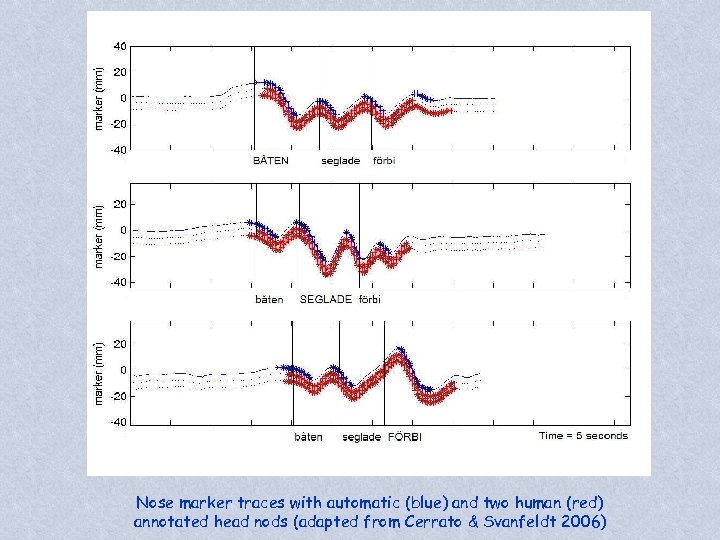 Nose marker traces with automatic (blue) and two human (red) annotated head nods (adapted from Cerrato & Svanfeldt 2006)
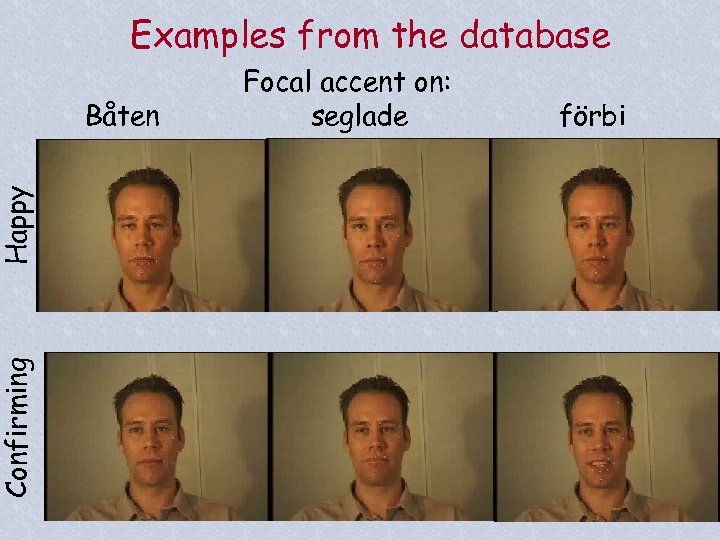 Happy Confirming Examples from the database Båten Focal accent on: seglade förbi
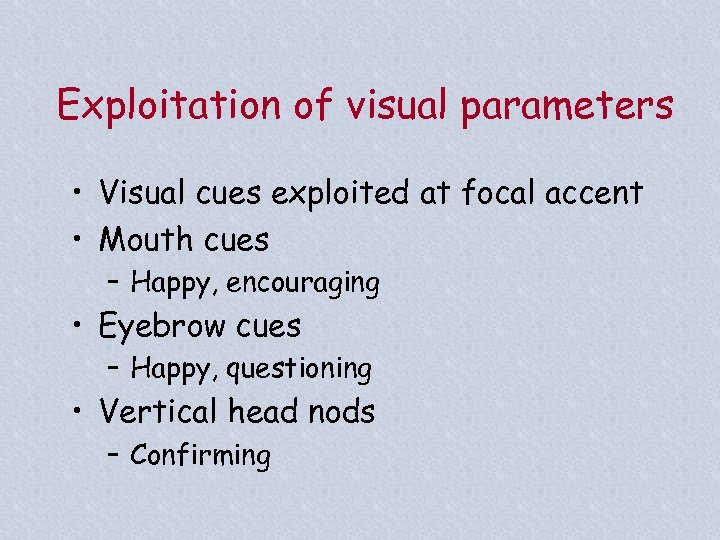 Exploitation of visual parameters • Visual cues exploited at focal accent • Mouth cues – Happy, encouraging • Eyebrow cues – Happy, questioning • Vertical head nods – Confirming
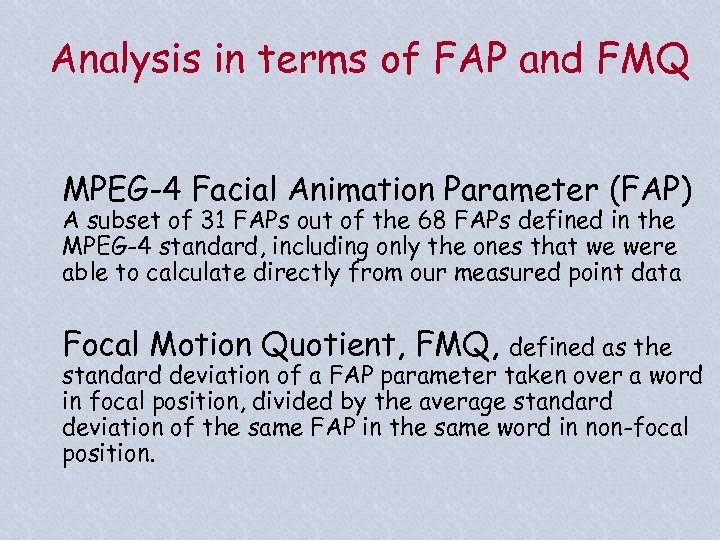 Analysis in terms of FAP and FMQ MPEG-4 Facial Animation Parameter (FAP) A subset of 31 FAPs out of the 68 FAPs defined in the MPEG-4 standard, including only the ones that we were able to calculate directly from our measured point data Focal Motion Quotient, FMQ, defined as the standard deviation of a FAP parameter taken over a word in focal position, divided by the average standard deviation of the same FAP in the same word in non-focal position.
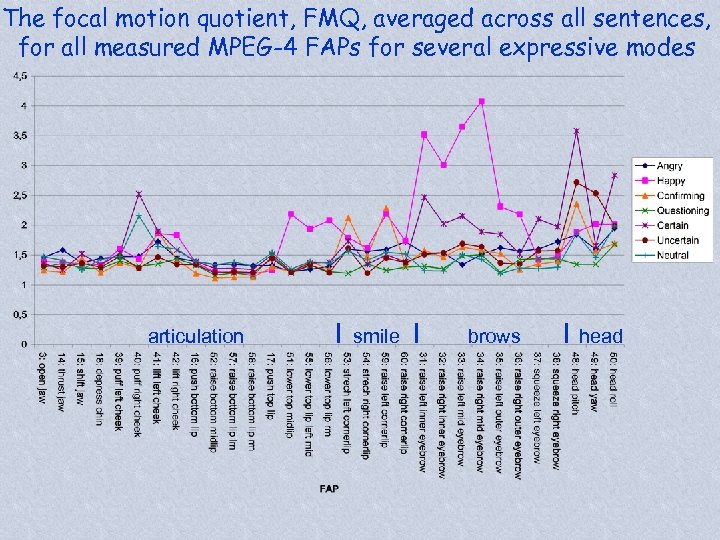 The focal motion quotient, FMQ, averaged across all sentences, for all measured MPEG-4 FAPs for several expressive modes articulation I smile I brows I head
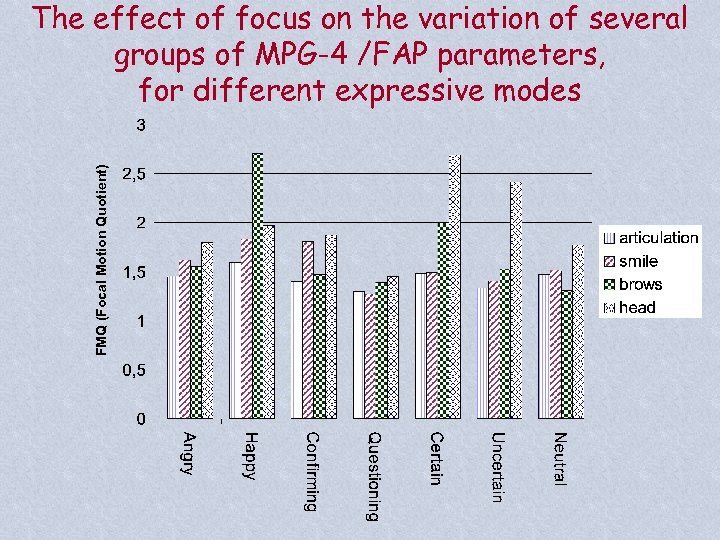 FMQ (Focal Motion Quotient) The effect of focus on the variation of several groups of MPG-4 /FAP parameters, for different expressive modes
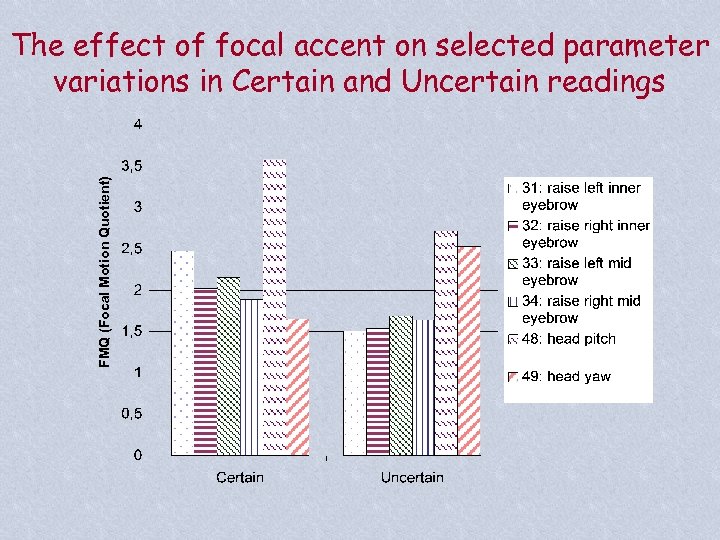 FMQ (Focal Motion Quotient) The effect of focal accent on selected parameter variations in Certain and Uncertain readings
 What´s next? • Better recordings • Detailed analysis of the eye region: ”Gaze and wrinkles” • Use in applications, e. g. spoken dialogue systems • And more audible prosody…….
 New cooperative project SIMULEKT - Simulering av svenskans prosodiska dialekttyper (Simulating intonational varieties of Swedish) VR 2007 -2009 And finally………. .
 Congratulations! Well done Gösta!