


 Скачать презентацию TSE Instrument Management in Surgery and Dentistry Current
018a2e4f6d2f0de1fd88df15cb89074e.ppt
- Количество слайдов: 19
 TSE: Instrument Management in Surgery and Dentistry Current CDC Recommendations Lynne Sehulster, Ph. D, M(ASCP) Division of Healthcare Quality Promotion Centers for Disease Control and Prevention Atlanta, GA 30333
 Information Resources u u u WHO Infection Control Guidelines for TSEs 1999: www. who. int/emcdocuments/tse/whocdscsraph 2003 c. html CDC Infection control Q & A: www. cdc. gov/ncidod/diseases/cjd_inf_ctrl_q a. htm CDC Guidelines for Infection Control in Dental Health-Care Settings - 2003 www. cdc. gov/mmwr/PDF/RR/RR 5217. pdf
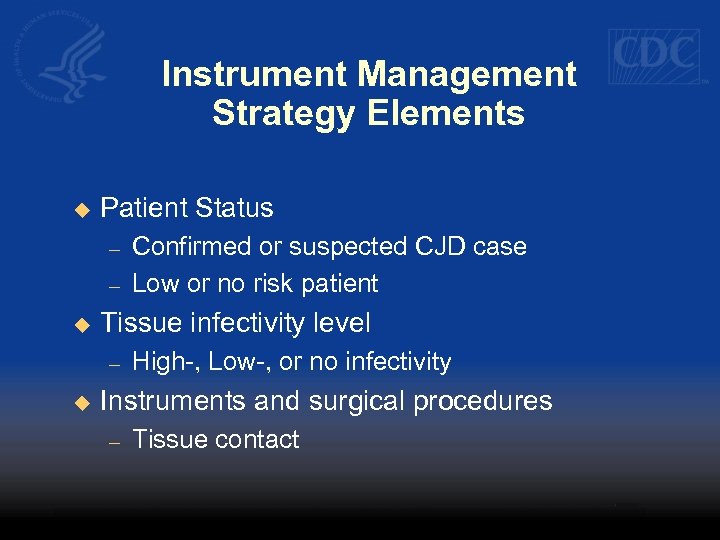 Instrument Management Strategy Elements u Patient Status – – u Tissue infectivity level – u Confirmed or suspected CJD case Low or no risk patient High-, Low-, or no infectivity Instruments and surgical procedures – Tissue contact
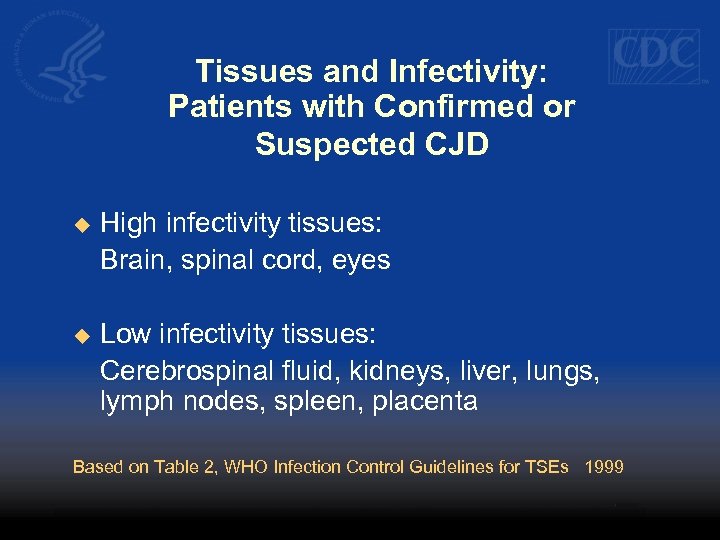 Tissues and Infectivity: Patients with Confirmed or Suspected CJD u High infectivity tissues: Brain, spinal cord, eyes u Low infectivity tissues: Cerebrospinal fluid, kidneys, liver, lungs, lymph nodes, spleen, placenta Based on Table 2, WHO Infection Control Guidelines for TSEs 1999
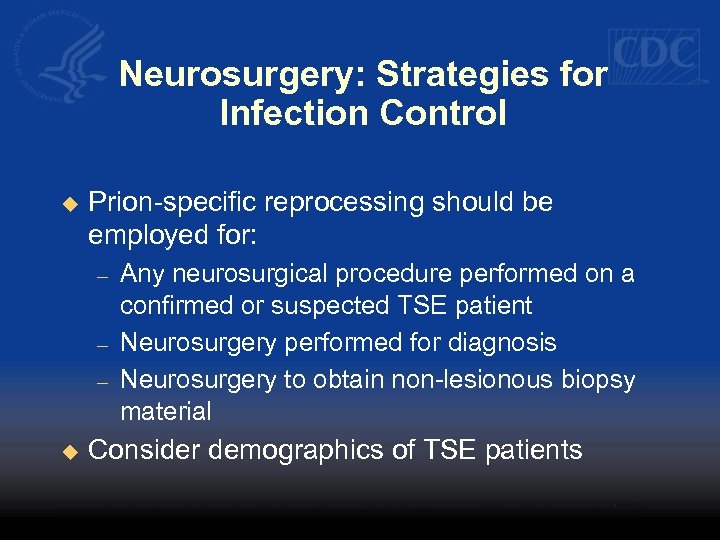 Neurosurgery: Strategies for Infection Control u Prion-specific reprocessing should be employed for: – – – u Any neurosurgical procedure performed on a confirmed or suspected TSE patient Neurosurgery performed for diagnosis Neurosurgery to obtain non-lesionous biopsy material Consider demographics of TSE patients
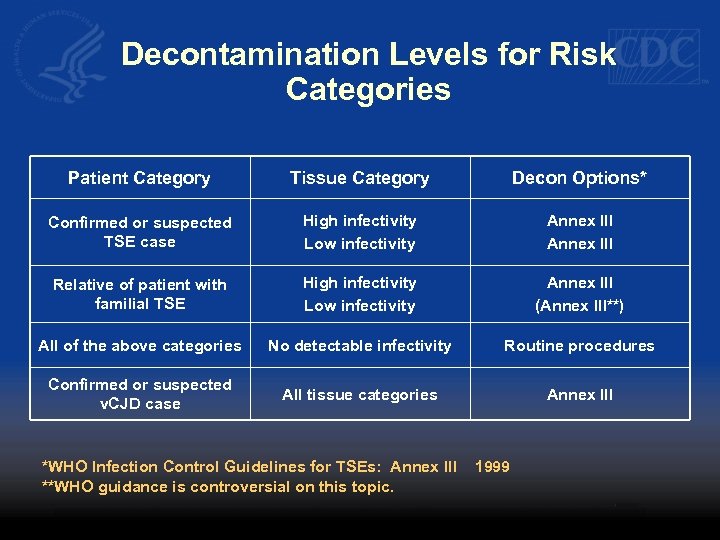 Decontamination Levels for Risk Categories Patient Category Tissue Category Decon Options* Confirmed or suspected TSE case High infectivity Low infectivity Annex III Relative of patient with familial TSE High infectivity Low infectivity Annex III (Annex III**) All of the above categories No detectable infectivity Routine procedures Confirmed or suspected v. CJD case All tissue categories Annex III *WHO Infection Control Guidelines for TSEs: Annex III **WHO guidance is controversial on this topic. 1999
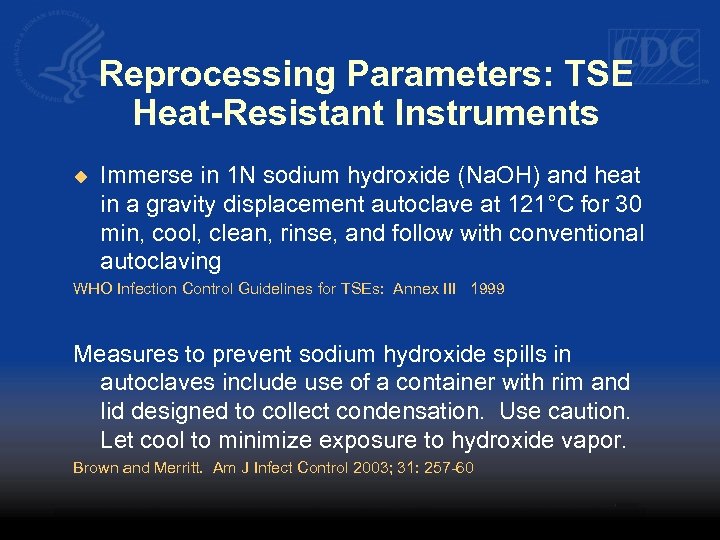 Reprocessing Parameters: TSE Heat-Resistant Instruments u Immerse in 1 N sodium hydroxide (Na. OH) and heat in a gravity displacement autoclave at 121°C for 30 min, cool, clean, rinse, and follow with conventional autoclaving WHO Infection Control Guidelines for TSEs: Annex III 1999 Measures to prevent sodium hydroxide spills in autoclaves include use of a container with rim and lid designed to collect condensation. Use caution. Let cool to minimize exposure to hydroxide vapor. Brown and Merritt. Am J Infect Control 2003; 31: 257 -60
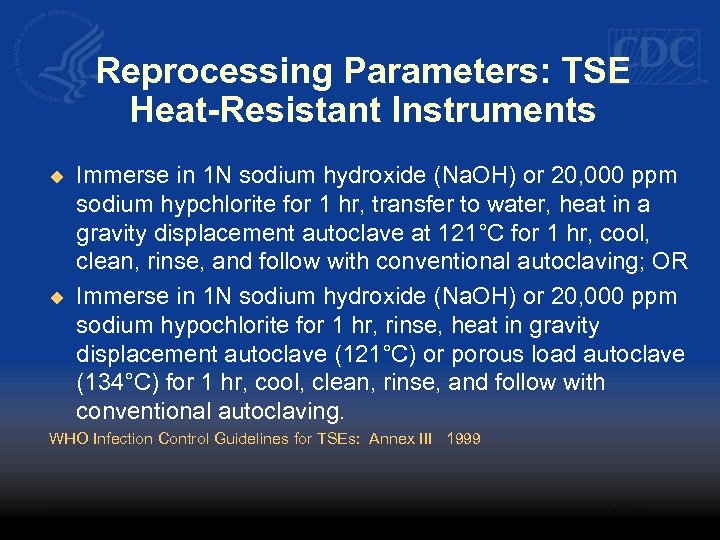 Reprocessing Parameters: TSE Heat-Resistant Instruments u u Immerse in 1 N sodium hydroxide (Na. OH) or 20, 000 ppm sodium hypchlorite for 1 hr, transfer to water, heat in a gravity displacement autoclave at 121°C for 1 hr, cool, clean, rinse, and follow with conventional autoclaving; OR Immerse in 1 N sodium hydroxide (Na. OH) or 20, 000 ppm sodium hypochlorite for 1 hr, rinse, heat in gravity displacement autoclave (121°C) or porous load autoclave (134°C) for 1 hr, cool, clean, rinse, and follow with conventional autoclaving. WHO Infection Control Guidelines for TSEs: Annex III 1999
 Reprocessing Parameters: TSE Heat-Sensitive Instruments u Instruments having contact with high- and lowinfectivity tissues – – u u High: brain, spinal cord, eyes Low: cerebrospinal fluid, kidneys, lungs, liver, lymph nodes, spleen, placenta Disposable instruments: discard Reusable instruments: soak in 2 N Na. OH or undiluted sodium hypochlorite for 1 hr, rinse, clean, reprocess with low-temperature process
 Chemicals / Autoclaving: Effects on Instruments u Inexpensive carbon-steel instruments are easily damaged u Gold plating damaged by sodium hypochlorite u Soldered and welded joints damaged by sodium hypochlorite u Autoclaving in Na. OH discolored instruments u Na. OH did not affect instrument function Brown, Merritt, Woods, Busick: J Biomed Mater Res Part B, 2005; 72: 186 -90
 JCAHO Sentinel Alert No. 20: June 2001 Major points emphasized: u Atypical clinical presentations possible u Time interval between biopsy and pathology report should be as short as possible u Neurosurgical instruments should not be reused while diagnosis is pending JCAHO recommends: u Policies and procedures for appropriate reprocessing u Quarantine instruments until diagnosis is confirmed
 Practical Advice u Quarantine the instruments: – – – Suitable if the time interval between surgery and confirmation of the diagnosis is short Have sufficient instrument inventory to accommodate this practice Keep instruments moist while awaiting release for decontamination and reprocessing
 Practical Advice II u To minimize potential exposures to patients in the event that instruments are returned to central sterile units before the diagnosis is confirmed: – – – Reprocess neurosurgical instruments as recommended Consider instrument tracking Restrict instruments in neurosurgery trays to those trays only
 More Research is Needed u Evaluate decontamination, cleaning, and reprocessing processes as are currently available in health care – – u u Cleaners: enzymatic, alkaline Terminal reprocessing: peracetic acid, hydrogen peroxide gas plasma Effects of repeated cycles of cleaning and conventional autoclaving Potential for prion contamination of other surfaces in reprocessing areas
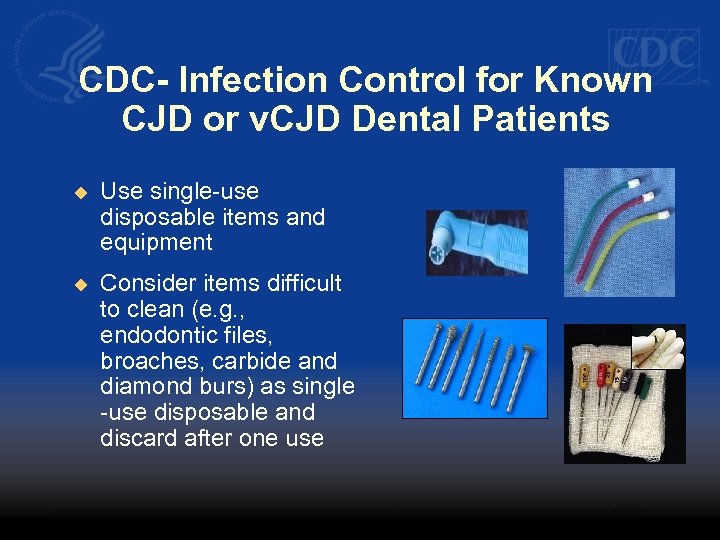 CDC- Infection Control for Known CJD or v. CJD Dental Patients u Use single-use disposable items and equipment u Consider items difficult to clean (e. g. , endodontic files, broaches, carbide and diamond burs) as single -use disposable and discard after one use
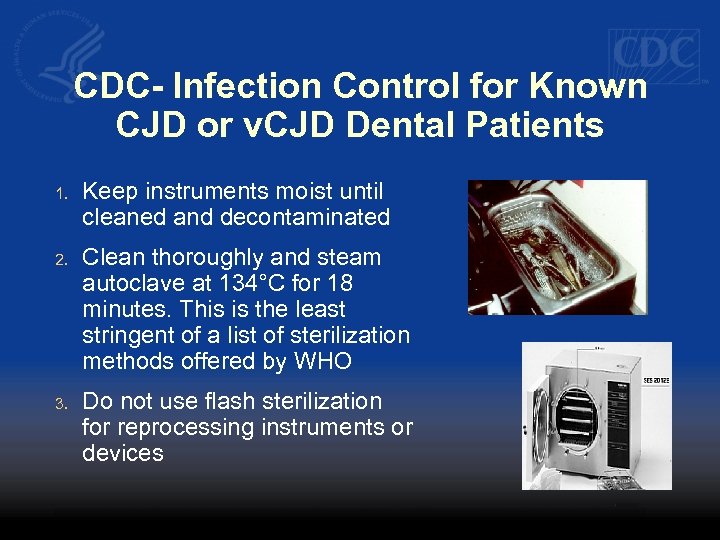 CDC- Infection Control for Known CJD or v. CJD Dental Patients 1. Keep instruments moist until cleaned and decontaminated 2. Clean thoroughly and steam autoclave at 134°C for 18 minutes. This is the least stringent of a list of sterilization methods offered by WHO 3. Do not use flash sterilization for reprocessing instruments or devices
 Summary: Dentistry 1. Risk of transmission of CJD during dental treatment is low 1. 2. No documentation of prions in human oral tissues No published reports of an association of CJD infection with dental treatment Additional precautions beyond Standard Precautions might be warranted for known CJD or v. CJD patients
 CDC Perspective: At-Risk Patients in the U. S. u Blood relative of patient with inheritable forms of TSEs Are asymptomatic individuals truly “at risk? ” WHO: no consensus - relatives of familial cases
 Thank You! Centers for Disease Control and Prevention National Center for Infectious Diseases Division of Viral and Rickettsial Diseases Division of Healthcare Quality Promotion