


 Скачать презентацию Trust Management A Tutorial Scott D Stoller May
55b604105b048e4afbf71bd8d2d0a29e.ppt
- Количество слайдов: 118
 Trust Management A Tutorial Scott D. Stoller May 2006 Scott Stoller, Stony Brook University
 Top Technical and Funding Priorities Federal Cyber Security and Information Assurance R&D Federal Plan for Cyber Security and Information Assurance Research and Development. A Report by the National Science and Technology Council’s Interagency Working Group on Cyber Security and Information Assurance, April 2006. Authentication, authorization, and trust management and Access control and privilege management are 2 of the 5 research areas identified as both a top technical priority and a top funding priority. http: //www. nitrd. gov/pubs/csia/Federal. Plan_CSIA_Rn. D. pdf May 2006 Scott Stoller, Stony Brook University
 Outline Introduction and Motivation Traditional policy frameworks Policy frameworks for decentralized systems Trust management Design Issues and Features Trust Management Frameworks Sample Application Domains Research Directions May 2006 Scott Stoller, Stony Brook University
 Traditional Frameworks: Access Control Lists ACL: a list of pairs
 Traditional Frameworks: Role-Based Access Control (RBAC) Role: an abstraction associated with a set of permissions, typically associated with a function or position in an organization. Examples: doctor, nurse, patient, receptionist RBAC policy specifies: the roles that each user may adopt the permissions associated with each role. Permission = [operation, resource] Operation may be resource-specific, not limited to read/write. May 2006 Scott Stoller, Stony Brook University
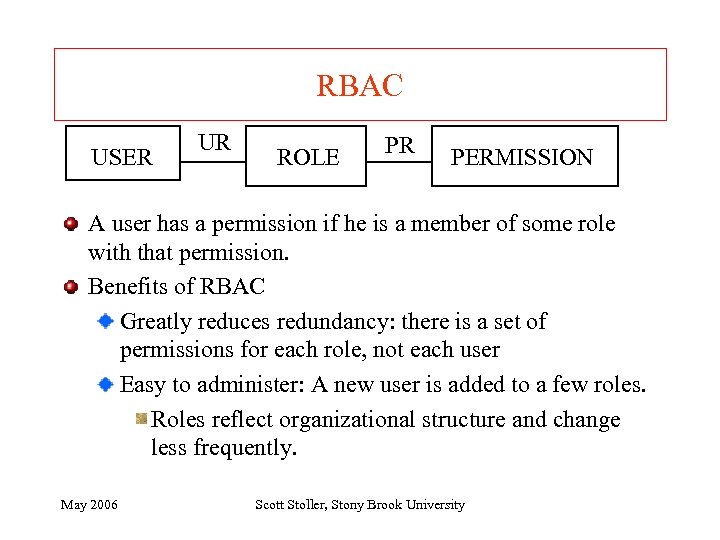 RBAC USER UR ROLE PR PERMISSION A user has a permission if he is a member of some role with that permission. Benefits of RBAC Greatly reduces redundancy: there is a set of permissions for each role, not each user Easy to administer: A new user is added to a few roles. Roles reflect organizational structure and change less frequently. May 2006 Scott Stoller, Stony Brook University
 RBAC: Role Activation A user must activate a role in a session in order to use the permissions associated with that role. Example: Dr. Smith is sometimes a doctor, sometimes a patient. Analogy: system administrator sometimes logs in as root, sometimes as a regular user Helps enforce the principle of least privilege. Limits potential damage due to human errors, software defects, etc. A session (a window, application, . . . ) belongs to one user. Multiple roles may be active in it. May 2006 Scott Stoller, Stony Brook University
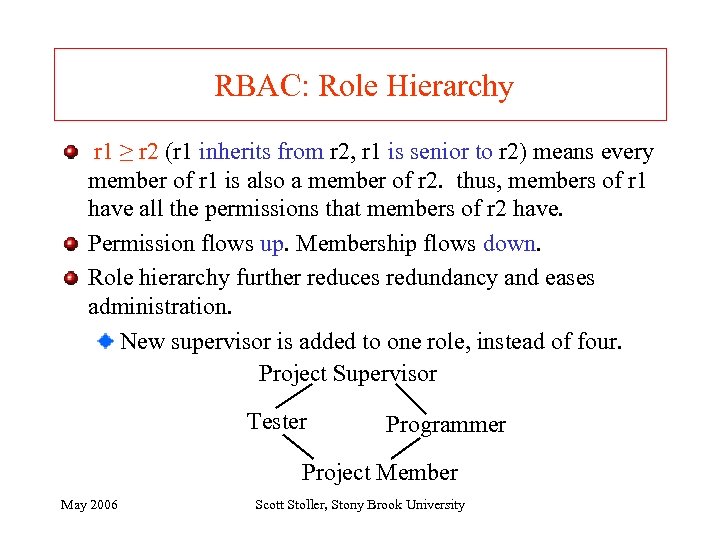 RBAC: Role Hierarchy r 1 ≥ r 2 (r 1 inherits from r 2, r 1 is senior to r 2) means every member of r 1 is also a member of r 2. thus, members of r 1 have all the permissions that members of r 2 have. Permission flows up. Membership flows down. Role hierarchy further reduces redundancy and eases administration. New supervisor is added to one role, instead of four. Project Supervisor Tester Programmer Project Member May 2006 Scott Stoller, Stony Brook University
 RBAC: Policy Administration Administrative policy: security policy that controls changes to the security policy In large organization, decentralized policy administration Example: senior admin, junior admin for each division Administrative RBAC (ARBAC) introduces administrative roles (in addition to regular roles) administrative permissions (for adding and removing users and permissions from regular roles) Example: project leader can add/remove users/permissions from roles on the project he/she leads. Who can change the ARBAC policy? ARBAC doesn’t say May 2006 Scott Stoller, Stony Brook University
 Public-Key Infrastructure (PKI) Public-key certificate: a certificate signed by a certification authority (CA), containing a public key K and a principal's name N, and stating that K belongs to N. Example: [public key 1 a 4 deb 6 c 5 c belongs to AMA] signed by Veri. Sign Who is trusted to issue public-key certificates? May 2006 Scott Stoller, Stony Brook University
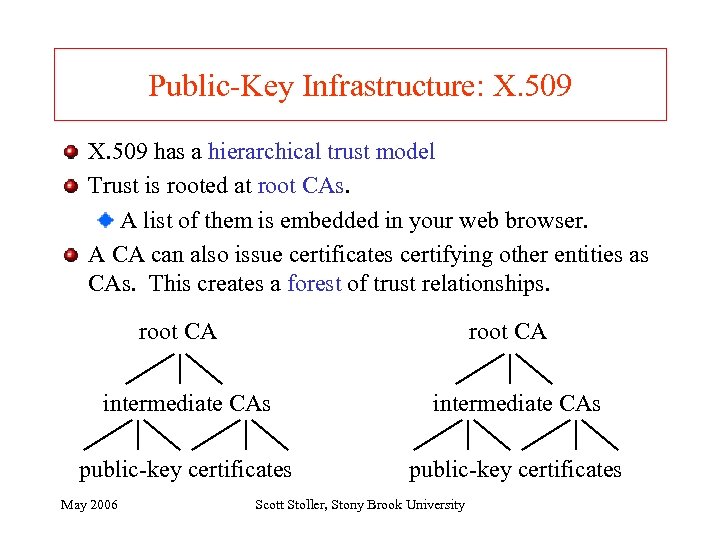 Public-Key Infrastructure: X. 509 has a hierarchical trust model Trust is rooted at root CAs. A list of them is embedded in your web browser. A CA can also issue certificates certifying other entities as CAs. This creates a forest of trust relationships. root CA intermediate CAs public-key certificates May 2006 Scott Stoller, Stony Brook University
 Public-Key Infrastructure: PGP Pretty Good Privacy (PGP) is based on a web of trust. Everyone may issue public-key certificates. Each user specifies a level of trust in each issuer. Each user specifies the total confidence needed for a public -key↔name relationship to be considered valid. Example: one certificate from an issuer trusted at level 10, or certificates from two distinct issuers trusted at level 5 or higher. A user can also build confidence in such a relationship through successful communication using a particular public key. May 2006 Scott Stoller, Stony Brook University
 Public-Key Infrastructure: X. 509 vs. PGP X. 509’s hierarchical trust is appropriate for e-commerce. Accountability Structure: known sources for certificates, revocation lists, etc. PGP’s web of trust is appropriate for personal communication. Individuals will not spend time and money to get Veri. Sign certificates ($795 for a 3 -year certificate for 40 -bit encryption) In current practice, authentication of personal communication is enforced mainly through nontechnical means. May 2006 Scott Stoller, Stony Brook University
 Essential features of policy frameworks for decentralized systems: attributes and relations Policy can use application-specific attributes and relations. Example: Nurses in the workgroup treating a patient can access the patient's medical record. Attributes: is. Nurse(employee) Relations: treating. Workgroup(patient, group). Encoding such policies as identity-based policies is impractical: potential users are not known to resource owners in advance dangerous: attributes can change RBAC is identity-based. May 2006 Scott Stoller, Stony Brook University
 Essential features of policy frameworks for decentralized systems: attributes and relations Attributes and relations can be defined in terms of other attributes and relations. Example: Nurses in the workgroup treating a patient can access the patient's medical record. A nurse is in the workgroup if a manager assigned him/her to it. This allows interactions that are essential in decentralized systems. Standard RBAC does not support this. Each role is defined independently (aside from inheritance). Example: RBAC does not support policies like role 1. members = role 2. members ∩ role 3. members May 2006 Scott Stoller, Stony Brook University
 Essential features of policy frameworks for decentralized systems: delegation Policy administration is completely decentralized at the top level. No globally-trusted administrators. No root of trust. Policies interact through delegation. Example: Hospitals, doctor's offices, insurers, and government agencies share information (medical, financial, and personnel records). They trust each other in limited ways. Example: Conference gives a discount to students enrolled at accredited universities. Conference trusts universities for enrollment information. Example: Military coalitions. May 2006 Scott Stoller, Stony Brook University
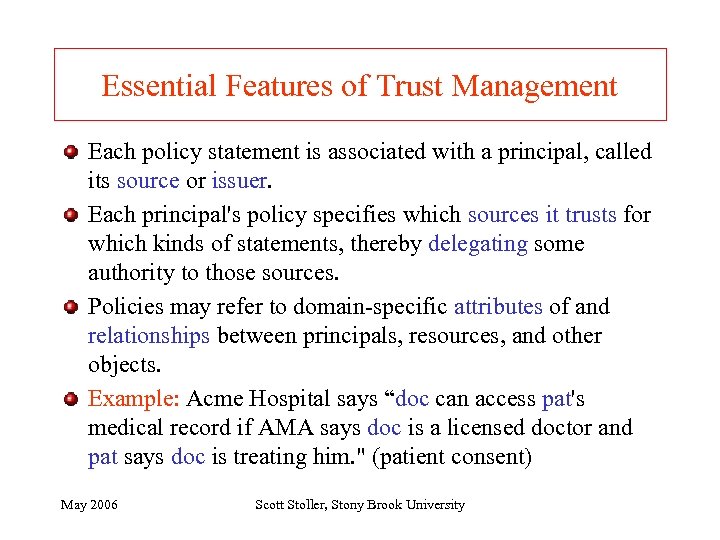 Essential Features of Trust Management Each policy statement is associated with a principal, called its source or issuer. Each principal's policy specifies which sources it trusts for which kinds of statements, thereby delegating some authority to those sources. Policies may refer to domain-specific attributes of and relationships between principals, resources, and other objects. Example: Acme Hospital says “doc can access pat's medical record if AMA says doc is a licensed doctor and pat says doc is treating him. " (patient consent) May 2006 Scott Stoller, Stony Brook University
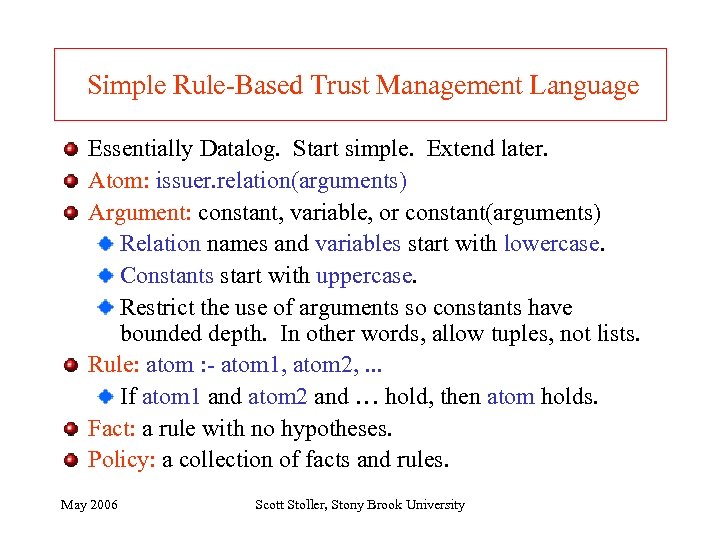 Simple Rule-Based Trust Management Language Essentially Datalog. Start simple. Extend later. Atom: issuer. relation(arguments) Argument: constant, variable, or constant(arguments) Relation names and variables start with lowercase. Constants start with uppercase. Restrict the use of arguments so constants have bounded depth. In other words, allow tuples, not lists. Rule: atom : - atom 1, atom 2, . . . If atom 1 and atom 2 and … hold, then atom holds. Fact: a rule with no hypotheses. Policy: a collection of facts and rules. May 2006 Scott Stoller, Stony Brook University
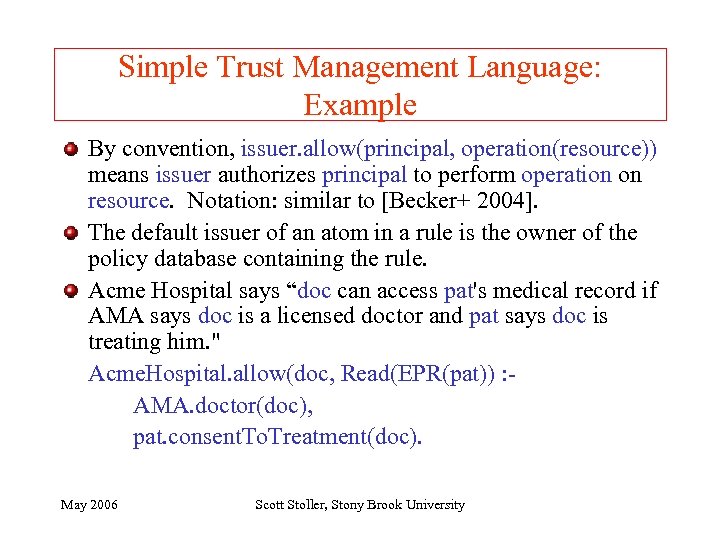 Simple Trust Management Language: Example By convention, issuer. allow(principal, operation(resource)) means issuer authorizes principal to perform operation on resource. Notation: similar to [Becker+ 2004]. The default issuer of an atom in a rule is the owner of the policy database containing the rule. Acme Hospital says “doc can access pat's medical record if AMA says doc is a licensed doctor and pat says doc is treating him. " Acme. Hospital. allow(doc, Read(EPR(pat)) : AMA. doctor(doc), pat. consent. To. Treatment(doc). May 2006 Scott Stoller, Stony Brook University
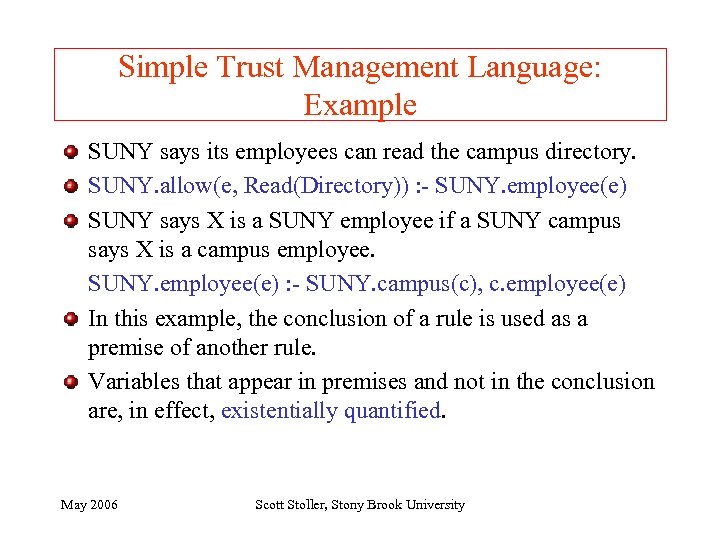 Simple Trust Management Language: Example SUNY says its employees can read the campus directory. SUNY. allow(e, Read(Directory)) : - SUNY. employee(e) SUNY says X is a SUNY employee if a SUNY campus says X is a campus employee. SUNY. employee(e) : - SUNY. campus(c), c. employee(e) In this example, the conclusion of a rule is used as a premise of another rule. Variables that appear in premises and not in the conclusion are, in effect, existentially quantified. May 2006 Scott Stoller, Stony Brook University
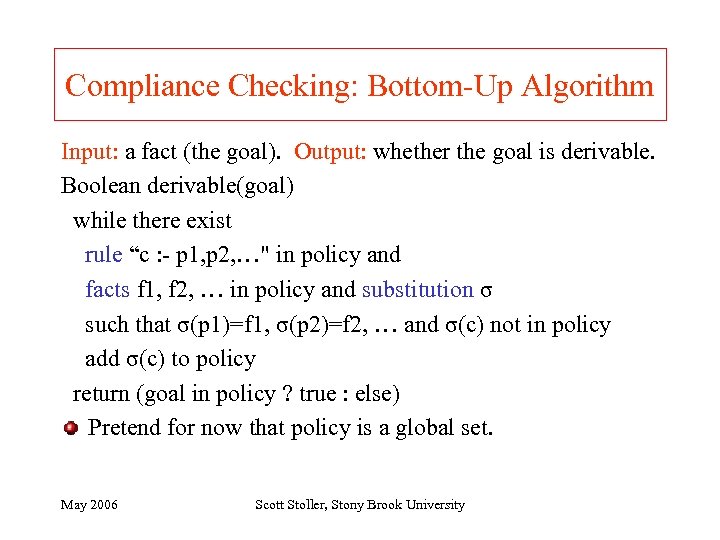 Compliance Checking: Bottom-Up Algorithm Input: a fact (the goal). Output: whether the goal is derivable. Boolean derivable(goal) while there exist rule “c : - p 1, p 2, …" in policy and facts f 1, f 2, … in policy and substitution σ such that σ(p 1)=f 1, σ(p 2)=f 2, … and σ(c) not in policy add σ(c) to policy return (goal in policy ? true : else) Pretend for now that policy is a global set. May 2006 Scott Stoller, Stony Brook University
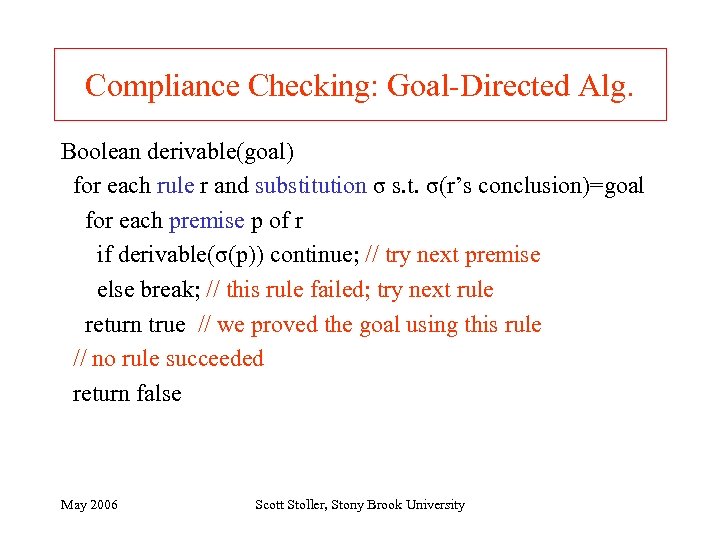 Compliance Checking: Goal-Directed Alg. Boolean derivable(goal) for each rule r and substitution σ s. t. σ(r’s conclusion)=goal for each premise p of r if derivable(σ(p)) continue; // try next premise else break; // this rule failed; try next rule return true // we proved the goal using this rule // no rule succeeded return false May 2006 Scott Stoller, Stony Brook University
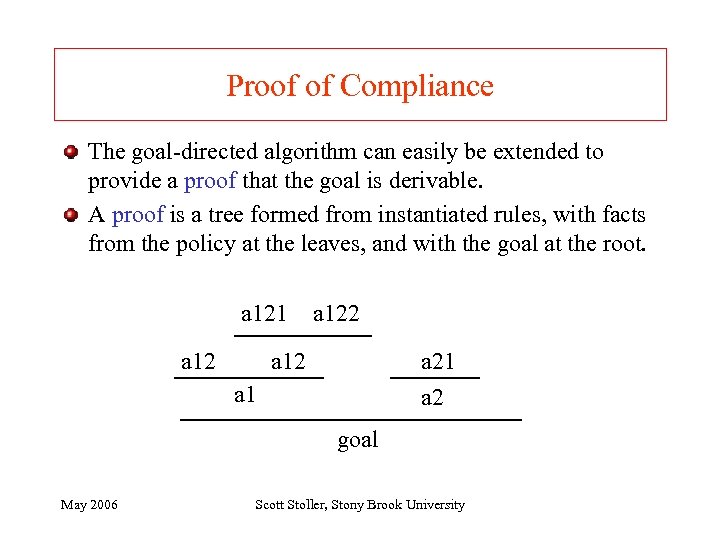 Proof of Compliance The goal-directed algorithm can easily be extended to provide a proof that the goal is derivable. A proof is a tree formed from instantiated rules, with facts from the policy at the leaves, and with the goal at the root. a 121 a 122 a 12 a 21 a 2 a 1 goal May 2006 Scott Stoller, Stony Brook University
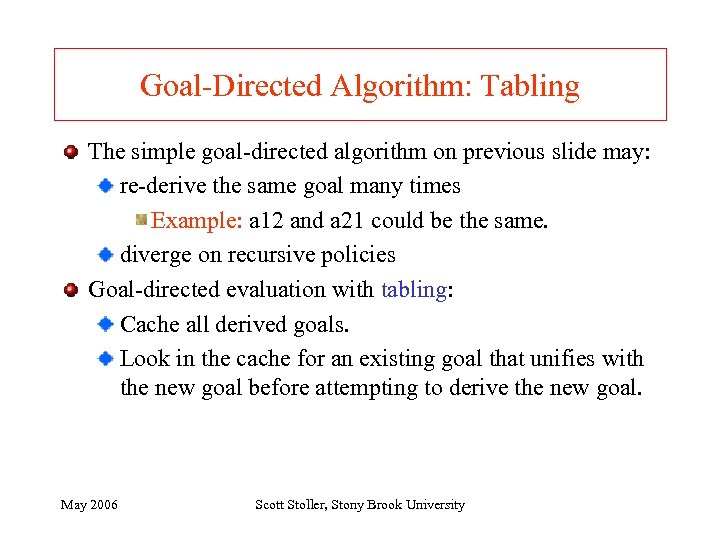 Goal-Directed Algorithm: Tabling The simple goal-directed algorithm on previous slide may: re-derive the same goal many times Example: a 12 and a 21 could be the same. diverge on recursive policies Goal-directed evaluation with tabling: Cache all derived goals. Look in the cache for an existing goal that unifies with the new goal before attempting to derive the new goal. May 2006 Scott Stoller, Stony Brook University
 Outline Introduction and Motivation Design Issues and Features Re-Delegation Proof Search Credential Gathering Policy Changes Trust Negotiation Constraints Trust Management Frameworks Sample Application Domains Research Directions May 2006 External Data Separation of Duty Separation of Privilege Roles Global and Local Names Scott Stoller, Stony Brook University
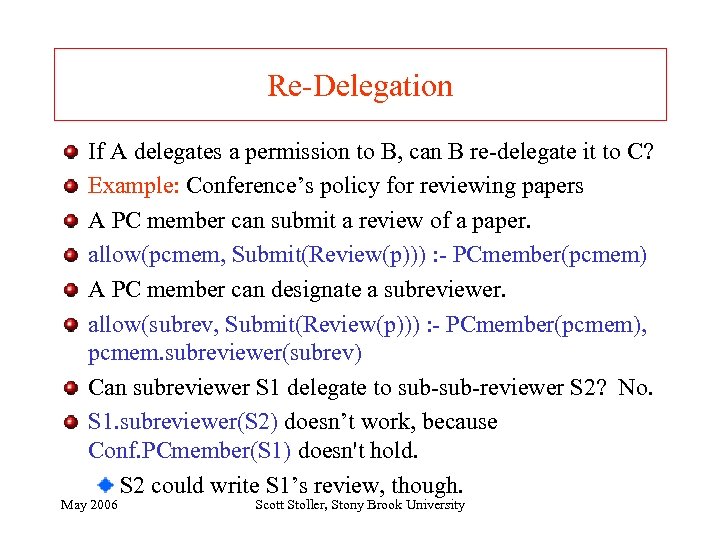 Re-Delegation If A delegates a permission to B, can B re-delegate it to C? Example: Conference’s policy for reviewing papers A PC member can submit a review of a paper. allow(pcmem, Submit(Review(p))) : - PCmember(pcmem) A PC member can designate a subreviewer. allow(subrev, Submit(Review(p))) : - PCmember(pcmem), pcmem. subreviewer(subrev) Can subreviewer S 1 delegate to sub-reviewer S 2? No. S 1. subreviewer(S 2) doesn’t work, because Conf. PCmember(S 1) doesn't hold. S 2 could write S 1’s review, though. May 2006 Scott Stoller, Stony Brook University
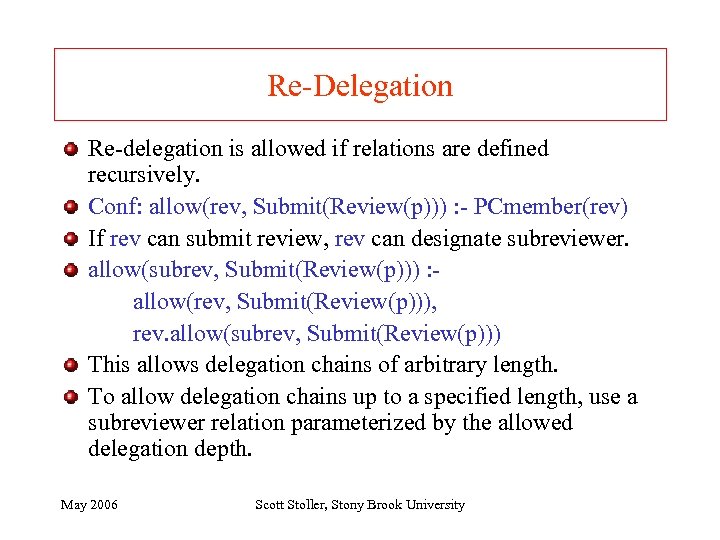 Re-Delegation Re-delegation is allowed if relations are defined recursively. Conf: allow(rev, Submit(Review(p))) : - PCmember(rev) If rev can submit review, rev can designate subreviewer. allow(subrev, Submit(Review(p))) : allow(rev, Submit(Review(p))), rev. allow(subrev, Submit(Review(p))) This allows delegation chains of arbitrary length. To allow delegation chains up to a specified length, use a subreviewer relation parameterized by the allowed delegation depth. May 2006 Scott Stoller, Stony Brook University
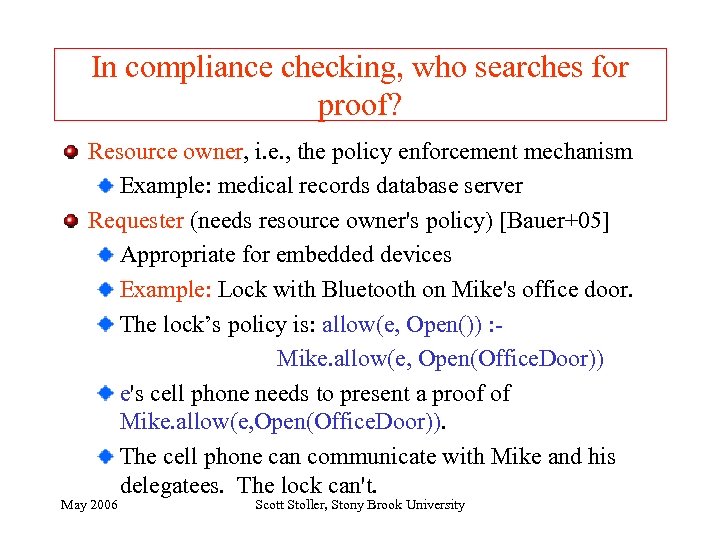 In compliance checking, who searches for proof? Resource owner, i. e. , the policy enforcement mechanism Example: medical records database server Requester (needs resource owner's policy) [Bauer+05] Appropriate for embedded devices Example: Lock with Bluetooth on Mike's office door. The lock’s policy is: allow(e, Open()) : Mike. allow(e, Open(Office. Door)) e's cell phone needs to present a proof of Mike. allow(e, Open(Office. Door)). The cell phone can communicate with Mike and his delegatees. The lock can't. May 2006 Scott Stoller, Stony Brook University
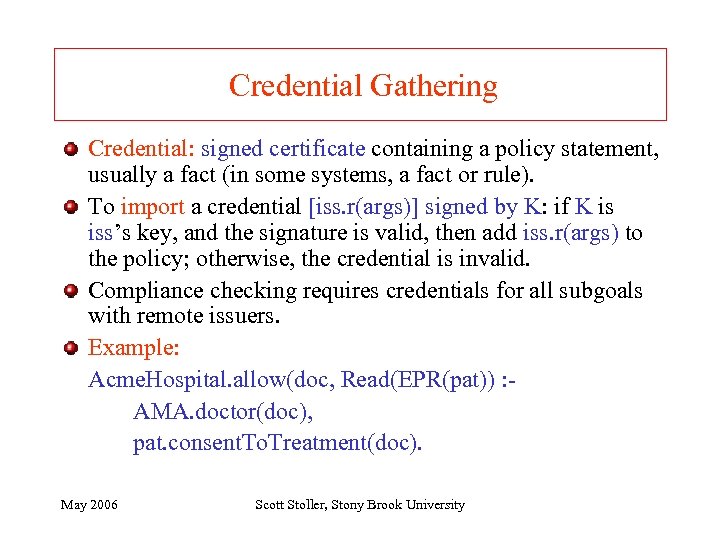 Credential Gathering Credential: signed certificate containing a policy statement, usually a fact (in some systems, a fact or rule). To import a credential [iss. r(args)] signed by K: if K is iss’s key, and the signature is valid, then add iss. r(args) to the policy; otherwise, the credential is invalid. Compliance checking requires credentials for all subgoals with remote issuers. Example: Acme. Hospital. allow(doc, Read(EPR(pat)) : AMA. doctor(doc), pat. consent. To. Treatment(doc). May 2006 Scott Stoller, Stony Brook University
 Where To Get Credentials? From issuer Example: request AMA. doctor(doc) from AMA From requester Example: request AMA. doctor(doc) from doc may have it or may request it from AMA. From a location specified in the policy (instead of hardcoding the decision in the evaluation algorithm). Details on the next slide. May 2006 Scott Stoller, Stony Brook University
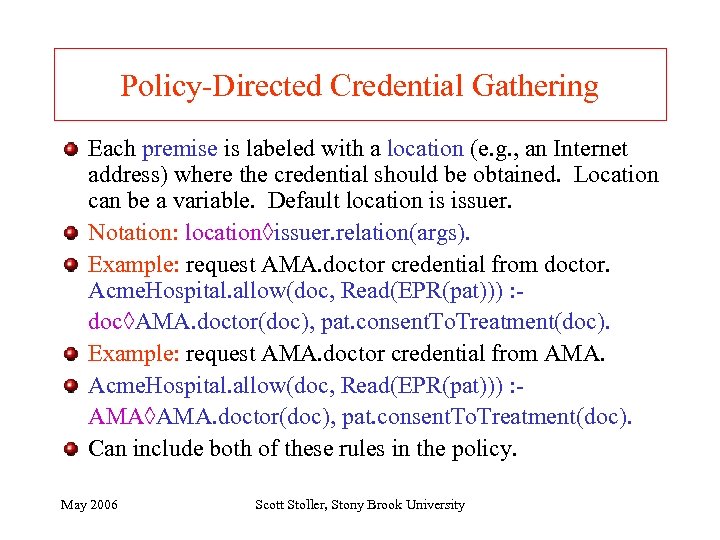 Policy-Directed Credential Gathering Each premise is labeled with a location (e. g. , an Internet address) where the credential should be obtained. Location can be a variable. Default location is issuer. Notation: location◊issuer. relation(args). Example: request AMA. doctor credential from doctor. Acme. Hospital. allow(doc, Read(EPR(pat))) : doc◊AMA. doctor(doc), pat. consent. To. Treatment(doc). Example: request AMA. doctor credential from AMA. Acme. Hospital. allow(doc, Read(EPR(pat))) : AMA◊AMA. doctor(doc), pat. consent. To. Treatment(doc). Can include both of these rules in the policy. May 2006 Scott Stoller, Stony Brook University
 Policy Changes Derived facts may be cached locally and may be sent in credentials and cached at other sites, for efficiency and fault-tolerance. Example: Hospital caches AMA. doctor credential. These facts may become invalid due to: Deletion of facts or rules. Addition of facts or rules, if the policy language is nonmonotonic (adding a fact or rule can invalidate facts), i. e. , can express negation or equivalent. This is a standard problem with caching in distributed systems. Standard solutions, such as expiration dates or revocation lists, can be used. May 2006 Scott Stoller, Stony Brook University
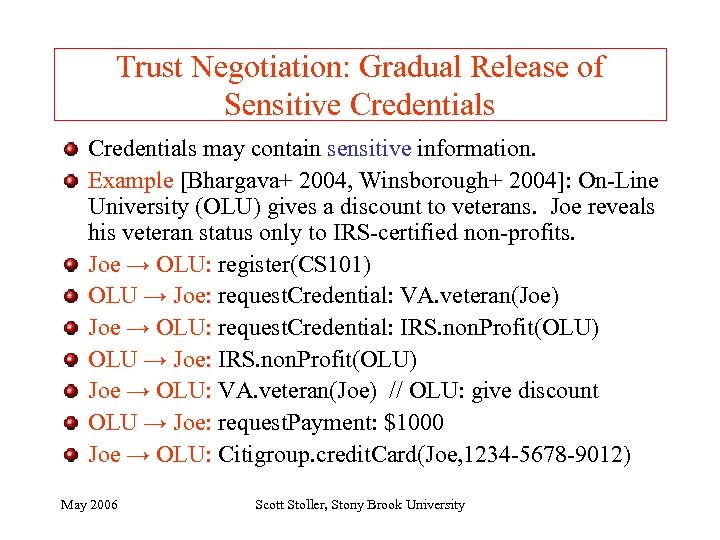 Trust Negotiation: Gradual Release of Sensitive Credentials may contain sensitive information. Example [Bhargava+ 2004, Winsborough+ 2004]: On-Line University (OLU) gives a discount to veterans. Joe reveals his veteran status only to IRS-certified non-profits. Joe → OLU: register(CS 101) OLU → Joe: request. Credential: VA. veteran(Joe) Joe → OLU: request. Credential: IRS. non. Profit(OLU) OLU → Joe: IRS. non. Profit(OLU) Joe → OLU: VA. veteran(Joe) // OLU: give discount OLU → Joe: request. Payment: $1000 Joe → OLU: Citigroup. credit. Card(Joe, 1234 -5678 -9012) May 2006 Scott Stoller, Stony Brook University
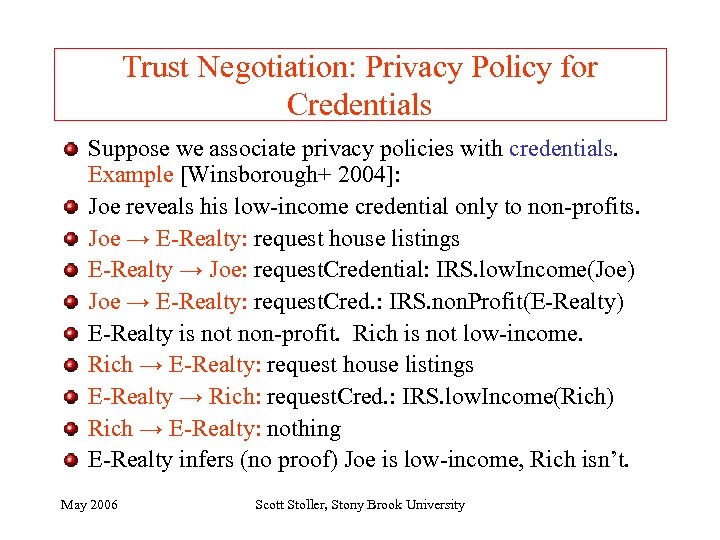 Trust Negotiation: Privacy Policy for Credentials Suppose we associate privacy policies with credentials. Example [Winsborough+ 2004]: Joe reveals his low-income credential only to non-profits. Joe → E-Realty: request house listings E-Realty → Joe: request. Credential: IRS. low. Income(Joe) Joe → E-Realty: request. Cred. : IRS. non. Profit(E-Realty) E-Realty is not non-profit. Rich is not low-income. Rich → E-Realty: request house listings E-Realty → Rich: request. Cred. : IRS. low. Income(Rich) Rich → E-Realty: nothing E-Realty infers (no proof) Joe is low-income, Rich isn’t. May 2006 Scott Stoller, Stony Brook University
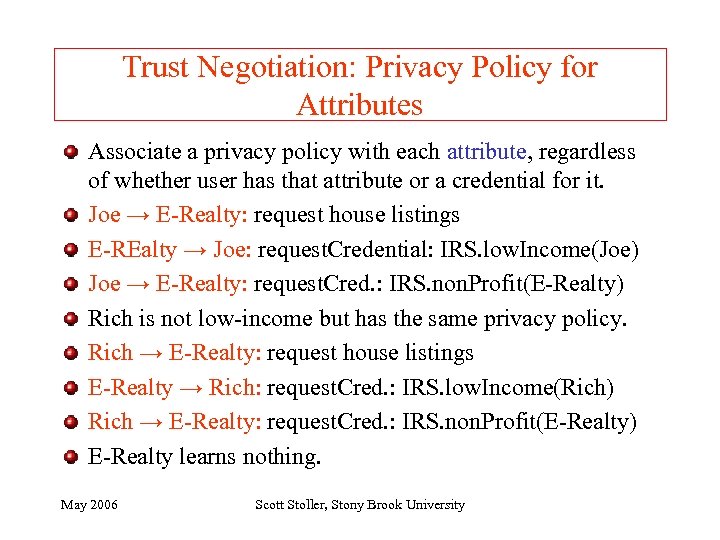 Trust Negotiation: Privacy Policy for Attributes Associate a privacy policy with each attribute, regardless of whether user has that attribute or a credential for it. Joe → E-Realty: request house listings E-REalty → Joe: request. Credential: IRS. low. Income(Joe) Joe → E-Realty: request. Cred. : IRS. non. Profit(E-Realty) Rich is not low-income but has the same privacy policy. Rich → E-Realty: request house listings E-Realty → Rich: request. Cred. : IRS. low. Income(Rich) Rich → E-Realty: request. Cred. : IRS. non. Profit(E-Realty) E-Realty learns nothing. May 2006 Scott Stoller, Stony Brook University
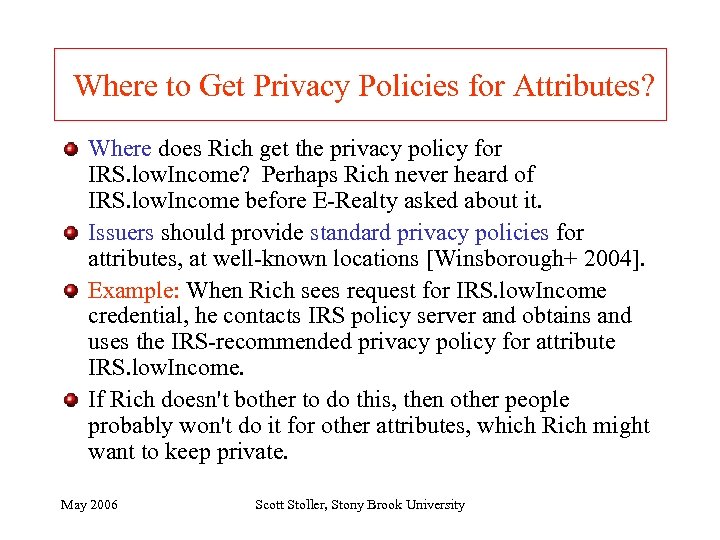 Where to Get Privacy Policies for Attributes? Where does Rich get the privacy policy for IRS. low. Income? Perhaps Rich never heard of IRS. low. Income before E-Realty asked about it. Issuers should provide standard privacy policies for attributes, at well-known locations [Winsborough+ 2004]. Example: When Rich sees request for IRS. low. Income credential, he contacts IRS policy server and obtains and uses the IRS-recommended privacy policy for attribute IRS. low. Income. If Rich doesn't bother to do this, then other people probably won't do it for other attributes, which Rich might want to keep private. May 2006 Scott Stoller, Stony Brook University
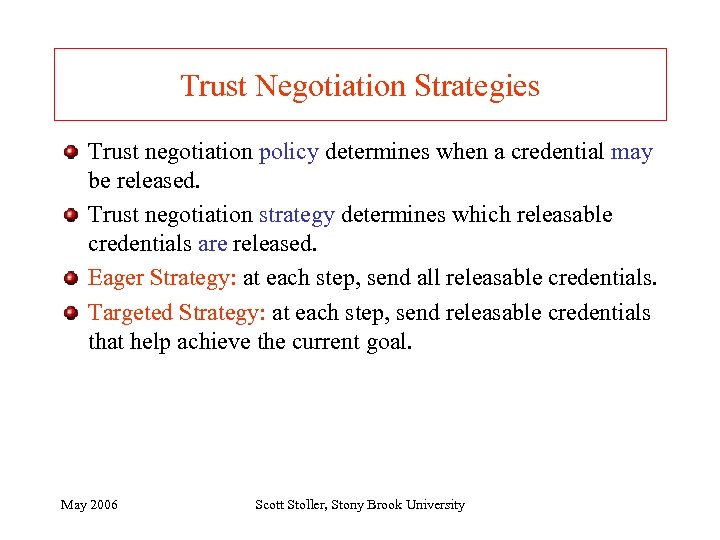 Trust Negotiation Strategies Trust negotiation policy determines when a credential may be released. Trust negotiation strategy determines which releasable credentials are released. Eager Strategy: at each step, send all releasable credentials. Targeted Strategy: at each step, send releasable credentials that help achieve the current goal. May 2006 Scott Stoller, Stony Brook University
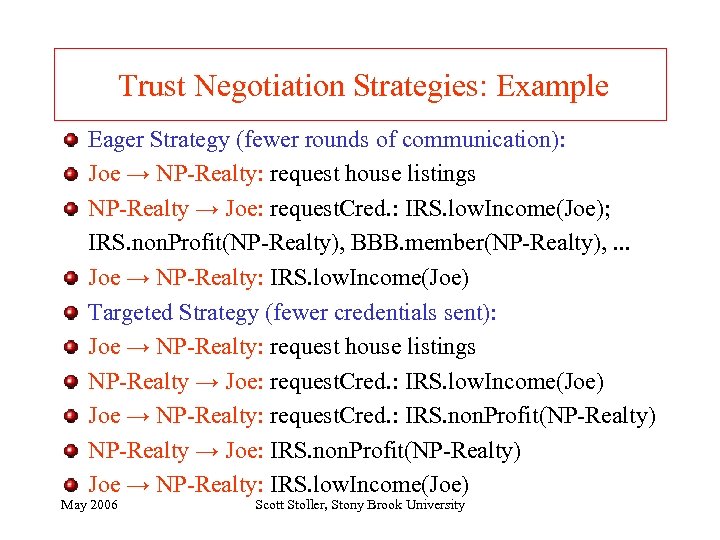 Trust Negotiation Strategies: Example Eager Strategy (fewer rounds of communication): Joe → NP-Realty: request house listings NP-Realty → Joe: request. Cred. : IRS. low. Income(Joe); IRS. non. Profit(NP-Realty), BBB. member(NP-Realty), . . . Joe → NP-Realty: IRS. low. Income(Joe) Targeted Strategy (fewer credentials sent): Joe → NP-Realty: request house listings NP-Realty → Joe: request. Cred. : IRS. low. Income(Joe) Joe → NP-Realty: request. Cred. : IRS. non. Profit(NP-Realty) NP-Realty → Joe: IRS. non. Profit(NP-Realty) Joe → NP-Realty: IRS. low. Income(Joe) May 2006 Scott Stoller, Stony Brook University
![Trust Negotiation: Hidden Credentials The hidden credentials framework [Holt+ 2003, Frikken+ 2006] for trust](https://present5.com/presentation/55b604105b048e4afbf71bd8d2d0a29e/image-39.jpg "Trust Negotiation: Hidden Credentials The hidden credentials framework [Holt+ 2003, Frikken+ 2006] for trust") Trust Negotiation: Hidden Credentials The hidden credentials framework [Holt+ 2003, Frikken+ 2006] for trust negotiation provides greater privacy. The server does not learn anything about client’s credentials, and the client does not learn anything about the server’s access control policy, except what each can infer from the outcome of the negotiation (success or failure). Privacy policies for attributes are unnecessary in this framework, because credentials are never revealed. Idea: Server uses identity-based encryption to encrypt responses so that the client can decrypt them only if the client possesses appropriate credentials. May 2006 Scott Stoller, Stony Brook University
Trust Negotiation: Hidden Credentials The hidden credentials framework [Holt+ 2003, Frikken+ 2006] for trust negotiation provides greater privacy. The server does not learn anything about client’s credentials, and the client does not learn anything about the server’s access control policy, except what each can infer from the outcome of the negotiation (success or failure). Privacy policies for attributes are unnecessary in this framework, because credentials are never revealed. Idea: Server uses identity-based encryption to encrypt responses so that the client can decrypt them only if the client possesses appropriate credentials. May 2006 Scott Stoller, Stony Brook University
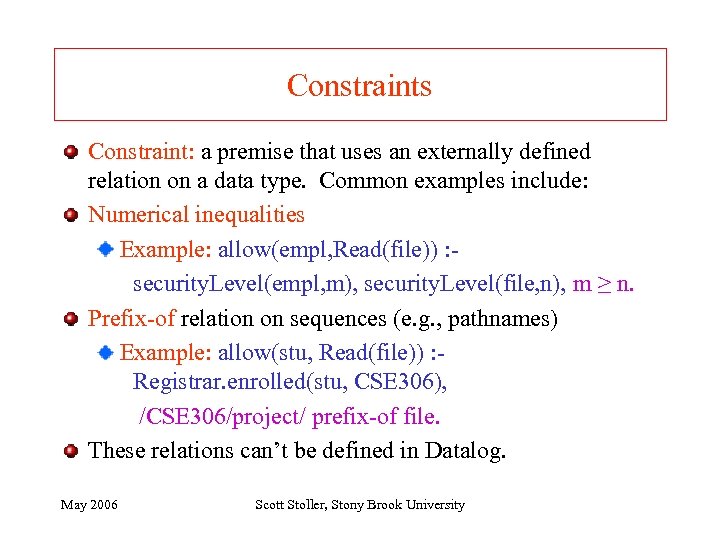 Constraints Constraint: a premise that uses an externally defined relation on a data type. Common examples include: Numerical inequalities Example: allow(empl, Read(file)) : security. Level(empl, m), security. Level(file, n), m ≥ n. Prefix-of relation on sequences (e. g. , pathnames) Example: allow(stu, Read(file)) : Registrar. enrolled(stu, CSE 306), /CSE 306/project/ prefix-of file. These relations can’t be defined in Datalog. May 2006 Scott Stoller, Stony Brook University
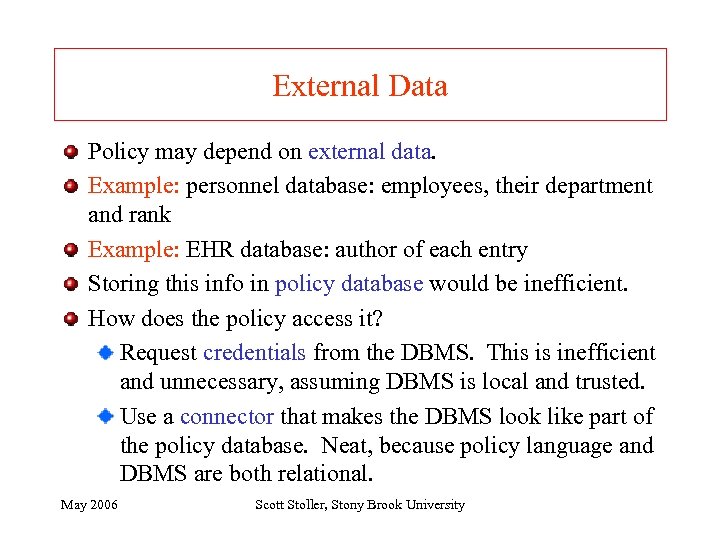 External Data Policy may depend on external data. Example: personnel database: employees, their department and rank Example: EHR database: author of each entry Storing this info in policy database would be inefficient. How does the policy access it? Request credentials from the DBMS. This is inefficient and unnecessary, assuming DBMS is local and trusted. Use a connector that makes the DBMS look like part of the policy database. Neat, because policy language and DBMS are both relational. May 2006 Scott Stoller, Stony Brook University
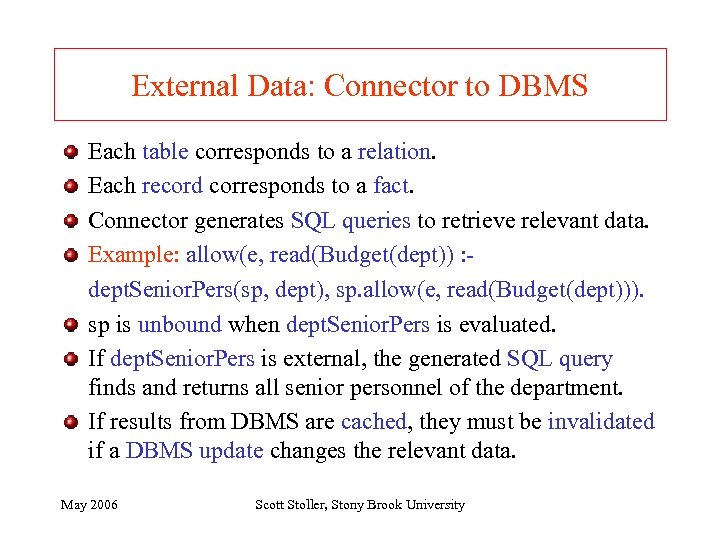 External Data: Connector to DBMS Each table corresponds to a relation. Each record corresponds to a fact. Connector generates SQL queries to retrieve relevant data. Example: allow(e, read(Budget(dept)) : dept. Senior. Pers(sp, dept), sp. allow(e, read(Budget(dept))). sp is unbound when dept. Senior. Pers is evaluated. If dept. Senior. Pers is external, the generated SQL query finds and returns all senior personnel of the department. If results from DBMS are cached, they must be invalidated if a DBMS update changes the relevant data. May 2006 Scott Stoller, Stony Brook University
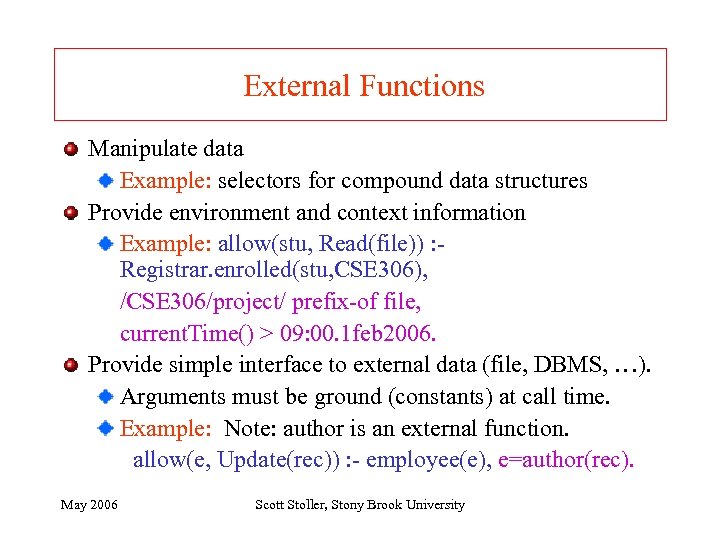 External Functions Manipulate data Example: selectors for compound data structures Provide environment and context information Example: allow(stu, Read(file)) : Registrar. enrolled(stu, CSE 306), /CSE 306/project/ prefix-of file, current. Time() > 09: 00. 1 feb 2006. Provide simple interface to external data (file, DBMS, …). Arguments must be ground (constants) at call time. Example: Note: author is an external function. allow(e, Update(rec)) : - employee(e), e=author(rec). May 2006 Scott Stoller, Stony Brook University
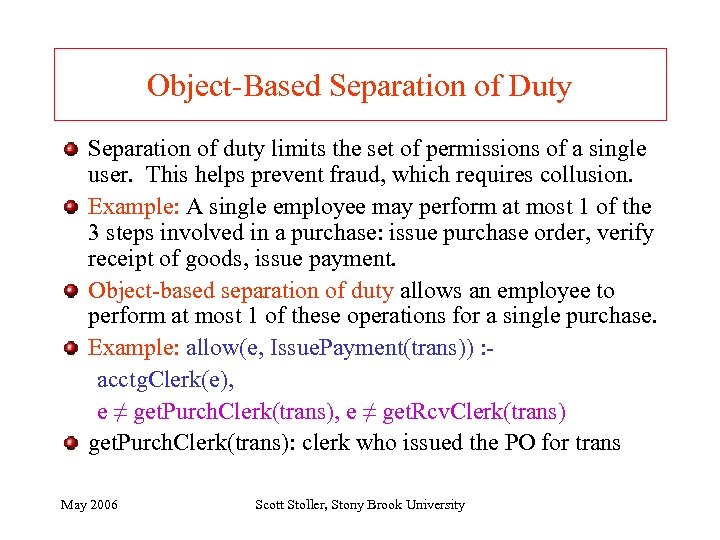 Object-Based Separation of Duty Separation of duty limits the set of permissions of a single user. This helps prevent fraud, which requires collusion. Example: A single employee may perform at most 1 of the 3 steps involved in a purchase: issue purchase order, verify receipt of goods, issue payment. Object-based separation of duty allows an employee to perform at most 1 of these operations for a single purchase. Example: allow(e, Issue. Payment(trans)) : acctg. Clerk(e), e ≠ get. Purch. Clerk(trans), e ≠ get. Rcv. Clerk(trans) get. Purch. Clerk(trans): clerk who issued the PO for trans May 2006 Scott Stoller, Stony Brook University
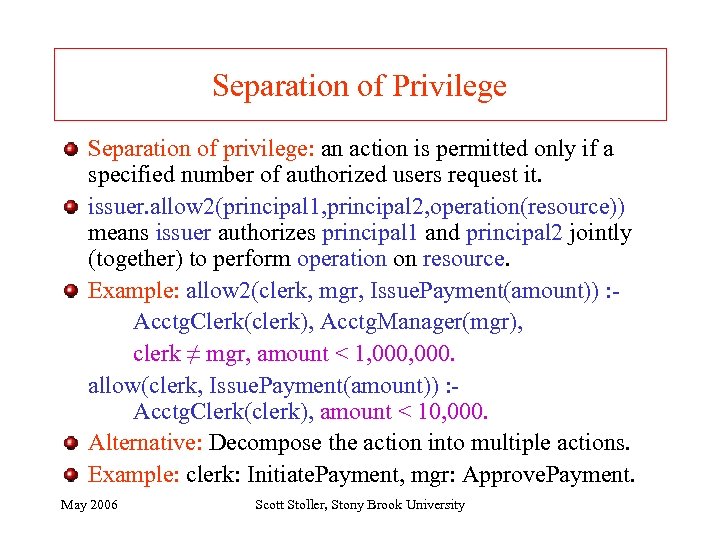 Separation of Privilege Separation of privilege: an action is permitted only if a specified number of authorized users request it. issuer. allow 2(principal 1, principal 2, operation(resource)) means issuer authorizes principal 1 and principal 2 jointly (together) to perform operation on resource. Example: allow 2(clerk, mgr, Issue. Payment(amount)) : Acctg. Clerk(clerk), Acctg. Manager(mgr), clerk ≠ mgr, amount < 1, 000. allow(clerk, Issue. Payment(amount)) : Acctg. Clerk(clerk), amount < 10, 000. Alternative: Decompose the action into multiple actions. Example: clerk: Initiate. Payment, mgr: Approve. Payment. May 2006 Scott Stoller, Stony Brook University
 Roles Parameterized role: r(args). Abbreviate r() as r. Example: Manager(department), Guardian(patient) “p is a member of r(args)” can be represented as r(p, args) roles as relations member(p, r(args)) roles as values Permission-role relation is defined by rules like: permit(p, oper(resource)) : - r(p, args), . . . permit(p, oper(resource)) : - member(p, r(args)), . . . Roles as values allows variables that range over roles, but this can be simulated with roles as relations. May 2006 Scott Stoller, Stony Brook University
 Role Hierarchy Role hierarchy can be expressed by rules for inheritance of membership. Example: Manager ≥ Employee is expressed by member(e, Employee) : - member(e, Manager). Role hierarchy could be expressed instead by rules for inheritance of permissions if we made the permission-role relation PR(action, role) explicit. May 2006 Scott Stoller, Stony Brook University
 Global and Local Names Local names: names of attributes and relations include the name of a principal, called its source or issuer. Example: AMA. doctor(Dan), BMA. doctor(Dan) Statements about src. r may be issued only by src. Global names: shared namespace for attributes & relations. Less structured, but more flexible. Example: Acme. Hosp. member(Dan, Doctor(AMA)) RT [Li+ 2003]: local. Cassandra [Becker+ 2004]: global. An ontology can provide common meaning for names. Local names for principals, e. g. , [SBU President]. Used in SPKI/SDSI. Can be simulated using parameterized roles. May 2006 Scott Stoller, Stony Brook University
 Outline Introduction and Motivation Design Issues and Features Trust Management Frameworks List of several proposed frameworks on next slide. We’ll discuss a few representative frameworks. Sample Application Domains Research Directions May 2006 Scott Stoller, Stony Brook University
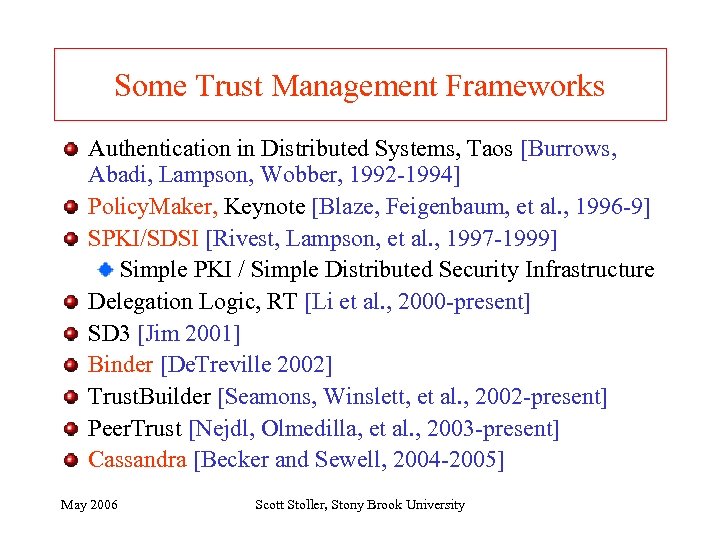 Some Trust Management Frameworks Authentication in Distributed Systems, Taos [Burrows, Abadi, Lampson, Wobber, 1992 -1994] Policy. Maker, Keynote [Blaze, Feigenbaum, et al. , 1996 -9] SPKI/SDSI [Rivest, Lampson, et al. , 1997 -1999] Simple PKI / Simple Distributed Security Infrastructure Delegation Logic, RT [Li et al. , 2000 -present] SD 3 [Jim 2001] Binder [De. Treville 2002] Trust. Builder [Seamons, Winslett, et al. , 2002 -present] Peer. Trust [Nejdl, Olmedilla, et al. , 2003 -present] Cassandra [Becker and Sewell, 2004 -2005] May 2006 Scott Stoller, Stony Brook University
![Policy. Maker [Blaze, Feigenbaum, et al. ] Policy. Maker is a blackboard-based trust management](https://present5.com/presentation/55b604105b048e4afbf71bd8d2d0a29e/image-51.jpg "Policy. Maker [Blaze, Feigenbaum, et al. ] Policy. Maker is a blackboard-based trust management") Policy. Maker [Blaze, Feigenbaum, et al. ] Policy. Maker is a blackboard-based trust management architecture. The blackboard contains requests (goals): action/statement to be authorized acceptance records: issuer allows action/statement Policy: functions that read requests and acceptance records from the blackboard and write acceptance records. Use any safe functional programming lang. (Safe. AWK) Policy. Maker is flexible but offers minimal functionality. Application gathers credentials, verifies signatures, etc. AWK interpreter (or …) evaluates policy functions May 2006 Scott Stoller, Stony Brook University
Policy. Maker [Blaze, Feigenbaum, et al. ] Policy. Maker is a blackboard-based trust management architecture. The blackboard contains requests (goals): action/statement to be authorized acceptance records: issuer allows action/statement Policy: functions that read requests and acceptance records from the blackboard and write acceptance records. Use any safe functional programming lang. (Safe. AWK) Policy. Maker is flexible but offers minimal functionality. Application gathers credentials, verifies signatures, etc. AWK interpreter (or …) evaluates policy functions May 2006 Scott Stoller, Stony Brook University
![SPKI/SDSI [Rivest, Lampson, et al. ] Name Certificates Local names for principals. The meaning](https://present5.com/presentation/55b604105b048e4afbf71bd8d2d0a29e/image-52.jpg "SPKI/SDSI [Rivest, Lampson, et al. ] Name Certificates Local names for principals. The meaning") SPKI/SDSI [Rivest, Lampson, et al. ] Name Certificates Local names for principals. The meaning of local names is given by name certificates that relate local names to each other and to global identifiers (public keys). Format: [K, name, subject, validity. Spec] signed by K Meaning: local name K name refers to subject may be a name or a public key Example: [K-SBU-CS, Chair, K-Ari, exp. june 2007] A local name mapped to multiple keys is a group name. Example: [K-SUNY, Student, K-Joe, exp. may 2006] [K-SUNY, Student, K-Mary, exp. may 2006] validity. Spec: expiration date, CRL location, . . . May 2006 Scott Stoller, Stony Brook University
SPKI/SDSI [Rivest, Lampson, et al. ] Name Certificates Local names for principals. The meaning of local names is given by name certificates that relate local names to each other and to global identifiers (public keys). Format: [K, name, subject, validity. Spec] signed by K Meaning: local name K name refers to subject may be a name or a public key Example: [K-SBU-CS, Chair, K-Ari, exp. june 2007] A local name mapped to multiple keys is a group name. Example: [K-SUNY, Student, K-Joe, exp. may 2006] [K-SUNY, Student, K-Mary, exp. may 2006] validity. Spec: expiration date, CRL location, . . . May 2006 Scott Stoller, Stony Brook University
![SPKI/SDSI: Authorization Certificate Format: [K, subject, deleg, tag, validity. Spec] signed by K Not](https://present5.com/presentation/55b604105b048e4afbf71bd8d2d0a29e/image-53.jpg "SPKI/SDSI: Authorization Certificate Format: [K, subject, deleg, tag, validity. Spec] signed by K Not") SPKI/SDSI: Authorization Certificate Format: [K, subject, deleg, tag, validity. Spec] signed by K Not using official syntax. Meaning: issuer K gives permission tag to subject. deleg indicates whether subject can delegate the permission (in addition to using it himself). subject may be a name (defined by other certificates), a public key, a threshold structure, or an object hash (ignore) A threshold structure [{K 1, K 2, …}, n] means any n of the listed keys can together authorize the delegated action (separation of privilege). May 2006 Scott Stoller, Stony Brook University
SPKI/SDSI: Authorization Certificate Format: [K, subject, deleg, tag, validity. Spec] signed by K Not using official syntax. Meaning: issuer K gives permission tag to subject. deleg indicates whether subject can delegate the permission (in addition to using it himself). subject may be a name (defined by other certificates), a public key, a threshold structure, or an object hash (ignore) A threshold structure [{K 1, K 2, …}, n] means any n of the listed keys can together authorize the delegated action (separation of privilege). May 2006 Scott Stoller, Stony Brook University
![SPKI/SDSI: Authorization Certif. Examples [K-SBU, [K-SBU Faculty], false, read. Dir, exp. 2006] Example with](https://present5.com/presentation/55b604105b048e4afbf71bd8d2d0a29e/image-54.jpg "SPKI/SDSI: Authorization Certif. Examples [K-SBU, [K-SBU Faculty], false, read. Dir, exp. 2006] Example with") SPKI/SDSI: Authorization Certif. Examples [K-SBU, [K-SBU Faculty], false, read. Dir, exp. 2006] Example with delegation: [K-SBU, [K-SBU Faculty], true, (get. Roster *), exp. 2006] Name Certificate: [K-SBU, Faculty, Scott, exp. 2009] [K-Scott, K-Sonny, false, (get. Roster CSE 394), exp. 2006] Sonny is the TA. He can’t delegate this permission. Authorization certificates define one relation: allows (delegates). Role-based policies can be expressed using groups May 2006 Scott Stoller, Stony Brook University
SPKI/SDSI: Authorization Certif. Examples [K-SBU, [K-SBU Faculty], false, read. Dir, exp. 2006] Example with delegation: [K-SBU, [K-SBU Faculty], true, (get. Roster *), exp. 2006] Name Certificate: [K-SBU, Faculty, Scott, exp. 2009] [K-Scott, K-Sonny, false, (get. Roster CSE 394), exp. 2006] Sonny is the TA. He can’t delegate this permission. Authorization certificates define one relation: allows (delegates). Role-based policies can be expressed using groups May 2006 Scott Stoller, Stony Brook University
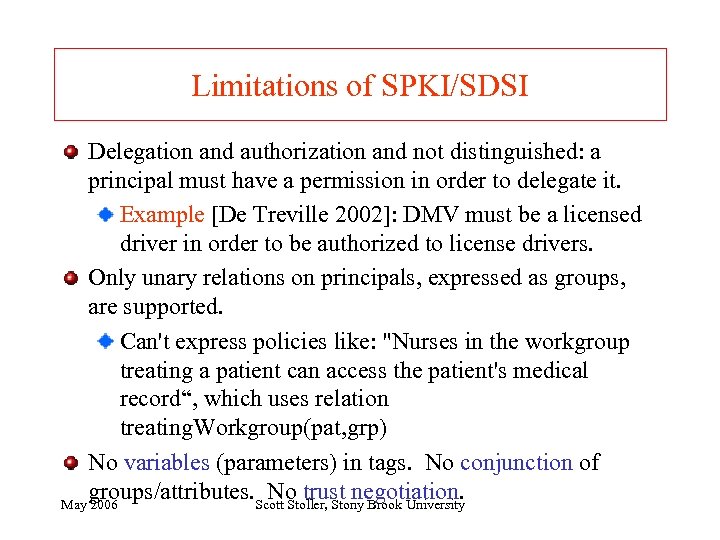 Limitations of SPKI/SDSI Delegation and authorization and not distinguished: a principal must have a permission in order to delegate it. Example [De Treville 2002]: DMV must be a licensed driver in order to be authorized to license drivers. Only unary relations on principals, expressed as groups, are supported. Can't express policies like: "Nurses in the workgroup treating a patient can access the patient's medical record“, which uses relation treating. Workgroup(pat, grp) No variables (parameters) in tags. No conjunction of groups/attributes. Scott Stoller, Stony Brook University No trust negotiation. May 2006
![Binder [De. Treville 2002] Our simple policy language (without constraints) is very similar to](https://present5.com/presentation/55b604105b048e4afbf71bd8d2d0a29e/image-56.jpg "Binder [De. Treville 2002] Our simple policy language (without constraints) is very similar to") Binder [De. Treville 2002] Our simple policy language (without constraints) is very similar to Binder’s. Authorization relation: issuer says can(principal, operation, resource) Nicely written paper; recommended as an introduction to rule-based trust management Allows communication of rules (discussed later), although the details are unspecified Does not consider trust negotiation. May 2006 Scott Stoller, Stony Brook University
Binder [De. Treville 2002] Our simple policy language (without constraints) is very similar to Binder’s. Authorization relation: issuer says can(principal, operation, resource) Nicely written paper; recommended as an introduction to rule-based trust management Allows communication of rules (discussed later), although the details are unspecified Does not consider trust negotiation. May 2006 Scott Stoller, Stony Brook University
![Cassandra [Becker and Sewell, 2004 -2005] Lang: Datalog + constraints + aggregation (nonmonotonic) Role-based](https://present5.com/presentation/55b604105b048e4afbf71bd8d2d0a29e/image-57.jpg "Cassandra [Becker and Sewell, 2004 -2005] Lang: Datalog + constraints + aggregation (nonmonotonic) Role-based") Cassandra [Becker and Sewell, 2004 -2005] Lang: Datalog + constraints + aggregation (nonmonotonic) Role-based Parameterized roles, parameterized actions (permissions) Global names (simulate local names using issuer and other parameters) Goal-directed evaluation with memoization (tabling) Policy-controlled credential gathering Role activation (but not sessions; details below) Trust negotiation External functions May 2006 Scott Stoller, Stony Brook University
Cassandra [Becker and Sewell, 2004 -2005] Lang: Datalog + constraints + aggregation (nonmonotonic) Role-based Parameterized roles, parameterized actions (permissions) Global names (simulate local names using issuer and other parameters) Goal-directed evaluation with memoization (tabling) Policy-controlled credential gathering Role activation (but not sessions; details below) Trust negotiation External functions May 2006 Scott Stoller, Stony Brook University
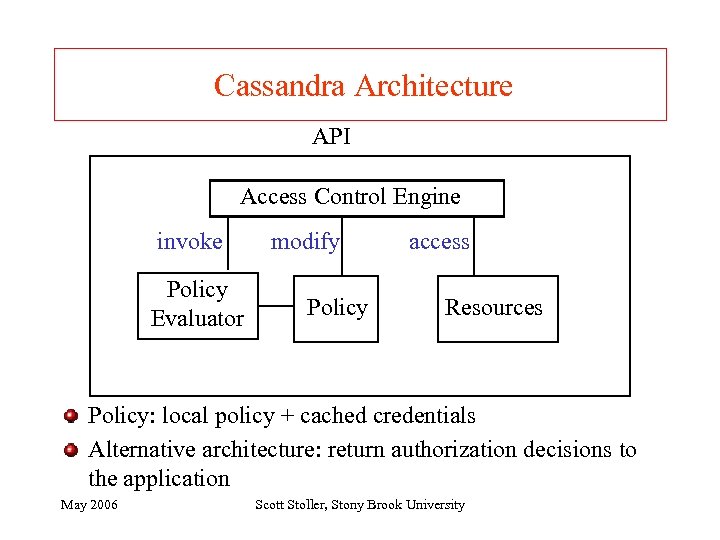 Cassandra Architecture API Access Control Engine invoke Policy Evaluator modify Policy access Resources Policy: local policy + cached credentials Alternative architecture: return authorization decisions to the application May 2006 Scott Stoller, Stony Brook University
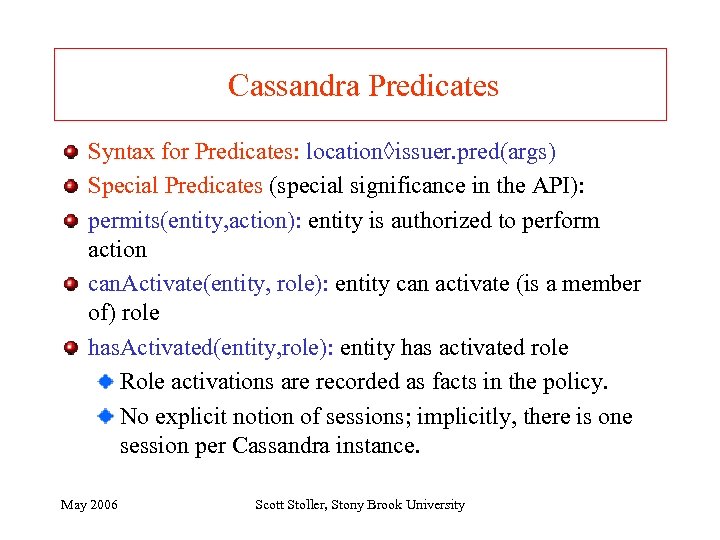 Cassandra Predicates Syntax for Predicates: location◊issuer. pred(args) Special Predicates (special significance in the API): permits(entity, action): entity is authorized to perform action can. Activate(entity, role): entity can activate (is a member of) role has. Activated(entity, role): entity has activated role Role activations are recorded as facts in the policy. No explicit notion of sessions; implicitly, there is one session per Cassandra instance. May 2006 Scott Stoller, Stony Brook University
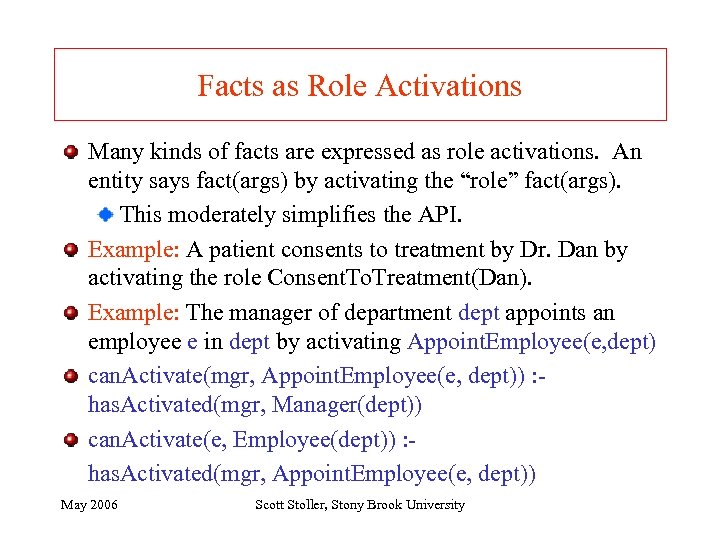 Facts as Role Activations Many kinds of facts are expressed as role activations. An entity says fact(args) by activating the “role” fact(args). This moderately simplifies the API. Example: A patient consents to treatment by Dr. Dan by activating the role Consent. To. Treatment(Dan). Example: The manager of department dept appoints an employee e in dept by activating Appoint. Employee(e, dept) can. Activate(mgr, Appoint. Employee(e, dept)) : has. Activated(mgr, Manager(dept)) can. Activate(e, Employee(dept)) : has. Activated(mgr, Appoint. Employee(e, dept)) May 2006 Scott Stoller, Stony Brook University
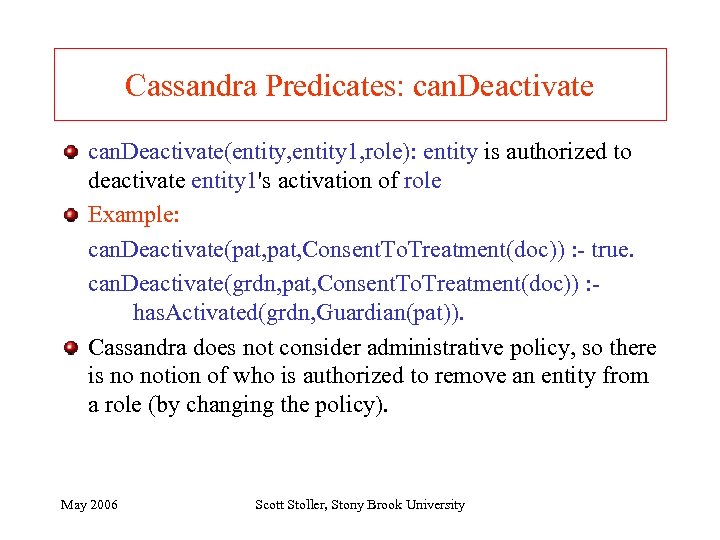 Cassandra Predicates: can. Deactivate(entity, entity 1, role): entity is authorized to deactivate entity 1's activation of role Example: can. Deactivate(pat, Consent. To. Treatment(doc)) : - true. can. Deactivate(grdn, pat, Consent. To. Treatment(doc)) : has. Activated(grdn, Guardian(pat)). Cassandra does not consider administrative policy, so there is no notion of who is authorized to remove an entity from a role (by changing the policy). May 2006 Scott Stoller, Stony Brook University
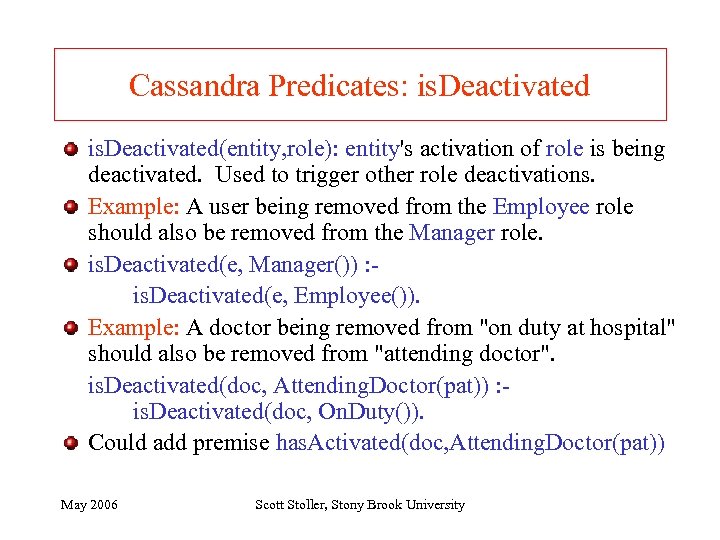 Cassandra Predicates: is. Deactivated(entity, role): entity's activation of role is being deactivated. Used to trigger other role deactivations. Example: A user being removed from the Employee role should also be removed from the Manager role. is. Deactivated(e, Manager()) : is. Deactivated(e, Employee()). Example: A doctor being removed from "on duty at hospital" should also be removed from "attending doctor". is. Deactivated(doc, Attending. Doctor(pat)) : is. Deactivated(doc, On. Duty()). Could add premise has. Activated(doc, Attending. Doctor(pat)) May 2006 Scott Stoller, Stony Brook University
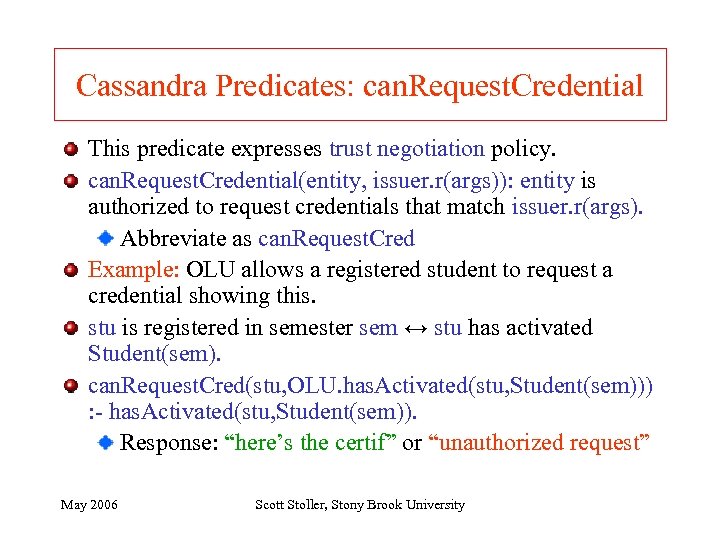 Cassandra Predicates: can. Request. Credential This predicate expresses trust negotiation policy. can. Request. Credential(entity, issuer. r(args)): entity is authorized to request credentials that match issuer. r(args). Abbreviate as can. Request. Cred Example: OLU allows a registered student to request a credential showing this. stu is registered in semester sem ↔ stu has activated Student(sem). can. Request. Cred(stu, OLU. has. Activated(stu, Student(sem))) : - has. Activated(stu, Student(sem)). Response: “here’s the certif” or “unauthorized request” May 2006 Scott Stoller, Stony Brook University
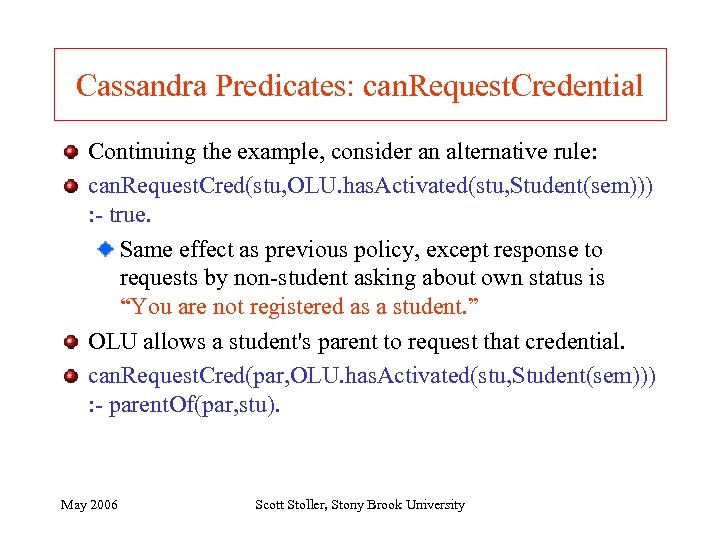 Cassandra Predicates: can. Request. Credential Continuing the example, consider an alternative rule: can. Request. Cred(stu, OLU. has. Activated(stu, Student(sem))) : - true. Same effect as previous policy, except response to requests by non-student asking about own status is “You are not registered as a student. ” OLU allows a student's parent to request that credential. can. Request. Cred(par, OLU. has. Activated(stu, Student(sem))) : - parent. Of(par, stu). May 2006 Scott Stoller, Stony Brook University
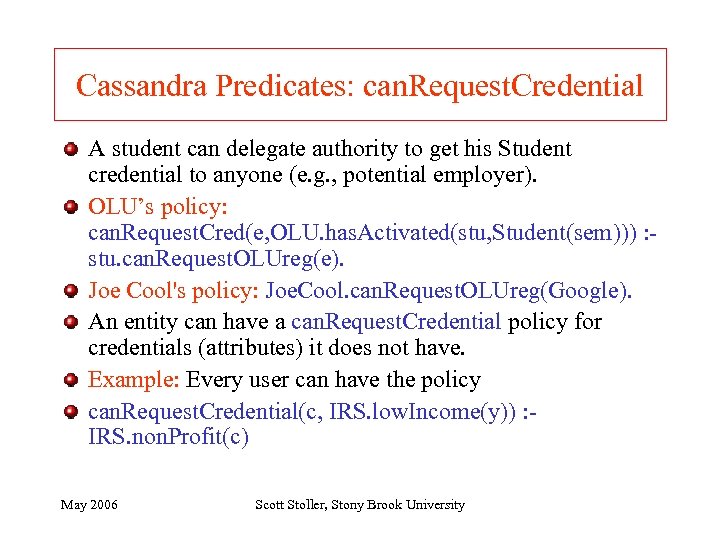 Cassandra Predicates: can. Request. Credential A student can delegate authority to get his Student credential to anyone (e. g. , potential employer). OLU’s policy: can. Request. Cred(e, OLU. has. Activated(stu, Student(sem))) : stu. can. Request. OLUreg(e). Joe Cool's policy: Joe. Cool. can. Request. OLUreg(Google). An entity can have a can. Request. Credential policy for credentials (attributes) it does not have. Example: Every user can have the policy can. Request. Credential(c, IRS. low. Income(y)) : IRS. non. Profit(c) May 2006 Scott Stoller, Stony Brook University
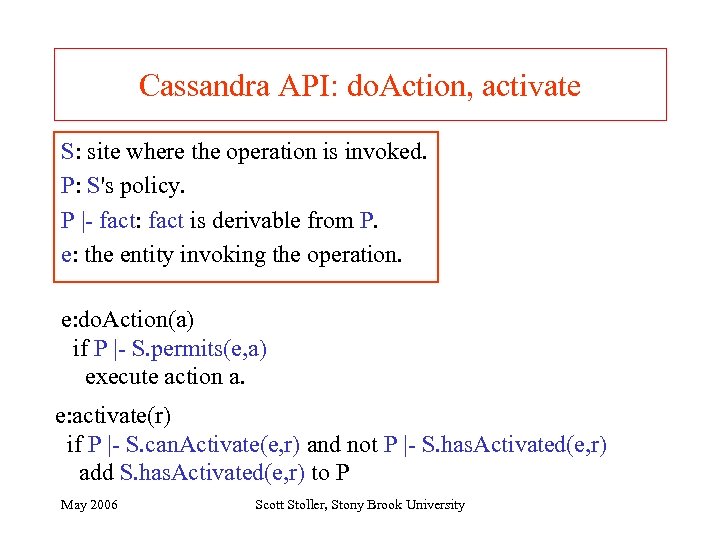 Cassandra API: do. Action, activate S: site where the operation is invoked. P: S's policy. P |- fact: fact is derivable from P. e: the entity invoking the operation. e: do. Action(a) if P |- S. permits(e, a) execute action a. e: activate(r) if P |- S. can. Activate(e, r) and not P |- S. has. Activated(e, r) add S. has. Activated(e, r) to P May 2006 Scott Stoller, Stony Brook University
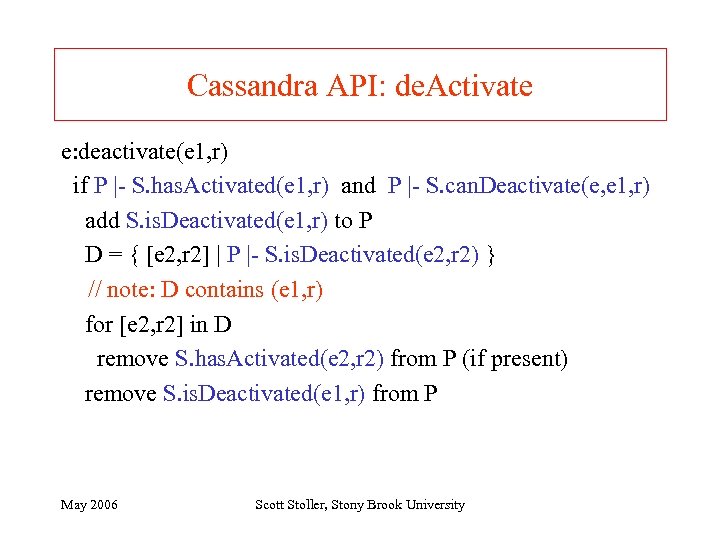 Cassandra API: de. Activate e: deactivate(e 1, r) if P |- S. has. Activated(e 1, r) and P |- S. can. Deactivate(e, e 1, r) add S. is. Deactivated(e 1, r) to P D = { [e 2, r 2] | P |- S. is. Deactivated(e 2, r 2) } // note: D contains (e 1, r) for [e 2, r 2] in D remove S. has. Activated(e 2, r 2) from P (if present) remove S. is. Deactivated(e 1, r) from P May 2006 Scott Stoller, Stony Brook University
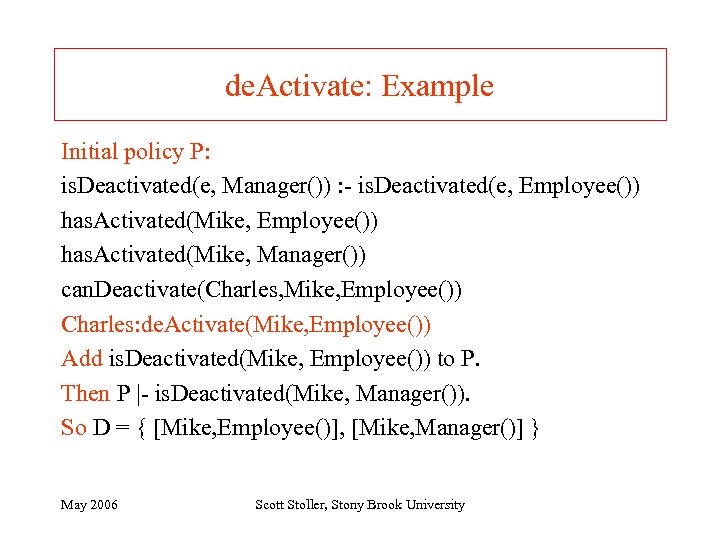 de. Activate: Example Initial policy P: is. Deactivated(e, Manager()) : - is. Deactivated(e, Employee()) has. Activated(Mike, Manager()) can. Deactivate(Charles, Mike, Employee()) Charles: de. Activate(Mike, Employee()) Add is. Deactivated(Mike, Employee()) to P. Then P |- is. Deactivated(Mike, Manager()). So D = { [Mike, Employee()], [Mike, Manager()] } May 2006 Scott Stoller, Stony Brook University
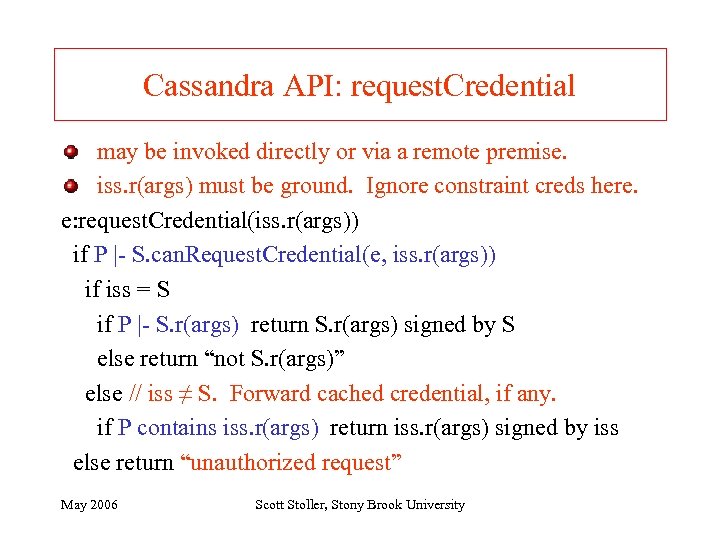 Cassandra API: request. Credential may be invoked directly or via a remote premise. iss. r(args) must be ground. Ignore constraint creds here. e: request. Credential(iss. r(args)) if P |- S. can. Request. Credential(e, iss. r(args)) if iss = S if P |- S. r(args) return S. r(args) signed by S else return “not S. r(args)” else // iss ≠ S. Forward cached credential, if any. if P contains iss. r(args) return iss. r(args) signed by iss else return “unauthorized request” May 2006 Scott Stoller, Stony Brook University
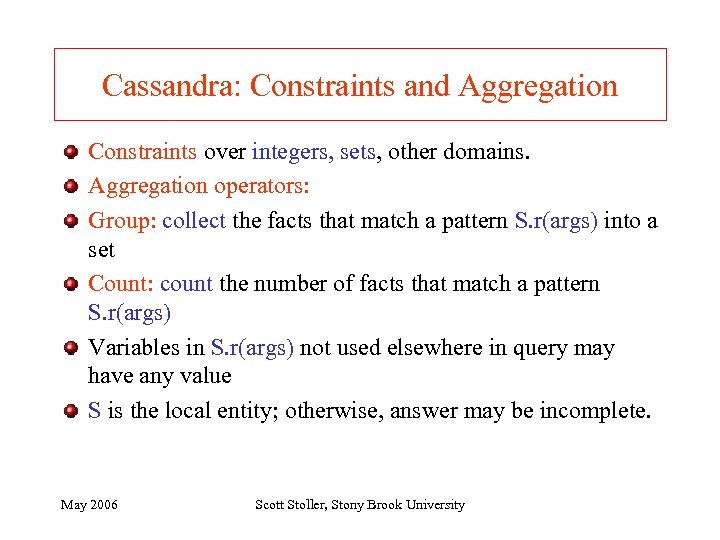 Cassandra: Constraints and Aggregation Constraints over integers, sets, other domains. Aggregation operators: Group: collect the facts that match a pattern S. r(args) into a set Count: count the number of facts that match a pattern S. r(args) Variables in S. r(args) not used elsewhere in query may have any value S is the local entity; otherwise, answer may be incomplete. May 2006 Scott Stoller, Stony Brook University
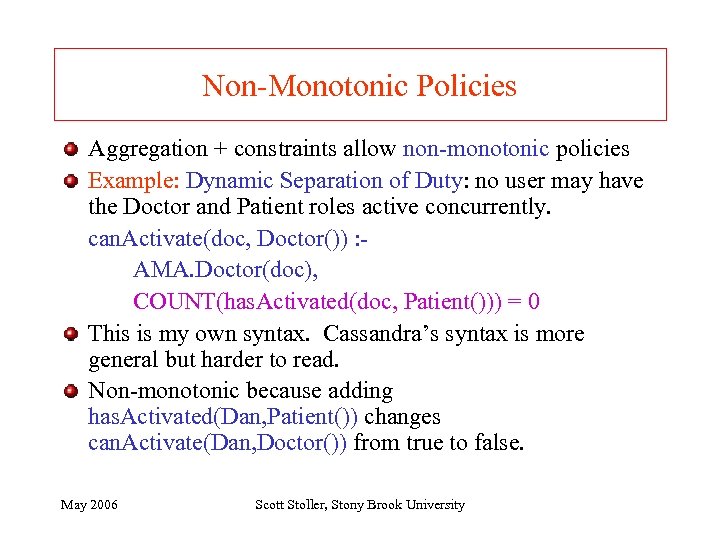 Non-Monotonic Policies Aggregation + constraints allow non-monotonic policies Example: Dynamic Separation of Duty: no user may have the Doctor and Patient roles active concurrently. can. Activate(doc, Doctor()) : AMA. Doctor(doc), COUNT(has. Activated(doc, Patient())) = 0 This is my own syntax. Cassandra’s syntax is more general but harder to read. Non-monotonic because adding has. Activated(Dan, Patient()) changes can. Activate(Dan, Doctor()) from true to false. May 2006 Scott Stoller, Stony Brook University
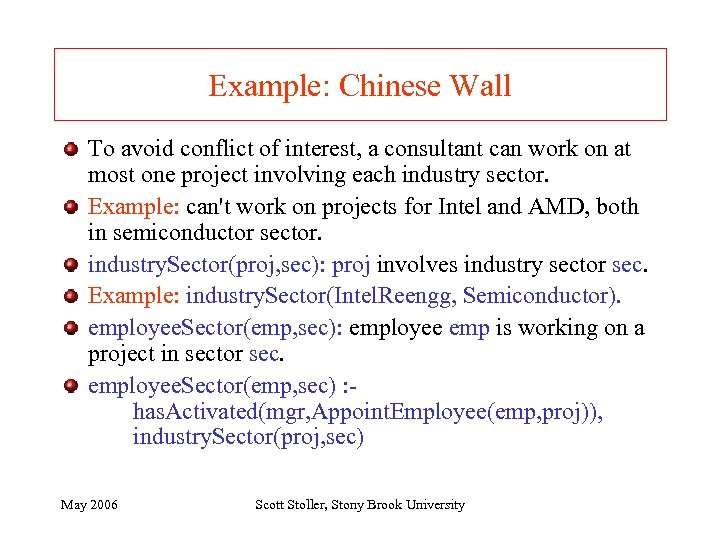 Example: Chinese Wall To avoid conflict of interest, a consultant can work on at most one project involving each industry sector. Example: can't work on projects for Intel and AMD, both in semiconductor sector. industry. Sector(proj, sec): proj involves industry sector sec. Example: industry. Sector(Intel. Reengg, Semiconductor). employee. Sector(emp, sec): employee emp is working on a project in sector sec. employee. Sector(emp, sec) : has. Activated(mgr, Appoint. Employee(emp, proj)), industry. Sector(proj, sec) May 2006 Scott Stoller, Stony Brook University
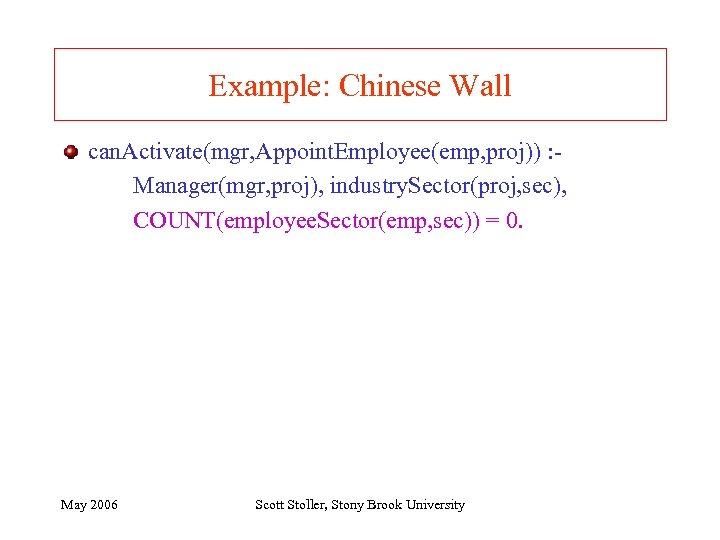 Example: Chinese Wall can. Activate(mgr, Appoint. Employee(emp, proj)) : Manager(mgr, proj), industry. Sector(proj, sec), COUNT(employee. Sector(emp, sec)) = 0. May 2006 Scott Stoller, Stony Brook University
 Outline Introduction and Motivation Design Issues and Features Trust Management Frameworks Sample Application Domains Electronic Health Records (EHR) Other application domains Research Directions May 2006 Scott Stoller, Stony Brook University
 POP QUIZ May 2006 Scott Stoller, Stony Brook University
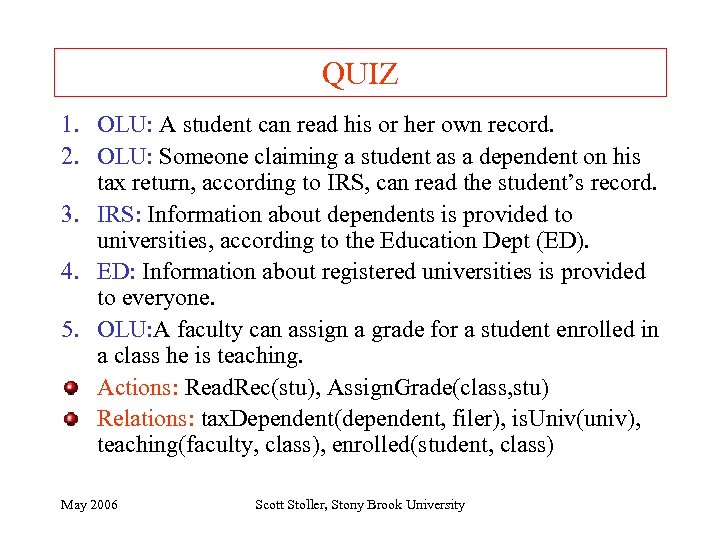 QUIZ 1. OLU: A student can read his or her own record. 2. OLU: Someone claiming a student as a dependent on his tax return, according to IRS, can read the student’s record. 3. IRS: Information about dependents is provided to universities, according to the Education Dept (ED). 4. ED: Information about registered universities is provided to everyone. 5. OLU: A faculty can assign a grade for a student enrolled in a class he is teaching. Actions: Read. Rec(stu), Assign. Grade(class, stu) Relations: tax. Dependent(dependent, filer), is. Univ(univ), teaching(faculty, class), enrolled(student, class) May 2006 Scott Stoller, Stony Brook University
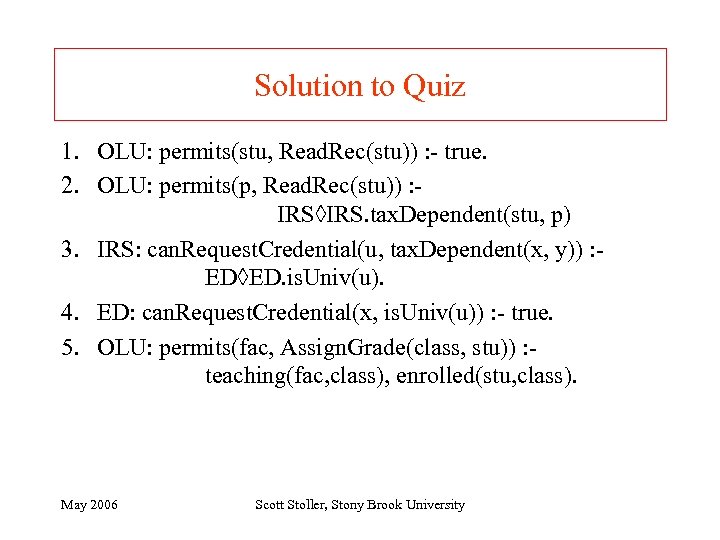 Solution to Quiz 1. OLU: permits(stu, Read. Rec(stu)) : - true. 2. OLU: permits(p, Read. Rec(stu)) : IRS. tax. Dependent(stu, p) 3. IRS: can. Request. Credential(u, tax. Dependent(x, y)) : ED ED. is. Univ(u). 4. ED: can. Request. Credential(x, is. Univ(u)) : - true. 5. OLU: permits(fac, Assign. Grade(class, stu)) : teaching(fac, class), enrolled(stu, class). May 2006 Scott Stoller, Stony Brook University
 Electronic Health Records (EHR) Promising application for RBAC and trust management People and organizations with limited trust must share sensitive information: patients, doctors, nurses, hospitals, billing companies, insurance companies, government agencies (e. g. , Medicaid, FDA), professional societies (e. g. , AMA), medical researchers, etc. More interactive information sharing will increase the need for trust management. Case study [Becker 2005]: Output Based Specification for Integrated Care Record Service, version 2, 2003. Developed by the National Health Service (NHS) of the United Kingdom. May 2006 Scott Stoller, Stony Brook University
 EHR Policy Spine: a nationwide EHR system one electronic health record (EHR) per patient multiple items per record Registration Authority (RA): issues credentials for clinicians, with name, affiliation, specialty, etc. typically for one organization, but may be regional Local health organizations: hospitals, doctors' offices, etc. one electronic patient record (EPR) per patient, with full data Patient Demographic System (PDS) One nationwide PDS May 2006 Scott Stoller, Stony Brook University
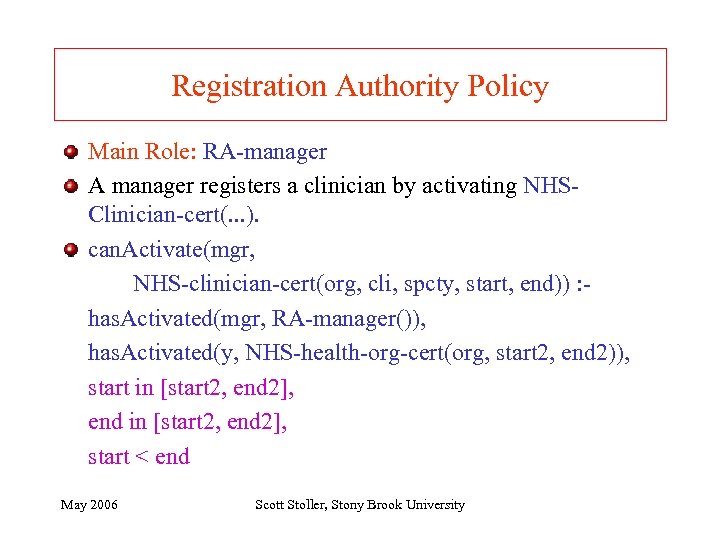 Registration Authority Policy Main Role: RA-manager A manager registers a clinician by activating NHSClinician-cert(. . . ). can. Activate(mgr, NHS-clinician-cert(org, cli, spcty, start, end)) : has. Activated(mgr, RA-manager()), has. Activated(y, NHS-health-org-cert(org, start 2, end 2)), start in [start 2, end 2], end in [start 2, end 2], start < end May 2006 Scott Stoller, Stony Brook University
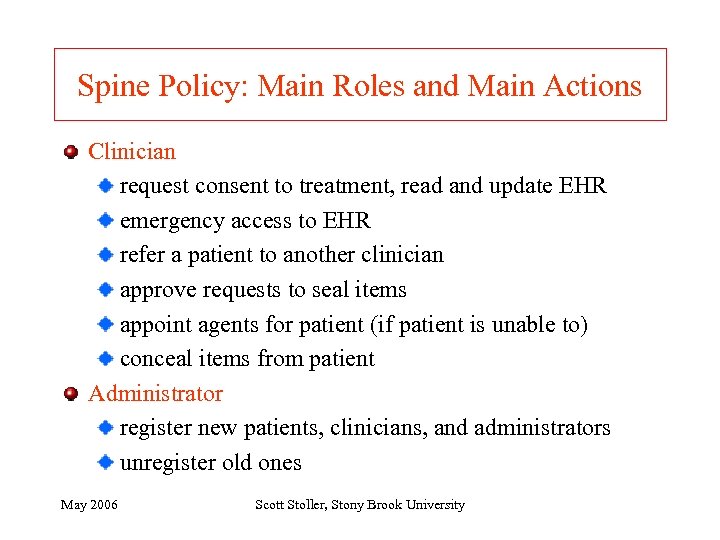 Spine Policy: Main Roles and Main Actions Clinician request consent to treatment, read and update EHR emergency access to EHR refer a patient to another clinician approve requests to seal items appoint agents for patient (if patient is unable to) conceal items from patient Administrator register new patients, clinicians, and administrators unregister old ones May 2006 Scott Stoller, Stony Brook University
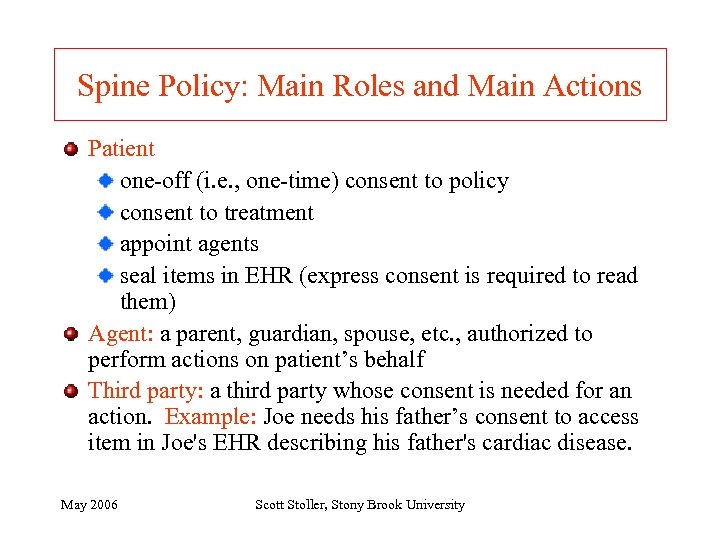 Spine Policy: Main Roles and Main Actions Patient one-off (i. e. , one-time) consent to policy consent to treatment appoint agents seal items in EHR (express consent is required to read them) Agent: a parent, guardian, spouse, etc. , authorized to perform actions on patient’s behalf Third party: a third party whose consent is needed for an action. Example: Joe needs his father’s consent to access item in Joe's EHR describing his father's cardiac disease. May 2006 Scott Stoller, Stony Brook University
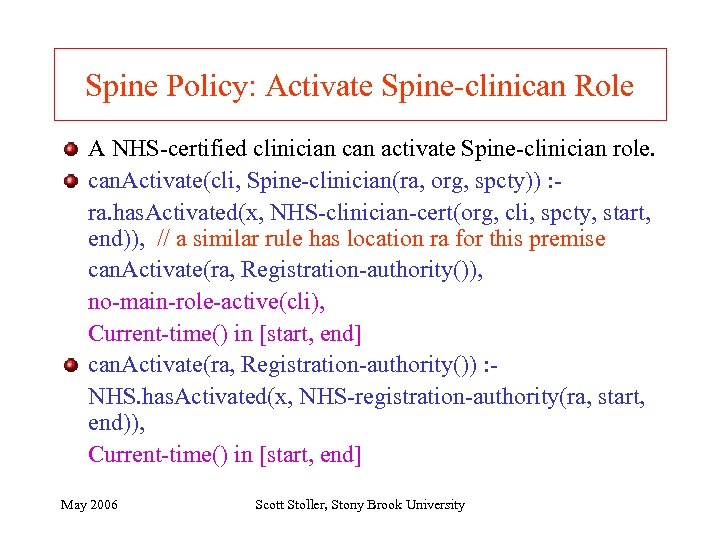 Spine Policy: Activate Spine-clinican Role A NHS-certified clinician can activate Spine-clinician role. can. Activate(cli, Spine-clinician(ra, org, spcty)) : ra. has. Activated(x, NHS-clinician-cert(org, cli, spcty, start, end)), // a similar rule has location ra for this premise can. Activate(ra, Registration-authority()), no-main-role-active(cli), Current-time() in [start, end] can. Activate(ra, Registration-authority()) : NHS. has. Activated(x, NHS-registration-authority(ra, start, end)), Current-time() in [start, end] May 2006 Scott Stoller, Stony Brook University
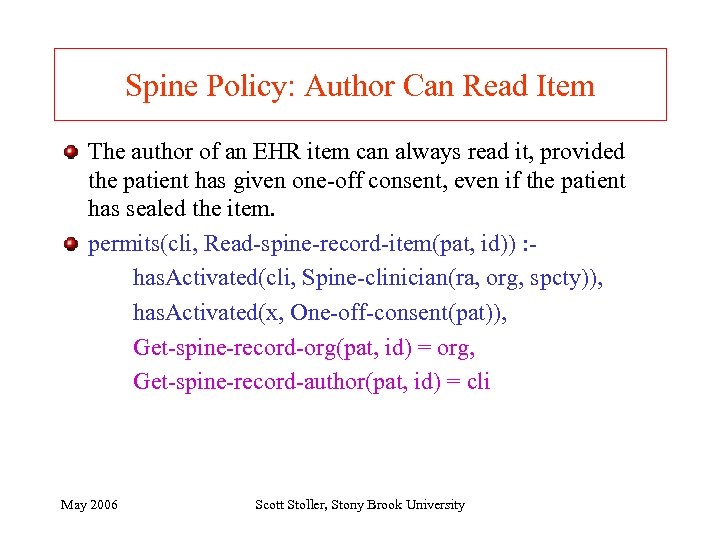 Spine Policy: Author Can Read Item The author of an EHR item can always read it, provided the patient has given one-off consent, even if the patient has sealed the item. permits(cli, Read-spine-record-item(pat, id)) : has. Activated(cli, Spine-clinician(ra, org, spcty)), has. Activated(x, One-off-consent(pat)), Get-spine-record-org(pat, id) = org, Get-spine-record-author(pat, id) = cli May 2006 Scott Stoller, Stony Brook University
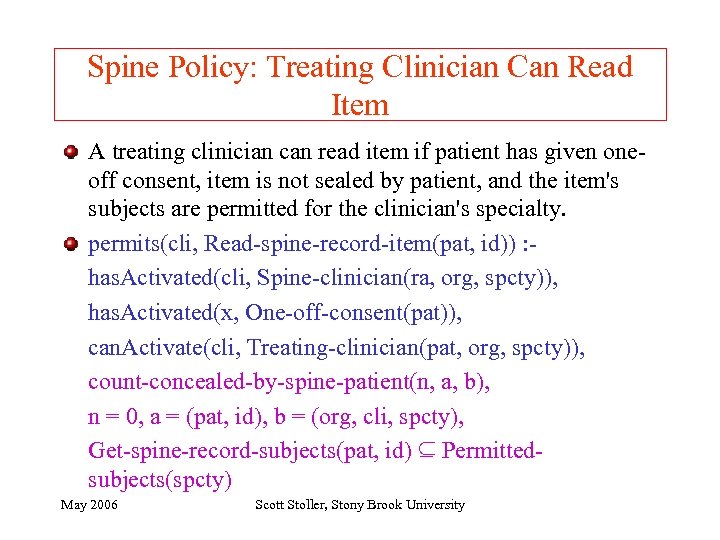 Spine Policy: Treating Clinician Can Read Item ∩ A treating clinician can read item if patient has given oneoff consent, item is not sealed by patient, and the item's subjects are permitted for the clinician's specialty. permits(cli, Read-spine-record-item(pat, id)) : has. Activated(cli, Spine-clinician(ra, org, spcty)), has. Activated(x, One-off-consent(pat)), can. Activate(cli, Treating-clinician(pat, org, spcty)), count-concealed-by-spine-patient(n, a, b), n = 0, a = (pat, id), b = (org, cli, spcty), Get-spine-record-subjects(pat, id) Permittedsubjects(spcty) May 2006 Scott Stoller, Stony Brook University
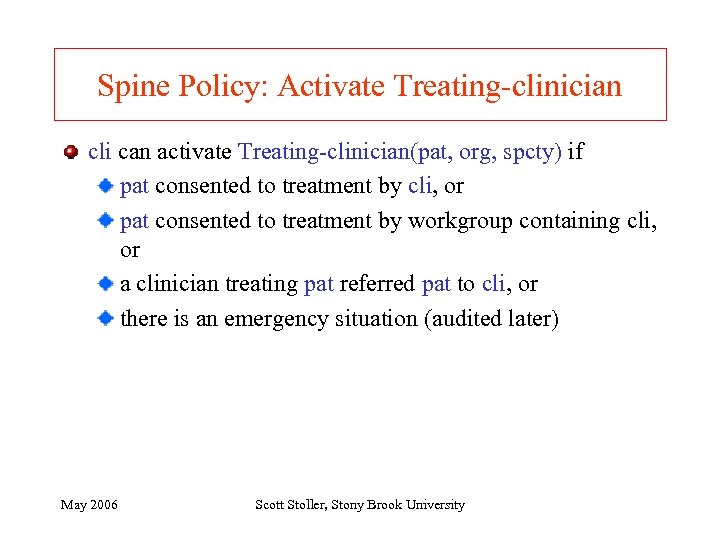 Spine Policy: Activate Treating-clinician cli can activate Treating-clinician(pat, org, spcty) if pat consented to treatment by cli, or pat consented to treatment by workgroup containing cli, or a clinician treating pat referred pat to cli, or there is an emergency situation (audited later) May 2006 Scott Stoller, Stony Brook University
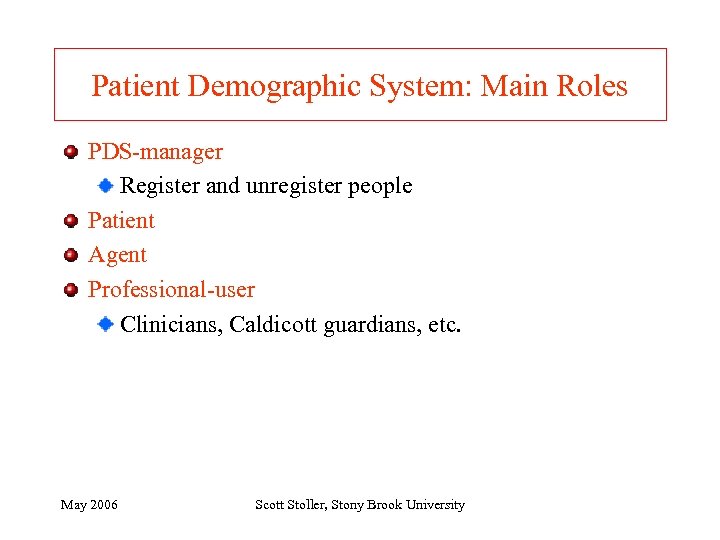 Patient Demographic System: Main Roles PDS-manager Register and unregister people Patient Agent Professional-user Clinicians, Caldicott guardians, etc. May 2006 Scott Stoller, Stony Brook University
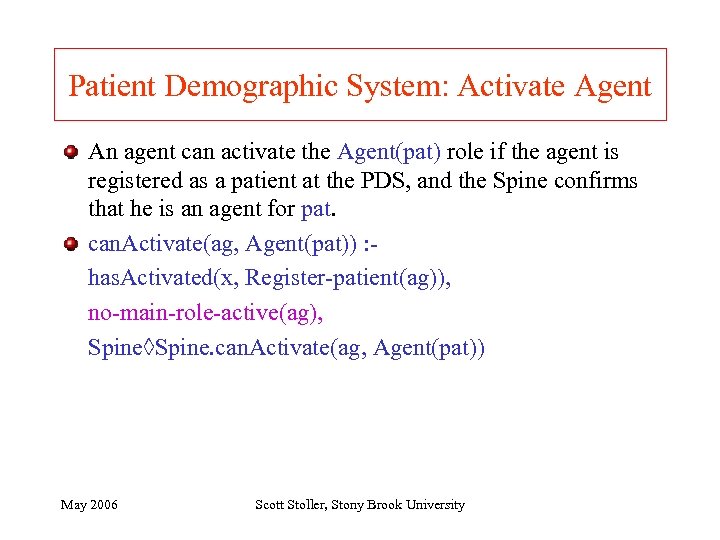 Patient Demographic System: Activate Agent An agent can activate the Agent(pat) role if the agent is registered as a patient at the PDS, and the Spine confirms that he is an agent for pat. can. Activate(ag, Agent(pat)) : has. Activated(x, Register-patient(ag)), no-main-role-active(ag), Spine◊Spine. can. Activate(ag, Agent(pat)) May 2006 Scott Stoller, Stony Brook University
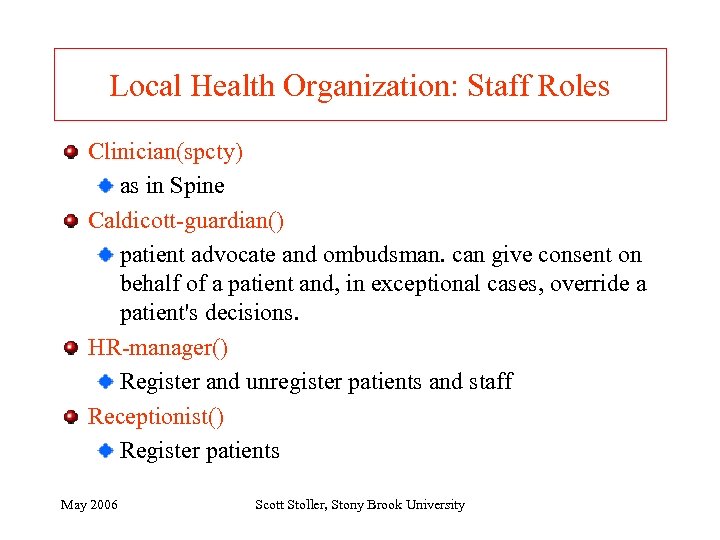 Local Health Organization: Staff Roles Clinician(spcty) as in Spine Caldicott-guardian() patient advocate and ombudsman. can give consent on behalf of a patient and, in exceptional cases, override a patient's decisions. HR-manager() Register and unregister patients and staff Receptionist() Register patients May 2006 Scott Stoller, Stony Brook University
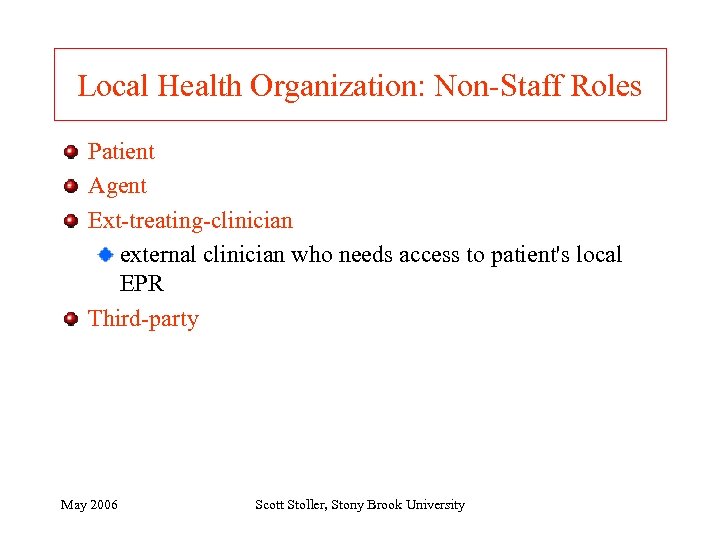 Local Health Organization: Non-Staff Roles Patient Agent Ext-treating-clinician external clinician who needs access to patient's local EPR Third-party May 2006 Scott Stoller, Stony Brook University
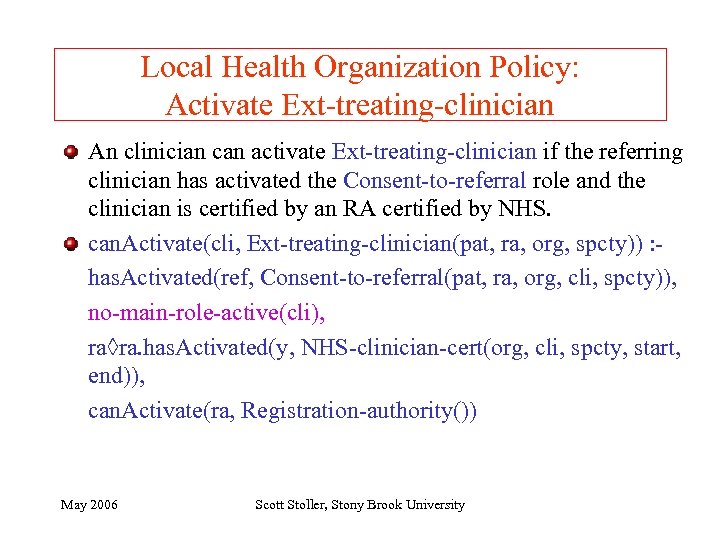 Local Health Organization Policy: Activate Ext-treating-clinician An clinician can activate Ext-treating-clinician if the referring clinician has activated the Consent-to-referral role and the clinician is certified by an RA certified by NHS. can. Activate(cli, Ext-treating-clinician(pat, ra, org, spcty)) : has. Activated(ref, Consent-to-referral(pat, ra, org, cli, spcty)), no-main-role-active(cli), ra◊ra. has. Activated(y, NHS-clinician-cert(org, cli, spcty, start, end)), can. Activate(ra, Registration-authority()) May 2006 Scott Stoller, Stony Brook University
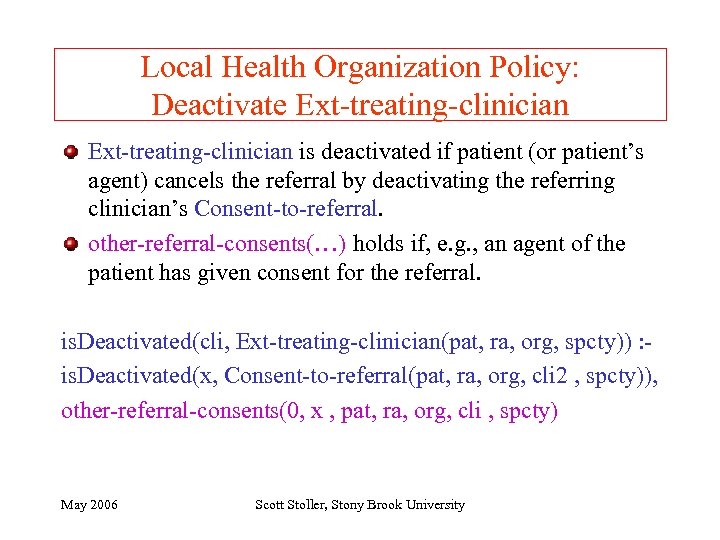 Local Health Organization Policy: Deactivate Ext-treating-clinician is deactivated if patient (or patient’s agent) cancels the referral by deactivating the referring clinician’s Consent-to-referral. other-referral-consents(…) holds if, e. g. , an agent of the patient has given consent for the referral. is. Deactivated(cli, Ext-treating-clinician(pat, ra, org, spcty)) : is. Deactivated(x, Consent-to-referral(pat, ra, org, cli 2 , spcty)), other-referral-consents(0, x , pat, ra, org, cli , spcty) May 2006 Scott Stoller, Stony Brook University
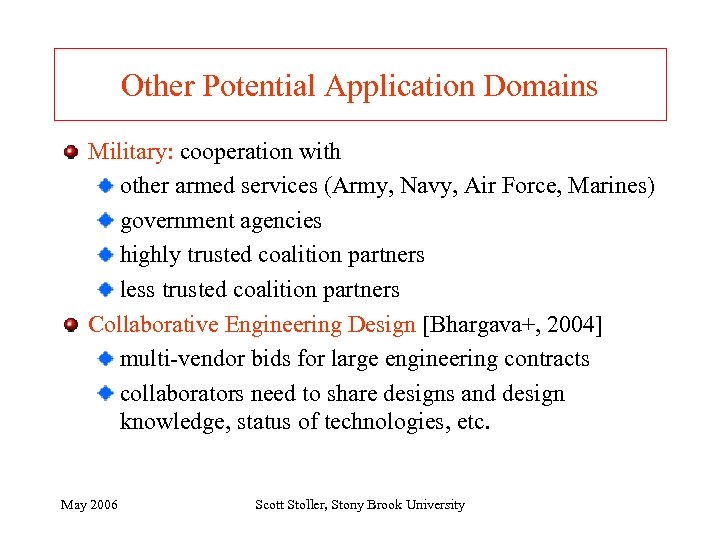 Other Potential Application Domains Military: cooperation with other armed services (Army, Navy, Air Force, Marines) government agencies highly trusted coalition partners less trusted coalition partners Collaborative Engineering Design [Bhargava+, 2004] multi-vendor bids for large engineering contracts collaborators need to share designs and design knowledge, status of technologies, etc. May 2006 Scott Stoller, Stony Brook University
![Other Potential Application Domains Supply Chain Management [Bhargava+, 2004] For tight integration, a company](https://present5.com/presentation/55b604105b048e4afbf71bd8d2d0a29e/image-94.jpg "Other Potential Application Domains Supply Chain Management [Bhargava+, 2004] For tight integration, a company") Other Potential Application Domains Supply Chain Management [Bhargava+, 2004] For tight integration, a company must give its suppliers, customers, and its customers' customers (to increase their confidence in its ability to deliver) some access to its order entry, order status, sales forecast, and production planning systems. May 2006 Scott Stoller, Stony Brook University
Other Potential Application Domains Supply Chain Management [Bhargava+, 2004] For tight integration, a company must give its suppliers, customers, and its customers' customers (to increase their confidence in its ability to deliver) some access to its order entry, order status, sales forecast, and production planning systems. May 2006 Scott Stoller, Stony Brook University
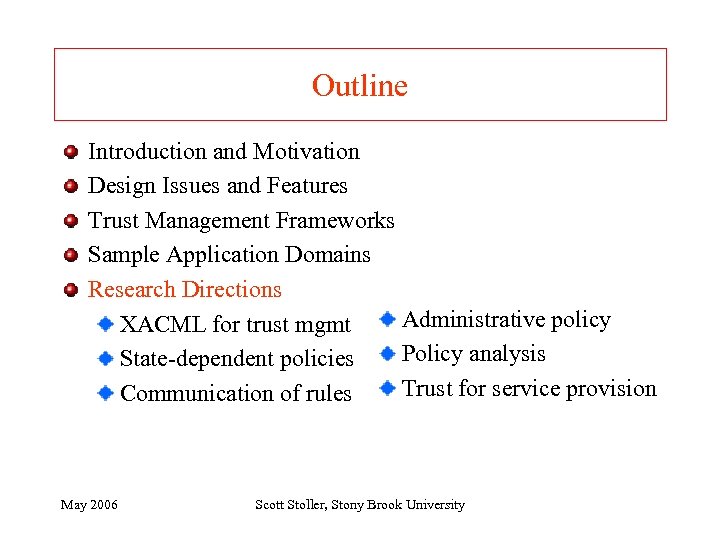 Outline Introduction and Motivation Design Issues and Features Trust Management Frameworks Sample Application Domains Research Directions Administrative policy XACML for trust mgmt Policy analysis State-dependent policies Trust for service provision Communication of rules May 2006 Scott Stoller, Stony Brook University
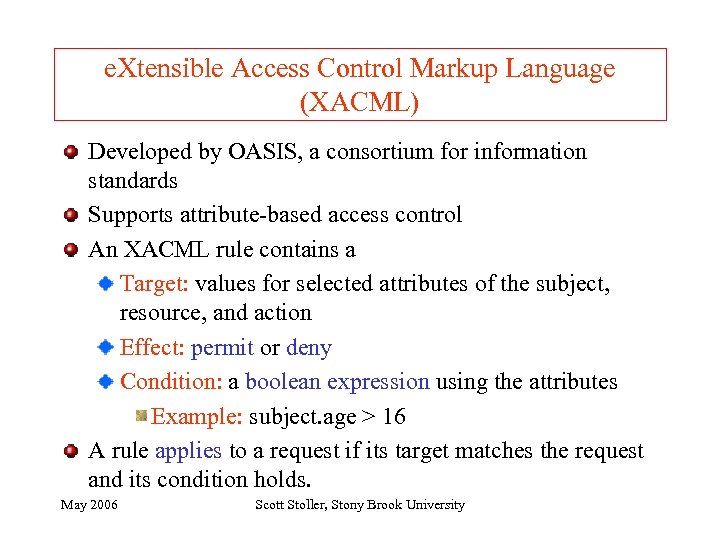 e. Xtensible Access Control Markup Language (XACML) Developed by OASIS, a consortium for information standards Supports attribute-based access control An XACML rule contains a Target: values for selected attributes of the subject, resource, and action Effect: permit or deny Condition: a boolean expression using the attributes Example: subject. age > 16 A rule applies to a request if its target matches the request and its condition holds. May 2006 Scott Stoller, Stony Brook University
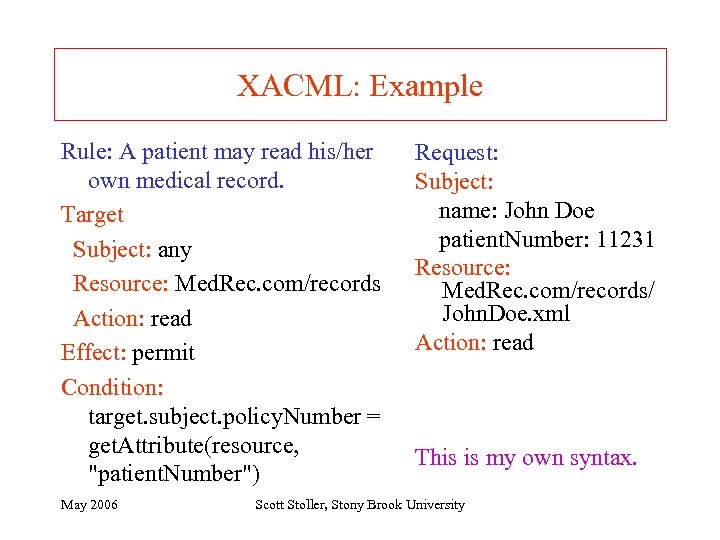 XACML: Example Rule: A patient may read his/her own medical record. Target Subject: any Resource: Med. Rec. com/records Action: read Effect: permit Condition: target. subject. policy. Number = get. Attribute(resource, "patient. Number") May 2006 Request: Subject: name: John Doe patient. Number: 11231 Resource: Med. Rec. com/records/ John. Doe. xml Action: read This is my own syntax. Scott Stoller, Stony Brook University
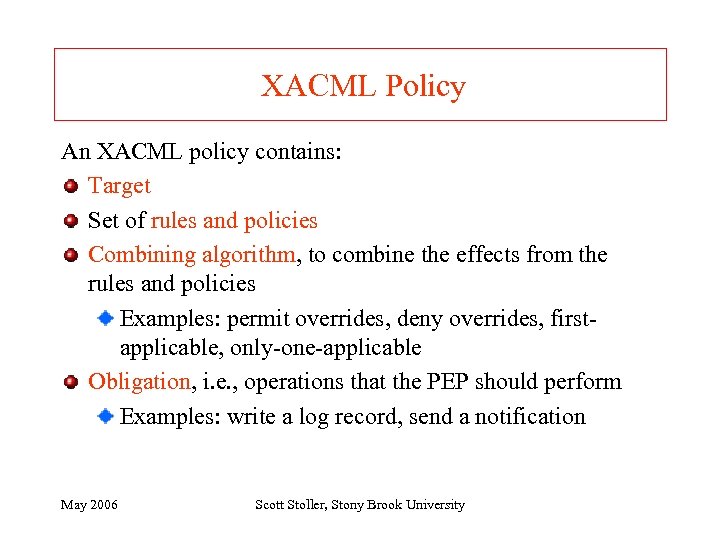 XACML Policy An XACML policy contains: Target Set of rules and policies Combining algorithm, to combine the effects from the rules and policies Examples: permit overrides, deny overrides, firstapplicable, only-one-applicable Obligation, i. e. , operations that the PEP should perform Examples: write a log record, send a notification May 2006 Scott Stoller, Stony Brook University
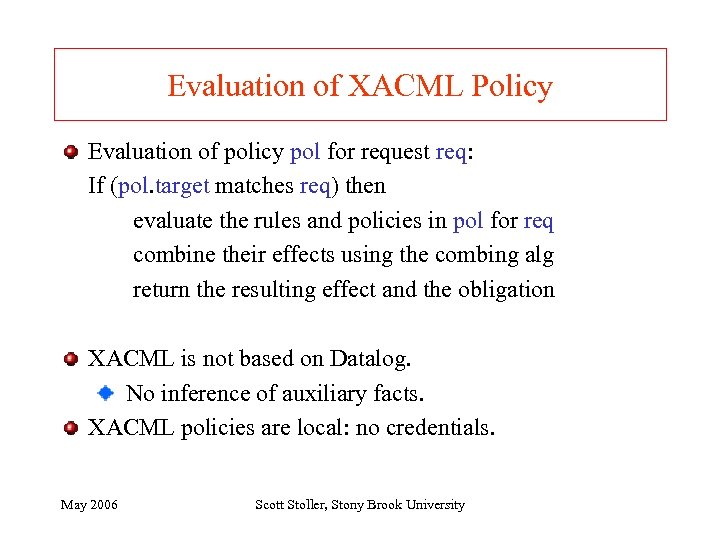 Evaluation of XACML Policy Evaluation of policy pol for request req: If (pol. target matches req) then evaluate the rules and policies in pol for req combine their effects using the combing alg return the resulting effect and the obligation XACML is not based on Datalog. No inference of auxiliary facts. XACML policies are local: no credentials. May 2006 Scott Stoller, Stony Brook University
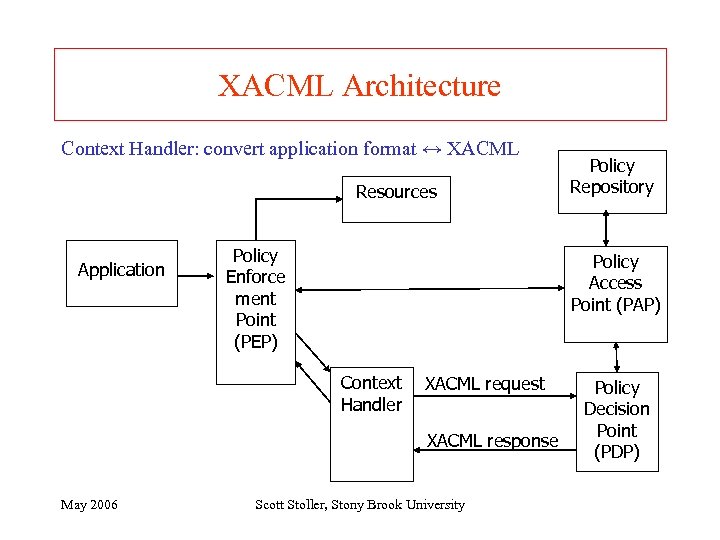 XACML Architecture Context Handler: convert application format ↔ XACML Resources Application Policy Enforce ment Point (PEP) Policy Access Point (PAP) Context Handler XACML request XACML response May 2006 Policy Repository Scott Stoller, Stony Brook University Policy Decision Point (PDP)
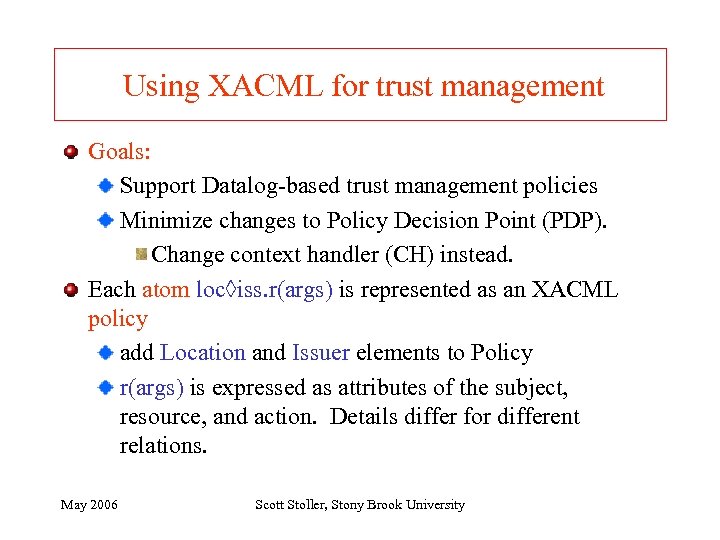 Using XACML for trust management Goals: Support Datalog-based trust management policies Minimize changes to Policy Decision Point (PDP). Change context handler (CH) instead. Each atom loc◊iss. r(args) is represented as an XACML policy add Location and Issuer elements to Policy r(args) is expressed as attributes of the subject, resource, and action. Details differ for different relations. May 2006 Scott Stoller, Stony Brook University
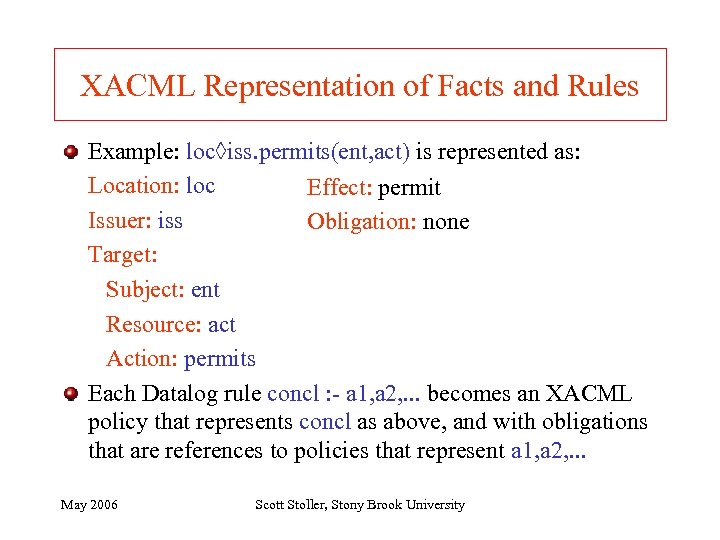 XACML Representation of Facts and Rules Example: loc◊iss. permits(ent, act) is represented as: Location: loc Effect: permit Issuer: iss Obligation: none Target: Subject: ent Resource: act Action: permits Each Datalog rule concl : - a 1, a 2, . . . becomes an XACML policy that represents concl as above, and with obligations that are references to policies that represent a 1, a 2, . . . May 2006 Scott Stoller, Stony Brook University
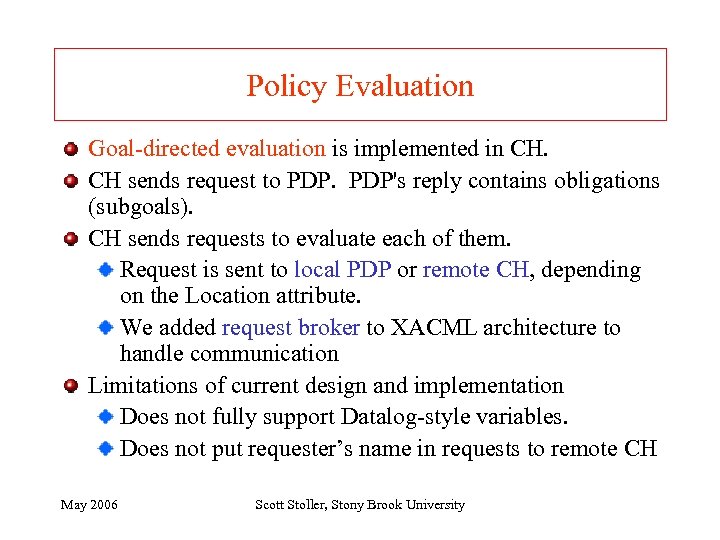 Policy Evaluation Goal-directed evaluation is implemented in CH. CH sends request to PDP's reply contains obligations (subgoals). CH sends requests to evaluate each of them. Request is sent to local PDP or remote CH, depending on the Location attribute. We added request broker to XACML architecture to handle communication Limitations of current design and implementation Does not fully support Datalog-style variables. Does not put requester’s name in requests to remote CH May 2006 Scott Stoller, Stony Brook University
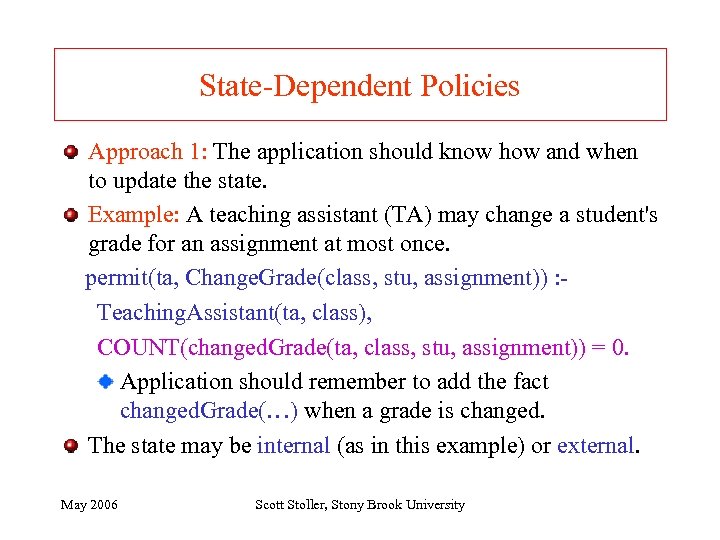 State-Dependent Policies Approach 1: The application should know how and when to update the state. Example: A teaching assistant (TA) may change a student's grade for an assignment at most once. permit(ta, Change. Grade(class, stu, assignment)) : Teaching. Assistant(ta, class), COUNT(changed. Grade(ta, class, stu, assignment)) = 0. Application should remember to add the fact changed. Grade(…) when a grade is changed. The state may be internal (as in this example) or external. May 2006 Scott Stoller, Stony Brook University
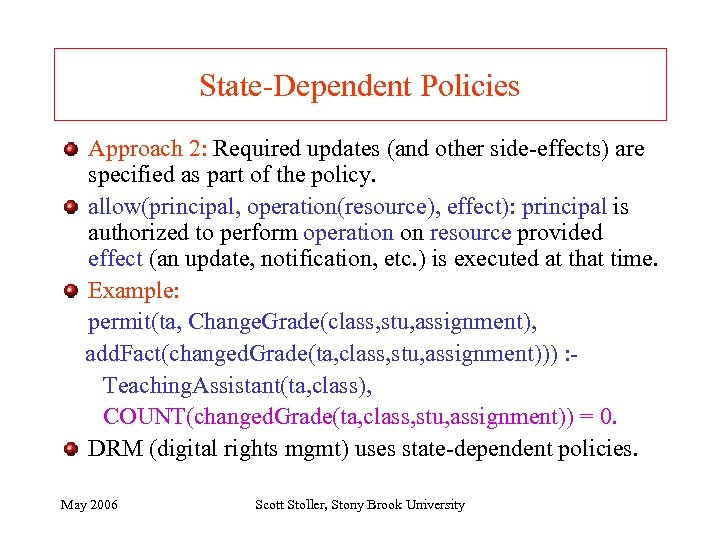 State-Dependent Policies Approach 2: Required updates (and other side-effects) are specified as part of the policy. allow(principal, operation(resource), effect): principal is authorized to perform operation on resource provided effect (an update, notification, etc. ) is executed at that time. Example: permit(ta, Change. Grade(class, stu, assignment), add. Fact(changed. Grade(ta, class, stu, assignment))) : Teaching. Assistant(ta, class), COUNT(changed. Grade(ta, class, stu, assignment)) = 0. DRM (digital rights mgmt) uses state-dependent policies. May 2006 Scott Stoller, Stony Brook University
 Communication of Rules Policy evaluator may gather rules, as well as facts, from other sites. This can be more efficient. Example: SUNY students get discount at Textbooks. com: get. Discount(stu) : - SUNY◊SUNY. student(stu). SUNY: student(stu) : - stu◊SUNYSB. student(stu) : - stu◊SUNYAlb. student(stu). Joe. Cool: SUNYSB. student(Joe. Cool). Without rule communication: for each student, Textbooks. com asks SUNY which asks student. May 2006 Scott Stoller, Stony Brook University
 Communication of Rules With rule communication: Textbooks. com imports rules from SUNY. Textbooks. com: SUNY. student(stu) : - SUNYSB. student(stu). SUNY. student(stu) : - SUNYAlb. student(stu) Only imported rules have conclusions with issuer ≠ self. Textbooks. com asks each student for campus credential and applies an imported rule to infer SUNY credential. This reduces communication overhead and delays. Facts concluded using imported rules cannot be exported. Example: [SUNY. student(Joe. Cool)] signed by Textbooks. com is an invalid credential. May 2006 Scott Stoller, Stony Brook University
 Which Rules to Send? Textbooks. com asks SUNY for rules relevant to SUNY. student. SUNY: student(stu) : - SUNYSB. student(stu), approved(stu) : - … Which rules should SUNY send? Rules with conclusion student(stu) and rules they depend on, recursively following dependencies. Some of the rules may have premises with remote issuers. Should all of them send relevant rules, too? May 2006 Scott Stoller, Stony Brook University
![Which Rules to Send? Binder [De. Treville 2002] does not address this issue. Secure](https://present5.com/presentation/55b604105b048e4afbf71bd8d2d0a29e/image-109.jpg "Which Rules to Send? Binder [De. Treville 2002] does not address this issue. Secure") Which Rules to Send? Binder [De. Treville 2002] does not address this issue. Secure Dynamically Distributed Datalog (SD 3) [Jim 2001] sends (in one step) all rules and facts that could be useful for answering the query. This minimizes communication delays but may send unnecessary rules and facts. Open Issues: Privacy policies for rules Policies that control which rules are sent, instead of a fixed algorithm. May 2006 Scott Stoller, Stony Brook University
Which Rules to Send? Binder [De. Treville 2002] does not address this issue. Secure Dynamically Distributed Datalog (SD 3) [Jim 2001] sends (in one step) all rules and facts that could be useful for answering the query. This minimizes communication delays but may send unnecessary rules and facts. Open Issues: Privacy policies for rules Policies that control which rules are sent, instead of a fixed algorithm. May 2006 Scott Stoller, Stony Brook University
 Administrative Policy Administrative policy: security policy that controls changes to the security policy. Introduce actions that update the policy add. Fact(fact), add. Rule(rule), remove. Fact(fact), remove. Rule(rule) Develop authorization rules for those actions. Example: allow(hrm, add. Fact(payment. Mgr(e))) : human. Resources. Mgr(hrm), employee(e). payment. Mgr may be internal (policy) data or external data. This extension to the API eliminates the need to encode such facts as role activations. May 2006 Scott Stoller, Stony Brook University
 Administrative Policy: Static Separation of Duty Separation of duty limits the set of permissions of a single user. This helps prevent fraud, which requires collusion. Example: A single employee may perform at most 1 of the 3 steps involved in a purchase: issue purchase order, verify receipt of goods, issue payment. Static separation of duty allows an employee to be a member of at most 1 of the corresponding roles (purchasing clerk, receiving clerk, accounting clerk). Example: allow(so, add. Fact(member(e, Purch. Clerk))) : COUNT(member(e, Rcv. Clerk))=0, COUNT(member(e, Acctg. Clerk))=0. May 2006 Scott Stoller, Stony Brook University
 Policy Analysis: Sample Analysis Questions Is a given principal allowed to perform a given action? Which principals are allowed to perform a given action? What is the effect of adding a given rule or fact? i. e. , what new actions can each principal perform? What is the effect of removing a given rule or fact? i. e. , what allowed actions does each principal lose? Is every principal that is allowed to perform a given action also allowed to perform another given action? Analysis algorithms for SPKI/SDSI [Jha+ 2004], XACML [Fisler+ 2005] May 2006 Scott Stoller, Stony Brook University
 Policy Analysis with Administrative Policy Given: a policy, including an administrative policy a set of (less trusted) administrators Ask questions about the policies reachable from the current policy through changes those administrators can perform. Does Q hold for some such policy? Does Q hold for every such policy? Q is a yes/no question from the previous slide. May 2006 Scott Stoller, Stony Brook University
 Policy Analysis with Administrative Policy: Example: Can an administrator for the CPU division give an employee access to resources in the RAM division? Such delegation of administrative control can be indirect. Example: The RAM division allows employees on the company’s re-engineering team to access RAM division resources. An administrator in the CPU division can appoint the CPU division’s representative on the reengineering team. Need to analyze possible delegation chains. This is computationally hard in general for rule-based languages [Li+ 2005, Sasturkar+ 2006]. Look for tractable cases of practical interest. May 2006 Scott Stoller, Stony Brook University
 Trust for Service Provision Access control: Who do I trust to access my resource/service? Usually a boolean answer is desired. Service provision: Who do I trust to provide this resource/service to me? Often desire a quantitative evaluation of providers Final decision depends on trust level, cost, speed, etc. Trust levels may be discrete (e. g. , low/med/high) or continuous (e. g. , a number between 0 and 1) A confidence level for the trust evaluation can also be maintained. May 2006 Scott Stoller, Stony Brook University
 Trust for Service Provision Examples: Trust in Internet content ratings from different organizations Internet storage providers (xdrive. com, idrive. com, netdrive. com, …) Availability, privacy, … Extend rule-based policy languages to support this Add relations, e. g. , accept. Service(service, provider, …) Add trust level as a parameter of appropriate relations, e. g. , accept. Service(service, provider, trust. Level) May 2006 Scott Stoller, Stony Brook University
 Recap: Essential Features of Trust Management Each policy statement is associated with a principal, called its source or issuer. Each principal's policy specifies which sources it trusts for which kinds of statements, thereby delegating some authority to those sources. Policies may refer to domain-specific attributes of and relationships between principals, resources, and other objects. Example: Acme. Hospital. allow(doc, Read(EPR(pat)) : AMA. doctor(doc), pat. consent. To. Treatment(doc). May 2006 Scott Stoller, Stony Brook University
 Recommended Readings John De. Treville. Binder, a Logic-Based Security Language. In Proceedings of the 2002 IEEE Symposium on Security and Privacy, pages 105 -113. IEEE Computer Society Press, 2002. A well-written intro to the topic. http: //research. microsoft. com/research/pubs/view. aspx? tr_id=545 Moritz Y. Becker and Peter Sewell. Cassandra: Flexible Trust Management, Applied to Electronic Health Records. In Proceedings of the 17 th IEEE Computer Security Foundations Workshop (CSFW), pages 139 -154. IEEE Computer Society Press, 2004. More comprehensive. http: //www 2. cantabgold. net/users/m. y. becker. 98/ May 2006 Scott Stoller, Stony Brook University