 Скачать презентацию Trust Davis A Non-Exploitable Online Reputation System Dimitri
a0ff7c22795b72ce019f1ceff55395b2.ppt
- Количество слайдов: 36



Trust. Davis: A Non-Exploitable Online Reputation System Dimitri De. Figueiredo and Earl T. Barr Dept. of Computer Science, University of California at Davis
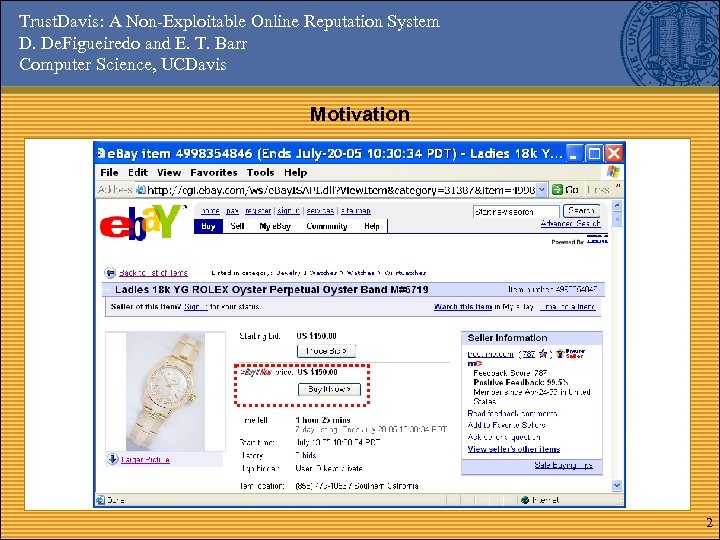
Trust. Davis: A Non-Exploitable Online Reputation System D. De. Figueiredo and E. T. Barr Computer Science, UCDavis Motivation 2
Trust. Davis: A Non-Exploitable Online Reputation System D. De. Figueiredo and E. T. Barr Computer Science, UCDavis Motivation • Should we buy? • How do we decide? 3
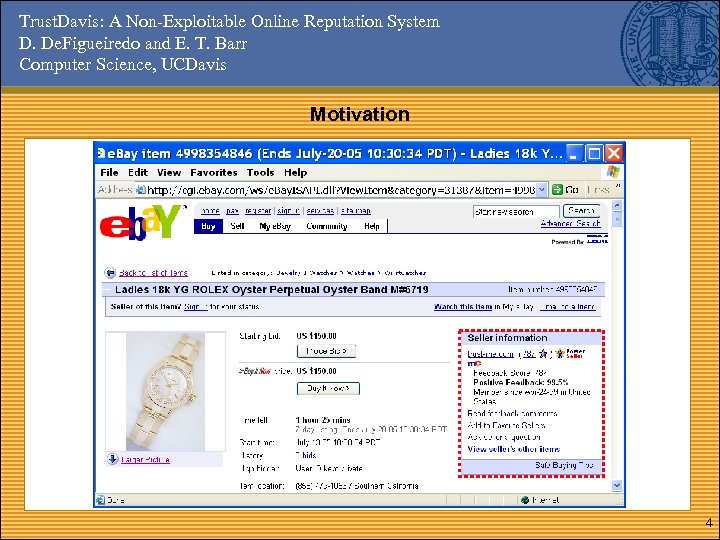
Trust. Davis: A Non-Exploitable Online Reputation System D. De. Figueiredo and E. T. Barr Computer Science, UCDavis Motivation 4
Trust. Davis: A Non-Exploitable Online Reputation System D. De. Figueiredo and E. T. Barr Computer Science, UCDavis Motivation • Should we buy? • How do we decide? • What we want: – accurately estimate risk of default – minimize the risk of default – minimize losses due to pseudonym change – avoid trusting a centralized authority • How do we achieve these goals? 5
Trust. Davis: A Non-Exploitable Online Reputation System D. De. Figueiredo and E. T. Barr Computer Science, UCDavis Motivation • Trust. Davis is a reputation system that realizes these goals. • It recasts these goals as the following properties: 6
Trust. Davis: A Non-Exploitable Online Reputation System D. De. Figueiredo and E. T. Barr Computer Science, UCDavis Motivation 1. Agents can accurately estimate risk – 2. Third parties provide accurate ratings Honest buyer/seller avoids risk (if possible) – 3. Insure transactions No advantage in obtaining multiple identities – 4. Agents can cope with pseudonym change No need to trust a centralized authority – No centralized services needed 7
Trust. Davis: A Non-Exploitable Online Reputation System D. De. Figueiredo and E. T. Barr Computer Science, UCDavis Motivation Incentive Compatibility: Each player should have incentives to perform the actions that enable the system to achieve a desired global outcome. 8
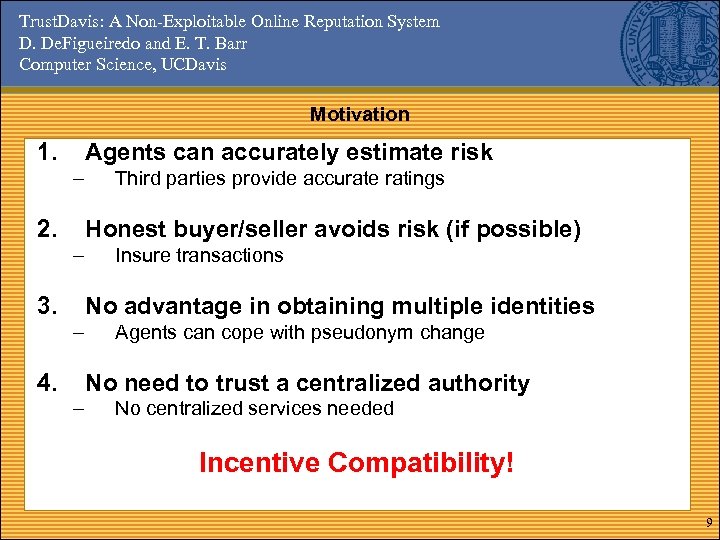
Trust. Davis: A Non-Exploitable Online Reputation System D. De. Figueiredo and E. T. Barr Computer Science, UCDavis Motivation 1. Agents can accurately estimate risk – 2. Third parties provide accurate ratings Honest buyer/seller avoids risk (if possible) – 3. Insure transactions No advantage in obtaining multiple identities – 4. Agents can cope with pseudonym change No need to trust a centralized authority – No centralized services needed Incentive Compatibility! 9
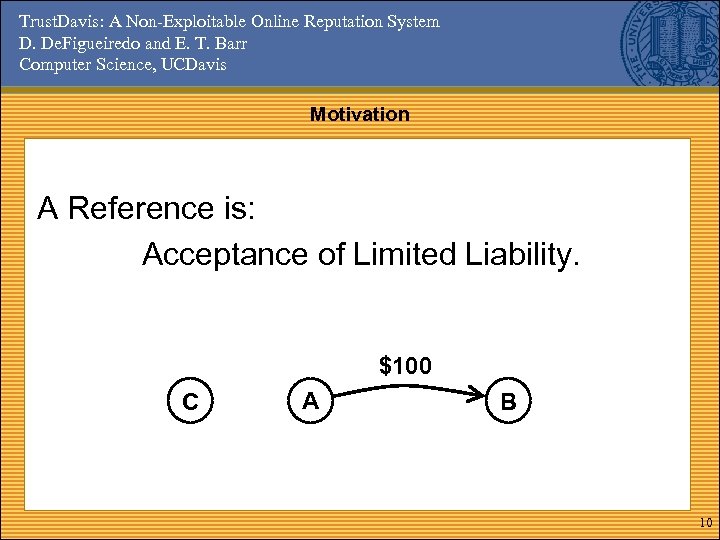
Trust. Davis: A Non-Exploitable Online Reputation System D. De. Figueiredo and E. T. Barr Computer Science, UCDavis Motivation A Reference is: Acceptance of Limited Liability. $100 C A B 10
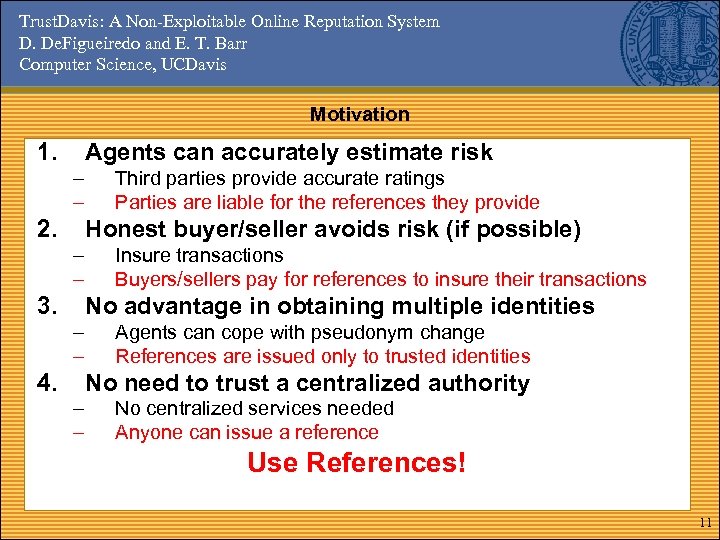
Trust. Davis: A Non-Exploitable Online Reputation System D. De. Figueiredo and E. T. Barr Computer Science, UCDavis Motivation 1. Agents can accurately estimate risk – – 2. Third parties provide accurate ratings Parties are liable for the references they provide Honest buyer/seller avoids risk (if possible) – – 3. Insure transactions Buyers/sellers pay for references to insure their transactions No advantage in obtaining multiple identities – – 4. Agents can cope with pseudonym change References are issued only to trusted identities No need to trust a centralized authority – – No centralized services needed Anyone can issue a reference Use References! 11
Trust. Davis: A Non-Exploitable Online Reputation System D. De. Figueiredo and E. T. Barr Computer Science, UCDavis Motivation Related Work: • Z. Abrams et al. – Workshop P 2 P Econ 2004 • S. Buchegger et al. – Workshop P 2 P Econ 2004 • C. Dellarocas – Ideabook 2004 • S. Lee et al. – IEEE Infocom 2003 • S. Kamvar et al. – “Eigen. Trust” 2003 • J. Golbeck et al. – Sematic Web 2003 • T. Riggs et al. – ACM/IEEE-CS CDL 2001 12
Trust. Davis: A Non-Exploitable Online Reputation System D. De. Figueiredo and E. T. Barr Computer Science, UCDavis Outline • Motivation • The Model – Buying references – Selling references • A Non-Exploitable Strategy • Future Work • Conclusion – Key ideas 13
Trust. Davis: A Non-Exploitable Online Reputation System D. De. Figueiredo and E. T. Barr Computer Science, UCDavis Outline • Trust. Davis leverages social networks • For now, examples assume No False Claims (NFC) • The use of Trust. Davis does NOT preclude trade outside the system. 14
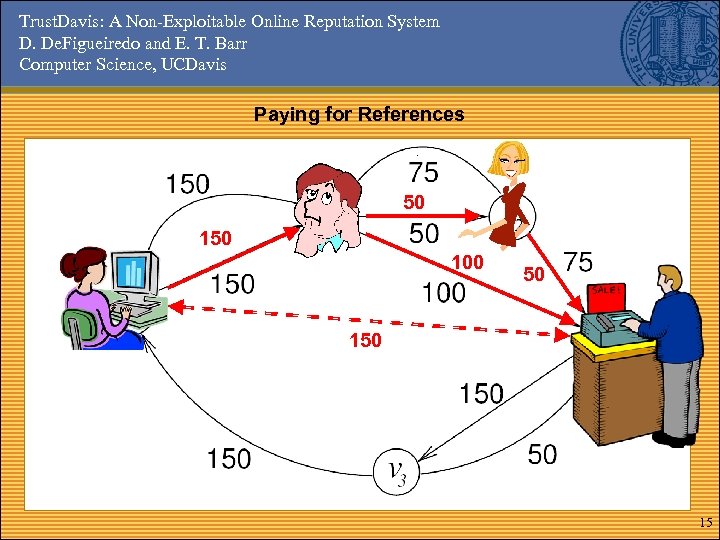
Trust. Davis: A Non-Exploitable Online Reputation System D. De. Figueiredo and E. T. Barr Computer Science, UCDavis Paying for References 50 100 50 15
Trust. Davis: A Non-Exploitable Online Reputation System D. De. Figueiredo and E. T. Barr Computer Science, UCDavis Outline • Motivation • The Model – Buying references – Selling references • A Non-Exploitable Strategy • Future Work • Conclusion – Key ideas 16
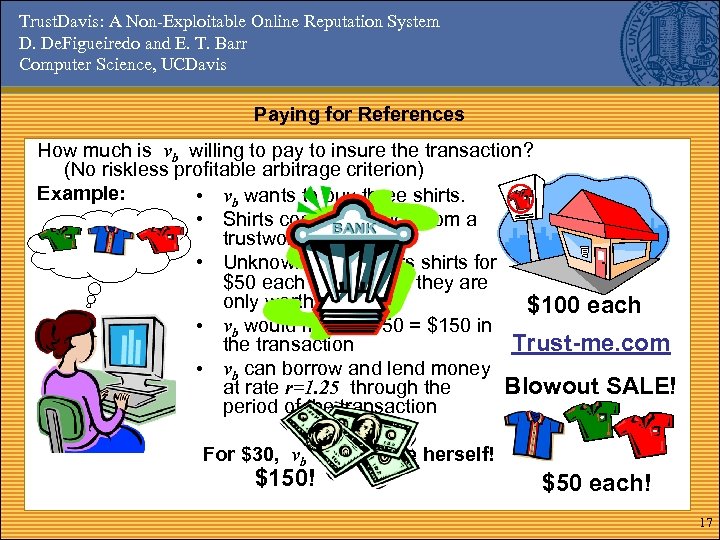
Trust. Davis: A Non-Exploitable Online Reputation System D. De. Figueiredo and E. T. Barr Computer Science, UCDavis Paying for References How much is vb willing to pay to insure the transaction? (No riskless profitable arbitrage criterion) Example: • vb wants to buy three shirts. • Shirts cost $100 each from a trustworthy seller • Unknown seller offers shirts for $50 each (but maybe they are only worth $25). $100 each • vb would risk 3 x $50 = $150 in Trust-me. com the transaction • vb can borrow and lend money at rate r=1. 25 through the Blowout SALE! period of the transaction For $30, vb can insure herself! $150! $50 each! 17
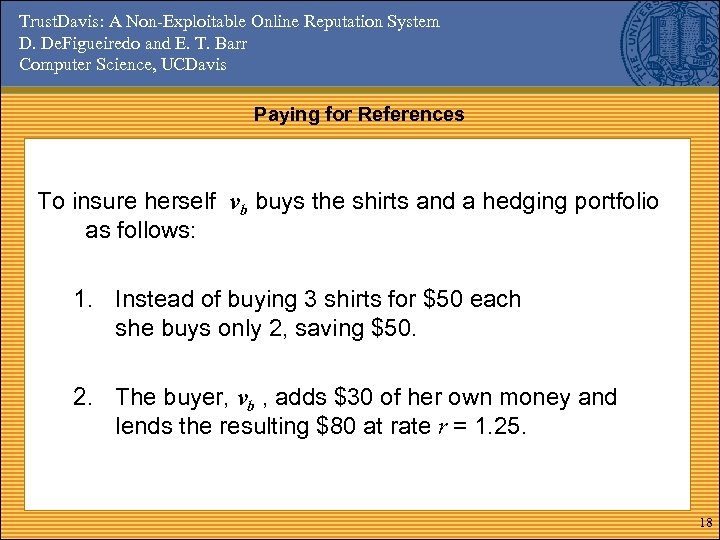
Trust. Davis: A Non-Exploitable Online Reputation System D. De. Figueiredo and E. T. Barr Computer Science, UCDavis Paying for References To insure herself vb buys the shirts and a hedging portfolio as follows: 1. Instead of buying 3 shirts for $50 each she buys only 2, saving $50. 2. The buyer, vb , adds $30 of her own money and lends the resulting $80 at rate r = 1. 25. 18
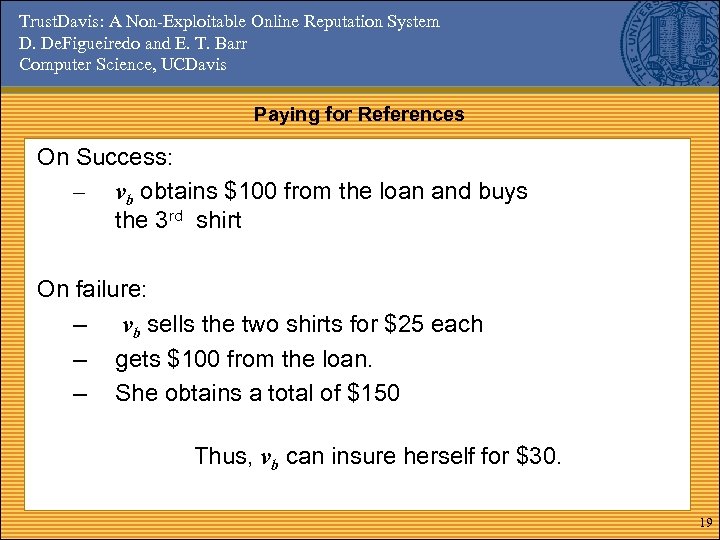
Trust. Davis: A Non-Exploitable Online Reputation System D. De. Figueiredo and E. T. Barr Computer Science, UCDavis Paying for References On Success: – vb obtains $100 from the loan and buys the 3 rd shirt On failure: – vb sells the two shirts for $25 each – gets $100 from the loan. – She obtains a total of $150 Thus, vb can insure herself for $30. 19
Trust. Davis: A Non-Exploitable Online Reputation System D. De. Figueiredo and E. T. Barr Computer Science, UCDavis Outline • Motivation • The Model – Buying references – Selling references • A Non-Exploitable Strategy • Future Work • Conclusion – Key ideas 20
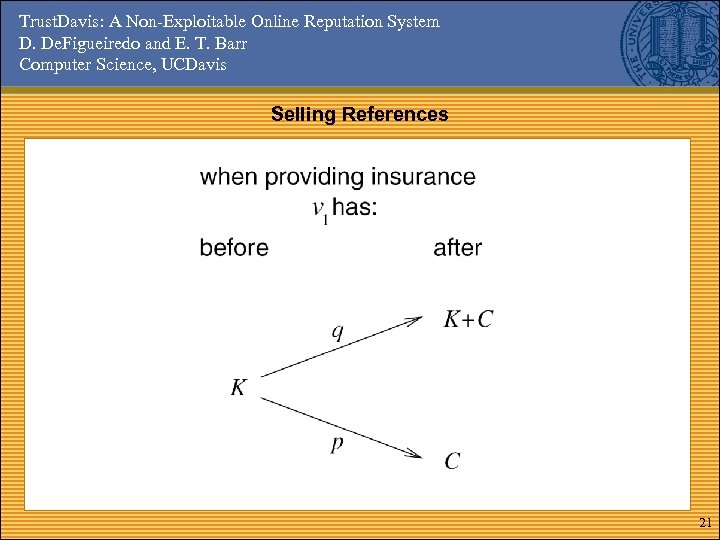
Trust. Davis: A Non-Exploitable Online Reputation System D. De. Figueiredo and E. T. Barr Computer Science, UCDavis Selling References 21
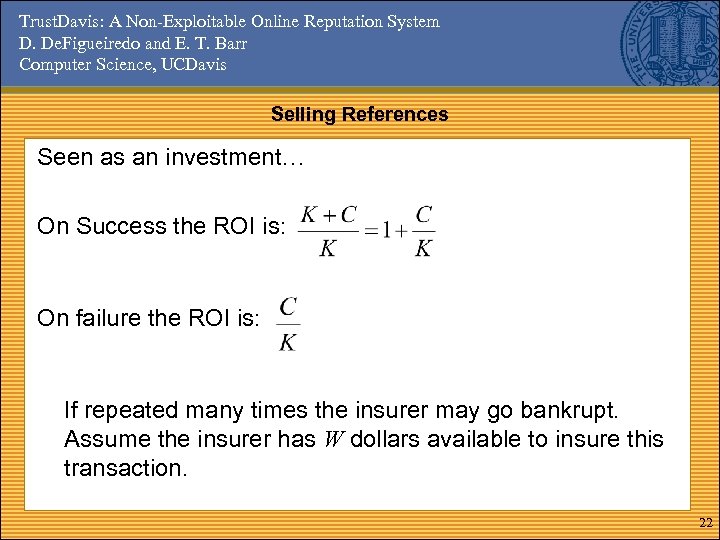
Trust. Davis: A Non-Exploitable Online Reputation System D. De. Figueiredo and E. T. Barr Computer Science, UCDavis Selling References Seen as an investment… On Success the ROI is: On failure the ROI is: If repeated many times the insurer may go bankrupt. Assume the insurer has W dollars available to insure this transaction. 22
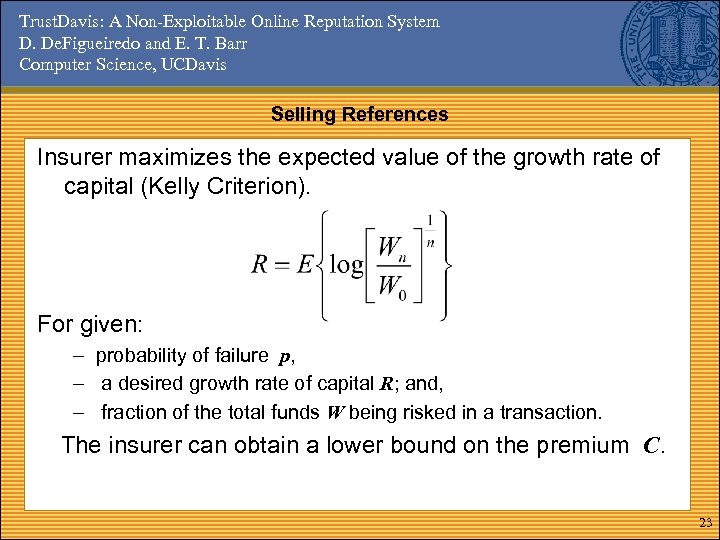
Trust. Davis: A Non-Exploitable Online Reputation System D. De. Figueiredo and E. T. Barr Computer Science, UCDavis Selling References Insurer maximizes the expected value of the growth rate of capital (Kelly Criterion). For given: – probability of failure p, – a desired growth rate of capital R; and, – fraction of the total funds W being risked in a transaction. The insurer can obtain a lower bound on the premium C. 23
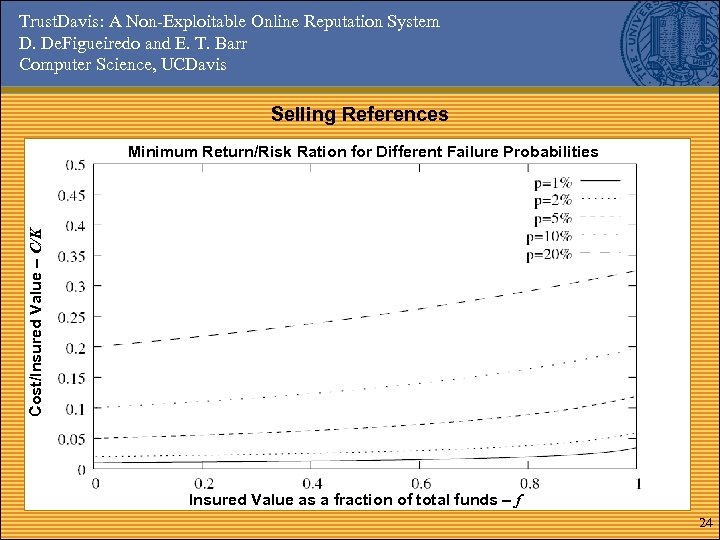
Trust. Davis: A Non-Exploitable Online Reputation System D. De. Figueiredo and E. T. Barr Computer Science, UCDavis Selling References Cost/Insured Value – C/K Minimum Return/Risk Ration for Different Failure Probabilities Insured Value as a fraction of total funds – f 24
Trust. Davis: A Non-Exploitable Online Reputation System D. De. Figueiredo and E. T. Barr Computer Science, UCDavis Outline • Motivation • The Model – Buying references – Selling references • A Non-Exploitable Strategy • Future Work • Conclusion – Key ideas 25
Trust. Davis: A Non-Exploitable Online Reputation System D. De. Figueiredo and E. T. Barr Computer Science, UCDavis A Non-Exploitable Strategy Two Scenarios: • No False Claims - NFC • With False Claims - FC False claims only change the probability p. We can incorporate the cost of verification. Key Idea: Save part of the money obtained in successful transactions in excess of the opportunity cost. 26
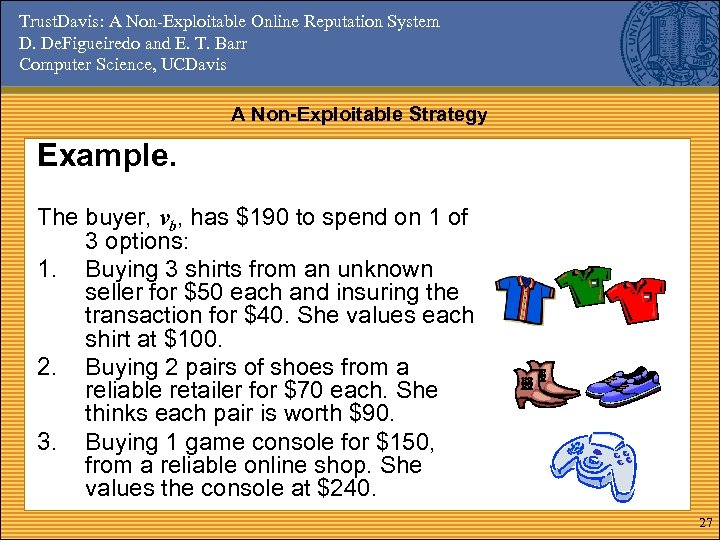
Trust. Davis: A Non-Exploitable Online Reputation System D. De. Figueiredo and E. T. Barr Computer Science, UCDavis A Non-Exploitable Strategy Example. The buyer, vb, has $190 to spend on 1 of 3 options: 1. Buying 3 shirts from an unknown seller for $50 each and insuring the transaction for $40. She values each shirt at $100. 2. Buying 2 pairs of shoes from a reliable retailer for $70 each. She thinks each pair is worth $90. 3. Buying 1 game console for $150, from a reliable online shop. She values the console at $240. 27
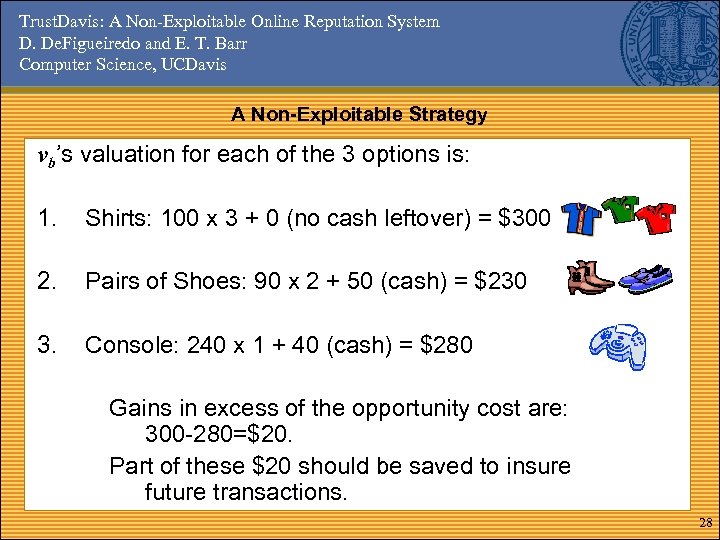
Trust. Davis: A Non-Exploitable Online Reputation System D. De. Figueiredo and E. T. Barr Computer Science, UCDavis A Non-Exploitable Strategy vb’s valuation for each of the 3 options is: 1. Shirts: 100 x 3 + 0 (no cash leftover) = $300 2. Pairs of Shoes: 90 x 2 + 50 (cash) = $230 3. Console: 240 x 1 + 40 (cash) = $280 Gains in excess of the opportunity cost are: 300 -280=$20. Part of these $20 should be saved to insure future transactions. 28
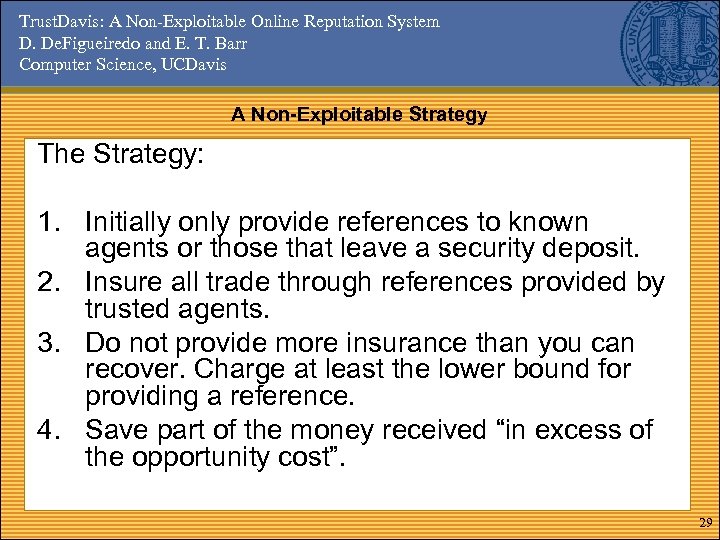
Trust. Davis: A Non-Exploitable Online Reputation System D. De. Figueiredo and E. T. Barr Computer Science, UCDavis A Non-Exploitable Strategy The Strategy: 1. Initially only provide references to known agents or those that leave a security deposit. 2. Insure all trade through references provided by trusted agents. 3. Do not provide more insurance than you can recover. Charge at least the lower bound for providing a reference. 4. Save part of the money received “in excess of the opportunity cost”. 29
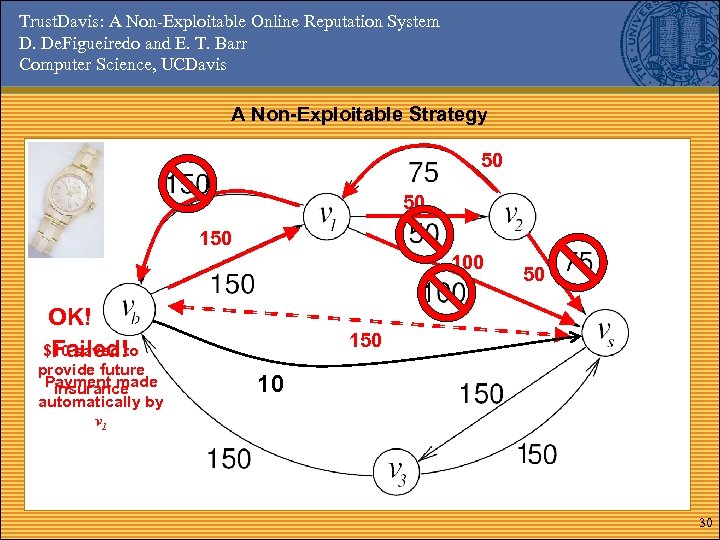
Trust. Davis: A Non-Exploitable Online Reputation System D. De. Figueiredo and E. T. Barr Computer Science, UCDavis A Non-Exploitable Strategy 50 50 100 OK! $10 saved to Failed! provide future Payment made insurance automatically by v 1 50 10 30
Trust. Davis: A Non-Exploitable Online Reputation System D. De. Figueiredo and E. T. Barr Computer Science, UCDavis Outline • Motivation • The Model – Buying references – Selling references • A Non-Exploitable Strategy • Future Work • Conclusion – Key ideas 31
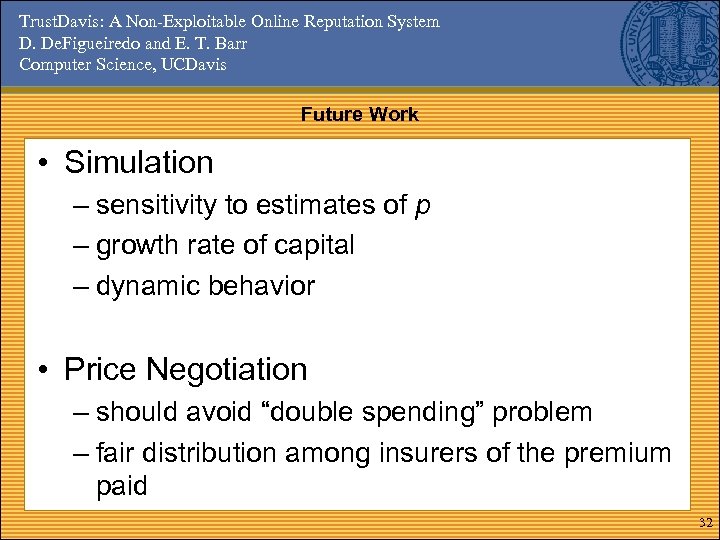
Trust. Davis: A Non-Exploitable Online Reputation System D. De. Figueiredo and E. T. Barr Computer Science, UCDavis Future Work • Simulation – sensitivity to estimates of p – growth rate of capital – dynamic behavior • Price Negotiation – should avoid “double spending” problem – fair distribution among insurers of the premium paid 32
Trust. Davis: A Non-Exploitable Online Reputation System D. De. Figueiredo and E. T. Barr Computer Science, UCDavis Outline • Motivation • The Model – Buying references – Selling references • A Non-Exploitable Strategy • Future Work • Conclusion – Key ideas 33
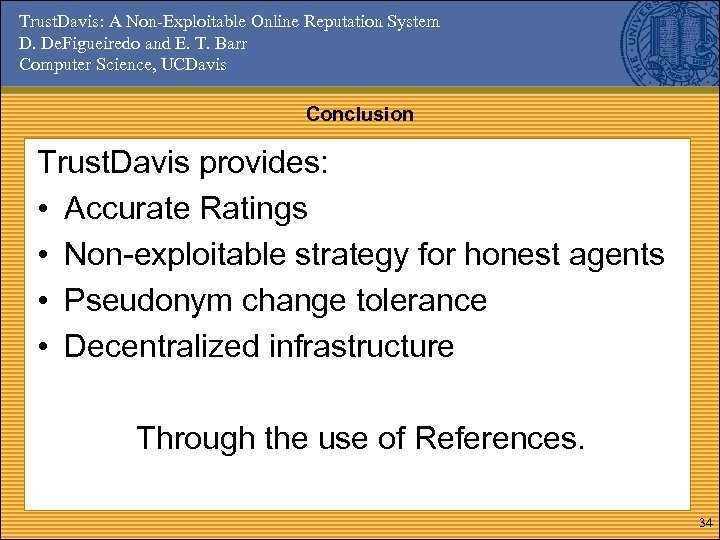
Trust. Davis: A Non-Exploitable Online Reputation System D. De. Figueiredo and E. T. Barr Computer Science, UCDavis Conclusion Trust. Davis provides: • Accurate Ratings • Non-exploitable strategy for honest agents • Pseudonym change tolerance • Decentralized infrastructure Through the use of References. 34
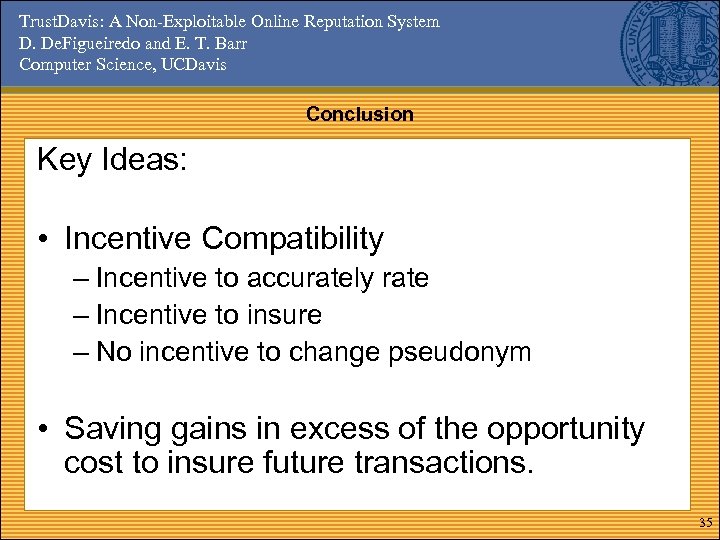
Trust. Davis: A Non-Exploitable Online Reputation System D. De. Figueiredo and E. T. Barr Computer Science, UCDavis Conclusion Key Ideas: • Incentive Compatibility – Incentive to accurately rate – Incentive to insure – No incentive to change pseudonym • Saving gains in excess of the opportunity cost to insure future transactions. 35
Trust. Davis: A Non-Exploitable Online Reputation System D. De. Figueiredo and E. T. Barr Computer Science, UCDavis The End Questions? Thank you! {defigueiredo, etbarr}@ucdavis. edu 36
Скачать презентацию Trust Davis A Non-Exploitable Online Reputation System Dimitri
a0ff7c22795b72ce019f1ceff55395b2.ppt