 Скачать презентацию TRUMBULL COUNTY EMS PROTOCOL PROCEDURES MANUAL 2009
976378c93bc3fcc9fa3f94808601417d.ppt
- Количество слайдов: 13



TRUMBULL COUNTY EMS PROTOCOL & PROCEDURES MANUAL 2009 APPROVED November 26, 2008 V. 2009 a
PRE-HOSPITAL MEDICAL PROTOCOL FOR ALL UNITS OPERATING UNDER THE MEDICAL AUTHORITY OF THE JOINT COMMITTEE OF EMERGENCY MEDICAL SERVICES IN TRUMBULL COUNTY TCEMS PROTOCOL COMMITTEE: TED SPIRTOS, M. D. JAMES M. SUDIMACK, M. D. GEORGE SNYDER, EMT-P, EMS COORDINATOR - FORUM HEALTH TMH FRED STOSIK, EMT-P TOM LAMBERT, EMT-P DALE BRIGGS, EMT-B, secretary The Administrative Section of the Protocol will be re-evaluated on a annual basis. The Medical protocol sections are evaluated on a continuous basis.
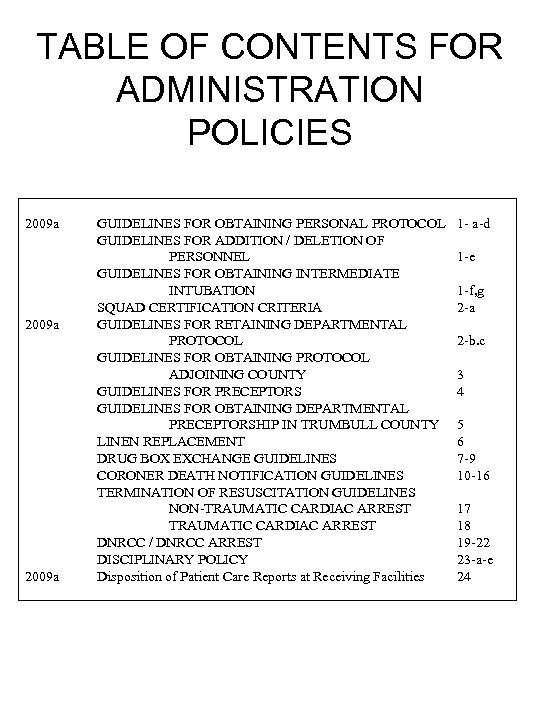
TABLE OF CONTENTS FOR ADMINISTRATION POLICIES 2009 a GUIDELINES FOR OBTAINING PERSONAL PROTOCOL GUIDELINES FOR ADDITION / DELETION OF PERSONNEL GUIDELINES FOR OBTAINING INTERMEDIATE INTUBATION SQUAD CERTIFICATION CRITERIA GUIDELINES FOR RETAINING DEPARTMENTAL PROTOCOL GUIDELINES FOR OBTAINING PROTOCOL ADJOINING COUNTY GUIDELINES FOR PRECEPTORS GUIDELINES FOR OBTAINING DEPARTMENTAL PRECEPTORSHIP IN TRUMBULL COUNTY LINEN REPLACEMENT DRUG BOX EXCHANGE GUIDELINES CORONER DEATH NOTIFICATION GUIDELINES TERMINATION OF RESUSCITATION GUIDELINES NON-TRAUMATIC CARDIAC ARREST DNRCC / DNRCC ARREST DISCIPLINARY POLICY Disposition of Patient Care Reports at Receiving Facilities 1 - a-d 1 -e 1 -f, g 2 -a 2 -b. c 3 4 5 6 7 -9 10 -16 17 18 19 -22 23 -a-e 24
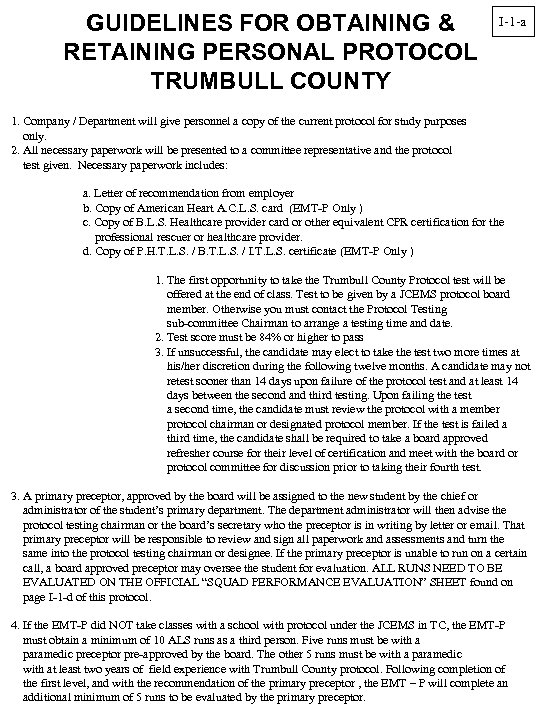
GUIDELINES FOR OBTAINING & RETAINING PERSONAL PROTOCOL TRUMBULL COUNTY I-1 -a 1. Company / Department will give personnel a copy of the current protocol for study purposes only. 2. All necessary paperwork will be presented to a committee representative and the protocol test given. Necessary paperwork includes: a. Letter of recommendation from employer b. Copy of American Heart A. C. L. S. card (EMT-P Only ) c. Copy of B. L. S. Healthcare provider card or other equivalent CPR certification for the professional rescuer or healthcare provider. d. Copy of P. H. T. L. S. / B. T. L. S. / I. T. L. S. certificate (EMT-P Only ) 1. The first opportunity to take the Trumbull County Protocol test will be offered at the end of class. Test to be given by a JCEMS protocol board member. Otherwise you must contact the Protocol Testing sub-committee Chairman to arrange a testing time and date. 2. Test score must be 84% or higher to pass 3. If unsuccessful, the candidate may elect to take the test two more times at his/her discretion during the following twelve months. A candidate may not retest sooner than 14 days upon failure of the protocol test and at least 14 days between the second and third testing. Upon failing the test a second time, the candidate must review the protocol with a member protocol chairman or designated protocol member. If the test is failed a third time, the candidate shall be required to take a board approved refresher course for their level of certification and meet with the board or protocol committee for discussion prior to taking their fourth test. 3. A primary preceptor, approved by the board will be assigned to the new student by the chief or administrator of the student’s primary department. The department administrator will then advise the protocol testing chairman or the board’s secretary who the preceptor is in writing by letter or email. That primary preceptor will be responsible to review and sign all paperwork and assessments and turn the same into the protocol testing chairman or designee. If the primary preceptor is unable to run on a certain call, a board approved preceptor may oversee the student for evaluation. ALL RUNS NEED TO BE EVALUATED ON THE OFFICIAL “SQUAD PERFORMANCE EVALUATION” SHEET found on page I-1 -d of this protocol. 4. If the EMT-P did NOT take classes with a school with protocol under the JCEMS in TC, the EMT-P must obtain a minimum of 10 ALS runs as a third person. Five runs must be with a paramedic preceptor pre-approved by the board. The other 5 runs must be with a paramedic with at least two years of field experience with Trumbull County protocol. Following completion of the first level, and with the recommendation of the primary preceptor , the EMT – P will complete an additional minimum of 5 runs to be evaluated by the primary preceptor.
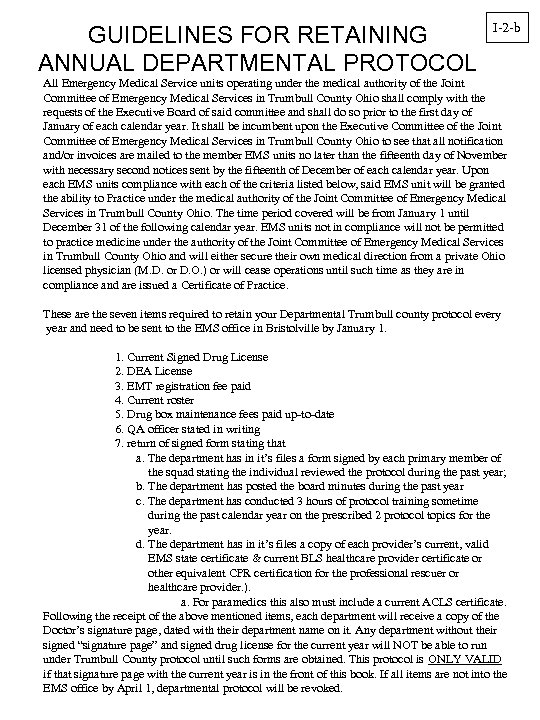
GUIDELINES FOR RETAINING ANNUAL DEPARTMENTAL PROTOCOL I-2 -b All Emergency Medical Service units operating under the medical authority of the Joint Committee of Emergency Medical Services in Trumbull County Ohio shall comply with the requests of the Executive Board of said committee and shall do so prior to the first day of January of each calendar year. It shall be incumbent upon the Executive Committee of the Joint Committee of Emergency Medical Services in Trumbull County Ohio to see that all notification and/or invoices are mailed to the member EMS units no later than the fifteenth day of November with necessary second notices sent by the fifteenth of December of each calendar year. Upon each EMS units compliance with each of the criteria listed below, said EMS unit will be granted the ability to Practice under the medical authority of the Joint Committee of Emergency Medical Services in Trumbull County Ohio. The time period covered will be from January 1 until December 31 of the following calendar year. EMS units not in compliance will not be permitted to practice medicine under the authority of the Joint Committee of Emergency Medical Services in Trumbull County Ohio and will either secure their own medical direction from a private Ohio licensed physician (M. D. or D. O. ) or will cease operations until such time as they are in compliance and are issued a Certificate of Practice. These are the seven items required to retain your Departmental Trumbull county protocol every year and need to be sent to the EMS office in Bristolville by January 1. 1. Current Signed Drug License 2. DEA License 3. EMT registration fee paid 4. Current roster 5. Drug box maintenance fees paid up-to-date 6. QA officer stated in writing 7. return of signed form stating that a. The department has in it’s files a form signed by each primary member of the squad stating the individual reviewed the protocol during the past year; b. The department has posted the board minutes during the past year c. The department has conducted 3 hours of protocol training sometime during the past calendar year on the prescribed 2 protocol topics for the year. d. The department has in it’s files a copy of each provider’s current, valid EMS state certificate & current BLS healthcare provider certificate or other equivalent CPR certification for the professional rescuer or healthcare provider. ). a. For paramedics this also must include a current ACLS certificate. Following the receipt of the above mentioned items, each department will receive a copy of the Doctor’s signature page, dated with their department name on it. Any department without their signed “signature page” and signed drug license for the current year will NOT be able to run under Trumbull County protocol until such forms are obtained. This protocol is ONLY VALID if that signature page with the current year is in the front of this book. If all items are not into the EMS office by April 1, departmental protocol will be revoked.
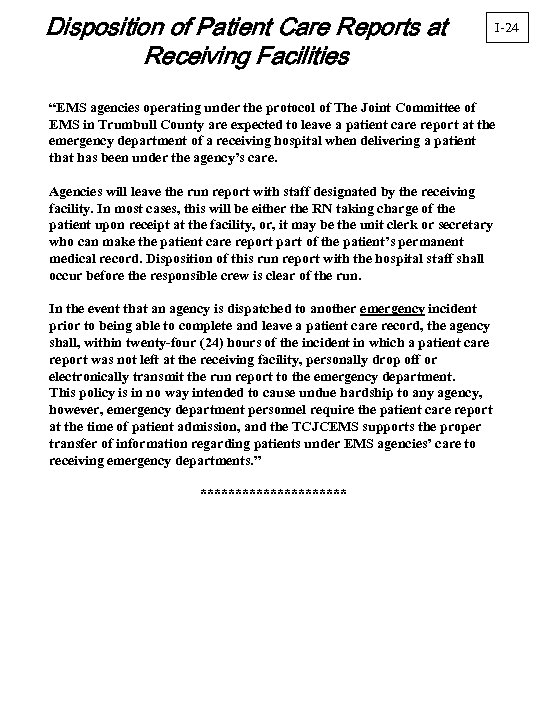
Disposition of Patient Care Reports at Receiving Facilities I-24 “EMS agencies operating under the protocol of The Joint Committee of EMS in Trumbull County are expected to leave a patient care report at the emergency department of a receiving hospital when delivering a patient that has been under the agency’s care. Agencies will leave the run report with staff designated by the receiving facility. In most cases, this will be either the RN taking charge of the patient upon receipt at the facility, or, it may be the unit clerk or secretary who can make the patient care report part of the patient’s permanent medical record. Disposition of this run report with the hospital staff shall occur before the responsible crew is clear of the run. In the event that an agency is dispatched to another emergency incident prior to being able to complete and leave a patient care record, the agency shall, within twenty-four (24) hours of the incident in which a patient care report was not left at the receiving facility, personally drop off or electronically transmit the run report to the emergency department. This policy is in no way intended to cause undue hardship to any agency, however, emergency department personnel require the patient care report at the time of patient admission, and the TCJCEMS supports the proper transfer of information regarding patients under EMS agencies’ care to receiving emergency departments. ” ***********
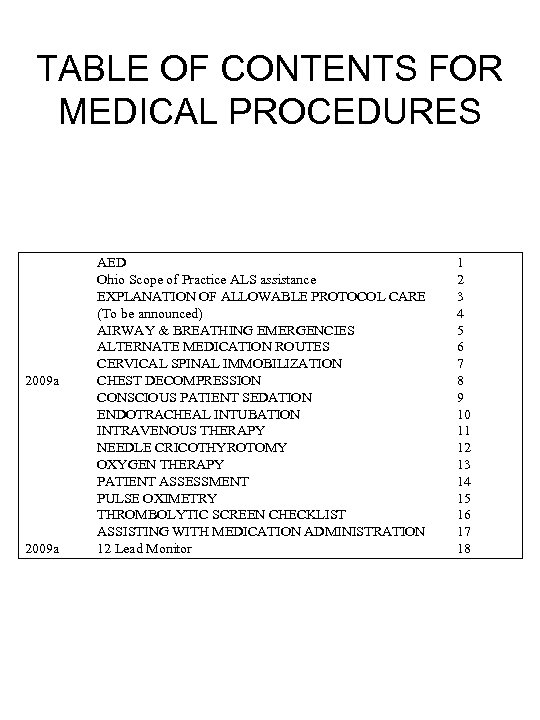
TABLE OF CONTENTS FOR MEDICAL PROCEDURES 2009 a AED Ohio Scope of Practice ALS assistance EXPLANATION OF ALLOWABLE PROTOCOL CARE (To be announced) AIRWAY & BREATHING EMERGENCIES ALTERNATE MEDICATION ROUTES CERVICAL SPINAL IMMOBILIZATION CHEST DECOMPRESSION CONSCIOUS PATIENT SEDATION ENDOTRACHEAL INTUBATION INTRAVENOUS THERAPY NEEDLE CRICOTHYROTOMY OXYGEN THERAPY PATIENT ASSESSMENT PULSE OXIMETRY THROMBOLYTIC SCREEN CHECKLIST ASSISTING WITH MEDICATION ADMINISTRATION 12 Lead Monitor 1 2 3 4 5 6 7 8 9 10 11 12 13 14 15 16 17 18
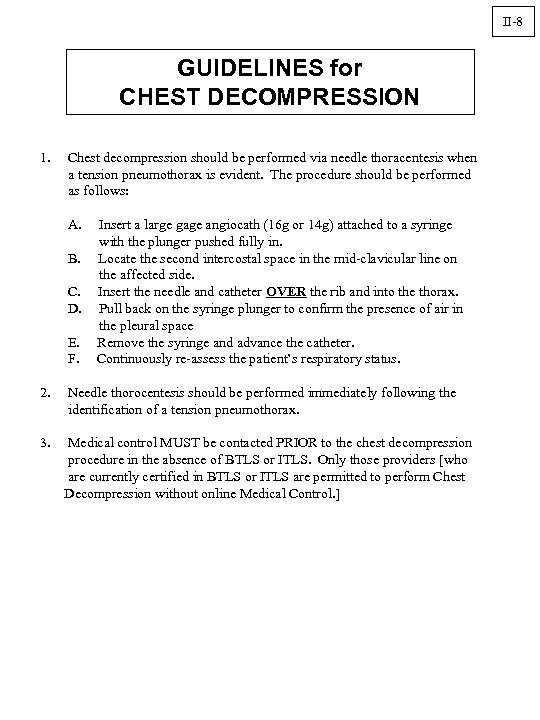
II-8 GUIDELINES for CHEST DECOMPRESSION 1. Chest decompression should be performed via needle thoracentesis when a tension pneumothorax is evident. The procedure should be performed as follows: A. B. C. D. E. F. Insert a large gage angiocath (16 g or 14 g) attached to a syringe with the plunger pushed fully in. Locate the second intercostal space in the mid-clavicular line on the affected side. Insert the needle and catheter OVER the rib and into the thorax. Pull back on the syringe plunger to confirm the presence of air in the pleural space Remove the syringe and advance the catheter. Continuously re-assess the patient’s respiratory status. 2. Needle thorocentesis should be performed immediately following the identification of a tension pneumothorax. 3. Medical control MUST be contacted PRIOR to the chest decompression procedure in the absence of BTLS or ITLS. Only those providers [who are currently certified in BTLS or ITLS are permitted to perform Chest Decompression without online Medical Control. ]

II-18 GUIDELINES for 12 -lead Monitor application
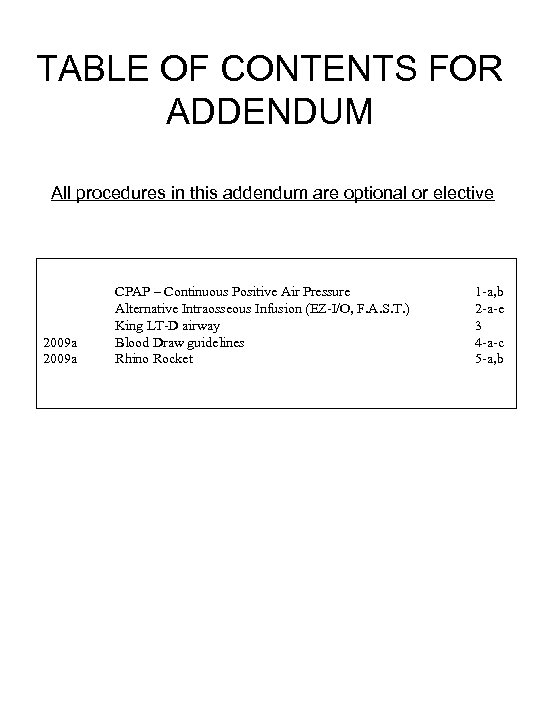
TABLE OF CONTENTS FOR ADDENDUM All procedures in this addendum are optional or elective 2009 a CPAP – Continuous Positive Air Pressure Alternative Intraosseous Infusion (EZ-I/O, F. A. S. T. ) King LT-D airway Blood Draw guidelines Rhino Rocket 1 -a, b 2 -a-e 3 4 -a-c 5 -a, b
A-4 -c E. Upon arrival at the ED, the providers and the patient will be met by a team ready to assess and treat the patient, and the providers will be directed to a room. F. Any member of the prehospital care team will then fill out a lab “downtime” form to accompany the blood to the lab so that it may be processed. G. Once the blood has been secured, EMS providers need to personally hand it to an RN, PCT or clinical staff member who is taking care of the patient. Get the staff member’s name and document the handoff (including times) on the EMS patient care report In the event that EMS providers have drawn blood, but have not drawn all four tubes, providers must notify the staff which tubes were not drawn. This ensures that the proper samples are drawn. H. The prehospital care team will then need to complete the patient care record, and that record will need to be left with the nursing staff responsible for the patient. III. Identification and Resolution of Problems A. This procedure is a living document. As problems are identified and corrected, changes may be made. Notification will be made as necessary. B. Prehospital care providers identifying problems should fill out a Continuing Performance Improvement Form, and forward it to the EMS Coordinator so that the problems may be rectified. C. Prehospital care providers may contact the EMS Coordinator at (330) 841 -9616. Revision 1: 18 DEC 2006 [GBS] Revision 2: 27 DEC 2006 [GBS] Revision 3: 25 APR 2007 [GBS]
GUIDELINES for the RHINO ROCKET A-5 -a Indications and procedure for insertion of the Rhino Rocket (the Rhino Rocket is an optional item similar to other optional items in the protocol). Indications An uncontrolled nosebleed that has not responded to other methods of bleeding control. Contraindications The Rhino Rocket is contraindicated in facial trauma, specifically to the nose or sinuses, or where there is any gross deformity or suspected injury to the nose or sinuses. The Rhino Rocket may be used ONLY by paramedics. First Responders, EMTs-Basic or Intermediate may NOT use the Rhino Rocket. Proof of training in the device’s use must be provided by the department or agency electing to utilize the equipment prior to its use by a protocoled individual, and documentation must be available upon the demand of the TCJCEMS.
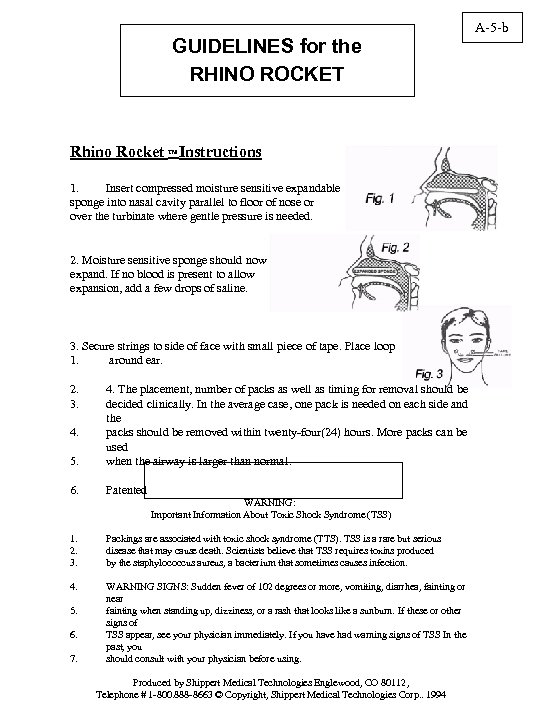
GUIDELINES for the RHINO ROCKET Rhino Rocket Instructions TM 1. Insert compressed moisture sensitive expandable sponge into nasal cavity parallel to floor of nose or over the turbinate where gentle pressure is needed. 2. Moisture sensitive sponge should now expand. If no blood is present to allow expansion, add a few drops of saline. 3. Secure strings to side of face with small piece of tape. Place loop 1. around ear. 2. 3. 5. 4. The placement, number of packs as well as timing for removal should be decided clinically. In the average case, one pack is needed on each side and the packs should be removed within twenty‑four(24) hours. More packs can be used when the airway is larger than normal. 6. Patented 4. WARNING: Important Information About Toxic Shock Syndrome (TSS) 1. 2. 3. Packings are associated with toxic shock syndrome (TTS). TSS is a rare but serious disease that may cause death. Scientists believe that TSS requires toxins produced by the staphylococcus aureus, a bacterium that sometimes causes infection. 4. WARNING SIGNS: Sudden fever of 102 degrees or more, vomiting, diarrhea, fainting or near fainting when standing up, dizziness, or a rash that looks like a sunburn. If these or other signs of TSS appear, see your physician immediately. If you have had warning signs of TSS In the past, you should consult with your physician before using. 5. 6. 7. Produced by Shippert Medical Technologies Englewood, CO 80112, Telephone # 1‑ 800. 888‑ 8663 © Copyright, Shippert Medical Technologies Corp. . 1994 A-5 -b
Скачать презентацию TRUMBULL COUNTY EMS PROTOCOL PROCEDURES MANUAL 2009
976378c93bc3fcc9fa3f94808601417d.ppt