


 Скачать презентацию Truman s Presidency and the Cold War 1945 -1953
ac5927df8ac25fe2101089ca1bc0f764.ppt
- Количество слайдов: 131
 Truman’s Presidency and the Cold War 1945 -1953
 Roots of the Cold War § US Point of View: § Stalin sought to create "spheres" of influence in Eastern Europe § Yalta Conference: Soviet pledge to allow democratic elections in eastern Europe was broken § The U. S. wanted democracy spread throughout the world with a strong United Nations to maintain global peace
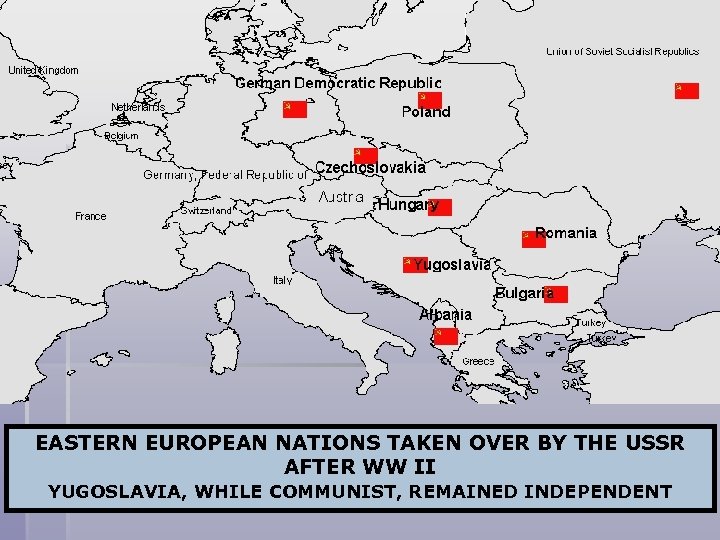 EASTERN EUROPEAN NATIONS TAKEN OVER BY THE USSR AFTER WW II YUGOSLAVIA, WHILE COMMUNIST, REMAINED INDEPENDENT
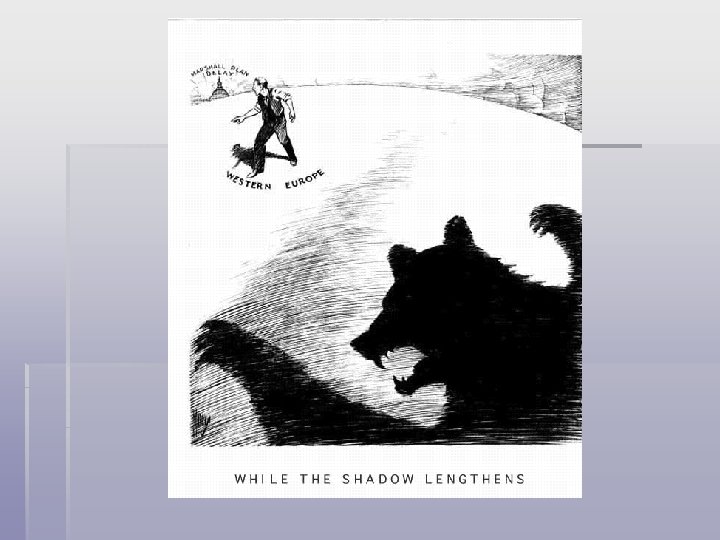
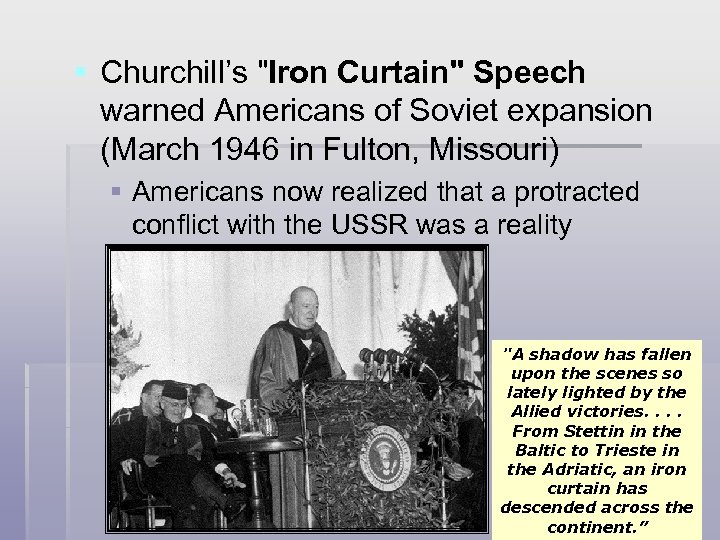 § Churchill’s "Iron Curtain" Speech warned Americans of Soviet expansion (March 1946 in Fulton, Missouri) § Americans now realized that a protracted conflict with the USSR was a reality "A shadow has fallen upon the scenes so lately lighted by the Allied victories. . From Stettin in the Baltic to Trieste in the Adriatic, an iron curtain has descended across the continent. ”
 § Soviet point of view: § U. S. did not open a second front in Western Europe early enough; millions of Soviet soldiers died fighting brunt of German armies alone § U. S. terminated lend-lease to the USSR in 1945 and refused $6 billion to Stalin § Soviets wanted a security guarantee for the Soviet western border § USSR had been twice attacked by Germany in 20 th century § Eastern Europe would now become a "buffer zone"
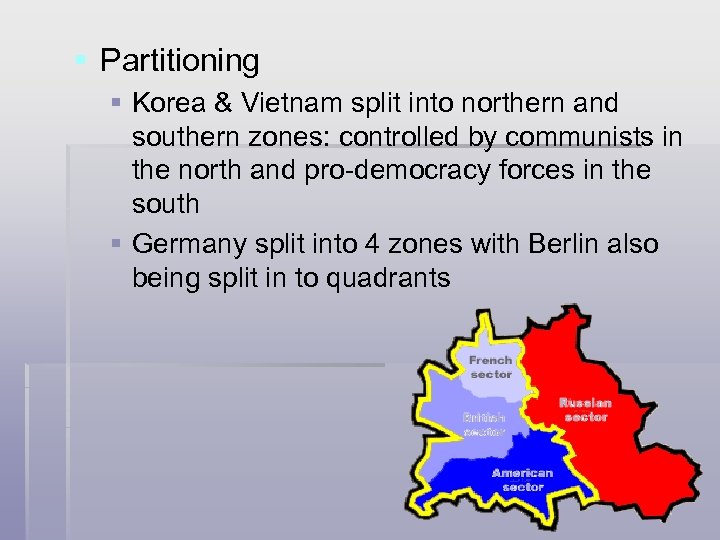 § Partitioning § Korea & Vietnam split into northern and southern zones: controlled by communists in the north and pro-democracy forces in the south § Germany split into 4 zones with Berlin also being split in to quadrants
 Shaping the Postwar World § Bretton Woods Conference (1944): International Monetary Fund (IMF) created by western Allies § World Bank founded to promote economic growth in war-torn and underdeveloped areas § Soviets declined to participate
 § United Nations § San Francisco Conference opened on April 25, 1945 § UN Charter created a General Assembly § Security Council composed of five permanent members: U. S. , USSR, China, Britain, and France § Any single veto would overrule a proposal § Responsible for settling disputes among UN member nations
 The German Question § Nuremberg Trials § Potsdam Conference had decided on punishing war crimes and a program of de. Nazifying Germany § Allies tried 22 top Nazis at Nuremberg, German from 1945 -1946 § 12 Nazis hanged and seven sentenced to long jail terms
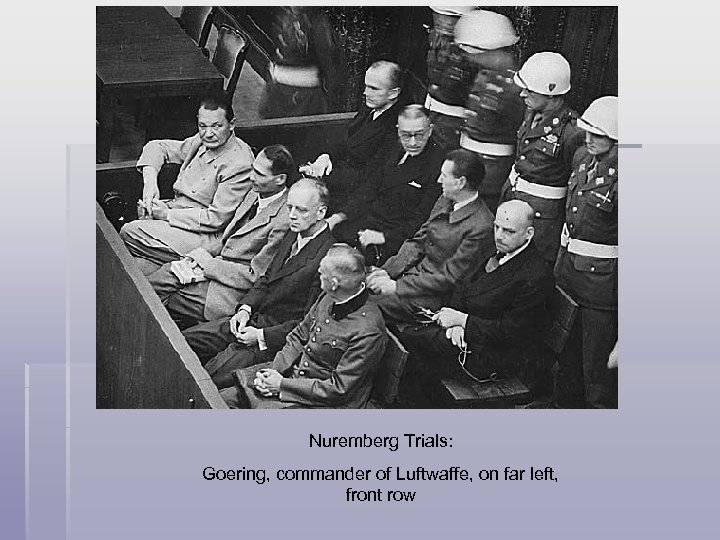 Nuremberg Trials: Goering, commander of Luftwaffe, on far left, front row
 § Partition of Germany § 1949, a democratic West Germany created; East Germany created under Soviet domination
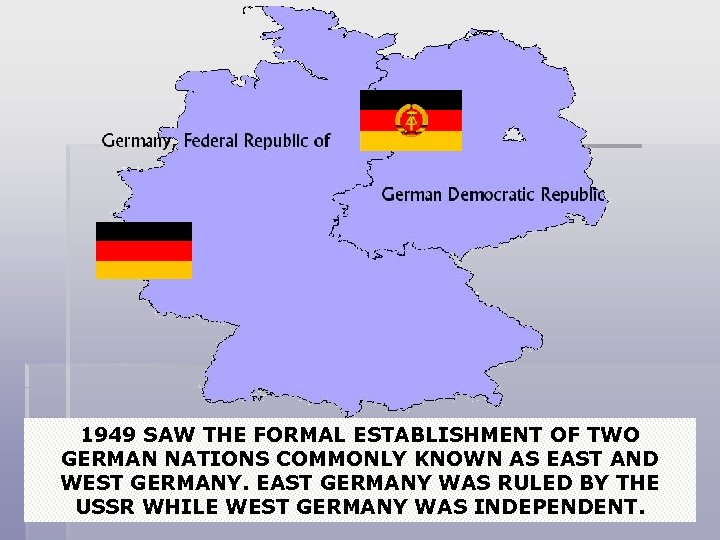 1949 SAW THE FORMAL ESTABLISHMENT OF TWO GERMAN NATIONS COMMONLY KNOWN AS EAST AND WEST GERMANY. EAST GERMANY WAS RULED BY THE USSR WHILE WEST GERMANY WAS INDEPENDENT.
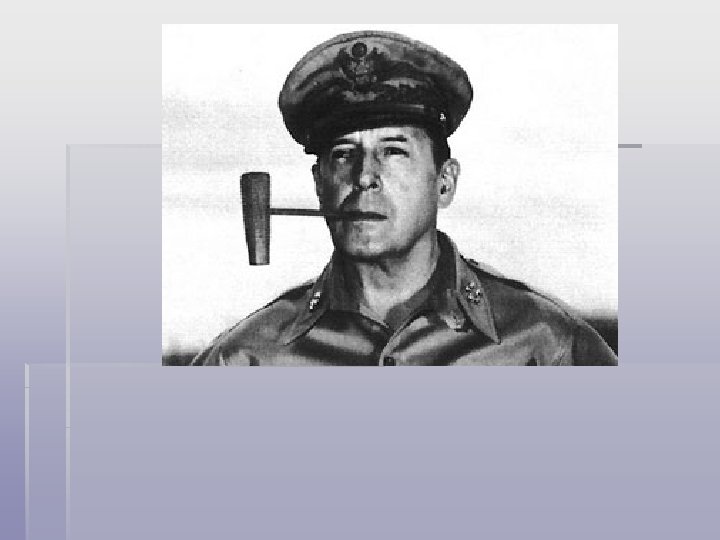
 Reconstruction of Japan § U. S. , led by Gen. Douglas Mac. Arthur, implemented democracy in Japan § Japanese war criminals tried between 1946 -48; 7 hanged (including Tojo), 18 sent to prison § Japan adopted a constitution in 1946 renouncing militarism & introducing Western-style democracy
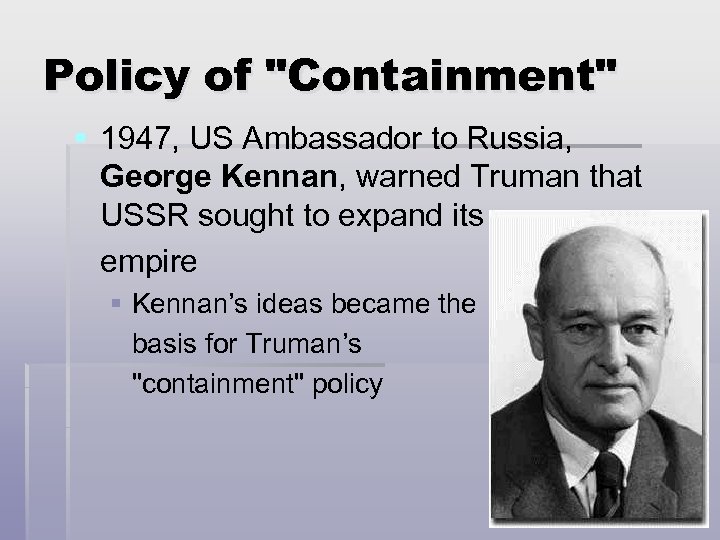 Policy of "Containment" § 1947, US Ambassador to Russia, George Kennan, warned Truman that USSR sought to expand its empire § Kennan’s ideas became the basis for Truman’s "containment" policy
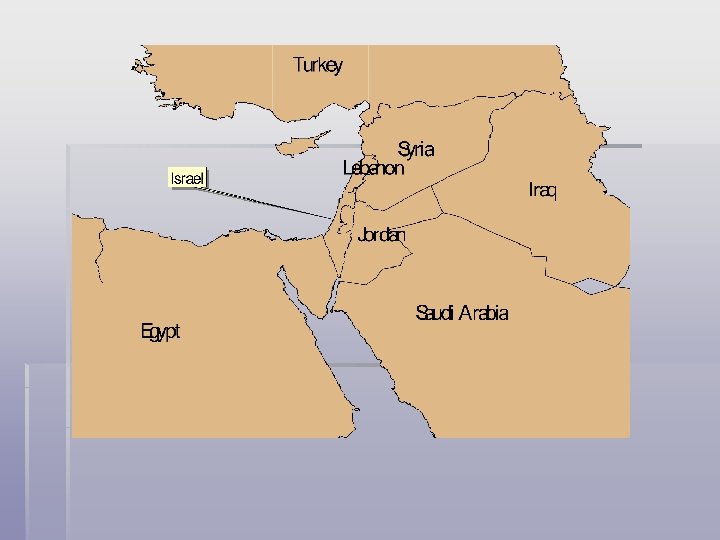
 § Truman Doctrine -- Defined U. S. foreign policy for next 20 years § Initiated a policy of "containment": prevention of the spread of communism § Truman quickly recognized Israel in 1948 - would be stronghold of democracy in Middle East
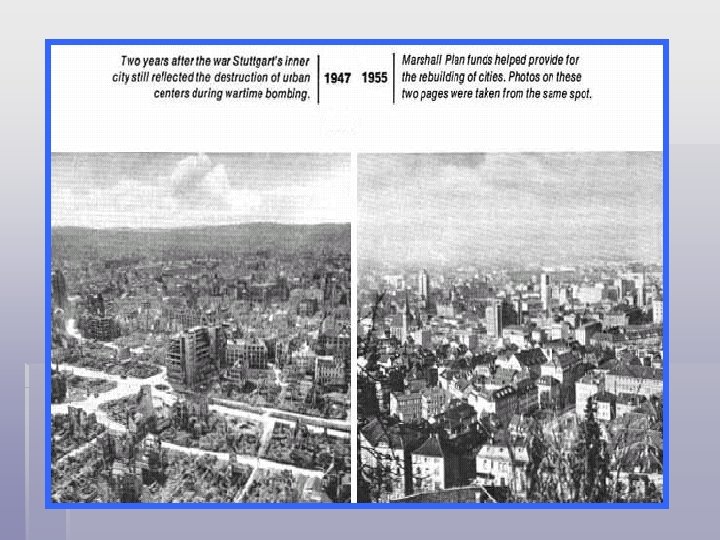
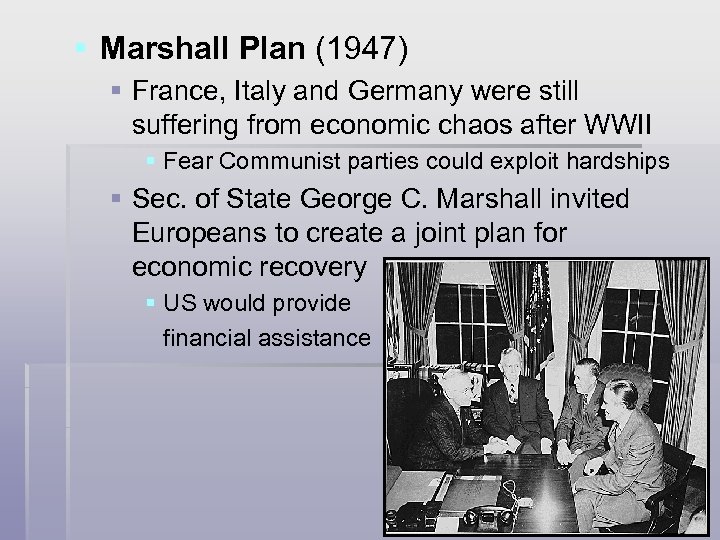 § Marshall Plan (1947) § France, Italy and Germany were still suffering from economic chaos after WWII § Fear Communist parties could exploit hardships § Sec. of State George C. Marshall invited Europeans to create a joint plan for economic recovery § US would provide financial assistance
 § Congress balked at am’t but changed course after the Soviet-sponsored a coup d’ etat in Czechoslovakia in 1948 § Plan allocated $12. 5 billion over four years in 16 cooperating countries § "economic miracle” § Eastern European nations prohibited from accepting aid from US & W. Europe
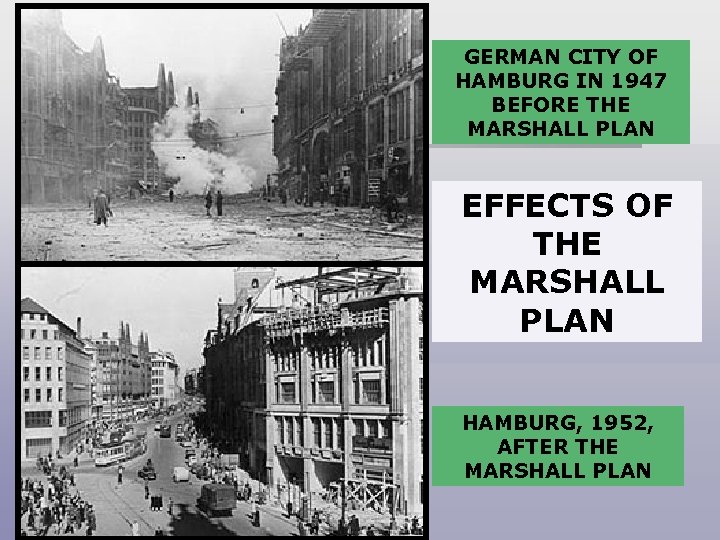 GERMAN CITY OF HAMBURG IN 1947 BEFORE THE MARSHALL PLAN EFFECTS OF THE MARSHALL PLAN HAMBURG, 1952, AFTER THE MARSHALL PLAN
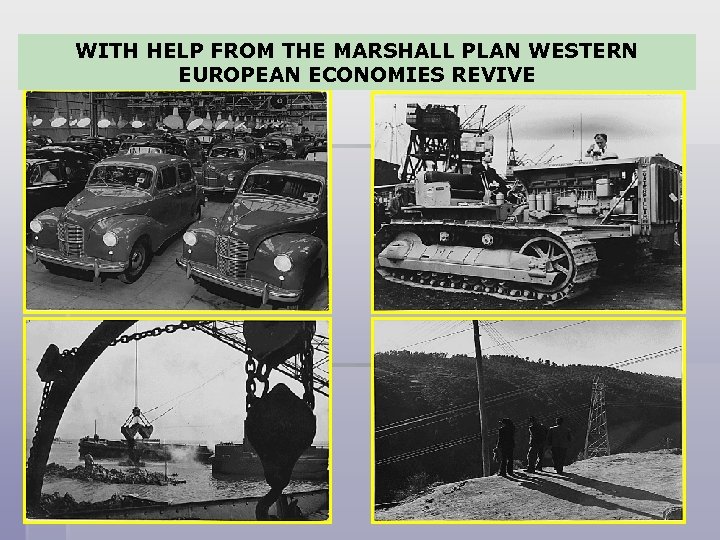 WITH HELP FROM THE MARSHALL PLAN WESTERN EUROPEAN ECONOMIES REVIVE
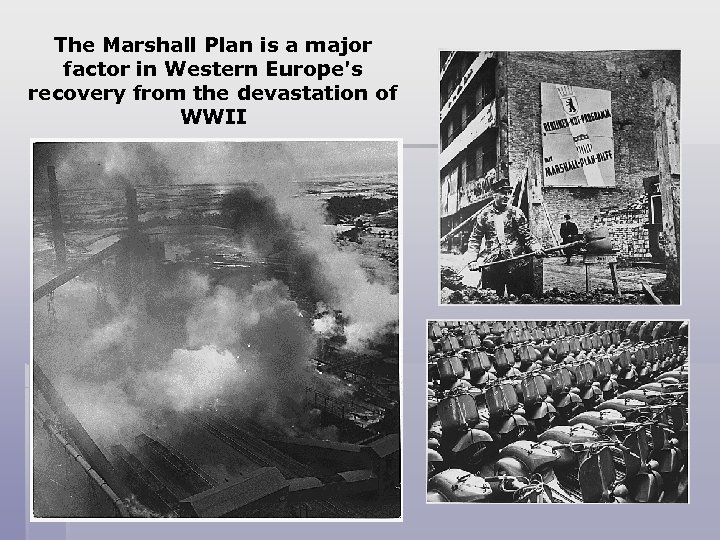 The Marshall Plan is a major factor in Western Europe's recovery from the devastation of WWII
 U. S. gov’t reorganization and rearmament § National Security Act of 1947 created the Department of Defense § Headed by new cabinet post -- Sec. of Defense § National Security Council (NSC) and Central Intelligence Agency (CIA) created § NSC Number 68 (1950) § U. S. would implement a rigorous worldwide defense of Communism with "an immediate and large-scale build up of our military. "
 § "Voice of America" authorized by Congress; beamed US broadcasts behind the iron curtain § Atomic Energy Commission created in 1946 -- president sole authority over use of atomic weapons
 § Berlin Airlift (1948 -49) § Berlin, inside East Germany, was cut off from the west by Soviet forces in 1948 § U. S. , French, & British zones in Berlin became an "island" inside East Germany § Soviets also shut off electric power § 2 million West Berliners became hostages § U. S. organized a massive airlift for nearly a year; 277, 000 flights § Many thought World War III was inevitable § Soviets lifted the blockade in May 1949 and the crisis subsided
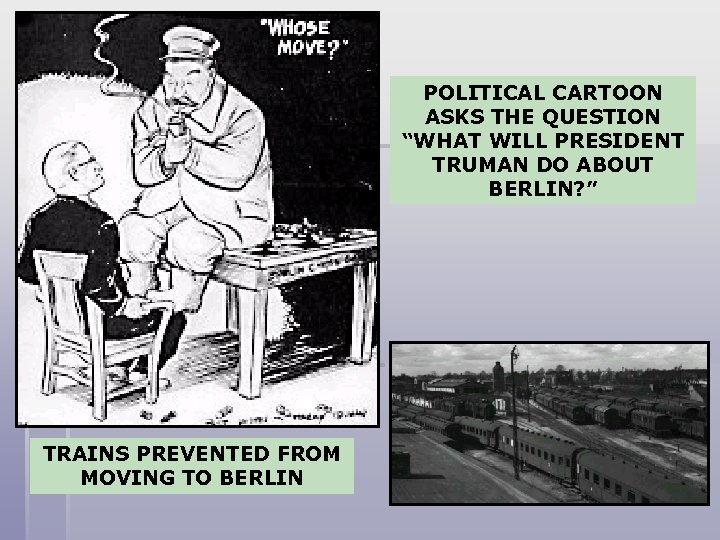 POLITICAL CARTOON ASKS THE QUESTION “WHAT WILL PRESIDENT TRUMAN DO ABOUT BERLIN? ” TRAINS PREVENTED FROM MOVING TO BERLIN
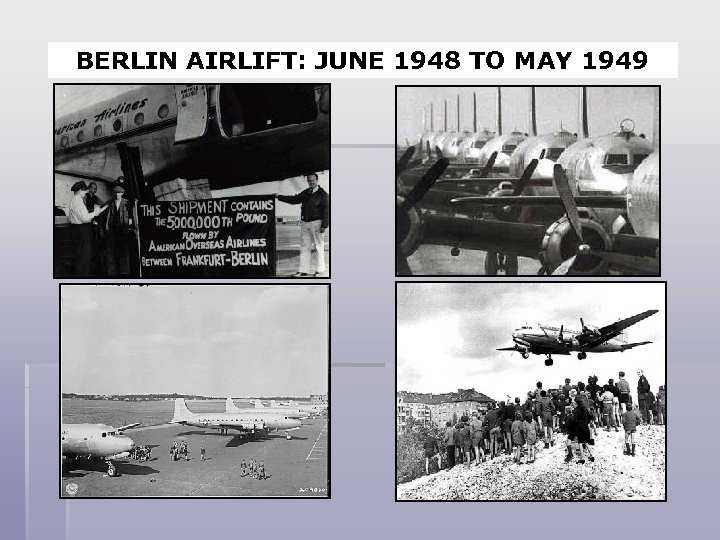 BERLIN AIRLIFT: JUNE 1948 TO MAY 1949
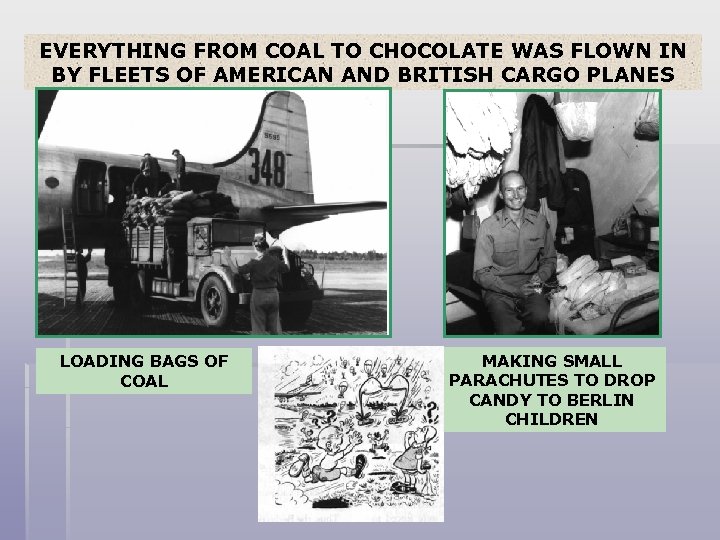 EVERYTHING FROM COAL TO CHOCOLATE WAS FLOWN IN BY FLEETS OF AMERICAN AND BRITISH CARGO PLANES LOADING BAGS OF COAL MAKING SMALL PARACHUTES TO DROP CANDY TO BERLIN CHILDREN
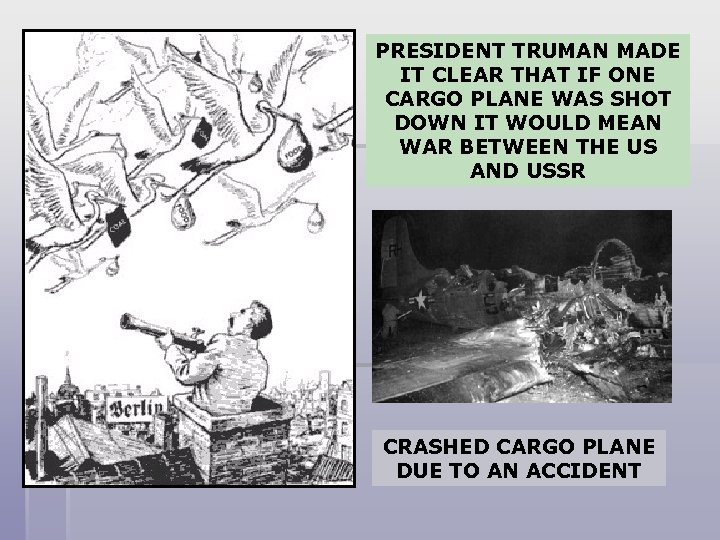 PRESIDENT TRUMAN MADE IT CLEAR THAT IF ONE CARGO PLANE WAS SHOT DOWN IT WOULD MEAN WAR BETWEEN THE US AND USSR CRASHED CARGO PLANE DUE TO AN ACCIDENT
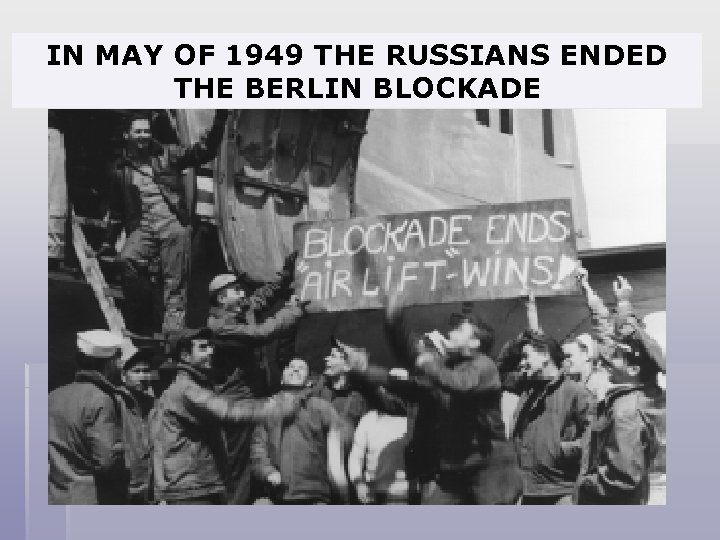 IN MAY OF 1949 THE RUSSIANS ENDED THE BERLIN BLOCKADE
 Cold War during Truman’s 2 nd term § Secretary of State Dean Acheson § North Atlantic Treaty Organization (NATO) § Created April 4, 1949 by 12 nations including U. S. , France, Britain, Italy § NATO created in response to Berlin Crisis
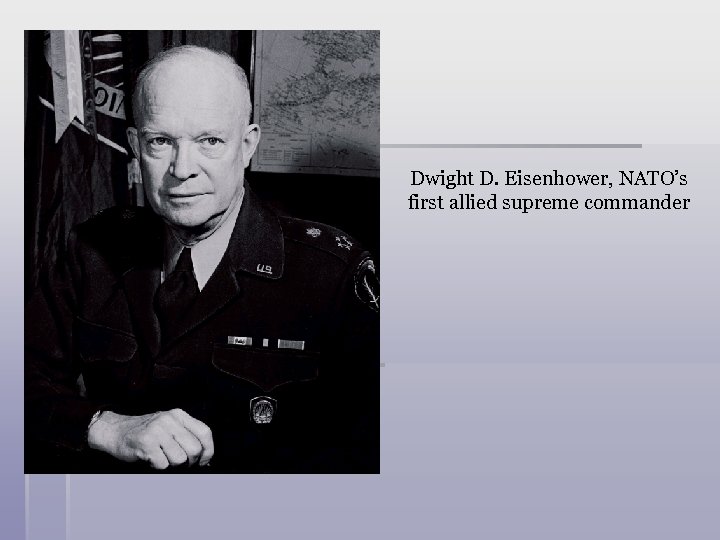 Dwight D. Eisenhower, NATO’s first allied supreme commander
 § Collective security organization; warned USSR that a threat to any NATO members would be met with force § In 1955, USSR formed Warsaw Pact as a response to NATO which included all Eastern Bloc countries -- satellite countries § ANZUS -- U. S. forged a collective security agreement with Australia and New Zealand to buttress democracy in Pacific § CENTO -- Central Treaty Organization (in Central America)
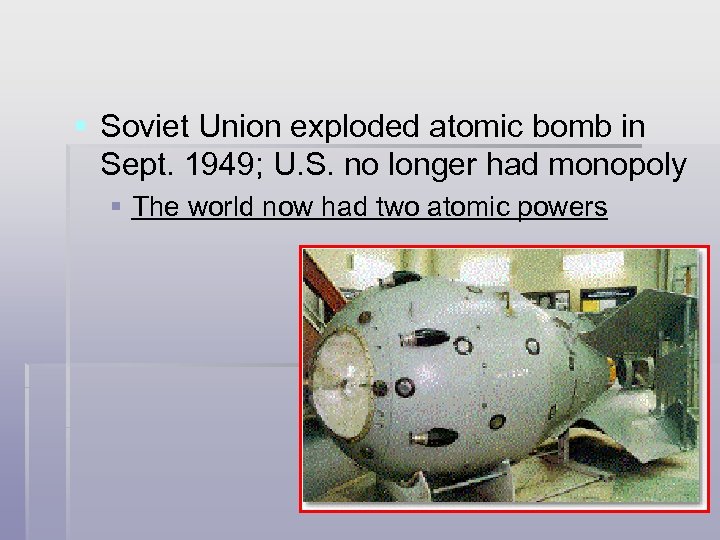 § Soviet Union exploded atomic bomb in Sept. 1949; U. S. no longer had monopoly § The world now had two atomic powers
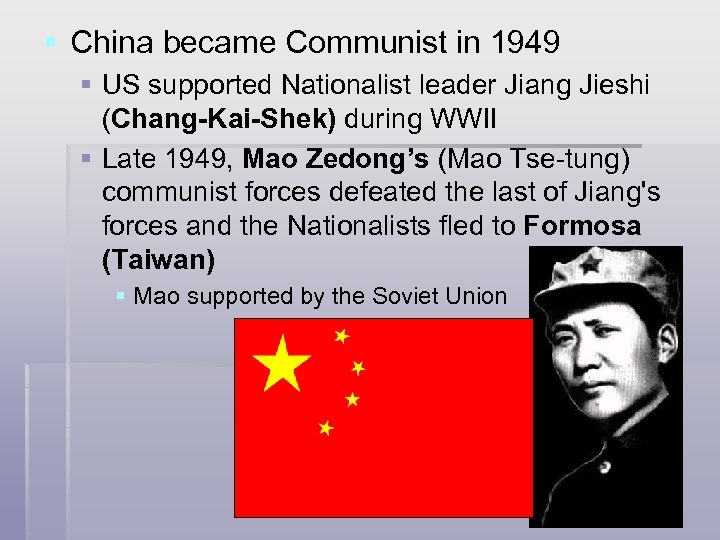 § China became Communist in 1949 § US supported Nationalist leader Jiang Jieshi (Chang-Kai-Shek) during WWII § Late 1949, Mao Zedong’s (Mao Tse-tung) communist forces defeated the last of Jiang's forces and the Nationalists fled to Formosa (Taiwan) § Mao supported by the Soviet Union
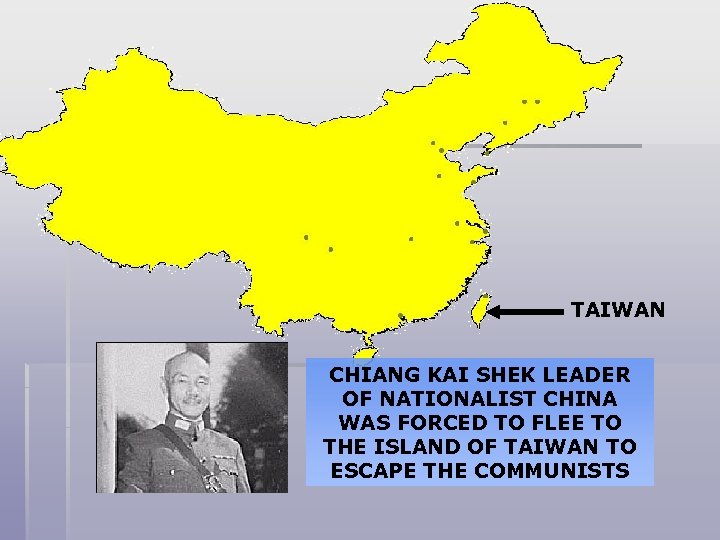 TAIWAN CHIANG KAI SHEK LEADER OF NATIONALIST CHINA WAS FORCED TO FLEE TO THE ISLAND OF TAIWAN TO ESCAPE THE COMMUNISTS
 § Loss of China was seen as a major defeat for U. S. containment § 25% of world's population became communist in one shot § Truman criticized for allowing China to fall to communists
 § U. S. refused to recognize the People’s Republic of China ("Red China") and maintained Jiang’s regime on the UN Security Council § USSR boycotted Security Council § People’s Republic of China not recognized as a permanent Security Council member until 1973
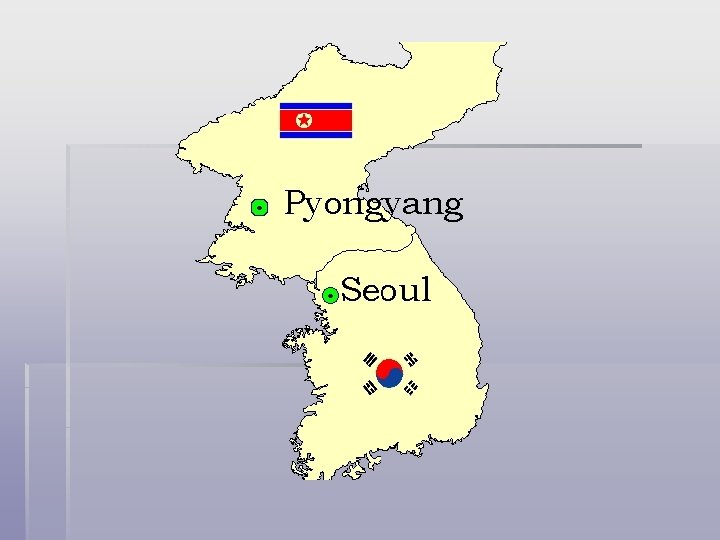
 Korean War (1950 -53) § Background § During WWII, Russian troops occupied northern Korea, US troops occupied southern Korea § 1949, both set up rival regimes on each side of the 38 th parallel
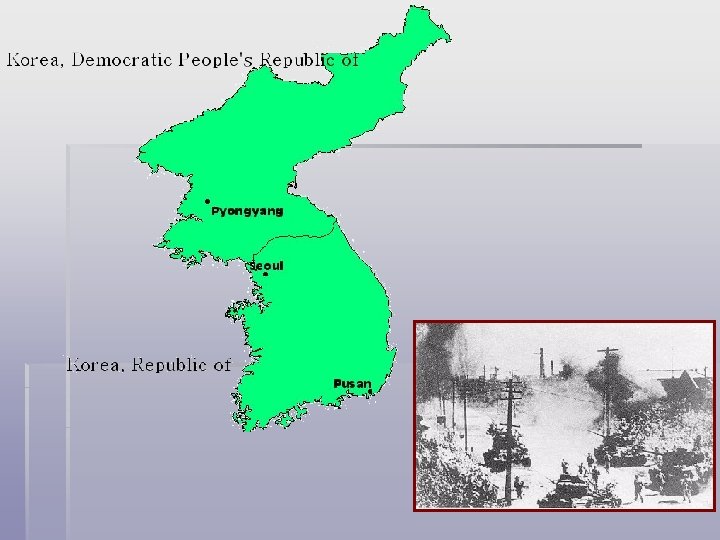
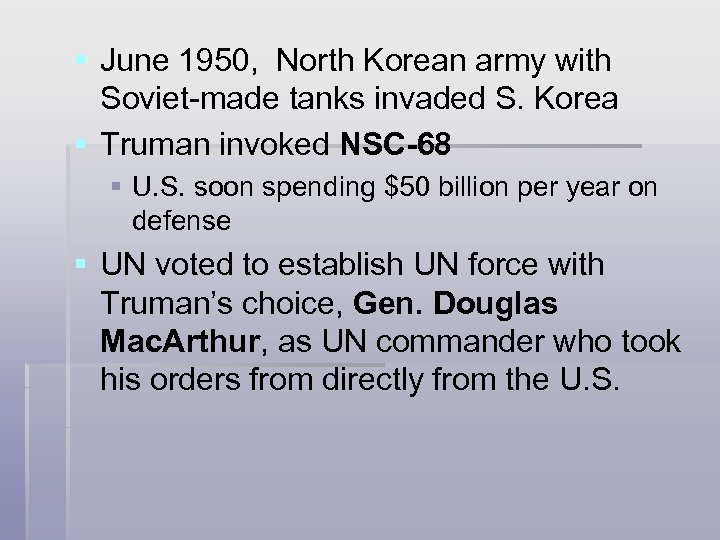 § June 1950, North Korean army with Soviet-made tanks invaded S. Korea § Truman invoked NSC-68 § U. S. soon spending $50 billion per year on defense § UN voted to establish UN force with Truman’s choice, Gen. Douglas Mac. Arthur, as UN commander who took his orders from directly from the U. S.
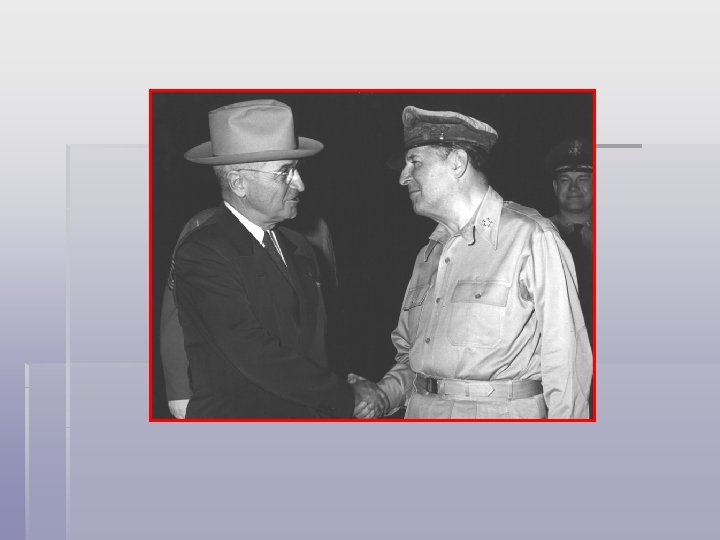
 § By August 1950, North Korea captured nearly all of South Korea § NK had superior military aid from Soviet Union § Mac. Arthur directed surprise amphibious landing at Inchon behind Korean lines § Within two weeks, UN forces recaptured nearly all of SK (N. Koreans pushed behind 38 th p. ) § **Mac. Arthur ordered UN forces to cross North of the 38 th parallel with support of Truman and UN § NK forces driven back near the Chinese border § UN calls for the establishment of a unified and democratic Korea
 § November 1950, 300, 000 Chinese soldiers poured into North Korea; forced UN troops to retreat with heavy losses across 38 th parallel
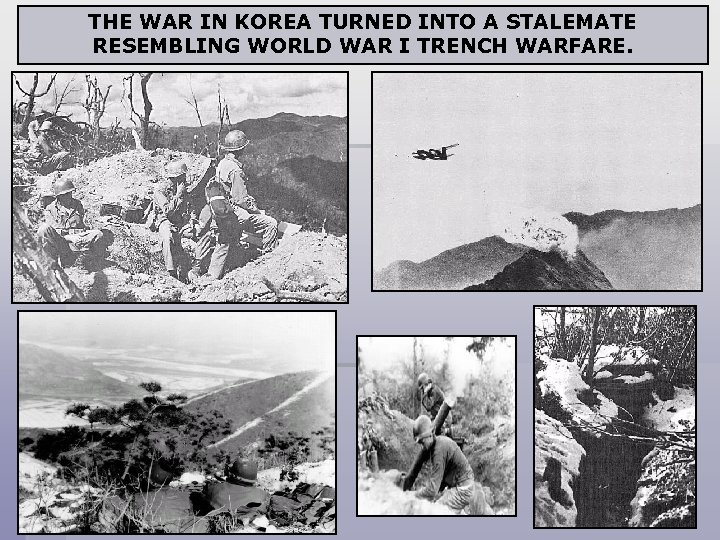 THE WAR IN KOREA TURNED INTO A STALEMATE RESEMBLING WORLD WAR I TRENCH WARFARE.
 § Truman fires Mac. Arthur § Truman seeks limited war § Nuclear weapons would not be used § Original objective again to restore border between N. & S. Korea
 § Mac. Arthur against limited war -- "No substitute for victory” § Mac. Arthur circumvents Truman and demands total N. Korean surrender § Undercuts Truman’s attempt at negotiations; threat to president’s power § Truman removes Mac. Arthur from command orders him back to US
 § Cease-Fire § Negotiations began in July 1951 and continued for 2 years while war continued § Cease-fire signed on July 27, 1953 § 38 th parallel as boundary is restored § DMZ along boundary § Americans disappointed at unclear conclusion
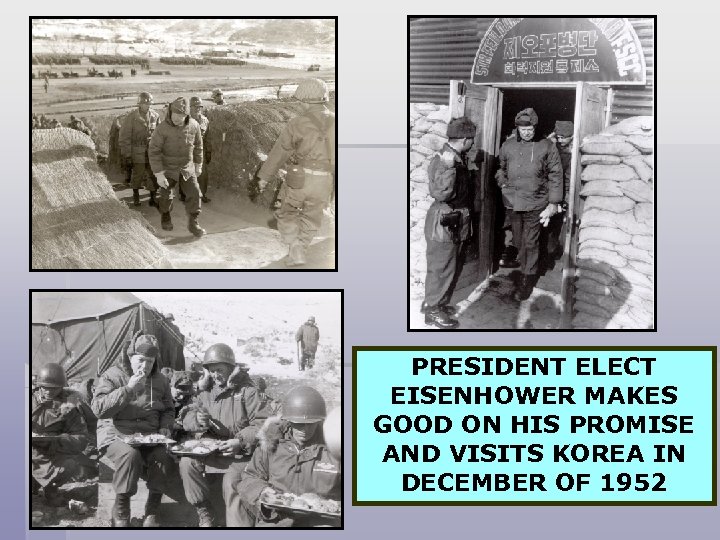 PRESIDENT ELECT EISENHOWER MAKES GOOD ON HIS PROMISE AND VISITS KOREA IN DECEMBER OF 1952
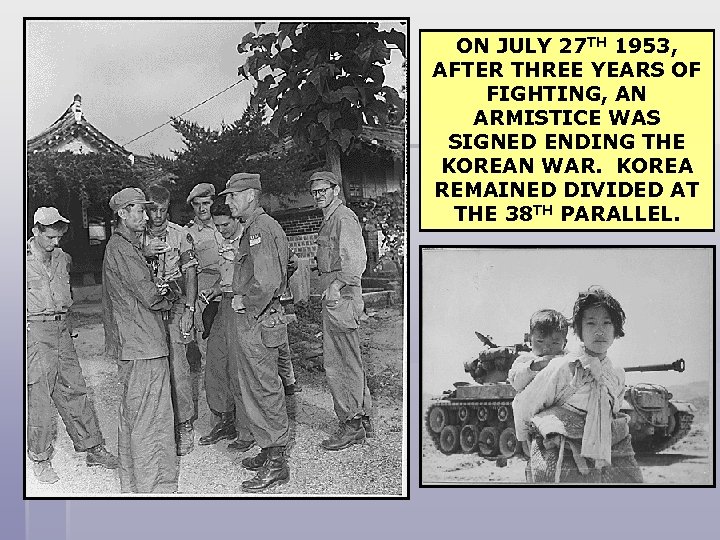 ON JULY 27 TH 1953, AFTER THREE YEARS OF FIGHTING, AN ARMISTICE WAS SIGNED ENDING THE KOREAN WAR. KOREA REMAINED DIVIDED AT THE 38 TH PARALLEL.
 § Results of Korean War § 54, 000 US soldiers § Total casualties as high as 4 million § UN successfully repelled North Korean attack on S. Korea § US successfully enforce its "containment" policy
 Truman’s First Term domestic policy § Taft-Hartley Act , June 1947 § Passed by Congress over Truman’s veto § Major provisions of Taft-Hartley Act § Most important: 80 day cooling-off period for strikers in key industries § Outlawed the "closed-shop" (process of hiring only union members) § By 1954, 15 states passed "right to work" laws outlawing the "union-shop. "
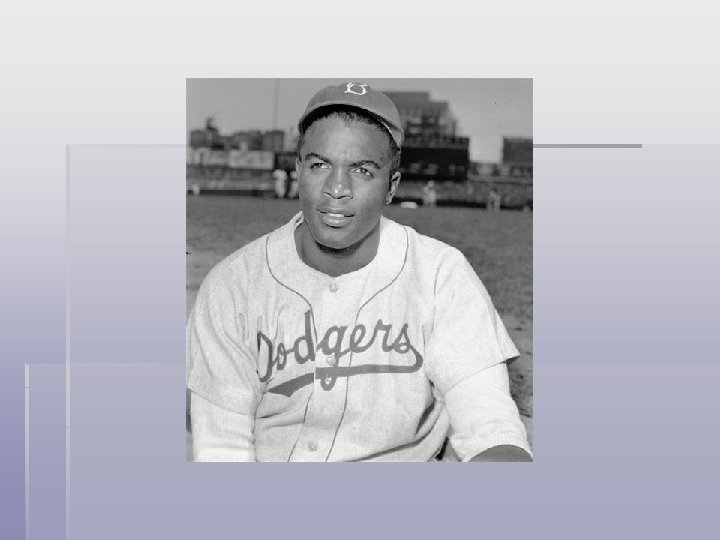
 § Civil Rights: gains for African Americans § 1946, Truman created the President’s Committee on Civil Rights § In 1947, committee published To Secure These Rights, calling for desegregation of American society, anti-lynching legislation and an end to poll taxes § 1948, desegregation of armed forces in 1953 § Jackie Robinson first African American in Major League Baseball in 1947 (Brooklyn Dodgers)
 § Presidential Succession Act of 1947 § Created as a contingency for nuclear war
 § 22 nd Amendment, 1951 (“Anti-FDR amendment”) § Limited president to two terms
 Anti-Communist Crusade"Red Scare" § American Fears -- Paranoia regarding communism and its sympathizers due to: § Communism at home: fear of spies infiltrating U. S. gov’t: Alger Hiss, Rosenbergs § Fear of nuclear war: Soviet A-bomb in 1949; H-bomb in 1953, Sputnik in 1957 § Spread of communism around the world (Eastern Europe, China, Korea) Continued
 § Demagogue politicians using fear for gain (HUAC, Mc. Carthy) § Fear of another depression (recessions in 1946 -47 & early ‘ 50 s) § A depression might trigger the growth of communism § Note: this was the 2 nd red scare of 20 th century (first occurred after WWI: 1919 -1920 during Wilson's presidency) § Culture reflected these fears: movies such as Invasion of the Body Snatchers, The Blob
 § Smith Act of 1940 § Made it illegal to advocate the overthrow of the government by force or to belong to an organization advocating such a position § Used by Truman administration to jail leaders of the American Communist Party § 11 communists brought to trial in New York in 1949 and sent to prison for advocating the overthrow of the US gov't by force
 § Committee on Un-American Activities (HUAC) indicts Alger Hiss, 1947 § HUAC created in 1945 to root out communism during the "Red Scare" after WWII that lasted into the mid-1950 s § Committee was sensationalistic, also going after public figures in Hollywood § Liberals targeted § Senate counterpart to HUAC also active in anticommunist investigations
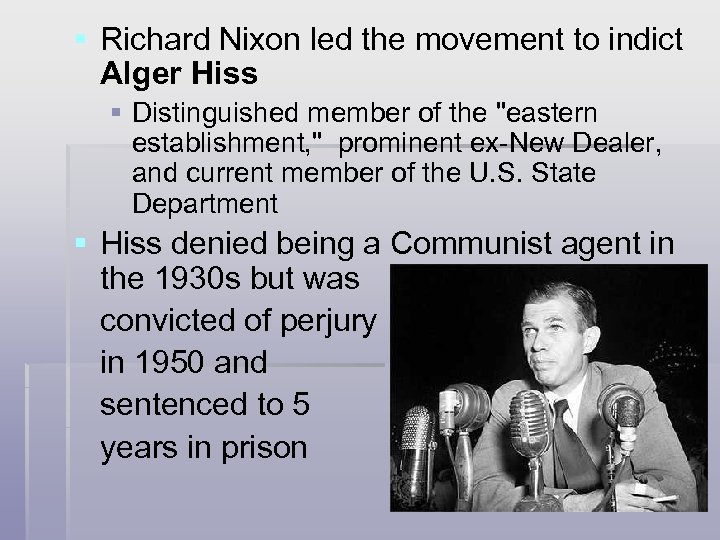 § Richard Nixon led the movement to indict Alger Hiss § Distinguished member of the "eastern establishment, " prominent ex-New Dealer, and current member of the U. S. State Department § Hiss denied being a Communist agent in the 1930 s but was convicted of perjury in 1950 and sentenced to 5 years in prison
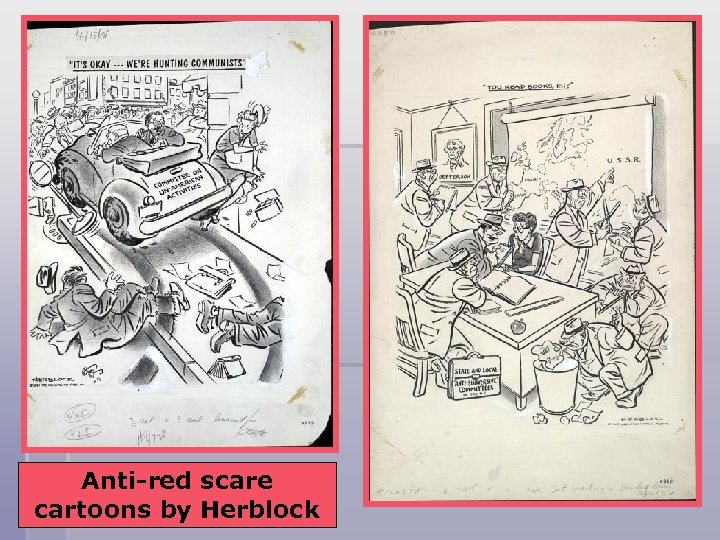 Anti-red scare cartoons by Herblock
 § Truman's "loyalty" program § Truman countered HUAC with anti-communist programs of his own § Attorney General identified 90 "disloyal" organizations who were not given the right to prove their innocence § Truman gave FBI approval and resources to go after suspected "reds“ § Loyalty Review Board investigated more than 3 million fed. Employees § Loyalty oaths were increasingly demanded of employees, esp. teachers § Many felt civil liberties were being suppressed § Gov’t employees forbidden to: § § Criticize US foreign policy Advocate equal rights for women Own books on socialism Attend foreign films
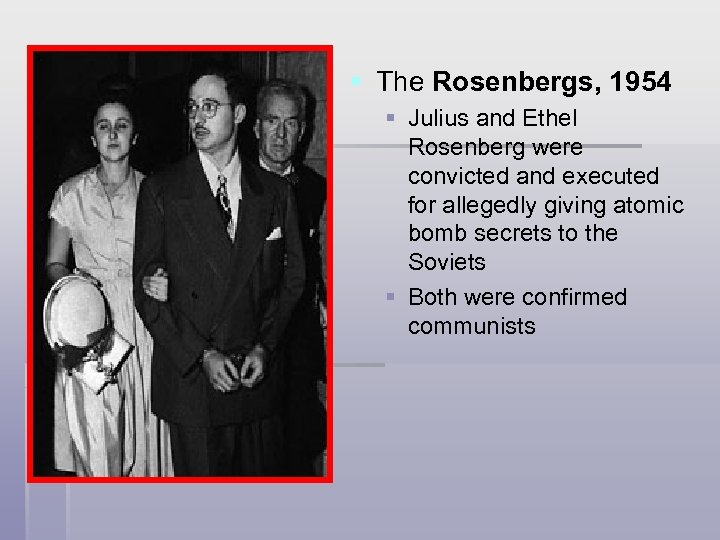 § The Rosenbergs, 1954 § Julius and Ethel Rosenberg were convicted and executed for allegedly giving atomic bomb secrets to the Soviets § Both were confirmed communists
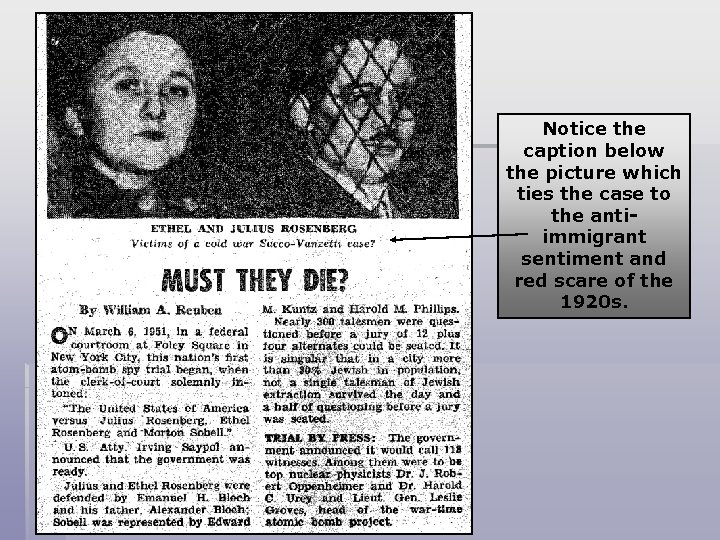 Notice the caption below the picture which ties the case to the antiimmigrant sentiment and red scare of the 1920 s.
 § Blacklisting § Many actors, writers, and directors had dabbled with the Communist Party in the 1930's when it was considered fashionable § 10 of these movie industry people, the "Hollywood Ten" refused to testify and decided to go to prison rather than testifying to the HUAC § The industry responded by denying work to 250 actors, writers, and directors
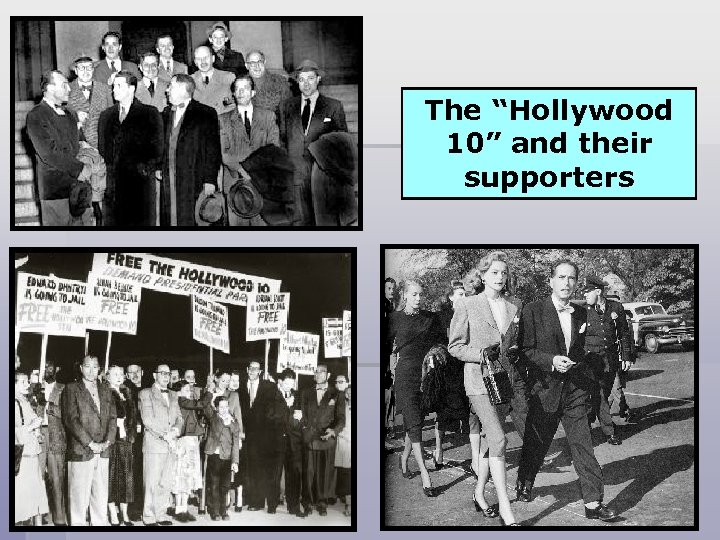 The “Hollywood 10” and their supporters
 § Mc. Carthyism § Senator Joseph R. Mc. Carthy (Wisconsin Republican) became a demagogue § In Feb. 1950, asserted that 200 unknown Communists were in the State Dept § Made sweeping accusations, employed guilt by association and documents out of context § Public convinced he was looking out for national security § Was unable to substantiate his claims but ruined many gov't officials § Supporters tended to be Republican and bluecollar
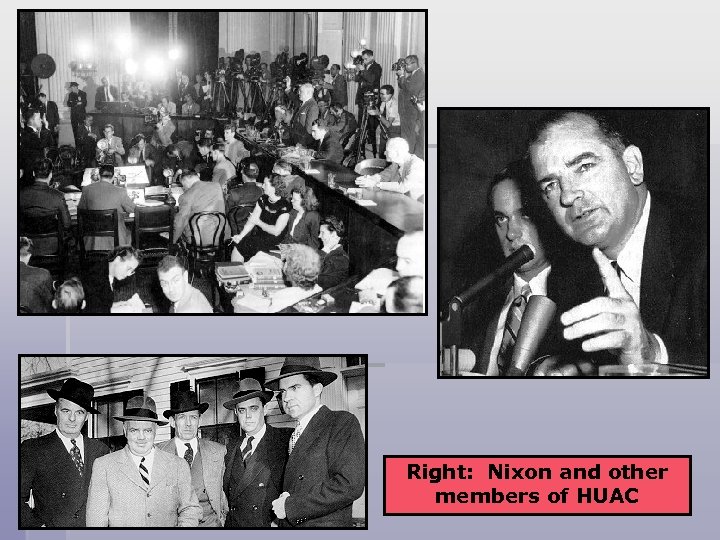 Right: Nixon and other members of HUAC
 § Other Accusations: § Claimed Democratic party was guilty of 20 years of treason § Wanted Truman impeached for being soft on communism § Hinted Eisenhower was "soft on communism” § Mc. Carthy would sometimes publicly claim people were gay as well as communist § Mc. Carthy’s Senate hearings created an atmosphere of conformity and fear
 § Downfall of Mc. Carthy occurred when he took on the Army in 1954 § Mc. Carthy was intensely examined by Joseph Welch, Army attorney § By Dec. , 1954, Senate passed a resolution condemning Mc. Carthy 67 -22
 § Did the end of Mc. Carthy signal the end of the red scare? Not really, but the hysteria did mellow § Sputnik caused some hysteria in 1957; Americans feared Soviets were technologically superior § Some Americans built bomb shelters in their back yards fearing nuclear with Soviets § School’s continued “duck and cover” drills to prepare for a nuclear attack § John Birch Society, an ultra-conservative nationalist group, emerged in late 1950 s; continued an attack on liberals for the next two decades § Arthur Miller’s The Crucible: popular play in 1950 s that used the 1692 Salem Witch Trials as a metaphor for Mc. Carthyism
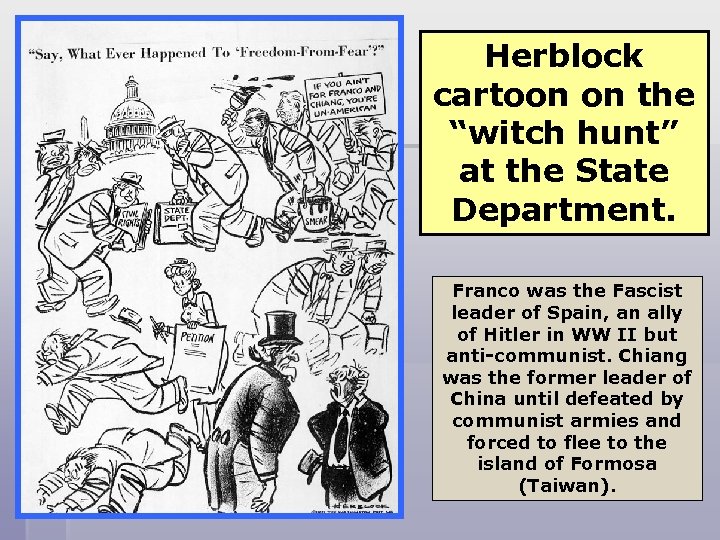 Herblock cartoon on the “witch hunt” at the State Department. Franco was the Fascist leader of Spain, an ally of Hitler in WW II but anti-communist. Chiang was the former leader of China until defeated by communist armies and forced to flee to the island of Formosa (Taiwan).
 Election of 1948 § Democrats split into three camps: Truman, southern States' Rights Party led by Strom Thurmond of S. C. , and new Progressive party under Henry Wallace § Thomas Dewey was nominated by the Republicans
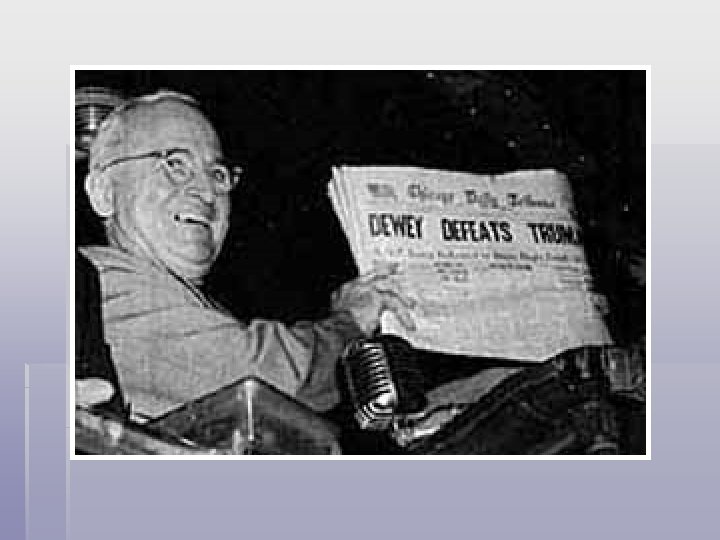
 § Truman called for full employment, higher minimum wage, better farm supports, new TVAs and extension of Social Security and more civil rights for Af. Am. — “Fair Deal” § Truman's support from farmers, workers, and blacks (felt threatened by R party) § Truman defeats Dewey in a stunning upset
 The “Vital Center”: 19481968 § A political consensus developed in America § Three major components common in both parties: § Anti-communism; containment § Belief that economic growth could solve all of society’s problems § JFK: “rising tides lift all boats” § Political pluralism: belief that a variety of ideas could compete in America (New Deal accepted by both parties)
 § “Vital Center” was shattered in 1968 § Vietnam War pits hawks against doves; amplifies generation gap § White conservative backlash against liberalism: “Great Society” programs of Johnson, the civil rights movement, and apparent lack of law and order, contributed to Republican control of the White House for 20 of the next 24 years
 The “Affluent Society”: § American Society in the Post-WWII era (19451970) § GI Bill of Rights, 1944 § Response to unemployment fears from 15 million returning GIs from WWII § Unrest after WWI resulted in race riot § Servicemen’s Readjustment Act of 1944 sent millions of veterans to school § Veteran’s Administration (VA) guaranteed about $16 billion in loans for veterans to buy homes, farms, and small businesses § Bill contributed to economic prosperity that emerged in late 1940 s
 The “Affluent Society”: contd… § Baby Boom § 1950 s population grew by over 28 million; 97% in urban and suburban areas § Between 1946 and 1961, 63. 5 million babies were born § Proportional growth in population unprecedented in American history
 § Economic boom: 1950 -1970 § National income nearly doubled in 1950 s; almost doubled again in 1960 s § Home ownership up to 60% from 40% in 20 s § Majority of postwar jobs went to women in urban offices and shops § By 1990 s, women accounted for about half of total workers § Clash between demands of suburban domesticity and realities of employment sparked the feminist revolt in the 1960 s
 § Consumerism mushroomed as Americans had more disposable income § Americans bought cars, gadgets for their homes, vacations, etc. in unprecedented numbers § Middle class § Over 12 million by early 1960 s § Suburbs § Grew 6 X faster than cities in 1950 s § Resulted from increased car production, white flight from urban areas due to black migration into Northern and Midwestern cities § Cult of domesticity re-emerges § Dr. Benjamin Spock: Commonsense Book of Baby and Child Care § Message: Women’s primary responsibility was to stay home and nurture their children
 Culture in the 1950 s § Television & Movies § TV emerged as the most popular entertainment medium in the 1950 s replacing radio § TV tended to reflect the conformity of the decade § Some movie stars became icons to the younger generation in 1950 s: James Dean, Marilyn Monroe
 § Rock n’ Roll: derived from African American blues (before Elvis it was known as "race" music) § Elvis Presley burst on the scene in 1956 as brought rock n' roll to masses § Rock n’ Roll became the music of the younger generation and emphasized the increasing generation gap between youth and their parents § Art: Abstract expressionism (1950 s) § Artists attempted spontaneous expression of their subjectivity using splattered paint and color field painting § Jackson Pollock
 § The Beat generation (beatniks) -- late 1950 s § Group of young men alienated by 20 thcentury life § Movement began in Greenwich Village, NY § Rebelled against the conformity and conservatism of middle-class America § Jack Kerouac: On the Road became the "bible" for restless youth § Emphasized alcohol, drugs, sex, jazz, Buddhism, and a vagabond lifestyle
 To what extent was there either conformity or consensus in American society between 1945 and 1960?
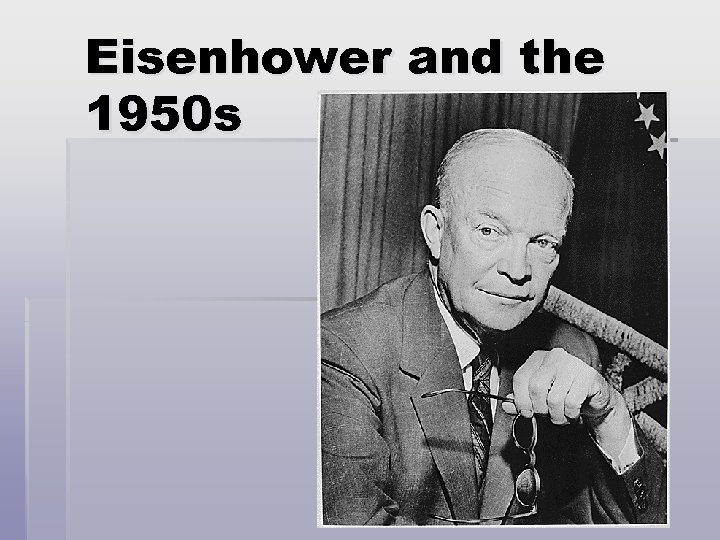 Eisenhower and the 1950 s
 Election of 1952 § Democrats nominated Adlai E. Stevenson § Republicans nominated Dwight D. Eisenhower ("Ike") § Eisenhower extremely popular hero of World War II § Richard Nixon nominated for Vice President § Eisenhower won by a landslide: 442 -89 § First time since 1928 the Republicans won some Southern states
 Eisenhower & "dynamic conservatism" § In effect, Ike maintained New Deal programs § Ike stated dynamic conservatism meant “being conservative when it comes to money and liberal when it comes to human beings. ” § Social Security benefits extended and minimum wage raised to $1. 00/hr
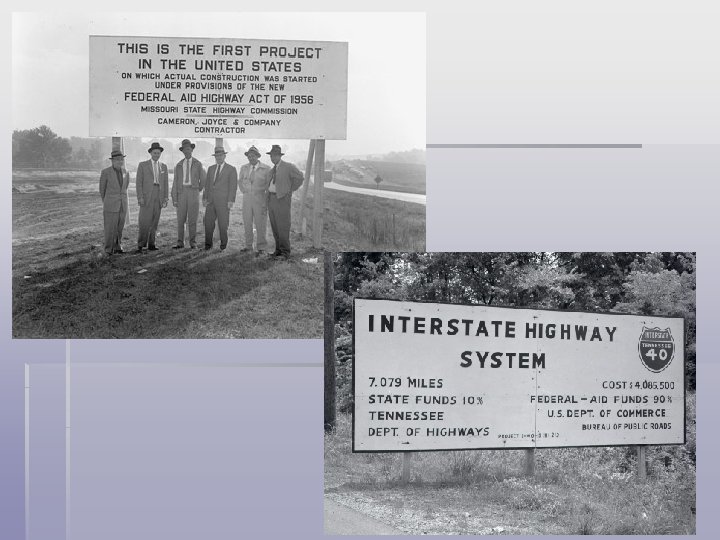
 § Interstate Highway system (1954) created modern interstate freeway system § $27 billion plan built 42, 000 miles of freeways § Federal gov’t paid 90% of cost and states 10% § Underlying purpose: evacuation in case of nuclear war or need to move troops and equipment quickly throughout the country § St. Lawrence Seaway: Massive project of locks opened the Great Lakes as seaports as they were now connected (via the St. Lawrence River) to the Atlantic Ocean § Dept. of Health, Education and Welfare created in 1953 to oversee some of FDR’s New Deal programs
 Civil Rights during the 1950 s § Eisenhower did not intend to be a "civil rights" president § Yet, oversaw some of most significant civil rights gains in U. S. history § 1940 s, NAACP began to attack "separate but equal" by suing segregated colleges & universities; blacks gained entrance into many Southern universities § Elementary and secondary schools remained segregated § Earl Warren appointed by Eisenhower as Chief Justice of Supreme Court in 1953 § Although viewed as a conservative, Warren would become the most significant Chief Justice of the 20 th century
 § Brown v. Board of Education of Topeka, 1954 § NAACP filed suit on behalf of Linda Brown, a black elementary school student § Topeka school board had denied Brown admission to an all -white school § Case reached Supreme Court in 1954 § Thurgood Marshall represented Linda Brown § Charged that public school segregation violated the "equal protection" clause of the 14 th Amendment to the Constitution § Segregation deprived blacks an equal educational opportunity § Separate could not be equal because segregation in itself lowered the morale and motivation of black students § Chief Justice Warren persuaded the Court to overturn Plessy v. Ferguson § "Separate educational facilities are inherently unequal. It has no place in public education. ” § One year later, Court ordered school integration "with all deliberate speed. "
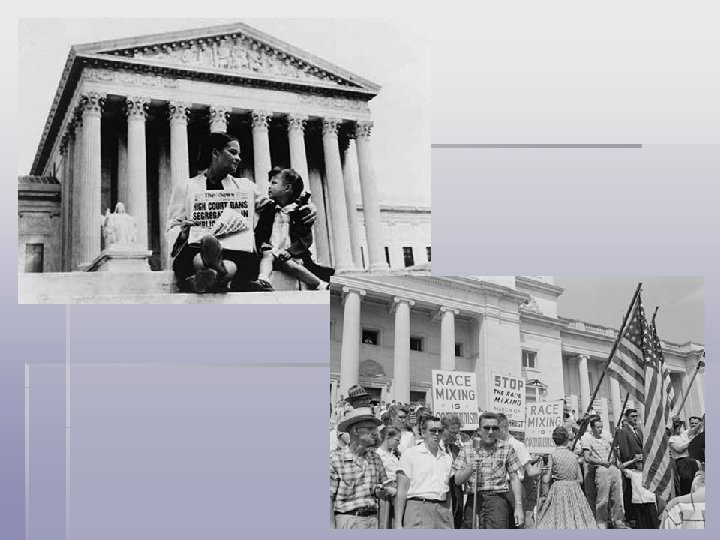
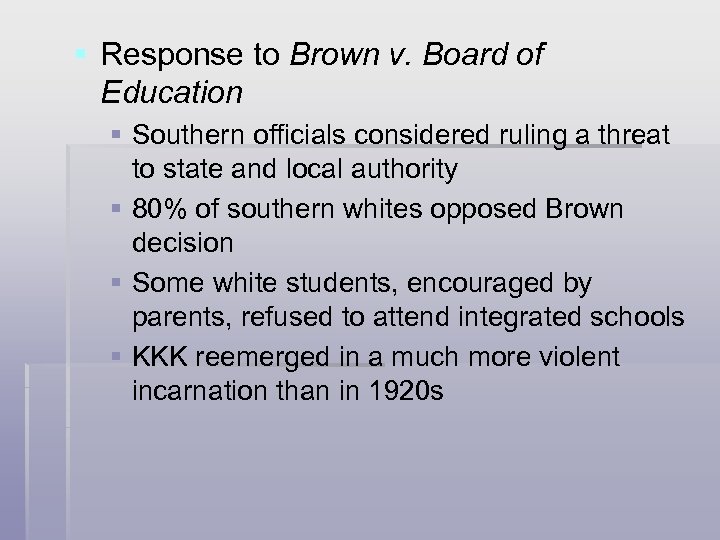 § Response to Brown v. Board of Education § Southern officials considered ruling a threat to state and local authority § 80% of southern whites opposed Brown decision § Some white students, encouraged by parents, refused to attend integrated schools § KKK reemerged in a much more violent incarnation than in 1920 s
 § Southern state legislatures passed more than 450 laws and resolutions aimed at preventing enforcement of Brown decision § "Massive Resistance", 1956: Virginia state legislature passed a massive resistance law cutting off state aid to desegregated schools § By 1962, only one-half of one percent of nonwhite school children in the South were in integrated schools § End of "Massive Resistance“ § 1959, federal and state courts nullified Virginia laws which prevented state funds from going to integrated schools
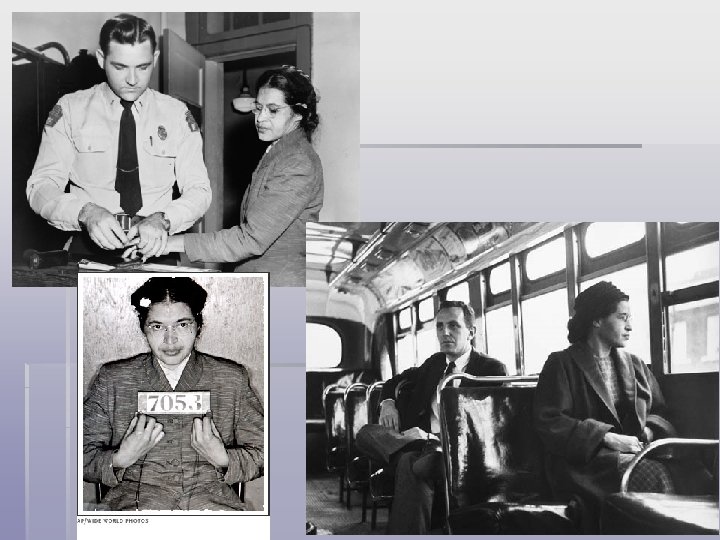
 § Montgomery Bus Boycott (1955 -56) § December 1955, Rosa Parks arrested in Montgomery, Alabama, after refusing to give her bus seat to a white man; she was ordered to sit at the back of the bus § Found guilty and fined $14 § African Americans leaders called for a boycott; nearly 80% of bus users were black § Rev. Martin Luther King, Jr. , leader of Dexter Avenue Baptist Church, became a leader of the boycott; emerged as leader of civil rights movement § Montgomery bus boycott lasted nearly 400 day § 1956, Supreme Court ruled segregation on Montgomery buses was unconstitutional
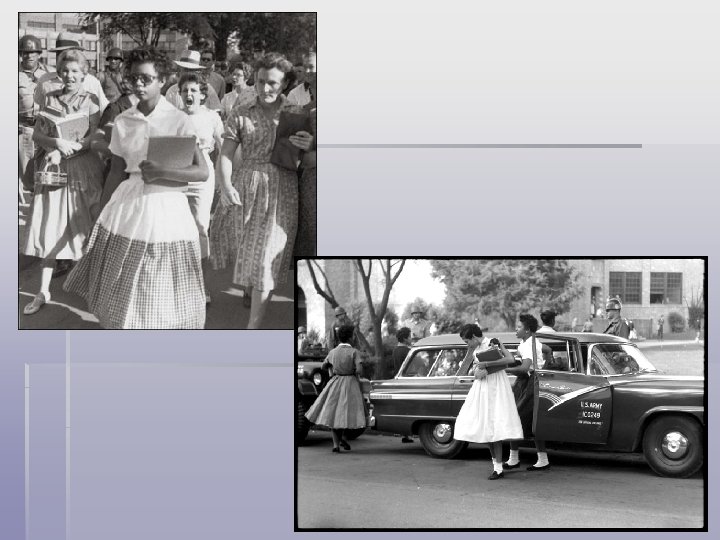
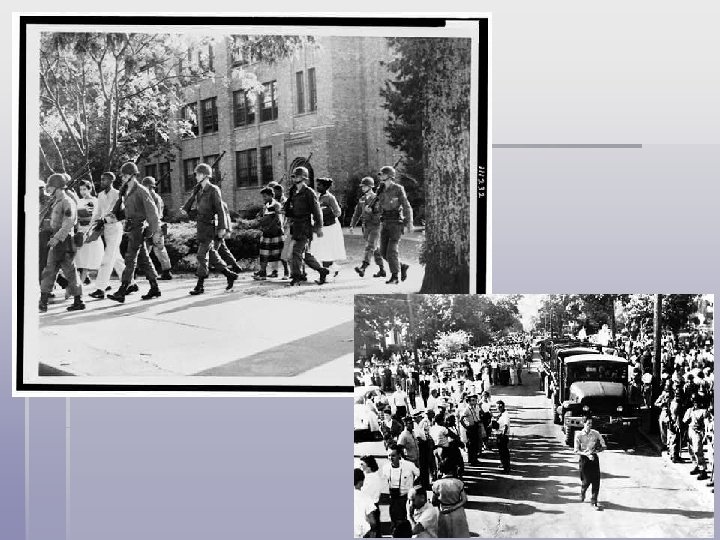
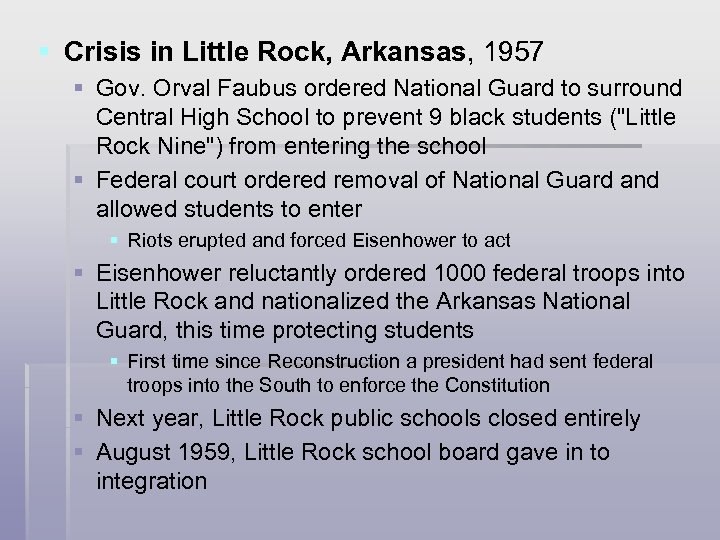 § Crisis in Little Rock, Arkansas, 1957 § Gov. Orval Faubus ordered National Guard to surround Central High School to prevent 9 black students ("Little Rock Nine") from entering the school § Federal court ordered removal of National Guard and allowed students to enter § Riots erupted and forced Eisenhower to act § Eisenhower reluctantly ordered 1000 federal troops into Little Rock and nationalized the Arkansas National Guard, this time protecting students § First time since Reconstruction a president had sent federal troops into the South to enforce the Constitution § Next year, Little Rock public schools closed entirely § August 1959, Little Rock school board gave in to integration
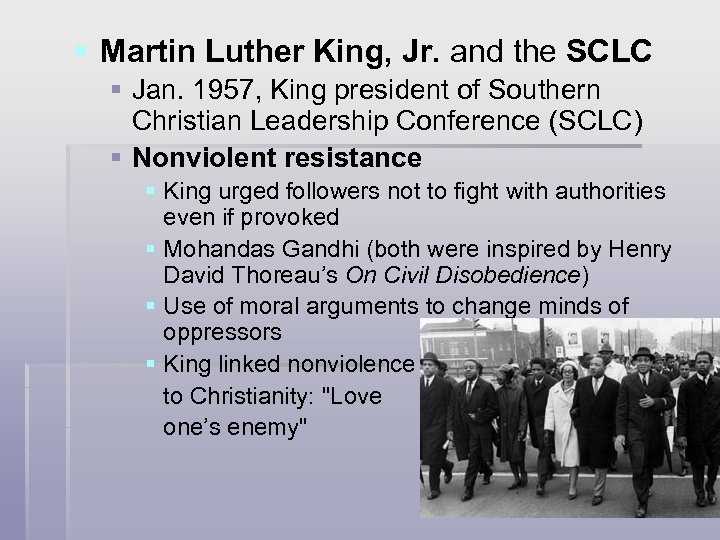 § Martin Luther King, Jr. and the SCLC § Jan. 1957, King president of Southern Christian Leadership Conference (SCLC) § Nonviolent resistance § King urged followers not to fight with authorities even if provoked § Mohandas Gandhi (both were inspired by Henry David Thoreau’s On Civil Disobedience) § Use of moral arguments to change minds of oppressors § King linked nonviolence to Christianity: "Love one’s enemy"
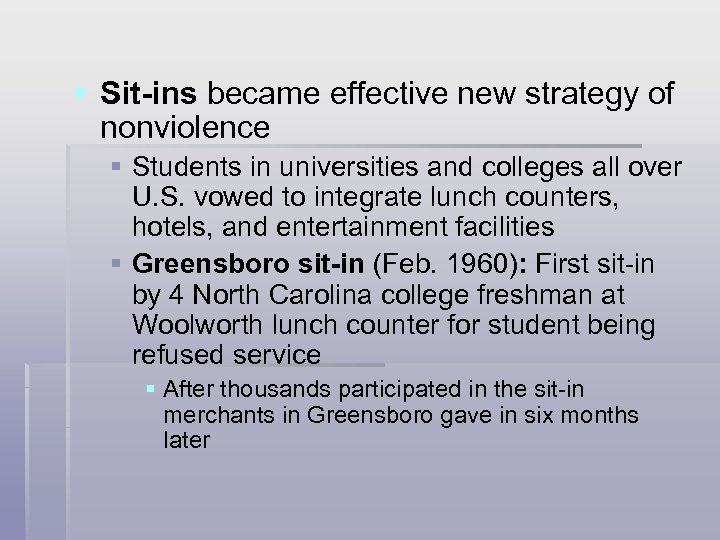 § Sit-ins became effective new strategy of nonviolence § Students in universities and colleges all over U. S. vowed to integrate lunch counters, hotels, and entertainment facilities § Greensboro sit-in (Feb. 1960): First sit-in by 4 North Carolina college freshman at Woolworth lunch counter for student being refused service § After thousands participated in the sit-in merchants in Greensboro gave in six months later
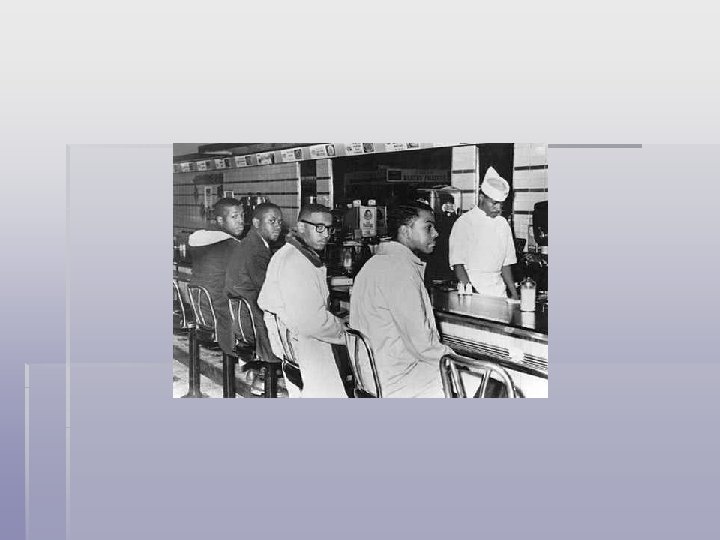
 § Student movement § Nonviolence of students provoked increasingly hostile actions from those who opposed them § Some blacks were beaten, and harassed by white teen-agers § Student Nonviolent Coordinating Committee created by SCLC to better organize the movement. (SNCC pronounced "snick") § "Jail not Bail" became the popular slogan § Students adopted civil disobedience when confronted with jail
 Cold War: 1953 -1961 § Sec. of State John Foster Dulles initiated new policy of massive retaliation § Two major principals: § Encourage liberation of the captive peoples in Eastern Europe by widespread use of political pressure and propaganda § Voice of America and Radio Free Europe urged people to overthrow their communist governments § Massive retaliation § Soviet or Chinese aggression would be countered with nuclear weapons directly on USSR and China § Brinksmanship -- the art of never backing down from a crisis, even if it meant pushing the nation to the brink of war
 § Rejects containment policy as it tolerated Soviet power where it already existed § US foreign policy should destroy communism; communism was "immoral“ § US & USSR begin arms race to accumulate sophisticated nuclear arsenals § Preemptive strike capabilities emphasized: destroy the other side before they can destroy you § Eisenhower was able to appear as a moderate (“good cop”) when compared to Dulles (“bad cop”)
 § Emergence of Mutual Assured Destruction (MAD) § Soviet development of the hydrogen bomb in 1953 meant Dulles’ policy of Massive Retaliation was less practical § Both sides would lose in a thermonuclear war § MAD became an important deterrent for nuclear war during the next four decades
 § "New Look Military” § Eisenhower sought to reduce military budget by scaling back the army and navy while building up an air fleet of superbombers with nuclear weapons § Nuclear force would cost less than huge conventional force – "more bang for the buck. “ § Nuclear force = "overkill"; US unable to respond to minor crises
 § Eisenhower’s "Farewell Address" (1961) : warned Americans of the dangerous growth of the military-industrial-complex § Vast, interwoven military establishment and arms industry § Power was enormous (largely in National Security Council) and had potential to effect democracy itself
 § Warsaw Pact § West Germany welcomed into NATO in 1955 with half million troops § 1955, Soviets sign Warsaw Pact in response new NATO strength in west § Countries include all the E. European satellite countries controlled by Moscow
 § Easing of the Cold War tensions occurred after Stalin’s death in 1953 § Stalin succeeded by Nikita Khrushchev in 1955 § New leadership offered opportunity to reduce tension § Publicly denounced bloody excesses of the Stalin regime § Set out to improve living conditions in USSR § "Peaceful coexistence" with the western democracies § Khrushchev hoped to impress nations in Asia, Africa, and Latin America with superiority of communism as an economic system § To the West: "We will bury you“ § War between USSR & West now seen as unnecessary § U. S. S. R. agreed to leave Austria in May 1955 § Eisenhower moved to relax tensions
 § Geneva Summit -- 1955 (July) § US meets with USSR, Britain, & France to begin discussions on European security and disarmament § No agreements made § USSR resists idea of reunited Germany § Both sides agreed to necessity of nuclear disarmament § US & USSR voluntarily suspend atmospheric testing in October, 1958
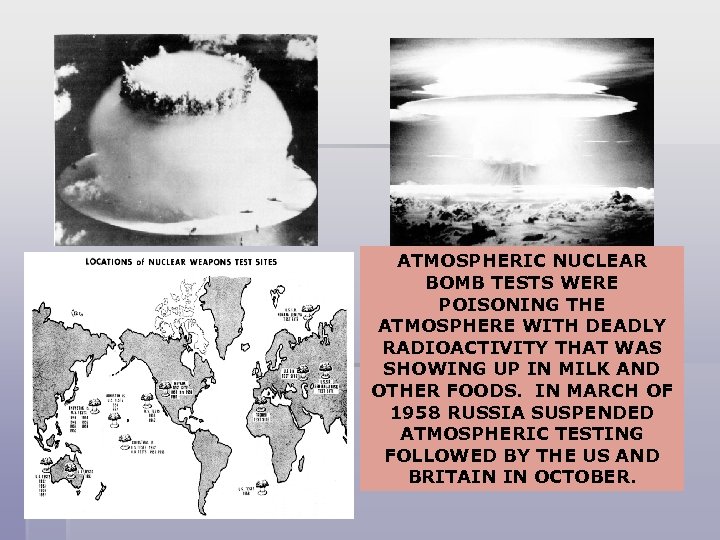 ATMOSPHERIC NUCLEAR BOMB TESTS WERE POISONING THE ATMOSPHERE WITH DEADLY RADIOACTIVITY THAT WAS SHOWING UP IN MILK AND OTHER FOODS. IN MARCH OF 1958 RUSSIA SUSPENDED ATMOSPHERIC TESTING FOLLOWED BY THE US AND BRITAIN IN OCTOBER.
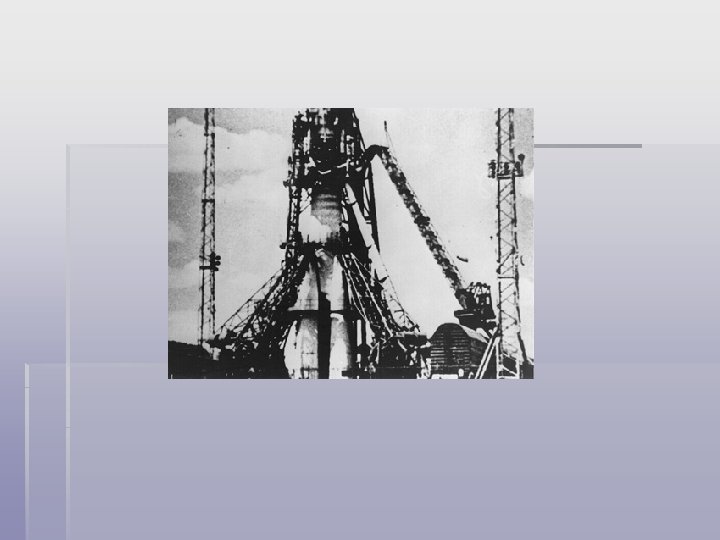
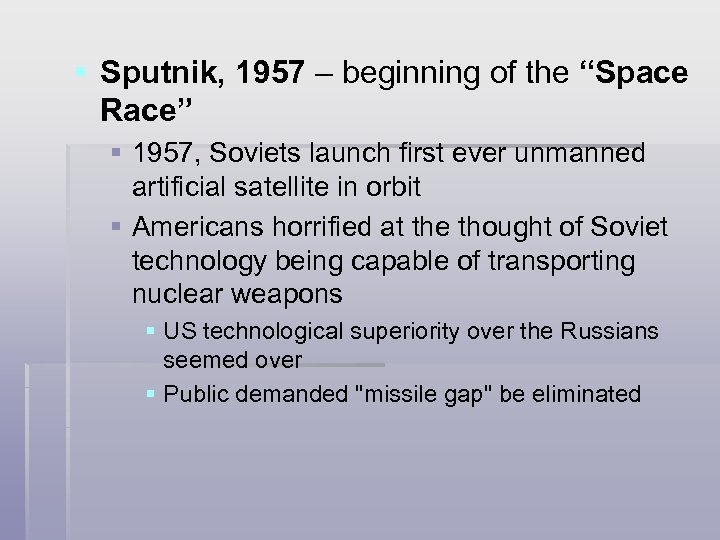 § Sputnik, 1957 – beginning of the “Space Race” § 1957, Soviets launch first ever unmanned artificial satellite in orbit § Americans horrified at the thought of Soviet technology being capable of transporting nuclear weapons § US technological superiority over the Russians seemed over § Public demanded "missile gap" be eliminated
 § National Defense Education Act (NDEA): Eisenhower ordered rigorous education program to match Soviet technology § 1/3 of all university scientists & engineers went into full-time weapons research § Special emphasis on math, science, & foreign languages § 1958, US successfully launched its satellite into orbit, Explorer I § 1958, NASA (National Aeronautics Space Agency) launched by Ike § US conducted massive arms buildup: more B -52’s, nuclear subs, short-range missiles in Europe
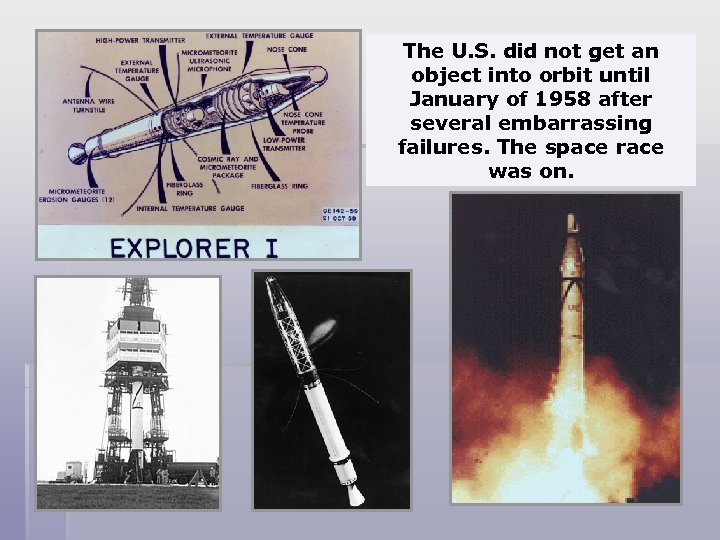 The U. S. did not get an object into orbit until January of 1958 after several embarrassing failures. The space race was on.
 § Khrushchev issues ultimatum on Berlin in November 1958 § Gave Western powers 6 months to vacate West Berlin § Eisenhower and Dulles refused to yield; world held its breath § Vice president Nixon visited USSR in 1959; "Kitchen Debates" with Khrushchev over which economic system was better § Sept. of 1959, Krushchev made a two-week trip to US § Left U. S. shaken at America’s affluence § Ike and Khrushchev agree to hold summit next year § Khrushchev stated Berlin ultimatum extended indefinitely
 § U-2 Incident results in worst U. S. Soviet relations since Stalin § May 1, 1960 -- U-2 spy plane shot down deep in Soviet territory § Incident occurred 10 days before planned Paris Summit § Eisenhower admitted he authorized U-2 flights for national security § Ike suspended further flights but Khrushchev demanded an apology at Paris § Ike refused and Khrushchev angrily called off Paris summit conference
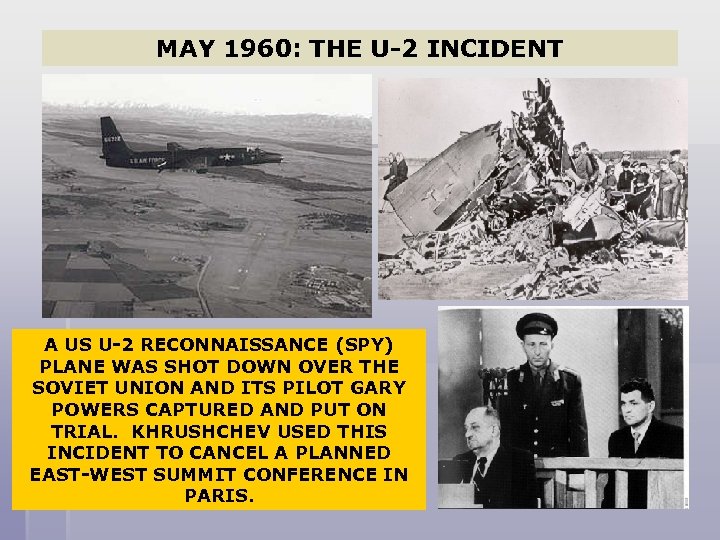 MAY 1960: THE U-2 INCIDENT A US U-2 RECONNAISSANCE (SPY) PLANE WAS SHOT DOWN OVER THE SOVIET UNION AND ITS PILOT GARY POWERS CAPTURED AND PUT ON TRIAL. KHRUSHCHEV USED THIS INCIDENT TO CANCEL A PLANNED EAST-WEST SUMMIT CONFERENCE IN PARIS.
 Cold War in the Middle East § Iran § CIA engineered coup in Iran in 1953 that installed the Shah as dictator § In 1979, the Iranian Revolution overthrew the Shah and exacted revenge against the U. S. by holding 50 Americans hostage for 444 days
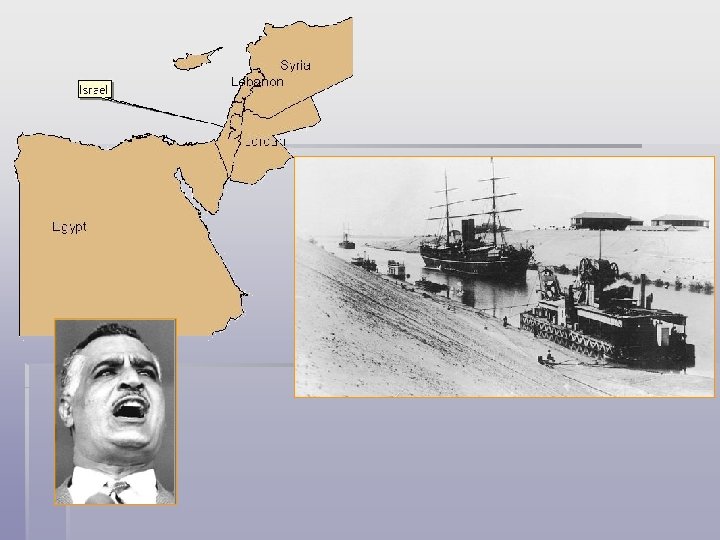
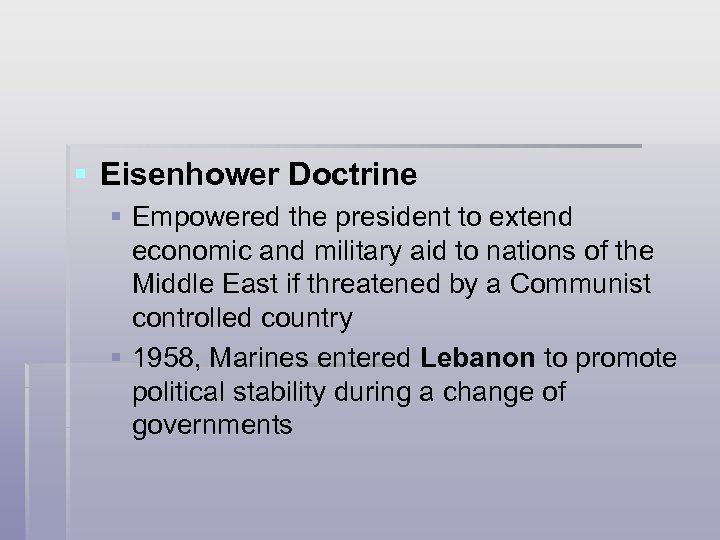
 § Suez Crisis § Egypt: Gamal Abdel Nasser becomes president (Arab nationalist) § Opposed existence of Israel (U. S. had supported Israel’s creation in 1948, at the expense of the Palestinians) § Nasser seized & nationalized the Suez Canal that was owned mostly by British and French stockholders § October 1956, France, Britain & Israel attacked Egypt in an attempt to internationalize the canal § Eisenhower honored the UN charter's nonaggression commitment and reluctantly denounced the attack on Egypt § Siding with the US, the Soviets threatened to send troops to Egypt § Britain, France and Israel withdrew troops and UN force sent to keep order § Nasser gained control of Suez
 § Eisenhower Doctrine § Empowered the president to extend economic and military aid to nations of the Middle East if threatened by a Communist controlled country § 1958, Marines entered Lebanon to promote political stability during a change of governments
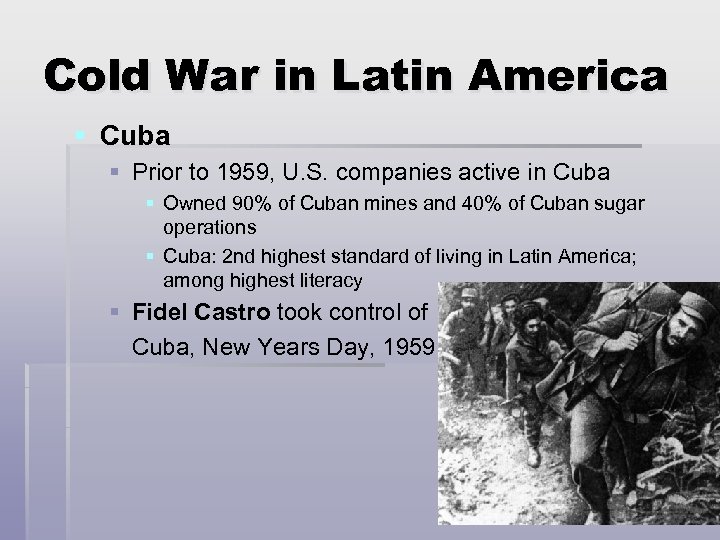 Cold War in Latin America § Cuba § Prior to 1959, U. S. companies active in Cuba § Owned 90% of Cuban mines and 40% of Cuban sugar operations § Cuba: 2 nd highest standard of living in Latin America; among highest literacy § Fidel Castro took control of Cuba, New Years Day, 1959
 § September 1959, Khrushchev decided to aid Cuba § U. S. began plotting against Castro § July 1960, Khrushchev publicly extended Soviet nuclear umbrella to Cuba § Khrushchev stated Monroe Doctrine was dead and he would shower missiles on the U. S. if it attacked Cuba § Sept 1960, CIA opened talks with mafia to arrange a "hit" on Castro § U. S. broke diplomatic relations in January, 1961 § Castro encouraged revolution in other parts of Latin America § Embargo est. in 1962
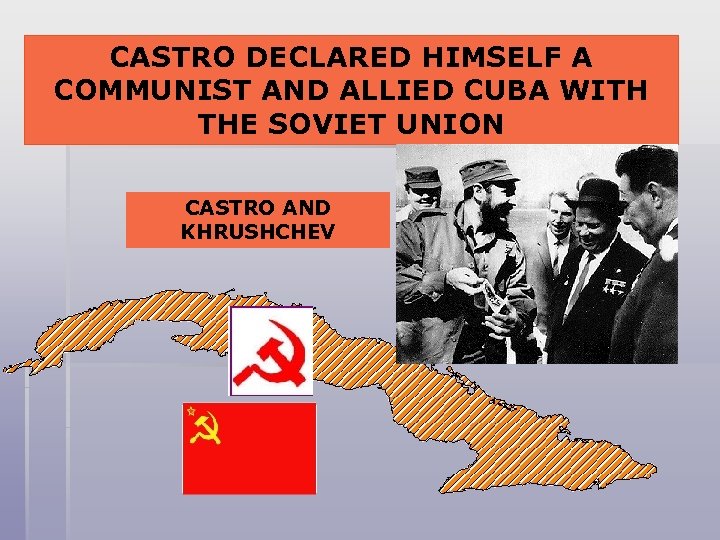 CASTRO DECLARED HIMSELF A COMMUNIST AND ALLIED CUBA WITH THE SOVIET UNION CASTRO AND KHRUSHCHEV