 Скачать презентацию Truman Boyes Professional Services APAC truman juniper net Next
71414ff07c46bf1a38b34ccc9ab6dad2.ppt
- Количество слайдов: 25




Truman Boyes Professional Services APAC truman@juniper. net Next Generation BRAS Access Technologies for Consumer Broadband Copyright © 2005 Juniper Networks, Inc. Proprietary and Confidential www. juniper. net 1
Agenda § Welcome. • Where is Broadband Going? • What Issues are we solving? • What are the methodologies that we are using to solve these issues? • Carriers to enter voice and video market • Digital Media Gateway • Speeds to increase ; needing more capacity… Copyright © 2005 Juniper Networks, Inc. Proprietary and Confidential www. juniper. net 2
Triple Play : VIDEO § The most complex of all services. • The most bandwidth • The most noticeable in terms of quality. § How is it delivered? Set Top Box. MS IPTV probably dominating in this area. BW 1. 51. 8 Mbps for normal TV. 7 -9 Mbps for HD compressed. § HQOS is still extremely important for this service. It’s enabled on the BNG. Copyright © 2005 Juniper Networks, Inc. Proprietary and Confidential www. juniper. net 3
Triple Play: Video (CONT) § Resources are critical when delivering video content. • Multicast is the resources solver. • But where do we want to save bandwidth? – As close to the customer as possible and everywhere back to the source. • IGMP snooping in DSLAM. IGMP multicast replication in DLSAM saves bandwidth between the BNG and DSLAM. • Allow sharing of bandwidth between unicast and multicast traffic for access interface. (This is where HQo. S can help). Copyright © 2005 Juniper Networks, Inc. Proprietary and Confidential www. juniper. net 4
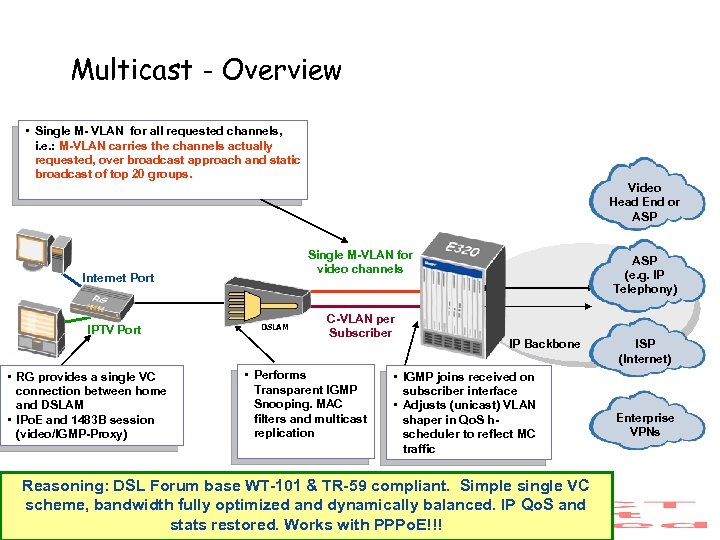
Multicast - Overview • Single M- VLAN for all requested channels, i. e. : M-VLAN carries the channels actually requested, over broadcast approach and static broadcast of top 20 groups. Single M-VLAN for video channels Internet Port IPTV Port • RG provides a single VC connection between home and DSLAM • IPo. E and 1483 B session (video/IGMP-Proxy) Video Head End or ASP DSLAM C-VLAN per Subscriber • Performs Transparent IGMP Snooping. MAC filters and multicast replication ASP (e. g. IP Telephony) IP Backbone • IGMP joins received on subscriber interface • Adjusts (unicast) VLAN shaper in Qo. S hscheduler to reflect MC traffic Reasoning: DSL Forum base WT-101 & TR-59 compliant. Simple single VC scheme, bandwidth fully optimized and dynamically balanced. IP Qo. S and stats restored. Works with PPPo. E!!! Copyright © 2005 Juniper Networks, Inc. Proprietary and Confidential ISP (Internet) Enterprise VPNs www. juniper. net 5
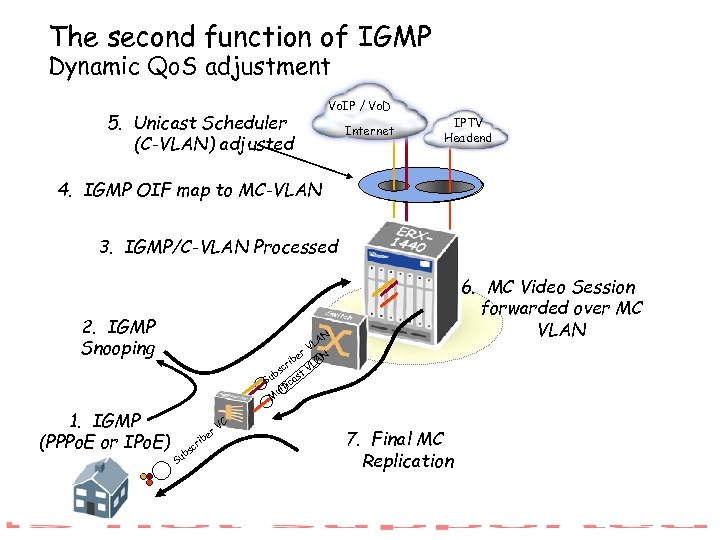
The second function of IGMP Dynamic Qo. S adjustment 5. Unicast Scheduler (C-VLAN) adjusted Vo. IP / Vo. D Internet IPTV Headend 4. IGMP OIF map to MC-VLAN 3. IGMP/C-VLAN Processed 2. IGMP Snooping 1. IGMP (PPPo. E or IPo. E) Copyright © 2005 Juniper Networks, Inc. 6. MC Video Session forwarded over MC VLAN AN VL er N ib LA cr V bs st Su ica ult M bs Su c er rib VC 7. Final MC Replication Proprietary and Confidential www. juniper. net 6
Customer to Service Relationship § If the carrier sells circuits, it may be wise to apply the 1: 1 customer to C-VLAN model. • May “map” port to C-VLAN, so customer has single VC to the RG and single C-VLAN interface on BNG. • Easy to apply Qo. S to single identifier. § N: 1 Model for true distinction between services. • The services run on different logical links. HQOS become an issue. • Provisioning and Troubleshooting multiple l 2 interfaces for a single customer will prove to be a challenge. Copyright © 2005 Juniper Networks, Inc. Proprietary and Confidential www. juniper. net 7
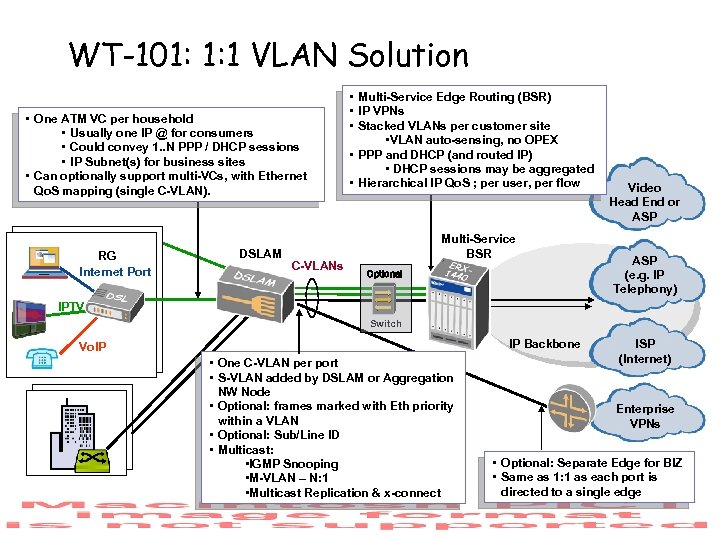
WT-101: 1: 1 VLAN Solution • One ATM VC per household • Usually one IP @ for consumers • Could convey 1. . N PPP / DHCP sessions • IP Subnet(s) for business sites • Can optionally support multi-VCs, with Ethernet Qo. S mapping (single C-VLAN). RG Internet Port DSLAM C-VLANs • Multi-Service Edge Routing (BSR) • IP VPNs • Stacked VLANs per customer site • VLAN auto-sensing, no OPEX • PPP and DHCP (and routed IP) • DHCP sessions may be aggregated • Hierarchical IP Qo. S ; per user, per flow Multi-Service BSR Optional Video Head End or ASP (e. g. IP Telephony) IPTV Switch IP Backbone Vo. IP • One C-VLAN per port • S-VLAN added by DSLAM or Aggregation NW Node • Optional: frames marked with Eth priority within a VLAN • Optional: Sub/Line ID • Multicast: • IGMP Snooping • M-VLAN – N: 1 • Multicast Replication & x-connect Copyright © 2005 Juniper Networks, Inc. ISP (Internet) Enterprise VPNs • Optional: Separate Edge for BIZ • Same as 1: 1 as each port is directed to a single edge Proprietary and Confidential www. juniper. net 8
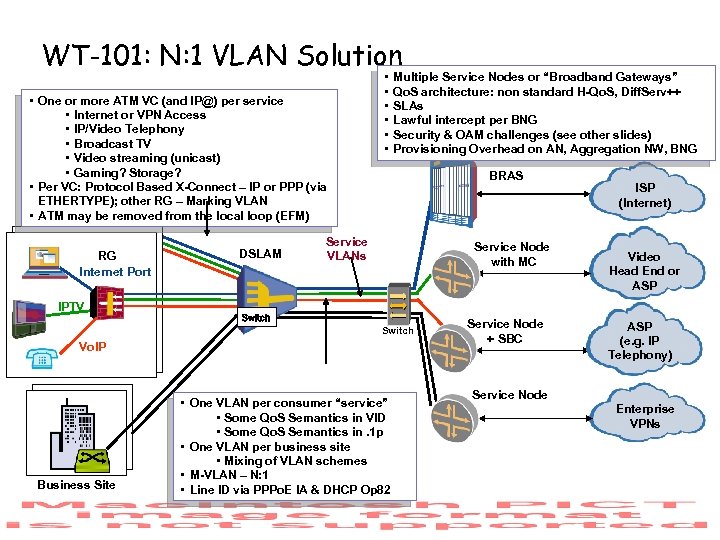
WT-101: N: 1 VLAN Solution • One or more ATM VC (and IP@) per service • Internet or VPN Access • IP/Video Telephony • Broadcast TV • Video streaming (unicast) • Gaming? Storage? • Per VC: Protocol Based X-Connect – IP or PPP (via ETHERTYPE); other RG – Marking VLAN • ATM may be removed from the local loop (EFM) RG Internet Port IPTV DSLAM • • • Multiple Service Nodes or “Broadband Gateways” Qo. S architecture: non standard H-Qo. S, Diff. Serv++ SLAs Lawful intercept per BNG Security & OAM challenges (see other slides) Provisioning Overhead on AN, Aggregation NW, BNG BRAS Service VLANs Service Node with MC Switch Vo. IP Business Site Copyright © 2005 Juniper Networks, Inc. ISP (Internet) • One VLAN per consumer “service” • Some Qo. S Semantics in VID • Some Qo. S Semantics in. 1 p • One VLAN per business site • Mixing of VLAN schemes • M-VLAN – N: 1 • Line ID via PPPo. E IA & DHCP Op 82 Service Node + SBC Video Head End or ASP (e. g. IP Telephony) Service Node Enterprise VPNs Proprietary and Confidential www. juniper. net 9
One BNG to rule them all § Policy enforcement is clear with a single BNG as access point into the SP net. § Multicast / HQOS is easy (at least the “carving” of the bandwidth between services at a single point is easy. § Lawful Intercept in a single location reduces the admin work. § What about L 2 C between BNG and DSLAM to obtain correct sync rates between customer and DSLAM. Copyright © 2005 Juniper Networks, Inc. Proprietary and Confidential www. juniper. net 10
Migrations from existing BRAS/ACCESS § Many SP’s have ATM DSLAMs, ATM networks, that connect to MPLS/IP cores § As we move to Ethernet it makes sense to use protocols that are better suited for Ethernet: PPPo. E. Why does it suite? • Client/Server instead of just point to point. • Protection on ethernet segments • Allows a move away from ATM infrastructure. • BNGs can start to support both PPPo. A and PPPo. E, and of course, PPPo. Eo. A. • Some DSLAMS are implementing PPPo. A to PPPo. E translation. Be warned about MTU issues. PPPo. E max MTU is 1492, many modems do not support MSS clamping, and PMTU discovery is not always going to work. • Draft: draft-arberg-pppoe-mtu-gt 1492 • PPPo. A ---> PPPo. E -----> DHCP when possible. Copyright © 2005 Juniper Networks, Inc. Proprietary and Confidential www. juniper. net 11
If you build it they will need to be trunked § VPLS/ Kompella / PWE 3/ trunking of Ethernet from some regions to a centralized BNG. § Grows a network quicker in some cases. § Make the choice to trunk or deploy BNG based on population densities and what equipment/infrastructure do you have in that region. § BNG’s could also provide trunking of some traffic back to other PE. Copyright © 2005 Juniper Networks, Inc. Proprietary and Confidential www. juniper. net 12
BRAS PE § Past 4 -5 yrs we have been building MPLS networks because they give us: • Fast re-route, link protection, node protection • Signaling of BW • Isolation of routing tables • BW reservations (ie. Reserve and possibly police LSP traffic from BRAS) § Why not enjoy the same benefits in BRAS networks ? • BRAS as dual homed PE direct to P nodes. Remove dependence on existing PE’s (potentially makes these nodes *more* available) Copyright © 2005 Juniper Networks, Inc. Proprietary and Confidential www. juniper. net 13
High Availability on BRAS § PPP State Replication § DHCP state replication § All routing protocol state preserved between routing engines / SRPs / controllers. § Software faults do happen, but can your network handle 30 k subscribers being dropped and reconnecting? § Software patches on the fly. Upgrade specific applications on BNGs, ie. DHCP local server to support new option. Moves away from monolithic operating system maintenance. Copyright © 2005 Juniper Networks, Inc. Proprietary and Confidential www. juniper. net 14
Service Activations / Alterations Now § BW policy changes that are activated by a customer through a portal. • Could be captive portal or user initiated § Service Change • 7 Mbps x. DSL line. Shaped to 1 M. User wants to download an ISO image; can increase service speed to line rate for period of time. • User subscribes to policy that blocks incoming traffic at the SP. • Could allow differentiated billing on volume for specific services. IE. Billable internet data, and all you can eat local content. Free to the provider traffic. Copyright © 2005 Juniper Networks, Inc. Proprietary and Confidential www. juniper. net 15
NGN Broadband in Summary § Broadband is changing • More services , speeds • More importance on the services – Means more Reliability is necessary § Carriers will be digital media gateways. Not the media companies : but the ppl that bring it to you. § Adoption of mechanisms like HQOS and DSLAM multicast replication are key to scaling and guaranteeing the right delivery of service. § Resiliency is extremely important. We are spending time to build these networks. Lets built it once the right way so that it can last at least 5 -6 years. Copyright © 2005 Juniper Networks, Inc. Proprietary and Confidential www. juniper. net 16
Thank You APRICOT 06! Truman@juniper. net Copyright © 2005 Juniper Networks, Inc. Proprietary and Confidential www. juniper. net 17
Broadband Today § ADSL, Cable, Wi. Fi, Metro Ethernet • North America dominating cable markets but growing in DSL deployment. • DSL in Asia / Europe / Americas • Wi. Fi in rural areas for last mile. Also available in highly populated areas for short range use. • 3 G dedicated access to augment this Wi. Fi market. • Ethernet delivery is cheap, and scalable to deploy in populated areas. Connecting multi-unit buildings for residential and business customers. Copyright © 2005 Juniper Networks, Inc. Proprietary and Confidential www. juniper. net 18
WT-101 Background WT-101 was born out of the desire of SP to take advantage of the benefits of Ethernet, which are primarily cost & simplicity and which align with general move to packet based NGN Participants actively involved § SP: BT, Bellsouth, DT, FT, Telecom Italia , Singtel § Vendors: Juniper, Alcatel, Cisco, Ericsson, Redback, Huawei, Fujitsu Network Architecture Philosophy § Simplest Architecture Possible (basic network design) § Simple L 2(-only) Access Node § Edge Architectures: Single Edge, Dual Edge (Video & Other) Multiple Edge – outside of scope, however if req, principles should be extended Business Models § Based on Multi-Service Business Requirements defined in TR-058 § Additional specification in WT-102 New term in WT-101: Copyright © 2005 Juniper Networks, Inc. Broadband Network Gateway (BNG) Defined as a device that implements a subset of BRAS requirements (defined in TR-092) with additional requirements in WT-101 Proprietary and Confidential www. juniper. net 19
WT-101 Overview & Status Access Node § Port (1: 1) / Protocol (N: 1) based x-connect § Restricted 802. 1 d bridging § Multicast: • IGMP: Snooping, Report Suppression/Proxy Reporting • Multicast VLAN: replication and x-connect to Subscriber ports § IWF for PPPo. A § Line ID: PPPo. E IA; DHCP Op 82 § Encapsulation & Line Params Signalling § Bulk Provisioning Ethernet Aggregation Network § Only Ethernet requirements – network architecture is not prescribed § 802. 1 ad (S-Tag) Bridging & with restricted forwarding § Support for 1: 1 & N: 1 VLAN Models § Multicast-VLAN § Simple Priority based Qo. S BNG § 802. 1 ad: • N: 1 & 1: 1 support • Dual-tag push & pop • Auto-sense VLAN (dynamic) & Static VLAN interfaces § Hierarchical Qo. S § Modular Multicast Requirements for several deployment scenarios • Multicast-VLAN • Dynamic H-Qo. S adjustment • PPP or IP for Unicast • Single and Dual BNG deployments § Security: • IP Spoofing Secure ARP & DHCP Snooping • Proxy-ARP CPE (RG) § Support of Legacy CPE for Legacy Services § RG requirements for new applications/services Copyright © 2005 Juniper Networks, Inc. Proprietary and Confidential www. juniper. net 20
WT-101 VLAN Architecture Priority is optional. Usually wiser to not change DSL interface Copyright © 2005 Juniper Networks, Inc. Proprietary and Confidential www. juniper. net 21
Multicast - Key Attributes § 1) Low Zap time (end user experience <1 s, network experience <250 ms) § 2) Minimize replication of multicast streams on the core network § 3) No duplication of multicast streams on the access network, • DSL line = low BW, end RG/STB can’t deal with duplicate packets § 4) Redundancy § 5) Ability to migrate to DSLAM IGMP-proxy or RG-Forking at a later stage § 6) Dynamic Qo. S adjustment on IGMP report § 7) Scale to multiple E 320’s connected to M-VLAN (~67 K subs for each E 320) § 8) DSL Forum - WT-101 compliant Copyright © 2005 Juniper Networks, Inc. Proprietary and Confidential www. juniper. net 22
Multicast Solutions – “Like Skinning a Cat!” § 1 a: IGMP to M-Series & IGMP-Proxy on E 320 § 1 b: PIM on M-Series & E 320 § 2 a: Multicast VR with IGMP-Proxy § 2 b: Multicast VR with PIM-SSM § 2 c: Only Internet VR with PIM-SSM Copyright © 2005 Juniper Networks, Inc. Proprietary and Confidential www. juniper. net 23
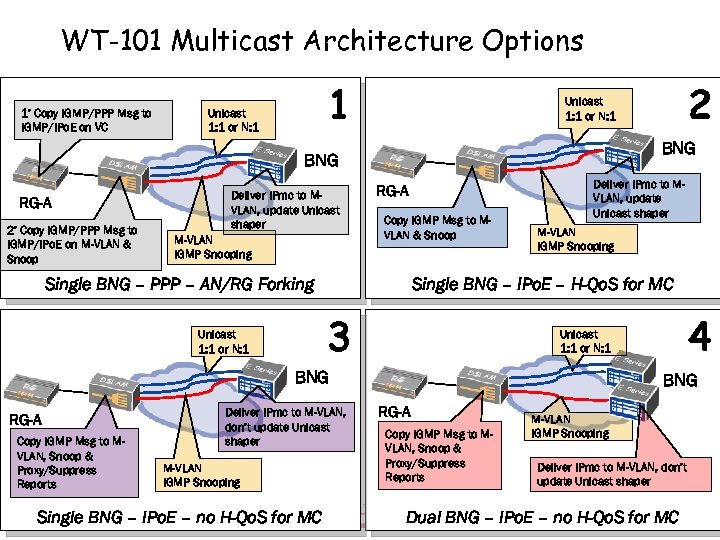
WT-101 Multicast Architecture Options 1’ Copy IGMP/PPP Msg to IGMP/IPo. E on VC 1 Unicast 1: 1 or N: 1 BNG RG-A 2’ Copy IGMP/PPP Msg to IGMP/IPo. E on M-VLAN & Snoop Deliver IPmc to MVLAN, update Unicast shaper M-VLAN IGMP Snooping RG-A Copy IGMP Msg to MVLAN & Snoop Single BNG – PPP – AN/RG Forking Deliver IPmc to MVLAN, update Unicast shaper M-VLAN IGMP Snooping Single BNG – IPo. E – H-Qo. S for MC 3 Unicast 1: 1 or N: 1 Copy IGMP Msg to MVLAN, Snoop & Proxy/Suppress Reports Deliver IPmc to M-VLAN, don’t update Unicast shaper M-VLAN IGMP Snooping Single BNG – IPo. E – no H-Qo. S for MC Copyright © 2005 Juniper Networks, Inc. 4 Unicast 1: 1 or N: 1 BNG RG-A 2 Unicast 1: 1 or N: 1 BNG RG-A Copy IGMP Msg to MVLAN, Snoop & Proxy/Suppress Reports M-VLAN IGMP Snooping Deliver IPmc to M-VLAN, don’t update Unicast shaper Dual BNG – IPo. E – no H-Qo. S for MC Proprietary and Confidential www. juniper. net 24
Reasons to go for C-VLAN § Faulting / Tracking -> Ethernet OAM immature (Eth-to-ATM OAM even worse) -> C-VLAN allows for ARP broadcast to check end-to-end connectivity § MAC spoofing -> checks/’hacks’ in DSLAMs and switches not considered as secure enough § Multi-session PPPo. E -> easier to control § Protocol translation -> MAC@ translation complicates DHCP setups (MAC@ is in DHCP payload as well). L 2 DSLAMs require too much complexity § Multicast -> need per-subscriber IGMP knowledge for Qo. S adjustments § End user id for legal interception -> easier to adapt existing system for ATM to ethernet Copyright © 2005 Juniper Networks, Inc. Proprietary and Confidential www. juniper. net 25
Скачать презентацию Truman Boyes Professional Services APAC truman juniper net Next
71414ff07c46bf1a38b34ccc9ab6dad2.ppt