


 Скачать презентацию True or False Atoms of elements are electrically
Radioisotopes.pptx
- Количество слайдов: 11
 True or False Atoms of elements are electrically neutral. The mass of an electron is equal to the mass of a neutron. The number of neutrons in the nucleus can be calculated by subtracting the atomic number from the mass number. Every atom of nitrogen has 7 protons and 7 neutrons. The charge of all protons is the same. The atomic number of an element is the sum of the protons and electrons in the atom. Radiation decreases with the distance between you and the source.
 Check your answers Atoms of elements are electrically neutral. True The mass of an electron is equal to the mass of a neutron. False The number of neutrons in the nucleus can be calculated by subtracting the atomic number from the mass number. True Every atom of nitrogen has 7 protons and 7 neutrons. False The charge of all protons is the same. True The atomic number of an element is the sum of the protons and electrons in the atom. False Radiation decreases with the distance between you and the source. True
 Topic of the lesson The phenomenon of radioactivity. Radioisotopes. The nuclear reaction.
 Learning objectives: - understand why isotopes occur and the nature of radioactivity - ability to write simple equation of nuclear reaction - the ability to predict the impact of radioactive decay on the number of protons, neutrons, and nucleons in the nucleus
 Frontal questions: - What is radiation? - How can you prove that element is radioactive? - How to determine whether a nucleus is stable or not?
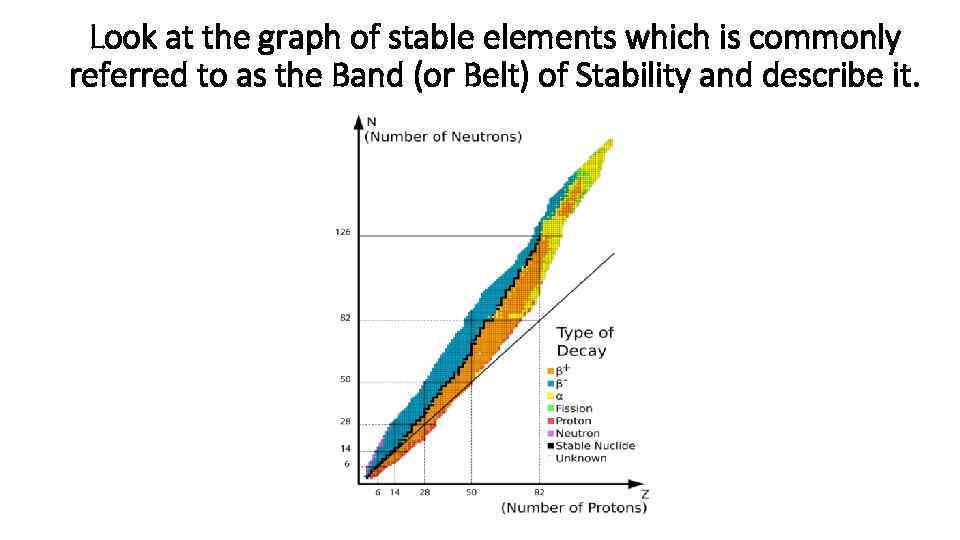 Look at the graph of stable elements which is commonly referred to as the Band (or Belt) of Stability and describe it.
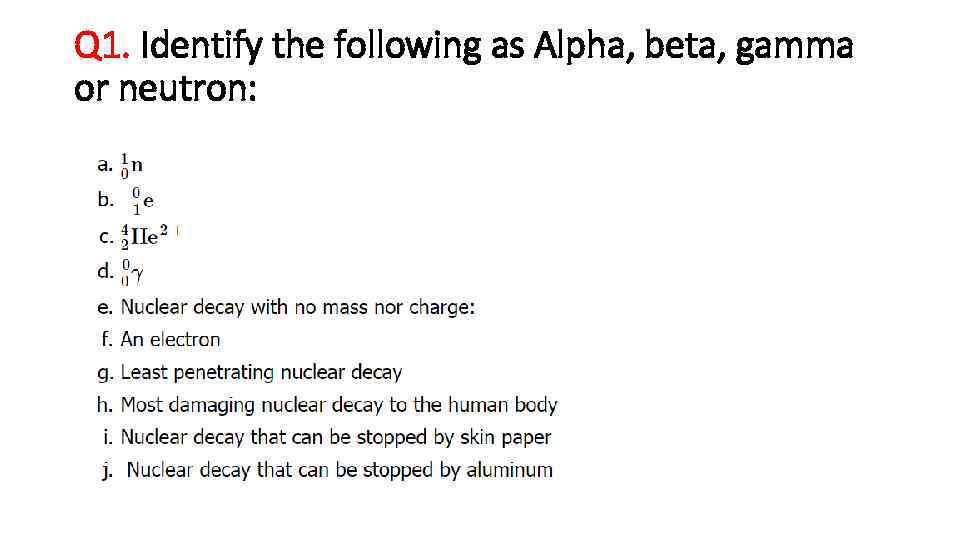 Q 1. Identify the following as Alpha, beta, gamma or neutron:
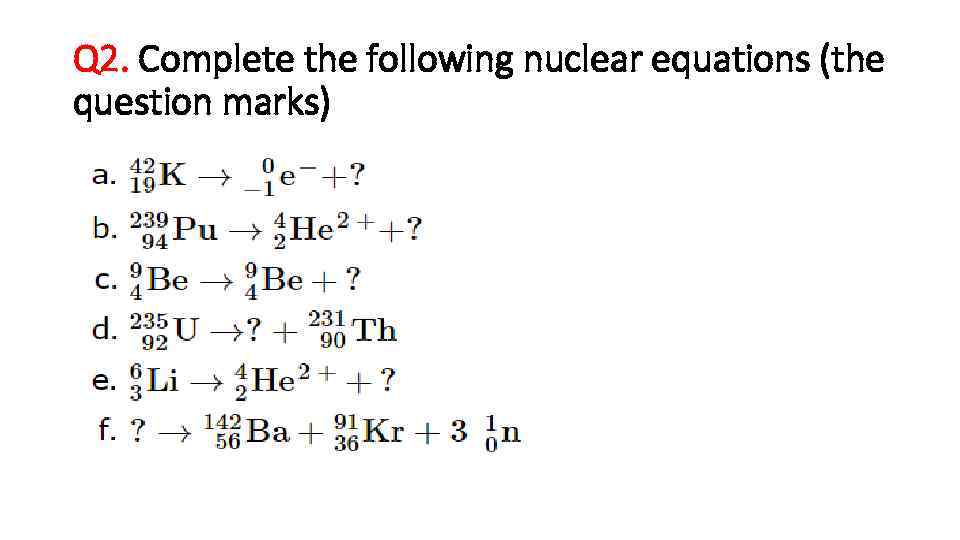 Q 2. Complete the following nuclear equations (the question marks)
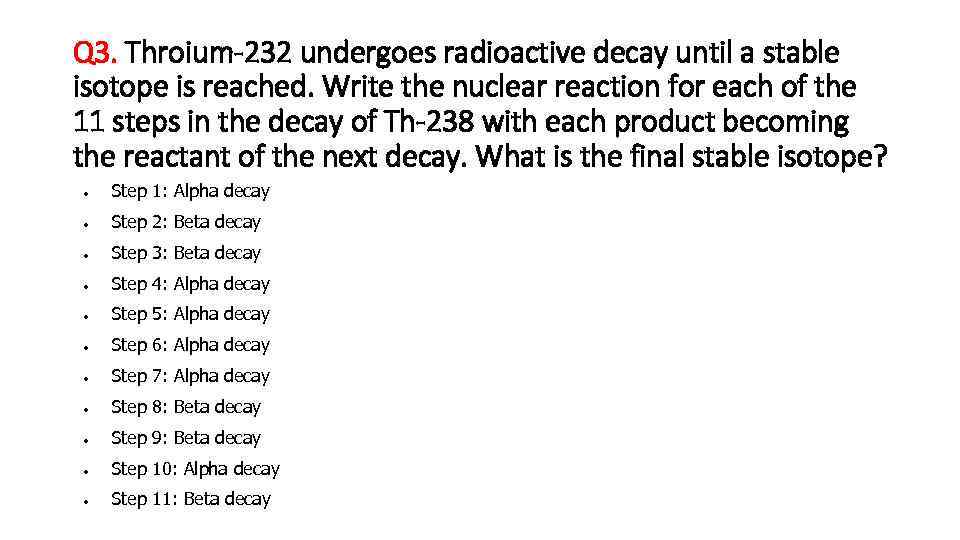 Q 3. Throium-232 undergoes radioactive decay until a stable isotope is reached. Write the nuclear reaction for each of the 11 steps in the decay of Th-238 with each product becoming the reactant of the next decay. What is the final stable isotope? Step 1: Alpha decay Step 2: Beta decay Step 3: Beta decay Step 4: Alpha decay Step 5: Alpha decay Step 6: Alpha decay Step 7: Alpha decay Step 8: Beta decay Step 9: Beta decay Step 10: Alpha decay Step 11: Beta decay
 Summing up the lesson
 Summing up the lesson