 Скачать презентацию TRPNO STANJE GLAGOLA Pasiv trpni oblici
ad3d7d602322802f7e8488891f093b2e.ppt
- Количество слайдов: 21



TRPNO STANJE GLAGOLA
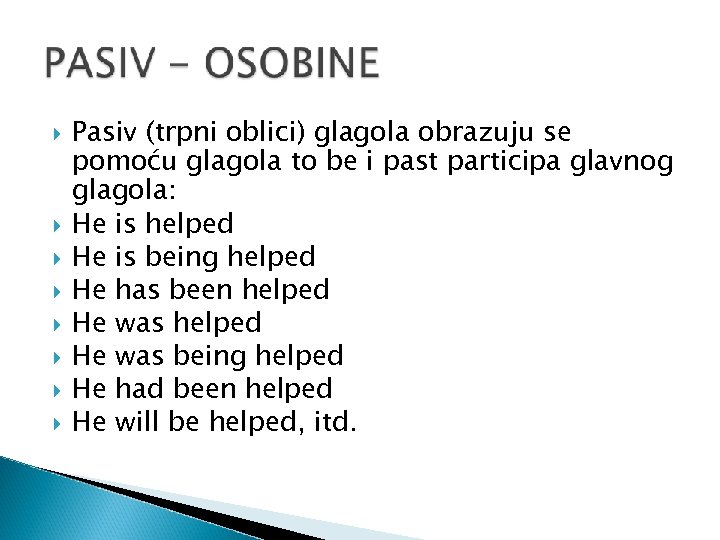
Pasiv (trpni oblici) glagola obrazuju se pomoću glagola to be i past participa glavnog glagola: He is helped He is being helped He has been helped He was being helped He had been helped He will be helped, itd.
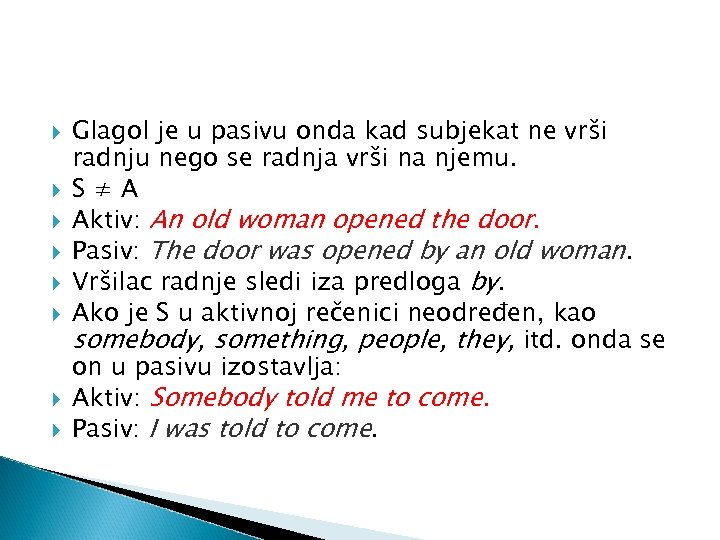
Glagol je u pasivu onda kad subjekat ne vrši radnju nego se radnja vrši na njemu. S≠A Aktiv: An old woman opened the door. Pasiv: The door was opened by an old woman. Vršilac radnje sledi iza predloga by. Ako je S u aktivnoj rečenici neodređen, kao somebody, something, people, they, itd. onda se on u pasivu izostavlja: Aktiv: Somebody told me to come. Pasiv: I was told to come.
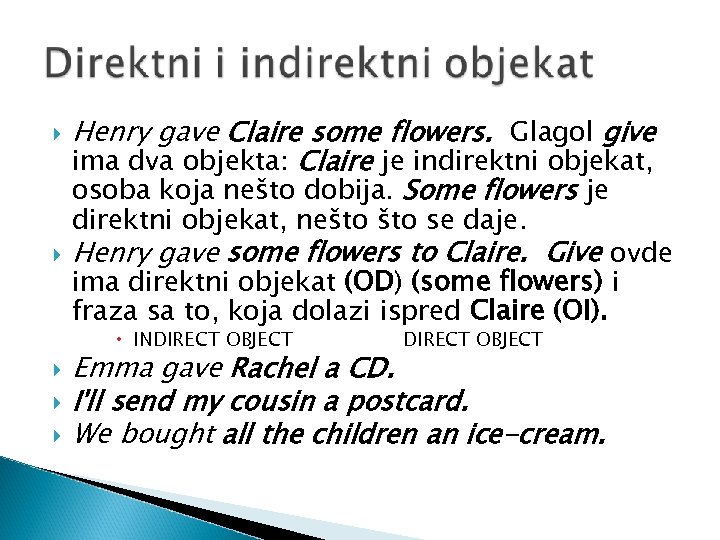
Henry gave Claire some flowers. Glagol give ima dva objekta: Claire je indirektni objekat, osoba koja nešto dobija. Some flowers je direktni objekat, nešto se daje. Henry gave some flowers to Claire. Give ovde ima direktni objekat (OD) (some flowers) i fraza sa to, koja dolazi ispred Claire (OI). INDIRECT OBJECT DIRECT OBJECT Emma gave Rachel a CD. I'll send my cousin a postcard. We bought all the children an ice-cream.
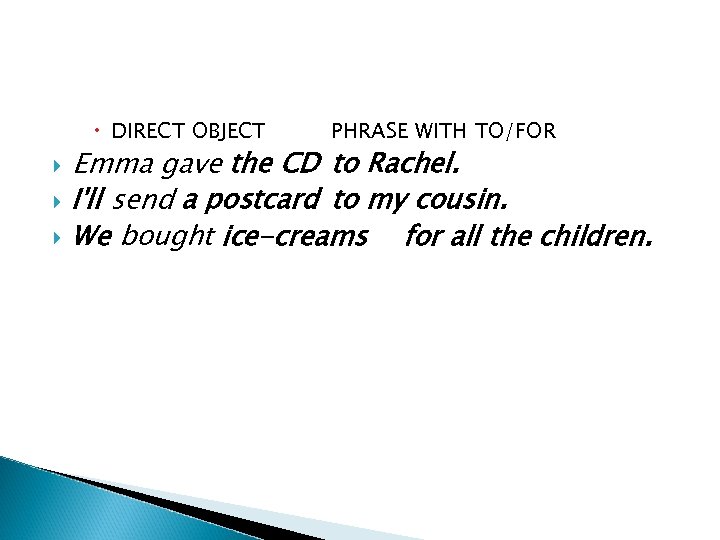
DIRECT OBJECT PHRASE WITH TO/FOR Emma gave the CD to Rachel. I'll send a postcard to my cousin. We bought ice-creams for all the children.
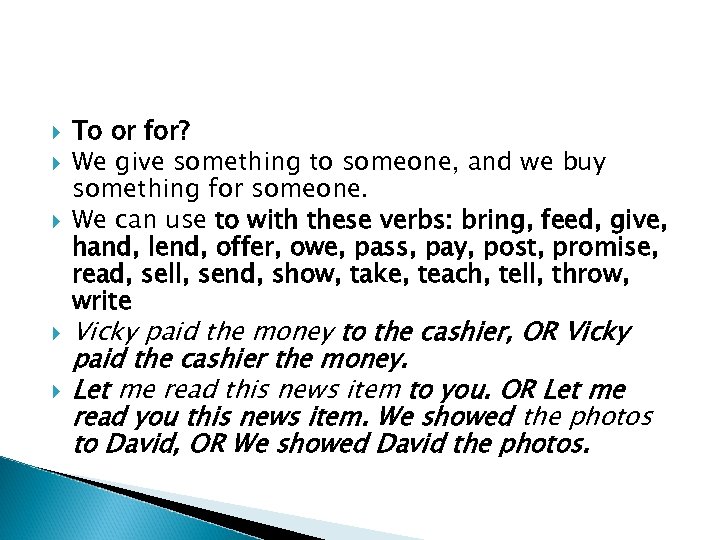
To or for? We give something to someone, and we buy something for someone. We can use to with these verbs: bring, feed, give, hand, lend, offer, owe, pass, pay, post, promise, read, sell, send, show, take, teach, tell, throw, write Vicky paid the money to the cashier, OR Vicky paid the cashier the money. Let me read this news item to you. OR Let me read you this news item. We showed the photos to David, OR We showed David the photos.
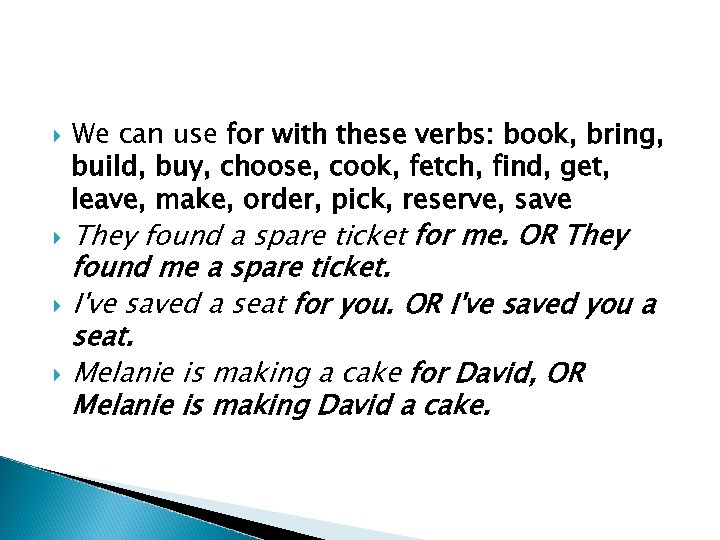
We can use for with these verbs: book, bring, build, buy, choose, cook, fetch, find, get, leave, make, order, pick, reserve, save They found a spare ticket for me. OR They found me a spare ticket. I've saved a seat for you. OR I've saved you a seat. Melanie is making a cake for David, OR Melanie is making David a cake.
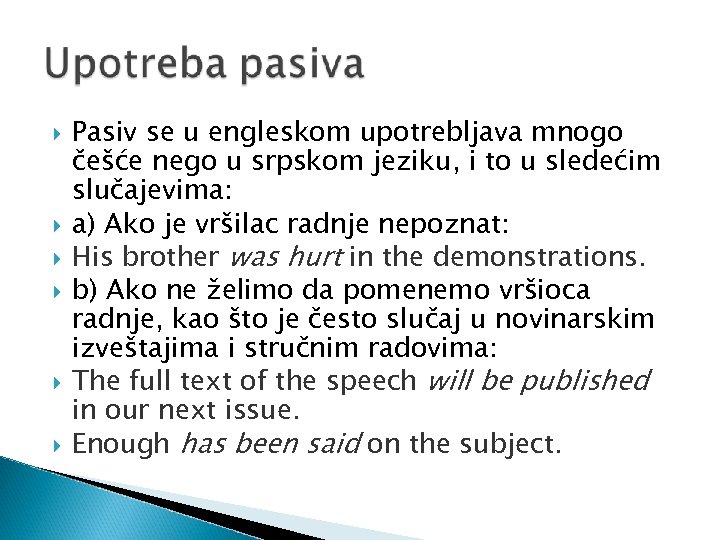
Pasiv se u engleskom upotrebljava mnogo češće nego u srpskom jeziku, i to u sledećim slučajevima: a) Ako je vršilac radnje nepoznat: His brother was hurt in the demonstrations. b) Ako ne želimo da pomenemo vršioca radnje, kao što je često slučaj u novinarskim izveštajima i stručnim radovima: The full text of the speech will be published in our next issue. Enough has been said on the subject.
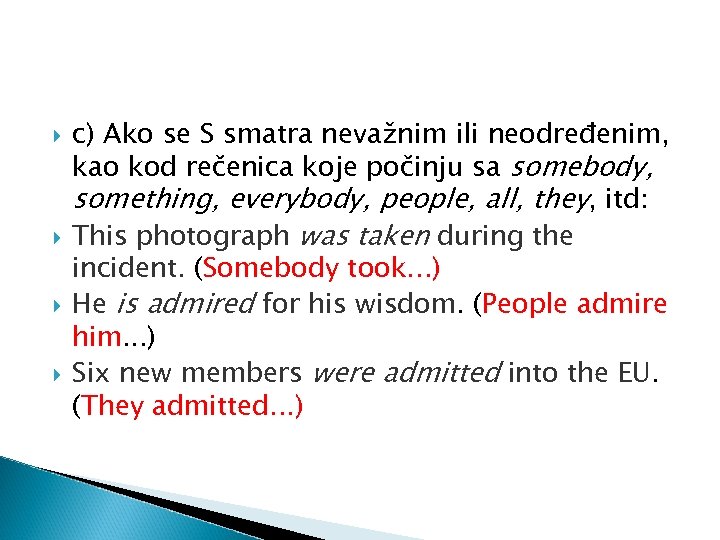
c) Ako se S smatra nevažnim ili neodređenim, kao kod rečenica koje počinju sa somebody, something, everybody, people, all, they, itd: This photograph was taken during the incident. (Somebody took. . . ) He is admired for his wisdom. (People admire him. . . ) Six new members were admitted into the EU. (They admitted. . . )
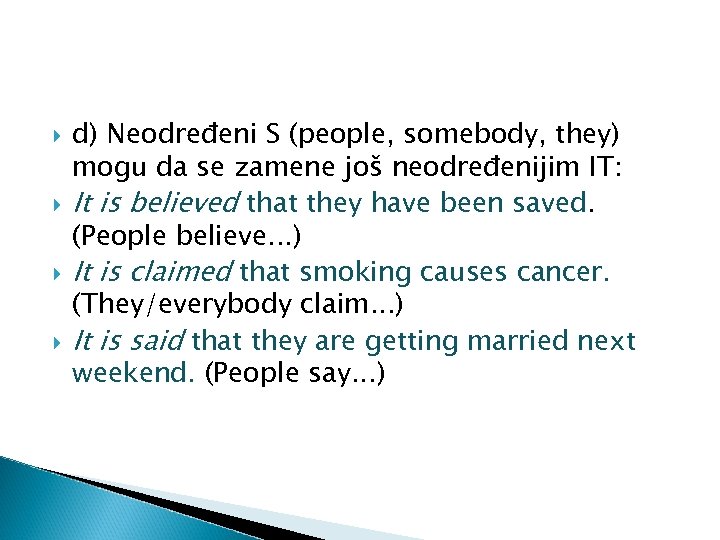
d) Neodređeni S (people, somebody, they) mogu da se zamene još neodređenijim IT: It is believed that they have been saved. (People believe. . . ) It is claimed that smoking causes cancer. (They/everybody claim. . . ) It is said that they are getting married next weekend. (People say. . . )
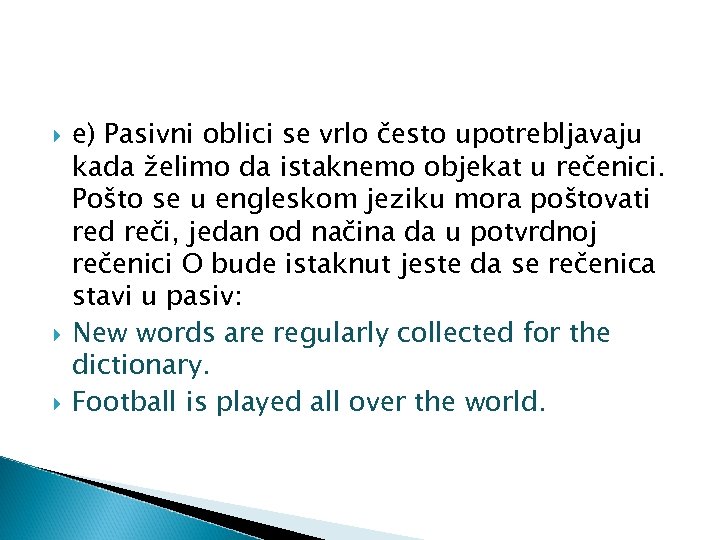
e) Pasivni oblici se vrlo često upotrebljavaju kada želimo da istaknemo objekat u rečenici. Pošto se u engleskom jeziku mora poštovati red reči, jedan od načina da u potvrdnoj rečenici O bude istaknut jeste da se rečenica stavi u pasiv: New words are regularly collected for the dictionary. Football is played all over the world.
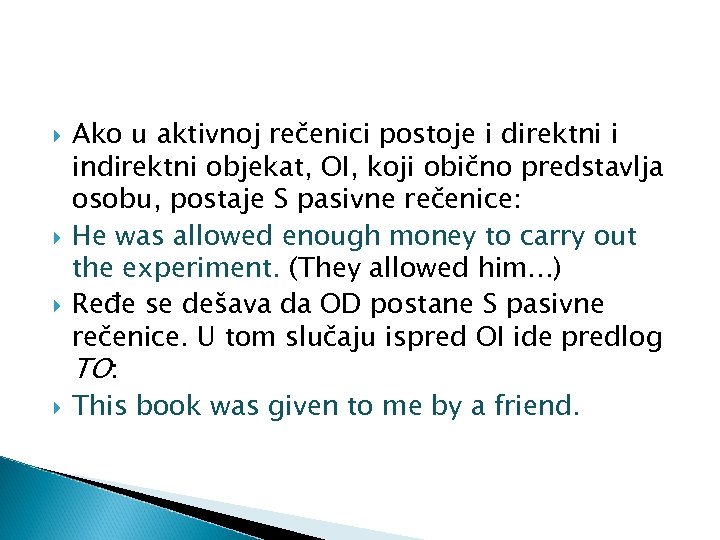
Ako u aktivnoj rečenici postoje i direktni i indirektni objekat, OI, koji obično predstavlja osobu, postaje S pasivne rečenice: He was allowed enough money to carry out the experiment. (They allowed him. . . ) Ređe se dešava da OD postane S pasivne rečenice. U tom slučaju ispred OI ide predlog TO: This book was given to me by a friend.
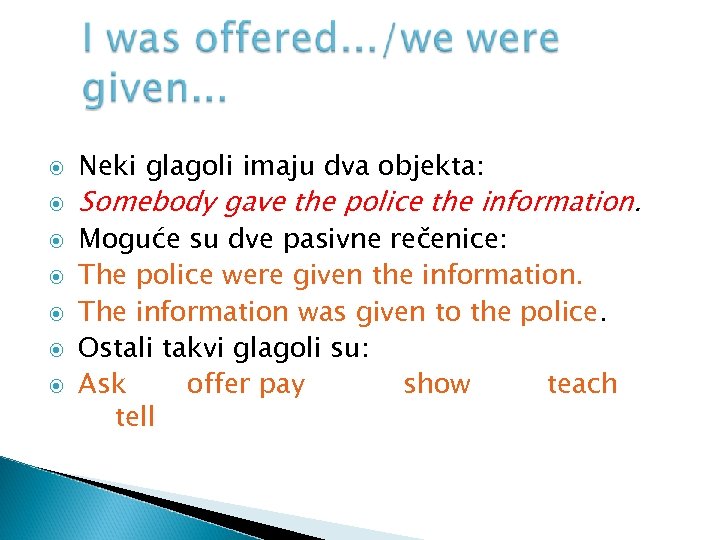
Neki glagoli imaju dva objekta: Somebody gave the police the information. Moguće su dve pasivne rečenice: The police were given the information. The information was given to the police. Ostali takvi glagoli su: Ask offer pay show teach tell
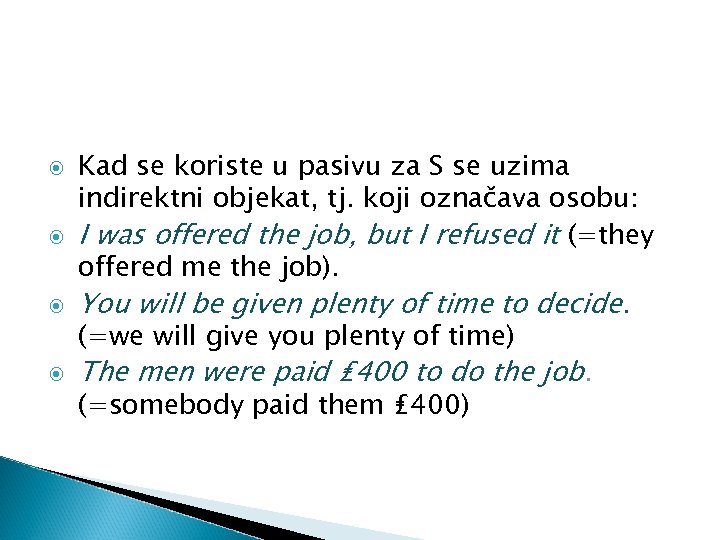
Kad se koriste u pasivu za S se uzima indirektni objekat, tj. koji označava osobu: I was offered the job, but I refused it (=they offered me the job). You will be given plenty of time to decide. (=we will give you plenty of time) The men were paid ₤ 400 to do the job. (=somebody paid them ₤ 400)
Past simple passive se uvek koristi za I was born. . . He was born in Belgrade = Rođen je u Beogradu. (NE He is born) Where were you born?
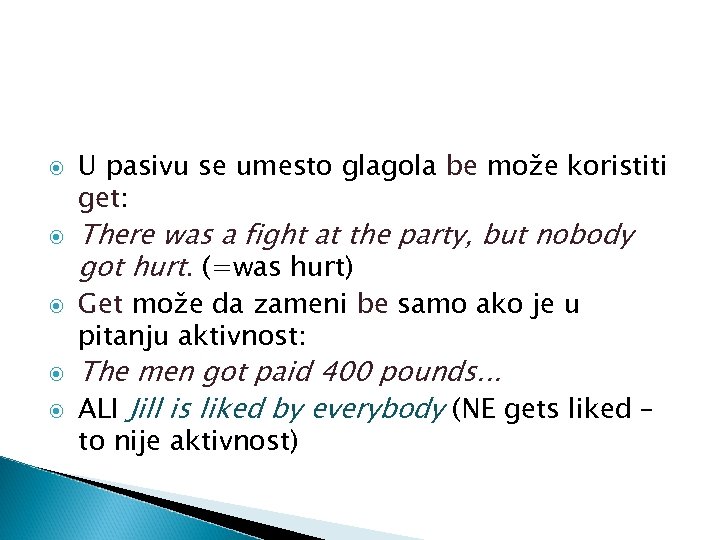
U pasivu se umesto glagola be može koristiti get: There was a fight at the party, but nobody got hurt. (=was hurt) Get može da zameni be samo ako je u pitanju aktivnost: The men got paid 400 pounds. . . ALI Jill is liked by everybody (NE gets liked – to nije aktivnost)
Glagoli koji su u srpskom jeziku povratni, u engleskom se upotrebljavaju kao pasivni: He is called George. (On se zove. . . ) They were all drowned. (Svi su se podavili. ) We were lost in the woods. (Izgubili smo se u šumi. ) Houses were made of wood at the time. (Kuće su se tada pravile od drveta. )
Choose the correct verb forms in this news report about a storm. Millions of pounds' worth of damage (►has caused/has been caused by a storm which ( 1 ) swept/was swept across the north of England last night. The River Ribble ( 2 ) burst/was burst i t s banks after heavy rain. Many people (3) rescued/were rescued from the floods by firefighters, who (4) received/were received hundreds of calls for help. Wind speeds (5) reached/were reached ninety miles an hour in some places. Roads (6) blocked/were blocked by fallen trees, and electricity lines (7) brought/were brought down, leaving thousands of homes without electricity.
Rewrite these sentences beginning with the underlined words. ► Thieves robbed a woman. A woman was robbed. 1 They may ban the film. 2 They offered Nancy a pay increase. 3 We need to correct the mistakes. 4 Someone reported that the situation was under control. 5 They are testing the new drug. 6 We haven't used the machine for ages.
Ova struktura se koristi da iskaže da je govornik organizovao da se nešto uradi, tj. neko drugi je nešto uradio za njega. Lisa painted her house. (ona je okrečila) Lisa had her house painted. (moler je okrečio) Red reči: S + have+ object+past participle Srodno je pasivu jer S nije A
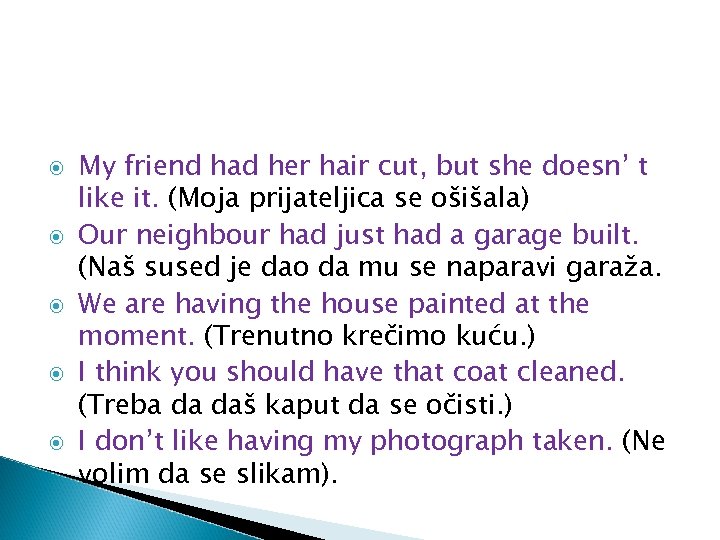
My friend had her hair cut, but she doesn’ t like it. (Moja prijateljica se ošišala) Our neighbour had just had a garage built. (Naš sused je dao da mu se naparavi garaža. We are having the house painted at the moment. (Trenutno krečimo kuću. ) I think you should have that coat cleaned. (Treba da daš kaput da se očisti. ) I don’t like having my photograph taken. (Ne volim da se slikam).
Скачать презентацию TRPNO STANJE GLAGOLA Pasiv trpni oblici
ad3d7d602322802f7e8488891f093b2e.ppt