 Скачать презентацию Tropical cyclone products and product development at CIRA RAMMB
333a92d2907abee09a186c88ca634485.ppt
- Количество слайдов: 26



Tropical cyclone products and product development at CIRA/RAMMB Presented by Cliff Matsumoto CIRA/CSU with contributions from Andrea Schumacher (CIRA) , John Knaff (NESDIS) and Mark De. Maria (NESDIS)
Outline • Tropical Cyclone Genesis Product • Multi-platform Tropical Cyclone – Surface Wind Analysis • Monte Carlo Tropical Cyclone Wind Probability Product • Intensity Forecasting Using the Logistic Growth Equation TCC 2009 2
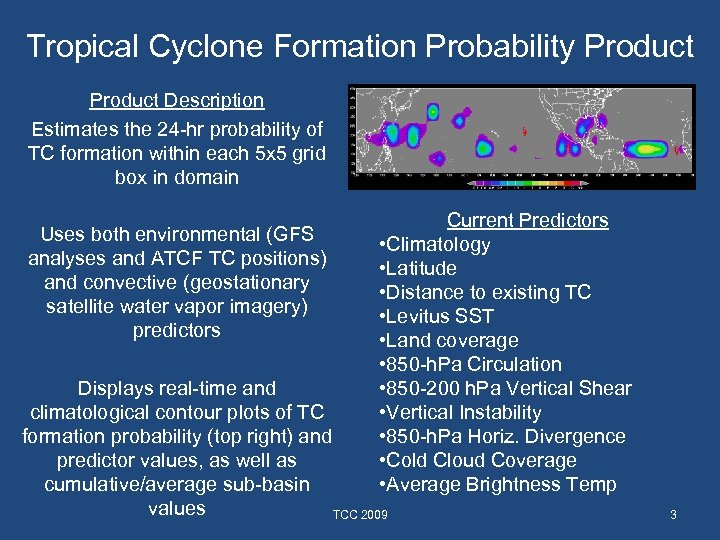
Tropical Cyclone Formation Probability Product Description Estimates the 24 -hr probability of TC formation within each 5 x 5 grid box in domain Uses both environmental (GFS analyses and ATCF TC positions) and convective (geostationary satellite water vapor imagery) predictors Current Predictors • Climatology • Latitude • Distance to existing TC • Levitus SST • Land coverage • 850 -h. Pa Circulation • 850 -200 h. Pa Vertical Shear • Vertical Instability • 850 -h. Pa Horiz. Divergence • Cold Cloud Coverage • Average Brightness Temp Displays real-time and climatological contour plots of TC formation probability (top right) and predictor values, as well as cumulative/average sub-basin values TCC 2009 3
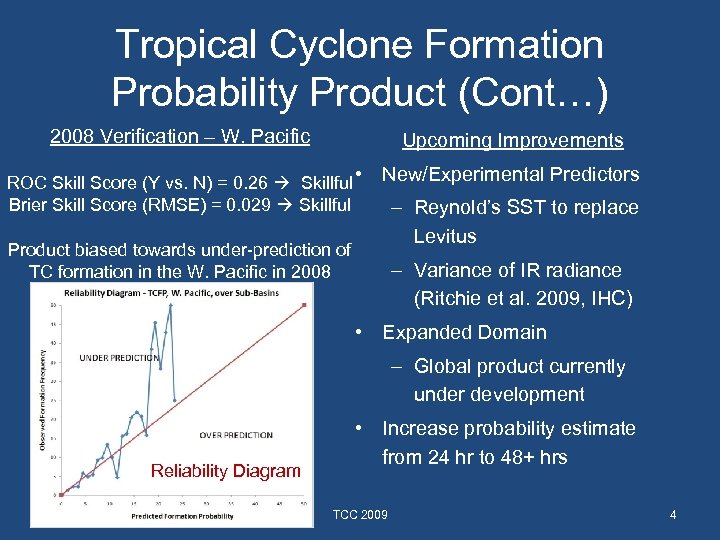
Tropical Cyclone Formation Probability Product (Cont…) 2008 Verification – W. Pacific Upcoming Improvements ROC Skill Score (Y vs. N) = 0. 26 Skillful • Brier Skill Score (RMSE) = 0. 029 Skillful New/Experimental Predictors Product biased towards under-prediction of TC formation in the W. Pacific in 2008 – Reynold’s SST to replace Levitus – Variance of IR radiance (Ritchie et al. 2009, IHC) • Expanded Domain – Global product currently under development Reliability Diagram • Increase probability estimate from 24 hr to 48+ hrs TCC 2009 4
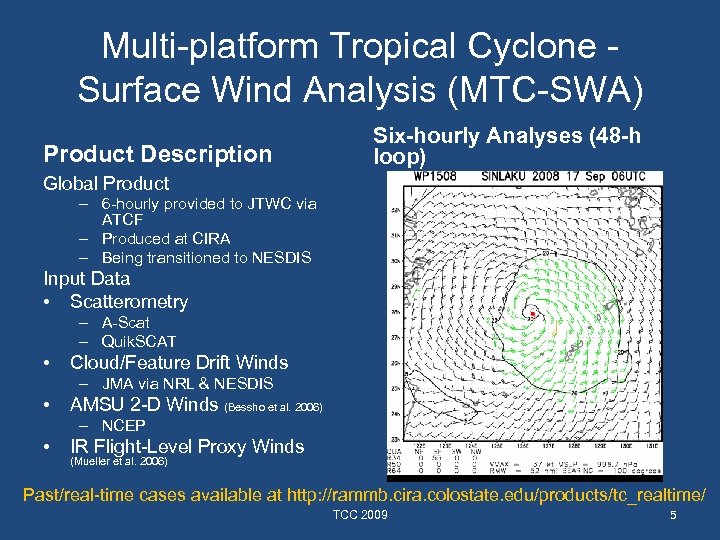
Multi-platform Tropical Cyclone Surface Wind Analysis (MTC-SWA) Product Description Six-hourly Analyses (48 -h loop) Global Product – 6 -hourly provided to JTWC via ATCF – Produced at CIRA – Being transitioned to NESDIS Input Data • Scatterometry – A-Scat – Quik. SCAT • Cloud/Feature Drift Winds – JMA via NRL & NESDIS • AMSU 2 -D Winds (Bessho et al. 2006) – NCEP • IR Flight-Level Proxy Winds (Mueller et al. 2006) Past/real-time cases available at http: //rammb. cira. colostate. edu/products/tc_realtime/ TCC 2009 5
![2008 Atlantic Verification with Recon 20 R 50 Bias 15 Bias[n. mi] 5 0](https://present5.com/presentation/333a92d2907abee09a186c88ca634485/image-6.jpg "2008 Atlantic Verification with Recon 20 R 50 Bias 15 Bias[n. mi] 5 0")
2008 Atlantic Verification with Recon 20 R 50 Bias 15 Bias[n. mi] 5 0 -5 NE SE SW NW ALL -10 MAE [n. mi] 10 -15 -20 -25 R 50 MAE NE -30 Quadrant Aircraft (2 -h) Atlantic All Atlantic 100 99 98 97 96 95 94 93 92 91 90 12 R 50 POD False Alarm Ratio Probability of Detection 50 45 40 35 30 25 20 15 10 5 0 SE SW NW Quadrant Aircraft (2 -h) Atlantic All Atlantic ALL R 50 FA Ratio 10 8 6 4 2 0 NE SE SW NW Quadrant Aircraft (2 -h) Atlantic All Atlantic ALL Full verification (RMSE, POD, R 34, R 64 etc. ) available from John. Knaff@noaa. gov TCC 2009 6
Monte Carlo Wind Probability Model • Estimates probability of 34, 50 and 64 kt wind to 5 days • Implemented at NHC/JTWC for 2006 hurricane season – Replaced Hurricane Strike Probabilities • 1000 track realizations from random sampling NHC track error distributions • Intensity of realizations from random sampling NHC intensity error distributions – Special treatment near land • Wind radii of realizations from radii CLIPER model and its radii error distributions • Serial correlation of errors included • Probability at a point from counting number of realizations passing within the wind radii of interest
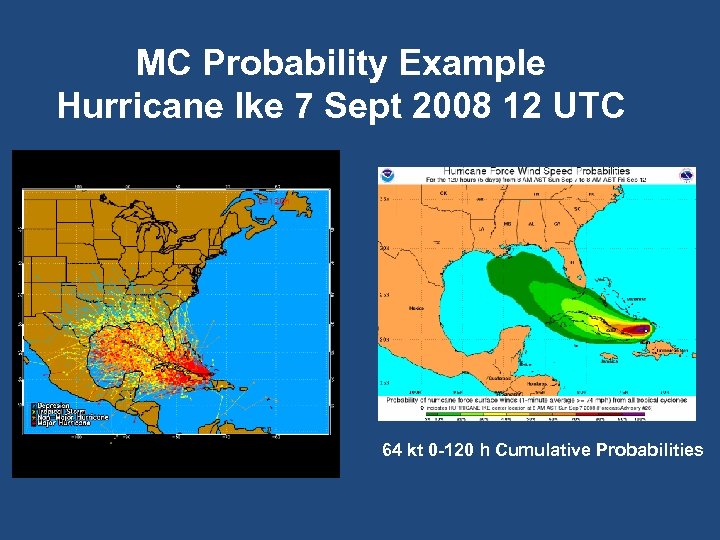
MC Probability Example Hurricane Ike 7 Sept 2008 12 UTC 1000 Track Realizations 64 kt 0 -120 h Cumulative Probabilities
Monte Carlo Wind Probability Application: Objective Warning/TC-COR Guidance • Goal: Develop an objective hurricane warning scheme based on wind probabilities (Atlantic) • Approach: – 2004 -2008 land-threatening Atlantic TCs as development sample – Examined 64 -kt, 36 -h cumulative MC wind probabilities versus NHC hurricane warnings over sample – Choose probability thresholds • Pup = when hurricane warnings issued • Pdown = when hurricane warnings dropped • Thresholds chosen by maximizing the fit (by R 2, MAE, averages) of the total distance warned and the total duration of warnings per storm between the scheme and NHC official warnings • Imposed condition that scheme could not miss any official warnings TCC 2009 9
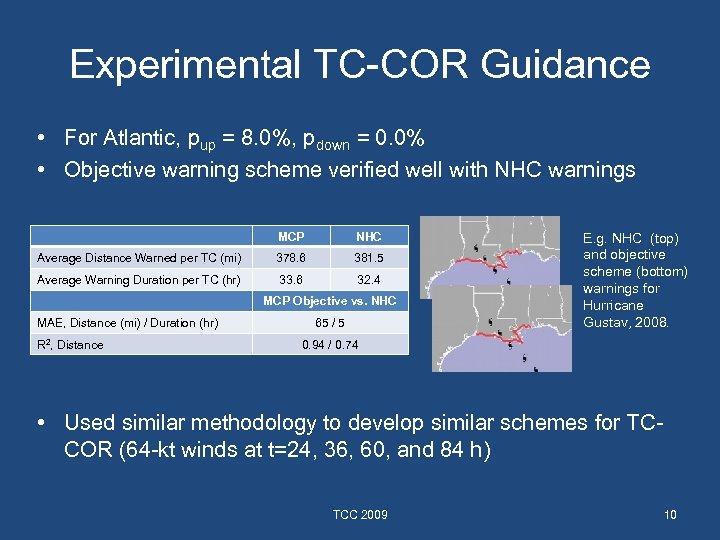
Experimental TC-COR Guidance • For Atlantic, pup = 8. 0%, pdown = 0. 0% • Objective warning scheme verified well with NHC warnings MCP NHC Average Distance Warned per TC (mi) 378. 6 381. 5 Average Warning Duration per TC (hr) 33. 6 32. 4 MCP Objective vs. NHC MAE, Distance (mi) / Duration (hr) R 2, Distance 65 / 5 E. g. NHC (top) and objective scheme (bottom) warnings for Hurricane Gustav, 2008. 0. 94 / 0. 74 • Used similar methodology to develop similar schemes for TCCOR (64 -kt winds at t=24, 36, 60, and 84 h) TCC 2009 10
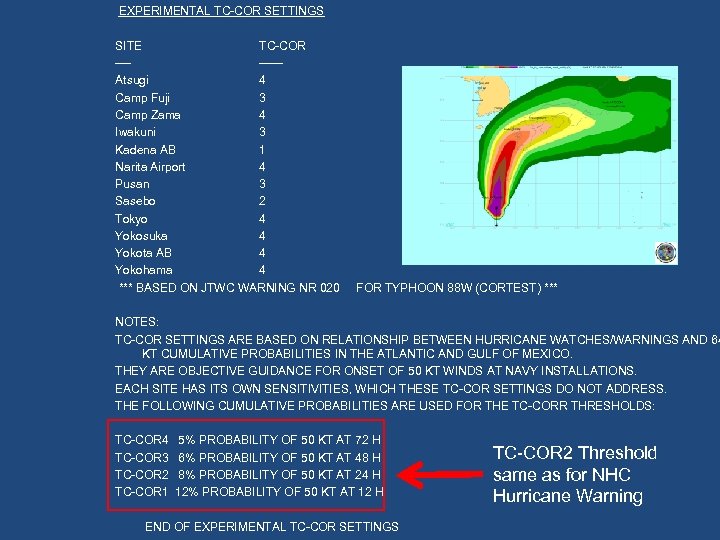
EXPERIMENTAL TC-COR SETTINGS SITE TC-COR ------ Atsugi 4 Camp Fuji 3 Camp Zama 4 Iwakuni 3 Kadena AB 1 Narita Airport 4 Pusan 3 Sasebo 2 Tokyo 4 Yokosuka 4 Yokota AB 4 Yokohama 4 *** BASED ON JTWC WARNING NR 020 FOR TYPHOON 88 W (CORTEST) *** NOTES: TC-COR SETTINGS ARE BASED ON RELATIONSHIP BETWEEN HURRICANE WATCHES/WARNINGS AND 64 KT CUMULATIVE PROBABILITIES IN THE ATLANTIC AND GULF OF MEXICO. THEY ARE OBJECTIVE GUIDANCE FOR ONSET OF 50 KT WINDS AT NAVY INSTALLATIONS. EACH SITE HAS ITS OWN SENSITIVITIES, WHICH THESE TC-COR SETTINGS DO NOT ADDRESS. THE FOLLOWING CUMULATIVE PROBABILITIES ARE USED FOR THE TC-CORR THRESHOLDS: TC-COR 4 5% PROBABILITY OF 50 KT AT 72 H TC-COR 2 Threshold TC-COR 3 6% PROBABILITY OF 50 KT AT 48 H TC-COR 2 8% PROBABILITY OF 50 KT AT 24 H same as for NHC TC-COR 1 12% PROBABILITY OF 50 KT AT 12 H Hurricane Warning END OF EXPERIMENTAL TC-COR SETTINGS
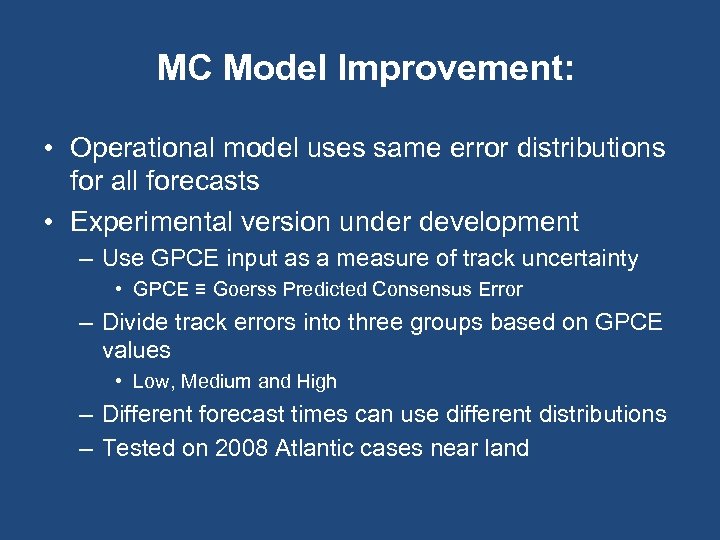
MC Model Improvement: • Operational model uses same error distributions for all forecasts • Experimental version under development – Use GPCE input as a measure of track uncertainty • GPCE ≡ Goerss Predicted Consensus Error – Divide track errors into three groups based on GPCE values • Low, Medium and High – Different forecast times can use different distributions – Tested on 2008 Atlantic cases near land
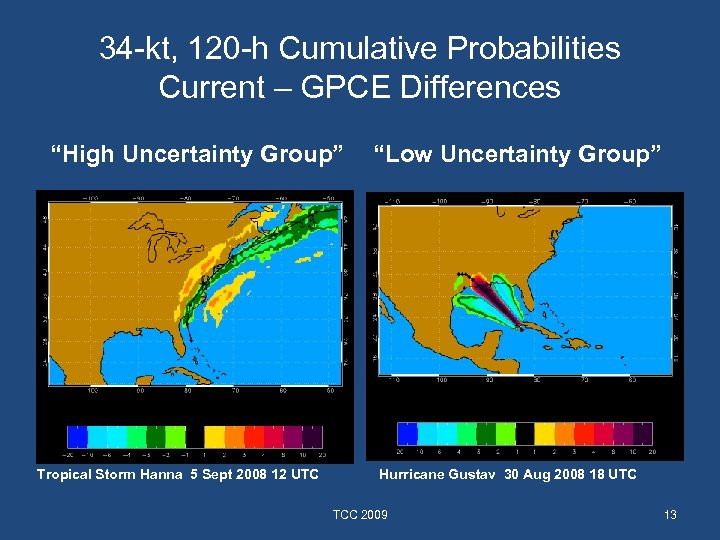
34 -kt, 120 -h Cumulative Probabilities Current – GPCE Differences “High Uncertainty Group” Tropical Storm Hanna 5 Sept 2008 12 UTC “Low Uncertainty Group” Hurricane Gustav 30 Aug 2008 18 UTC TCC 2009 13
Future Plans for MC Model • Test GPCE version in all basins in 2009 – Results on password protected web page • Operational transition of GPCE version in 2010 if recommended by NHC • Automated coastal watch/warnings (JHT project) • Provide landfall intensity and timing distributions (JHT project)
Intensity Forecasting Using the Logistic Growth Equation • SHIPS and STIPS – Predict intensity changes using linear regression – Some skill relative to climatology and persistence models • Linear regression limitations – Intensity change linear function of time-averaged predictors • e. g. , 48 hr intensity change 48 hr average shear – Land effects included in post-processing step • Difficulty with water/land/water tracks – No constraints on intensity changes • Requires large developmental samples – Designed to predict the mean (not rapid) changes
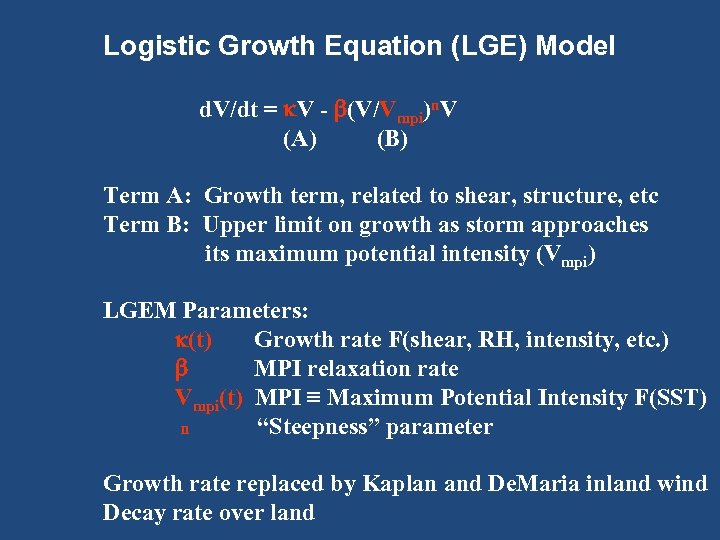
Logistic Growth Equation (LGE) Model d. V/dt = V - (V/Vmpi)n. V (A) (B) Term A: Growth term, related to shear, structure, etc Term B: Upper limit on growth as storm approaches its maximum potential intensity (Vmpi) LGEM Parameters: (t) Growth rate F(shear, RH, intensity, etc. ) MPI relaxation rate Vmpi(t) MPI ≡ Maximum Potential Intensity F(SST) n “Steepness” parameter Growth rate replaced by Kaplan and De. Maria inland wind Decay rate over land
LGE vs SHIPS/STIPS • Advantages – Intensity tendency proportional to instantaneous predictors (shear, etc) – Land effects included directly – Solution constrained between zero and MPI – Much smaller number of free parameters – Model specific initialization using Adjoint equation • Under development • Disadvantages – Persistence harder to include in nonlinear prediction – Potential for low bias for weak storms with d. V/dt ~ V
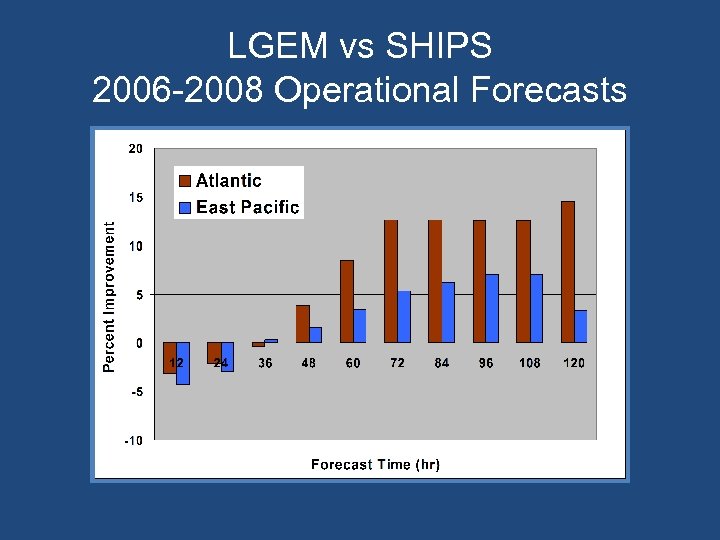
LGEM vs SHIPS 2006 -2008 Operational Forecasts
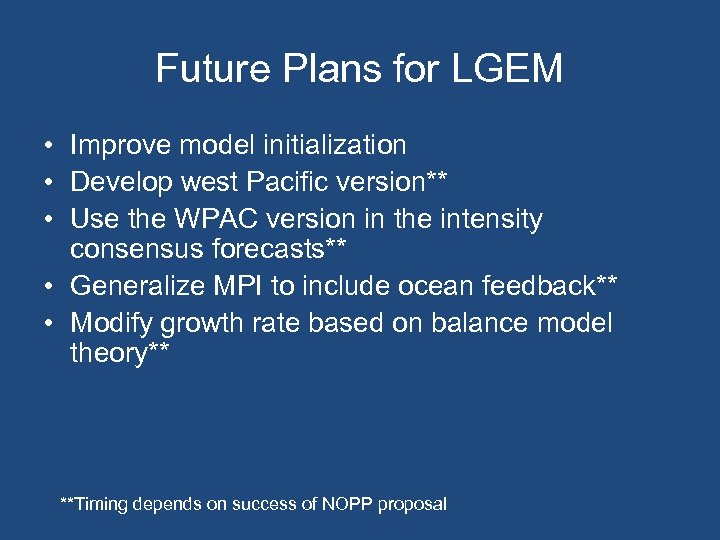
Future Plans for LGEM • Improve model initialization • Develop west Pacific version** • Use the WPAC version in the intensity consensus forecasts** • Generalize MPI to include ocean feedback** • Modify growth rate based on balance model theory** **Timing depends on success of NOPP proposal
References Bessho, K. , M. De. Maria, and J. A. Knaff , 2006: Tropical Cyclone Wind Retrievals from the Advanced Microwave Sounder Unit (AMSU): Application to Surface Wind Analysis. J. of Applied Meteorology. 45: 3, 399 -415. De. Maria, M. , 2009: A simplified dynamical system for tropical cyclone intensity prediction. Mon. Wea. Rev. , 137, 68 -82. De. Maria, M. , J. A. Knaff, R. Knaff, C. Lauer, C. R. Sampson, and R. T. De. Maria, 2009: A New Method for Estimating Tropical Cyclone Wind Speed Probabilities. Wea. Forecasting, Submitted. Mueller, K. J. , M. De. Maria, J. A. Knaff, J. P. Kossin, T. H. Vonder Haar: , 2006: Objective Estimation of Tropical Cyclone Wind Structure from Infrared Satellite Data. Wea Forecasting, 21: 6, 990– 1005. Schumacher, A. B. , M. De. Maria and J. A. Knaff, 2009: Objective Estimation of the 24 -Hour Probability of Tropical Cyclone Formation, Wea. Forecasting, 24, 456 -471. Published papers are available at http: //rammb. cira. colostate. edu/resources/publications. asp TCC 2009 20

Back up slides
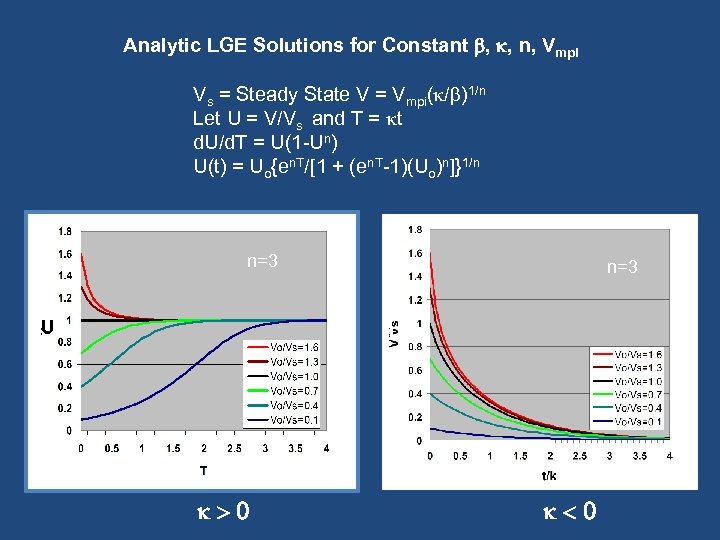
Analytic LGE Solutions for Constant , , n, Vmpi Vs = Steady State V = Vmpi( / )1/n Let U = V/Vs and T = t d. U/d. T = U(1 -Un) U(t) = Uo{en. T/[1 + (en. T-1)(Uo)n]}1/n n=3 U 0 0
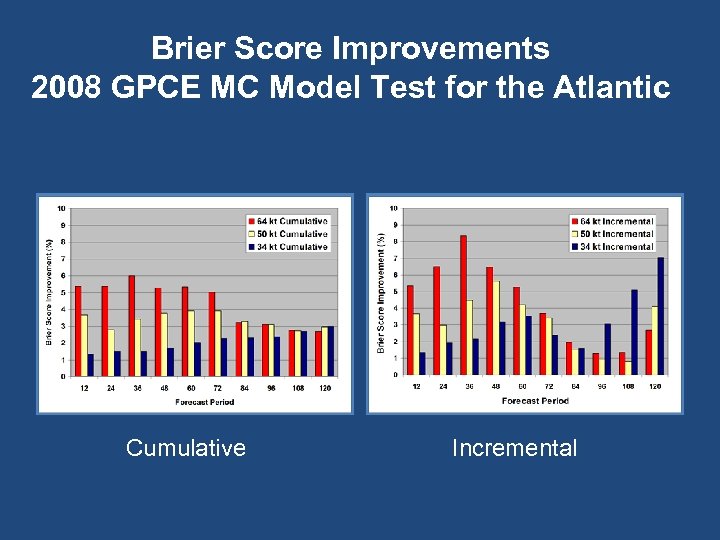
Brier Score Improvements 2008 GPCE MC Model Test for the Atlantic Cumulative Incremental
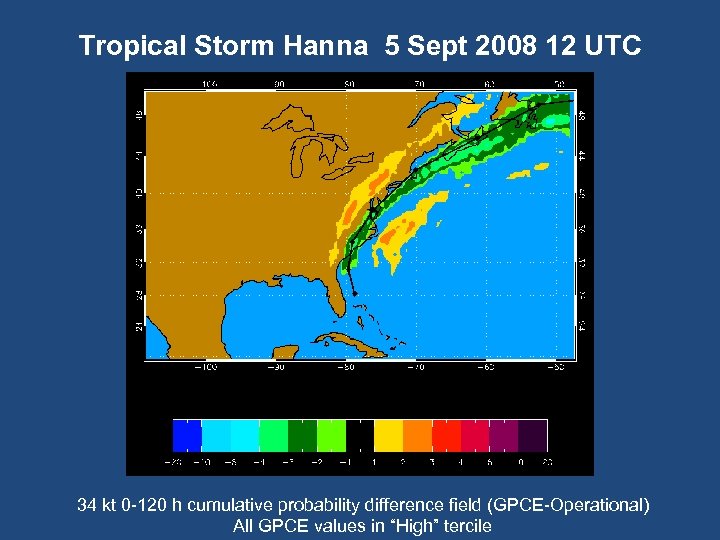
Tropical Storm Hanna 5 Sept 2008 12 UTC 34 kt 0 -120 h cumulative probability difference field (GPCE-Operational) All GPCE values in “High” tercile
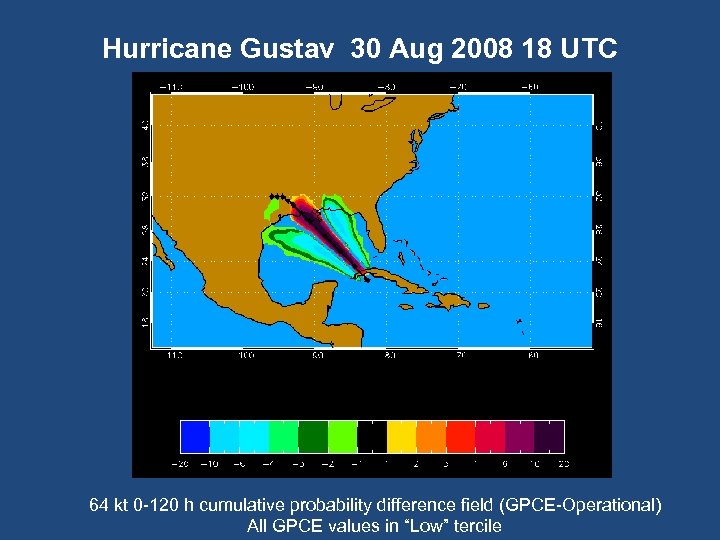
Hurricane Gustav 30 Aug 2008 18 UTC 64 kt 0 -120 h cumulative probability difference field (GPCE-Operational) All GPCE values in “Low” tercile
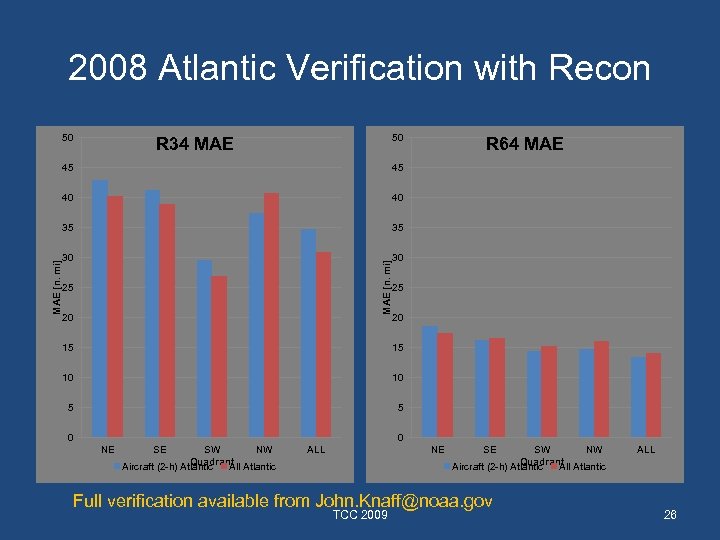
2008 Atlantic Verification with Recon 50 50 R 34 MAE 40 35 35 30 30 MAE [n. mi] 45 40 MAE [n. mi] 45 R 64 MAE 25 20 15 15 10 10 5 5 0 0 NE SE SW NW Quadrant Aircraft (2 -h) Atlantic All Atlantic ALL NE SE SW NW Quadrant Aircraft (2 -h) Atlantic All Atlantic Full verification available from John. Knaff@noaa. gov TCC 2009 ALL 26
Скачать презентацию Tropical cyclone products and product development at CIRA RAMMB
333a92d2907abee09a186c88ca634485.ppt