


 Скачать презентацию Troop 402 Junior Leader Training George Hay Kain
81fa51c7811c0b6a67727e3006d67e20.ppt
- Количество слайдов: 103
 Troop 402 Junior Leader Training George Hay Kain, III Assistant Scoutmaster for Training Assistant Scoutmaster
 Training Session at Yorkshire United Methodist Church Tuesday and Wednesday June 18 -19, 1996
 Introduction u Purpose: To give YOU the resources YOU need to do YOUR job u Evidence: Upon completion, YOU will wear the “trained” emblem u Method: games, videos, hand outs, demonstrations, plus u The Junior Leader Handbook, and other resources
 Query u How many have had this course before? u How many have been through a Councillevel course? u How many have been to the National Junior Leader Instructor Camp at Philmont Scout Ranch?
 Agenda u We will cover: – Leadership – Cooperation u Meal break – Problem Solving – Team Building u Presentation of Patches and Certificates
 Warm-Up Game #1 u Moon Ball – Form a circle, with a ball handy – Rules: you can’t hit the ball twice in a row – Set a goal beforehand for consecutive ball hits aloft without the ball touching the ground. – (Start now)
 Moon Ball Reflection u Was your goal realistic? u Did you achieve your goal? u If so, how?
 Warm-Up Game #2 u Yurt Circle – Join hands and expand the circle outward until the circle is tight – Count off by twos – Bending at the ankles, not the waist, ones lean in and twos lean out – Do it slowly, then reverse positions – (Start now)
 Yurt Circle Reflection u If everyone works together, each person can accomplish a remarkable forward or backward lean
 Warm-Up Game #3 u Everybody Up – Let’s try to build group cooperation – Two same-size persons sit down facing each other, legs out, knees bent, feet touching opposite person’s feet – Grasp other persons hands tightly, and pull each other into upright standing position – Repeat, adding more and more people on each side, until everyone is included – (Start now)
 Reflection on Everybody Up u Were you eventually able to get everybody included, and upright? u Is there any real limit to the number of people that can play this game, as long as they work together? u Would Moon Ball, Yurt Circle, and Everybody Up be fun games for the Troop?
 Why are we here today? u to learn a leadership style that works great in Scouting u to learn to work together to accomplish a common goal u to learn how to deal with problems we all encounter in Scouting u and to have some fun at the same time
 Overview u I’m a leader - what do I do now? u More than an honor, it’s a challenge u Lead Troop 25 and your Patrol u Decide the course Patrol and Troop will follow along the Scouting trail u Help others master Scouting skills u Be a role model for other Scouts.
 What Is Leading Anyway? u If others think of you as the boss, you’re probably not leading. u If they think of you as one of the guys and everything you set out to do is getting done, you’re probably a good leader.
 Skills and Techniques of Successful Scout Leaders: u They ask a lot of questions u They make a lot of suggestions u They don’t give too many orders u They use the Scoutmaster and Assistant Scoutmasters as a resource. u They took Troop Junior Leader Training – That’s why you are here today!
 Further Training Opportunities: u Council-level Junior Leader Training – week--long training conference in summer u National Junior Leader Instructor Camp – Philmont Scout Ranch in New Mexico
 Get Into Your Job Break It Down into Pieces u Tackle one piece at a time u Think of your Junior Leader Handbook as a toolbox. – take it with you to meetings – take it on campouts – take it to summer camp
 Other “toolboxes”: u Boy Scout Handbook – the basic tool for all Scouting u Woods Wisdom - a good source for: – games (for learning and for fun) – ceremonies (how about some new ones? ) – programming themes u the Troop’s adult leaders u other junior leaders
 Presentation of Junior Leader Handbooks u Put your name in it now u Read it, know it, follow it u Keep it as a resource for the rest of your Scout career
 Presentation of Course Outlines u Most of the information in these outlines that doesn’t come from the video can be found in your Junior Leader Handbooks or in other Scouting resources
 Now let’s watch a video segment on leadership u (Start the Video Now)
 Now let’s try Activity #1 The “Blind Square”
 The “Blind Square” u Needed: 50’ of rope and blindfolds u Only the “Leader” may talk u Form in a circle and blindfold yourselves u Reach down and grab the rope with both hands u Objective: to form a square, using the rope to establish the boundaries
 “Blind Square” rules: u No one may let the rope leave his hands for more than five seconds at a time u Only the “leader” may speak – Leader may number the other people in the group if desired – The “leader” decides when the square is formed u (Try it now - when finished, we’ll proceed)
 Reflection on the “Blind Square” u Sit where you are u Who took the leadership role? u How did decisions get made? u What didn’t you like about this style? u How often do leaders act like “big bosses”? u How does it feel to be lead by “big boss”? u Is “big boss” style prevalent in Scouting? u Could we play this without “Big Boss”?
 Now let’s try a “Blind Equilateral Triangle”, but with cooperation u Everyone is still blindfolded – put on your blindfolds again u This time, however, everyone may talk u (Try it now - when finished, we’ll proceed)
 Reflection on the “Blind Equilateral Triangle” u Who assumed leadership roles? u Did the leadership role shift during the activity? u Did you follow, even though you were not sure the idea would work? u What’s good about this leadership style? u What didn’t you like about the “Big Boss”? u How could “shared leadership” work in our Troop?
 Identifying the Traits of a Good Leader: u 1. u 2. u 3. u 4. u 5. u 6. u 7.
 Now let’s watch the next video segment, “Cooperation” (resume video)
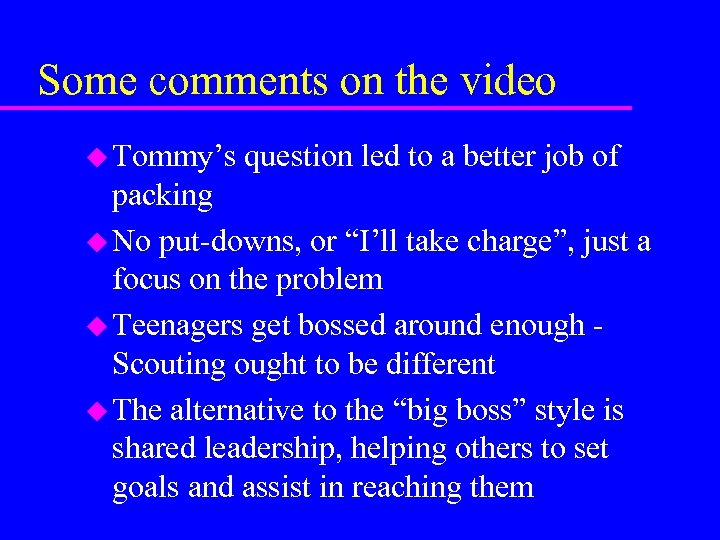 Some comments on the video u Tommy’s question led to a better job of packing u No put-downs, or “I’ll take charge”, just a focus on the problem u Teenagers get bossed around enough Scouting ought to be different u The alternative to the “big boss” style is shared leadership, helping others to set goals and assist in reaching them
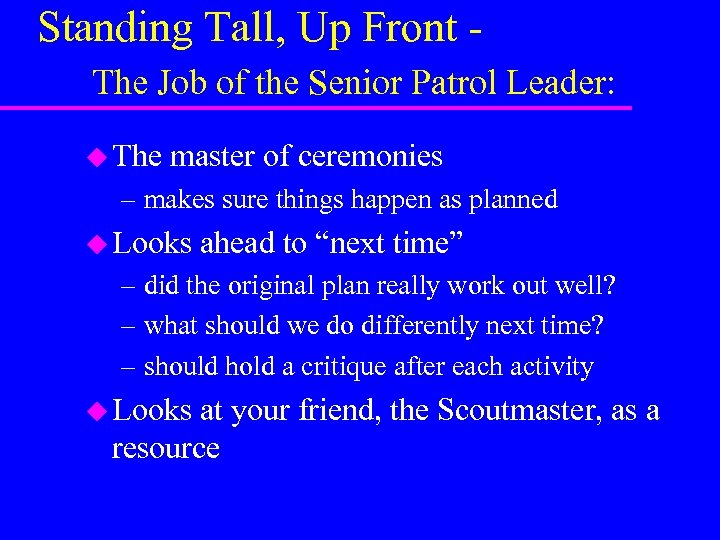 Standing Tall, Up Front The Job of the Senior Patrol Leader: u The master of ceremonies – makes sure things happen as planned u Looks ahead to “next time” – did the original plan really work out well? – what should we do differently next time? – should hold a critique after each activity u Looks at your friend, the Scoutmaster, as a resource
 Helping Others Grow = u When someone doesn’t do the assigned task, it is your job to find someone who will u Resist the urge to pick up a dropped ball and run with it – Rather, pick it up and pass it to someone else – this is called DELEGATING » Delegating is one trait of a good leader » It allows others to grow in experience
 The SPL has lots of helpers to call upon: u the Assistant Senior Patrol Leader – that’s what assistants are for u Scribe, Quartermaster, etc. u Other junior leaders
 The Senior Patrol Leader u is elected by the Scouts to represent them as the top junior leader in the troop u the SPL reports to the Scoutmaster
 Senior Patrol Leader Duties: u runs all troop meetings, events, activities, & the annual program planning conference u runs Patrol Leaders’ Council meetings u appoints other troop junior leaders – with advice and counsel of Scoutmaster u Assigns duties and responsibilities to junior leaders u Assists with Junior Leader Training
 And as with all other Junior Leaders u Sets a good example u Enthusiastically wears the Scout uniform correctly u Lives by the Scout Oath and Law u Shows Scout spirit
 The Assistant Senior Patrol Leader u 2 nd highest junior leader in the troop u appointed by the SPL u acts as SPL when SPL is absent u provides leadership to other junior leaders
 Assistant Senior Patrol Leader Duties: u helps SPL lead meetings and activities u runs troop in absence of SPL u helps train and supervise troop scribe, quartermaster, instructors, librarian, historian, and chaplain aide u serves as a member of the Patrol Leaders’ Council u sets a good example in the uniform, Oath, Law, & spirit
 The Patrol Leader u the elected leader of his patrol u represents his patrol on the Patrol Leaders’ Council u reports to the SPL
 The Patrol Leader’s Duties u appoints assistant patrol leader u represents patrol on the PLC u plans and steers patrol meetings u helps Scouts advance u chief recruiter for new Scouts u keeps patrol members informed u knows his resources – his other patrol members & other leaders
 And again, as with all other JL’s u sets the example u wears the uniform correctly u lives by the Scout Oath and Law u shows Scout spirit
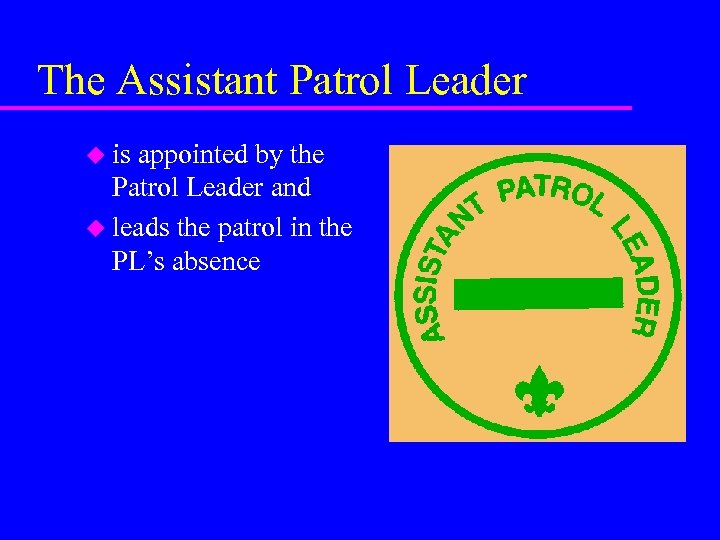 The Assistant Patrol Leader u is appointed by the Patrol Leader and u leads the patrol in the PL’s absence
 Assistant Patrol Leader duties: u helps PL plan and steer patrol meetings and activities u helps PL keep patrol members informed u helps patrol get ready for all troop activities u represents his patrol at patrol leaders’ council meetings when PL can not attend u helps control the patrol and in building patrol spirit u sets example - uniform, Oath, Law, & spirit
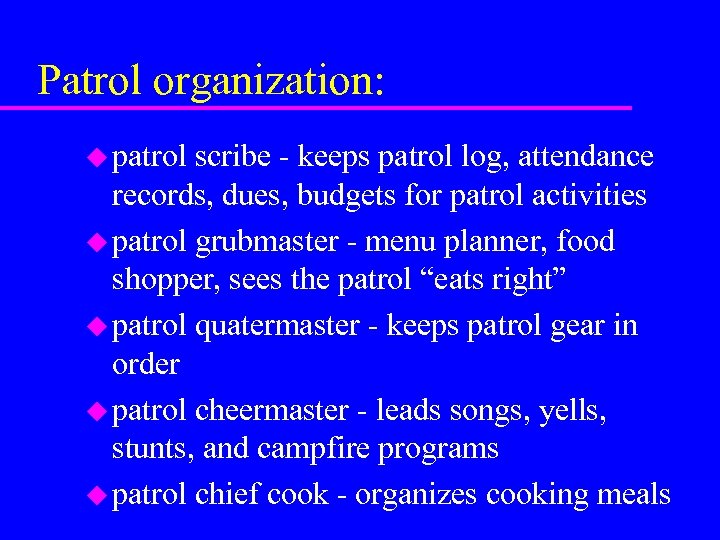 Patrol organization: u patrol scribe - keeps patrol log, attendance records, dues, budgets for patrol activities u patrol grubmaster - menu planner, food shopper, sees the patrol “eats right” u patrol quatermaster - keeps patrol gear in order u patrol cheermaster - leads songs, yells, stunts, and campfire programs u patrol chief cook - organizes cooking meals
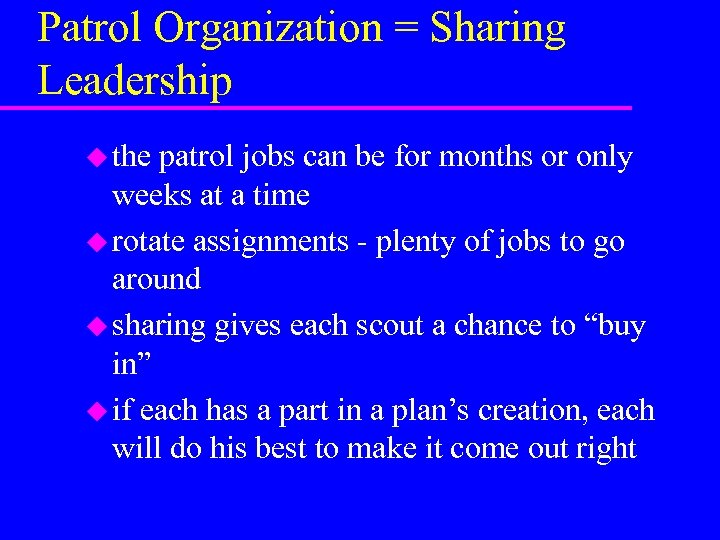 Patrol Organization = Sharing Leadership u the patrol jobs can be for months or only weeks at a time u rotate assignments - plenty of jobs to go around u sharing gives each scout a chance to “buy in” u if each has a part in a plan’s creation, each will do his best to make it come out right
 Troop Support Staff Jobs: u every troop needs troop-level junior leader support staff to get the job done u “behind the scenes” but still very important u all of the following staffers report to the assistant senior patrol leader
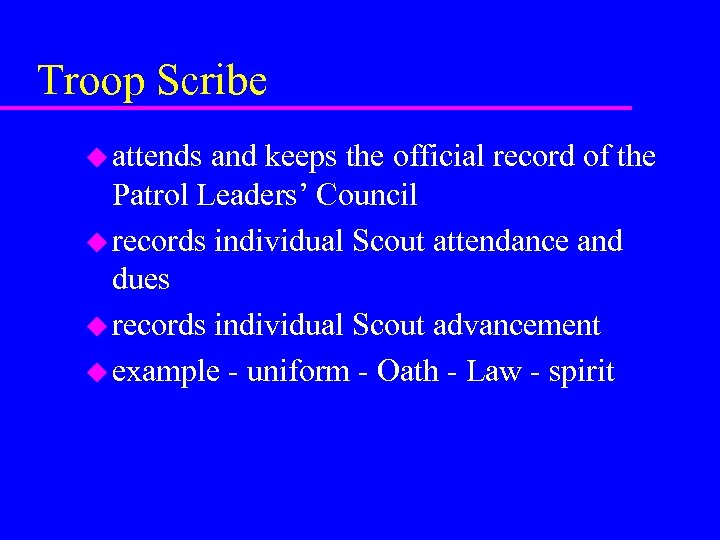 Troop Scribe u attends and keeps the official record of the Patrol Leaders’ Council u records individual Scout attendance and dues u records individual Scout advancement u example - uniform - Oath - Law - spirit
 Troop Quartermaster u keeps records of patrol and troop equipment u ensures equipment is in good working order u issues equipment and ensures it is returned in good condition u suggests new or replacement items u example - uniform - Oath - Law - spirit
 Troop Instructors u teach basic Scouting skills to troop and patrols u can prepare and make special presentations that will be educational for troop meetings – games with a point, from Woods Wisdom, etc. – learning can be fun, if you make it so – examples: cross the river, lift the cook pot, etc. u example - uniform - Oath - Law - spirit
 Chaplain Aide u assists troop chaplain with religious services at troop activities u tells scouts about religious emblem program u ensures religious holidays considered in troop program planning u plans religious observances at troop outings u example - uniform - Oath - Law - spirit
 Troop Librarian u sets up and cares for troop library – records new troop books and pamphlets – runs troop lending library and follows up on late returns u example - uniform - Oath - Law - spirit
 Troop Historian u gathers pictures and facts about past troop activities u keeps troop historical file and/or scrapbook u cares for troop trophies, ribbons, souvenirs u keeps information about former troop members u example - uniform - Oath - Law - spirit
 Our Troop is just one part in the National Scouting movement
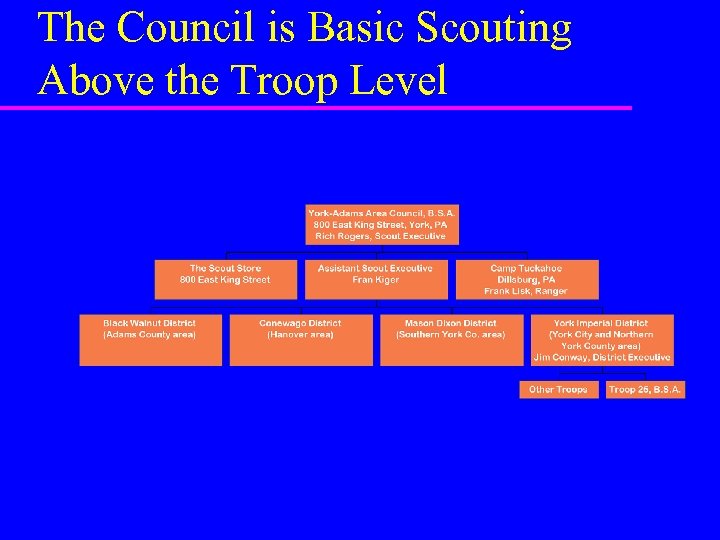 The Council is Basic Scouting Above the Troop Level
 Troop 25’s Organization Chart
 Activity #3 - My Friend, the Potato u observe closely the potatoes you have received u introduce “your potato” to the group – tell us about unique size, shape, etc. u now we’ll put the potatos back in the bag, mix them up, and retrieve them one by one u do you recognize “your” potato
 Reflection on “My Friend the Potato” u What really happened here? u In what ways are we all alike? u How do these similarities help us get things done?
 Are differences good or bad? u How are we different from one another? u How do differences strengthen the group as a whole? u When do differences keep a group from reaching its goal? u How can we find out about the special qualities and abilities of each member of our troop? u Are these talents differences?
 I’m hungry - how about you? u pick up a food sack and let’s eat!
 Reflection on the meal activity u Did we think before we acted? – how many people were there to feed? – how much, and what kinds of food was available – how did we handle any “shortages” – what is the 12 th point of the Scout Law? – are there other Law points relevant here?
 A Leader’s comment u Our success as leaders will be determined by how well we are able to take the unique talents of each member of our group and mold them into a team committed to accomplishing a common goal
 New let’s watch the next video segment - Problem Solving (first part) This segment deals with problem solving - there are three sequential steps a boy can take to frame a problem and see it in a larger context. . .
 Steps to frame a problem: u Empathy - put yourself in the other’s place u Invention- invent as many solutions as you can u Selection - which is best for the most people - caring is as important as justice u Now here’s the video. . . u (start video, proceed afterwards)
 Activity #5 - the “Tent Scene” u divide into groups of about three people u discuss how your group would resolve the conflict over the tent flaps u each group will then present their solution in the form of a skit or role-playing u after all skits completed, we’ll return to the video to see how Tommy solved the problem u (let’s do it now)
 Activity #6 - “Nine Magazines” u the purpose of this activity is to show Scouts may need to look at several possible alternatives before arriving at a no-lose situation u if you think you have the solution, become the “guesser”. If you are correct, you’ll then become the “medium” u when it seems most of us have the answer, we’ll return to the video u (play the game now, then go to video)
 Activity #7 - The “Scene” with Tommy and Sam u Divide yourselves into two groups u Use empathy, invention, and selection to deal with the Sam and Tommy problem u Each group is to select two actors to portray their group’s solution
 Reflection on Activity #7 u how was group #1’s solution different from group #2? u which solution do you prefer, and why? u what alternatives might we have missed? u was it a win/win solution? why or why not? u how would you feel in Sam’s place? u how could the problem have been avoided?
 A Patrol Duty Roster can be Handy u It matches expected chores to available people u It rotates the people among the chores – everyone should have a chance at the “fun” stuff – just as everyone should have a chance at the “necessary” stuff u Patrol Scribe can save them for future reference
 Review troop and patrol job descriptions u any questions in genera about troop and patrol jobs? u do you have any questions about your specific job? u what do you plan to do better than your predecessor did? u how will you do it? u what help can the rest of us give you?
 It Really Helps to Be Well Informed u You can’t lead if you don’t know where you are going u Sources of information – Patrol Leaders’ Council Meetings – Troop Meetings – The Troop 25 Bugler ¯ Yorkshire Troop 25 Virtual Scout Room Web Page
 How Can I Remember Everything? u Pocket note pad and pen/pencil – In left breast pocket at all times u Three ring binder (three styles) – Zippered edge retains loose items – Clear insert covers let you customize » Leadership Certificate on front, roster on back – Flexible cover fits in pack
 Three Ring Binder Tips u Use a 1 -31 date index sheet u Keep index up to date in front or back cover insert u Keep copies in it of – JLTC notes – issues of The Troop 25 Bugler – any handouts from Troop and PLC meetings, etc. .
 Importance of Troop Roster u Keep a copy in your wallet at all times u Useful for musters u Useful to “spread the word”
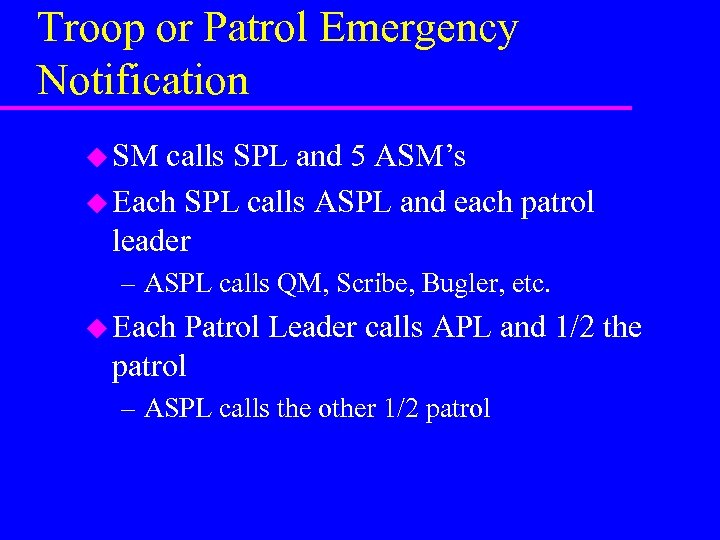 Troop or Patrol Emergency Notification u SM calls SPL and 5 ASM’s u Each SPL calls ASPL and each patrol leader – ASPL calls QM, Scribe, Bugler, etc. u Each Patrol Leader calls APL and 1/2 the patrol – ASPL calls the other 1/2 patrol
 Looking the part u You are a role model. You should be proud to WEAR your scout uniform, and wear it CORRECTLY at all scout functions. u How do I know what is correct? – Inside front and back covers of the Boy Scout Handbook – Boy Scout/Varsity Scout Uniform Inspection Sheet, No. 34283 – Insignia Guide, No. 33064 u Check your own uniforms as we go
 Common Uniform Mistakes u Belt tab and buckle not “brass on brass” u Misplacement of service stars – Make a template from a plastic milk carton to help you – Keep the template in your shirt pocket - it will survive the washer!
 The Metal Rank Pin u You should not wear both the metal rank pin and the cloth rank patch at the same time – Use one or the other, but not both – Metal pin may be used on campaign hat – Save it for your son or grandson
 Nameplates u Nameplates (optional) when worn should be – above the BSA strip and – above the interpreter strip – above the WEARER’S right breast pocket
 Order of the Arrow Sash u The OA sash is not to be worn with the merit badge sash.
 Merit Badge Sash u The Insignia Guide, p. 4 says “Only temporary patches (no badges of rank) may be worn on the back of the merit badge sash. u Only one merit badge sash may be worn.
 Quality Unit Award u Right Sleeve, Most Recent Year Only u 4” below seam or u If Baden Powell Patrol Star is worn – below and touching it
 Headgear Regulations u Official headgear may be worn while the unit or individual is participating in an indoor formal ceremony or service duty (except in religious institutions where custom forbids) – Flag ceremonies, inspections, orderly duty, ushering service
 When Not to Wear Your Headgear u In informal indoor activity where no official ceremony is involved, headgear is removed as when in street clothes.
 Drum and Bugle Corps Uniforms u Members wear the official uniform for their registration status u Special helmets, scarves, gloves, unofficial leggings, and the carrying of ceremonial guns and swords while in the uniform of the Boy Scouts of America is a violation of the Rules and Regulations of the Boy Scouts of America.
 Musician Badge u The Musician Badge is the only special insignia that may be worn by members of scout drum & bugle corps. It is worn on the right sleeve centered 1/2” below the patrol medallion.
 Varsity Scout Letter u Varsity Scout letter, cloth No. 00047, may be worn – on right breast of jacket or – on bottom front of the merit badge sash
 Embroidered Square Knots u Remember “Right Side Up” – The loop of the embroidered square knot that comes in front of the standing part is always to the wearer’s right.
 Time Out for a Uniform Inspection
 Now let’s view the video “Team Building” u (view video now, then proceed)
 Activity #8 - “Willow in the Wind” u Stand shoulder to shoulder in a circle u One person, “the faller”, stands rigid and trusting in the center u Remaining rigid, the faller falls slowly in any direction u Before he falls too far, redirect him to another part of the circle u This “fall-catch-push” sequence should continue until the faller feels relaxed, and
 Here it is - the Big One! u The “Trust Fall” – each Scout will be asked in turn to stand atop a five foot platform and fall backwards into the waiting arms of the rest of us – close your eyes prior to, and during the fall – keep your arms close to your sides (hands grasping trousers, or crossed over chest) – fall with your body rigid, not bending at the waist (There’s more. . . )
 More “Trust Fall” instructions u remove all objects from your pockets u catchers should remove jewelry u two lines of catchers stand facing each other, shoulder to shoulder – hands extended, palms up, hands alternated (zippered!) – close together to form a safe landing area u Catchers: don’t lock hands with the person facing you – Knocked heads would result
 “Trust Fall” communications u We will need a communications code between faller and catchers u Faller: “Ready to fall!” u Catchers: “Fall away!” u Faller: “Falling!” u ANY QUESTIONS BEFORE WE PROCEED? – If not, let’s do it now
 Reflections on “Willow” and “Trust Fall” u What did you like about these two games? u What is scary about the trust fall? u How is the trust fall like what we have been talking about today? u How will trusting each other help us to have a better troup?
 Goal Setting u How about your patrol becoming a “Baden Powell Patrol” – see Junior Leader Handbook for details u How about our troop becoming a “Quality Unit” this year? – the Scoutmaster has the details u What other goals do we want to set?
 Where to get more information u Other training sessions u List books, articles, electronic sources u Consulting services, other sources
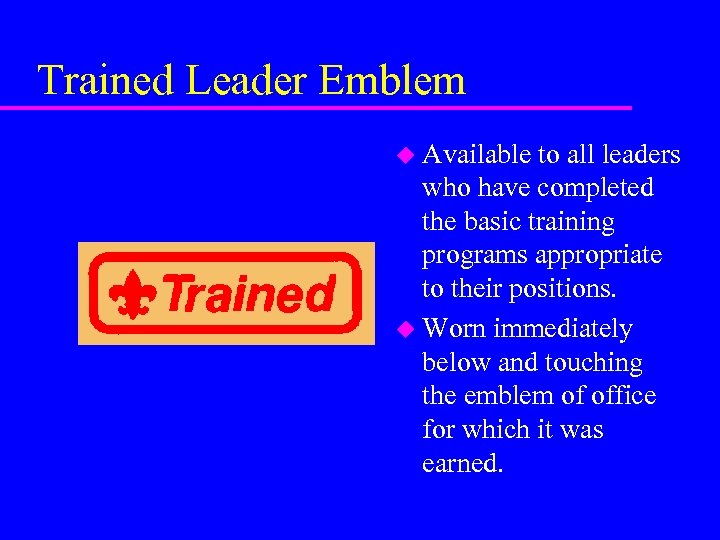 Trained Leader Emblem u Available to all leaders who have completed the basic training programs appropriate to their positions. u Worn immediately below and touching the emblem of office for which it was earned.
 A Note to Den Chiefs u Your training today is for the position you hold in the Troop. u There is a special den chief training conference for the den chief position you hold in the Pack.
 “Trained” Emblem is Job Specific u The Trained Leader emblem may be worn only in connection with the emblem of office for which basic training has been completed.
 Closing Reflection from the Leader u Today we had fun, and met some challenges u We’ve learned new skills to be better leaders u How can we use these experiences to make our Troop even better?
 Presentation of Certificates and Trained Leader Emblems
 Distribution of Critique Forms