


 Скачать презентацию TRIZ Innovation Vishwanath Ramdas This presentation
fed5e178ac4990359a83e8e17badd53b.ppt
- Количество слайдов: 77
 TRIZ – Innovation Vishwanath Ramdas
 This presentation thanks • http: //Mazur. net/triz • www. Triz-journal. com • Presentation style – Tom Asacker – Tom Peters
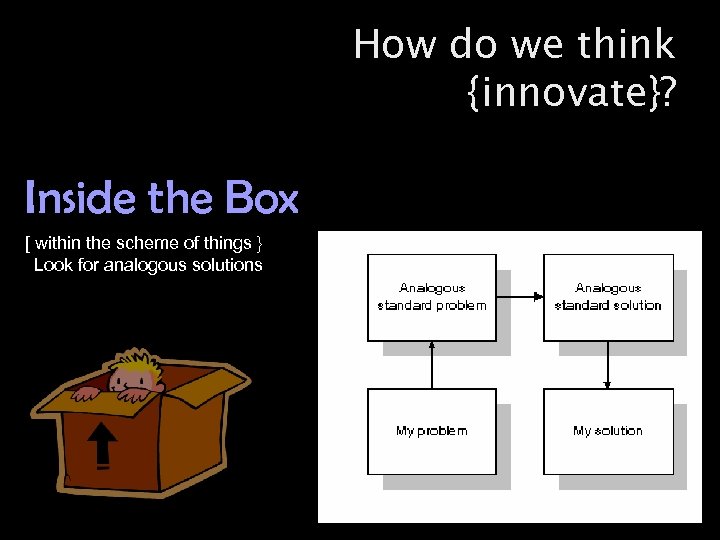 How do we think {innovate}? Inside the Box [ within the scheme of things } Look for analogous solutions
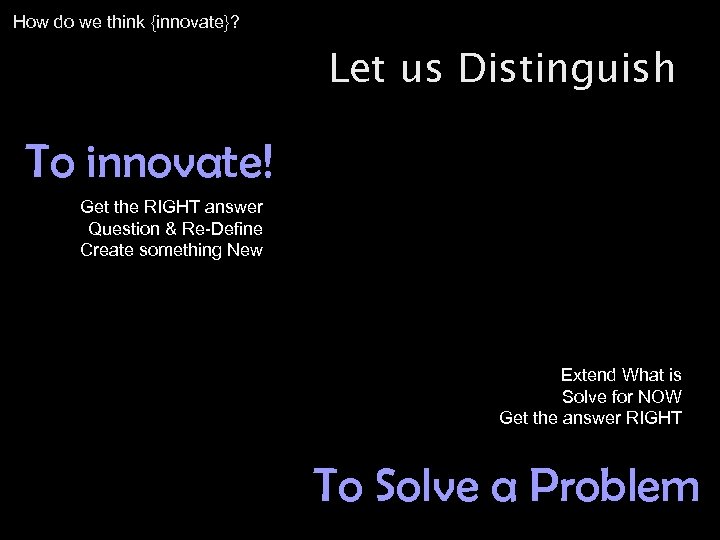 How do we think {innovate}? Let us Distinguish To innovate! Get the RIGHT answer Question & Re-Define Create something New Extend What is Solve for NOW Get the answer RIGHT To Solve a Problem
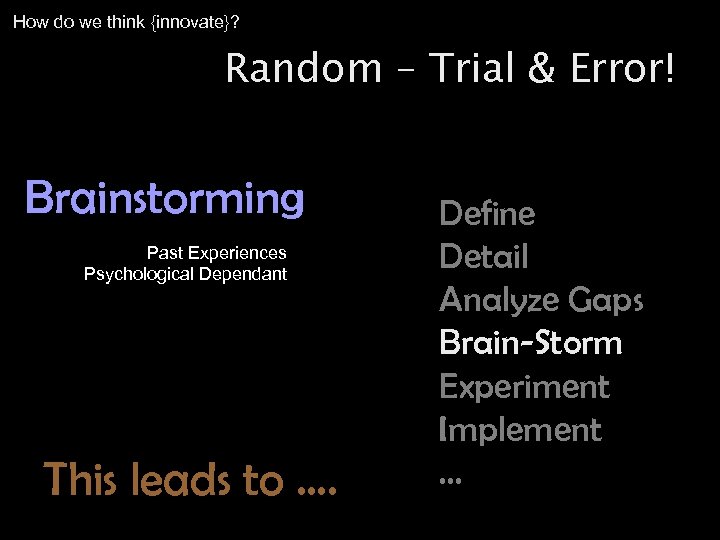 How do we think {innovate}? Random – Trial & Error! Brainstorming Past Experiences Psychological Dependant This leads to …. Define Detail Analyze Gaps Brain-Storm Experiment Implement …
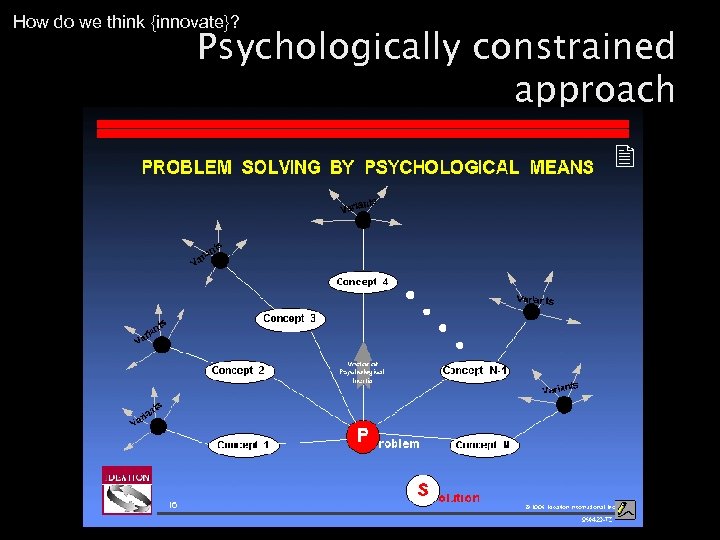 How do we think {innovate}? Psychologically constrained approach
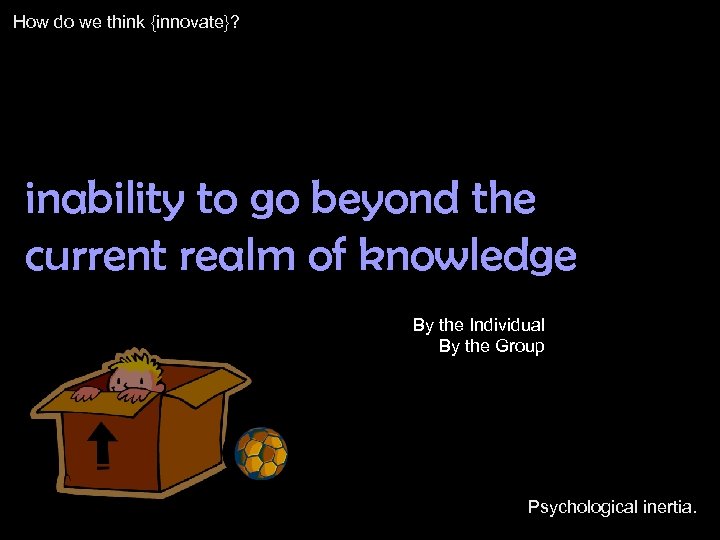 How do we think {innovate}? inability to go beyond the current realm of knowledge By the Individual By the Group Psychological inertia.
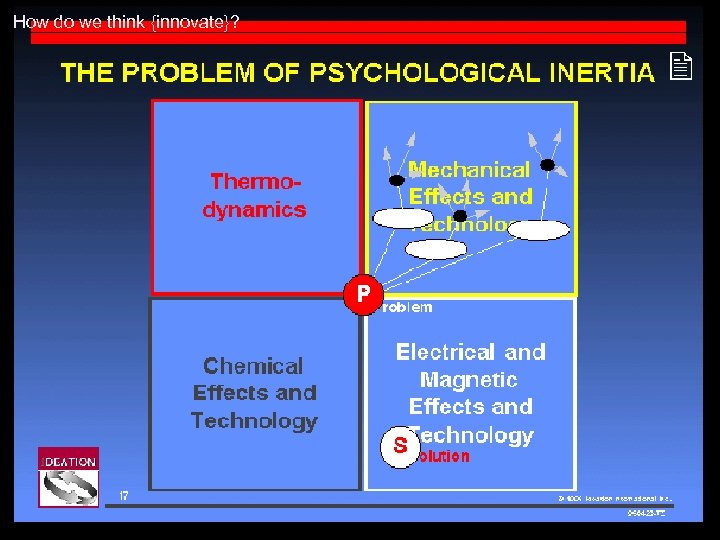 How do we think {innovate}?
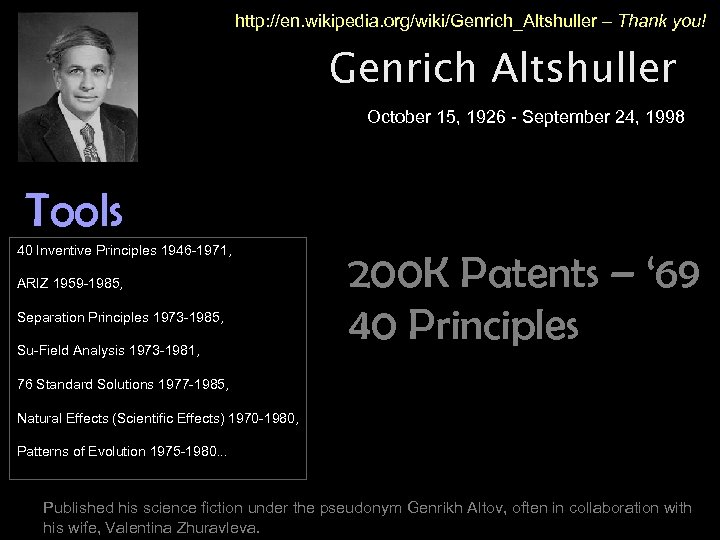 http: //en. wikipedia. org/wiki/Genrich_Altshuller – Thank you! Genrich Altshuller October 15, 1926 - September 24, 1998 Tools 40 Inventive Principles 1946 -1971, ARIZ 1959 -1985, Separation Principles 1973 -1985, Su-Field Analysis 1973 -1981, 200 K Patents – ‘ 69 40 Principles 76 Standard Solutions 1977 -1985, Natural Effects (Scientific Effects) 1970 -1980, Patterns of Evolution 1975 -1980. . . Published his science fiction under the pseudonym Genrikh Altov, often in collaboration with his wife, Valentina Zhuravleva.
 TRIZ – Theory of Innovative Problem Solving { Teoriya Resheniya Izobreatatelskikh Zadatch } Founding Principle. . Be a systematic step by step procedure. be repeatable and reliable
 TRIZ Founding Principles be able to access the body of inventive knowledge be able to add to the body of inventive knowledge be familiar enough to inventors
 TRIZ Altshuller studied patents. 200 K Patents. . Found that only a small portion are true innovations Remaining are straight forward improvements Today it is 1. 4 Million Patents. . he then classified these patents
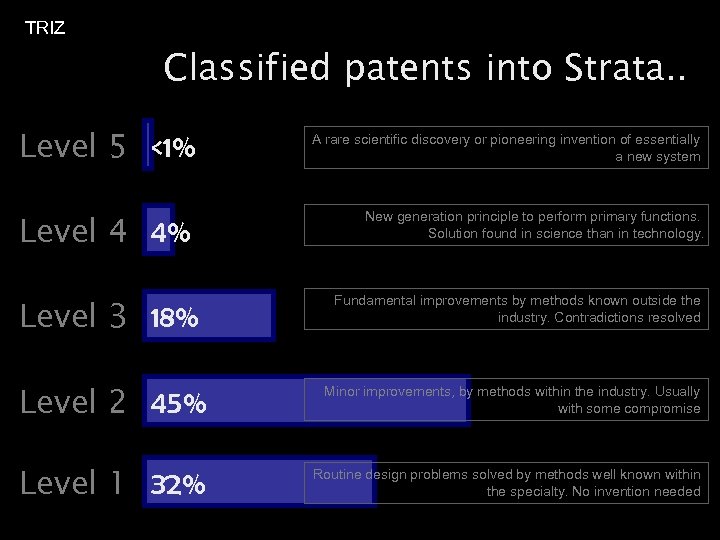 TRIZ Classified patents into Strata. . Level 5 <1% Level 4 4% Level 3 18% A rare scientific discovery or pioneering invention of essentially a new system New generation principle to perform primary functions. Solution found in science than in technology. Fundamental improvements by methods known outside the industry. Contradictions resolved Level 2 45% Minor improvements, by methods within the industry. Usually with some compromise Level 1 32% Routine design problems solved by methods well known within the specialty. No invention needed
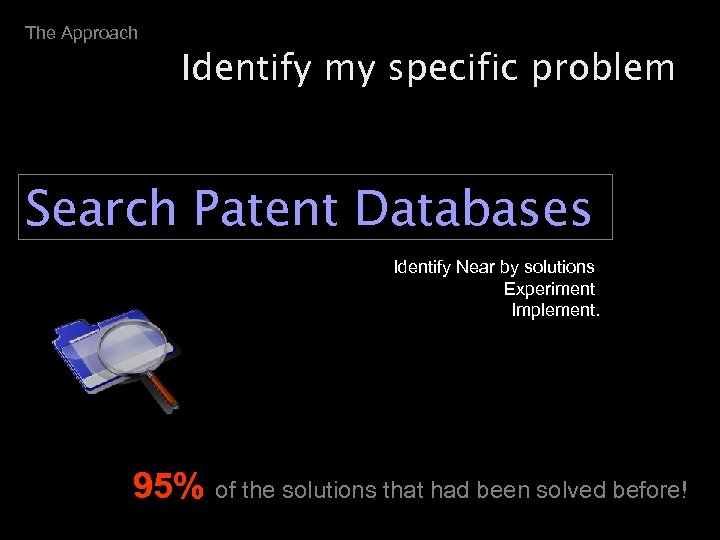
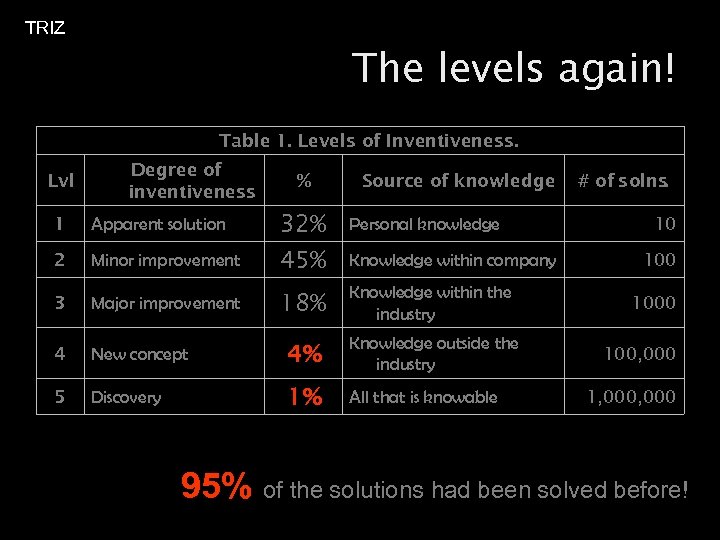 TRIZ The levels again! Table 1. Levels of Inventiveness. Lvl Degree of inventiveness % Source of knowledge Personal knowledge Minor improvement 32% 45% 3 Major improvement 18% Knowledge within the industry 4 New concept 4% Knowledge outside the industry 5 Discovery 1% All that is knowable 1 Apparent solution 2 Knowledge within company # of solns. 10 1000 100, 000 1, 000 95% of the solutions had been solved before!
 TRIZ Altshuller found …. True innovation strived to overcome contradictions. Contradictions between opposing forces like Speed – Friction Complexity – Utility
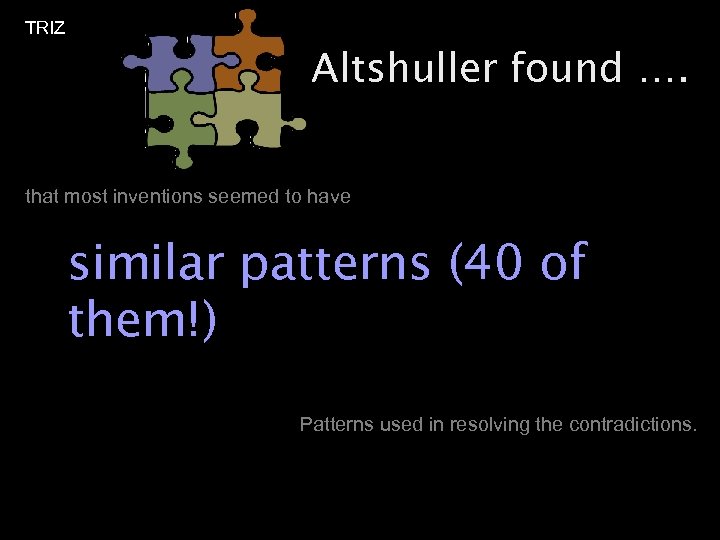 TRIZ Altshuller found …. that most inventions seemed to have similar patterns (40 of them!) Patterns used in resolving the contradictions.
 TRIZ – The Approach The first Steps
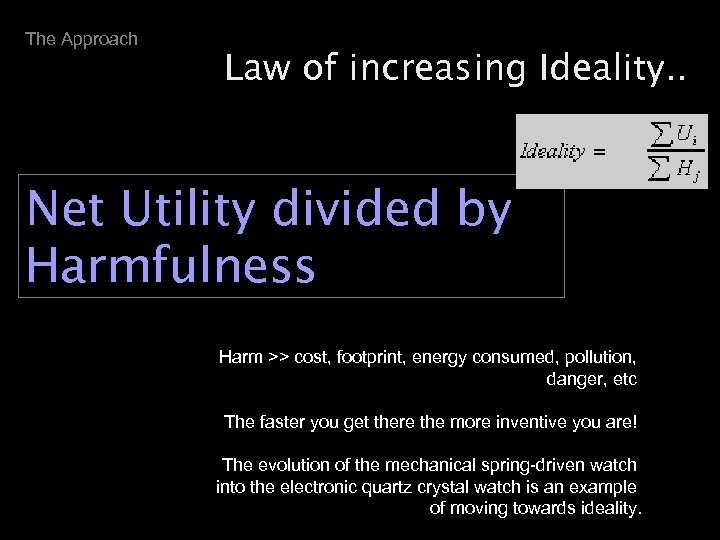 The Approach Law of increasing Ideality. . Net Utility divided by Harmfulness Harm >> cost, footprint, energy consumed, pollution, danger, etc The faster you get there the more inventive you are! The evolution of the mechanical spring-driven watch into the electronic quartz crystal watch is an example of moving towards ideality.
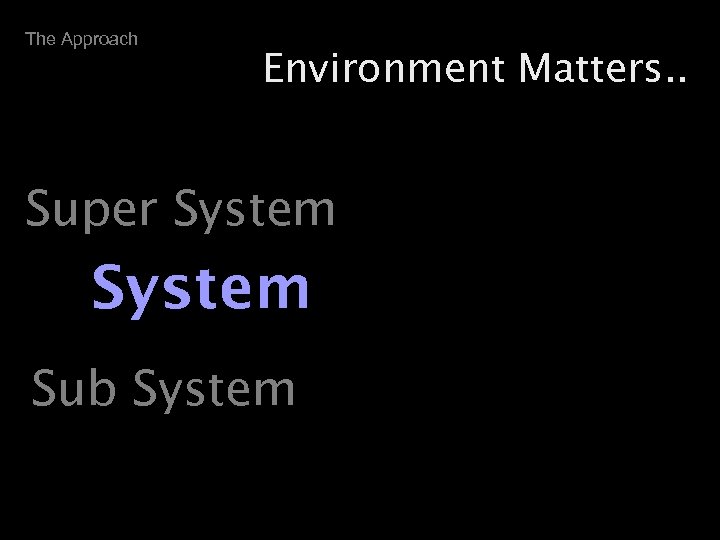 The Approach Environment Matters. . Super System Sub System
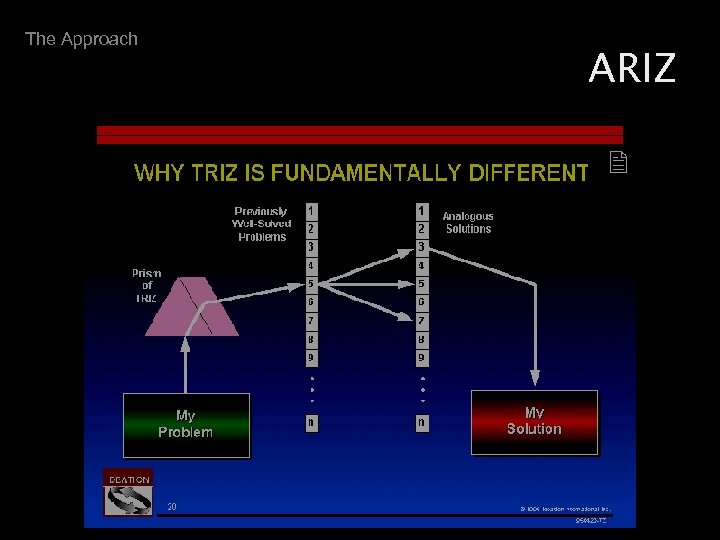 The Approach ARIZ
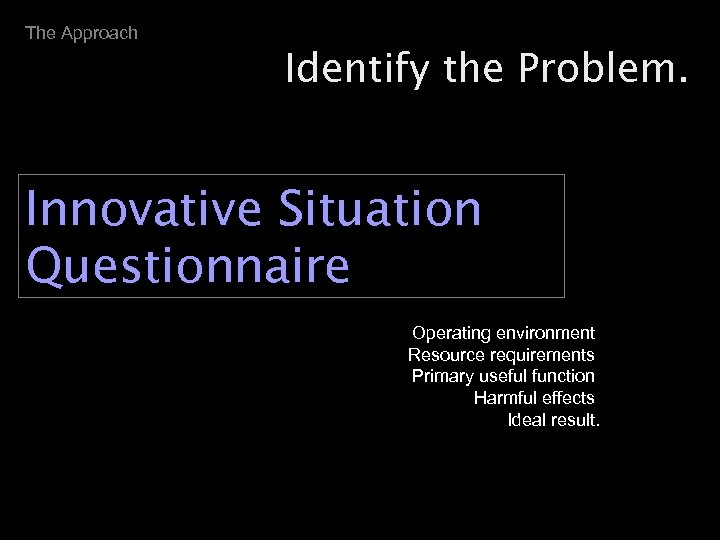 The Approach Identify the Problem. Innovative Situation Questionnaire Operating environment Resource requirements Primary useful function Harmful effects Ideal result.
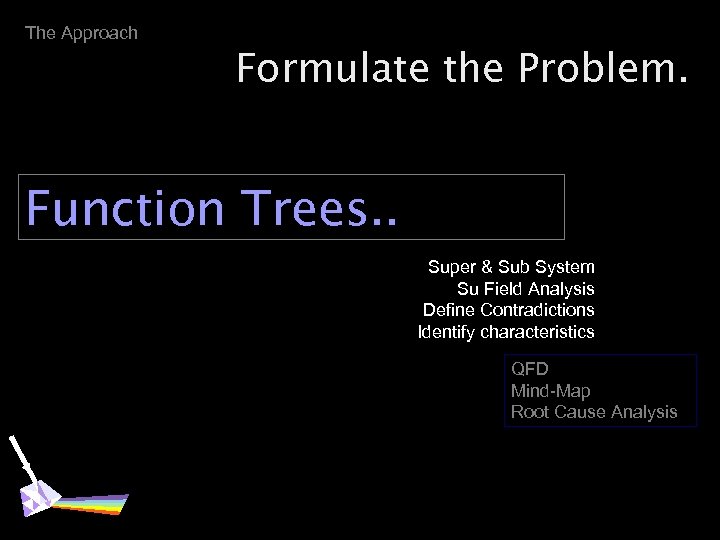 The Approach Formulate the Problem. Function Trees. . Super & Sub System Su Field Analysis Define Contradictions Identify characteristics QFD Mind-Map Root Cause Analysis
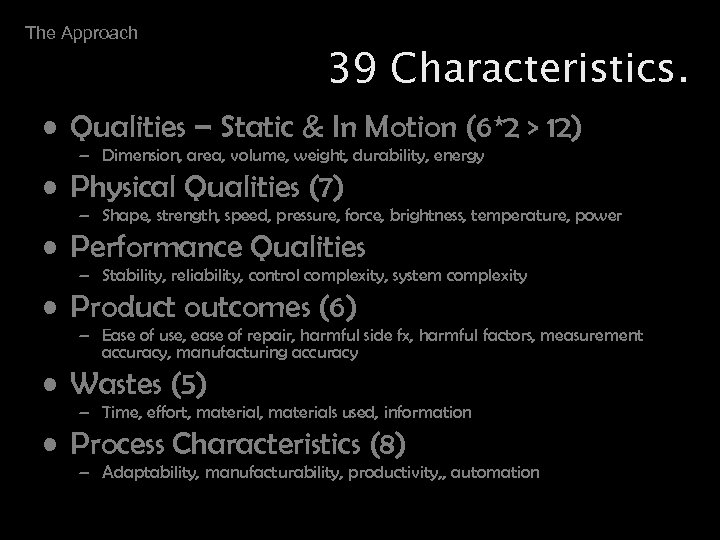 The Approach 39 Characteristics. • Qualities – Static & In Motion (6*2 > 12) – Dimension, area, volume, weight, durability, energy • Physical Qualities (7) – Shape, strength, speed, pressure, force, brightness, temperature, power • Performance Qualities – Stability, reliability, control complexity, system complexity • Product outcomes (6) – Ease of use, ease of repair, harmful side fx, harmful factors, measurement accuracy, manufacturing accuracy • Wastes (5) – Time, effort, materials used, information • Process Characteristics (8) – Adaptability, manufacturability, productivity, , automation
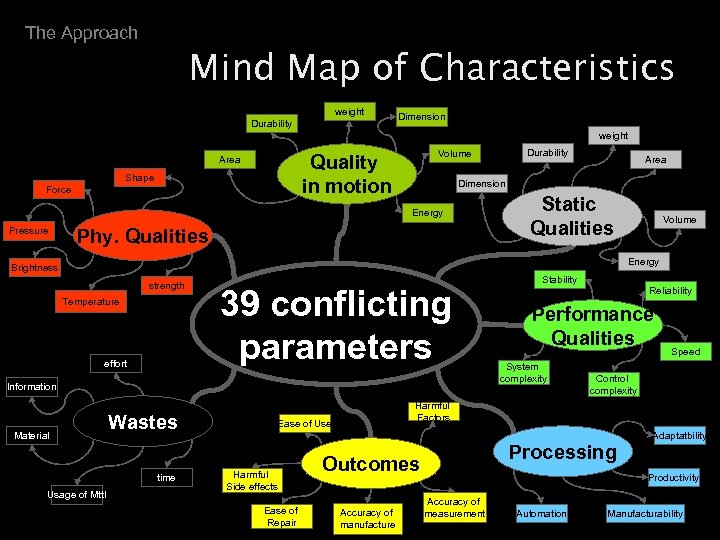 The Approach Mind Map of Characteristics weight Durability Dimension weight Shape Force Area Dimension Energy Pressure Durability Volume Quality in motion Area Phy. Qualities Static Qualities Volume Energy Brightness strength Temperature effort 39 conflicting parameters Information Material Wastes time Usage of Mttl Ease of Repair Reliability Performance Qualities System complexity Speed Control complexity Harmful Factors Ease of Use Harmful Side effects Stability Processing Outcomes Accuracy of manufacture Adaptatbility Productivity Accuracy of measurement Automation Manufacturability
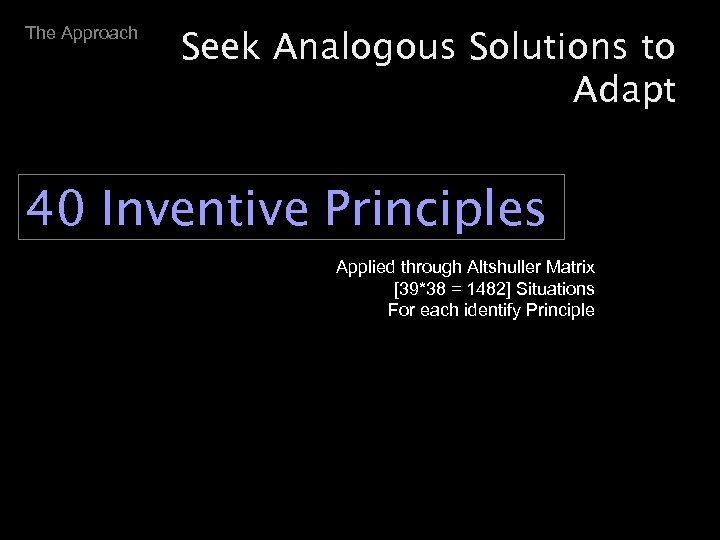 The Approach Seek Analogous Solutions to Adapt 40 Inventive Principles Applied through Altshuller Matrix [39*38 = 1482] Situations For each identify Principle
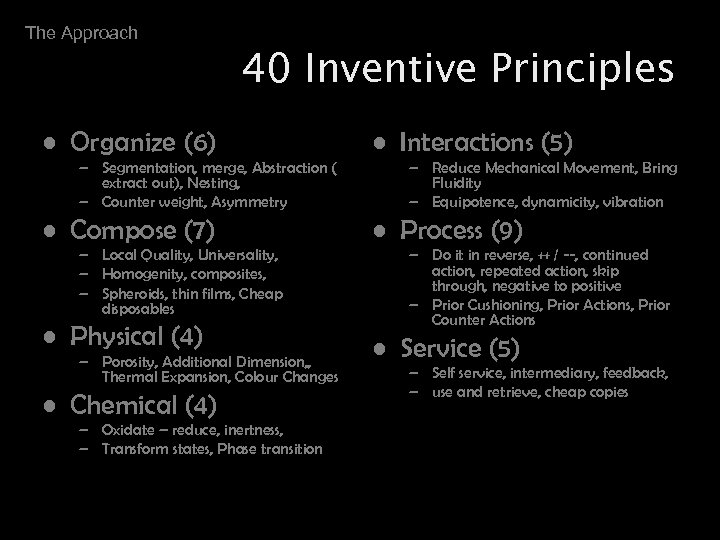 The Approach 40 Inventive Principles • Organize (6) – Segmentation, merge, Abstraction ( extract out), Nesting, – Counter weight, Asymmetry • Compose (7) – Local Quality, Universality, – Homogenity, composites, – Spheroids, thin films, Cheap disposables • Physical (4) – Porosity, Additional Dimension, , Thermal Expansion, Colour Changes • Chemical (4) – Oxidate – reduce, inertness, – Transform states, Phase transition • Interactions (5) – Reduce Mechanical Movement, Bring Fluidity – Equipotence, dynamicity, vibration • Process (9) – Do it in reverse, ++ / --, continued action, repeated action, skip through, negative to positive – Prior Cushioning, Prior Actions, Prior Counter Actions • Service (5) – Self service, intermediary, feedback, – use and retrieve, cheap copies
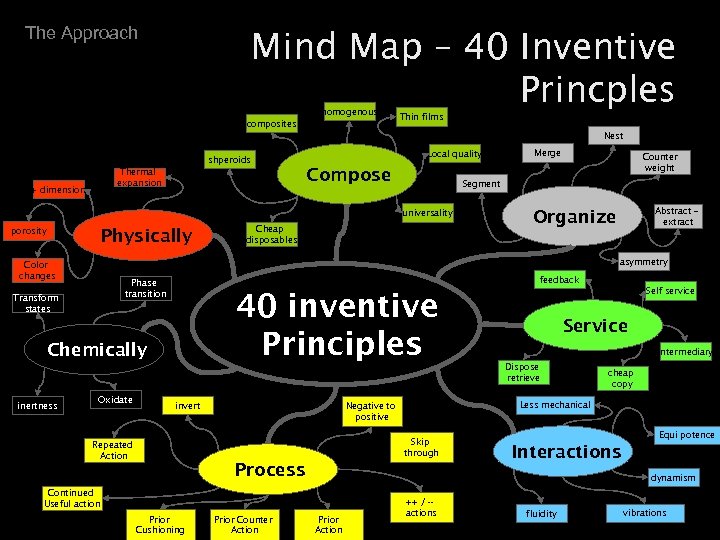 The Approach Mind Map – 40 Inventive Princples homogenous composites Thin films Nest shperoids Thermal expansion + dimension Local quality Compose Physically Cheap disposables Abstract – extract Organize asymmetry Color changes feedback Phase transition Transform states 40 inventive Principles Chemically inertness Counter weight Segment universality porosity Merge Oxidate invert Process Prior Counter Action intermediary Dispose retrieve cheap copy Equi potence Interactions dynamism Continued Useful action Prior Cushioning Service Less mechanical Negative to positive Skip through Repeated Action Self service Prior Action ++ / -actions fluidity vibrations
 The Approach Identify my specific problem Search Patent Databases Identify Near by solutions Experiment Implement. 95% of the solutions that had been solved before!
 TRIZ - TRIX Tools of the Trade. .
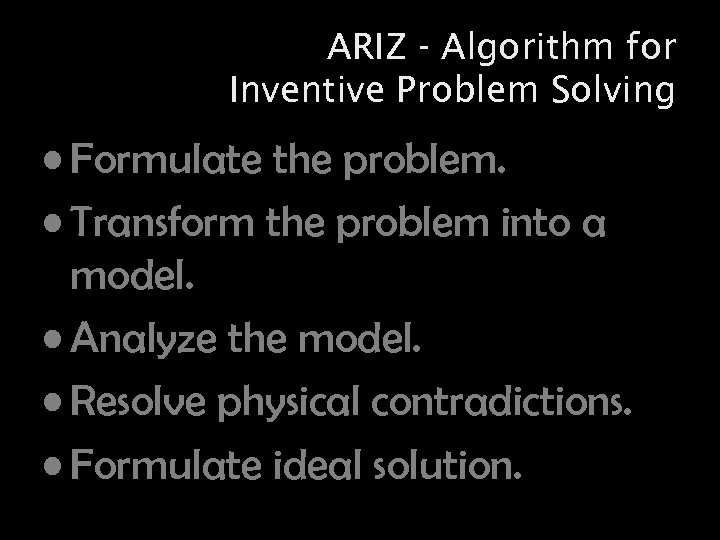 ARIZ - Algorithm for Inventive Problem Solving • Formulate the problem. • Transform the problem into a model. • Analyze the model. • Resolve physical contradictions. • Formulate ideal solution.
 Su-Field Analysis • Interactions of objects ( substances ) • Through Fields • Standard triangulation • Between subject and object and • The Field in between. • The field is where the contradiction is
 Anticipatory Failure Determination (AFD) • Failure factor analysis • ? FMEA/ QFD / Ishikawa?
 Directed Product Evolution (DPE) • Road map to the future! • Following Principles – Technology lifecycle – Increasing IFR ( ideal final result) – Increasing complexity followed by simplicity Uneven development of sub systems – Matching mis-matching of parts – Macro to micronization – Increasing Dynamism and control – Reducing human intervention – automation
 Some companies with TRIZ • • • Allied Signal Aerospace Sector Chrysler Corp. Emerson Electric Ford Motor Co. General Motors Corp. Johnson & Johnson Rockwell International UNISYS Xerox Corporation LG group
 40 Triz Principles Foundation of TRIZ. .
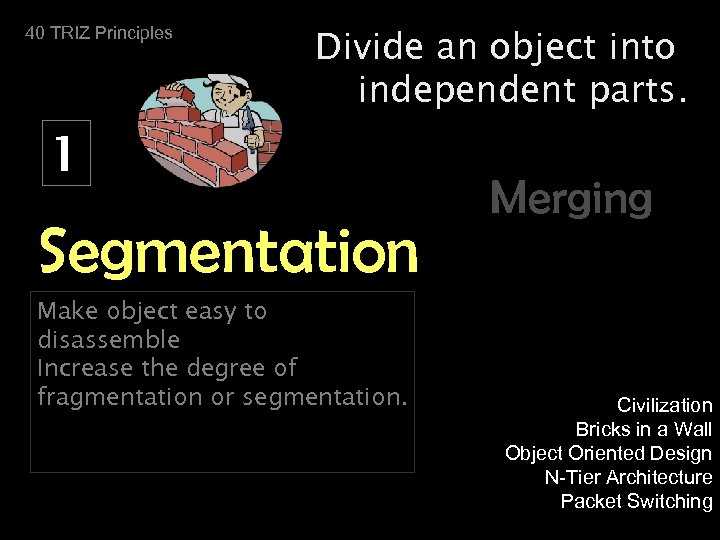 40 TRIZ Principles Divide an object into independent parts. 1 Segmentation Make object easy to disassemble Increase the degree of fragmentation or segmentation. Merging Civilization Bricks in a Wall Object Oriented Design N-Tier Architecture Packet Switching
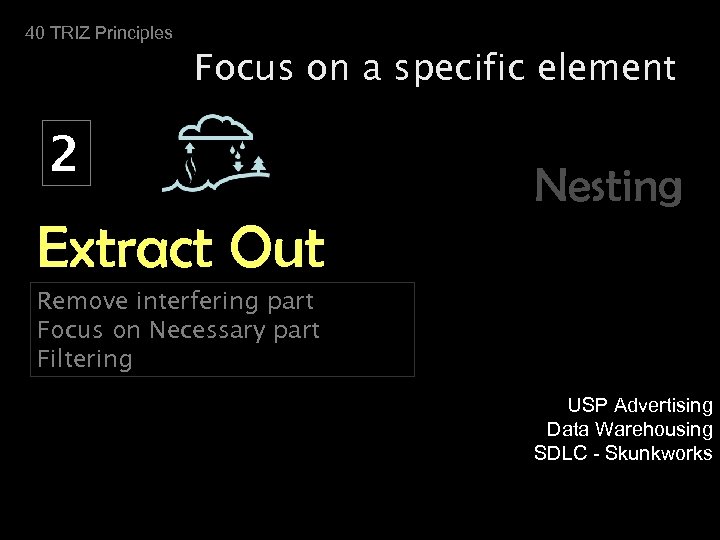 40 TRIZ Principles Focus on a specific element 2 Nesting Extract Out Remove interfering part Focus on Necessary part Filtering USP Advertising Data Warehousing SDLC - Skunkworks
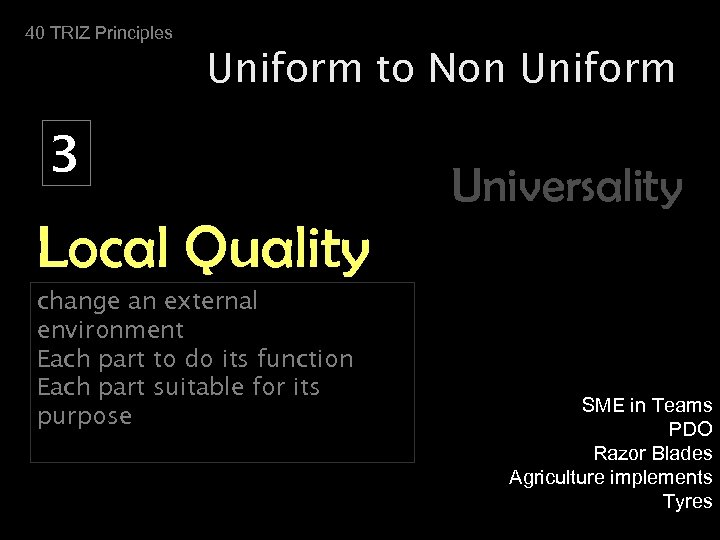 40 TRIZ Principles Uniform to Non Uniform 3 Universality Local Quality change an external environment Each part to do its function Each part suitable for its purpose SME in Teams PDO Razor Blades Agriculture implements Tyres
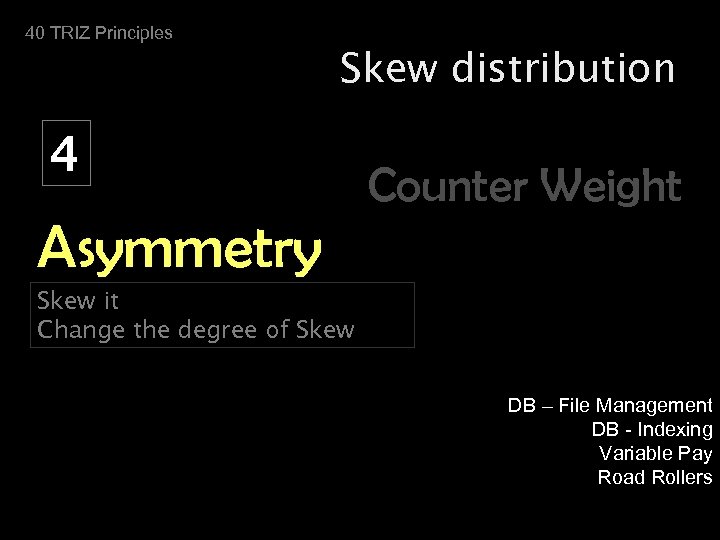 40 TRIZ Principles Skew distribution 4 Counter Weight Asymmetry Skew it Change the degree of Skew DB – File Management DB - Indexing Variable Pay Road Rollers
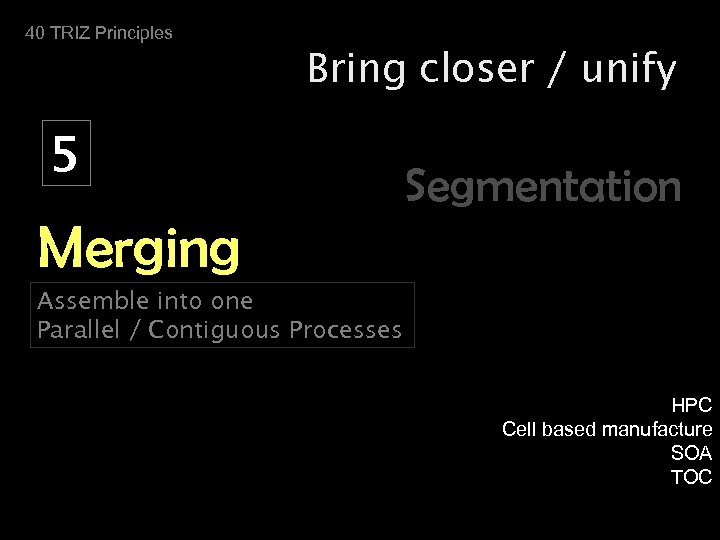 40 TRIZ Principles Bring closer / unify 5 Segmentation Merging Assemble into one Parallel / Contiguous Processes HPC Cell based manufacture SOA TOC
 40 TRIZ Principles Use everywhere 6 Local Quality Universality Standard Object in multiple contexts Casio – Screw Standards Rationalize SOA Normalization
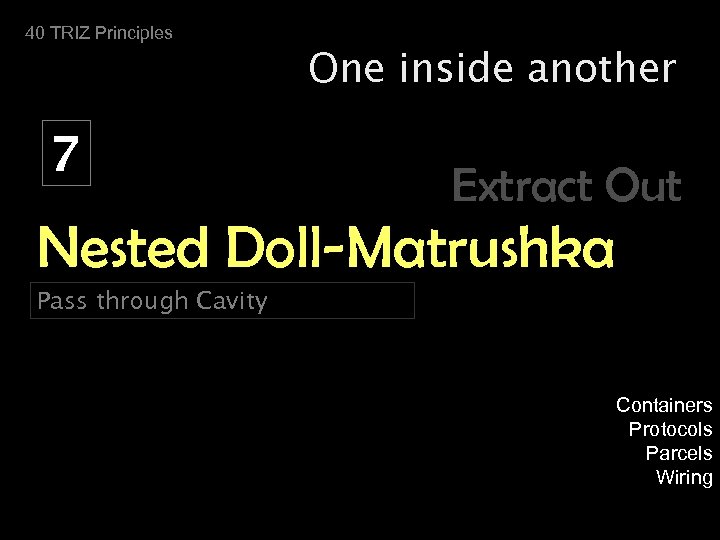 40 TRIZ Principles One inside another 7 Extract Out Nested Doll-Matrushka Pass through Cavity Containers Protocols Parcels Wiring
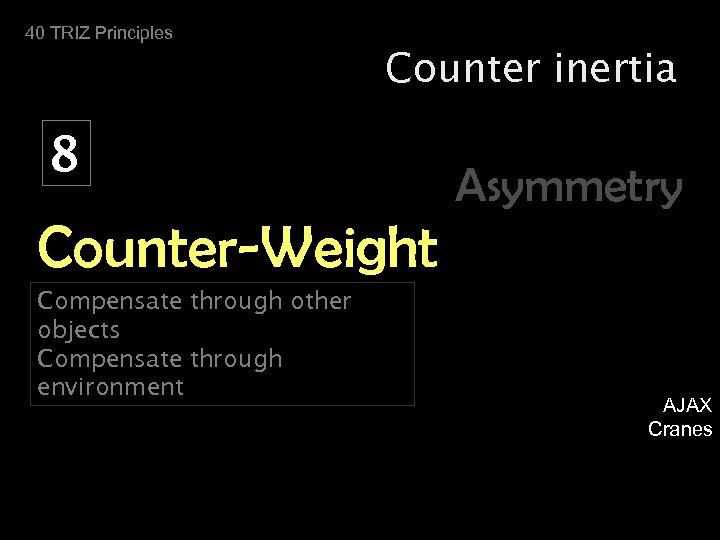 40 TRIZ Principles Counter inertia 8 Asymmetry Counter-Weight Compensate through other objects Compensate through environment AJAX Cranes
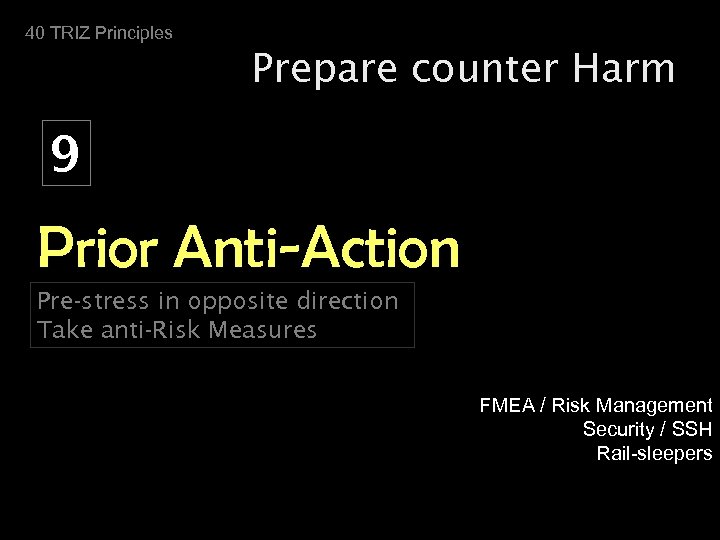 40 TRIZ Principles Prepare counter Harm 9 Prior Anti-Action Pre-stress in opposite direction Take anti-Risk Measures FMEA / Risk Management Security / SSH Rail-sleepers
 40 TRIZ Principles Prepare before time is due 10 Prior Action Pre process activities – offline Pre Arrange and ready for event Cron Jobs Indexes DW-DM Assembly line Cooking Pre-Fab Construction
 40 TRIZ Principles Prepare emergencies before hand 11 Prior Cushioning Redundancy Risk Mitigation PPA-FMEA DR-BC Redundancy Peak Demands
 40 TRIZ Principles Reduce Position changes 12 Vibration Equi-potentiality Eliminate the need to restructure Job Rotation-Peter Principle Flexible Matrix Organization
 40 TRIZ Principles Counter Intuition / Norm 13 Do it in reverse Invert the Actions – the other way around Change the conditions of elements Change orientations LD Process Flux Core Welding ‘Ready, Fire, Aim’ - Tom Peters Unlearning
 40 TRIZ Principles Curvature 14 Spheroidality Rectilinear – Curvilinear Rollers Balls Spirals Domes Linear to Rotary motion Electric engines Chamfering Ergonomics-Aesthetics Quality Circles Token Rings SAN - Ring
 40 TRIZ Principles Allow / Encourage Change 15 Dynamics Self Optimizing Moving parts Adaptive Components SWAT Self learning DM-DW DHTML-AJAX Customization
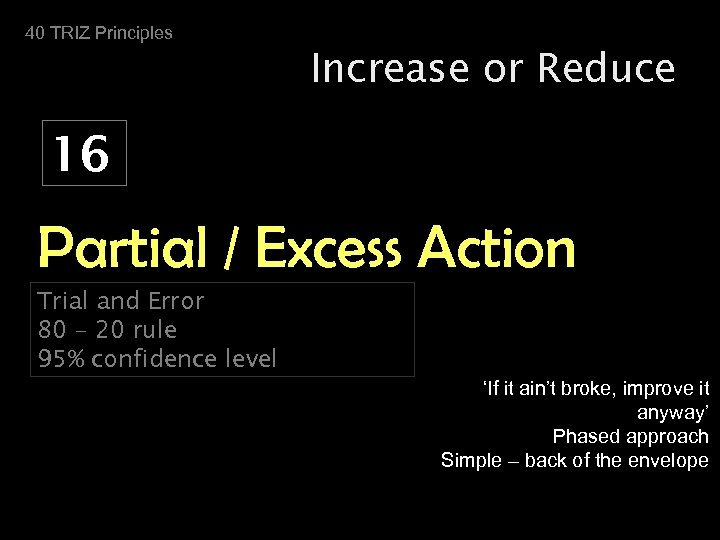 40 TRIZ Principles Increase or Reduce 16 Partial / Excess Action Trial and Error 80 – 20 rule 95% confidence level ‘If it ain’t broke, improve it anyway’ Phased approach Simple – back of the envelope
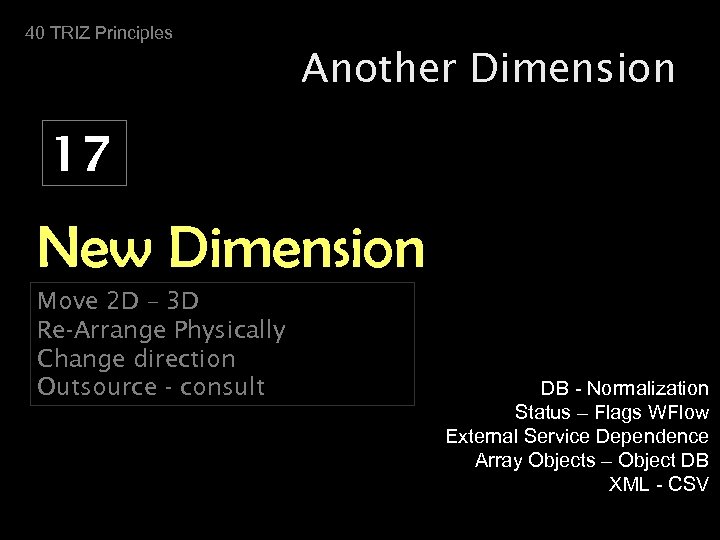 40 TRIZ Principles Another Dimension 17 New Dimension Move 2 D – 3 D Re-Arrange Physically Change direction Outsource - consult DB - Normalization Status – Flags WFlow External Service Dependence Array Objects – Object DB XML - CSV
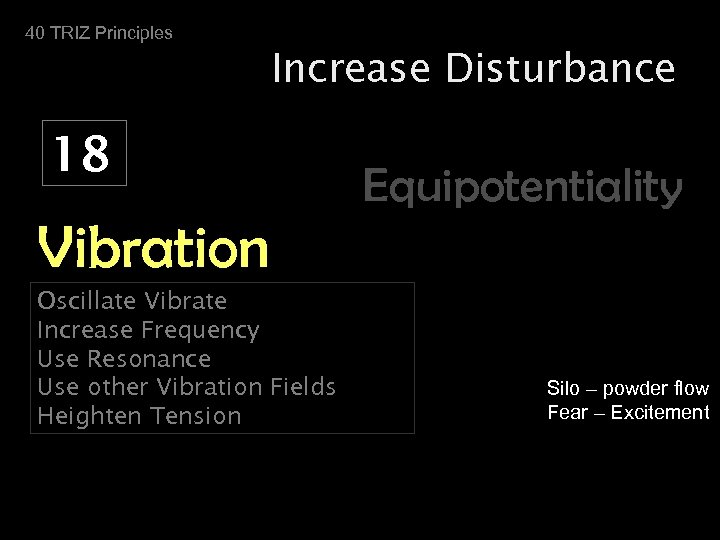 40 TRIZ Principles Increase Disturbance 18 Equipotentiality Vibration Oscillate Vibrate Increase Frequency Use Resonance Use other Vibration Fields Heighten Tension Silo – powder flow Fear – Excitement
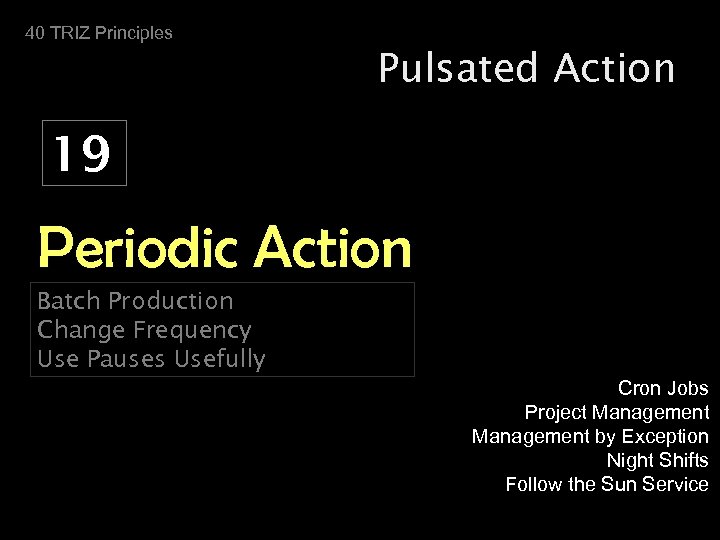 40 TRIZ Principles Pulsated Action 19 Periodic Action Batch Production Change Frequency Use Pauses Usefully Cron Jobs Project Management by Exception Night Shifts Follow the Sun Service
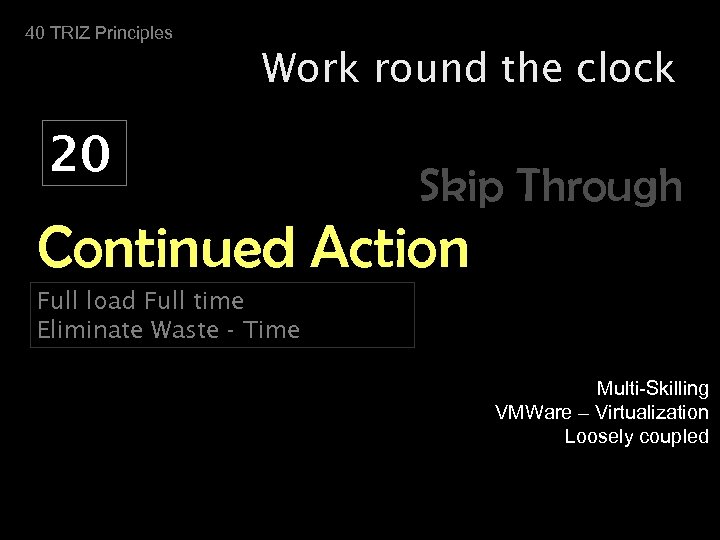 40 TRIZ Principles Work round the clock 20 Skip Through Continued Action Full load Full time Eliminate Waste - Time Multi-Skilling VMWare – Virtualization Loosely coupled
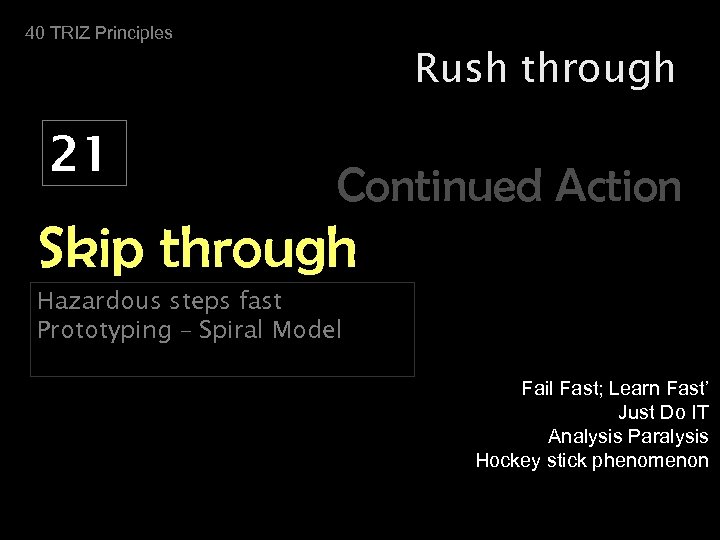 40 TRIZ Principles Rush through 21 Continued Action Skip through Hazardous steps fast Prototyping – Spiral Model Fail Fast; Learn Fast’ Just Do IT Analysis Paralysis Hockey stick phenomenon
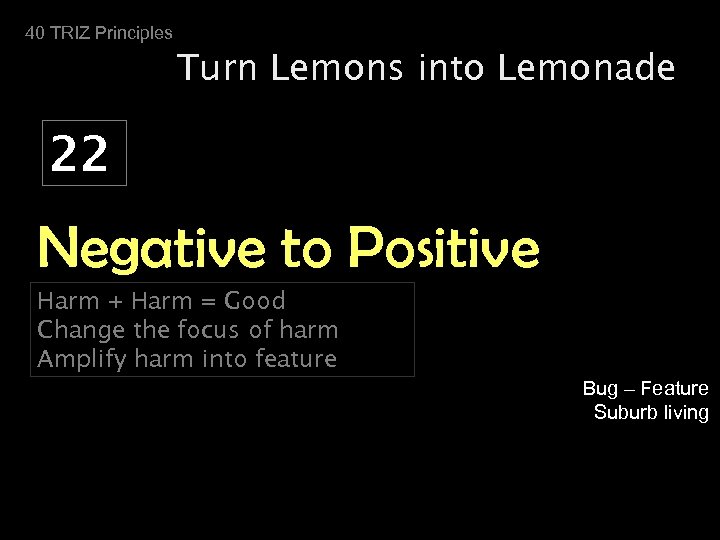 40 TRIZ Principles Turn Lemons into Lemonade 22 Negative to Positive Harm + Harm = Good Change the focus of harm Amplify harm into feature Bug – Feature Suburb living
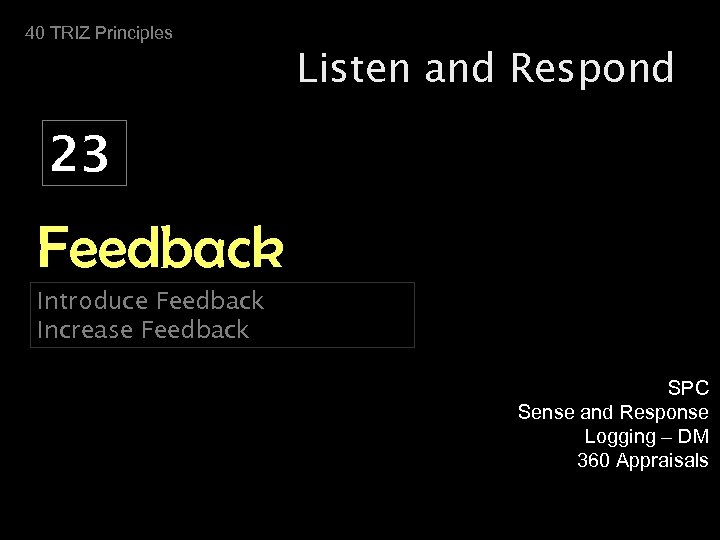 40 TRIZ Principles Listen and Respond 23 Feedback Introduce Feedback Increase Feedback SPC Sense and Response Logging – DM 360 Appraisals
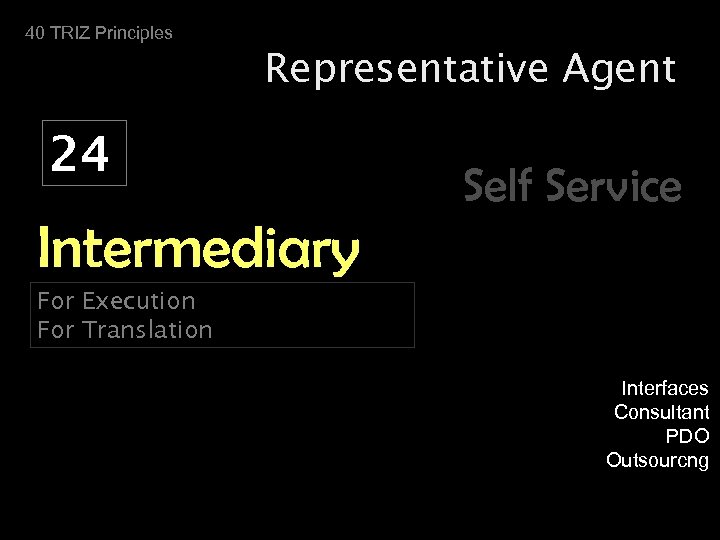 40 TRIZ Principles Representative Agent 24 Self Service Intermediary For Execution For Translation Interfaces Consultant PDO Outsourcng
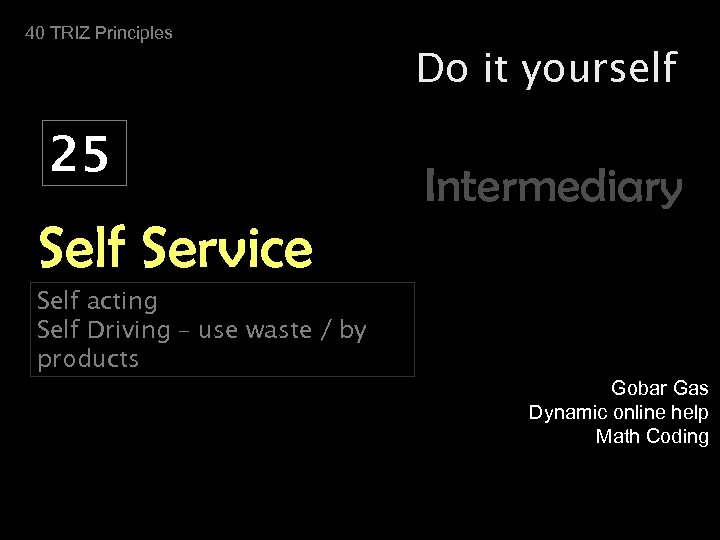 40 TRIZ Principles Do it yourself 25 Intermediary Self Service Self acting Self Driving – use waste / by products Gobar Gas Dynamic online help Math Coding
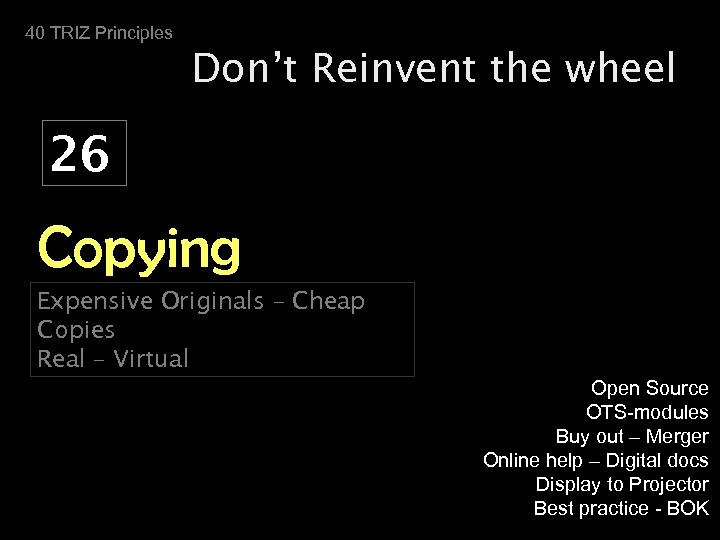 40 TRIZ Principles Don’t Reinvent the wheel 26 Copying Expensive Originals – Cheap Copies Real – Virtual Open Source OTS-modules Buy out – Merger Online help – Digital docs Display to Projector Best practice - BOK
 40 TRIZ Principles Cheap Objects 27 Cheap Shortlife Objects Cheap Compromises Paper cutlery Lesser Payload
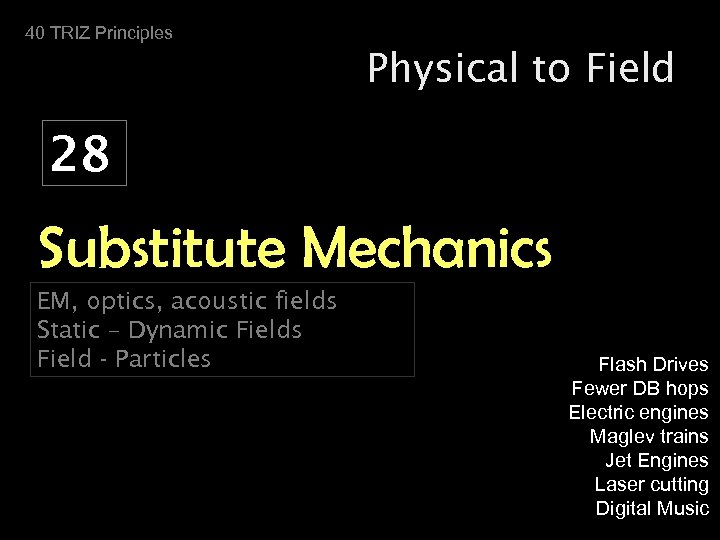 40 TRIZ Principles Physical to Field 28 Substitute Mechanics EM, optics, acoustic fields Static – Dynamic Fields Field - Particles Flash Drives Fewer DB hops Electric engines Maglev trains Jet Engines Laser cutting Digital Music
 40 TRIZ Principles Pneumatics & hydraulics 29 Fluidity Gaseuos – liquid parts Air Cushions Panama Canal
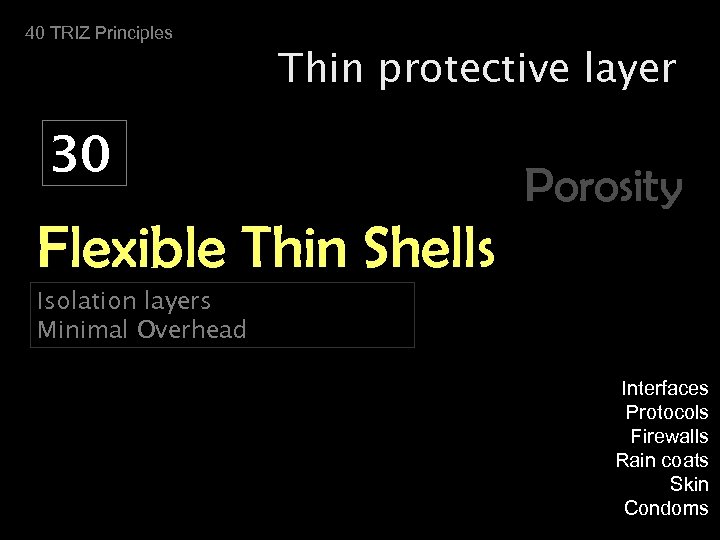 40 TRIZ Principles Thin protective layer 30 Porosity Flexible Thin Shells Isolation layers Minimal Overhead Interfaces Protocols Firewalls Rain coats Skin Condoms
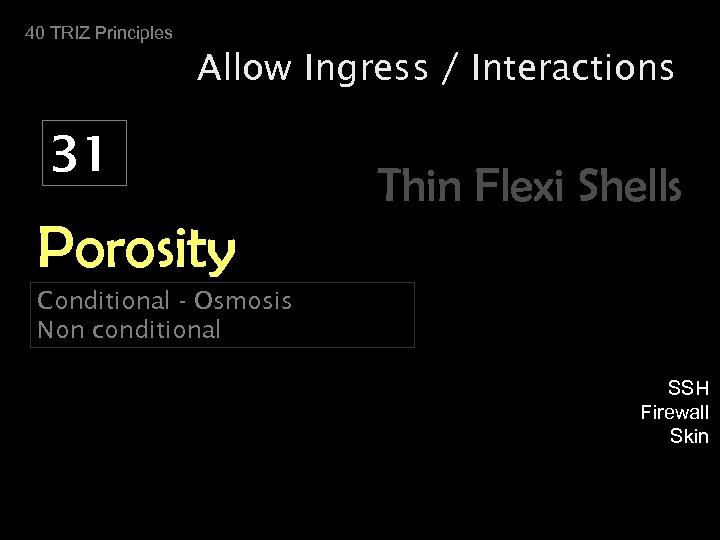 40 TRIZ Principles Allow Ingress / Interactions 31 Thin Flexi Shells Porosity Conditional - Osmosis Non conditional SSH Firewall Skin
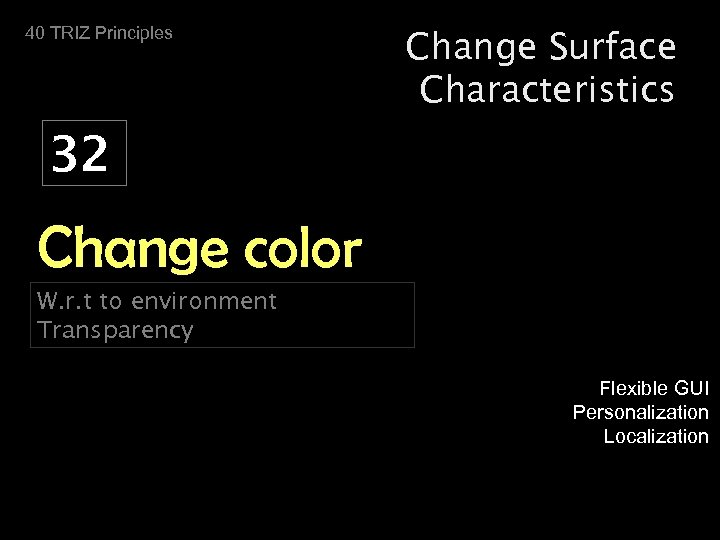 40 TRIZ Principles Change Surface Characteristics 32 Change color W. r. t to environment Transparency Flexible GUI Personalization Localization
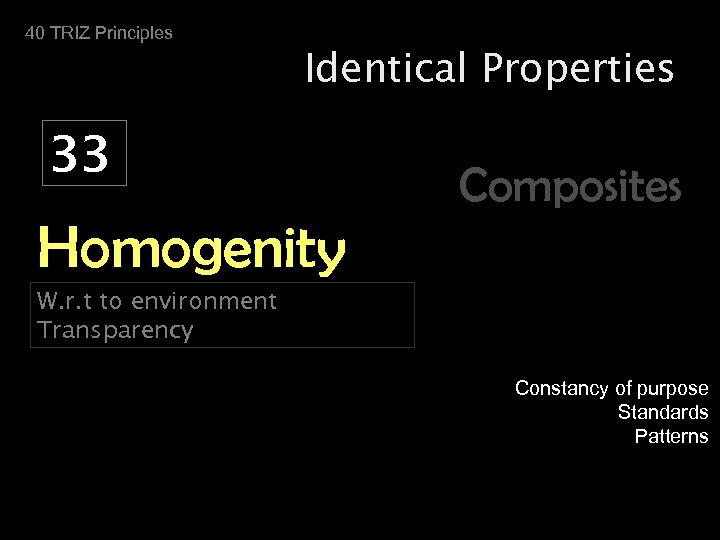 40 TRIZ Principles Identical Properties 33 Composites Homogenity W. r. t to environment Transparency Constancy of purpose Standards Patterns
 40 TRIZ Principles Throw and Re-Use 34 Discard & Recover Discard useless Parts Retain / Recover Consumables Shuttle Session Variables Persistance PDO Cache
 40 TRIZ Principles Change State 35 Parameter Changes Change Density/Concentration Degree of Flexibility Simulation Telephone Banking
 40 TRIZ Principles Change State 36 Phase Transitions Phenomena during transitions Simulation Telephone Banking
 40 TRIZ Principles Material Expansion / Contraction 37 Thermal Expansion Differential Expansion Motivation
 40 TRIZ Principles Catalysis / Enhance Action 38 Inertness Strong Oxidation Accelerate Action Ionization Case-Studies Best Practices
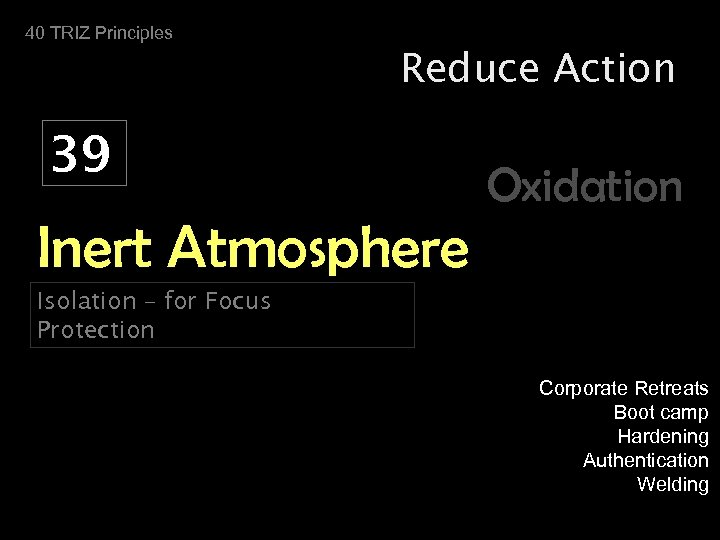 40 TRIZ Principles Reduce Action 39 Oxidation Inert Atmosphere Isolation – for Focus Protection Corporate Retreats Boot camp Hardening Authentication Welding
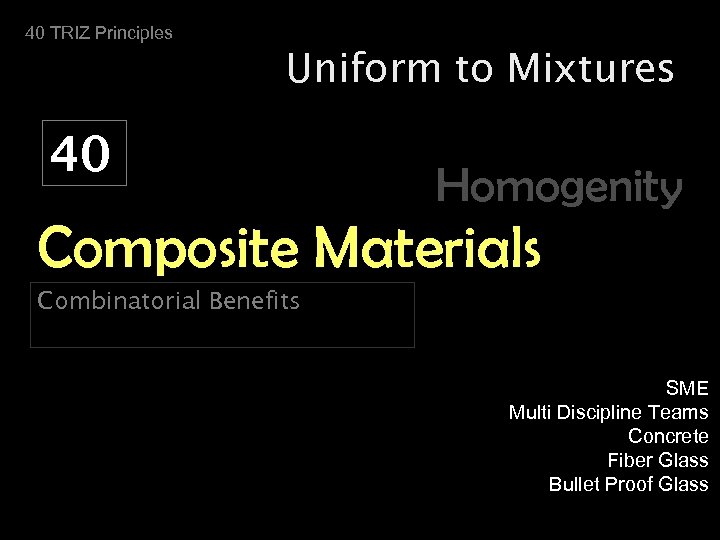 40 TRIZ Principles Uniform to Mixtures 40 Homogenity Composite Materials Combinatorial Benefits SME Multi Discipline Teams Concrete Fiber Glass Bullet Proof Glass
 Thanks Again to • http: //Mazur. net/triz • www. Triz-journal. com • Presentation style – Tom Asacker – Tom Peters Work in Progress …. To be Continued
 Vishwanath Ramdas is … • Process and Business Consultant • Working in areas like ITSM, Software development, process consulting … • Based in bangalore [India] • Visit him @ – http: //gopu 44. googlepages. com