


 Скачать презентацию TRIX Trapped Radium Ion e Xperiments Oscar Versolato
da26ef8b6bf7a8b448908111d7c0bd8a.ppt
- Количество слайдов: 29
 TRIX: Trapped Radium Ion e. Xperiments Oscar Versolato TRIm. P: Trapped Radioactive Isotopes: micro-laboratories for fundamental
 Outline • Where’s The Netherlands in Amsterdam? • Introduction to research group TRI P • TRIX project: Trapped (single !) Radium Ion e. Xperiments • Bonus material 1: shelving • Bonus material 2: ion trapping
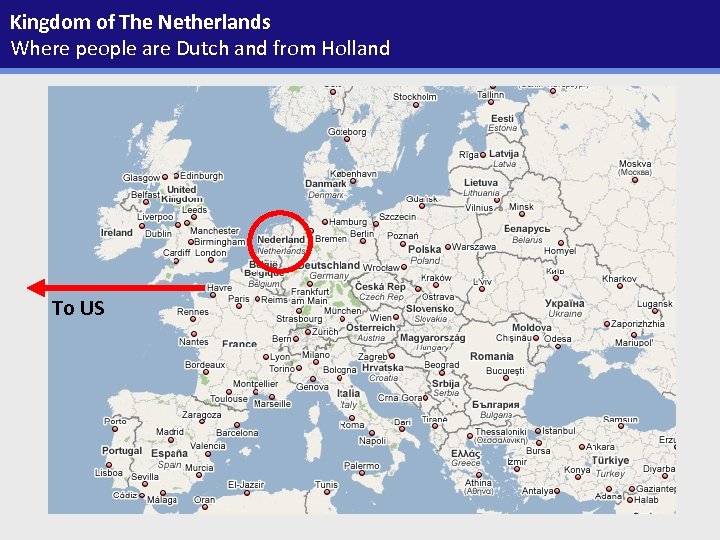 Kingdom of The Netherlands Where people are Dutch and from Holland To US
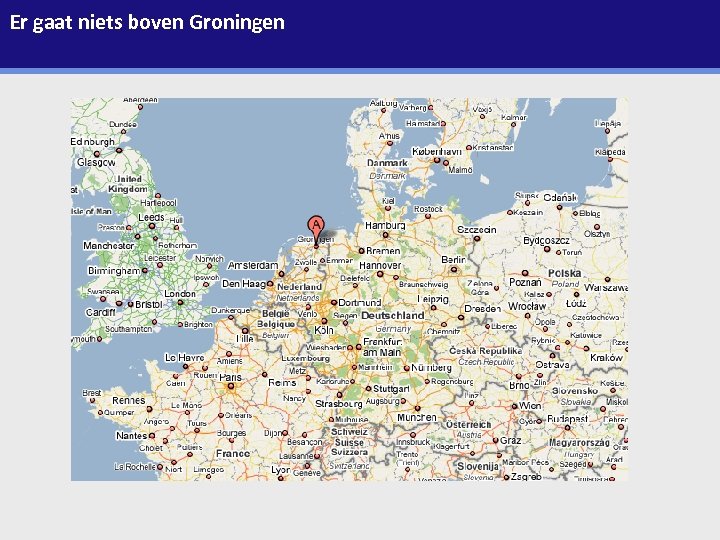 Er gaat niets boven Groningen
 Groningen: a students dream come true
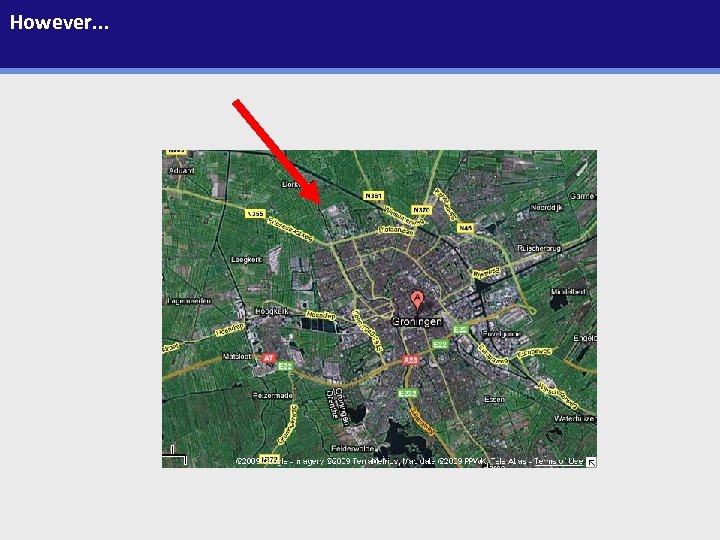 However. . .
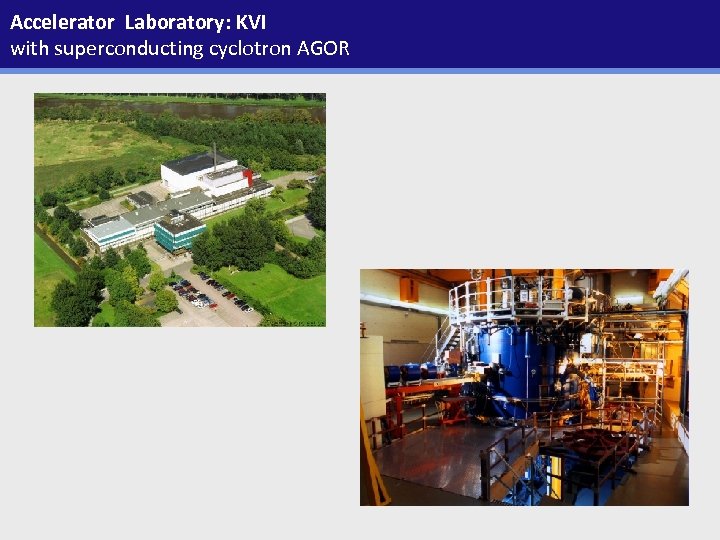 Accelerator Laboratory: KVI with superconducting cyclotron AGOR
 TRIm. P: Trapped Radioactive Isotopes: micro-laboratories for fundamental Physics
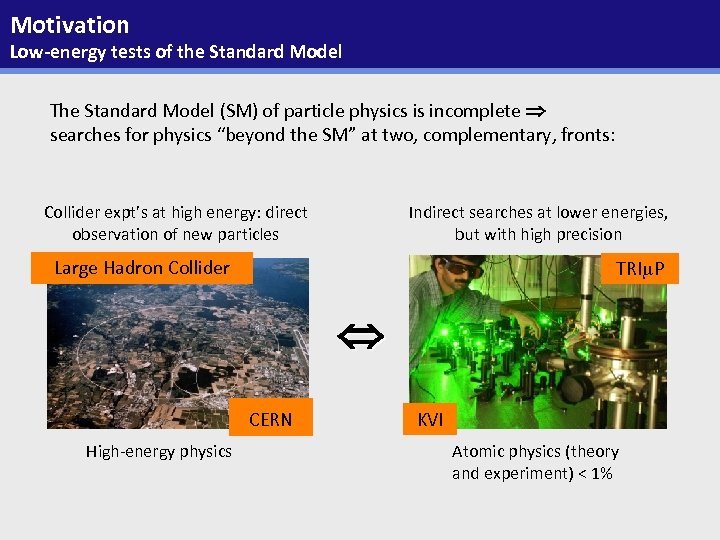 Motivation Low-energy tests of the Standard Model The Standard Model (SM) of particle physics is incomplete searches for physics “beyond the SM” at two, complementary, fronts: Collider expt’s at high energy: direct observation of new particles Indirect searches at lower energies, but with high precision Large Hadron Collider TRI P CERN High-energy physics KVI Atomic physics (theory and experiment) < 1%
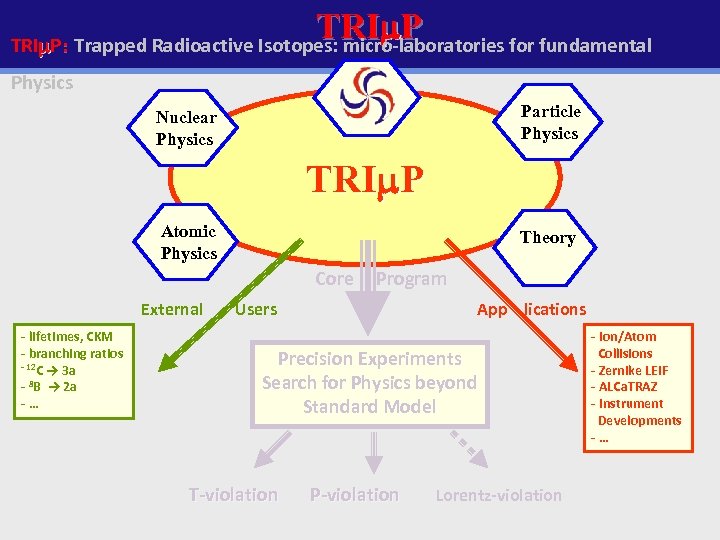 TRIm. P: Trapped Radioactive Isotopes: micro-laboratories for fundamental Physics Particle Physics Nuclear Physics TRIm. P Atomic Physics Theory Core External - lifetimes, CKM - branching ratios - 12 C → 3 a - 8 B → 2 a -… Program Users App lications Precision Experiments Search for Physics beyond Standard Model T-violation P-violation Lorentz-violation - Ion/Atom Collisions - Zernike LEIF - ALCa. TRAZ - Instrument Developments -…
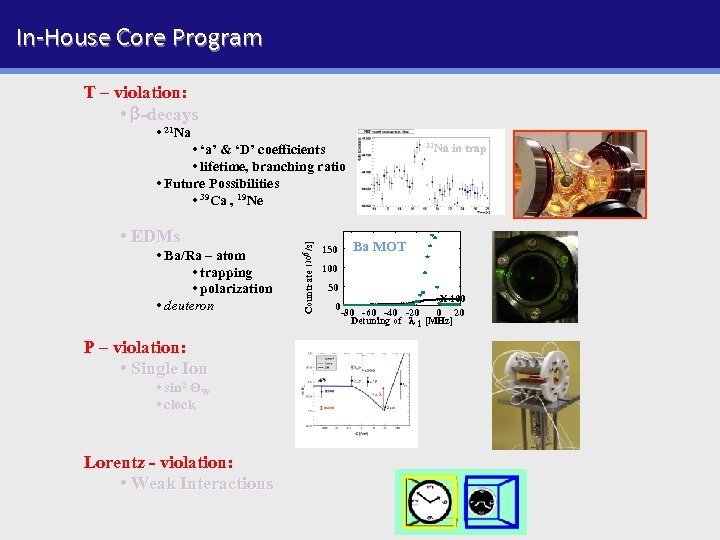 In-House Core Program T – violation: • b-decays • 21 Na • Ba/Ra – atom • trapping • polarization • deuteron P – violation: • Single Ion • sin 2 ϴW • clock Lorentz - violation: • Weak Interactions Countrate • EDMs [106 /s] • ‘a’ & ‘D’ coefficients • lifetime, branching ratio • Future Possibilities • 39 Ca , 19 Ne 150 in trap Ba MOT 100 50 0 X 100 -80 -60 -40 -20 0 20 Detuning of l 1 [MHz]
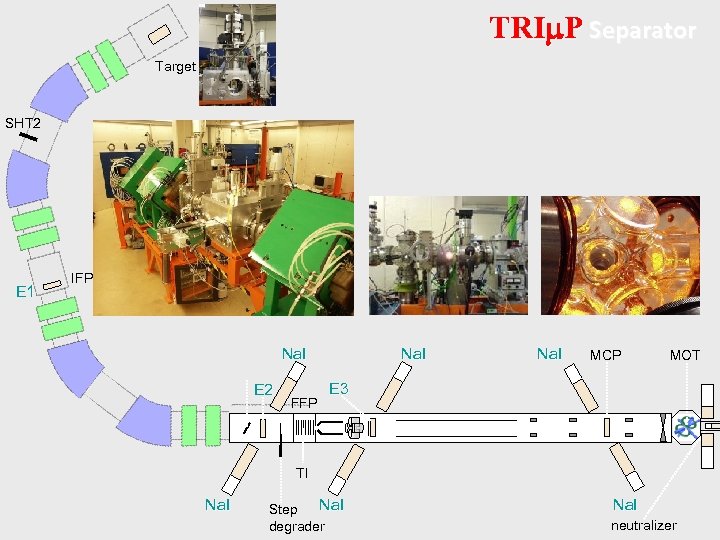 TRIm. P Separator Target SHT 2 E 1 IFP Na. I E 2 FFP Na. I MCP MOT E 3 TI Na. I Step degrader Na. I neutralizer
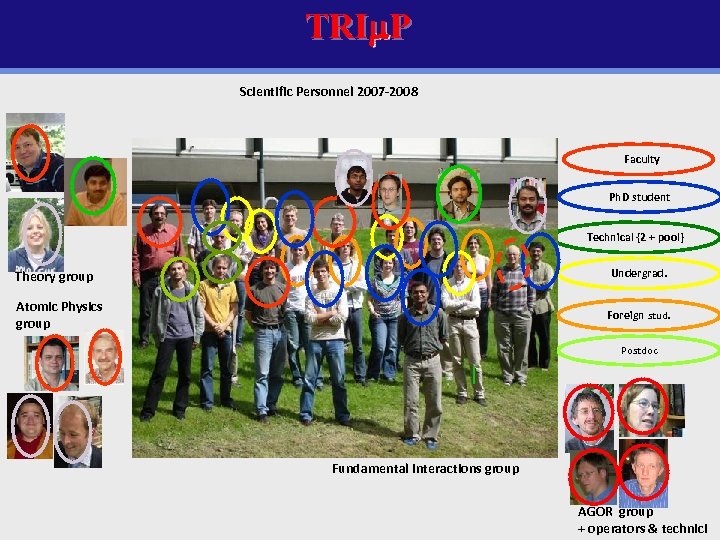 TRIm. P Scientific Personnel 2007 -2008 Faculty Ph. D student Technical {2 + pool} Theory group Undergrad. Atomic Physics group Foreign stud. Postdoc Fundamental Interactions group AGOR group + operators & technici
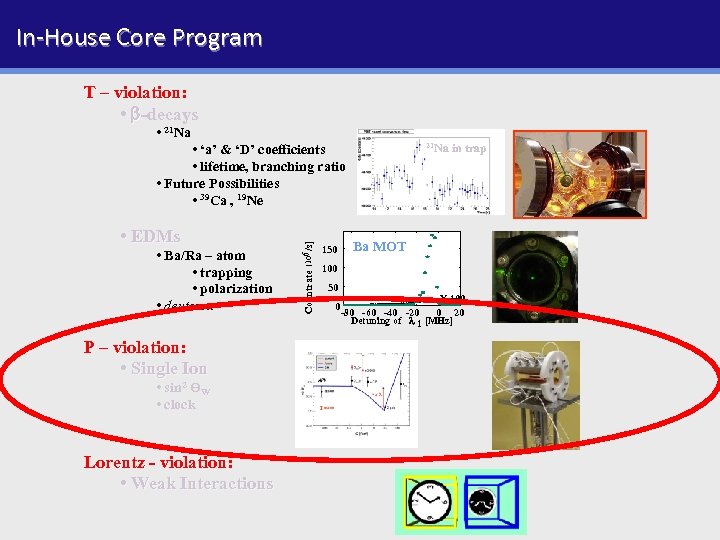 In-House Core Program T – violation: • b-decays • 21 Na • Ba/Ra – atom • trapping • polarization • deuteron P – violation: • Single Ion • sin 2 ϴW • clock Lorentz - violation: • Weak Interactions Countrate • EDMs [106 /s] • ‘a’ & ‘D’ coefficients • lifetime, branching ratio • Future Possibilities • 39 Ca , 19 Ne 150 in trap Ba MOT 100 50 0 X 100 -80 -60 -40 -20 0 20 Detuning of l 1 [MHz]
 TRIX: Trapped Radium Ion e. Xperiments Atomic parity violation & All-optical atomic clock
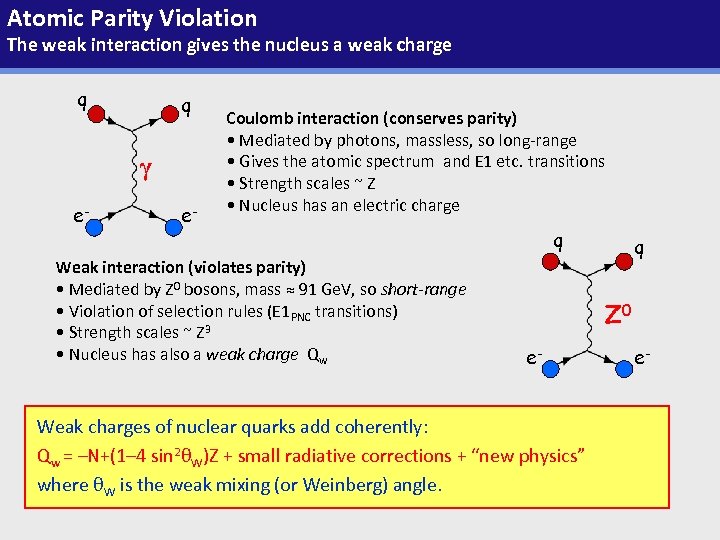 Atomic Parity Violation The weak interaction gives the nucleus a weak charge q q γ e- e- Coulomb interaction (conserves parity) • Mediated by photons, massless, so long-range • Gives the atomic spectrum and E 1 etc. transitions • Strength scales ~ Z • Nucleus has an electric charge Weak interaction (violates parity) • Mediated by Z 0 bosons, mass ≈ 91 Ge. V, so short-range • Violation of selection rules (E 1 PNC transitions) • Strength scales ~ Z 3 • Nucleus has also a weak charge Qw q q Z 0 e- Weak charges of nuclear quarks add coherently: Qw = –N+(1– 4 sin 2θW)Z + small radiative corrections + “new physics” where θW is the weak mixing (or Weinberg) angle. e-
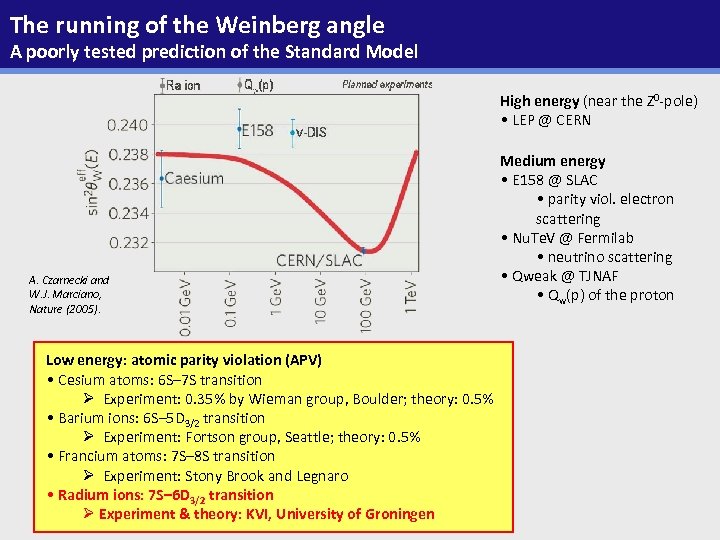 The running of the Weinberg angle A poorly tested prediction of the Standard Model High energy (near the Z 0 -pole) • LEP @ CERN A. Czarnecki and W. J. Marciano, Nature (2005). Low energy: atomic parity violation (APV) • Cesium atoms: 6 S– 7 S transition Ø Experiment: 0. 35% by Wieman group, Boulder; theory: 0. 5% • Barium ions: 6 S– 5 D 3/2 transition Ø Experiment: Fortson group, Seattle; theory: 0. 5% • Francium atoms: 7 S– 8 S transition Ø Experiment: Stony Brook and Legnaro • Radium ions: 7 S– 6 D 3/2 transition Ø Experiment & theory: KVI, University of Groningen Medium energy • E 158 @ SLAC • parity viol. electron scattering • Nu. Te. V @ Fermilab • neutrino scattering • Qweak @ TJNAF • Qw(p) of the proton
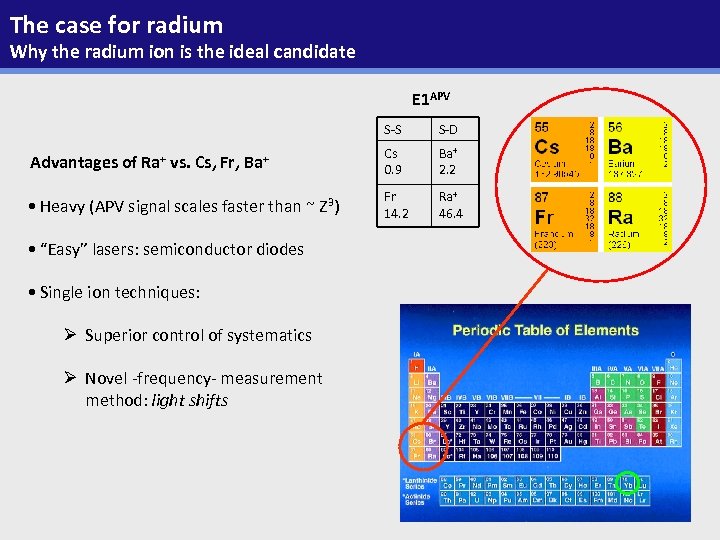 The case for radium Why the radium ion is the ideal candidate E 1 APV S-S Advantages of Ra+ vs. Cs, Fr, Ba+ • Heavy (APV signal scales faster than ~ Z 3) • “Easy” lasers: semiconductor diodes • Single ion techniques: Ø Superior control of systematics Ø Novel -frequency- measurement method: light shifts S-D Cs 0. 9 Ba+ 2. 2 Fr 14. 2 Ra+ 46. 4
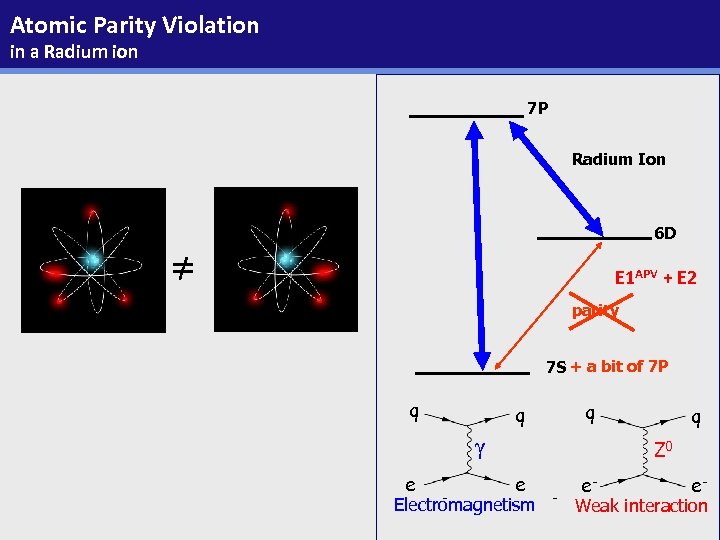 Atomic Parity Violation in a Radium ion 7 P Radium Ion 6 D ≠ E 1 APV + E 2 parity 7 S + a bit of 7 P q q q γ e q Z 0 e Electromagnetism - e- e- Weak interaction
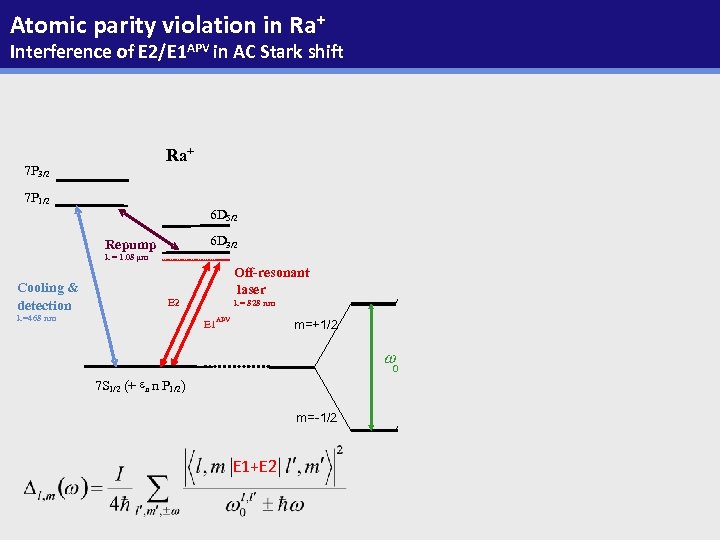 Atomic parity violation in Ra+ Interference of E 2/E 1 APV in AC Stark shift Interference produces differential light shift of ground state m-levels: Ra+ 7 P 3/2 7 P 1/2 6 D 5/2 6 D 3/2 Repump λ = 1. 08 μm Cooling & detection Off-resonant laser E 2 λ =468 nm Ddiff = Dpnc λ = 828 nm APV m=+1/2 E 1 w 0 7 S 1/2 (+ εn n P 1/2) m=-1/2 E 1+E 2 w 0 + Ddiff
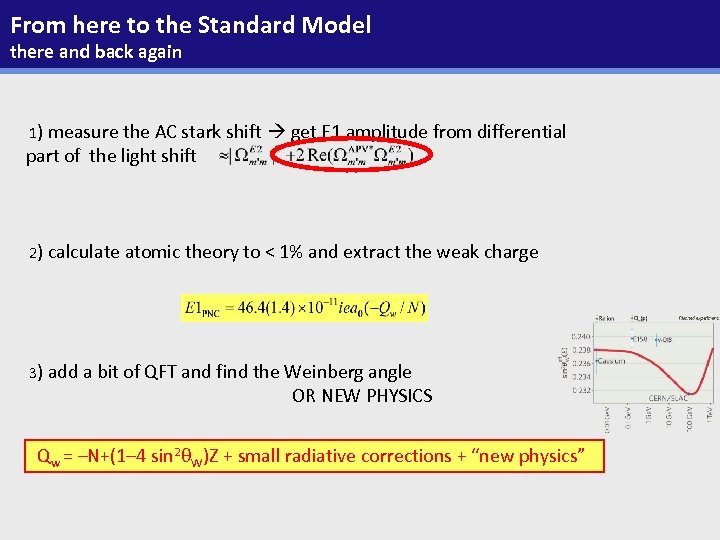 From here to the Standard Model there and back again 1) measure the AC stark shift get E 1 amplitude from differential part of the light shift 2) calculate atomic theory to < 1% and extract the weak charge 3) add a bit of QFT and find the Weinberg angle OR NEW PHYSICS Qw = –N+(1– 4 sin 2θW)Z + small radiative corrections + “new physics”
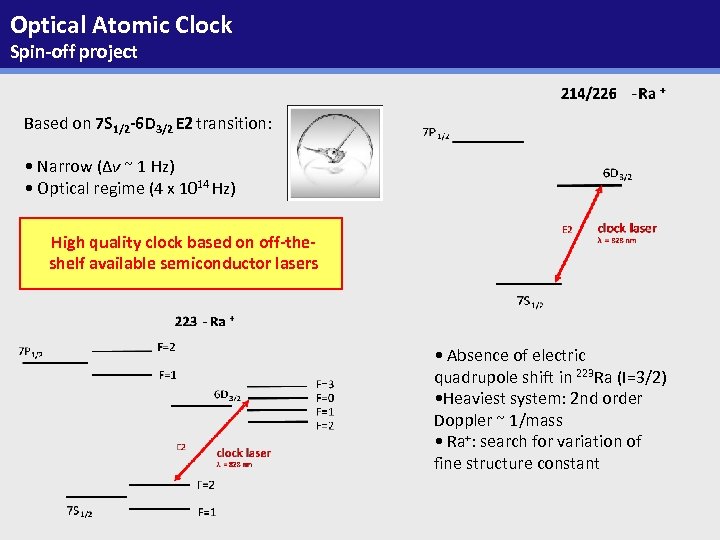 Optical Atomic Clock Spin-off project Based on 7 S 1/2 -6 D 3/2 E 2 transition: • Narrow (Δν ~ 1 Hz) • Optical regime (4 x 10¹⁴ Hz) High quality clock based on off-theshelf available semiconductor lasers • Absence of electric quadrupole shift in 223 Ra (I=3/2) • Heaviest system: 2 nd order Doppler ~ 1/mass • Ra+: search for variation of fine structure constant
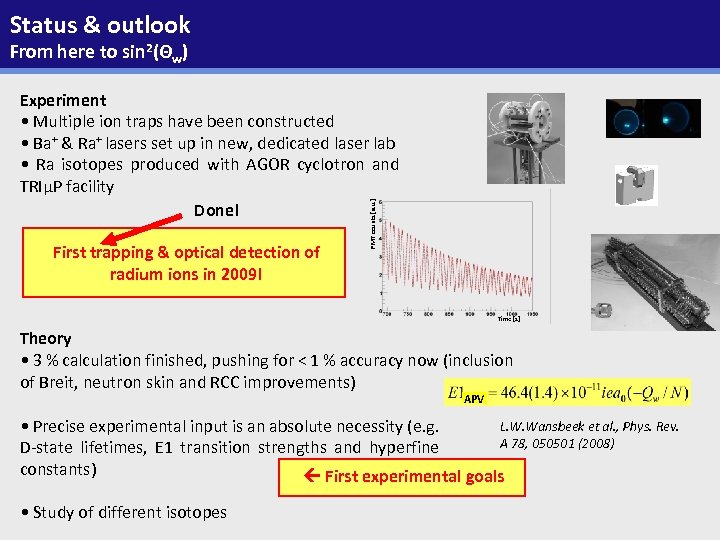 Status & outlook From here to sin 2(Θw) First trapping & optical detection of radium ions in 2009! PMT counts [a. u. ] Experiment • Multiple ion traps have been constructed • Ba+ & Ra+ lasers set up in new, dedicated laser lab • Ra isotopes produced with AGOR cyclotron and TRIμP facility Done! Time [s] Theory • 3 % calculation finished, pushing for < 1 % accuracy now (inclusion of Breit, neutron skin and RCC improvements) APV L. W. Wansbeek et al. , Phys. Rev. • Precise experimental input is an absolute necessity (e. g. A 78, 050501 (2008) D-state lifetimes, E 1 transition strengths and hyperfine constants) First experimental goals • Study of different isotopes
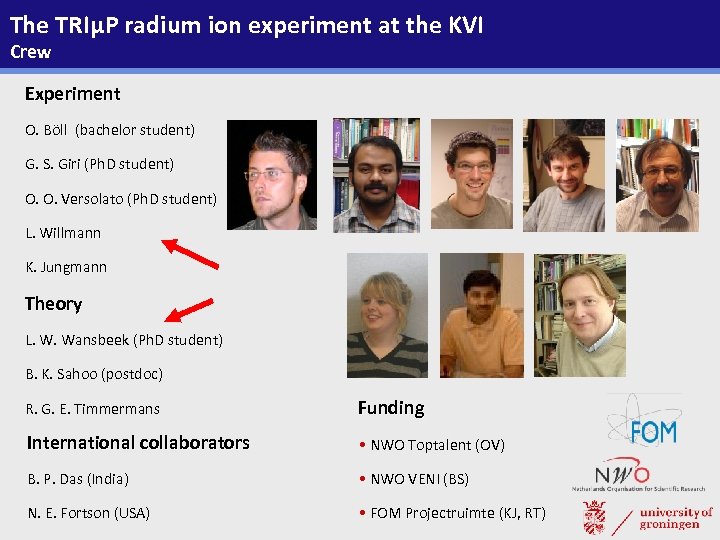 The TRIμP radium ion experiment at the KVI Crew Experiment O. Böll (bachelor student) G. S. Giri (Ph. D student) O. O. Versolato (Ph. D student) L. Willmann K. Jungmann Theory L. W. Wansbeek (Ph. D student) student B. K. Sahoo (postdoc) R. G. E. Timmermans Funding International collaborators • NWO Toptalent (OV) B. P. Das (India) • NWO VENI (BS) N. E. Fortson (USA) • FOM Projectruimte (KJ, RT)
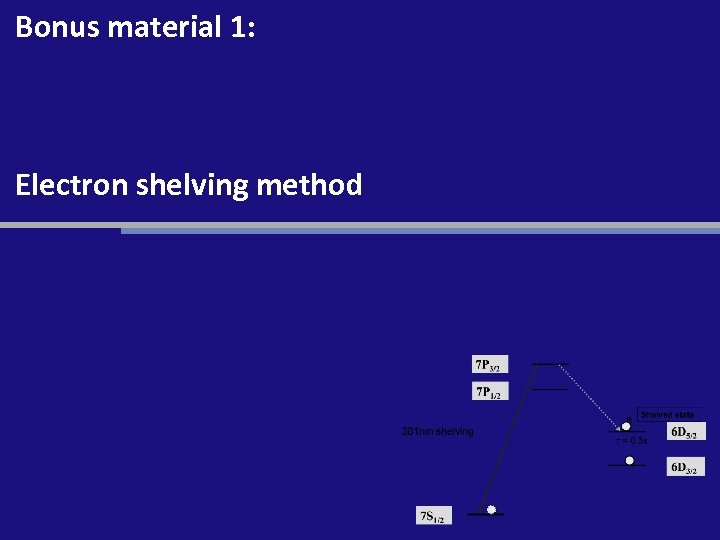 Bonus material 1: Electron shelving method
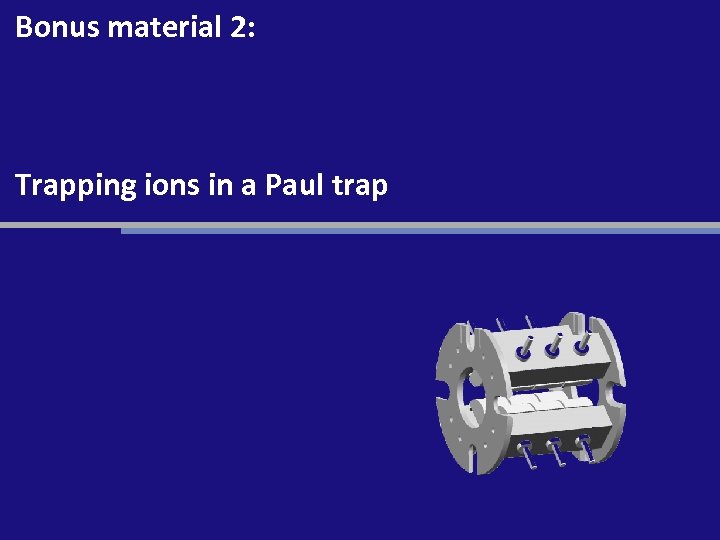 Bonus material 2: Trapping ions in a Paul trap
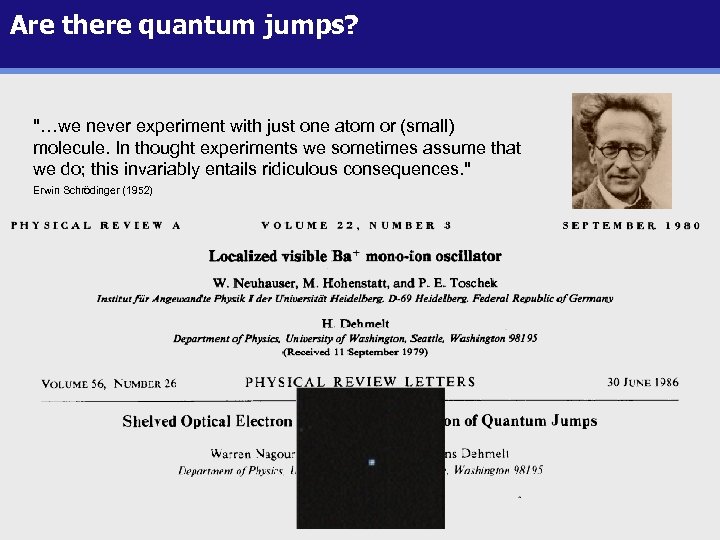 Are there quantum jumps? "…we never experiment with just one atom or (small) molecule. In thought experiments we sometimes assume that we do; this invariably entails ridiculous consequences. " Erwin Schrödinger (1952)
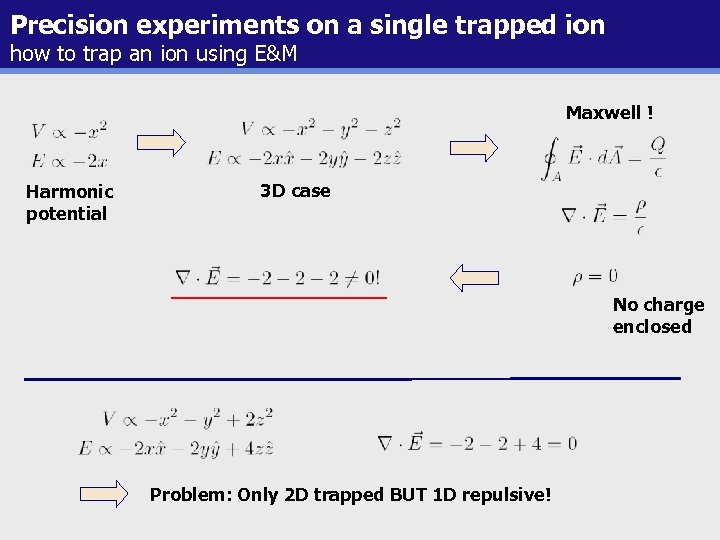 Precision experiments on a single trapped ion how to trap an ion using E&M Maxwell ! Harmonic potential 3 D case No charge enclosed Problem: Only 2 D trapped BUT 1 D repulsive!
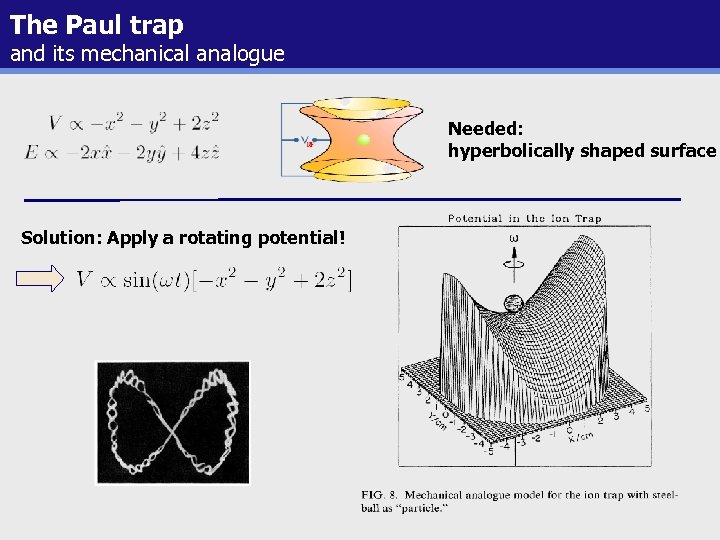 The Paul trap and its mechanical analogue Needed: hyperbolically shaped surface Solution: Apply a rotating potential!