


 Скачать презентацию Trials and Resolving Disputes 2007 Prentice Hall
Bus.Law-3week.ppt
- Количество слайдов: 40
 Trials and Resolving Disputes © 2007 Prentice Hall, Business Law, sixth edition, Henry R. Cheeseman
 BASIC TRIAL PROCEDURES A distinctive element of our judicial system is that it is an adversary system of justice. It requires the parties to represent themselves and to argue their positions before a court. 2 -2
 BASIC TRIAL PROCEDURES (continued) The responsibility for bringing a lawsuit, shaping its issues, and presenting evidence rests upon the parties to the dispute. 2 -3
 BASIC TRIAL PROCEDURES (continued) Courts play a small role in establishing the facts of a case. Unlike in many countries that use a system of inquiry run by judges, judges in our country do not investigate the parties or the facts of a case. Instead, the court applies legal rules to the facts that the parties establish. 2 -4
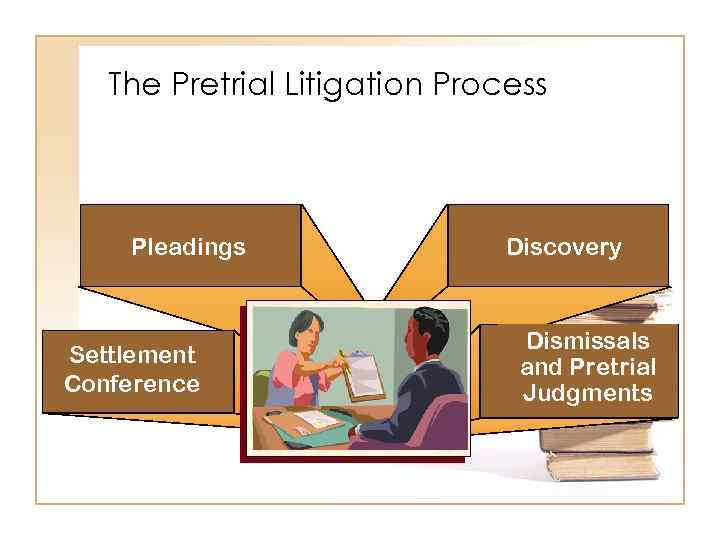 The Pretrial Litigation Process Pleadings Settlement Conference Discovery Dismissals and Pretrial Judgments 2 -5
 PLEADINGS STAGE Pleadings … are the formal statements made to the court by the parties to a case that list their claims and defenses. 2 -6
 The Pleadings • Complaint • Answer • Cross-Complaint • Reply 2 -7
 Complaint … is a statement that sets forth the plaintiff’s claim against the defendant. 2 -8
 The complaint contains statements: • alleging the essential facts necessary for the court to take jurisdiction. • of the facts necessary to claim that the plaintiff is entitled to a remedy. • of the remedy the plaintiff is seeking. 2 -9
 Complaint and Summons • Plaintiff files a complaint – Lists parties – Allege facts and laws violated – Prayer for relief • Court issues summons – Directs plaintiff to appear and answer 2 - 10
 Answer • Defendants must file answer admitting or denying allegations – If allegations are admitted, judgment entered against defendant – If no answer is filed, default judgment entered – May assert affirmative defenses 2 - 11
 Cross-Complaint and Reply • The defendant sues the plaintiff for damages or some other remedy • Original plaintiff must file a reply and serve on defendant 2 - 12
 Intervention and Consolidation • Intervention – Other parties have interest in lawsuit and become parties • Consolidation – Several plaintiffs have filed lawsuits stemming from same situation – Court will consolidate if no undue prejudice – Reduce strain on court system 2 - 13
 Statute of Limitations • A statute that establishes the period during which a plaintiff must bring a lawsuit against a defendant. • If a lawsuit is not filed within this time period, the plaintiff loses his or her right to sue. 2 - 14
 DISCOVERY STAGE: Obtaining Information before Trial. After the pleadings, litigation enters the discovery stage. The parties use various legal tools to obtain evidence about the dispute. The attorneys are interested in gathering information from the opposing parties and their witnesses and experts. 2 - 15
 Discovery • A legal process during which both parties engage in various activities to discover facts of the case from the other party and witnesses prior to trial. 2 - 16
 Discovery (continued) • Discovery serves several functions: – Preventing surprise – Allowing parties to thoroughly prepare for trial – Preserving evidence – Saving court time – Promoting the settlement of cases 2 - 17
 Discovery (continued) The major forms of discovery are: • Depositions • Interrogatories • Production of documents • Physical and mental examination 2 - 18
 Depositions • Oral testimony given by party or witness – – Under oath Preserves evidence Parties must give depositions Witnesses can be compelled by subpoena 2 - 19
 Interrogatories • Written questions submitted by one party to the other • May require documents • Must be answered and returned within a set time period • Attested to 2 - 20
 Production of Documents • Documents that parties request the other side produce or make available for review 2 - 21
 Examinations • If the physical or mental condition of a party are at question, and examination by an expert may be required. 2 - 22
 Dismissals and Pretrial Judgments • Pretrial Motion – A motion a party can make to try to dispose of all or part of a lawsuit prior to trial. • • Motion for judgment on the pleadings Motion for summary judgment 2 - 23
 Dismissals and Pretrial Judgments (continued) • Motion for Judgment on the Pleadings Motion that alleges that if all the facts presented in the pleadings are taken as true, the party making the motion would win the lawsuit when the proper law is applied to these asserted facts. 2 - 24
 Dismissals and Pretrial Judgments (continued) • Motion for Summary Judgment – Motion that asserts that there are no factual disputes to be decided by the jury. – Judge can apply the proper law to the undisputed facts and decide the case without a jury. – These motions are supported by affidavits, documents, and deposition testimony. 2 - 25
 Settlement Conference • Federal court rules and most state rules allow for a pretrial hearing or settlement conference • Ninety percent of all cases settle before trial 2 - 26
 Cost-Benefit Analysis of a Lawsuit • The following factors should be considered in deciding whether to bring or settle a lawsuit: – The probability of winning or losing. – The amount of money to be won or lost. – Lawyers’ fees and other costs of litigation. – Loss of time by managers and other personnel. 2 - 27
 Cost-Benefit Analysis of a Lawsuit (continued) – The unpredictability of the legal system and the possibility of error. – Other factors peculiar to the parties and lawsuit. – The long-term effects on the relationship and reputation of the parties. – The amount of prejudgment interest provided by the law. – The aggravation and psychological costs associated with a lawsuit. 2 - 28
 The Trial After discovery is complete, if there has been no dismissal, summary judgment, or settlement, the dispute is set for trial. 2 - 29
 The Trial • A party to an action at law is guaranteed the right to a jury trial in cases in federal court. • If either party requests a jury, the trial will be by jury. • If both parties waive their right to a jury, the trial will be without a jury. 2 - 30
 Phases of a Trial 1. 2. 3. 4. 5. 6. 7. 8. 9. Jury Selection Opening Statements The Plaintiff’s Case The Defendant’s Case Rebuttal and Rejoinder Closing Arguments Jury Instructions Jury Deliberation Entry of Judgment 2 - 31
 The Appeal • In a civil case, – either party can appeal the trial court’s decision – Appeal can be filed once a final judgment is entered. • In a criminal case, – only the defendant can appeal. 2 - 32
 The Appeal (continued) • The appeal is made to the appropriate appellate court. • Notice of appeal must be filed within a prescribed time after judgment is entered. 2 - 33
 Alternative Dispute Resolution (ADR) • Methods of resolving disputes other than litigation. • Developed in response to the expense and difficulty of bringing a lawsuit. 2 - 34
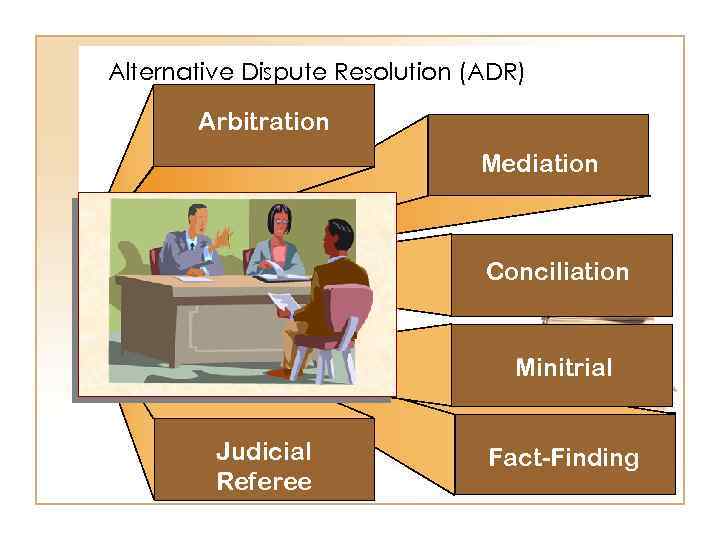 Alternative Dispute Resolution (ADR) Arbitration Mediation Conciliation Minitrial Judicial Referee Fact-Finding 2 - 35
 Arbitration • Parties choose neutral third party to hear evidence and testimony and decide the case. • Arbitrator makes a decision and enters an award. • Arbitration may be binding or non-binding 2 - 36
 Key ADR Legislation • Uniform Arbitration Act – Adopted by half of the states. – Promotes the arbitration of disputes at the state level. • Federal Arbitration Act – Arbitration agreements involving commerce are valid, irrevocable, and enforceable contracts. 2 - 37
 Mediation and Conciliation • Mediation: – Parties choose a neutral third party to assist them – Parties reach settlement – Mediator does not make judgment or issue award • Conciliation – Parties use an interested third party to act as mediator 2 - 38
 Minitrial • Short session in which lawyers for each side present their cases to representatives of each party who have the authority to settle the dispute. 2 - 39
 Fact-Finding • Process in which the parties hire a neutral party to investigate the dispute and report findings back to both sides 2 - 40