


 Скачать презентацию TRIAGE Lee Wallis Senior Lecturer Division of Emergency
6321873464c5ce156f937cf93b313881.ppt
- Количество слайдов: 36
 TRIAGE Lee Wallis Senior Lecturer Division of Emergency Medicine, UCT/SU
 Triage • Background • Cape Triage Group • Cape Triage Score – Development – The CTS – Validation • South African Triage Score • EWS in children
 Triage • French verb trier – To sieve / to sort • Medically: – The process of applying medical priority to patients to do the most for the most
 History of triage • Baron Dominique Jean Larré – Napoleon’s surgeon – Changed the treatment of injured soldiers • Least injured first, return to war • Little improvement until Vietnam • Military now use standard civilian priorities • Triage common to EDs in West for 20+ years
 Triage tools • Discriminators: – Demographics • Old or young triaged out – Mechanism of injury • Only for trauma – Anatomy • Dependent upon examination – time consuming – Physiology • Most reliable • Intended use: – – Hospital vs Pre-hospital Day-to-day vs MCI Trauma vs Other Adult vs Child
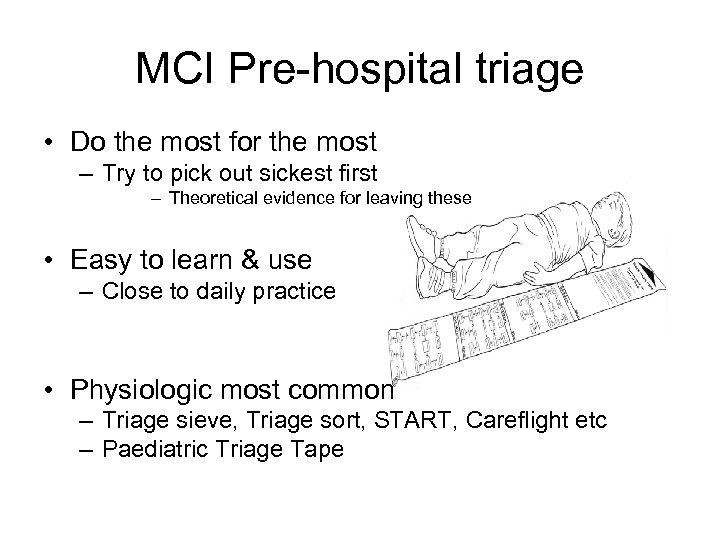 MCI Pre-hospital triage • Do the most for the most – Try to pick out sickest first – Theoretical evidence for leaving these • Easy to learn & use – Close to daily practice • Physiologic most common – Triage sieve, Triage sort, START, Careflight etc – Paediatric Triage Tape
 MCI Hospital triage • Triage Sort • • RR 0 -4 SBP 0 -4 GCS 0 -4 Total 0 -12 P 3 – 12 P 2 – 11 P 1 - other • + Basic Anatomical information
 Daily Pre-hospital triage • Often not done • When done - trauma only – TS, RTS, TRTS, PHI, CRAMS, ACS TTC, etc • Children – PTS, adult tools – Physiologically incorrect • Most used to identify need for Trauma Centre care (USA)
 Hospital triage - subjective • Senior doctor or nurse • Front door of unit – Eyeball – Gut-feel • Accuracy as low as 35% • Poorly reproducible • 24 / 7 coverage
 Hospital triage - objective • MCI – triage sort or similar • Day-to-day – Manchester triage, CTS, ATAS, ESI, PTS – Complicated, time consuming, training implications, senior staff
 Cape Triage Group • Convened Jan 2004 • Joint division of Emergency medicine, UCT / SU • Jan 2004 • 32 registrars, 5 waiting posts • Dip PEC, MPhil, MSC, MMed / FCEM • Private & Public • Pre-hospital & hospital • Doctors, nurses, paramedics – 1 speech therapist….
 CTG: objectives • Saw the need for triage in W Cape (SA) setting • Develop a tool for hospital EU use • Pre-hospital triage • Not a MCI tool
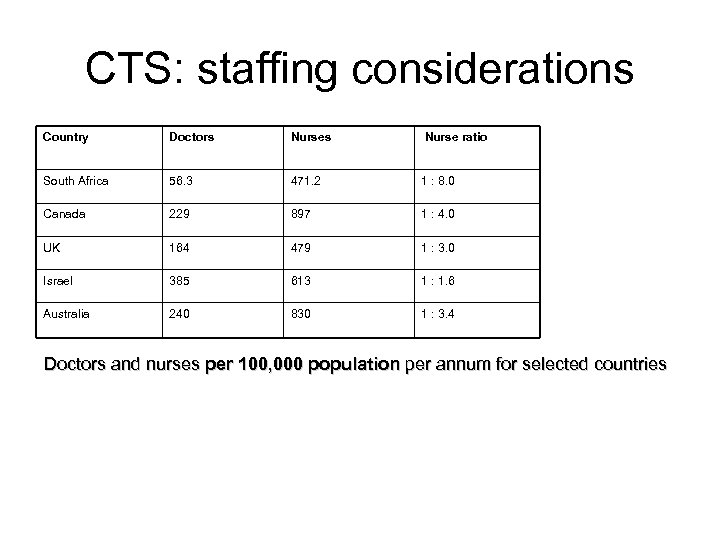 CTS: staffing considerations Country Doctors Nurses Nurse ratio South Africa 56. 3 471. 2 1 : 8. 0 Canada 229 897 1 : 4. 0 UK 164 479 1 : 3. 0 Israel 385 613 1 : 1. 6 Australia 240 830 1 : 3. 4 Doctors and nurses per 100, 000 population per annum for selected countries
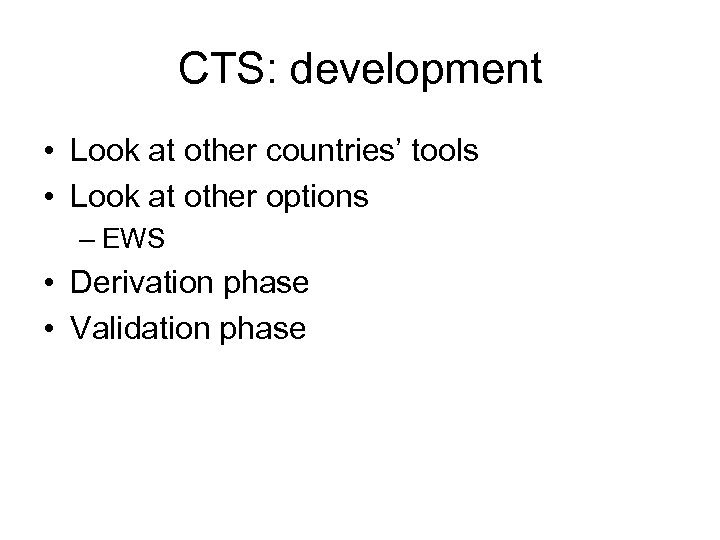 CTS: development • Look at other countries’ tools • Look at other options – EWS • Derivation phase • Validation phase
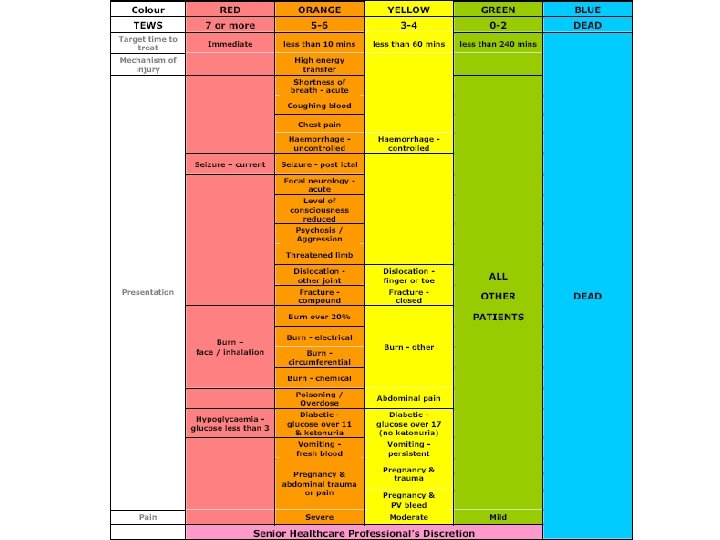
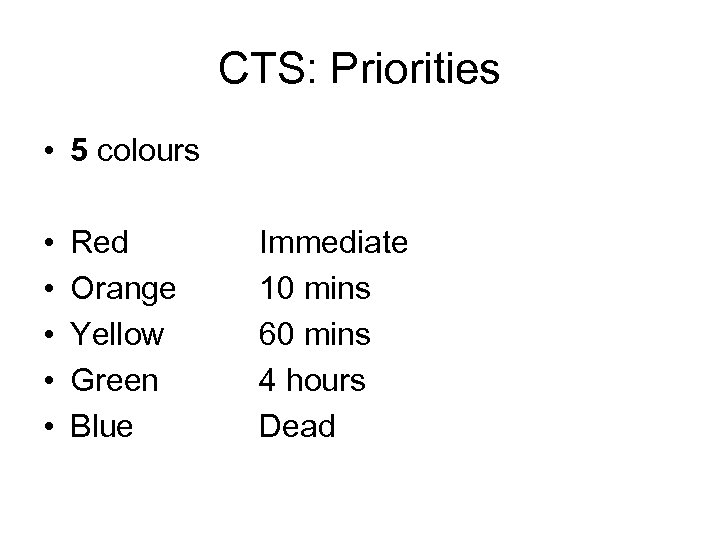 CTS: Priorities • 5 colours • • • Red Orange Yellow Green Blue Immediate 10 mins 60 mins 4 hours Dead
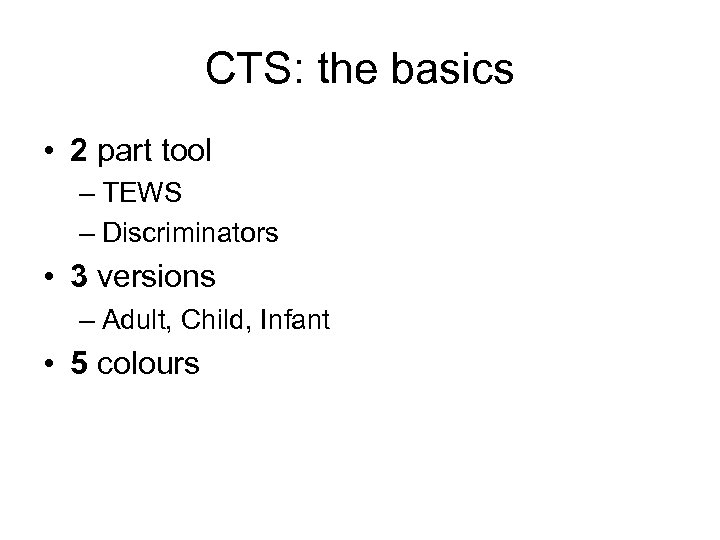 CTS: the basics • 2 part tool – TEWS – Discriminators • 3 versions – Adult, Child, Infant • 5 colours
 CTS: TEWS • Triage Early Warning Score • From MEWS – UK ICU outreach program • MEWS reduced ICU admission and mortality / Lo. S • Minor modifications to adult version = TEWS
 CTS: adult • TEWS Derivation: from MEWS • Discriminators: committee consensus • Validation – 1500 GF Jooste, 2000 Mediclinic, 12, 000 CHC EUs – 2 MPhils
 CTS: child & infant • TEWS Derivation: – 1500 healthy school children – 4000 injured children RXH TU • Discriminators: committee consensus • Validation – 8000 children at CHC EUs • Age, height, weight related vital signs • Logistic regression vs neural nets • Ph. D
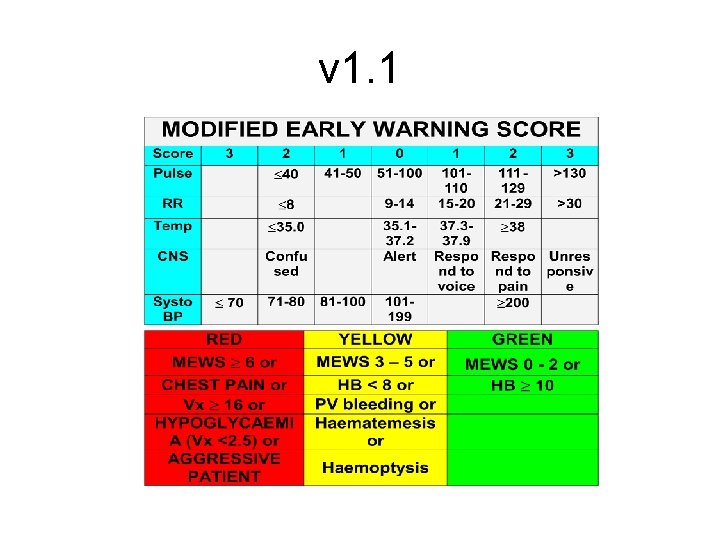 v 1. 1
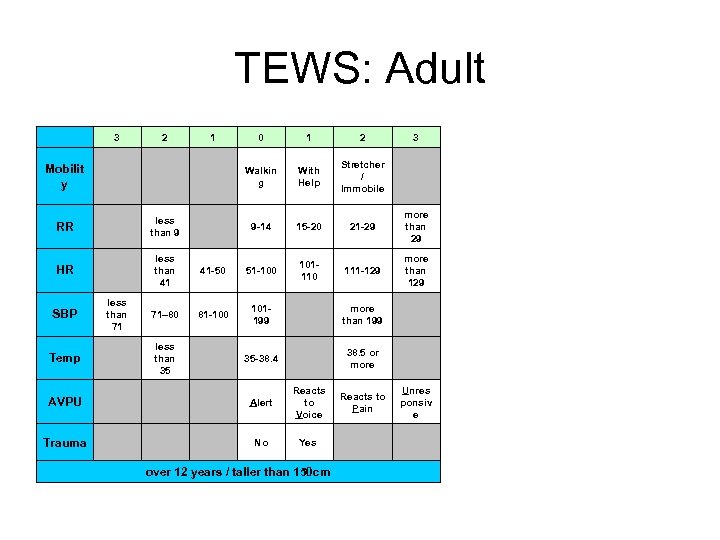 TEWS: Adult 3 2 1 0 1 2 3 Mobilit y Walkin g With Help Stretcher / Immobile RR less than 9 9 -14 15 -20 21 -29 more than 29 HR less than 41 41 -50 51 -100 101110 111 -129 more than 129 SBP less than 71 71– 80 81 -100 101199 more than 199 Temp less than 35 35 -38. 4 38. 5 or more AVPU Alert Reacts to Voice Reacts to Pain Unres ponsiv e Trauma No Yes over 12 years / taller than 150 cm
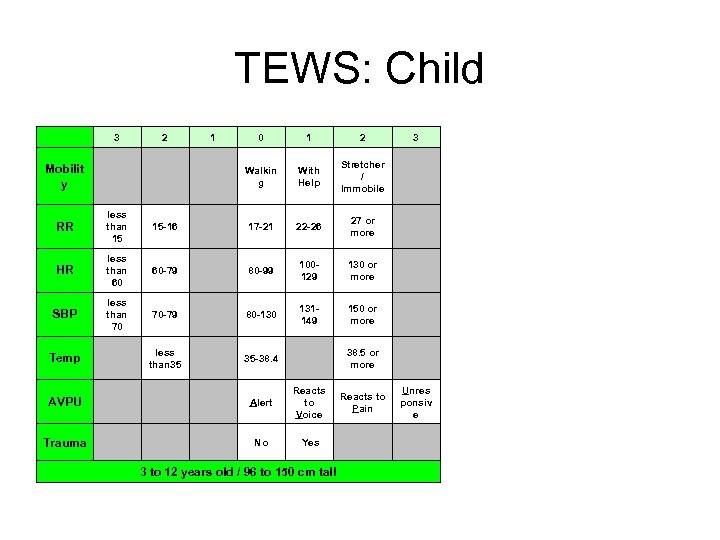 TEWS: Child 3 2 1 0 1 2 3 Mobilit y Walkin g With Help Stretcher / Immobile RR less than 15 15 -16 17 -21 22 -26 27 or more HR less than 60 60 -79 80 -99 100129 130 or more SBP less than 70 70 -79 80 -130 131149 150 or more Temp less than 35 35 -38. 4 38. 5 or more AVPU Alert Reacts to Voice Reacts to Pain Unres ponsiv e Trauma No Yes 3 to 12 years old / 96 to 150 cm tall
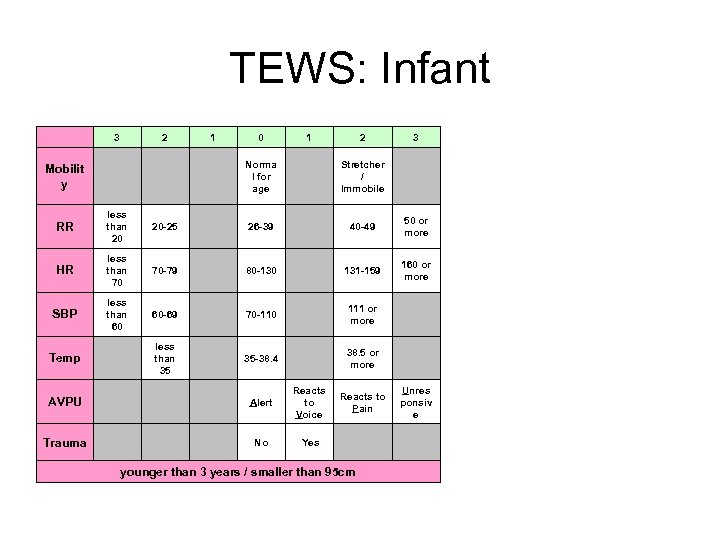 TEWS: Infant 3 2 1 0 1 2 3 Mobilit y Norma l for age Stretcher / Immobile RR less than 20 20 -25 26 -39 40 -49 50 or more HR less than 70 70 -79 80 -130 131 -159 160 or more SBP less than 60 60 -69 70 -110 111 or more Temp less than 35 35 -38. 4 38. 5 or more AVPU Alert Reacts to Voice Reacts to Pain Unres ponsiv e Trauma No Yes younger than 3 years / smaller than 95 cm
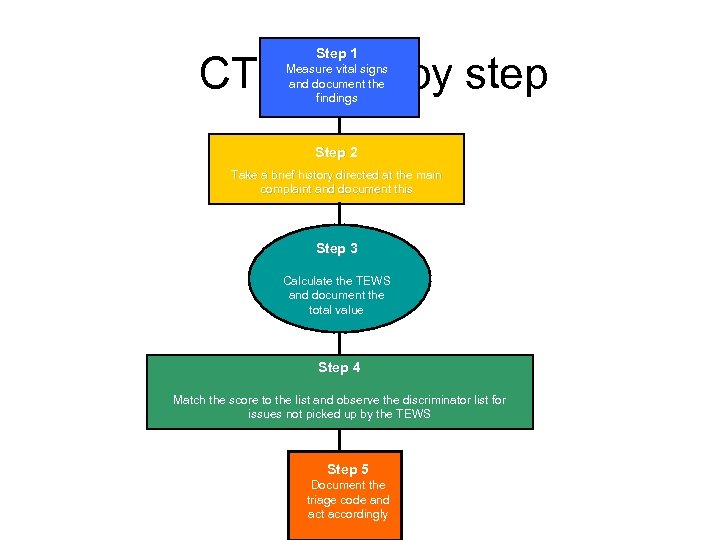 Step 1 CTS: step by step Measure vital signs and document the findings Step 2 Take a brief history directed at the main complaint and document this Step 3 Calculate the TEWS and document the total value Step 4 Match the score to the list and observe the discriminator list for issues not picked up by the TEWS Step 5 Document the triage code and act accordingly
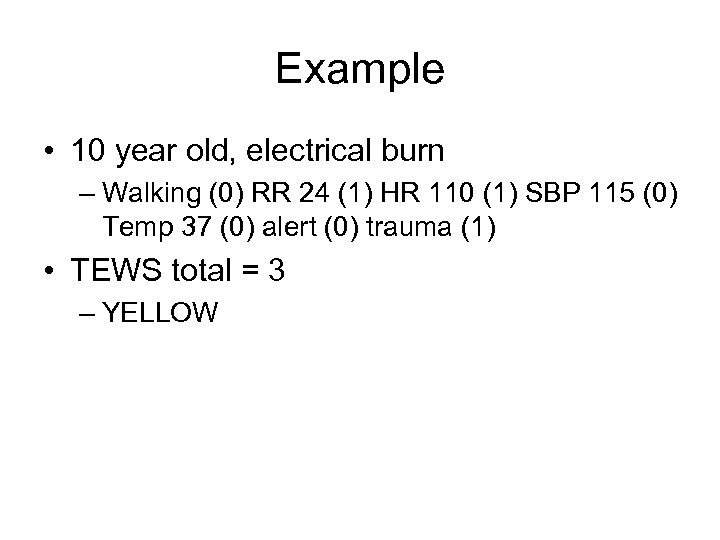 Example • 10 year old, electrical burn – Walking (0) RR 24 (1) HR 110 (1) SBP 115 (0) Temp 37 (0) alert (0) trauma (1) • TEWS total = 3 – YELLOW
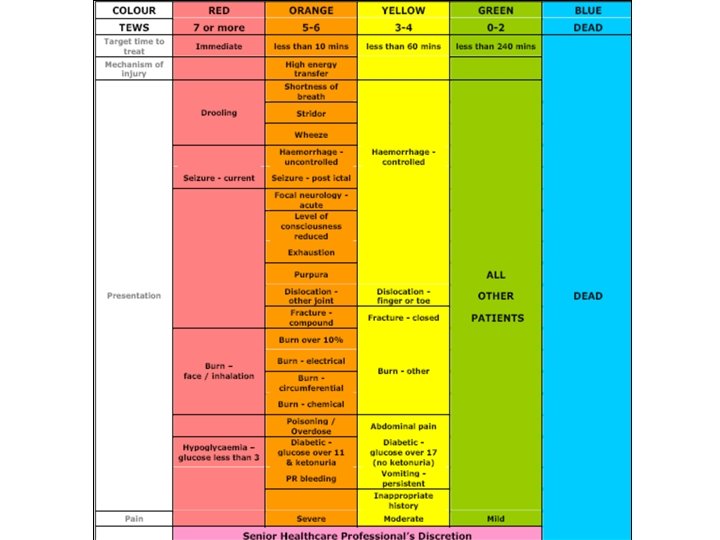
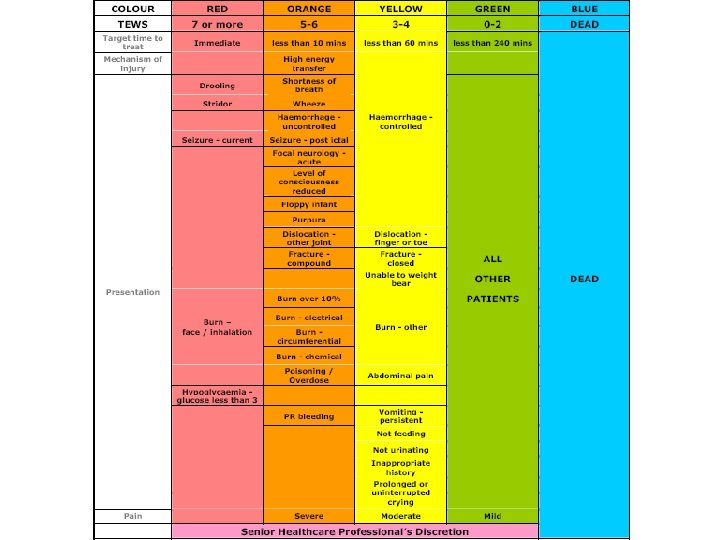
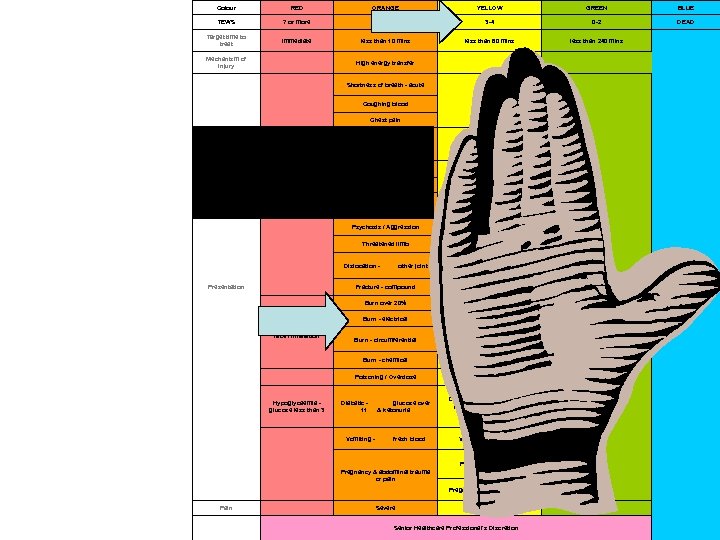 Colour RED ORANGE YELLOW GREEN BLUE TEWS 7 or more 5 -6 3 -4 0 -2 DEAD Target time to treat Immediate less than 10 mins less than 60 mins less than 240 mins High energy transfer Mechanism of injury Discriminators: Adult Shortness of breath - acute Coughing blood Psychosis / Aggression Threatened limb Chest pain • Final Triage Haemorrhage - uncontrolled Seizure – current Haemorrhage - controlled Seizure - post ictal – ORANGE Focal neurology - acute Level of consciousness reduced Dislocation - other joint Dislocation - finger or toe ALL Fracture - compound Fracture - closed OTHER DEAD PATIENTS Burn - circumferential Burn - chemical Presentation Burn over 20% Burn - electrical Burn – face / inhalation Burn - other Poisoning / Overdose Abdominal pain Hypoglycaemia - glucose less than 3 Diabetic - glucose over 11 & ketonuria Diabetic - glucose over 17 (no ketonuria) Vomiting - fresh blood Vomiting - persistent Pregnancy & PV bleed Moderate Mild Pregnancy & trauma Pregnancy & abdominal trauma or pain Pain Severe Senior Healthcare Professional’s Discretion
 CTS: management aids • Series of management pointers – Including: • Diabetes – test glucose • Low temp – blankets • Chest pain – ECG • Aimed at ENA
 CTS: benefits • GF Jooste, 4 CHCs: • Reduced waiting times – 590 mins mean, to 30 mins red, 60 orange, 400 green • Decreased EU length of stay • Improved patient flow, decreased overcrowding in EU • Reduction in mortality 2% to 0. 7% – Morbidity? • Improved patient and health provider satisfaction
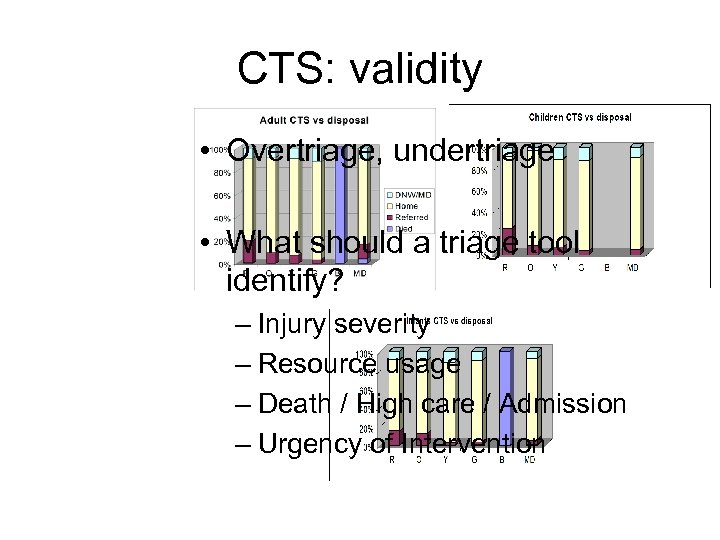 CTS: validity • Overtriage, undertriage • What should a triage tool identify? – Injury severity – Resource usage – Death / High care / Admission – Urgency of Intervention
 CTS: Implementation • 1 Jan roll out W Cape • All EUs – Primary Care – Secondary & tertiary care • • Do. H funded and supported Intensive training program Educational materials Posters, keycards, patient leaflets
 Future developments: CTS • 1 year M&E manager – Audits – QA – Performance indicator thresholds • CTS living tool – Modify as needed – Keep same format
 Future developments: SATS • CTS taken on by 4 provinces so far • Call for SA Triage Group – First meet June 2006, Durban – Represent all provinces • Develop a SATS – Based on CTS
 Future developments: EWS • MEWS part of TEWS for in-patient monitoring – Mortality and morbidity benefit, Lo. S reduction • Validate child & infant versions • Funding for age – group specific EWS from UK