 Скачать презентацию Tri Star MPPT Training Program Brad Berwald Sr
a4898cbcbd41d34043bd929b2407d833.ppt
- Количество слайдов: 59



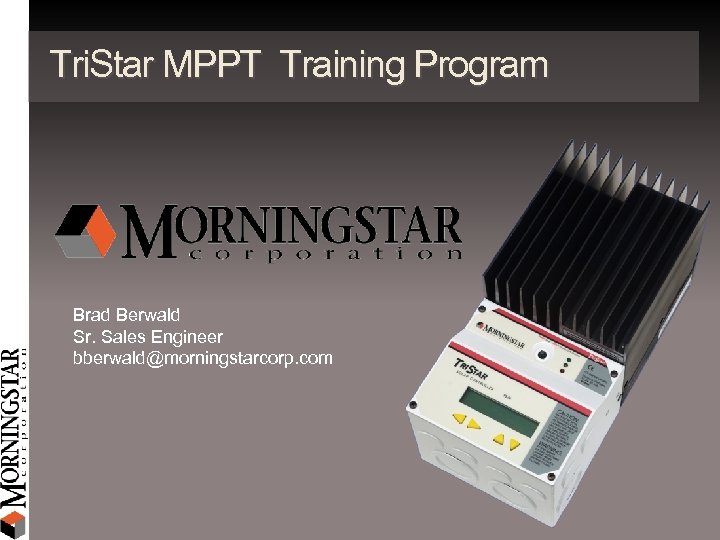
Tri. Star MPPT Training Program Brad Berwald Sr. Sales Engineer bberwald@morningstarcorp. com
Training Overview Tri. Star Family Applications – where is it used? Product Details – ratings, specs and features. MPPT Advantages – the benefits of an MPPT controller over other types. Competitive Advantages – Tri. Star MPPT’s features that beat the competition Sizing and Setup – how to configure the TS MPPT Product Communications – all the ways you can communicate with the TS MPPT Questions?

TRISTAR APPLICATIONS
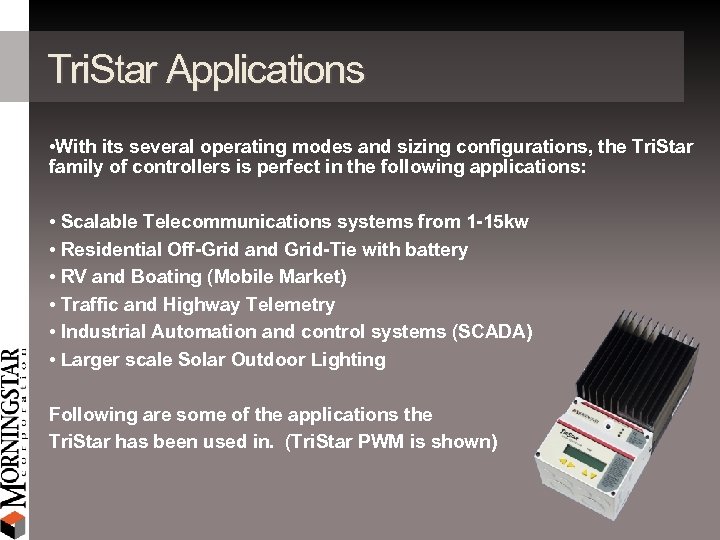
Tri. Star Applications • With its several operating modes and sizing configurations, the Tri. Star family of controllers is perfect in the following applications: • Scalable Telecommunications systems from 1 -15 kw • Residential Off-Grid and Grid-Tie with battery • RV and Boating (Mobile Market) • Traffic and Highway Telemetry • Industrial Automation and control systems (SCADA) • Larger scale Solar Outdoor Lighting Following are some of the applications the Tri. Star has been used in. (Tri. Star PWM is shown)
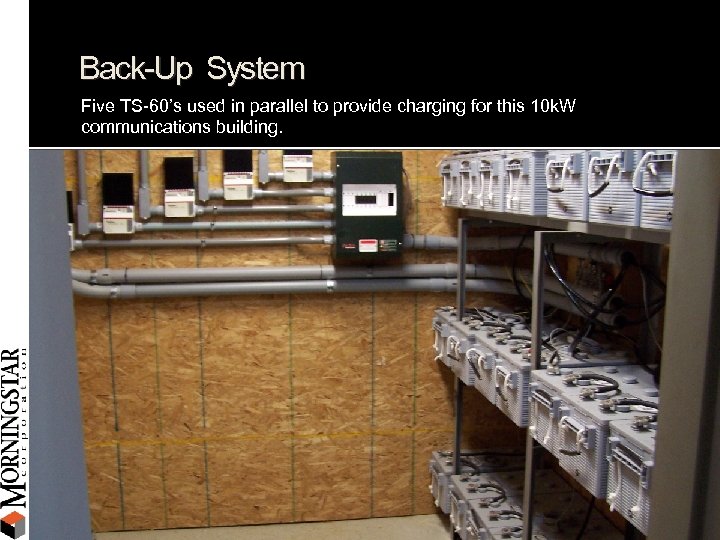
Back-Up System Five TS-60’s used in parallel to provide charging for this 10 k. W communications building.
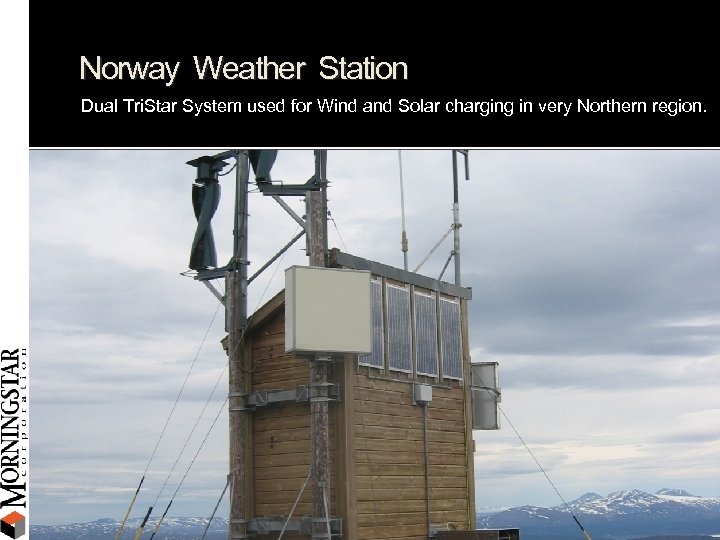
Norway Weather Station Dual Tri. Star System used for Wind and Solar charging in very Northern region.
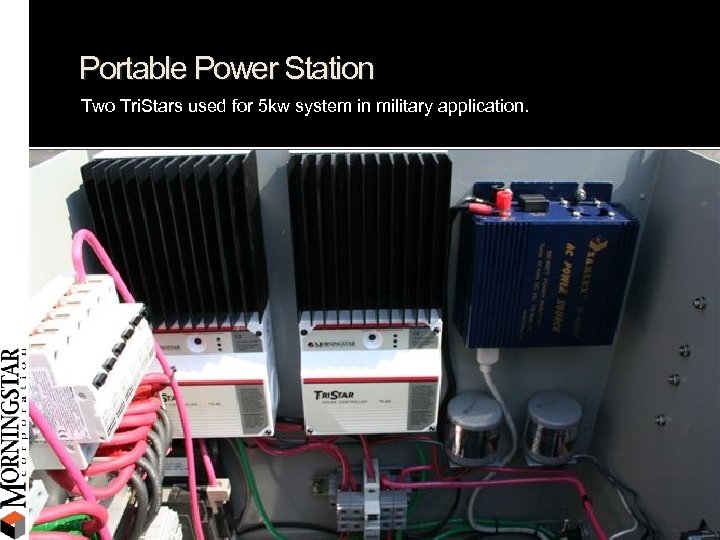
Portable Power Station Two Tri. Stars used for 5 kw system in military application.

PRODUCT DETAILS
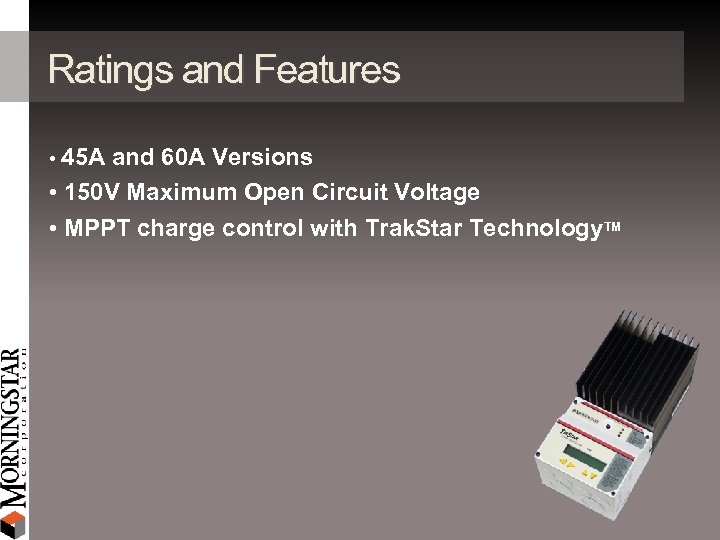
Ratings and Features • 45 A and 60 A Versions • 150 V Maximum Open Circuit Voltage • MPPT charge control with Trak. Star Technology. TM
Maximizes Energy Harvest • Very fast sweeping of the entire I-V curve • Recognition of multiple power points during shading or mixed PV arrays • Excellent performance at sunrise and low solar insolation levels
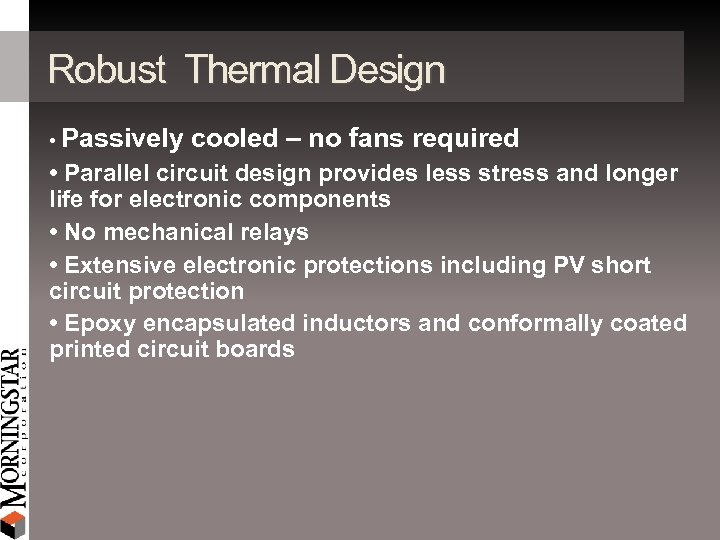
Robust Thermal Design • Passively cooled – no fans required • Parallel circuit design provides less stress and longer life for electronic components • No mechanical relays • Extensive electronic protections including PV short circuit protection • Epoxy encapsulated inductors and conformally coated printed circuit boards
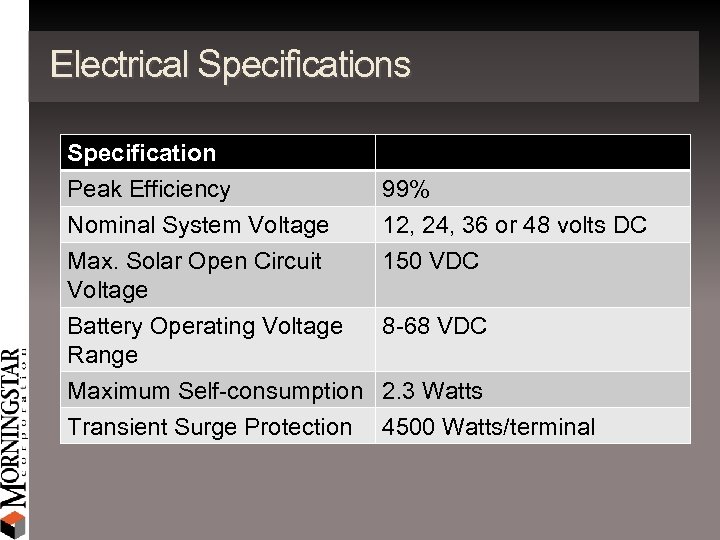
Electrical Specifications Specification Peak Efficiency Nominal System Voltage Max. Solar Open Circuit Voltage 99% 12, 24, 36 or 48 volts DC 150 VDC Battery Operating Voltage 8 -68 VDC Range Maximum Self-consumption 2. 3 Watts Transient Surge Protection 4500 Watts/terminal
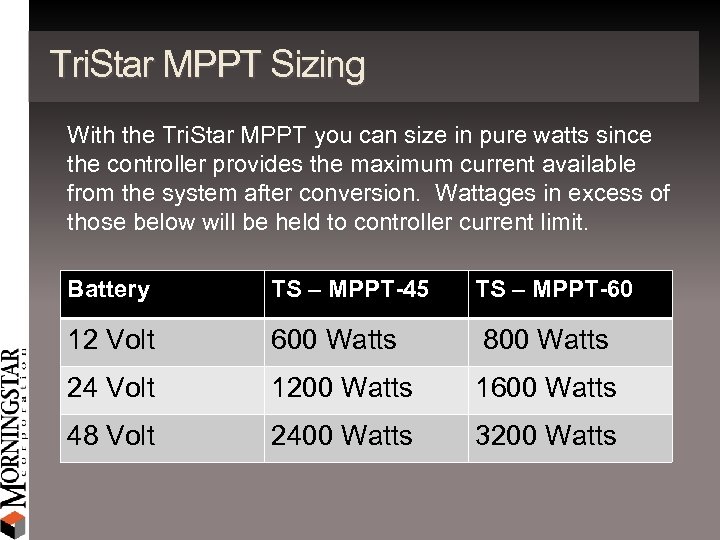
Tri. Star MPPT Sizing With the Tri. Star MPPT you can size in pure watts since the controller provides the maximum current available from the system after conversion. Wattages in excess of those below will be held to controller current limit. Battery TS – MPPT-45 TS – MPPT-60 12 Volt 600 Watts 800 Watts 24 Volt 1200 Watts 1600 Watts 48 Volt 2400 Watts 3200 Watts
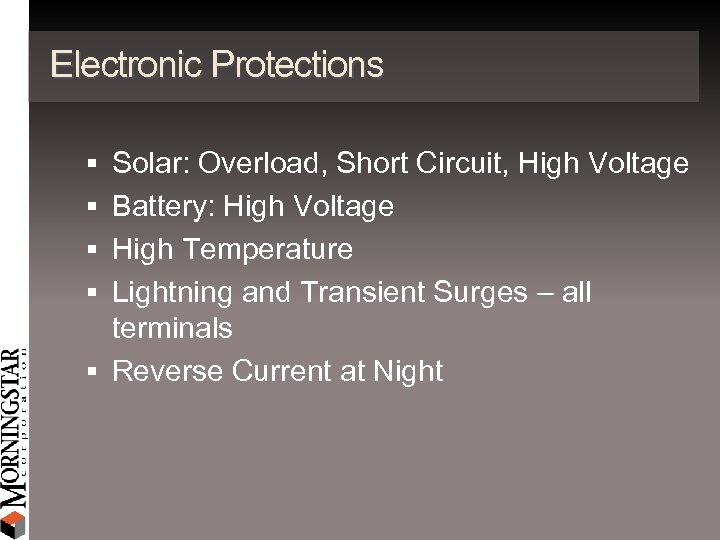
Electronic Protections Solar: Overload, Short Circuit, High Voltage Battery: High Voltage High Temperature Lightning and Transient Surges – all terminals Reverse Current at Night
Certifications CE Compliant ETL Listed (UL 1741) FCC Class B Part 15 Compliant Complies with (NEC) U. S. National Electric Code Ro. HS Compliant Manufactured in a certified ISO 9001 facility

MPPT ADVANTAGES
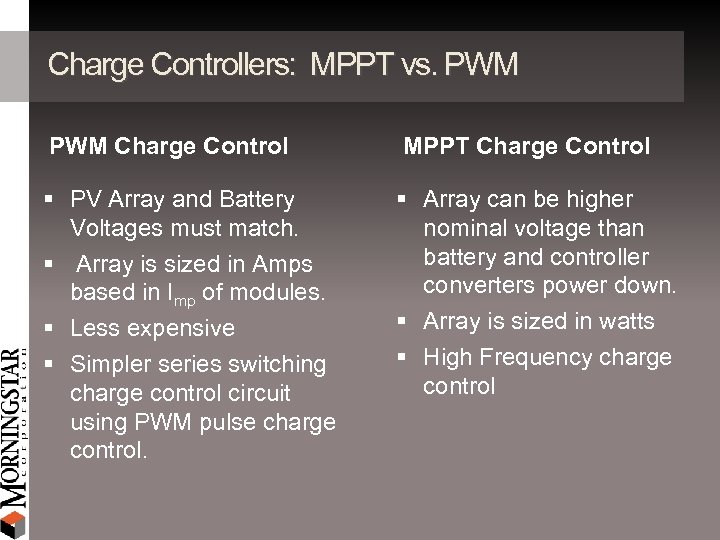
Charge Controllers: MPPT vs. PWM Charge Control MPPT Charge Control PV Array and Battery Voltages must match. Array can be higher nominal voltage than battery and controller converters power down. Array is sized in Amps based in Imp of modules. Less expensive Array is sized in watts Simpler series switching charge control circuit using PWM pulse charge control. High Frequency charge control
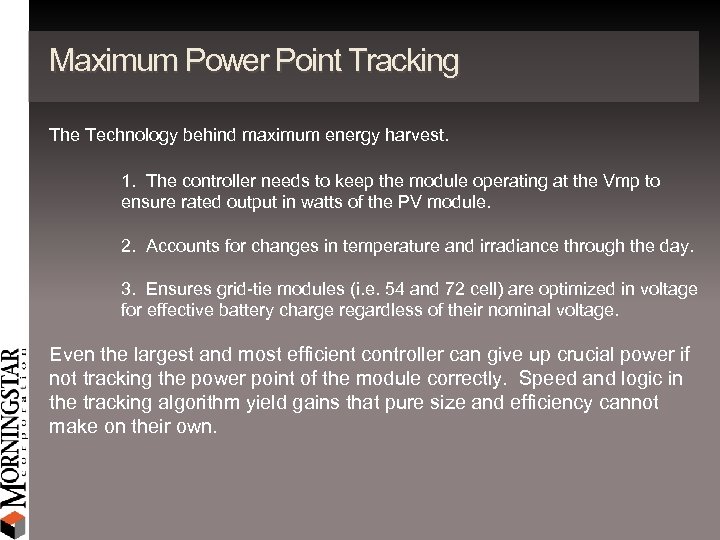
Maximum Power Point Tracking The Technology behind maximum energy harvest. 1. The controller needs to keep the module operating at the Vmp to ensure rated output in watts of the PV module. 2. Accounts for changes in temperature and irradiance through the day. 3. Ensures grid-tie modules (i. e. 54 and 72 cell) are optimized in voltage for effective battery charge regardless of their nominal voltage. Even the largest and most efficient controller can give up crucial power if not tracking the power point of the module correctly. Speed and logic in the tracking algorithm yield gains that pure size and efficiency cannot make on their own.
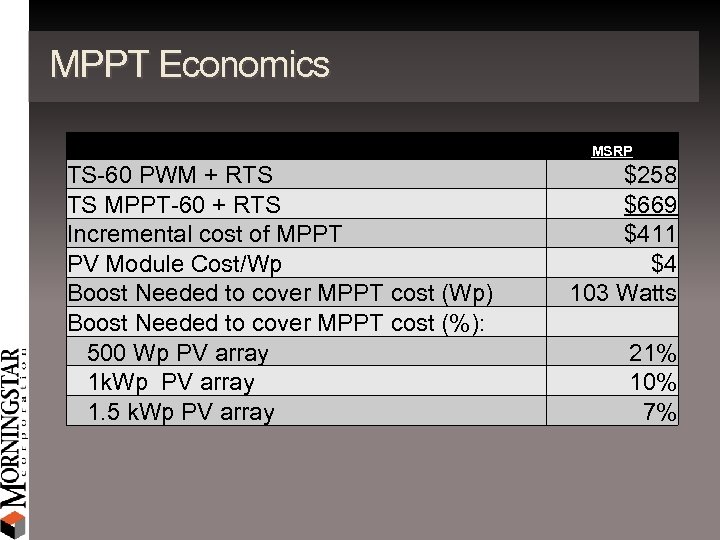
MPPT Economics MSRP TS-60 PWM + RTS TS MPPT-60 + RTS Incremental cost of MPPT PV Module Cost/Wp Boost Needed to cover MPPT cost (Wp) Boost Needed to cover MPPT cost (%): 500 Wp PV array 1 k. Wp PV array 1. 5 k. Wp PV array $258 $669 $411 $4 103 Watts 21% 10% 7%
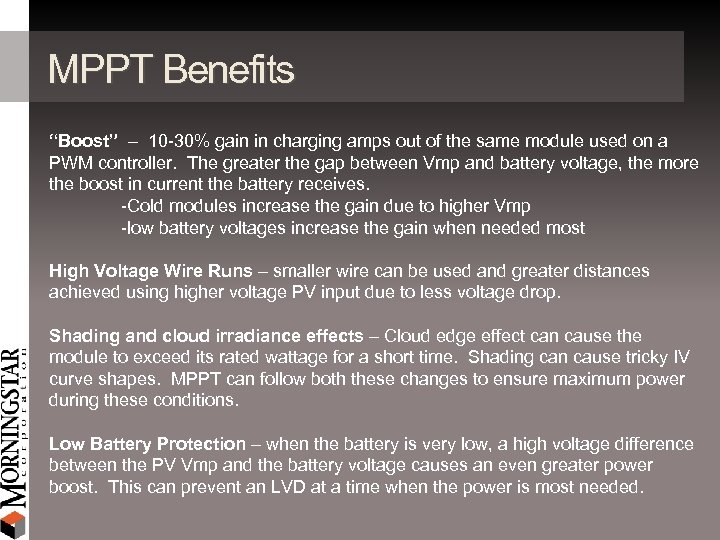
MPPT Benefits “Boost” – 10 -30% gain in charging amps out of the same module used on a PWM controller. The greater the gap between Vmp and battery voltage, the more the boost in current the battery receives. -Cold modules increase the gain due to higher Vmp -low battery voltages increase the gain when needed most High Voltage Wire Runs – smaller wire can be used and greater distances achieved using higher voltage PV input due to less voltage drop. Shading and cloud irradiance effects – Cloud edge effect can cause the module to exceed its rated wattage for a short time. Shading can cause tricky IV curve shapes. MPPT can follow both these changes to ensure maximum power during these conditions. Low Battery Protection – when the battery is very low, a high voltage difference between the PV Vmp and the battery voltage causes an even greater power boost. This can prevent an LVD at a time when the power is most needed.
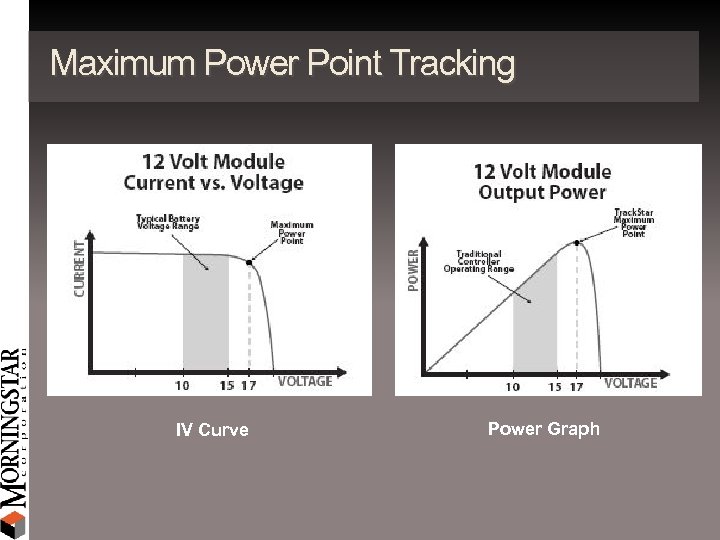
Maximum Power Point Tracking IV Curve Power Graph
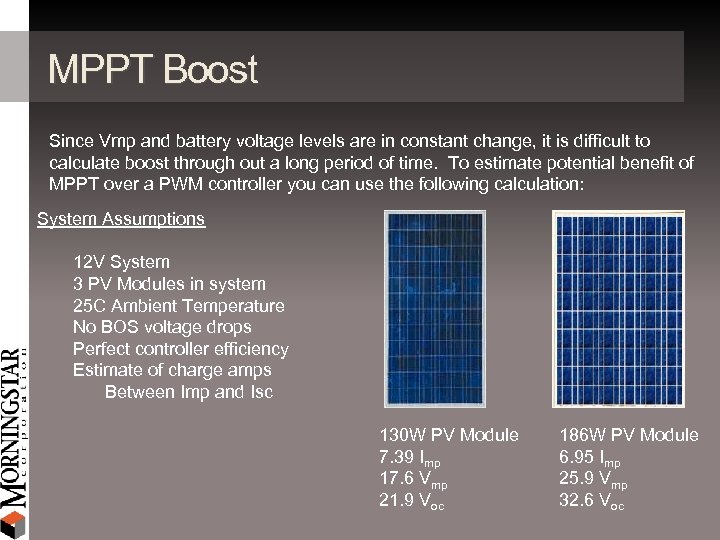
MPPT Boost Since Vmp and battery voltage levels are in constant change, it is difficult to calculate boost through out a long period of time. To estimate potential benefit of MPPT over a PWM controller you can use the following calculation: System Assumptions 12 V System 3 PV Modules in system 25 C Ambient Temperature No BOS voltage drops Perfect controller efficiency Estimate of charge amps Between Imp and Isc 130 W PV Module 7. 39 Imp 17. 6 Vmp 21. 9 Voc 186 W PV Module 6. 95 Imp 25. 9 Vmp 32. 6 Voc
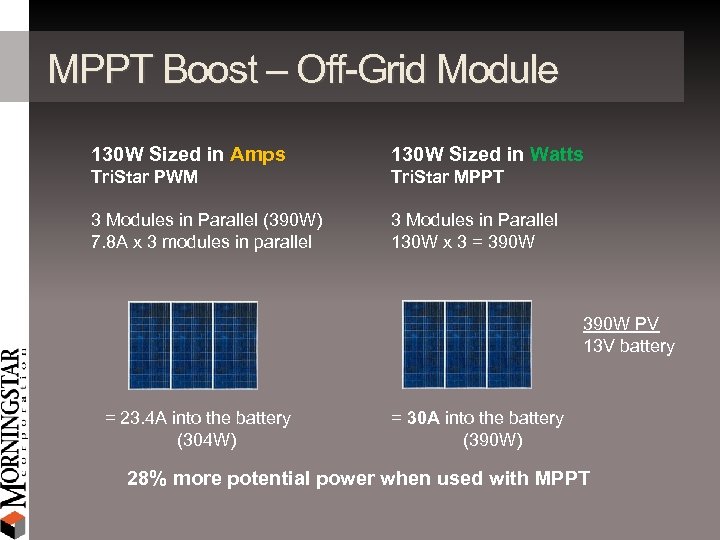
MPPT Boost – Off-Grid Module 130 W Sized in Amps 130 W Sized in Watts Tri. Star PWM Tri. Star MPPT 3 Modules in Parallel (390 W) 7. 8 A x 3 modules in parallel 3 Modules in Parallel 130 W x 3 = 390 W PV 13 V battery = 23. 4 A into the battery (304 W) = 30 A into the battery (390 W) 28% more potential power when used with MPPT
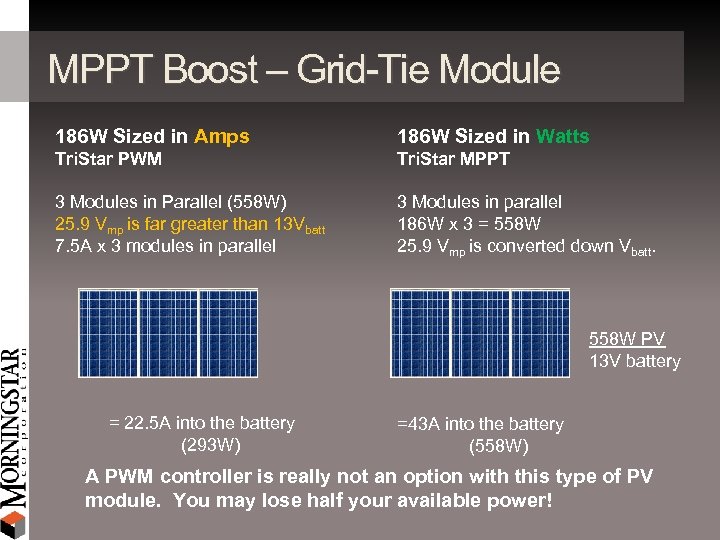
MPPT Boost – Grid-Tie Module 186 W Sized in Amps 186 W Sized in Watts Tri. Star PWM Tri. Star MPPT 3 Modules in Parallel (558 W) 25. 9 Vmp is far greater than 13 Vbatt 7. 5 A x 3 modules in parallel 3 Modules in parallel 186 W x 3 = 558 W 25. 9 Vmp is converted down Vbatt. 558 W PV 13 V battery = 22. 5 A into the battery (293 W) =43 A into the battery (558 W) A PWM controller is really not an option with this type of PV module. You may lose half your available power!
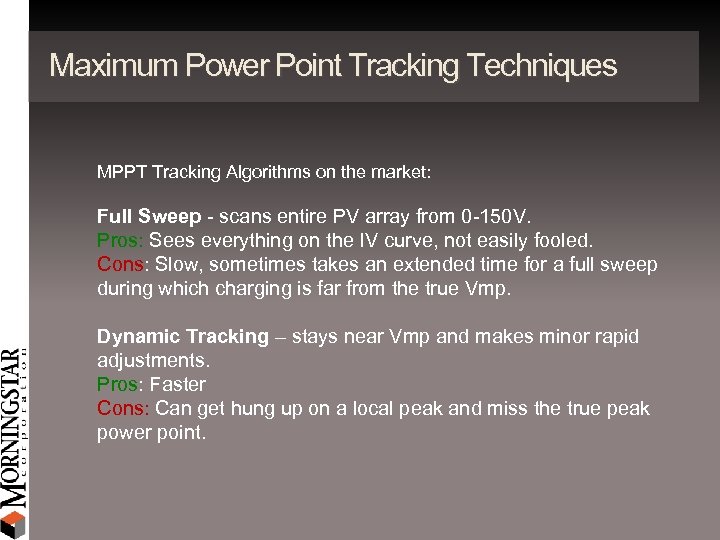
Maximum Power Point Tracking Techniques MPPT Tracking Algorithms on the market: Full Sweep - scans entire PV array from 0 -150 V. Pros: Sees everything on the IV curve, not easily fooled. Cons: Slow, sometimes takes an extended time for a full sweep during which charging is far from the true Vmp. Dynamic Tracking – stays near Vmp and makes minor rapid adjustments. Pros: Faster Cons: Can get hung up on a local peak and miss the true peak power point.
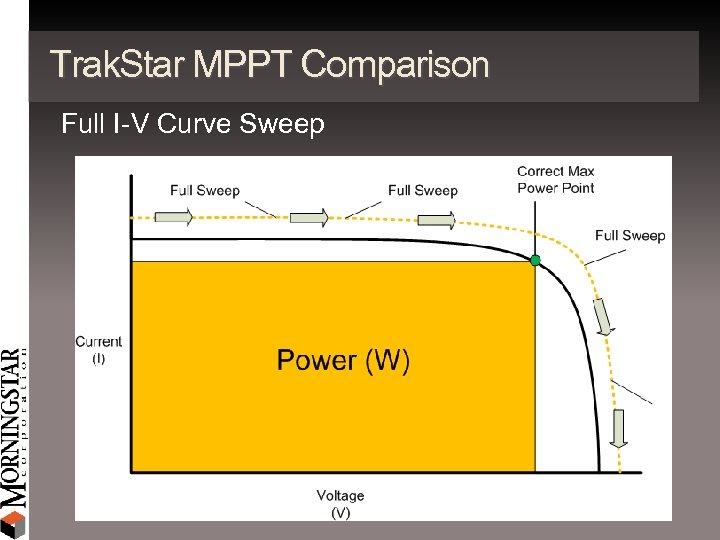
Trak. Star MPPT Comparison Full I-V Curve Sweep
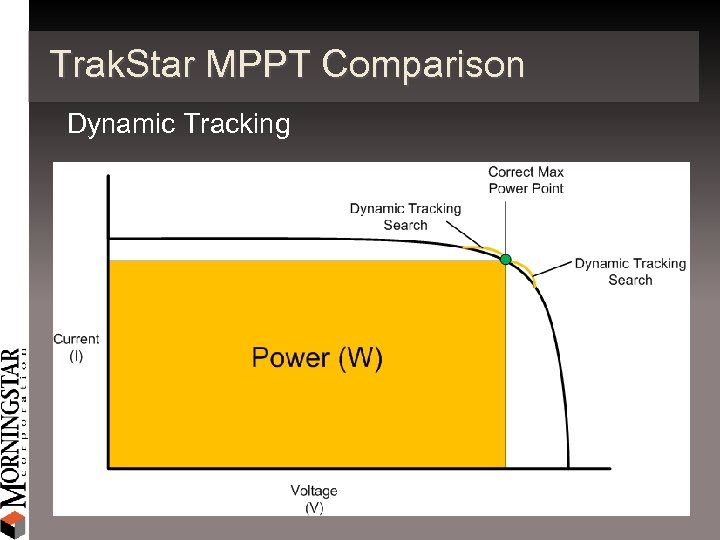
Trak. Star MPPT Comparison Dynamic Tracking
Dynamic tracking alone causes the controller to: -Only see what is happening locally at the presumed power point. -Not detect what true Voc is. -Be fooled by shading effects, mixed module types or flat IV curves often seen on thin film modules. -Take time to re-track during periods of fast changing irradiance and temperature levels. (cool winds on the panel surface or fast moving clouds).
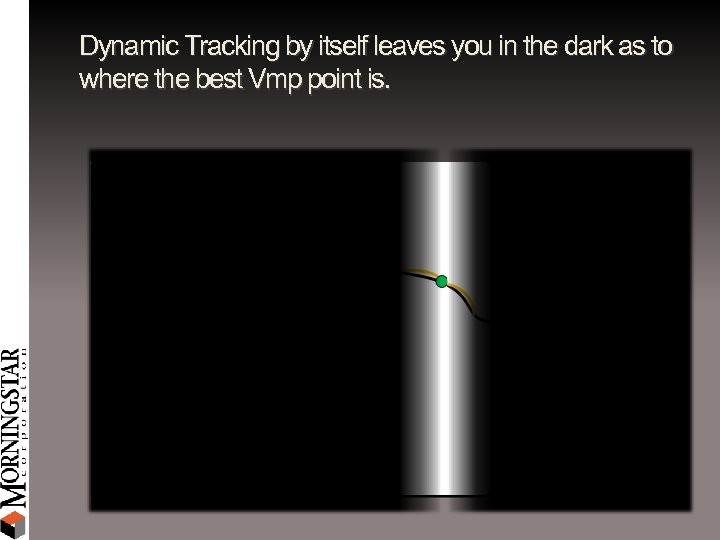
Dynamic Tracking by itself leaves you in the dark as to where the best Vmp point is.
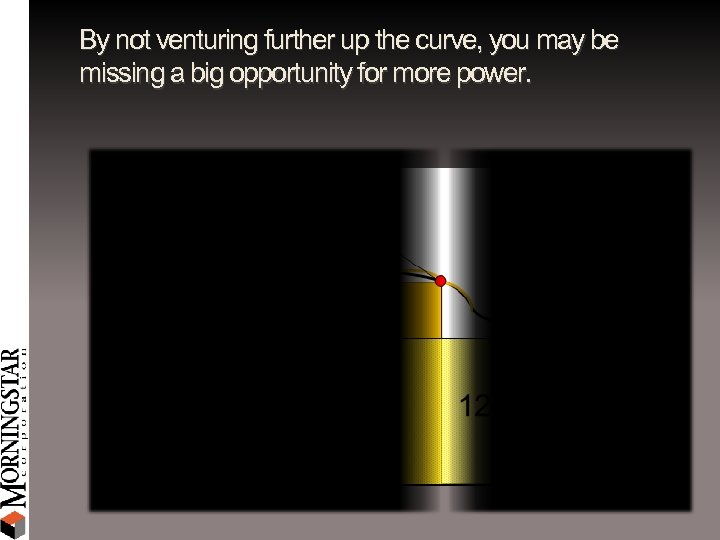
By not venturing further up the curve, you may be missing a big opportunity for more power.
Maximum Power Point Tracking Morningstar Trak. Star Technology can - Full array sweeps from 0 -150 V in ¼ second! Other controllers take up to 30 seconds during which light levels could change. not - The TS-MPPT offers the ability to sweep often to make sure to miss any fast changing max power points. - Dual chipset provides specialized control -DSP – high speed MPPT, charge control, protections and data logging -Secondary Processor – Ethernet and communications

COMPETITIVE ADVANTAGES
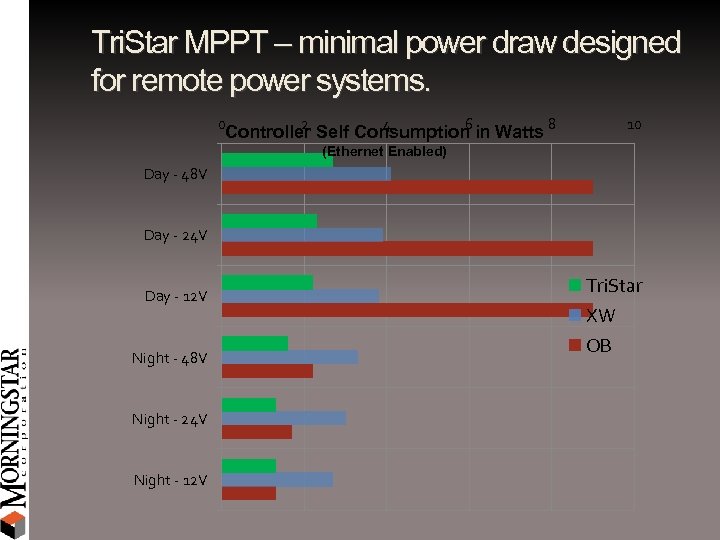
Tri. Star MPPT – minimal power draw designed for remote power systems. 0 2 4 6 Controller Self Consumption in Watts 8 10 (Ethernet Enabled) Day - 48 V Day - 24 V Day - 12 V Night - 48 V Night - 24 V Night - 12 V Tri. Star XW OB
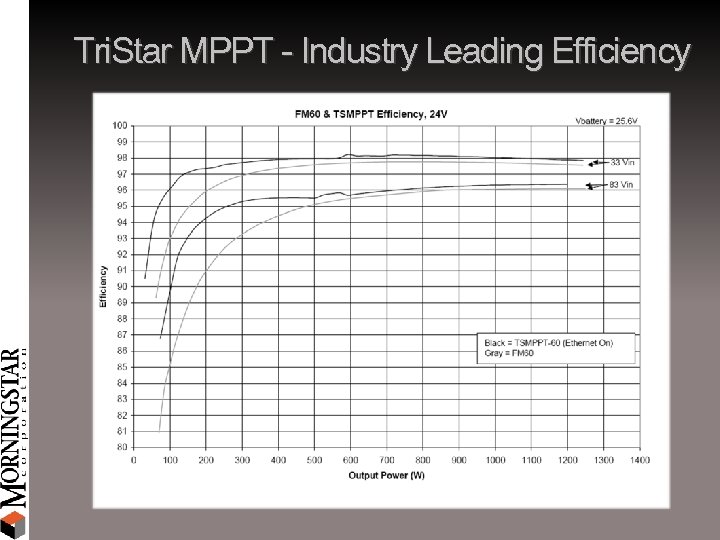
Tri. Star MPPT - Industry Leading Efficiency
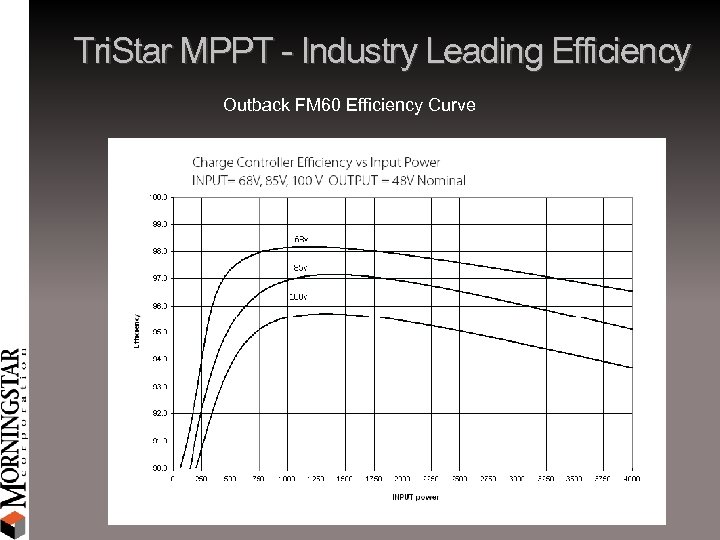
Tri. Star MPPT - Industry Leading Efficiency Outback FM 60 Efficiency Curve
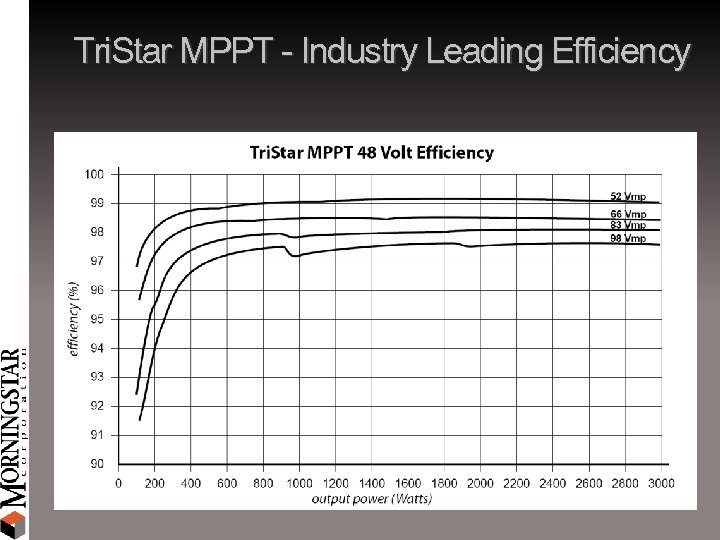
Tri. Star MPPT - Industry Leading Efficiency
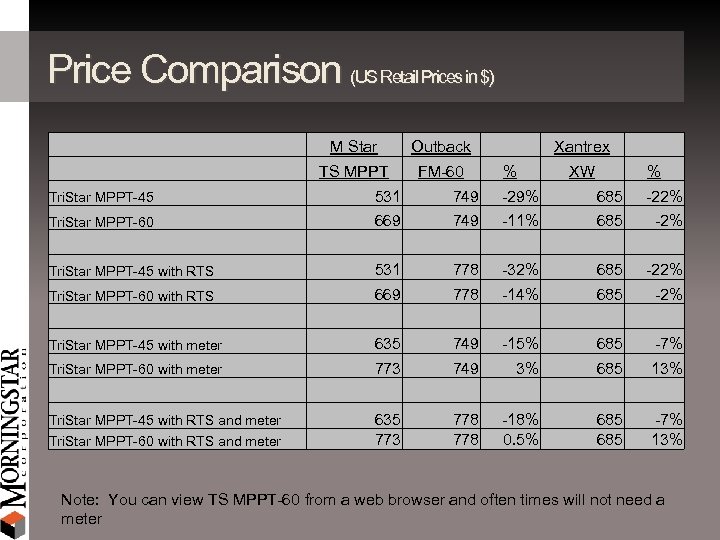
Price Comparison (US Retail Prices in $) M Star Outback TS MPPT FM-60 Xantrex % XW % Tri. Star MPPT-45 531 749 -29% 685 -22% Tri. Star MPPT-60 669 749 -11% 685 -2% Tri. Star MPPT-45 with RTS 531 778 -32% 685 -22% Tri. Star MPPT-60 with RTS 669 778 -14% 685 -2% Tri. Star MPPT-45 with meter 635 749 -15% 685 -7% Tri. Star MPPT-60 with meter 773 749 3% 685 13% 685 -7% 13% Tri. Star MPPT-45 with RTS and meter Tri. Star MPPT-60 with RTS and meter 635 773 778 -18% 0. 5% Note: You can view TS MPPT-60 from a web browser and often times will not need a meter
TS MPPT SIZING AND SETUP
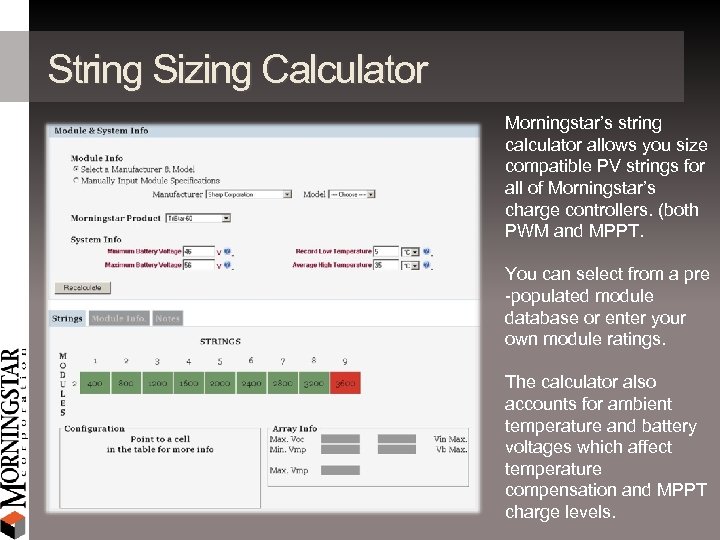
String Sizing Calculator Morningstar’s string calculator allows you size compatible PV strings for all of Morningstar’s charge controllers. (both PWM and MPPT. You can select from a pre -populated module database or enter your own module ratings. The calculator also accounts for ambient temperature and battery voltages which affect temperature compensation and MPPT charge levels.
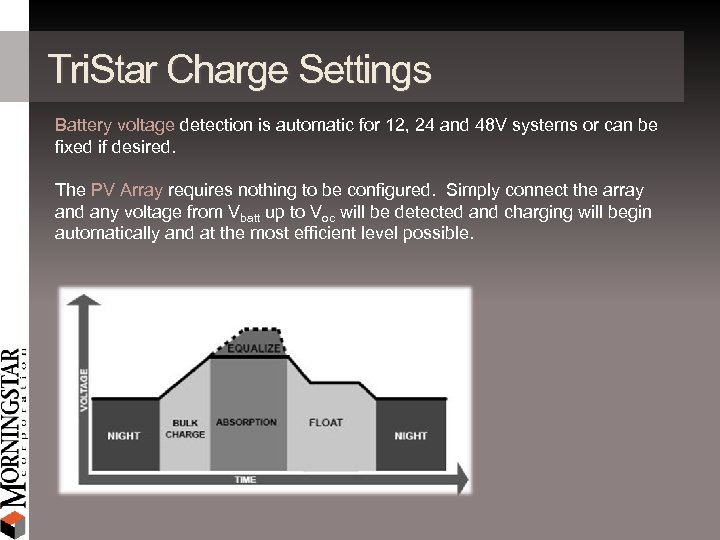
Tri. Star Charge Settings Battery voltage detection is automatic for 12, 24 and 48 V systems or can be fixed if desired. The PV Array requires nothing to be configured. Simply connect the array and any voltage from Vbatt up to Voc will be detected and charging will begin automatically and at the most efficient level possible.
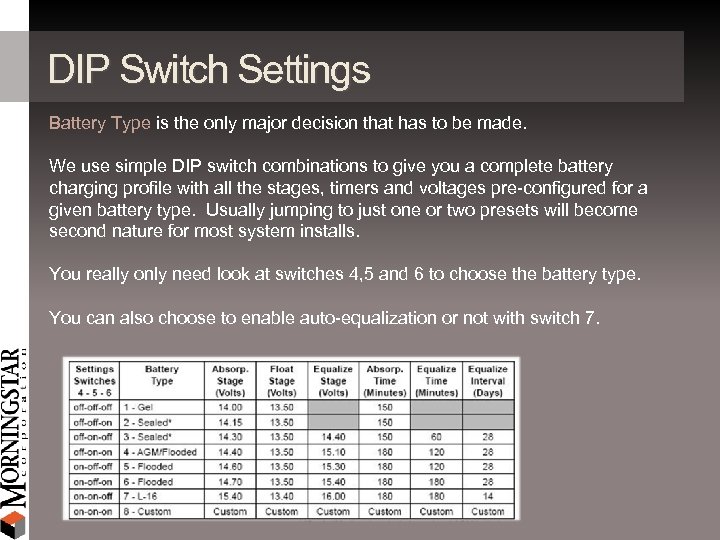
DIP Switch Settings Battery Type is the only major decision that has to be made. We use simple DIP switch combinations to give you a complete battery charging profile with all the stages, timers and voltages pre-configured for a given battery type. Usually jumping to just one or two presets will become second nature for most system installs. You really only need look at switches 4, 5 and 6 to choose the battery type. You can also choose to enable auto-equalization or not with switch 7.
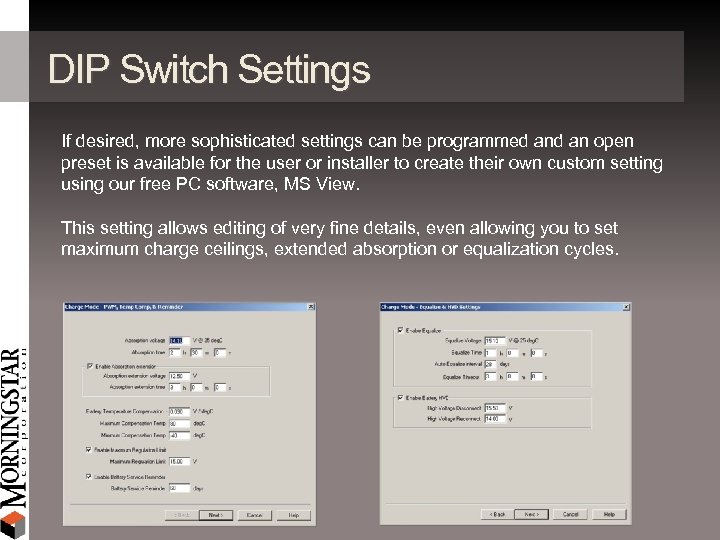
DIP Switch Settings If desired, more sophisticated settings can be programmed an open preset is available for the user or installer to create their own custom setting using our free PC software, MS View. This setting allows editing of very fine details, even allowing you to set maximum charge ceilings, extended absorption or equalization cycles.

PRODUCT COMMUNICATIONS
Tri. Star MPPT Communications • Networked Controllers Working Together • Controllers interacting with other site hardware • Data logging of site data for later retrieval • Remote monitoring and control
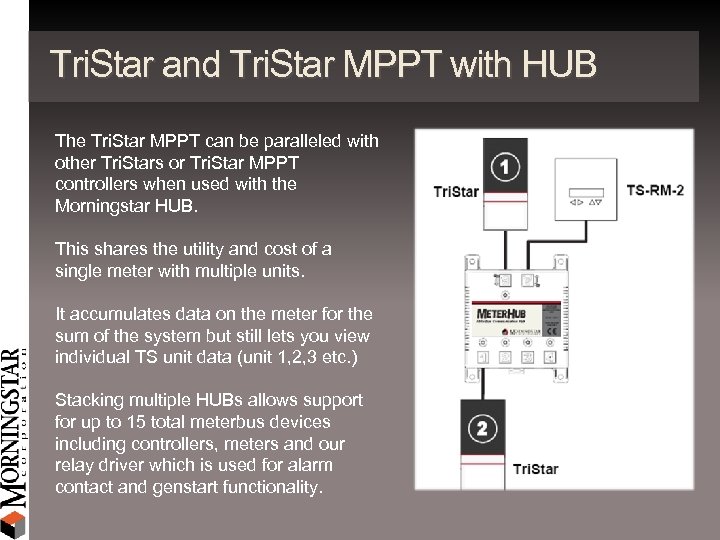
Tri. Star and Tri. Star MPPT with HUB The Tri. Star MPPT can be paralleled with other Tri. Stars or Tri. Star MPPT controllers when used with the Morningstar HUB. This shares the utility and cost of a single meter with multiple units. It accumulates data on the meter for the sum of the system but still lets you view individual TS unit data (unit 1, 2, 3 etc. ) Stacking multiple HUBs allows support for up to 15 total meterbus devices including controllers, meters and our relay driver which is used for alarm contact and genstart functionality.
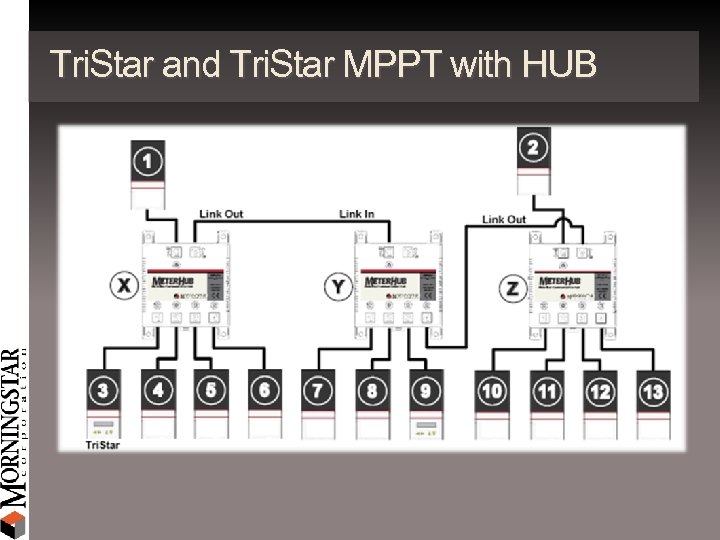
Tri. Star and Tri. Star MPPT with HUB
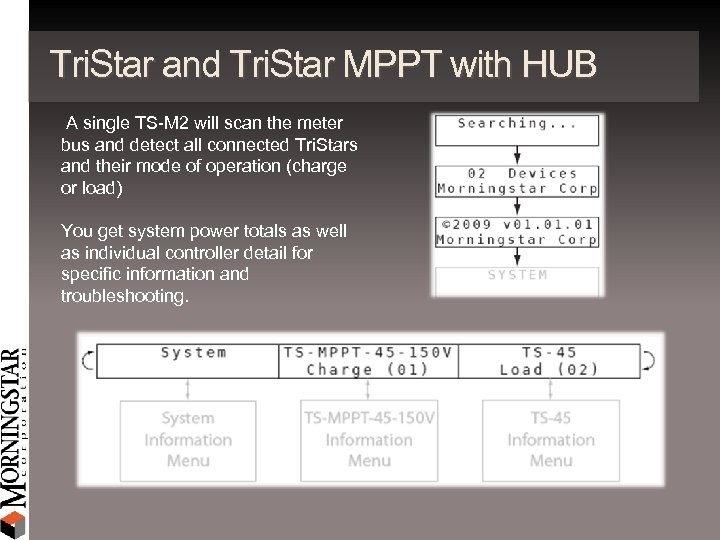
Tri. Star and Tri. Star MPPT with HUB A single TS-M 2 will scan the meter bus and detect all connected Tri. Stars and their mode of operation (charge or load) You get system power totals as well as individual controller detail for specific information and troubleshooting.
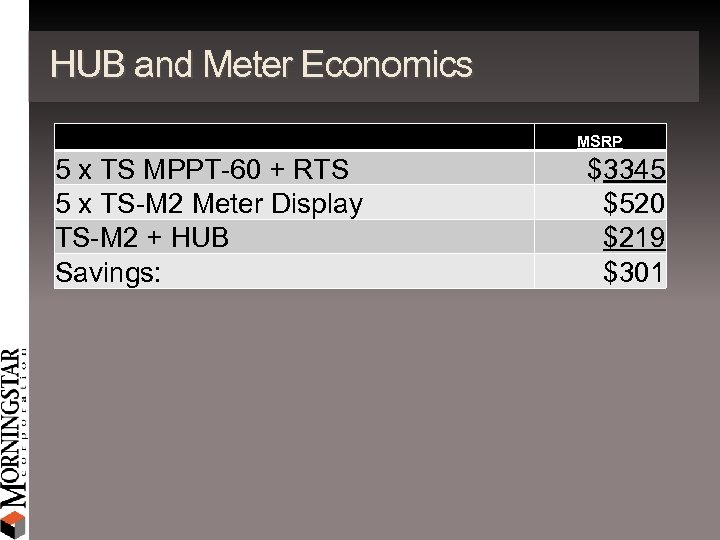
HUB and Meter Economics MSRP 5 x TS MPPT-60 + RTS 5 x TS-M 2 Meter Display TS-M 2 + HUB Savings: $3345 $520 $219 $301
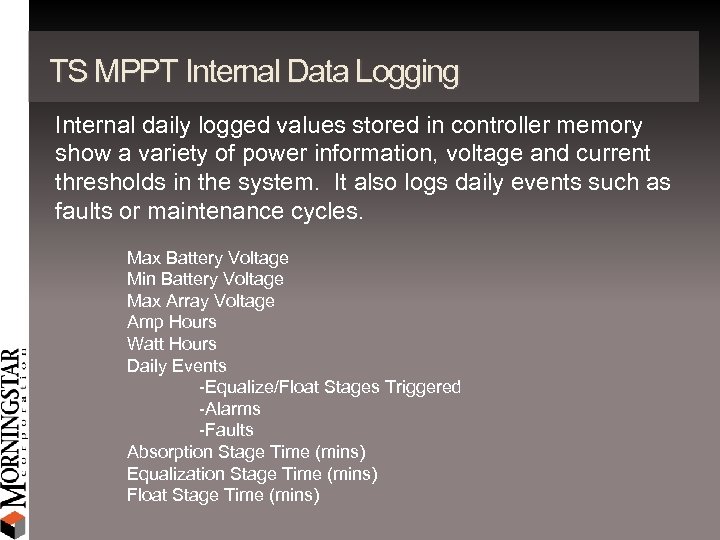
TS MPPT Internal Data Logging Internal daily logged values stored in controller memory show a variety of power information, voltage and current thresholds in the system. It also logs daily events such as faults or maintenance cycles. Max Battery Voltage Min Battery Voltage Max Array Voltage Amp Hours Watt Hours Daily Events -Equalize/Float Stages Triggered -Alarms -Faults Absorption Stage Time (mins) Equalization Stage Time (mins) Float Stage Time (mins)
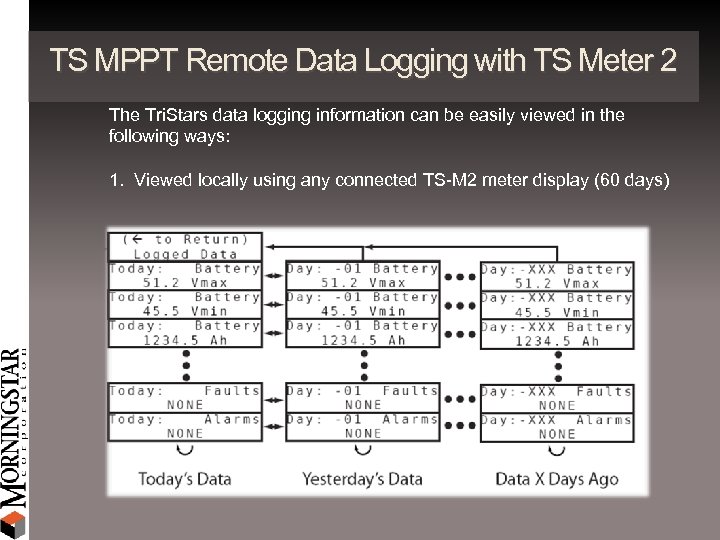
TS MPPT Remote Data Logging with TS Meter 2 The Tri. Stars data logging information can be easily viewed in the following ways: 1. Viewed locally using any connected TS-M 2 meter display (60 days)
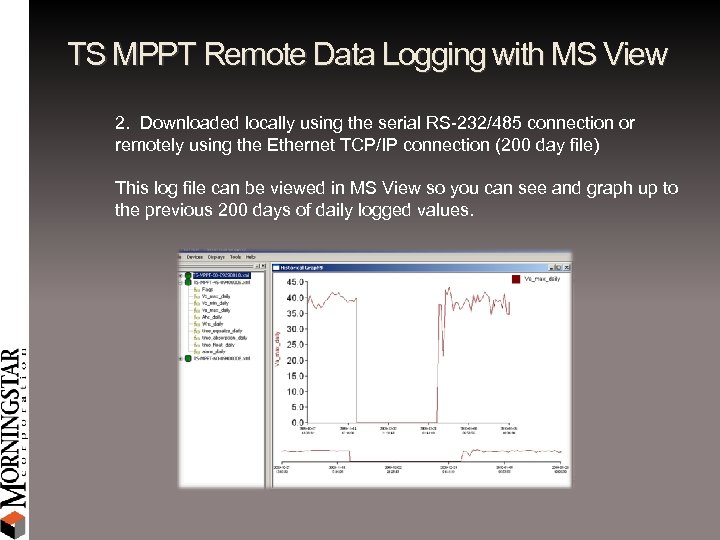
TS MPPT Remote Data Logging with MS View 2. Downloaded locally using the serial RS-232/485 connection or remotely using the Ethernet TCP/IP connection (200 day file) This log file can be viewed in MS View so you can see and graph up to the previous 200 days of daily logged values.
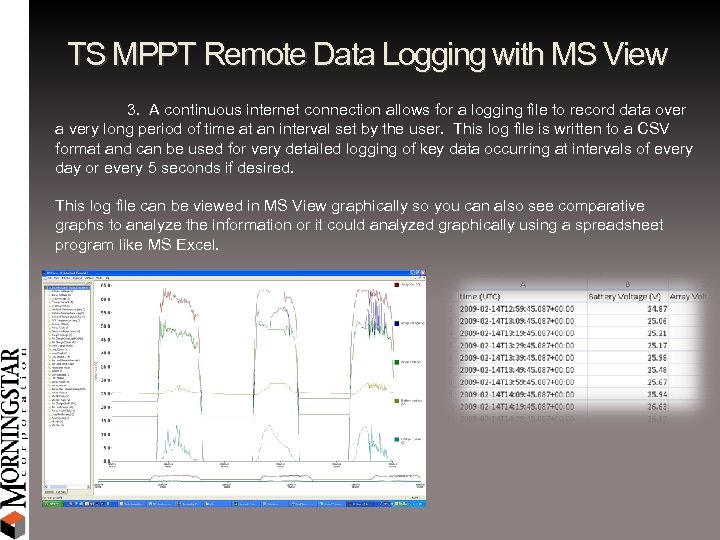
TS MPPT Remote Data Logging with MS View 3. A continuous internet connection allows for a logging file to record data over a very long period of time at an interval set by the user. This log file is written to a CSV format and can be used for very detailed logging of key data occurring at intervals of every day or every 5 seconds if desired. This log file can be viewed in MS View graphically so you can also see comparative graphs to analyze the information or it could analyzed graphically using a spreadsheet program like MS Excel.
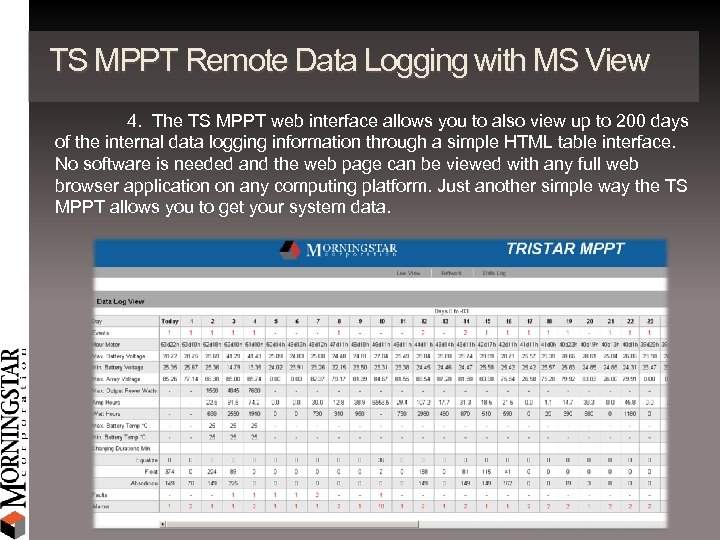
TS MPPT Remote Data Logging with MS View 4. The TS MPPT web interface allows you to also view up to 200 days of the internal data logging information through a simple HTML table interface. No software is needed and the web page can be viewed with any full web browser application on any computing platform. Just another simple way the TS MPPT allows you to get your system data.
Tri. Star – Notification Often a remote data connection is not something that can be continually monitored due to the lack of bandwidth, or the fact that there are two many sites to effective keep track of in real time. The TS MPPT with Ethernet offers two solutions to better manage large quantities of sites. SNMP – Simple Network Management Protocol SNMP is a network standard that allows networked equipment to send out a proactive alert in the event of a problem with the system. A listening server will detect these alerts and allow for identification to pursue further information about the problem. Email Alerts – Programmable Proactive Alerts Using comparative logic, the user can setup conditions that the TS MPPT will watch for and when detected, can send an email with details of the alert and on which unit it happened.
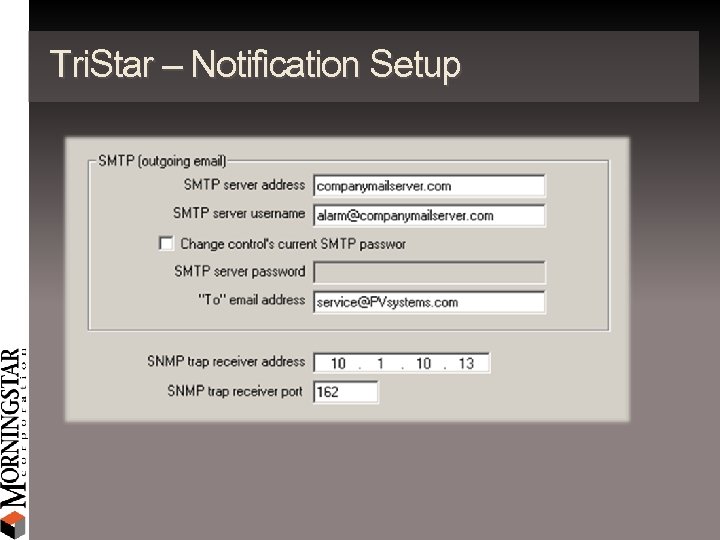
Tri. Star – Notification Setup
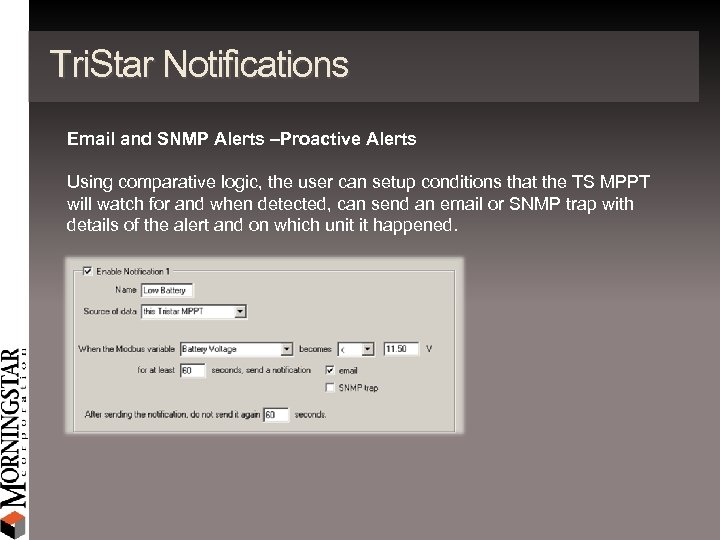
Tri. Star Notifications Email and SNMP Alerts –Proactive Alerts Using comparative logic, the user can setup conditions that the TS MPPT will watch for and when detected, can send an email or SNMP trap with details of the alert and on which unit it happened.
Tri. Star – MODBUS Open Protocol All of Morningstar’s data enabled controllers use an open industrial data protocol known as MODBUS. By choosing this type of protocol, we allow 3 rd party software and hardware to easily communicate with our controllers. We do not limit the customer to our proprietary hardware to use our system information. MODBUS is continuing to be chosen as the standard of choice for remote telemetry, power monitoring and inter-device communication. We believe MODBUS support will allow our products to grow easily with the industry’s rapid pace of energy technology development.
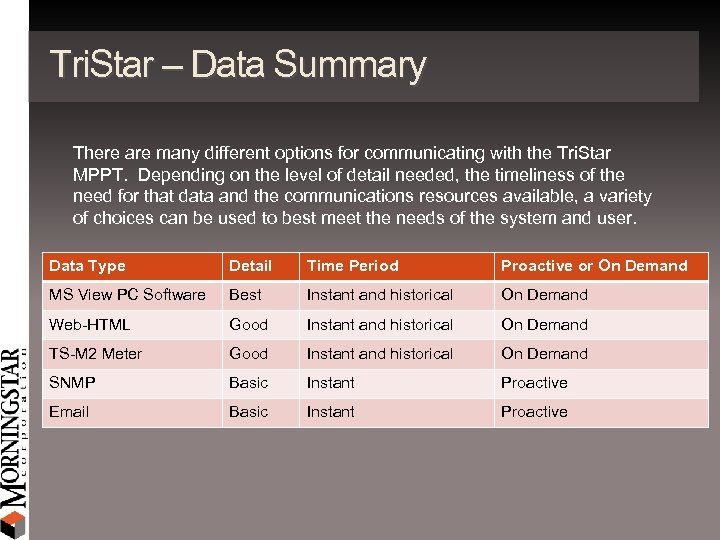
Tri. Star – Data Summary There are many different options for communicating with the Tri. Star MPPT. Depending on the level of detail needed, the timeliness of the need for that data and the communications resources available, a variety of choices can be used to best meet the needs of the system and user. Data Type Detail Time Period Proactive or On Demand MS View PC Software Best Instant and historical On Demand Web-HTML Good Instant and historical On Demand TS-M 2 Meter Good Instant and historical On Demand SNMP Basic Instant Proactive Email Basic Instant Proactive
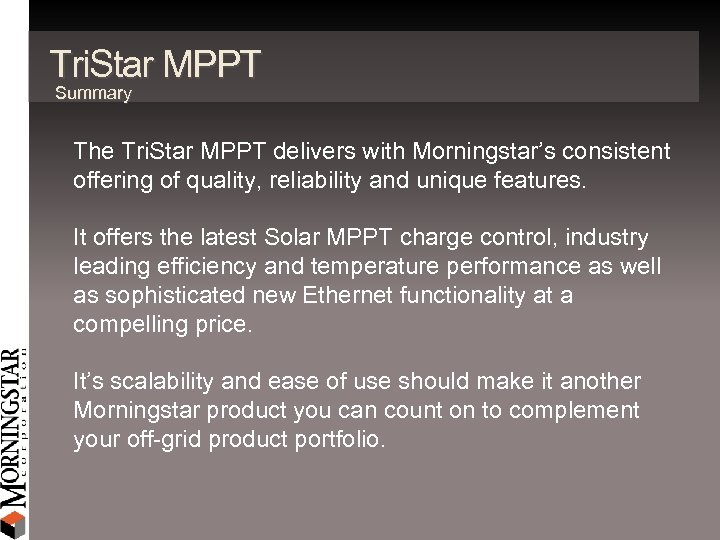
Tri. Star MPPT Summary The Tri. Star MPPT delivers with Morningstar’s consistent offering of quality, reliability and unique features. It offers the latest Solar MPPT charge control, industry leading efficiency and temperature performance as well as sophisticated new Ethernet functionality at a compelling price. It’s scalability and ease of use should make it another Morningstar product you can count on to complement your off-grid product portfolio.
Скачать презентацию Tri Star MPPT Training Program Brad Berwald Sr
a4898cbcbd41d34043bd929b2407d833.ppt