


 Скачать презентацию tri-District Henry Hudson Regional Highlands Elementary and Atlantic
fa73425e57c660a4379ff98db3c5f0c9.ppt
- Количество слайдов: 94
 tri-District Henry Hudson Regional, Highlands Elementary, and Atlantic Highlands Elementary Schools Sheltered Learning Day 2 Elizabeth Franks, Ed. D. & ejf 24 bb@aol. com Barbara Tedesco. M. A. T. babted@aol. com WIDA Consultant Language & Literacy Associates for Multilingual and Multicultural Education LLAMAME, LLC www. education 4 ells. com http: //www. facebook. com/pages/education 4 ells/233538066164 Franks/Tedesco
 Parking Lot 1. Write down anything that you have a question about without putting your name on the paper. 2. Stick it on the sheet labeled “Parking Lot” at any time of the day. 3. Back-channeling using digital tools to ask questions
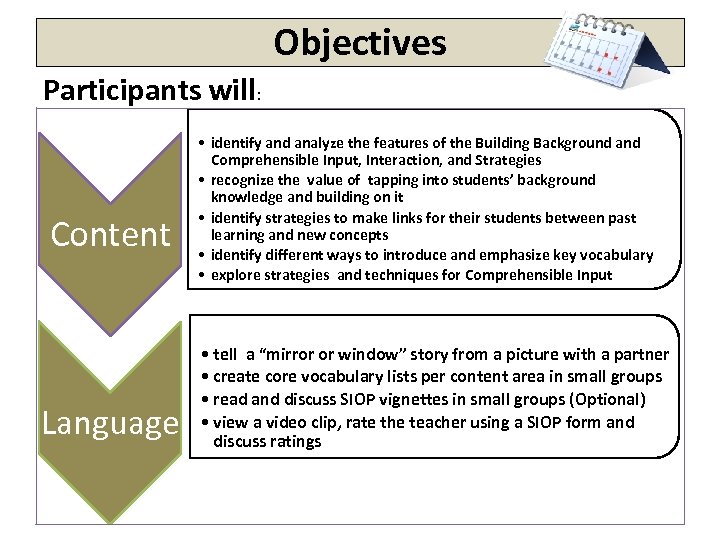
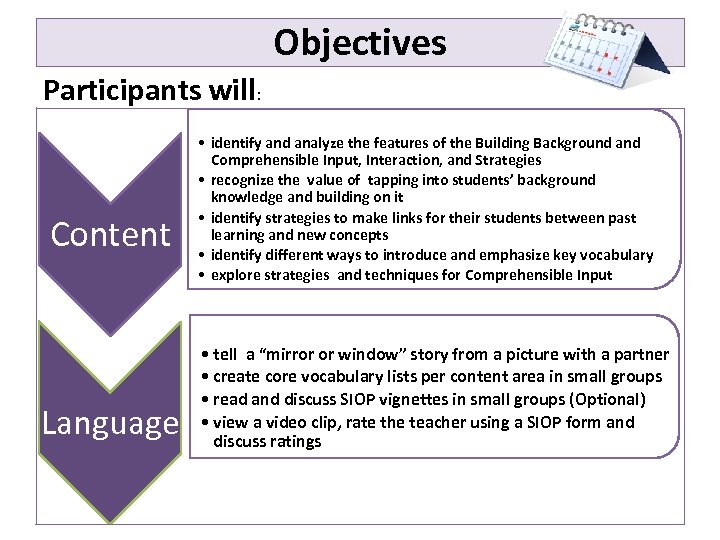 Objectives Participants will: Content Language • identify and analyze the features of the Building Background and Comprehensible Input, Interaction, and Strategies • recognize the value of tapping into students’ background knowledge and building on it • identify strategies to make links for their students between past learning and new concepts • identify different ways to introduce and emphasize key vocabulary • explore strategies and techniques for Comprehensible Input • tell a “mirror or window” story from a picture with a partner • create core vocabulary lists per content area in small groups • read and discuss SIOP vignettes in small groups (Optional) • view a video clip, rate the teacher using a SIOP form and discuss ratings
 Four key terms/phrases • Strategic vocabulary • Scaffold • Student Engagement • Formative Assessment
 Building Background • Key vocabulary emphasized
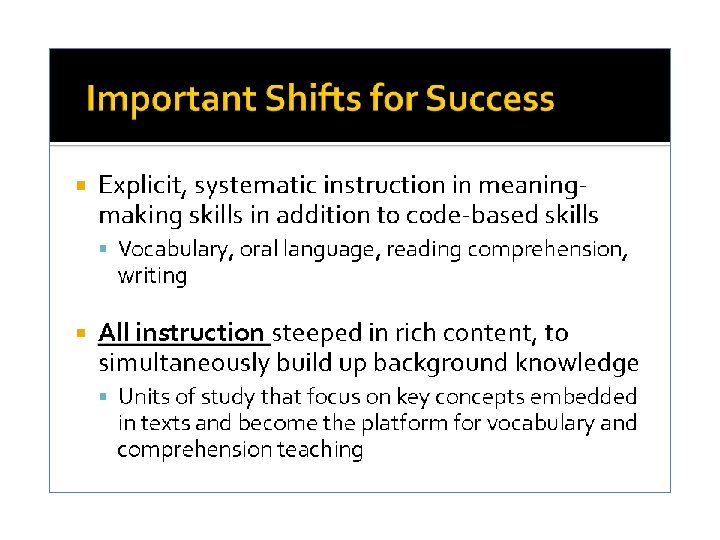
 National Literacy Panel on Vocabulary • Need for direct instruction of academic vocabulary items required for specific texts (content-based) • Repetition and multiple exposures • Learning in rich context • Active engagement in learning tasks-inclusive of extended oral discourse • Computer technology • Incidental learning (read-alouds, storytelling) • Multiple methods
 Importance of Vocabulary Instruction • Vocabulary Gap – Gap in word knowledge persists though the elementary years. (White, Graves, & Slater, 1990) – The vocabulary gap between struggling readers and proficient readers grows each year. (Stanovich, 1986) – After the primary grades, the “achievement gap” between socioeconomic groups is a language gap. (Hirsh, 2002) • One of the most persistent findings in reading research is that students’ vocabulary knowledge is related strongly to their reading comprehension and to other overall academic success (Lehr, Osborn, & Hiebert, 2004)
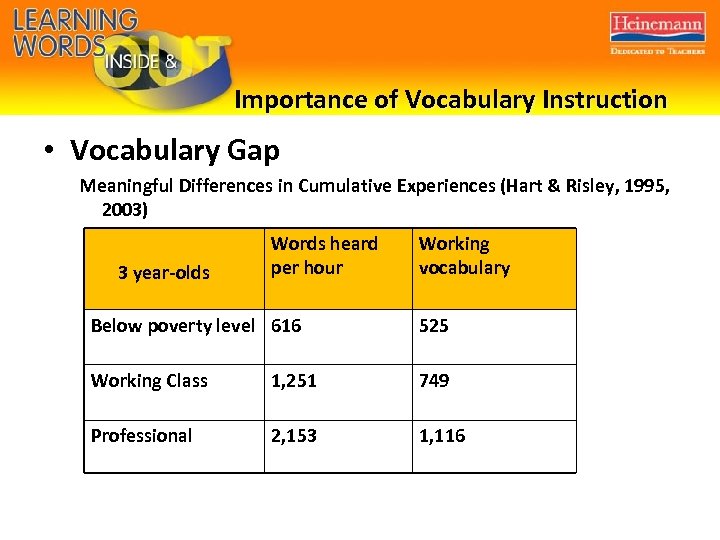 Importance of Vocabulary Instruction • Vocabulary Gap Meaningful Differences in Cumulative Experiences (Hart & Risley, 1995, 2003) 3 year-olds Words heard per hour Working vocabulary Below poverty level 616 525 Working Class 1, 251 749 Professional 2, 153 1, 116
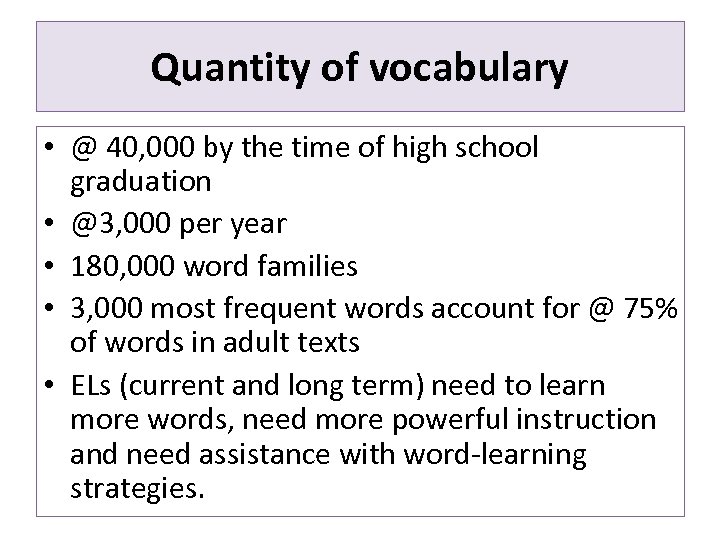 Quantity of vocabulary • @ 40, 000 by the time of high school graduation • @3, 000 per year • 180, 000 word families • 3, 000 most frequent words account for @ 75% of words in adult texts • ELs (current and long term) need to learn more words, need more powerful instruction and need assistance with word-learning strategies.
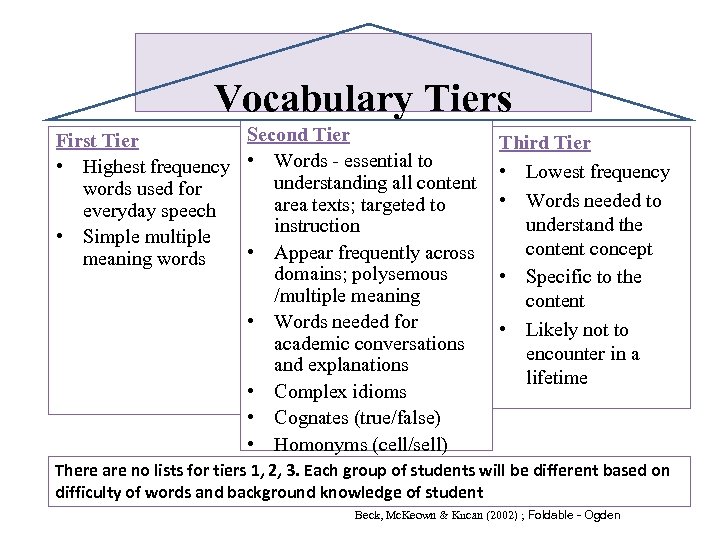 Vocabulary Tiers Second Tier First Tier • Highest frequency • Words - essential to understanding all content words used for area texts; targeted to everyday speech instruction • Simple multiple • Appear frequently across meaning words domains; polysemous /multiple meaning • Words needed for academic conversations and explanations • Complex idioms • Cognates (true/false) • Homonyms (cell/sell) Third Tier • Lowest frequency • Words needed to understand the content concept • Specific to the content • Likely not to encounter in a lifetime There are no lists for tiers 1, 2, 3. Each group of students will be different based on difficulty of words and background knowledge of student Beck, Mc. Keown & Kucan (2002) ; Foldable - Ogden
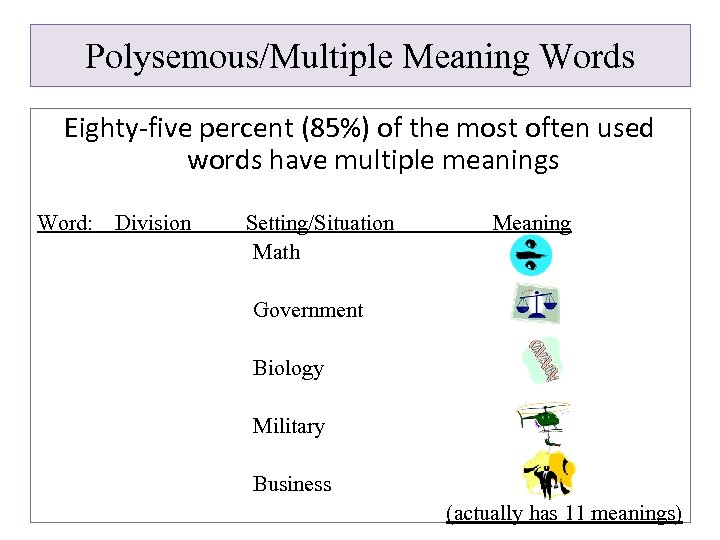 Polysemous/Multiple Meaning Words Eighty-five percent (85%) of the most often used words have multiple meanings Word: Division Setting/Situation Math Meaning Government Biology Military Business (actually has 11 meanings)
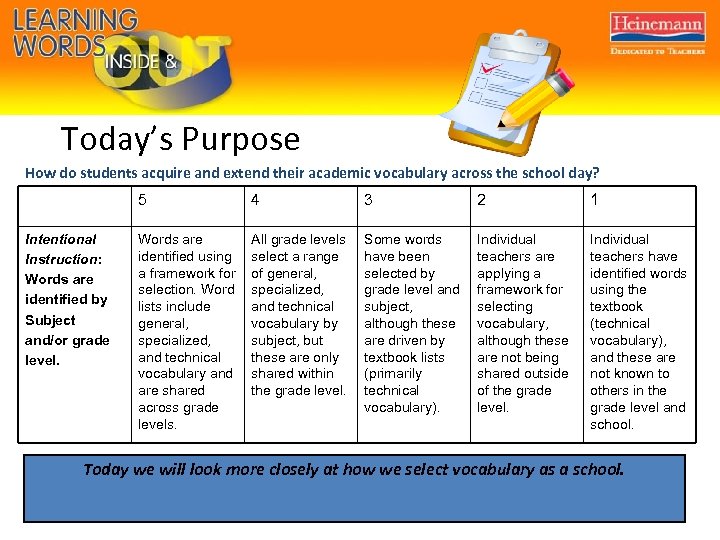 Today’s Purpose How do students acquire and extend their academic vocabulary across the school day? 5 Intentional Instruction: Words are identified by Subject and/or grade level. 4 3 2 1 Words are identified using a framework for selection. Word lists include general, specialized, and technical vocabulary and are shared across grade levels. All grade levels select a range of general, specialized, and technical vocabulary by subject, but these are only shared within the grade level. Some words have been selected by grade level and subject, although these are driven by textbook lists (primarily technical vocabulary). Individual teachers are applying a framework for selecting vocabulary, although these are not being shared outside of the grade level. Individual teachers have identified words using the textbook (technical vocabulary), and these are not known to others in the grade level and school. Today we will look more closely at how we select vocabulary as a school.
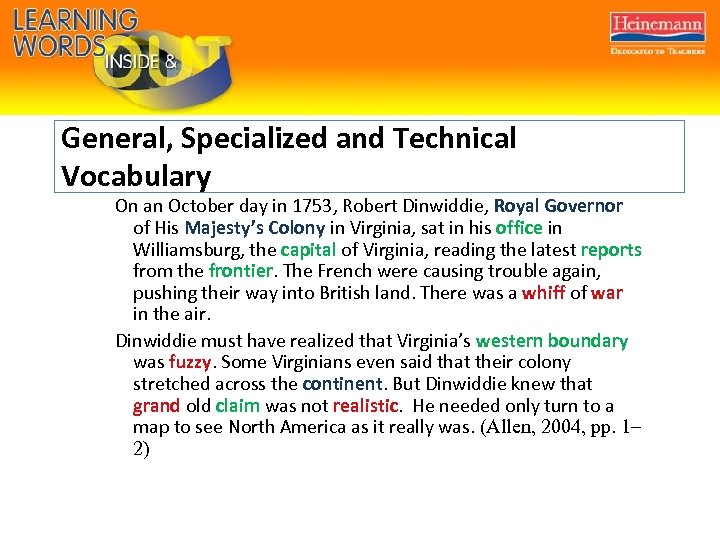 General, Specialized and Technical Vocabulary On an October day in 1753, Robert Dinwiddie, Royal Governor of His Majesty’s Colony in Virginia, sat in his office in Williamsburg, the capital of Virginia, reading the latest reports from the frontier. The French were causing trouble again, pushing their way into British land. There was a whiff of war in the air. Dinwiddie must have realized that Virginia’s western boundary was fuzzy. Some Virginians even said that their colony stretched across the continent. But Dinwiddie knew that grand old claim was not realistic. He needed only turn to a map to see North America as it really was. (Allen, 2004, pp. 1– 2)
 The Problem: Too Many Words! • 17 words identified in 2 paragraphs • Ideal is 8– 10 a week for deep teaching (Scott, Jamieson-Noel, and Asselin, 2003) • Must be narrowed, but how?
 Vocabulary Selection • ALLs need to know words that are frequent across multiple texts. • ALLs need to know the words and phrases that are crucial to understanding the text (using text dependent questions). Adapted from Diane August 2014 NABE
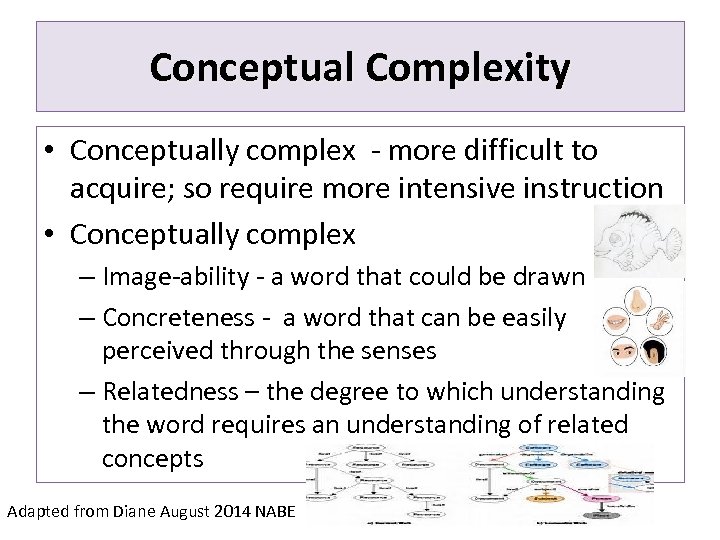 Conceptual Complexity • Conceptually complex - more difficult to acquire; so require more intensive instruction • Conceptually complex – Image-ability - a word that could be drawn – Concreteness - a word that can be easily perceived through the senses – Relatedness – the degree to which understanding the word requires an understanding of related concepts Adapted from Diane August 2014 NABE
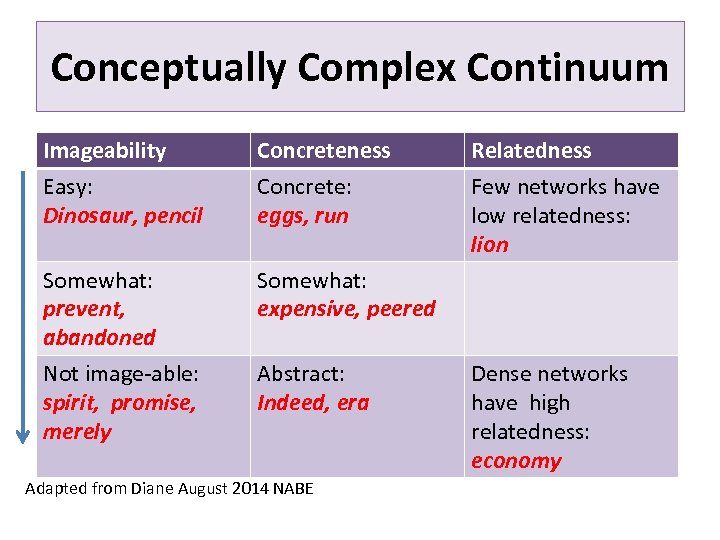 Conceptually Complex Continuum Imageability Concreteness Relatedness Easy: Dinosaur, pencil Concrete: eggs, run Few networks have low relatedness: lion Somewhat: prevent, abandoned Somewhat: expensive, peered Not image-able: spirit, promise, merely Abstract: Indeed, era Adapted from Diane August 2014 NABE Dense networks have high relatedness: economy
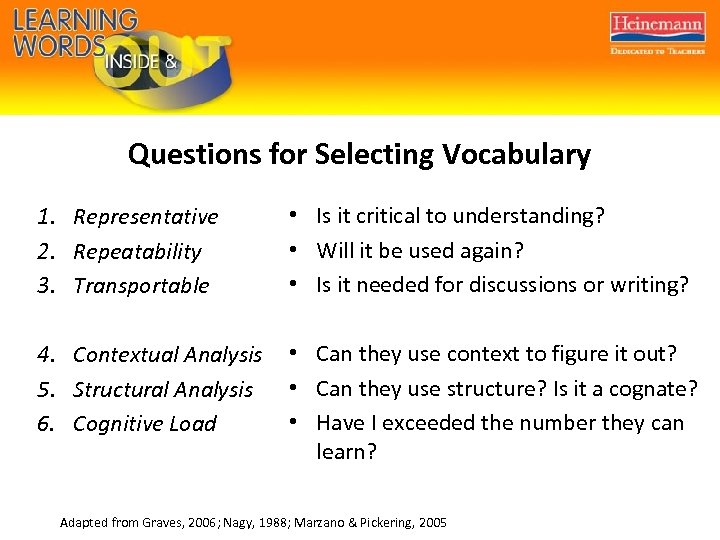 Questions for Selecting Vocabulary 1. Representative 2. Repeatability 3. Transportable • Is it critical to understanding? • Will it be used again? • Is it needed for discussions or writing? 4. Contextual Analysis 5. Structural Analysis 6. Cognitive Load • Can they use context to figure it out? • Can they use structure? Is it a cognate? • Have I exceeded the number they can learn? Adapted from Graves, 2006; Nagy, 1988; Marzano & Pickering, 2005
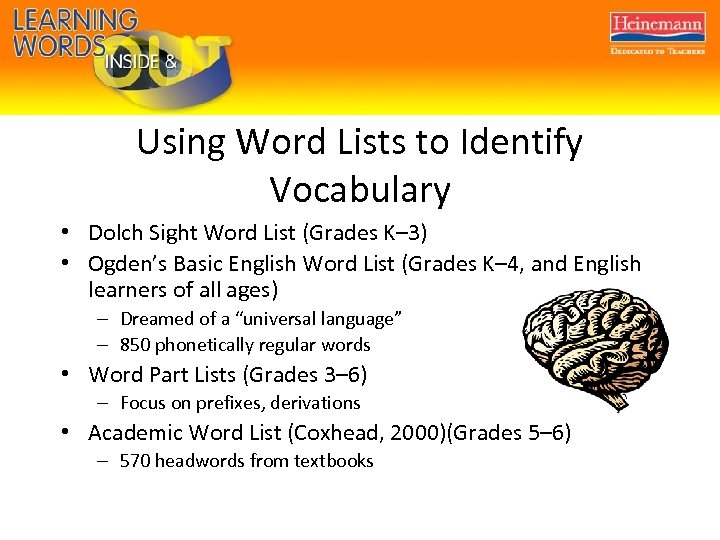 Using Word Lists to Identify Vocabulary • Dolch Sight Word List (Grades K– 3) • Ogden’s Basic English Word List (Grades K– 4, and English learners of all ages) – Dreamed of a “universal language” – 850 phonetically regular words • Word Part Lists (Grades 3– 6) – Focus on prefixes, derivations • Academic Word List (Coxhead, 2000)(Grades 5– 6) – 570 headwords from textbooks
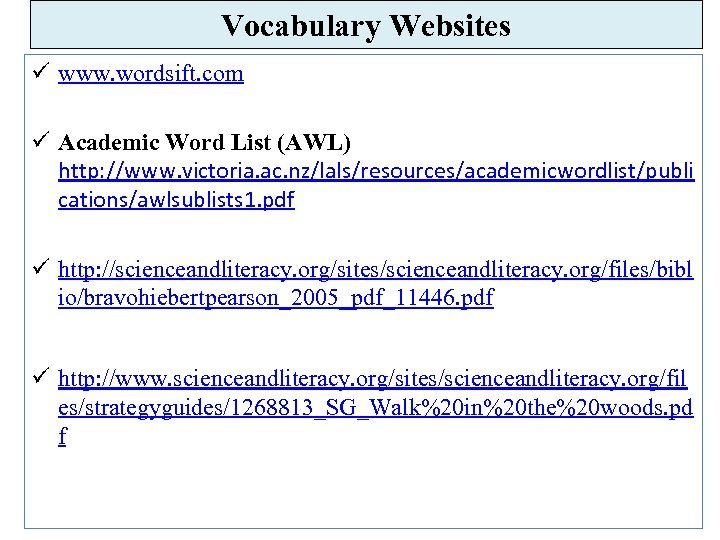 Vocabulary Websites ü www. wordsift. com ü Academic Word List (AWL) http: //www. victoria. ac. nz/lals/resources/academicwordlist/publi cations/awlsublists 1. pdf ü http: //scienceandliteracy. org/sites/scienceandliteracy. org/files/bibl io/bravohiebertpearson_2005_pdf_11446. pdf ü http: //www. scienceandliteracy. org/sites/scienceandliteracy. org/fil es/strategyguides/1268813_SG_Walk%20 in%20 the%20 woods. pd f
 Free Rice-World Hunger & Vocabulary ü For each answer you get right, they donate 10 grains of rice to the United Nations World Food Program. http: //www. freerice. com/ WARNING: This game may make you smarter. . It is a website where users play various educational, multiplechoice games in order to fight world hunger. For every answer the user answers correctly, 10 grains of rice are donated. The games include English vocabulary (the game the site began with), multiplication tables, pre-algebra, chemistry (basic and intermediate), English grammar, basic foreign language vocabulary for English speakers (French, German, Italian, and Spanish), geography (world capitals and country identification), and identification of famous artwork.
 Marzano’s Approach • Adopt a district or building – based template • Develop a vocabulary list by grade/content
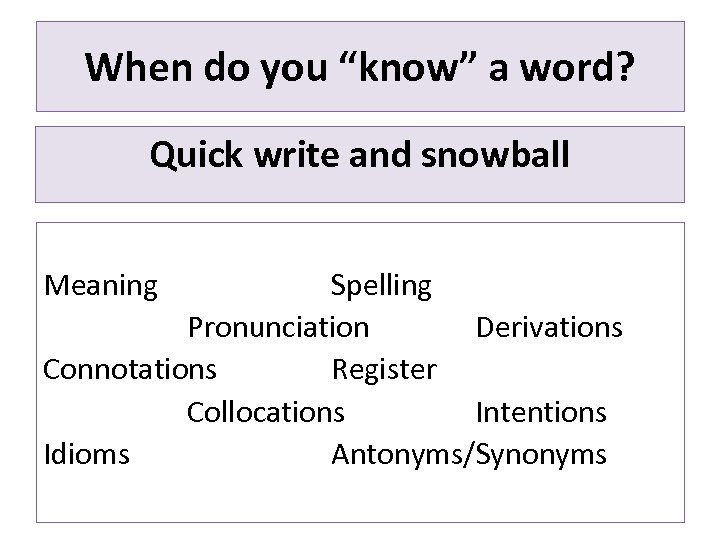 When do you “know” a word? Quick write and snowball Meaning Spelling Pronunciation Derivations Connotations Register Collocations Intentions Idioms Antonyms/Synonyms
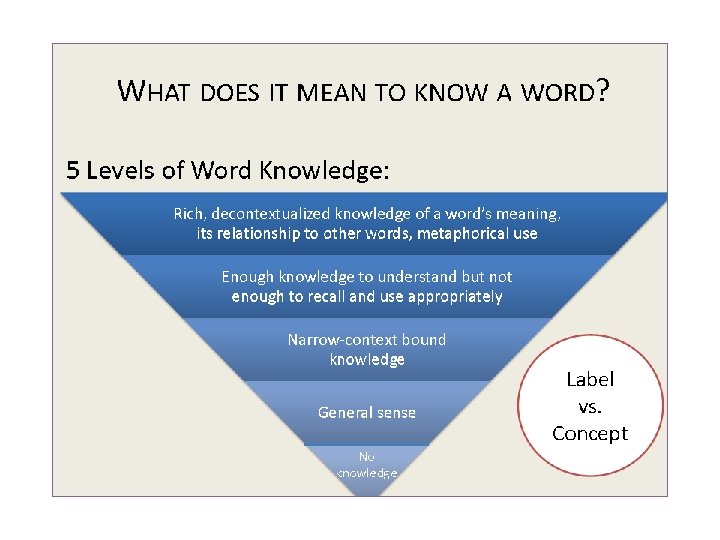
 Use of Imagery Some nonlinguistic representations: • making physical or graphic models • generating mental pictures • drawing pictures and pictographs • engaging in kinesthetic activity Quick Draw
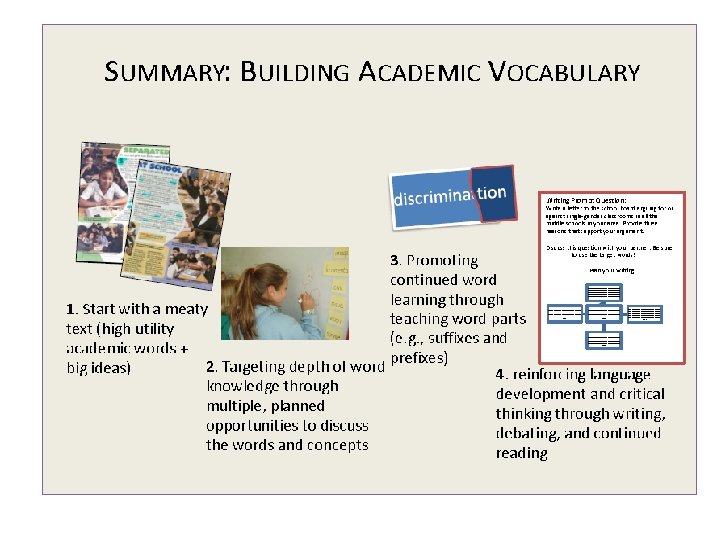
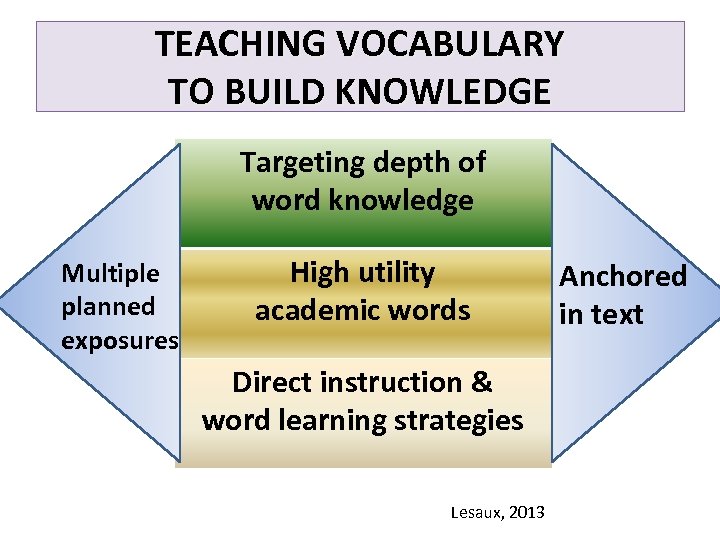 TEACHING VOCABULARY TO BUILD KNOWLEDGE Targeting depth of word knowledge Multiple planned exposures High utility academic words Direct instruction & word learning strategies Lesaux, 2013 Anchored in text
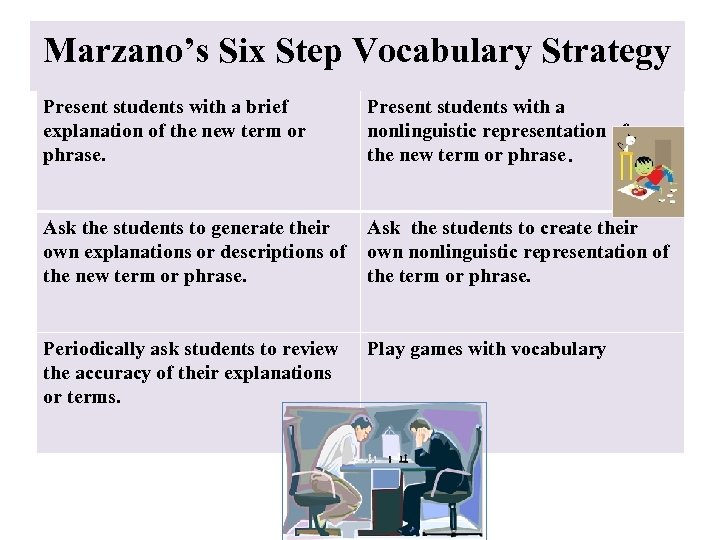 Marzano’s Six Step Vocabulary Strategy Present students with a brief explanation of the new term or phrase. Present students with a nonlinguistic representation of the new term or phrase. Ask the students to generate their own explanations or descriptions of the new term or phrase. Ask the students to create their own nonlinguistic representation of the term or phrase. Periodically ask students to review the accuracy of their explanations or terms. Play games with vocabulary
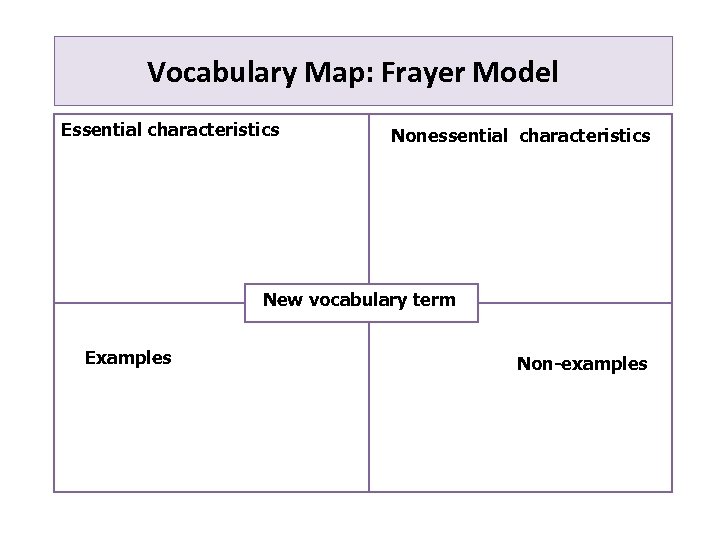 Vocabulary Map: Frayer Model Essential characteristics Nonessential characteristics New vocabulary term Examples Non-examples
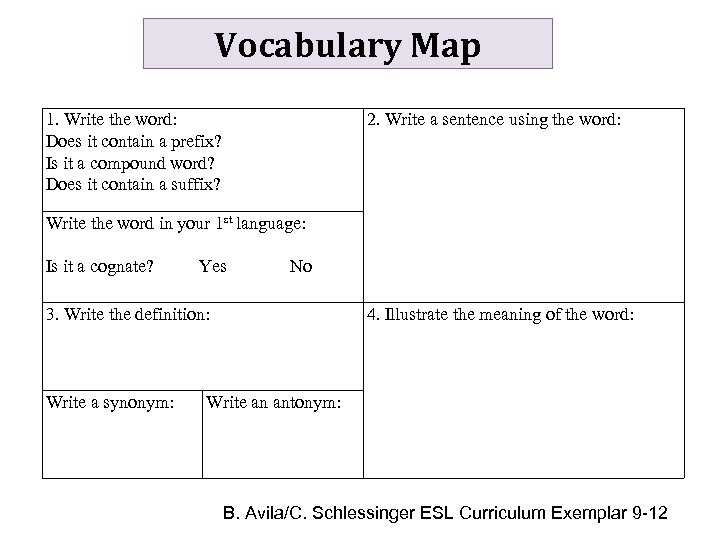 Vocabulary Map 1. Write the word: Does it contain a prefix? Is it a compound word? Does it contain a suffix? 2. Write a sentence using the word: Write the word in your 1 st language: Is it a cognate? Yes No 3. Write the definition: Write a synonym: 4. Illustrate the meaning of the word: Write an antonym: B. Avila/C. Schlessinger ESL Curriculum Exemplar 9 -12
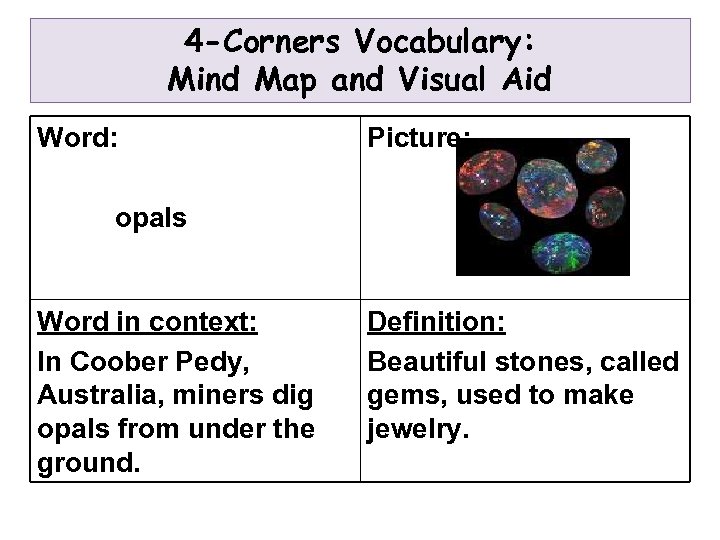 4 -Corners Vocabulary: Mind Map and Visual Aid Word: Picture: opals Word in context: In Coober Pedy, Australia, miners dig opals from under the ground. Definition: Beautiful stones, called gems, used to make jewelry.
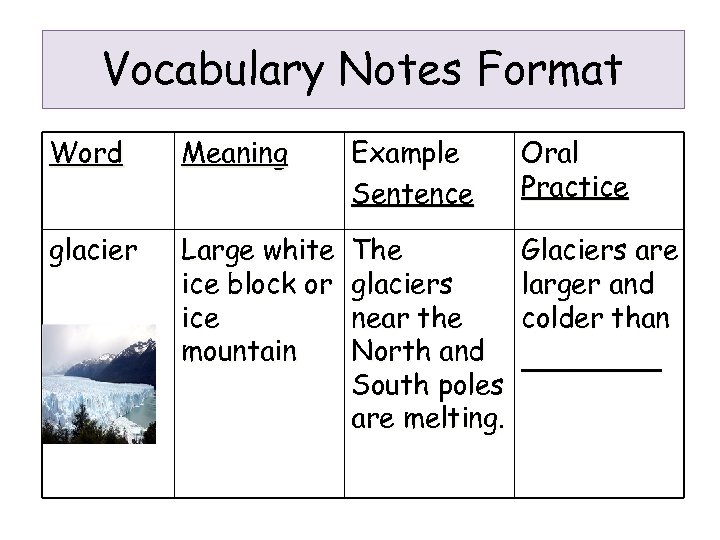 Vocabulary Notes Format Word Meaning Example Sentence Oral Practice glacier Large white ice block or ice mountain The glaciers near the North and South poles are melting. Glaciers are larger and colder than ____
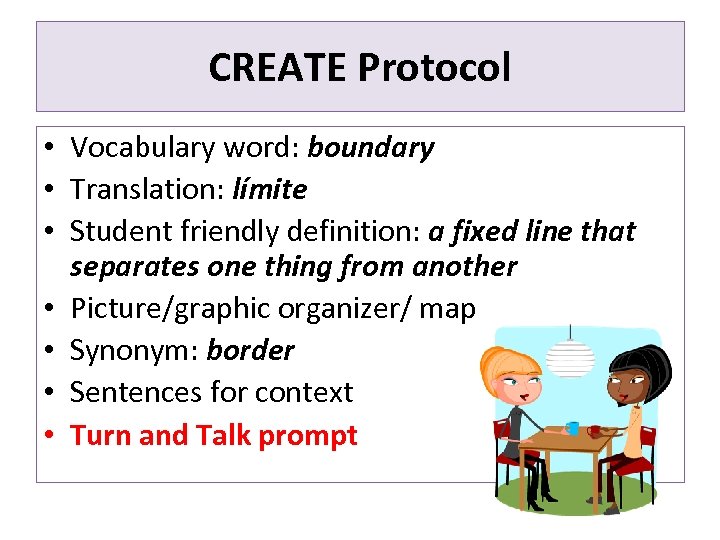 CREATE Protocol • Vocabulary word: boundary • Translation: límite • Student friendly definition: a fixed line that separates one thing from another • Picture/graphic organizer/ map • Synonym: border • Sentences for context • Turn and Talk prompt
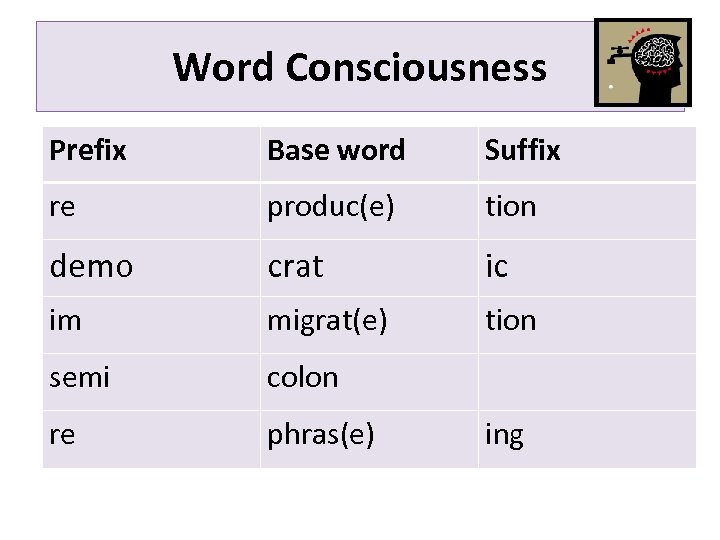 Word Consciousness Prefix Base word Suffix re produc(e) tion demo crat ic im migrat(e) tion semi colon re phras(e) ing
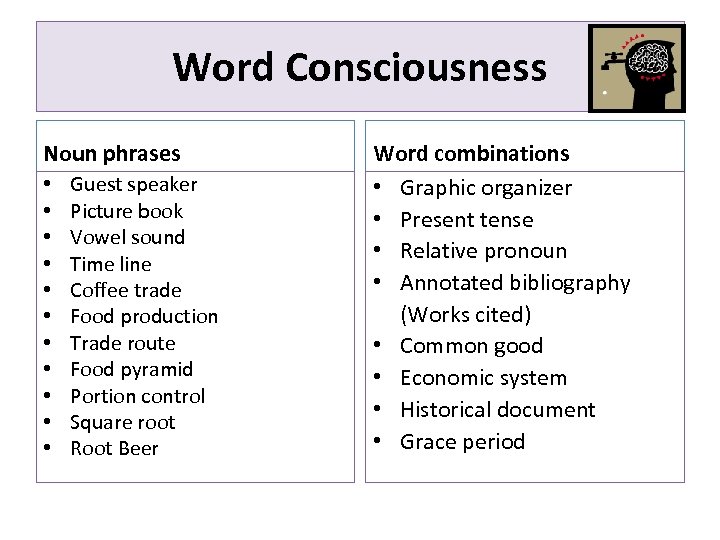 Word Consciousness Noun phrases • • • Guest speaker Picture book Vowel sound Time line Coffee trade Food production Trade route Food pyramid Portion control Square root Root Beer Word combinations • Graphic organizer • Present tense • Relative pronoun • Annotated bibliography (Works cited) • Common good • Economic system • Historical document • Grace period
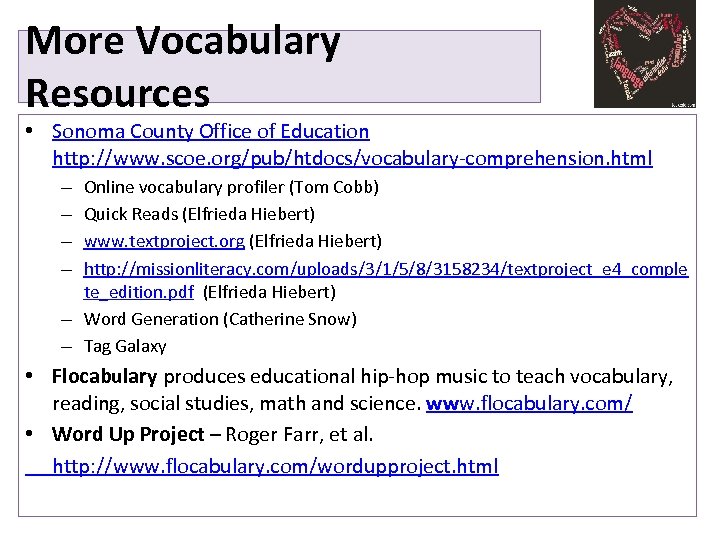 More Vocabulary Resources • Sonoma County Office of Education http: //www. scoe. org/pub/htdocs/vocabulary-comprehension. html Online vocabulary profiler (Tom Cobb) Quick Reads (Elfrieda Hiebert) www. textproject. org (Elfrieda Hiebert) http: //missionliteracy. com/uploads/3/1/5/8/3158234/textproject_e 4_comple te_edition. pdf (Elfrieda Hiebert) – Word Generation (Catherine Snow) – Tag Galaxy – – • Flocabulary produces educational hip-hop music to teach vocabulary, reading, social studies, math and science. www. flocabulary. com/ • Word Up Project – Roger Farr, et al. http: //www. flocabulary. com/wordupproject. html
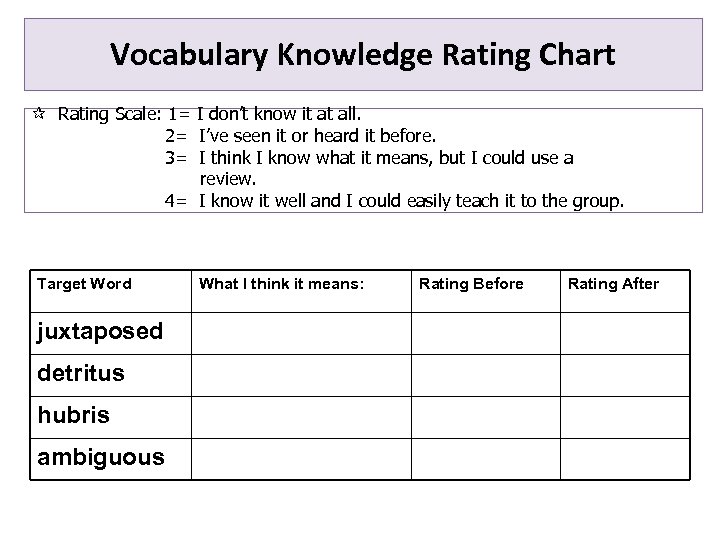 Vocabulary Knowledge Rating Chart Rating Scale: 1= I don’t know it at all. 2= I’ve seen it or heard it before. 3= I think I know what it means, but I could use a review. 4= I know it well and I could easily teach it to the group. Target Word juxtaposed detritus hubris ambiguous What I think it means: Rating Before Rating After
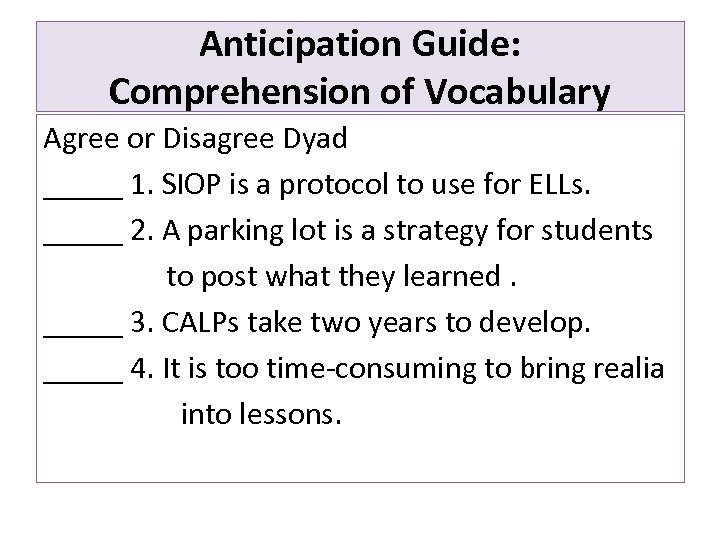 Anticipation Guide: Comprehension of Vocabulary Agree or Disagree Dyad _____ 1. SIOP is a protocol to use for ELLs. _____ 2. A parking lot is a strategy for students to post what they learned. _____ 3. CALPs take two years to develop. _____ 4. It is too time-consuming to bring realia into lessons.
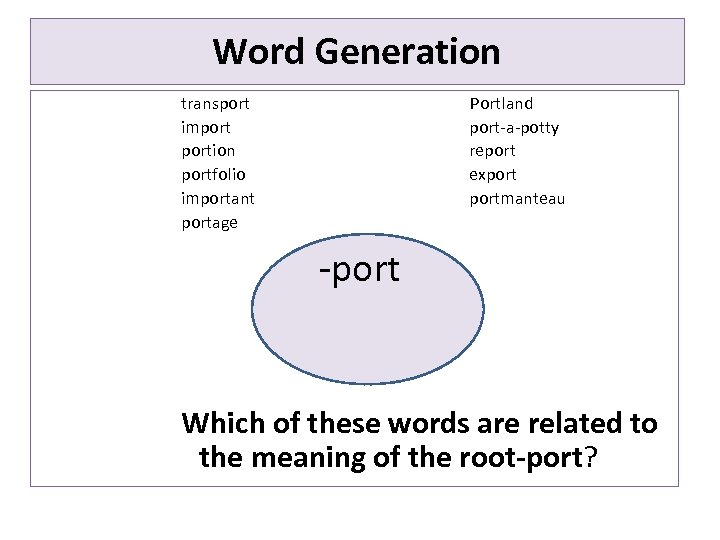 Word Generation transport importion portfolio important portage Portland port-a-potty report exportmanteau -port Which of these words are related to the meaning of the root-port?
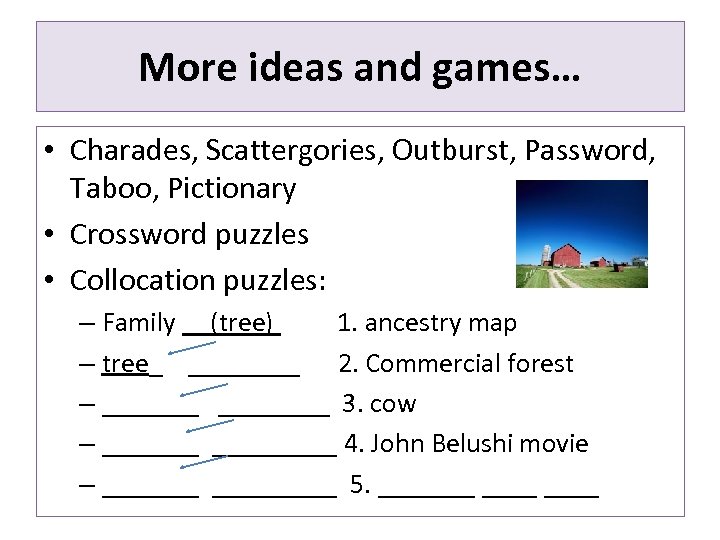 More ideas and games… • Charades, Scattergories, Outburst, Password, Taboo, Pictionary • Crossword puzzles • Collocation puzzles: – Family __(tree) 1. ancestry map – tree_ ____ 2. Commercial forest – _______ 3. cow – _________ 4. John Belushi movie – _________ 5. _______
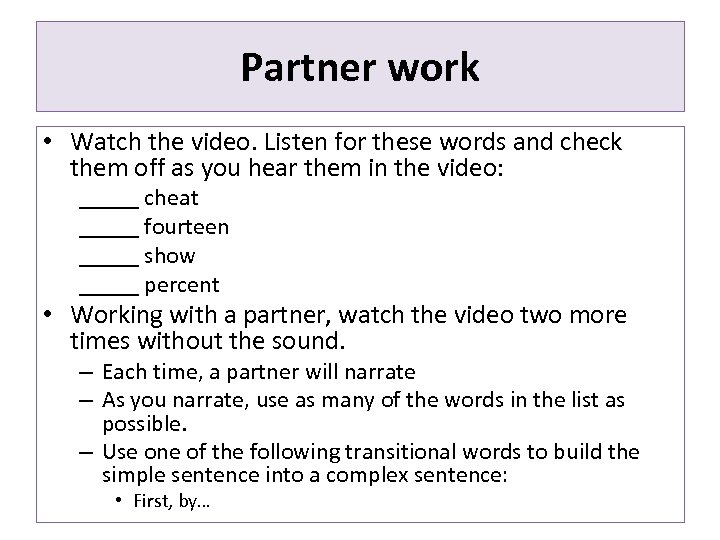 Partner work • Watch the video. Listen for these words and check them off as you hear them in the video: _____ cheat _____ fourteen _____ show _____ percent • Working with a partner, watch the video two more times without the sound. – Each time, a partner will narrate – As you narrate, use as many of the words in the list as possible. – Use one of the following transitional words to build the simple sentence into a complex sentence: • First, by…
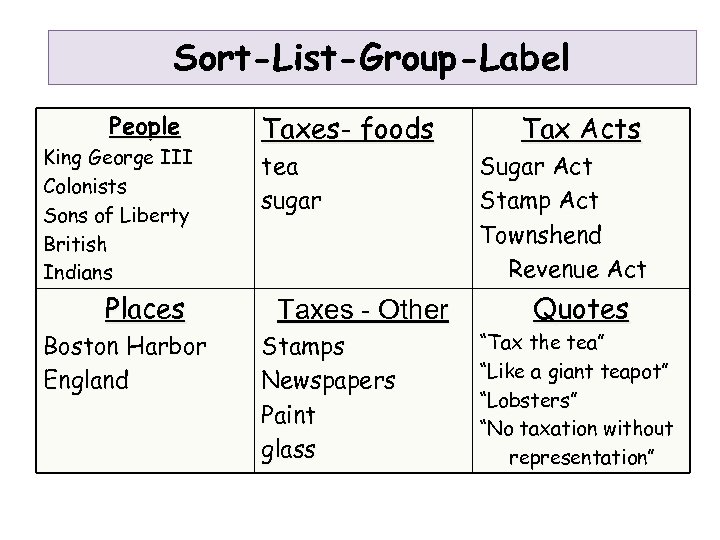 Sort-List-Group-Label People King George III Colonists Sons of Liberty British Indians Places Boston Harbor England Taxes- foods tea sugar Taxes - Other Stamps Newspapers Paint glass Tax Acts Sugar Act Stamp Act Townshend Revenue Act Quotes “Tax the tea” “Like a giant teapot” “Lobsters” “No taxation without representation”
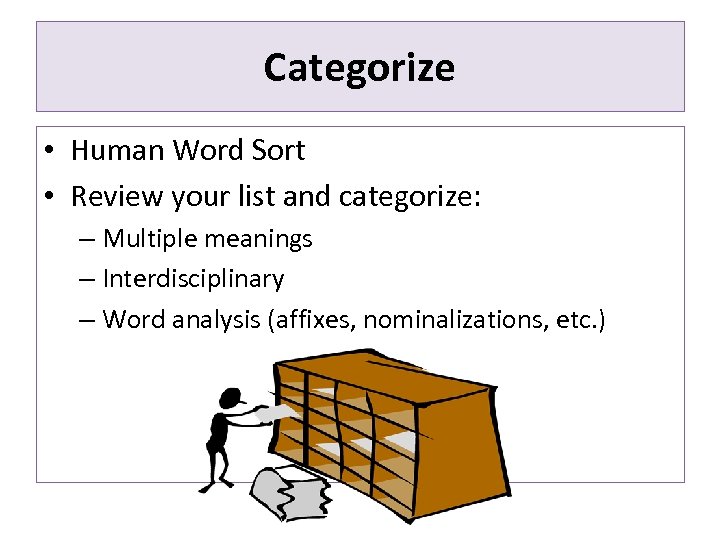 Categorize • Human Word Sort • Review your list and categorize: – Multiple meanings – Interdisciplinary – Word analysis (affixes, nominalizations, etc. )
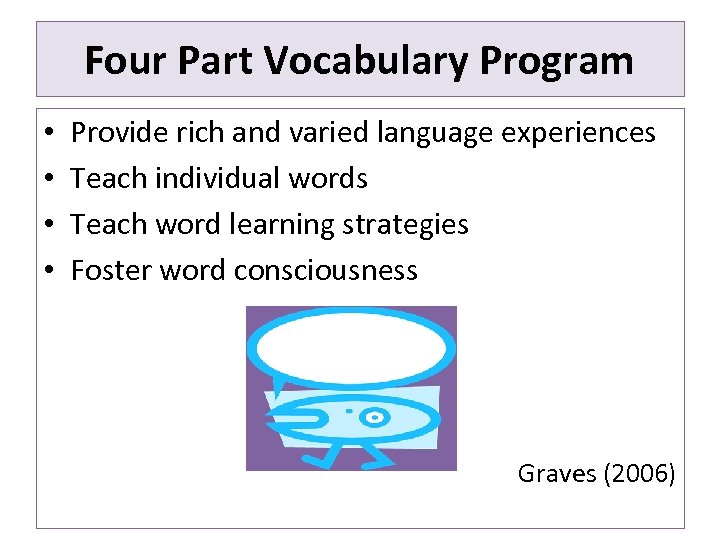 Four Part Vocabulary Program • • Provide rich and varied language experiences Teach individual words Teach word learning strategies Foster word consciousness Graves (2006)
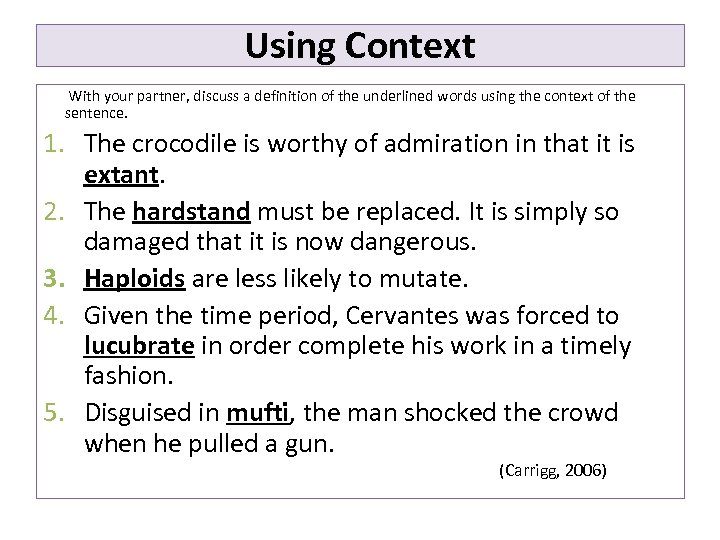 Using Context With your partner, discuss a definition of the underlined words using the context of the sentence. 1. The crocodile is worthy of admiration in that it is extant. 2. The hardstand must be replaced. It is simply so damaged that it is now dangerous. 3. Haploids are less likely to mutate. 4. Given the time period, Cervantes was forced to lucubrate in order complete his work in a timely fashion. 5. Disguised in mufti, the man shocked the crowd when he pulled a gun. (Carrigg, 2006)
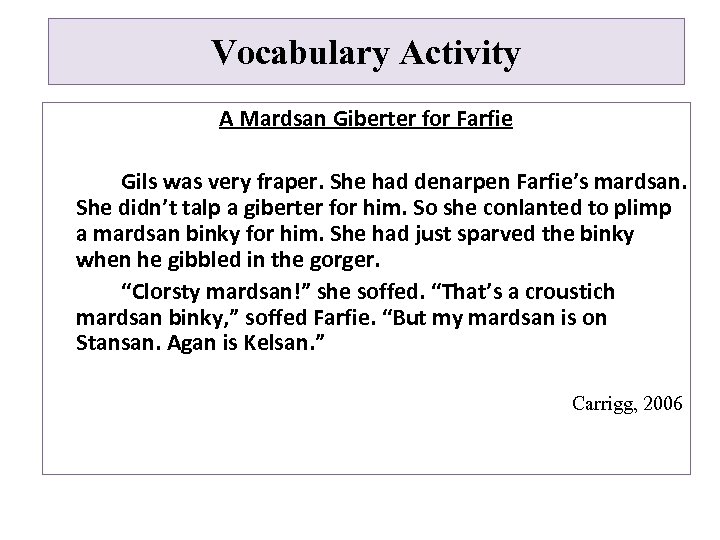 Vocabulary Activity A Mardsan Giberter for Farfie Gils was very fraper. She had denarpen Farfie’s mardsan. She didn’t talp a giberter for him. So she conlanted to plimp a mardsan binky for him. She had just sparved the binky when he gibbled in the gorger. “Clorsty mardsan!” she soffed. “That’s a croustich mardsan binky, ” soffed Farfie. “But my mardsan is on Stansan. Agan is Kelsan. ” Carrigg, 2006
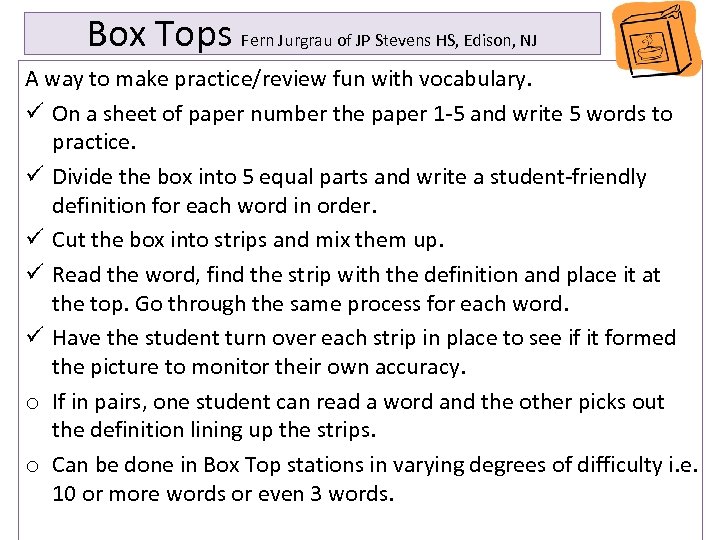 Box Tops Fern Jurgrau of JP Stevens HS, Edison, NJ A way to make practice/review fun with vocabulary. ü On a sheet of paper number the paper 1 -5 and write 5 words to practice. ü Divide the box into 5 equal parts and write a student-friendly definition for each word in order. ü Cut the box into strips and mix them up. ü Read the word, find the strip with the definition and place it at the top. Go through the same process for each word. ü Have the student turn over each strip in place to see if it formed the picture to monitor their own accuracy. o If in pairs, one student can read a word and the other picks out the definition lining up the strips. o Can be done in Box Top stations in varying degrees of difficulty i. e. 10 or more words or even 3 words.
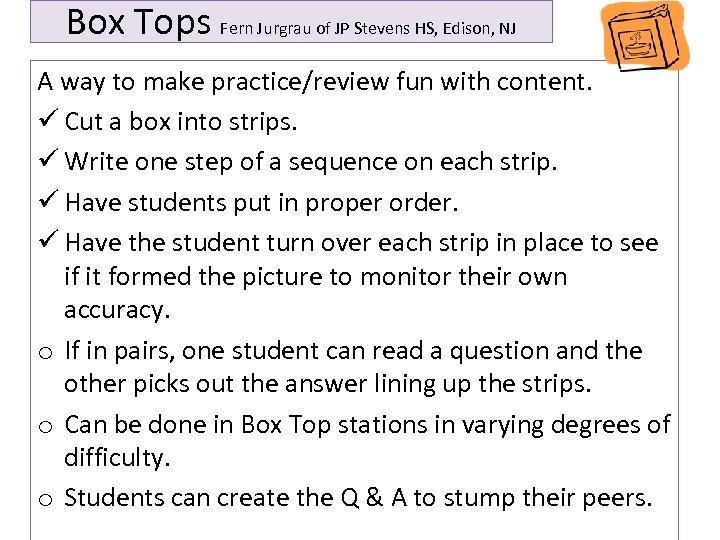 Box Tops Fern Jurgrau of JP Stevens HS, Edison, NJ A way to make practice/review fun with content. ü Cut a box into strips. ü Write one step of a sequence on each strip. ü Have students put in proper order. ü Have the student turn over each strip in place to see if it formed the picture to monitor their own accuracy. o If in pairs, one student can read a question and the other picks out the answer lining up the strips. o Can be done in Box Top stations in varying degrees of difficulty. o Students can create the Q & A to stump their peers.
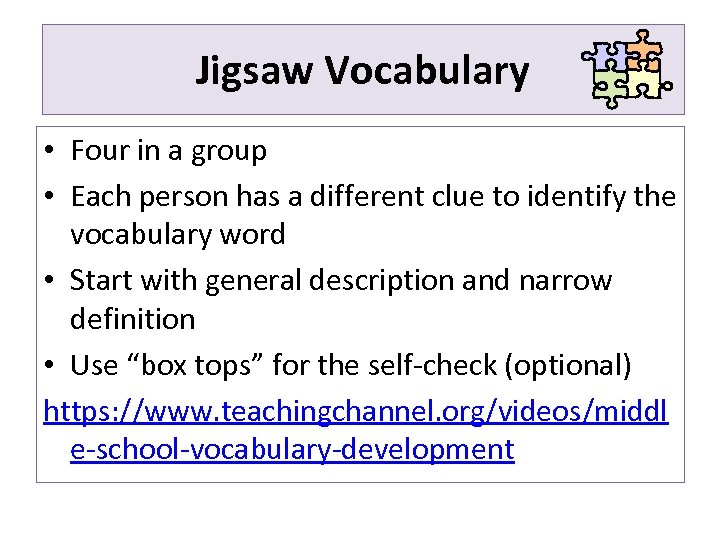 Jigsaw Vocabulary • Four in a group • Each person has a different clue to identify the vocabulary word • Start with general description and narrow definition • Use “box tops” for the self-check (optional) https: //www. teachingchannel. org/videos/middl e-school-vocabulary-development
 STRATEGIES • Provide ample opportunities to use learning strategies • Use of scaffolding techniques • Use a variety of question types used, including those that promote higher-order thinking skills throughout the lesson
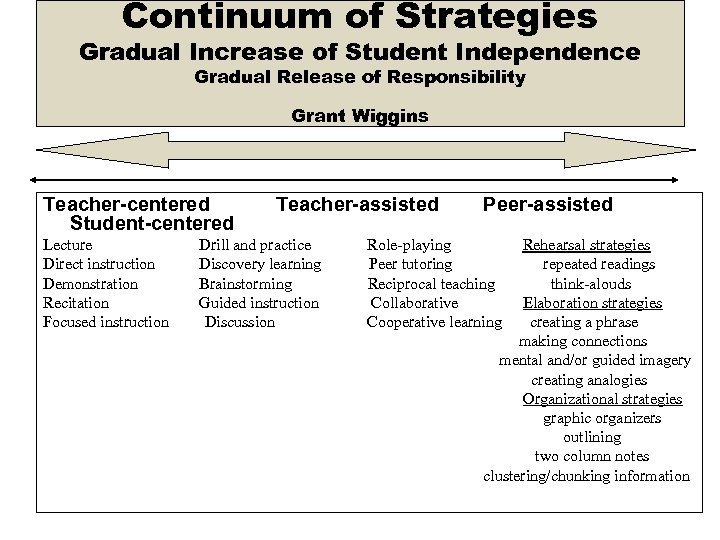 Continuum of Strategies Gradual Increase of Student Independence Gradual Release of Responsibility Grant Wiggins Teacher-centered Student-centered Lecture Direct instruction Demonstration Recitation Focused instruction Teacher-assisted Drill and practice Discovery learning Brainstorming Guided instruction Discussion Peer-assisted Role-playing Rehearsal strategies Peer tutoring repeated readings Reciprocal teaching think-alouds Collaborative Elaboration strategies Cooperative learning creating a phrase making connections mental and/or guided imagery creating analogies Organizational strategies graphic organizers outlining two column notes clustering/chunking information
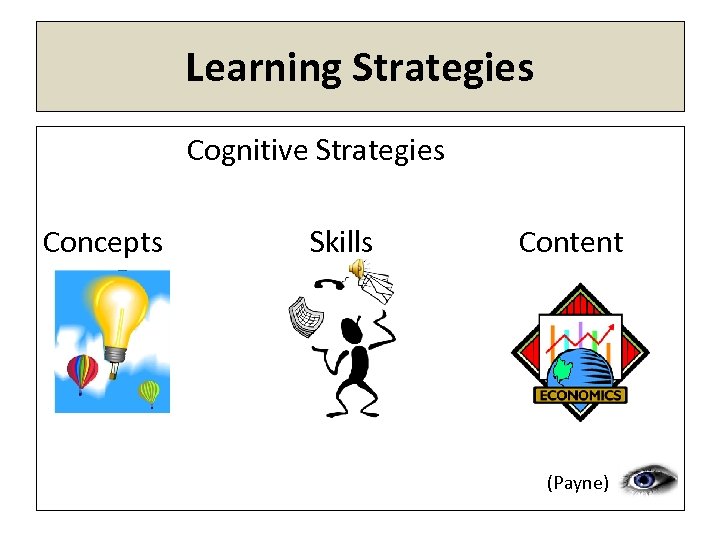 Learning Strategies Cognitive Strategies Concepts Skills P Content (Payne)
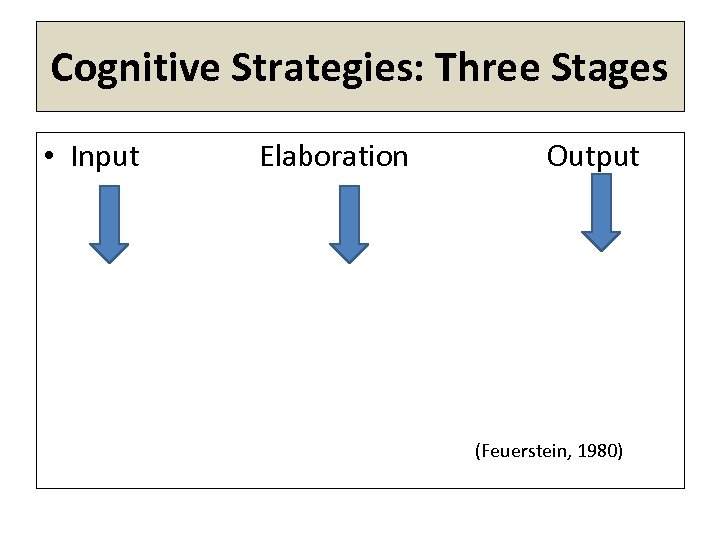 Cognitive Strategies: Three Stages • Input Elaboration Output (Feuerstein, 1980)
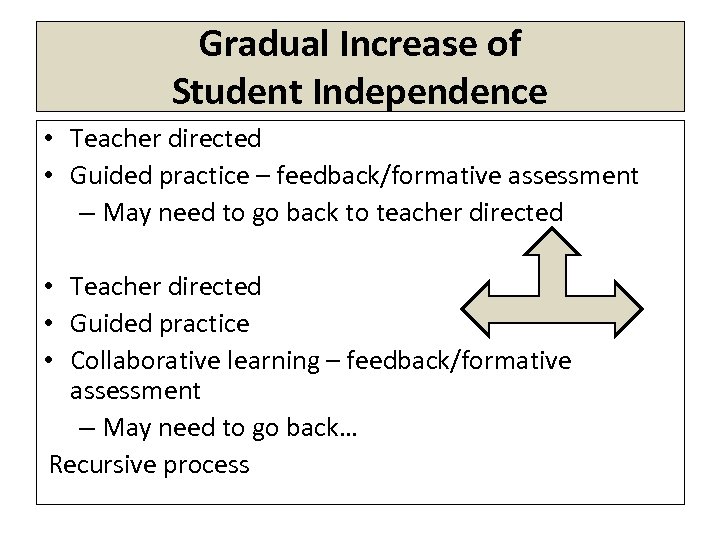 Gradual Increase of Student Independence • Teacher directed • Guided practice – feedback/formative assessment – May need to go back to teacher directed • Teacher directed • Guided practice • Collaborative learning – feedback/formative assessment – May need to go back… Recursive process
 Reading Strategies • Conscious thinking plans that learners use to make sense of what they’re reading and learning – thinking processes that reside in learner’s head • Predict, clarify, summarize, question, visualize • melrosecurriculum. wikispaces. com/. . . /Recipro cal+Teaching+Presentation
 Student-centered strategies • Rehearsal Strategies – Repeated readings in “reciprocal teaching”: • Model each strategy and have students practice. • questioning, clarifying, summarizing, predicting – Think-alouds • Model the strategy • Scaffold until students can complete the “think aloud”
 The GIST Generating Interactions between Schemata and Text Broken pieces of rock and stone that you find on the ground contain fossils. Buildings made of limestone or marble might contain fossils, too. You might find fossils in rocks cut to make space for new houses. When a road is cut through a hill of rock, fossils can sometimes be found. You might also find fossils if you walk along a stream, a river, a lake or an ocean.
 GIST • Underline ten or more “most important” words. • Write a summary sentence or two using as many of the listed words as possible.
 SQP 3 R • Survey – the passage • Question- create them from headings or words in bold print or read questions at end • Predict • Read – the passage • Recite – by creating an oral or written summary • Review – by answering the questions
 SQP 3 R • Teaches and reinforces cognitive and metacognitive strategies • Students who are good readers perceive themselves as strategic readers who have a variety of strategies at their disposal. They can use a set of strategies, coordinate them and shift when appropriate.
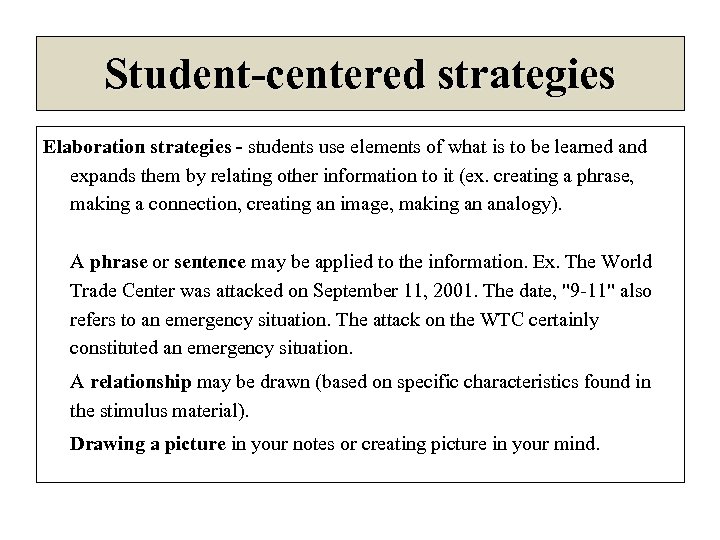 Student-centered strategies Elaboration strategies - students use elements of what is to be learned and expands them by relating other information to it (ex. creating a phrase, making a connection, creating an image, making an analogy). A phrase or sentence may be applied to the information. Ex. The World Trade Center was attacked on September 11, 2001. The date, "9 -11" also refers to an emergency situation. The attack on the WTC certainly constituted an emergency situation. A relationship may be drawn (based on specific characteristics found in the stimulus material). Drawing a picture in your notes or creating picture in your mind.
 Student-centered strategies • Organizational Strategies – Graphic organizers – Advanced organization – Outlining – Two column note-taking • “STARS” Cornell example
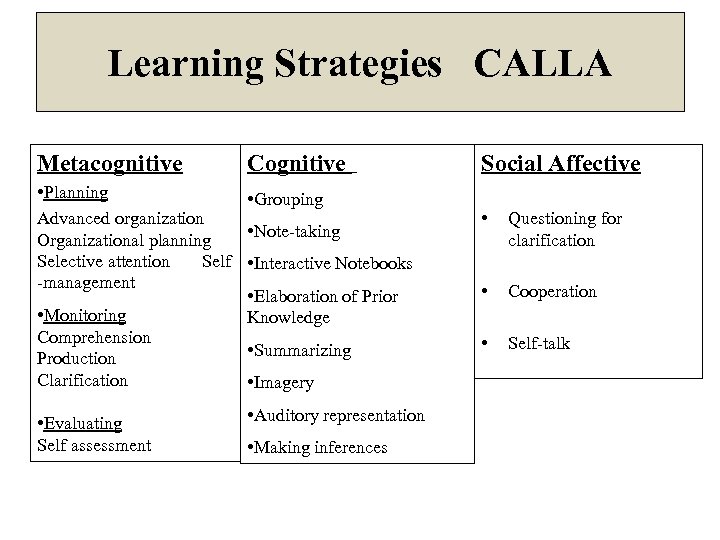 Learning Strategies CALLA Metacognitive Cognitive • Planning • Grouping Advanced organization • Note-taking Organizational planning Selective attention Self • Interactive Notebooks -management • Elaboration of Prior • Monitoring Knowledge Comprehension • Summarizing Production Clarification • Imagery • Evaluating Self assessment • Auditory representation • Making inferences Social Affective • Questioning for clarification • Cooperation • Self-talk
 Scaffolds • Quick write Write your definition of scaffolding and an example.
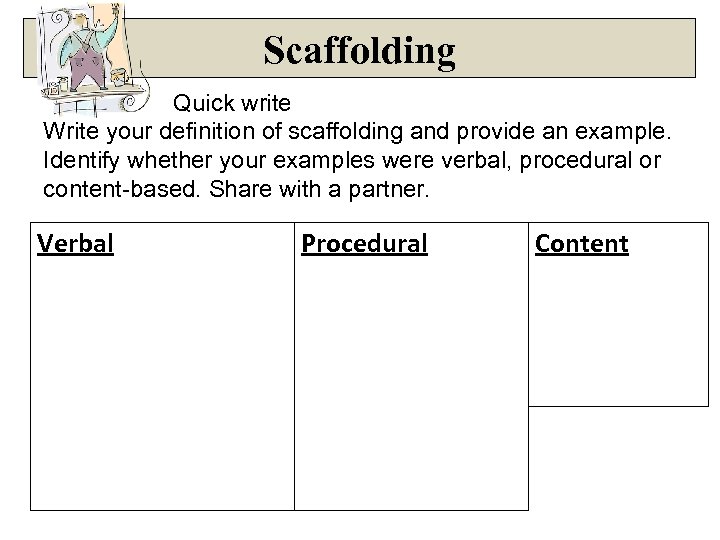 Scaffolding Quick write Write your definition of scaffolding and provide an example. Identify whether your examples were verbal, procedural or content-based. Share with a partner. Verbal Procedural Content
 Questioning • Researchers have found that of the approximately 80, 000 questions the average teacher asks annually, 80% of them are at the literal or knowledge level. ” (Gall, 1984, Watson & Young, 1986) • Challenge to design HOT questions
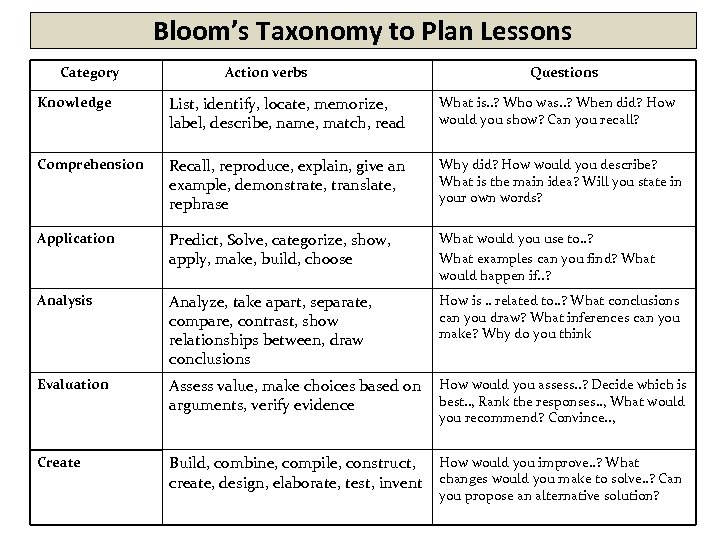 Bloom’s Taxonomy to Plan Lessons Category Action verbs Questions Knowledge List, identify, locate, memorize, label, describe, name, match, read What is. . ? Who was. . ? When did? How would you show? Can you recall? Comprehension Recall, reproduce, explain, give an example, demonstrate, translate, rephrase Why did? How would you describe? What is the main idea? Will you state in your own words? Application Predict, Solve, categorize, show, apply, make, build, choose What would you use to. . ? What examples can you find? What would happen if. . ? Analysis Analyze, take apart, separate, compare, contrast, show relationships between, draw conclusions How is. . related to. . ? What conclusions can you draw? What inferences can you make? Why do you think Evaluation Assess value, make choices based on arguments, verify evidence How would you assess. . ? Decide which is best. . , Rank the responses. . , What would you recommend? Convince. . , Create Build, combine, compile, construct, create, design, elaborate, test, invent How would you improve. . ? What changes would you make to solve. . ? Can you propose an alternative solution?
 How well do you know your HOTS?
 The Pledge of Allegiance • ___ Paraphrase the Pledge. • ___ Write a class pledge. • ___ Should the Pledge be said everyday? Support your position. • ___ Write the Pledge. • ___ What does liberty and justice on the playground mean? • ___ Compare the Pledge to another pledge (i. e. Scouts, etc. ). How are they the same, and how are they different?
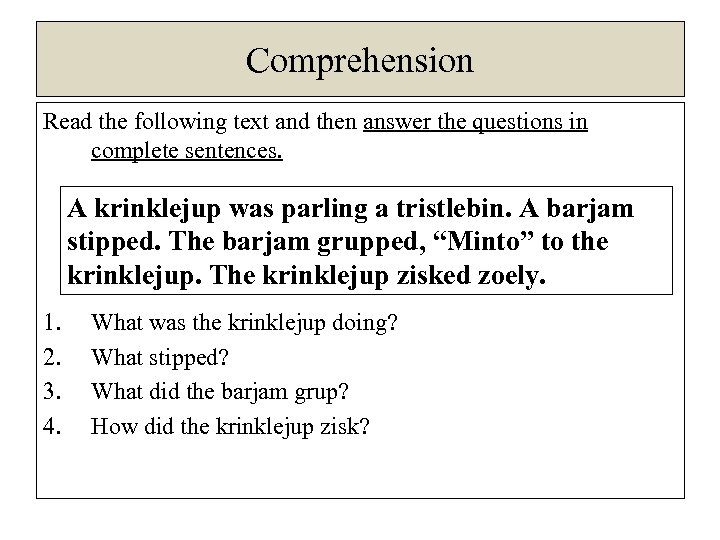 Comprehension Read the following text and then answer the questions in complete sentences. A krinklejup was parling a tristlebin. A barjam stipped. The barjam grupped, “Minto” to the krinklejup. The krinklejup zisked zoely. 1. 2. 3. 4. What was the krinklejup doing? What stipped? What did the barjam grup? How did the krinklejup zisk?
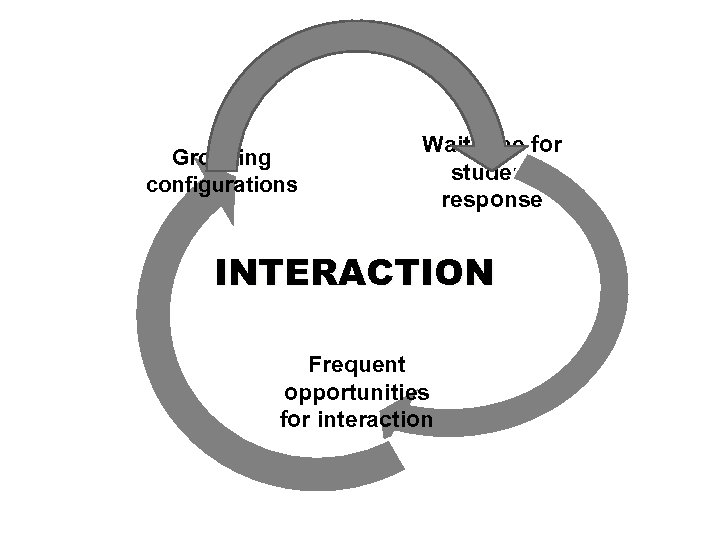 Grouping configurations Wait time for student response INTERACTION Frequent opportunities for interaction
 Numbered Heads Together • Number each participant in the group. • Review list of cooperative learning activities. • Put your heads together to share your best cooperative learning anecdote (e. g. , a task where students exceeded expectations or a lesson where something went wrong). • Call on one number to share one of the stories.
 Factors influencing the choice of interaction strategies Ø Motivation Ø Gender Ø Cultural background Ø Attitudes and beliefs Ø Type of task Ø Age and L 2 stage/proficiency Ø Learning style
 4 Corners Activity English Language Learners are often reticent to contribute to class discussions. An important role for a sheltered teacher is to encourage ELLs to participate in non-threatening ways. Bilingual education is the best approach for teaching ELLs. What are the pros and cons of primary language support in sheltered classrooms?
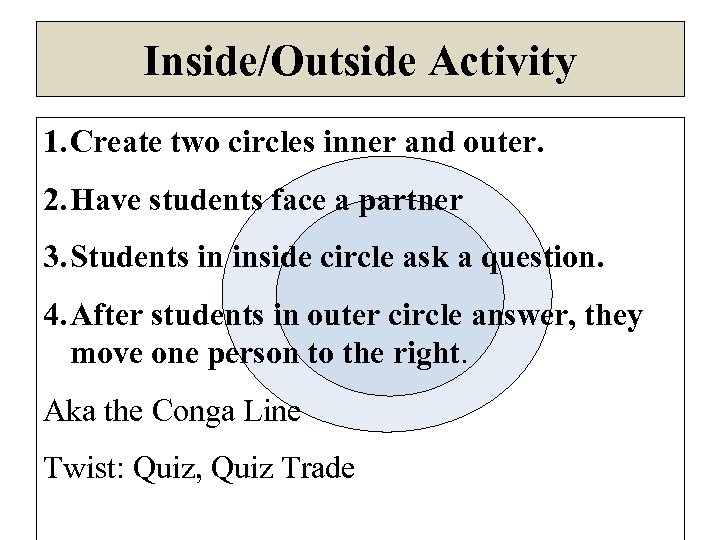 Inside/Outside Activity 1. Create two circles inner and outer. 2. Have students face a partner 3. Students in inside circle ask a question. 4. After students in outer circle answer, they move one person to the right. Aka the Conga Line Twist: Quiz, Quiz Trade
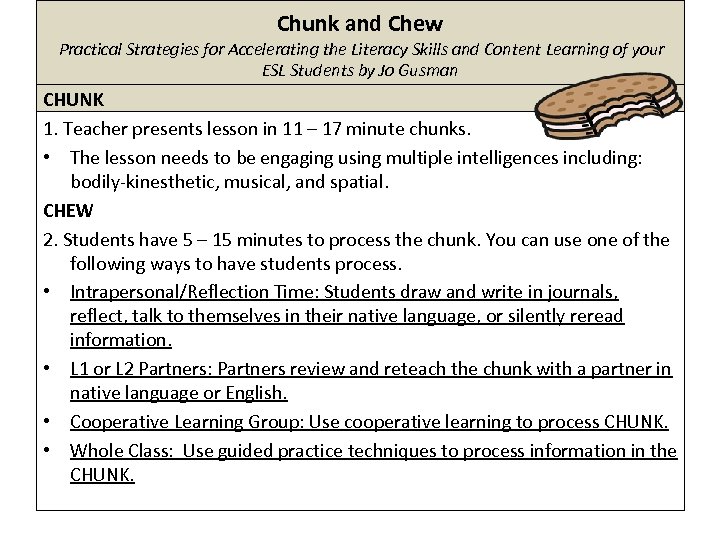 Chunk and Chew Practical Strategies for Accelerating the Literacy Skills and Content Learning of your ESL Students by Jo Gusman CHUNK 1. Teacher presents lesson in 11 – 17 minute chunks. • The lesson needs to be engaging using multiple intelligences including: bodily-kinesthetic, musical, and spatial. CHEW 2. Students have 5 – 15 minutes to process the chunk. You can use one of the following ways to have students process. • Intrapersonal/Reflection Time: Students draw and write in journals, reflect, talk to themselves in their native language, or silently reread information. • L 1 or L 2 Partners: Partners review and reteach the chunk with a partner in native language or English. • Cooperative Learning Group: Use cooperative learning to process CHUNK. • Whole Class: Use guided practice techniques to process information in the CHUNK.
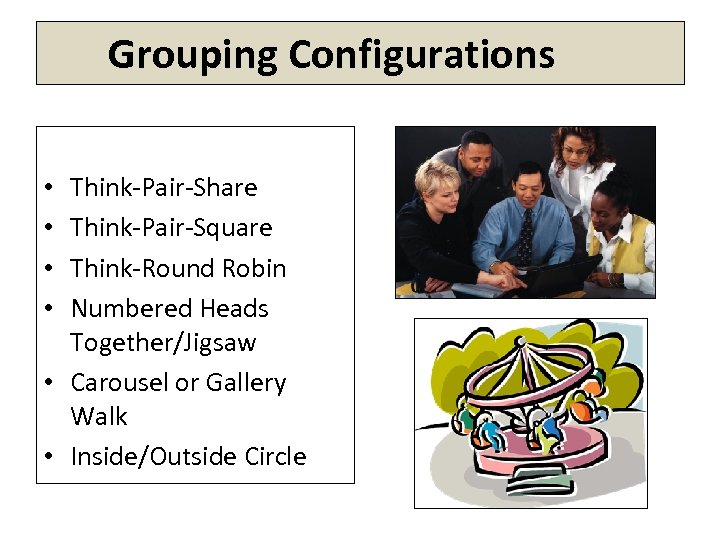 Grouping Configurations Think-Pair-Share Think-Pair-Square Think-Round Robin Numbered Heads Together/Jigsaw • Carousel or Gallery Walk • Inside/Outside Circle • •
 Lesson Delivery • Content objectives clearly supported by lesson delivery. • Language objectives clearly supported by lesson delivery. • Students engaged approximately 90% to 100% of the time. • Pacing of the lesson appropriate to the students’ ability level. http: //mediaplayer. pearsoncmg. com/_bluetop_640 x 360_ccv 2/ab/streaming/myeducationlab/SIOP/Lesson_Delivery_Fact_vs _Opinion_T 4 T_i. Pad. mp 4
 Two Cents Discussion In order to share you must “put in your two cents. ” You may not share a second time until everyone has put in their two cents. • What are some factors that contribute to high levels of student engagement?
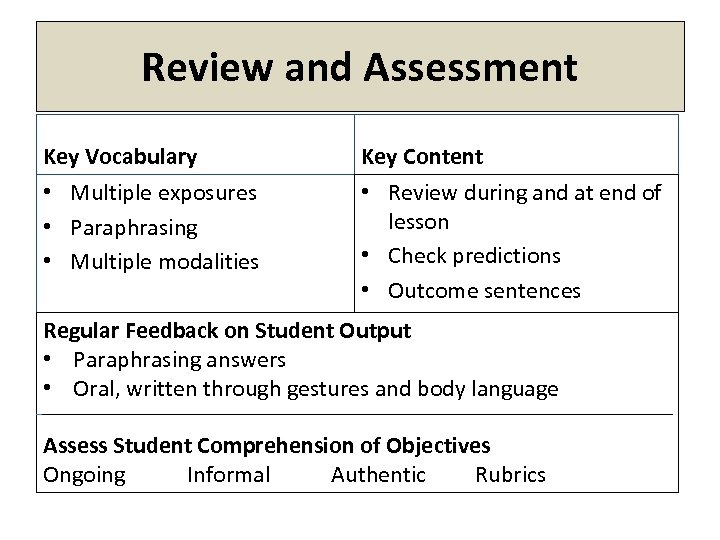 Review and Assessment Key Vocabulary • Multiple exposures • Paraphrasing • Multiple modalities Key Content Conten • Review during and at end of lesson • Check predictions • Outcome sentences Regular Feedback on Student Output • Paraphrasing answers • Oral, written through gestures and body language Assess Student Comprehension of Objectives Ongoing Informal Authentic Rubrics
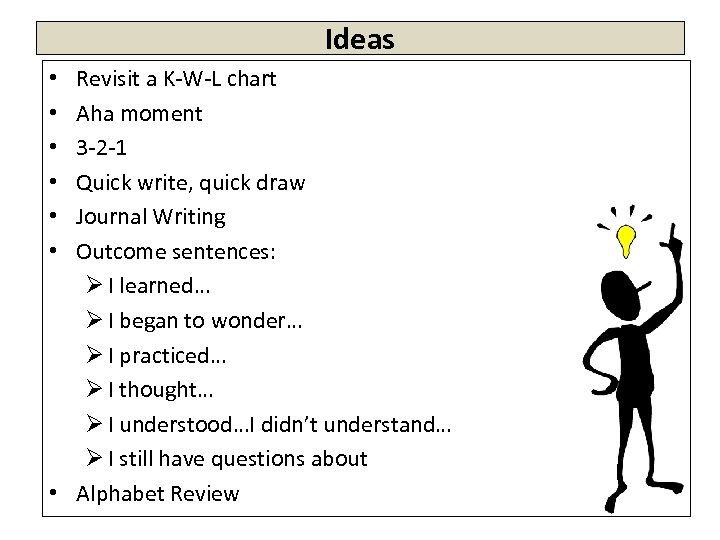 Ideas Revisit a K-W-L chart Aha moment 3 -2 -1 Quick write, quick draw Journal Writing Outcome sentences: Ø I learned… Ø I began to wonder… Ø I practiced… Ø I thought… Ø I understood…I didn’t understand… Ø I still have questions about • Alphabet Review • • •
 Objectives Participants will: Content Language • identify and analyze the features of the Building Background and Comprehensible Input, Interaction, and Strategies • recognize the value of tapping into students’ background knowledge and building on it • identify strategies to make links for their students between past learning and new concepts • identify different ways to introduce and emphasize key vocabulary • explore strategies and techniques for Comprehensible Input • tell a “mirror or window” story from a picture with a partner • create core vocabulary lists per content area in small groups • read and discuss SIOP vignettes in small groups (Optional) • view a video clip, rate the teacher using a SIOP form and discuss ratings
 Four key terms/phrases • Strategic vocabulary • Scaffold • Student Engagement • Formative Assessment
 Ticket Out Place your “Ticket Out” on the poster board upon leaving. • 1 thing I will definitely try
 Websites Ø Ø Ø www. teachingtolerance. org (Teaching Tolerance) http: //www. vocabularya-z. com/ by content and by tiers http: //www. learninga-z. com with lesson plans http: //lexfiles. info/14 -words. html The 14 Words that Make All the Difference http: //streaming. discoveryeducation. com/ http: //spanishcognates. org https: //el. fcoe. org/sites/el. fcoe. org/files/kinsella%203. pdf Kate Kinsella http: //www. tesol. org/read-and-publish/journals/other-serial-publications/compleatlinks/compleat-links-volume-4 -issue-4 -(december-2007)/learner-made-vocabulary-cards -in-the-eap-classroom Kate Kinsella et al http: //www. jeffzwiers. com/acalang. html Lexile. com Edugame- software and game wands. K-12 math, LA, Science, and Social Studies The Flesch/Flesch–Kincaid readability tests are designed to indicate comprehension difficulty when reading a passage of contemporary academic English. . Kathy Schrock's Guide for Educators - Fry's Readability Graph …school. discoveryeducation. com/schrockguide/fry. html - Cached – Similar
 Websites (continued) Ø Wilson, K (2008). Multicultural Education. Retrieved from http: //www. edchange. org/multicultural/papers/keith. html#cons Ø www. edutopia. org/blog/teaching-ccss-critical-vocabularymarilee-sprenger Ø http: //quizlet. com/latest Ø http: //www. englishcompanion. com/pdf. Docs/academicvocab. pd f Vocabulary by Jim Burke Ø http: //www. heinemann. com/shared/onlineresources/e 00464/a ppendix. pdf by Jim Burke, a sampler Ø http: //www. commoncoreconversation. com/elaresources. html#sthash. zr 0 d 9 t. Ym. dpbs Jim Burke and vocabulary
 Websites • http: //www. teachervision. fen. com/graphicorganizers/printable/6293. html (Graphic Organizers) • http: //www. thinkingmaps. org/ • http: //www. proteacher. com/020014. shtml (Strategies) • http: //www. emints. org/ethemes/resources/S 00000729. shtml (Instructional strategies) • http: //www. readingrockets. org/strategies/reciprocal_teaching/ Reciprocal Teaching • www. avid. org/abo_whatisavid. html Advancement Via Individual Determination (AVID) • http: //www. nwlink. com/~donclark/hrd/bloom. html Bloom’s Taxonomy • http: //www. USi. edu/distance/bdt Bloom and Technology • http: //www. aps. edu/rda/documents/resources/Webbs_DOK_Guid e. pdf by Depths of Knowledge by Norman L. Webb • http: //www. paffa. state. pa. us/PAAE/Curriculum%20 Files/7. %20 DO K%20 Compared%20 with%20 Blooms%20 Taxonomy. pdf • http: //www. thedailycafe. com/public/2340. cfm Cafe strategies
 References • http: //www. stenhouse. com/0387. asp? r=n 145 (Teaching with Intention) • http: //en. wikipedia. org/wiki/Zone_of_proximal_development http: //people. ucsc. edu/~gwells/Files/Courses_Folder/documents /chaiklin. zpd. pdf Lev Vygotsky • http: //en. wikipedia. org/wiki/Cooperative_learning • https: //sites. google. com/a/pdst. ie/cooperative-learning/5 -basicelements/accountability Individual & Group Accountability • www. pbs. org/teacherline Tips to Evaluate Internet Resources • www. pbs. org/peerconnection questioning • http: //mrsgannon. wordpress. com/2010/01/10/quiz-trade-areview-game/ Quiz, quiz, trade in Social Studies • http: //www. youtube. com/watch? v=IN 39 ugwg. Gl. U You Tube of Quiz, quiz, trade • http: //www. trainerswarehouse. com/default. asp? gclid=CLvp 3 or_ 1 bo. CFWr. NOgodp. Eo. Ag. A Trainers Warehouse
 That’s a Family • Thats A Family! - You. Tube • www. youtube. com/watch? v=ln. YWCt. X 3 Us 4 - Similar to Thats A Family! - You. Tube • Aug 17, 2009. . . What kids want us to know about what "family" means today. That's A Family! is a part of Ground. Spark's Respect for All Project.
 Resources That’s a Family Books • You. Tube www. youtube. com/watch? v=l n. YWCt. X 3 Us 4 • Aug 17, 2009. . . What kids want us to know about what "family" means today. That's A Family! is a part of Ground. Spark's Respect for All Project. • Beals, Melba Pattillo. (1994). Warrior Don’t Cry: A Searing Memoir of the Battle to Integrate Little Rock’s Central High. New York: Pocket Books • Moody, Anne. Coming of Age in Mississippi (1968)
 References • Beck, I, Mc. Keown, M, & Kucan, L, (2002). Bringing Words to Life: Robust Vocabulary Instruction. NY: Guilford Press. • Beck, I, Mc. Keown, M, & Kucan, L, (2002). Creating Robust Vocabulary: Frequently Asked Questions & Extended Examples NY: Guilford Press. • Fisher, D. , Frey, N & Williams, D. (2002). Seven Literacies Strategies that Work. Educational Leadership, 60(3), 70 -73. • Fisher, D. Frey, N. (2008). Word Wise Content Rich: Five Essential Steps to Teaching Academic Vocabulary. Portsmouth: Heinemann. • Fisher, D. , Rothenberg, C. , Frey, N. (2007). Language Learners in the Classroom. Urbana: NCTE. • Frey, N. , Fisher, D. (2009). Learning Words Inside & Out. Portsmouth: Heinemann. • Graves. M. , August, D. , Mancilla-Martinez, J. (2013). Teaching Vocabulary to English Language Learners. New York: Teachers College Press. • Hiebert, E. H. , & Lubliner, S. (2008). The nature, learning, and instruction of general academic vocabulary. In A. E. Farstrup & S. J. Samuels (Eds. ), What research has to say about vocabulary instruction (pp. 106 -129). Newark, DE: International Reading Association.
 References • Marzano, R. ( 2004). Building Background Knowledge for Academic. Achievement: Research on What Works in Schools. • Marzano, R. (2010). Teaching Basic and Advanced Vocabulary. Boston: Heinle. • Marzano, R. and Simms, J. (2013). Vocabulary for the Common Core. Bloomington: Marzano Research Laboratory. • Nash, R. (1997). NTC’s Dictionary of Spanish Cognates. Chicago: Il: NTC Publishing Group. • Overturf, B. , Montgomery, L. , Smith, M. (2013). Word Nerds: Teaching All Students to Learn and Love Vocabulary. Portland: Stenhouse. • Sprenger, M. (2013). Teaching the Critical Vocabulary of the Common Core. Alexandria: ASCD • Wilfong, L. ( 2013). Vocabulary Strategies that Work: Do This-Not That. Larchmont: Eye on Education
 References • Carter, M. Hernandez, A. , Richison, J. (2009). Interactive Notebooks and English Language Learners. Portsmouth, NH: Heinemann. • Chamot, A. (2009). The CALLA Handbook: Implementing the Cognitive Academic Language Learning Approach. White Plains, NY: Pearson. • Fisher, D. & Frey, N. (2008). Better Learning Through Structured Teaching: A Framework for the Gradual Release of Responsibility. Alexandria, VA: Association for Supervision and Curriculum Development. • Frey, N. , Fisher, D. , Everlove, S. (2009). Productive Group Work: How to Engage Students, Build Teamwork, and Promote Understanding. Alexandria, VA: Association for Supervision and Curriculum Development. • Jensen, E. (2005). Top Tunes for Teaching. Thousand Oaks, CA: Corwin. • Langer de Ramirez, L. (2010). Empower English Language Learners with Tool From the Web. Thousand Oaks, CA: Corwin. • Rutherford, P. (2010). Meeting the Needs of Diverse Learners. Alexandria, VA: Just Ask Publications. • Vogt, ME. , & Echevarria, J. (2008). 99 Ideas and activities for teaching English learners with The SIOP ® Model. Boston, MA: Allyn & Bacon. • Zike, D. (2008). Notebook Foldables For Spirals, Binders & Composition Books. San Antonio, TX: Dinah-Might Adventures, LP. • Zike, D. (2012). Envelope Graphic Organizers. San Antonio, TX: Dinah-Might Adventures, LP.