


 Скачать презентацию Trends in Video Delivery Michael Adams VP Application
8850319f9889c20076195a21834351e5.ppt
- Количество слайдов: 14
 Trends in Video Delivery Michael Adams VP, Application Software Strategy March 2008
 Agenda • • • How is the delivery of video changing? Drivers Trends The future – 8 years out Summary www. tandbergtv. com 2
 How is the video delivery model changing • Trends – – From One-way to Two-way Broadcast to On-demand Ti. Vo to n. PVR TV to TV, PC and mobile (3 screens) • Why? – Customers are demanding it – Web leads them to expect it – Targeted advertising requires it • What are the delivery network bandwidth consequences? www. tandbergtv. com 3
 From One-way to Two-way • HFC enabled real-time, two-way by segmenting the network into small service groups with manageable ingress noise characteristics. • Real-time, two-way signaling was first deployed in digital cable deployments starting in late 1990’s. • Real-time, two-way was a key enabling technology for VOD • It also enables High Speed Internet and Voice over IP services • Transition completed by 2005 (large operators) www. tandbergtv. com 4
 From Broadcast to Unicast • TV is gradually moving from a broadcast to a unicast delivery model. • This trend started with on-demand programming for example movies on-demand subscription on-demand (e. g. HBO on demand). • Even for live programming, such as sports and news, there advantages to unicast delivery: – Advertising can be targeted according to individual customer demographics and preferences – Splicing technology (called VOD play-listing) is now being incorporated into VOD servers – n. PVR services can be seamlessly added without the need for an expensive DVR www. tandbergtv. com 5
 From Ti. Vo to n. PVR • Ti. Vo is the service so loved by consumers it was even profiled in “Sex in the City”, but it does have drawbacks: – – – You have to remember to program it Only so many tuners Only so much storage Prone to failure (spinning memory) Cost • Network Personal Video Recorder (n. PVR) emulates a DVR and solves most of these problems. • TWC pioneered an effort to obtain programming rights successfully with their “Start Over” service. www. tandbergtv. com 6
 From TV to TV, PC and mobile devices • For subscribers who had graduated college by 2005, PC is seen as an additional way to view video programming. • For those younger, it is seen as a replacement! • Comcast and TWC are starting to realize that their emerging new competitors are i. Tunes, Net. Flix, and Blockbuster. • Mobile video is the latest craze in Asia, and will likely spread in Europe and America. It is dependent on deployment of next generation wireless protocols (e. g. Wi. Max and LTE). www. tandbergtv. com 7
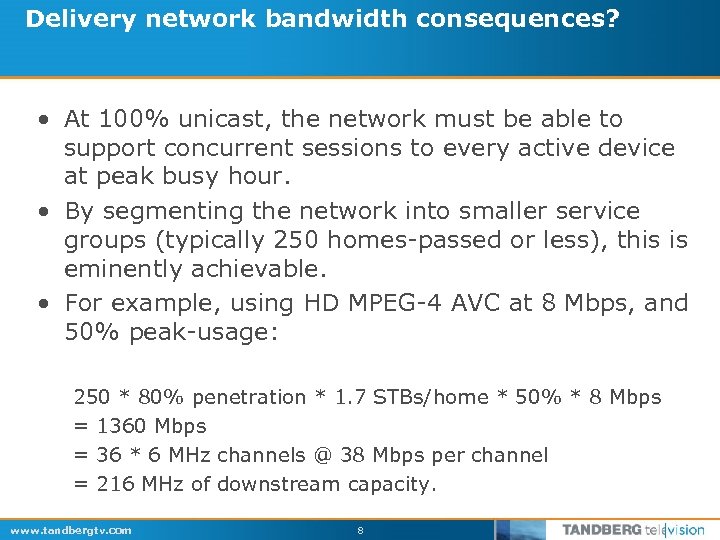 Delivery network bandwidth consequences? • At 100% unicast, the network must be able to support concurrent sessions to every active device at peak busy hour. • By segmenting the network into smaller service groups (typically 250 homes-passed or less), this is eminently achievable. • For example, using HD MPEG-4 AVC at 8 Mbps, and 50% peak-usage: 250 * 80% penetration * 1. 7 STBs/home * 50% * 8 Mbps = 1360 Mbps = 36 * 6 MHz channels @ 38 Mbps per channel = 216 MHz of downstream capacity. www. tandbergtv. com 8
 Analog Longevity and Dual Must-Carry • Under the FCC’s report and order, Cable Operators will be required from Feb 18 2009 to Feb 17 2012 to: – Carry a local broadcaster’s digital signal in analog and digital formats; or, – Carry the signal only in digital format, provided that all subscribers have the “necessary equipment” (digital set-top boxes) to view the broadcast content. – Carry the high-definition signal of broadcasters in high-definition format. • But this is “only” signals from local broadcasters; there is no legal obstacle to migration of cable programming to all-digital. www. tandbergtv. com 9
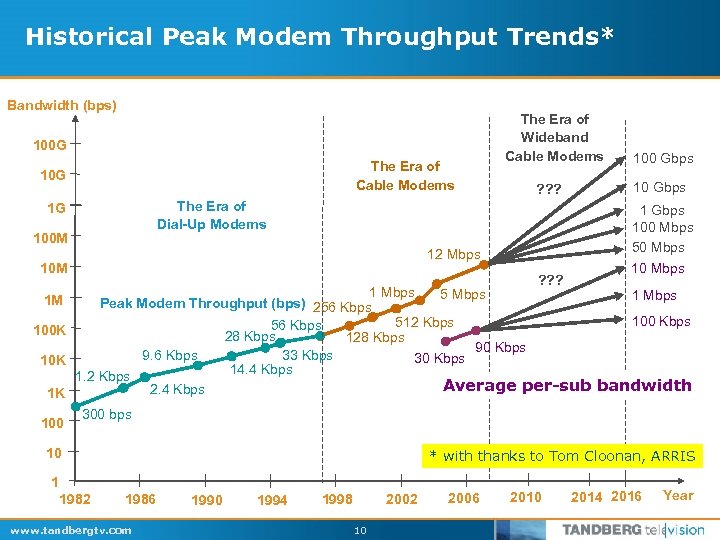 Historical Peak Modem Throughput Trends* Bandwidth (bps) 100 G The Era of Cable Modems 10 G The Era of Wideband Cable Modems ? ? ? The Era of Dial-Up Modems 1 G 100 M 10 Gbps 100 Mbps 50 Mbps 12 Mbps 10 M 100 Gbps ? ? ? 10 Mbps 1 Mbps 5 Mbps 1 Mbps Peak Modem Throughput (bps) 256 Kbps 100 Kbps 512 Kbps 56 Kbps 100 K 28 Kbps 128 Kbps 90 Kbps 33 Kbps 9. 6 Kbps 30 Kbps 10 K 14. 4 Kbps 1. 2 Kbps Average per-sub bandwidth 2. 4 Kbps 1 K 1 M 100 300 bps 10 * with thanks to Tom Cloonan, ARRIS 1 1982 1986 www. tandbergtv. com 1990 1994 1998 2002 10 2006 2010 2014 2016 Year
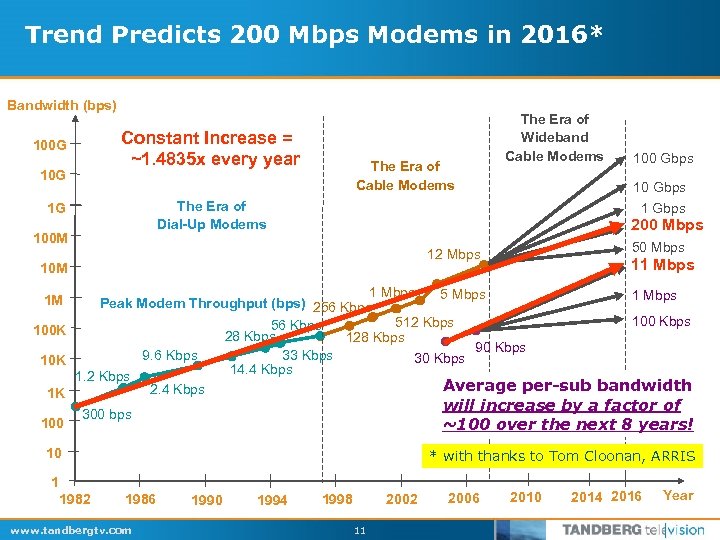 Trend Predicts 200 Mbps Modems in 2016* Bandwidth (bps) Constant Increase = ~1. 4835 x every year 100 G 10 G The Era of Cable Modems The Era of Wideband Cable Modems 10 Gbps 1 Gbps The Era of Dial-Up Modems 1 G 100 M 100 Gbps 200 Mbps 50 Mbps 12 Mbps 10 M 11 Mbps 5 Mbps 1 Mbps Peak Modem Throughput (bps) 256 Kbps 100 Kbps 512 Kbps 56 Kbps 100 K 28 Kbps 128 Kbps 90 Kbps 33 Kbps 9. 6 Kbps 30 Kbps 10 K 14. 4 Kbps 1. 2 Kbps Average per-sub bandwidth 2. 4 Kbps 1 K 1 M 100 will increase by a factor of ~100 over the next 8 years! 300 bps 10 * with thanks to Tom Cloonan, ARRIS 1 1982 1986 www. tandbergtv. com 1990 1994 1998 2002 11 2006 2010 2014 2016 Year
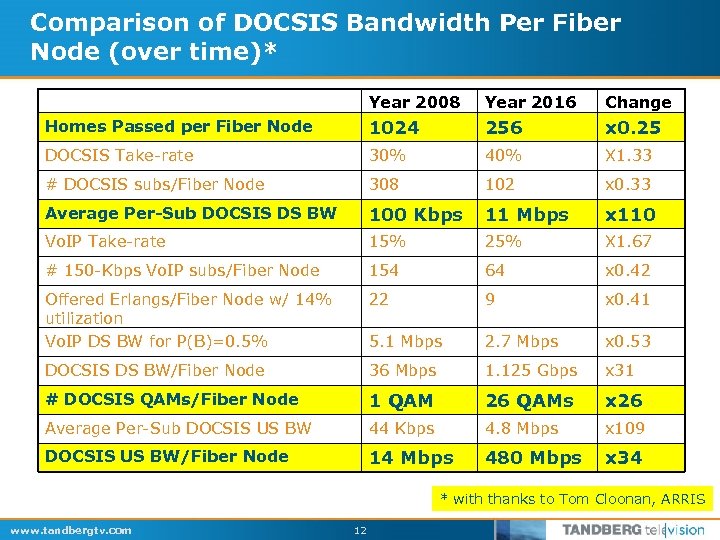 Comparison of DOCSIS Bandwidth Per Fiber Node (over time)* Year 2008 Year 2016 Change Homes Passed per Fiber Node 1024 256 x 0. 25 DOCSIS Take-rate 30% 40% X 1. 33 # DOCSIS subs/Fiber Node 308 102 x 0. 33 Average Per-Sub DOCSIS DS BW 100 Kbps 11 Mbps x 110 Vo. IP Take-rate 15% 25% X 1. 67 # 150 -Kbps Vo. IP subs/Fiber Node 154 64 x 0. 42 Offered Erlangs/Fiber Node w/ 14% utilization Vo. IP DS BW for P(B)=0. 5% 22 9 x 0. 41 5. 1 Mbps 2. 7 Mbps x 0. 53 DOCSIS DS BW/Fiber Node 36 Mbps 1. 125 Gbps x 31 # DOCSIS QAMs/Fiber Node 1 QAM 26 QAMs x 26 Average Per-Sub DOCSIS US BW 44 Kbps 4. 8 Mbps x 109 DOCSIS US BW/Fiber Node 14 Mbps 480 Mbps x 34 * with thanks to Tom Cloonan, ARRIS www. tandbergtv. com 12
 Summary • We are seeing a compounding of trends: 1. From 2. From 3. From 4. From One-way to Two-way Broadcast to Unicast Ti. Vo to n. PVR TV to TV, PC, and mobile devices • Delivery network consequences are manageable with today’s technology www. tandbergtv. com 16
 Thank You Questions? ------Thank You! www. tandbergtv. com 17