 Скачать презентацию TRENDS IN THE TOURISM LABOUR MARKET International Conference
4d93345119099ef401356d48130bf5c5.ppt
- Количество слайдов: 10



TRENDS IN THE TOURISM LABOUR MARKET International Conference of the Czech EU Presidency Tourism Industry: Employment and Labour Market Challenges Prague, 10 – 11 June 2009 ALAIN DUPEYRAS Head of the OECD Tourism Unit 1
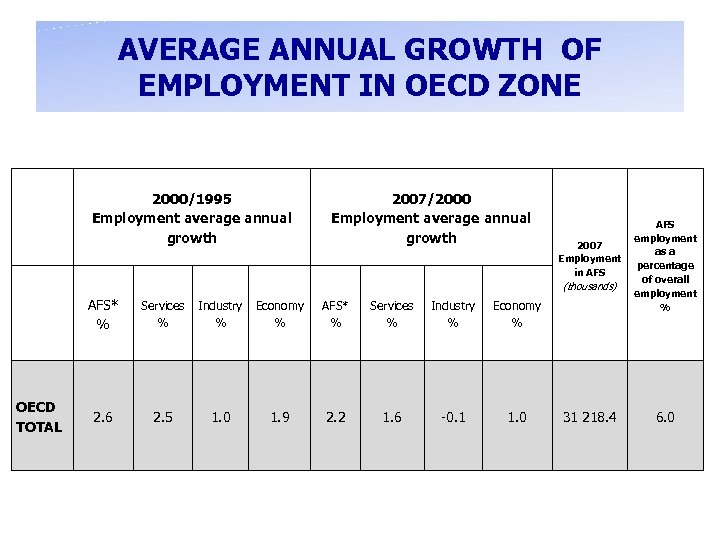
AVERAGE ANNUAL GROWTH OF EMPLOYMENT IN OECD ZONE 2000/1995 Employment average annual growth 2007/2000 Employment average annual growth 2007 Employment in AFS (thousands) AFS* % OECD TOTAL Services % Industry % Economy % AFS* % Services % Industry % Economy % 2. 6 2. 5 1. 0 1. 9 2. 2 1. 6 -0. 1 1. 0 31 218. 4 AFS employment as a percentage of overall employment % 6. 0
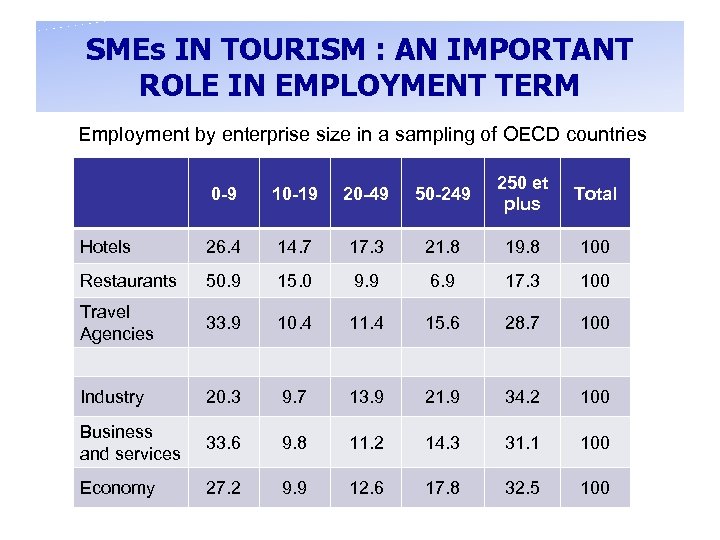
SMEs IN TOURISM : AN IMPORTANT ROLE IN EMPLOYMENT TERM Employment by enterprise size in a sampling of OECD countries 0 -9 10 -19 20 -49 50 -249 250 et plus Total Hotels 26. 4 14. 7 17. 3 21. 8 19. 8 100 Restaurants 50. 9 15. 0 9. 9 6. 9 17. 3 100 Travel Agencies 33. 9 10. 4 11. 4 15. 6 28. 7 100 Industry 20. 3 9. 7 13. 9 21. 9 34. 2 100 Business and services 33. 6 9. 8 11. 2 14. 3 31. 1 100 Economy 27. 2 9. 9 12. 6 17. 8 32. 5 100
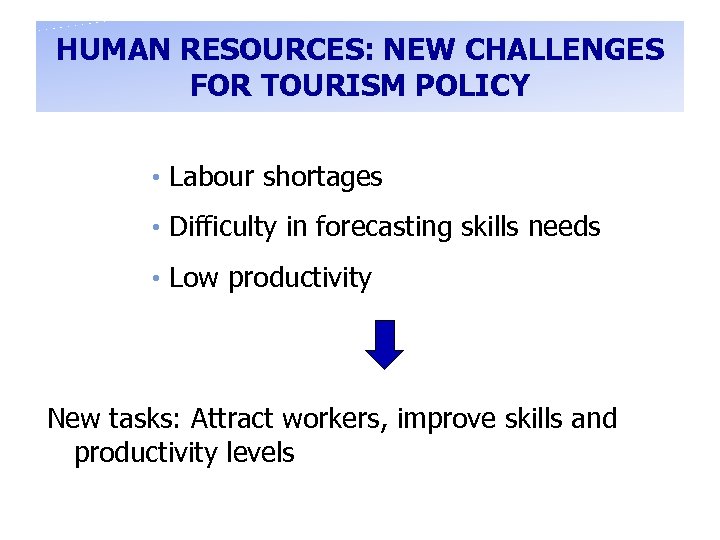
HUMAN RESOURCES: NEW CHALLENGES FOR TOURISM POLICY • Labour shortages • Difficulty in forecasting skills needs • Low productivity New tasks: Attract workers, improve skills and productivity levels
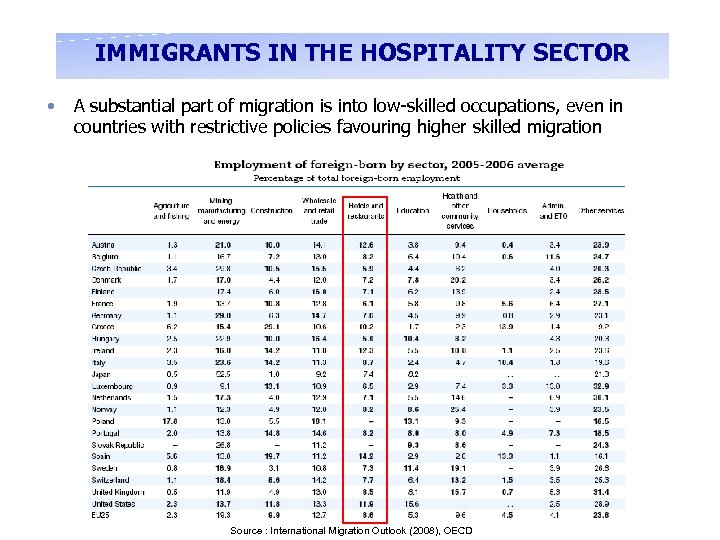
IMMIGRANTS IN THE HOSPITALITY SECTOR • A substantial part of migration is into low-skilled occupations, even in countries with restrictive policies favouring higher skilled migration Source : International Migration Outlook (2008), OECD
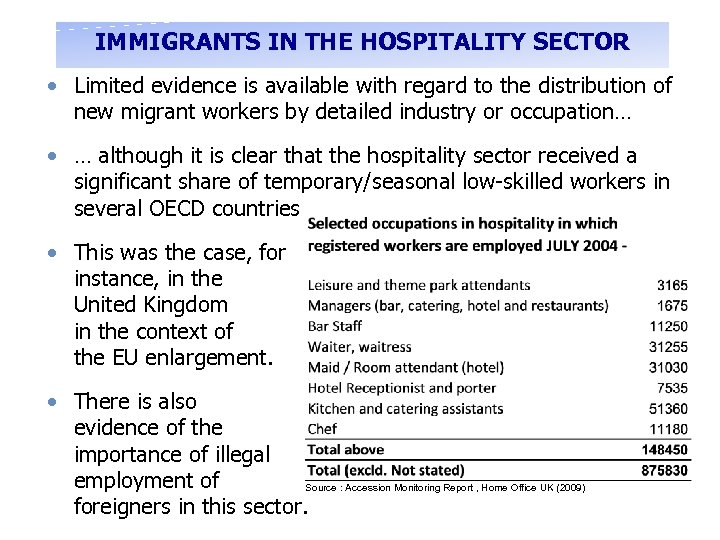
IMMIGRANTS IN THE HOSPITALITY SECTOR • Limited evidence is available with regard to the distribution of new migrant workers by detailed industry or occupation… • … although it is clear that the hospitality sector received a significant share of temporary/seasonal low-skilled workers in several OECD countries • This was the case, for instance, in the United Kingdom in the context of the EU enlargement. • There is also evidence of the importance of illegal employment of Source : Accession Monitoring Report , Home Office UK (2009) foreigners in this sector.
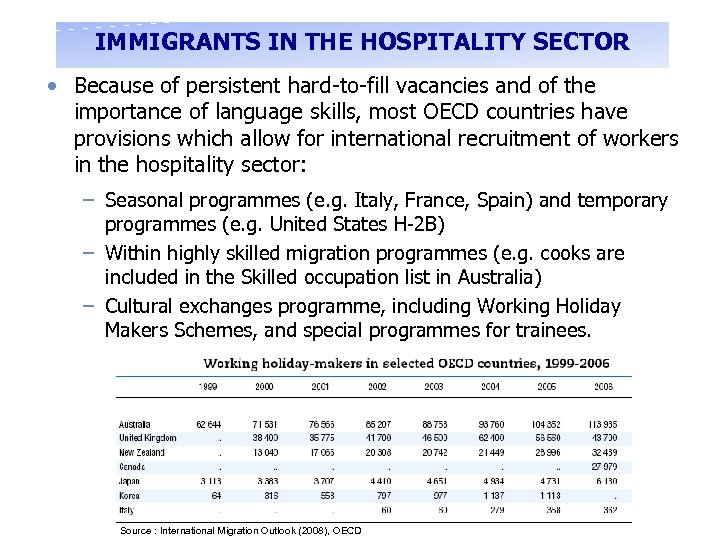
IMMIGRANTS IN THE HOSPITALITY SECTOR • Because of persistent hard-to-fill vacancies and of the importance of language skills, most OECD countries have provisions which allow for international recruitment of workers in the hospitality sector: – Seasonal programmes (e. g. Italy, France, Spain) and temporary programmes (e. g. United States H-2 B) – Within highly skilled migration programmes (e. g. cooks are included in the Skilled occupation list in Australia) – Cultural exchanges programme, including Working Holiday Makers Schemes, and special programmes for trainees. Source : International Migration Outlook (2008), OECD
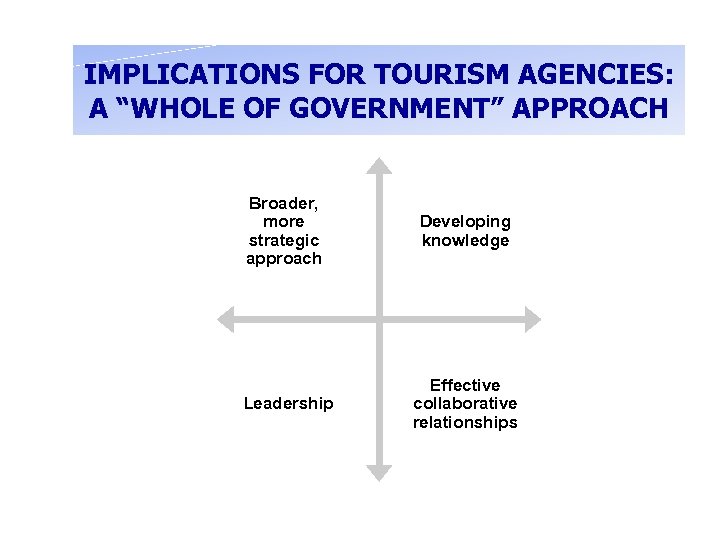
IMPLICATIONS FOR TOURISM AGENCIES: A “WHOLE OF GOVERNMENT” APPROACH Broader, more strategic approach Developing knowledge Leadership Effective collaborative relationships
WHAT NEEDS TO BE DONE? DEVELOP STRATEGIC GUIDANCE • Increase emphasis on supply side issues and yield per visitor STRENGTHEN GOVERNANCE AND LEADERSHIP • Encourage a “whole-of-government” approach ENCOURAGE POLICY AND INDUSTRY PARTNERSHIPS • Work actively with immigration agencies to develop programmes for seasonal jobs or low-skilled workers CONCENTRATE ON INNOVATION • Increase product development and incentives for entrepreneurs, e. g. Scottish Enterprise, Innotour (Switzerland) IMPROVE SUPPORT DATA / INTELLIGENCE • Develop indicators to measure employment features and to assess efficiency of support programmes 9
FOR MORE INFORMATION VISIT OR EMAIL • • www. oecd. org/cfe/tourism. contact@oecd. org PUBLICATIONS • • The Impact of Culture on Tourism in OECD Countries 2010: Trends and Policies (forthcoming) 10
Скачать презентацию TRENDS IN THE TOURISM LABOUR MARKET International Conference
4d93345119099ef401356d48130bf5c5.ppt