 Скачать презентацию Trends in Inter-Regional Goods Movement Paul O Roberts
b41cdc4088b5818b16bf8bfddbe3b9dd.ppt
- Количество слайдов: 59




Trends in Inter-Regional Goods Movement Paul O. Roberts
Freight movement is fundamental to the functioning of a modern economy n n 2 A major difference between a developed economy and the third world is trade Specialization, utilization of superior resources, and economies of scale in production and distribution are important All depend on efficient freight movement to be successful Trade was important to the Roman Empire…it is even more important today
Different Views of Logistics
There are several ways to view logistics n n Supply chain view n Geographic view n 4 Input/Output view Regional economy view
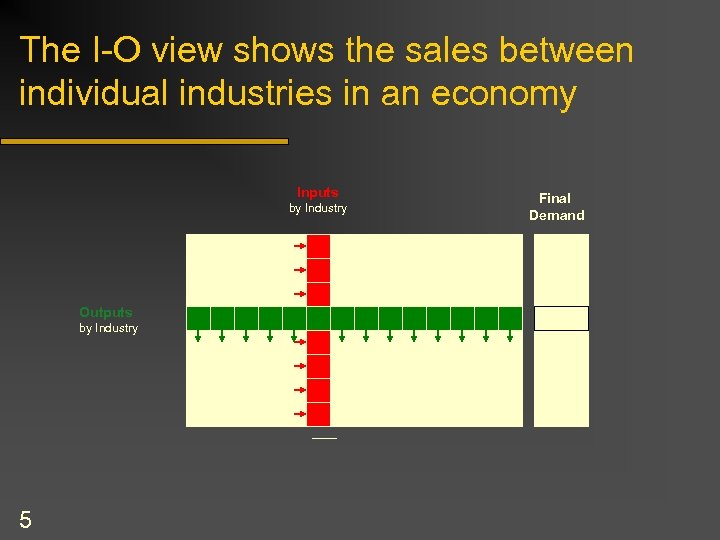
The I-O view shows the sales between individual industries in an economy Inputs by Industry Outputs by Industry 5 Final Demand
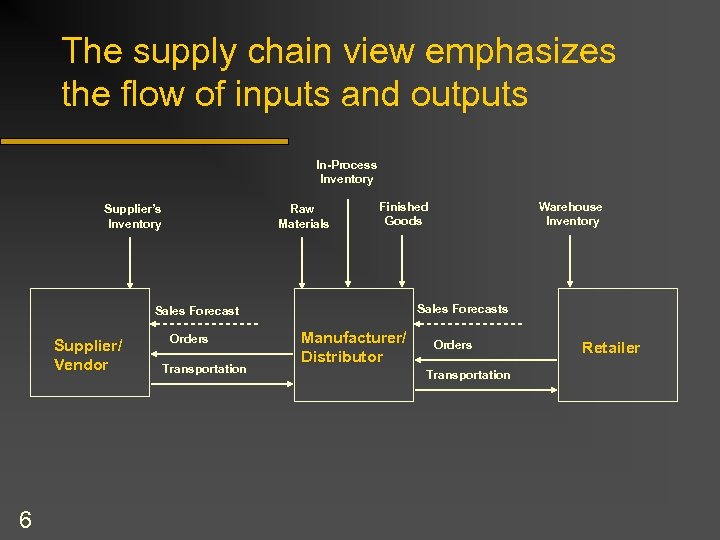
The supply chain view emphasizes the flow of inputs and outputs In-Process Inventory Supplier’s Inventory Raw Materials Finished Goods Sales Forecast Supplier/ Vendor 6 Orders Transportation Warehouse Inventory Manufacturer/ Distributor Orders Transportation Retailer
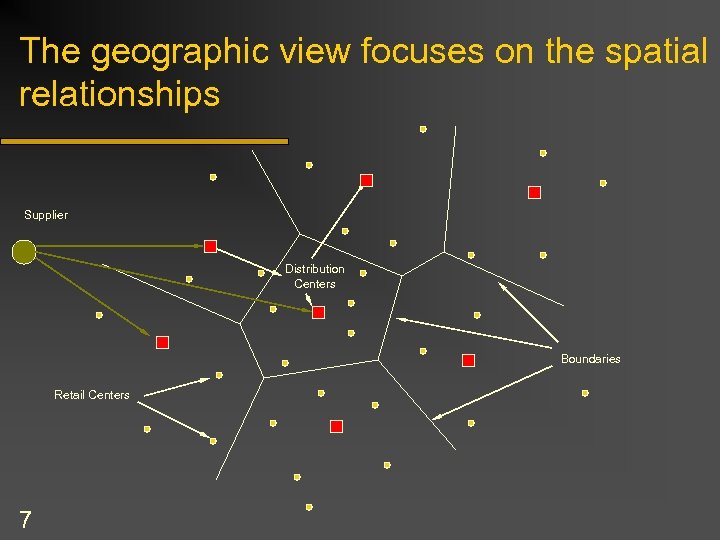
The geographic view focuses on the spatial relationships Supplier Distribution Centers Boundaries Retail Centers 7
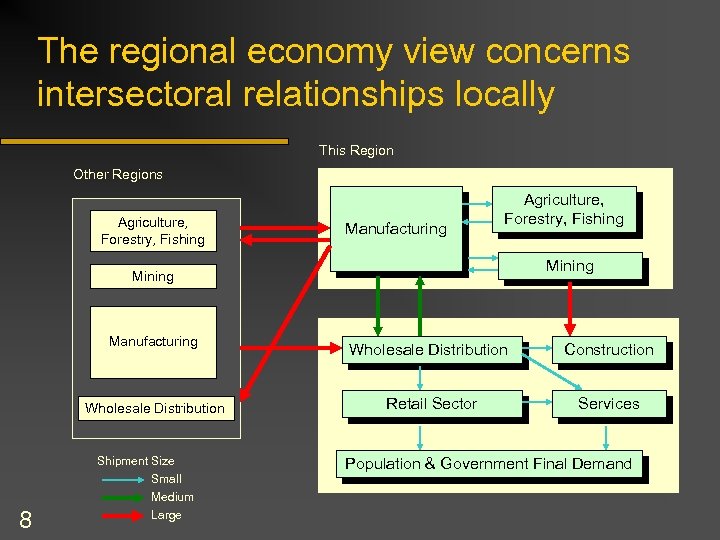
The regional economy view concerns intersectoral relationships locally This Region Other Regions Agriculture, Forestry, Fishing Manufacturing Agriculture, Forestry, Fishing Mining Manufacturing Wholesale Distribution 8 Shipment Size Small Medium Large Wholesale Distribution Construction Retail Sector Services Population & Government Final Demand

Trends in Logistics
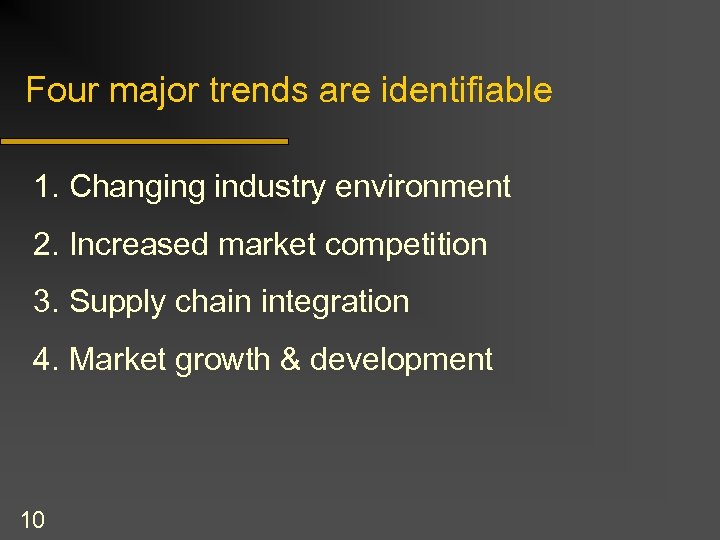
Four major trends are identifiable 1. Changing industry environment 2. Increased market competition 3. Supply chain integration 4. Market growth & development 10

Trend 1: Changing Industry Environment 11
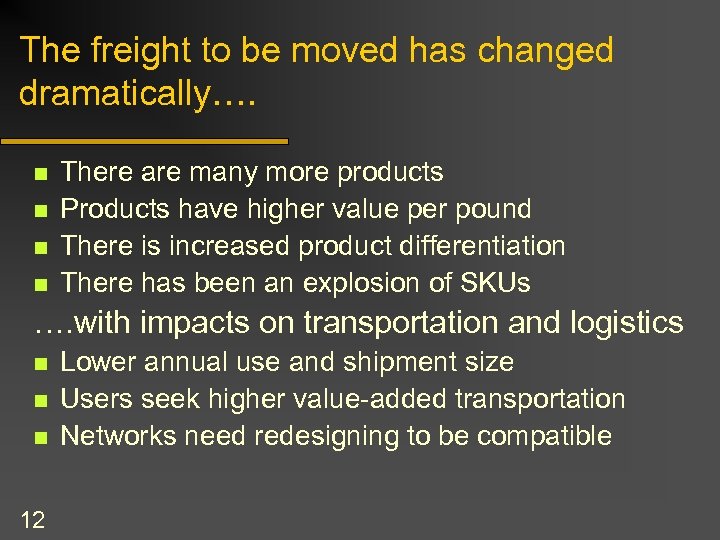
The freight to be moved has changed dramatically…. n n There are many more products Products have higher value per pound There is increased product differentiation There has been an explosion of SKUs …. with impacts on transportation and logistics n n n 12 Lower annual use and shipment size Users seek higher value-added transportation Networks need redesigning to be compatible
Transportation industry deregulation, which began in 1980, had impacts on…. n the transport sector n the logistics costs of many firms n the US economy n the world economy 13
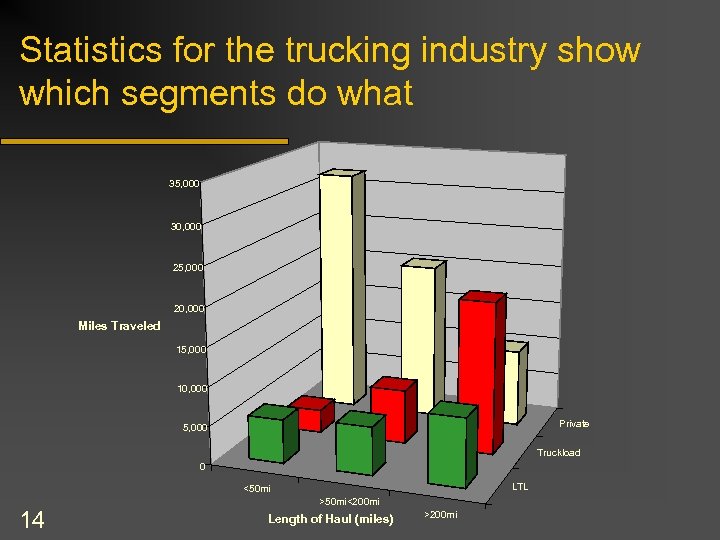
Statistics for the trucking industry show which segments do what 35, 000 30, 000 25, 000 20, 000 Miles Traveled 15, 000 10, 000 Private 5, 000 Truckload 0 LTL <50 mi 14 >50 mi<200 mi Length of Haul (miles) >200 mi
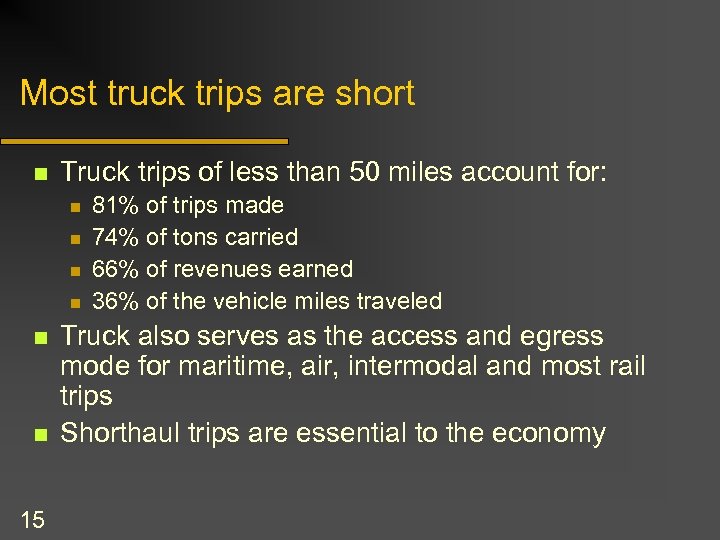
Most truck trips are short n Truck trips of less than 50 miles account for: n n n 15 81% of trips made 74% of tons carried 66% of revenues earned 36% of the vehicle miles traveled Truck also serves as the access and egress mode for maritime, air, intermodal and most rail trips Shorthaul trips are essential to the economy
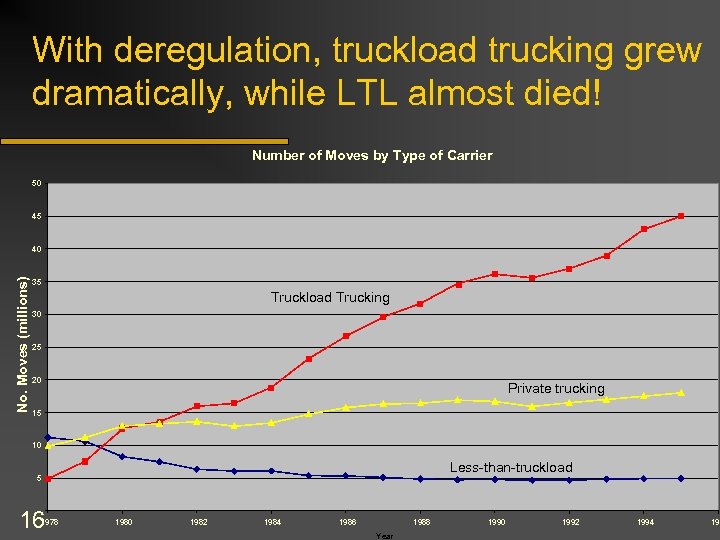
With deregulation, truckload trucking grew dramatically, while LTL almost died! Number of Moves by Type of Carrier 50 45 No. Moves (millions) 40 35 Truckload Trucking 30 25 20 Private trucking 15 10 Less-than-truckload 5 16 1978 1980 1982 1984 1986 1988 Year 1990 1992 1994 199
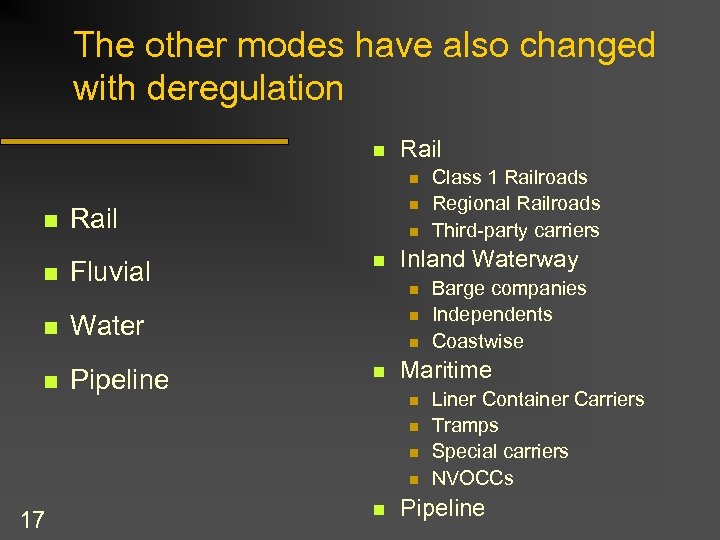
The other modes have also changed with deregulation n Rail n Fluvial n Pipeline n Water n n Inland Waterway n n n n Barge companies Independents Coastwise Maritime n 17 Class 1 Railroads Regional Railroads Third-party carriers Liner Container Carriers Tramps Special carriers NVOCCs Pipeline
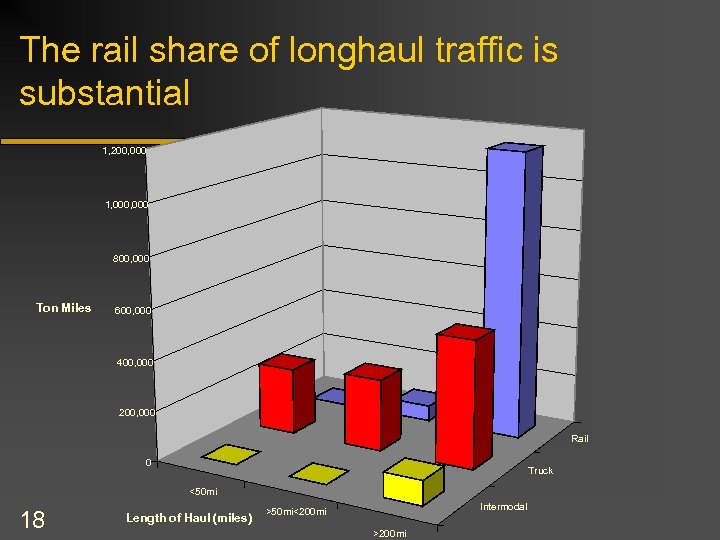
The rail share of longhaul traffic is substantial 1, 200, 000 1, 000 800, 000 Ton Miles 600, 000 400, 000 200, 000 Rail 0 Truck <50 mi 18 Length of Haul (miles) Intermodal >50 mi<200 mi >200 mi
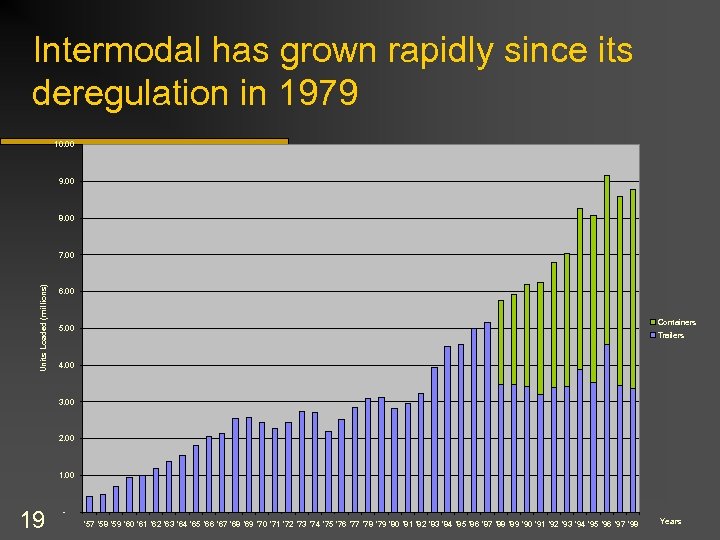
Intermodal has grown rapidly since its deregulation in 1979 10. 00 9. 00 8. 00 Units Loaded (millions) 7. 00 6. 00 Containers 5. 00 Trailers 4. 00 3. 00 2. 00 19 '57 '58 '59 '60 '61 '62 '63 '64 '65 '66 '67 '68 '69 '70 '71 '72 '73 '74 '75 '76 '77 '78 '79 '80 '81 '82 '83 '84 '85 '86 '87 '88 '89 '90 '91 '92 '93 '94 '95 '96 '97 '98 Years
Trend 2: Increased Market Competition 20
Market competition drives producers toward cost minimization Total cost includes: n n n n 21 Acquisition Inbound transportation Production Storage Distribution Sale Shipment size and transport cost Tradeoff of transport cost and carrying cost
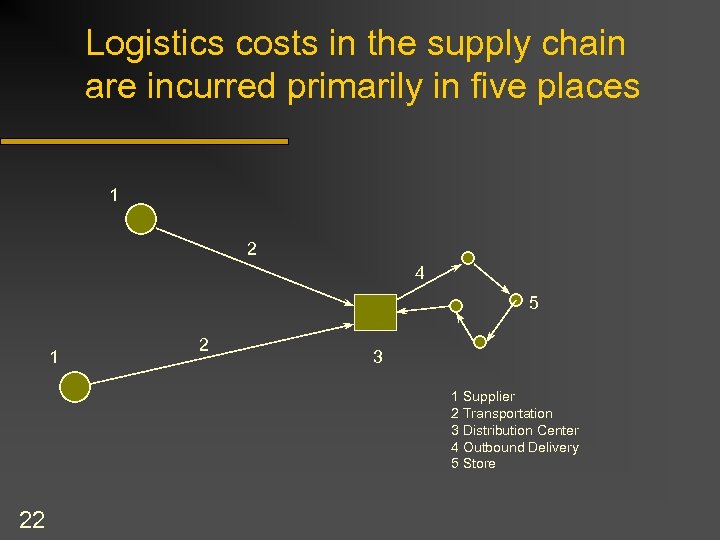
Logistics costs in the supply chain are incurred primarily in five places 1 2 4 5 1 2 3 1 Supplier 2 Transportation 3 Distribution Center 4 Outbound Delivery 5 Store 22
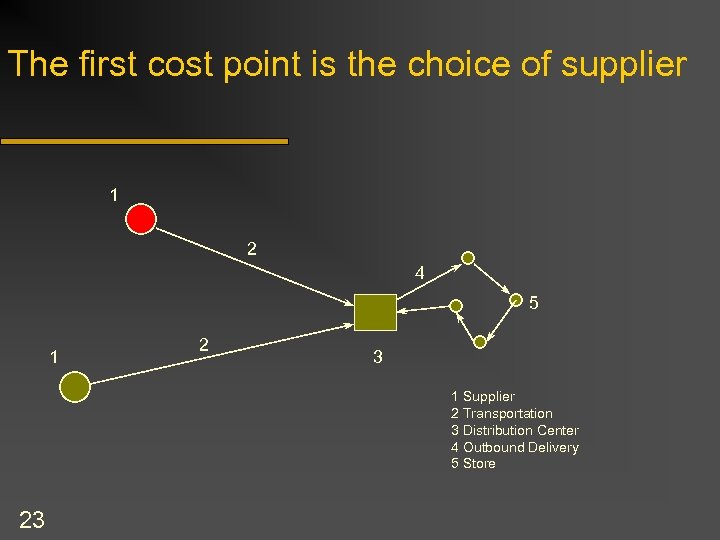
The first cost point is the choice of supplier 1 2 4 5 1 2 3 1 Supplier 2 Transportation 3 Distribution Center 4 Outbound Delivery 5 Store 23
The choice of supplier is an important determinant of final delivered cost n It determines the cost of the product n It impacts transport cost and service levels n It also determines producer quality n It influences product availability and lead time 24
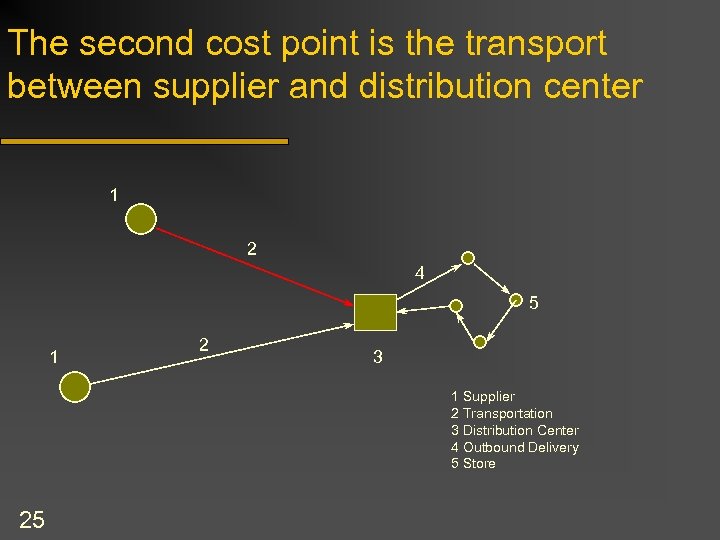
The second cost point is the transport between supplier and distribution center 1 2 4 5 1 2 3 1 Supplier 2 Transportation 3 Distribution Center 4 Outbound Delivery 5 Store 25
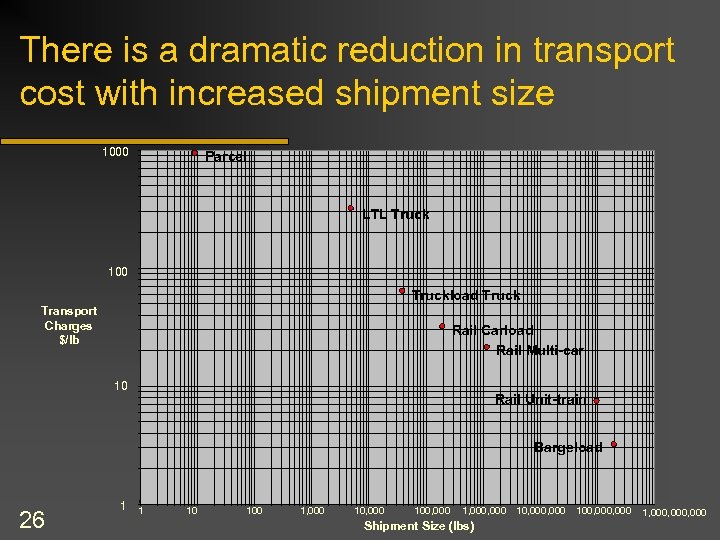
There is a dramatic reduction in transport cost with increased shipment size 1000 Parcel LTL Truck 100 Truckload Truck Transport Charges $/lb Rail Carload Rail Multi-car 10 Rail Unit-train Bargeload 26 1 1 10 100 1, 000 100, 000 1, 000, 000 100, 000 Shipment Size (lbs) 1, 000, 000
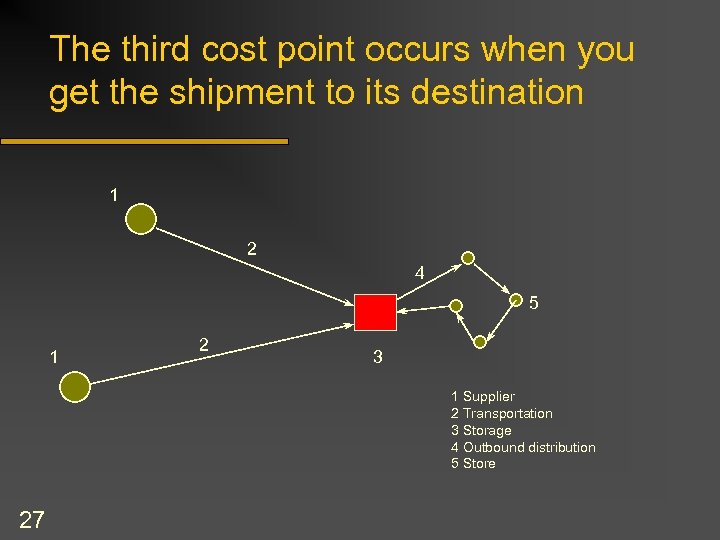
The third cost point occurs when you get the shipment to its destination 1 2 4 5 1 2 3 1 Supplier 2 Transportation 3 Storage 4 Outbound distribution 5 Store 27
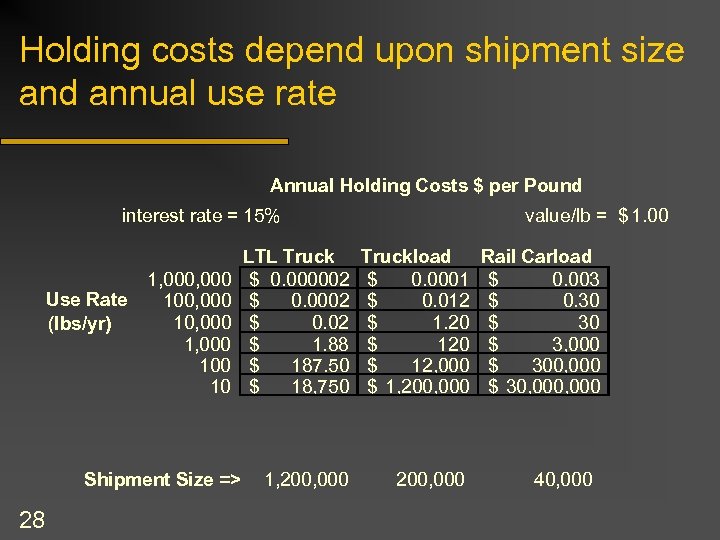
Holding costs depend upon shipment size and annual use rate Annual Holding Costs $ per Pound interest rate = 15% Use Rate (lbs/yr) 1, 000 100, 000 1, 000 10 Shipment Size => 28 value/lb = $ 1. 00 LTL Truck $ 0. 000002 $ 0. 02 $ 1. 88 $ 187. 50 $ 18, 750 Truckload $ 0. 0001 $ 0. 012 $ 1. 20 $ 12, 000 $ 1, 200, 000 Rail Carload $ 0. 003 $ 0. 30 $ 3, 000 $ 300, 000 $ 30, 000 40, 000
Another type of holding cost involves the use of safety stock n n 29 Safety stock is inventory held to prevent stockout if there is a delay If a stockout costs nothing, it is not necessary to carry safety stock Safety stock is held continuously Sharing safety stock over many users can reduce the cost
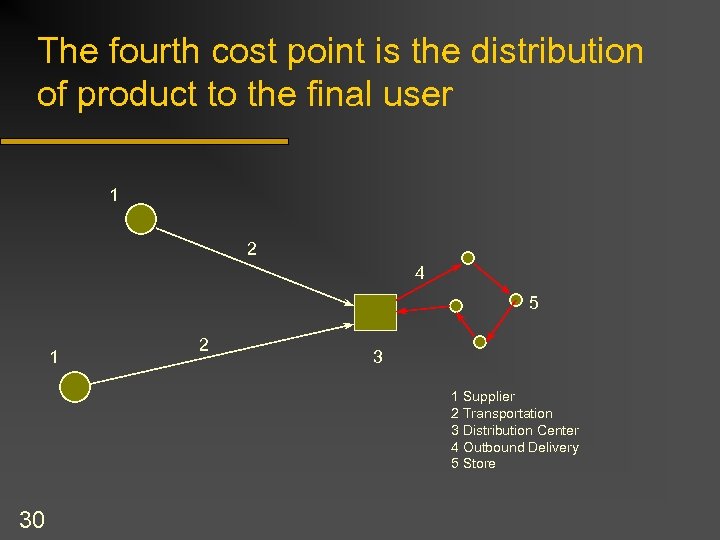
The fourth cost point is the distribution of product to the final user 1 2 4 5 1 2 3 1 Supplier 2 Transportation 3 Distribution Center 4 Outbound Delivery 5 Store 30
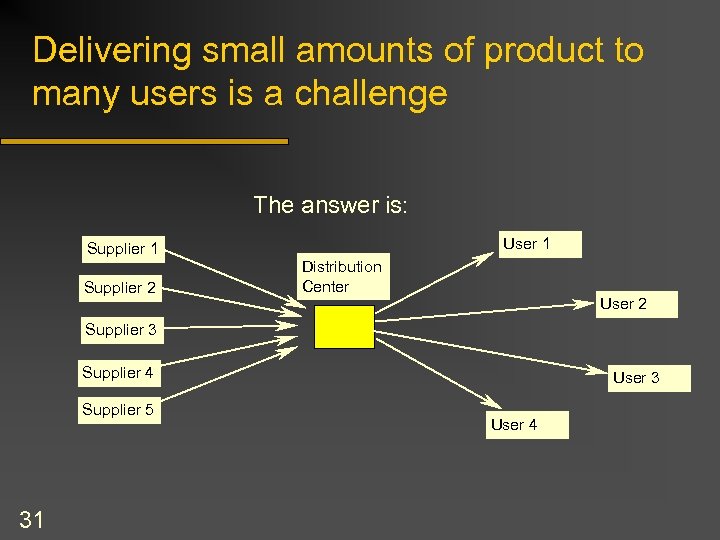
Delivering small amounts of product to many users is a challenge The answer is: Supplier 1 Supplier 2 User 1 Distribution Center User 2 Supplier 3 Supplier 4 Supplier 5 31 User 3 User 4
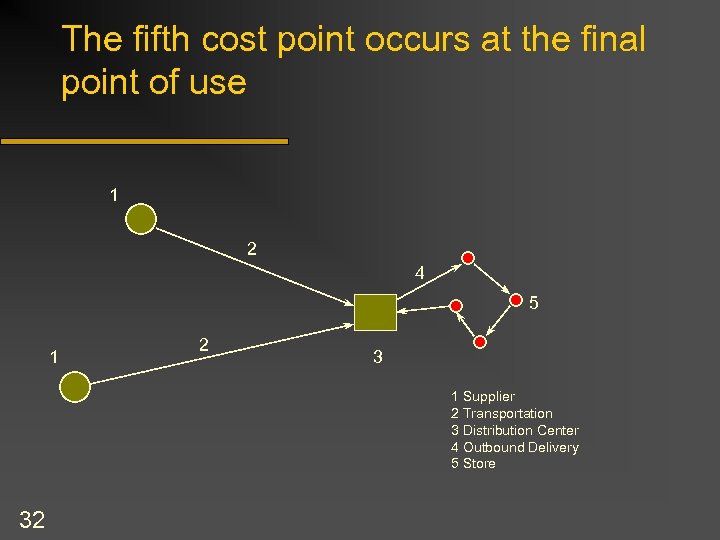
The fifth cost point occurs at the final point of use 1 2 4 5 1 2 3 1 Supplier 2 Transportation 3 Distribution Center 4 Outbound Delivery 5 Store 32
Finally, there are costs at the point of sale (or use) of the product n n n 33 Inventory holding cost is managed by inventory control systems There are only two basic systems—Quantitydetermined and Frequency-determined In a quantity-determined system the size of shipment is specified In a frequency-determined system the time between shipments is specified Each lends itself to a different situation
Identifying the 5 cost points is only part of the problem n n 34 There are numerous tradeoffs between these key economic relationships Supply chain design must take these tradeoffs into account A good system must be continuously adjusted to keep it in balance The next topic looks at a few factors involved in the design of logistics systems
Trend 3: Supply Chain Integration 35
Supply chain integration is now occurring in most industries n Network restructuring n Vertical and horizontal integration n Strategic alliances n Market rationalization n Purchasing strategy n E-commerce 36
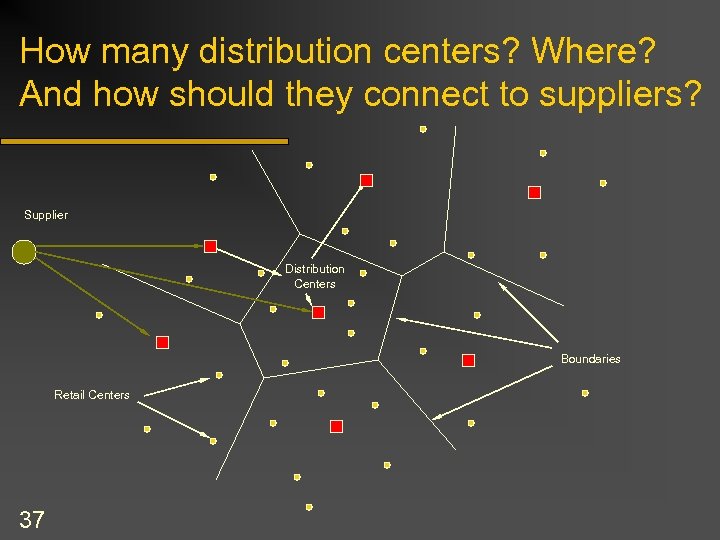
How many distribution centers? Where? And how should they connect to suppliers? Supplier Distribution Centers Boundaries Retail Centers 37
Most logistics strategies involve tradeoffs n Direct vs. cross-dock n Inventory at store vs. warehouse n Inbound vs. outbound n Big supplier vs. close supplier n Inventory at hub vs. warehouse 38
E-Commerce has created some myths n E-business will fundamentally change retailing n Stores won’t be needed n Businesses can now locate anywhere n All they will need is a computer and a modem Logistics in the future is a whole new world 39
E-commerce will revolutionize logistics by electronic data transmission/manipulation n Communication influences the way businesses do business n Twenty calls to move a truckload n Convert physical movements to electronic n This is obviously the biggest initiative underway by many companies 40
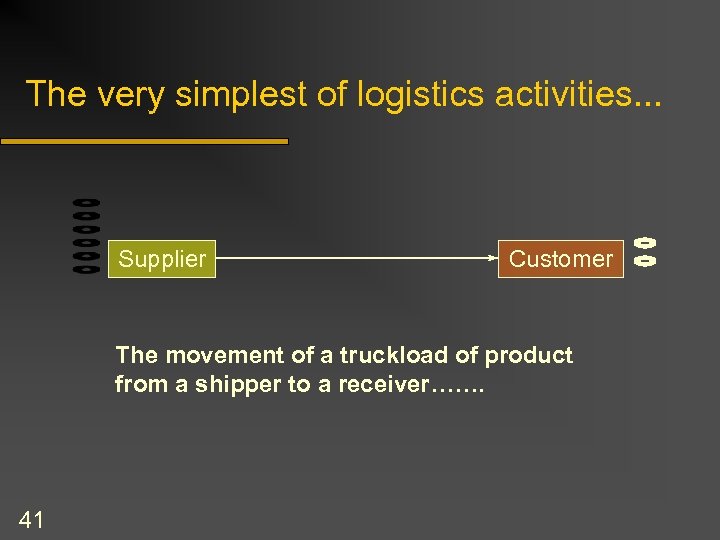
The very simplest of logistics activities. . . Supplier Customer The movement of a truckload of product from a shipper to a receiver……. 41
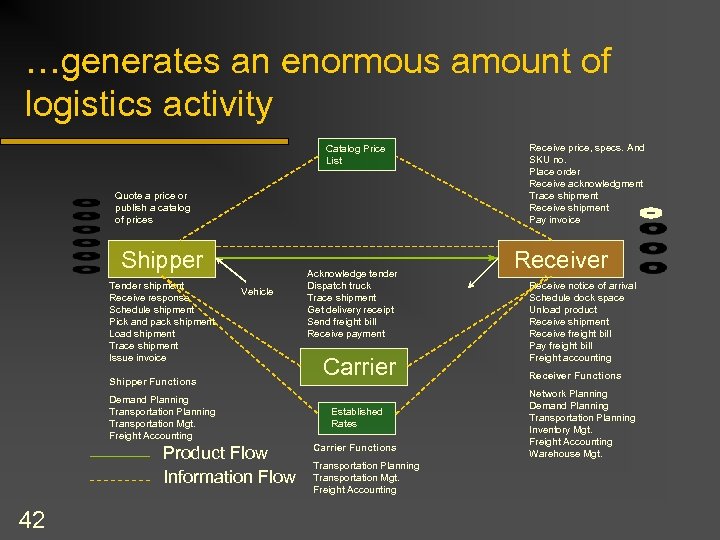
…generates an enormous amount of logistics activity Catalog Price List Quote a price or publish a catalog of prices Shipper Tender shipment Receive response Schedule shipment Pick and pack shipment Load shipment Trace shipment Issue invoice Vehicle Shipper Functions Demand Planning Transportation Mgt. Freight Accounting Product Flow Information Flow 42 Acknowledge tender Dispatch truck Trace shipment Get delivery receipt Send freight bill Receive payment Carrier Established Rates Carrier Functions Transportation Planning Transportation Mgt. Freight Accounting Receive price, specs. And SKU no. Place order Receive acknowledgment Trace shipment Receive shipment Pay invoice Receiver Receive notice of arrival Schedule dock space Unload product Receive shipment Receive freight bill Pay freight bill Freight accounting Receiver Functions Network Planning Demand Planning Transportation Planning Inventory Mgt. Freight Accounting Warehouse Mgt.
E-commerce won’t reduce trade…It will increase it! 43

Trend 5: Market Growth & Development 44
Growing trade means more freight movement, not less n n n n 45 Efficient freight movements are crucial to a region They allow raw materials to come into the region Inter-plant movements depend on local trucking They carry regional production out Sales to other regions earn “foreign exchange” Foreign exchange is used to purchase “imports” Imports are distributed to retailers in the region Retailers sell to the population of the region
An urban area is an economic microcosm…like a country only smaller n n Economies of scale in a region Reasons for locating in urban clusters n n 46 Specialized suppliers Industry-specific labor force Community of common interests Competitive atmosphere
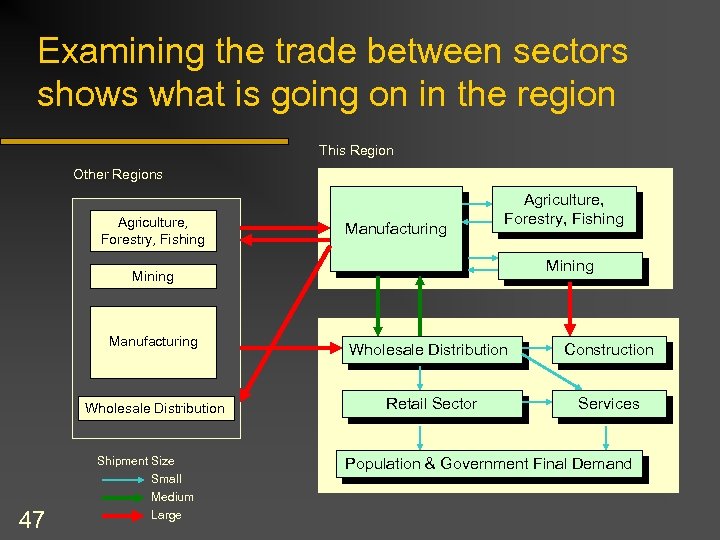
Examining the trade between sectors shows what is going on in the region This Region Other Regions Agriculture, Forestry, Fishing Manufacturing Agriculture, Forestry, Fishing Mining Manufacturing Wholesale Distribution 47 Shipment Size Small Medium Large Wholesale Distribution Construction Retail Sector Services Population & Government Final Demand
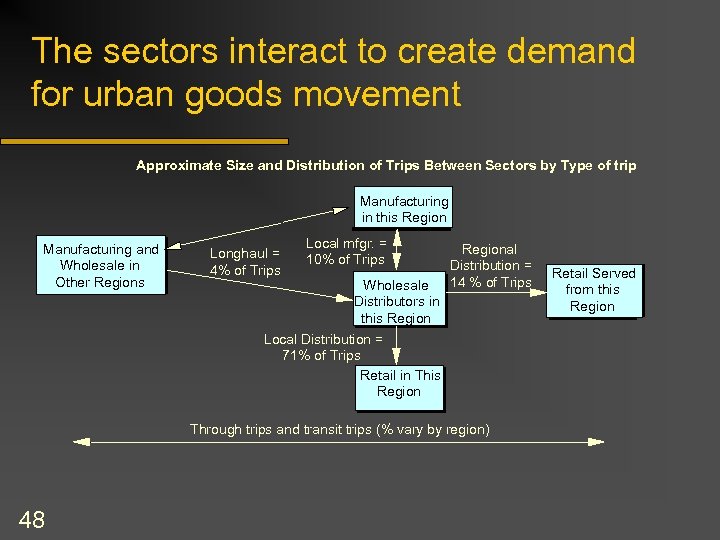
The sectors interact to create demand for urban goods movement Approximate Size and Distribution of Trips Between Sectors by Type of trip Manufacturing in this Region Manufacturing and Wholesale in Other Regions Longhaul = 4% of Trips Local mfgr. = 10% of Trips Wholesale Distributors in this Region Local Distribution = 71% of Trips Retail in This Regional Distribution = 14 % of Trips Through trips and transit trips (% vary by region) 48 Retail Served from this Region
Growing congestion on urban highways impacts logistics costs negatively n n 49 Traffic congestion in some urban areas has reached crisis proportions Some industries have relocated to reduce their exposure Urban congestion also impacts intercity trucking because there are no bypasses Congestion makes the U. S. less competitively globally
The market for transportation is also growing in response to globalization n Steps in the supply chain n n 50 Sourcing Inbound transport Local resources Worldwide economy Local markets/local taxation
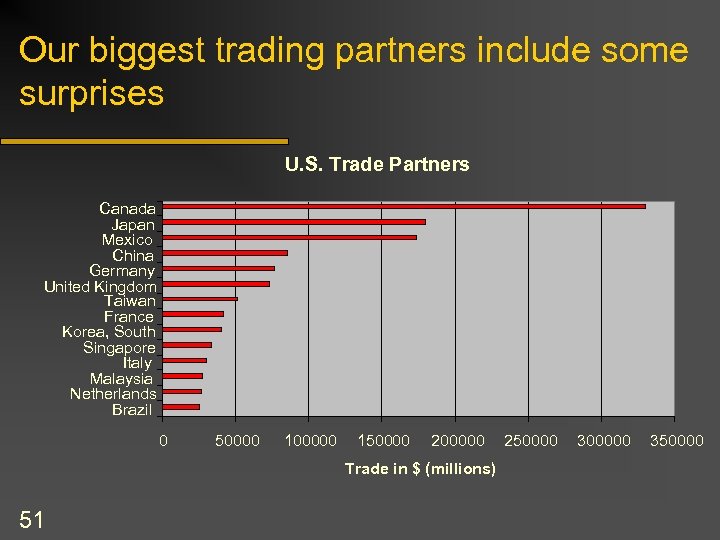
Our biggest trading partners include some surprises U. S. Trade Partners Canada Japan Mexico China Germany United Kingdom Taiwan France Korea, South Singapore Italy Malaysia Netherlands Brazil 0 50000 100000 150000 200000 Trade in $ (millions) 51 250000 300000 350000
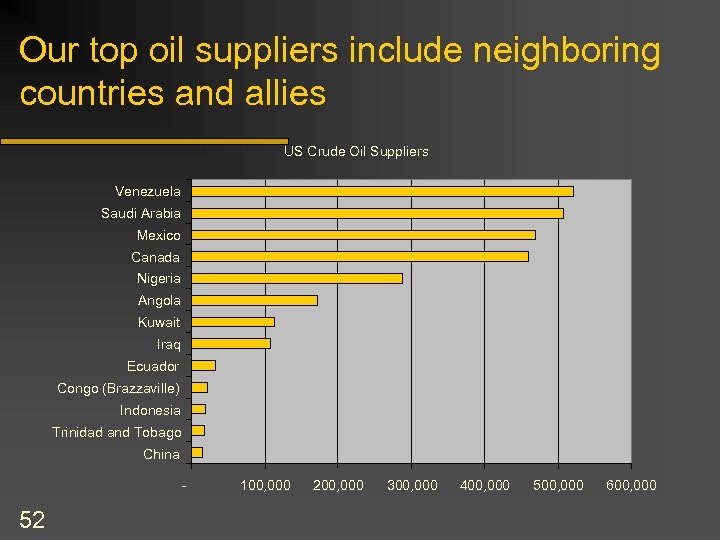
Our top oil suppliers include neighboring countries and allies US Crude Oil Suppliers Venezuela Saudi Arabia Mexico Canada Nigeria Angola Kuwait Iraq Ecuador Congo (Brazzaville) Indonesia Trinidad and Tobago China - 52 100, 000 200, 000 300, 000 400, 000 500, 000 600, 000
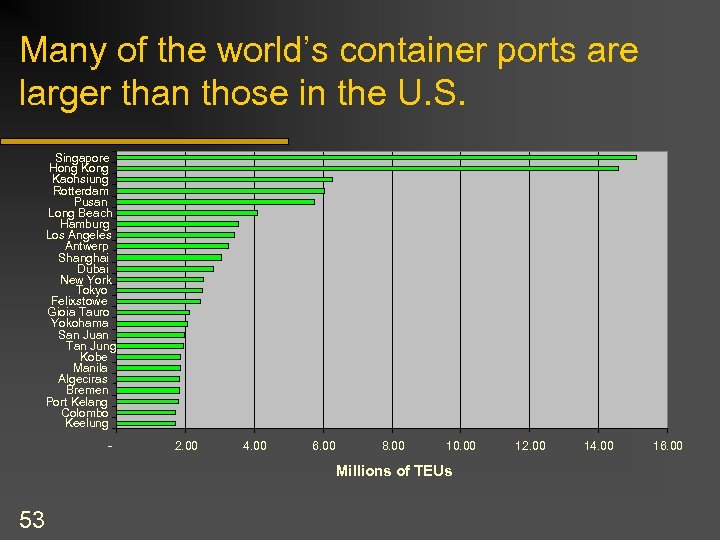
Many of the world’s container ports are larger than those in the U. S. Singapore Hong Kaohsiung Rotterdam Pusan Long Beach Hamburg Los Angeles Antwerp Shanghai Dubai New York Tokyo Felixstowe Gioia Tauro Yokohama San Juan Tan Jung Kobe Manila Algeciras Bremen Port Kelang Colombo Keelung - 2. 00 4. 00 6. 00 8. 00 10. 00 Millions of TEUs 53 12. 00 14. 00 16. 00

Implications for Policy
Firms will continue to adapt to the rapid changes in the business environment n n 55 Logistics is now a high-level executive function Common formats, industry standards and more flexible technology are spurring automation of procedures Electronics is eliminating paperwork in many processes E-commerce is a really big deal
A number of important transportation policies are under review, including: n n n n 56 Truck sizes and weights Rail reregulation/equal access Truck safety and hours of service Future rail mergers Construction of more highways Maritime deregulation Port dredging
Domestic economic policy is also of importance in some areas n Clean air regulation n Tax reduction vs. pay off the national debt n Initiatives to slow urban sprawl n Efforts to reduce greenhouse gases n National energy policy n Not seriously addressed is urban congestion 57
Finally, national trade policy will have tremendous influence on logistics n n n 58 Admission of China to the WTO Continued policy promoting open trade Laws restricting international funds flows

59
Скачать презентацию Trends in Inter-Regional Goods Movement Paul O Roberts
b41cdc4088b5818b16bf8bfddbe3b9dd.ppt