


 Скачать презентацию Trend in Supply Chain Optimization and Humanitarian Logistics
61523c2a7d7a45ae13b808fe8179ad76.ppt
- Количество слайдов: 62
 Trend in Supply Chain Optimization and Humanitarian Logistics Tokyo University of Marine Science and Technology KUBO Mikio
 Agenda Definition of the Supply Chain (SC) and Logistics Decision Levels of the SC Classification of Inventory Basic Models in the SC n n Logistics Network Design Inventory Production Planning Vehicle Routing SC Risk Management and Humanitarian SC
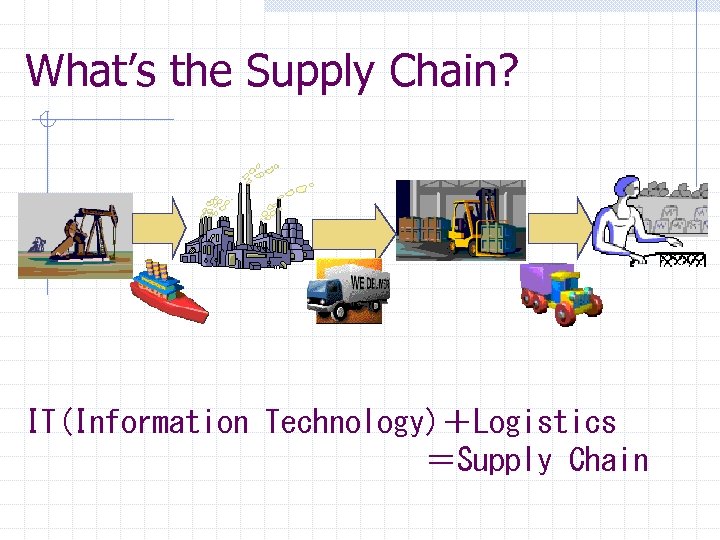 What’s the Supply Chain? IT(Information Technology)+Logistics =Supply Chain
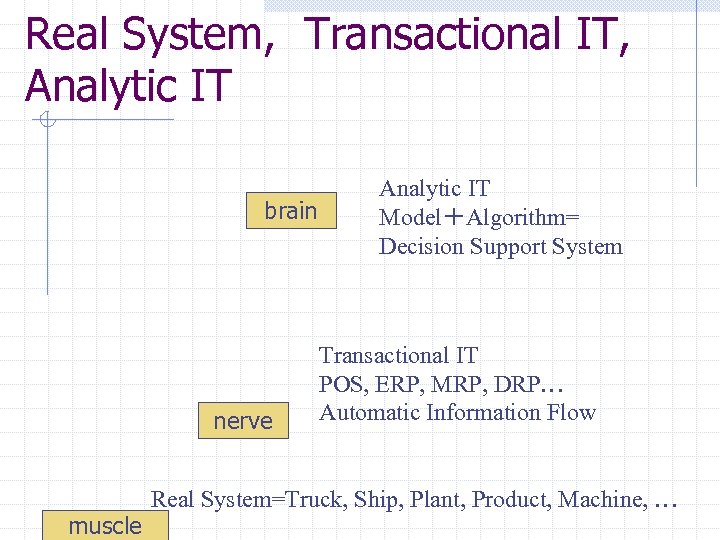 Real System, Transactional IT, Analytic IT brain nerve muscle Analytic IT Model+Algorithm= Decision Support System Transactional IT POS, ERP, MRP, DRP… Automatic Information Flow Real System=Truck, Ship, Plant, Product, Machine, …
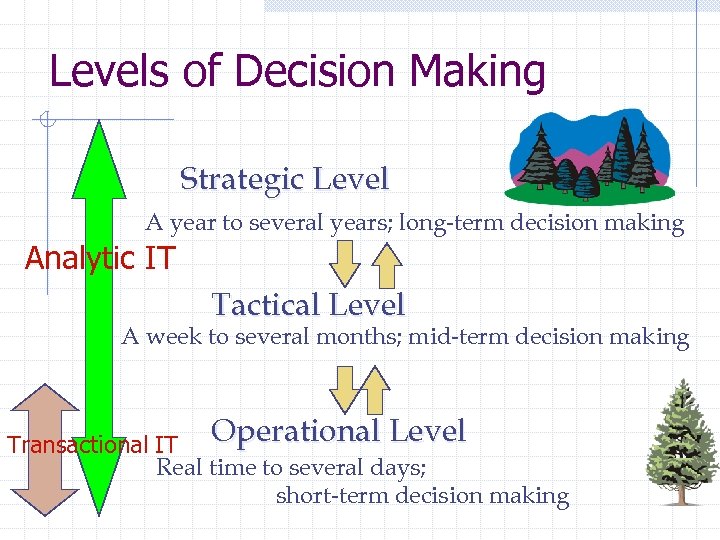 Levels of Decision Making Strategic Level A year to several years; long-term decision making Analytic IT Tactical Level A week to several months; mid-term decision making Operational Level Transactional IT Operational Level Real time to several days; short-term decision making
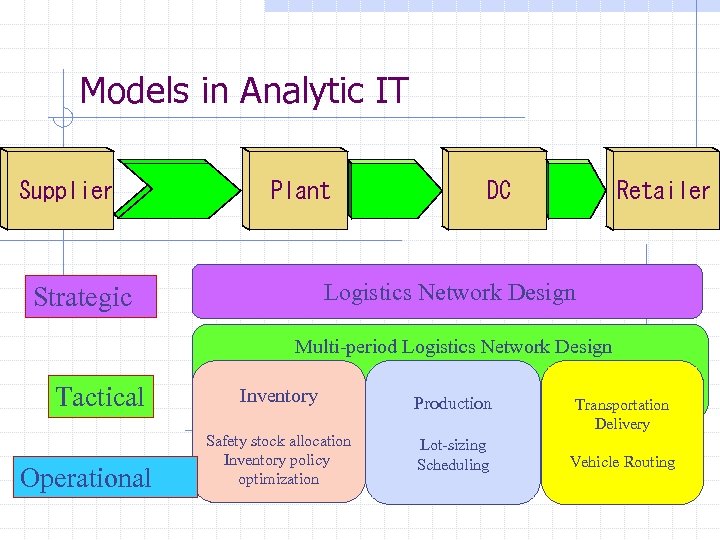 Models in Analytic IT Supplier Plant Retailer DC Logistics Network Design Strategic Multi-period Logistics Network Design Tactical Operational Inventory Safety stock allocation Inventory policy optimization Production Lot-sizing Scheduling Transportation Delivery Vehicle Routing
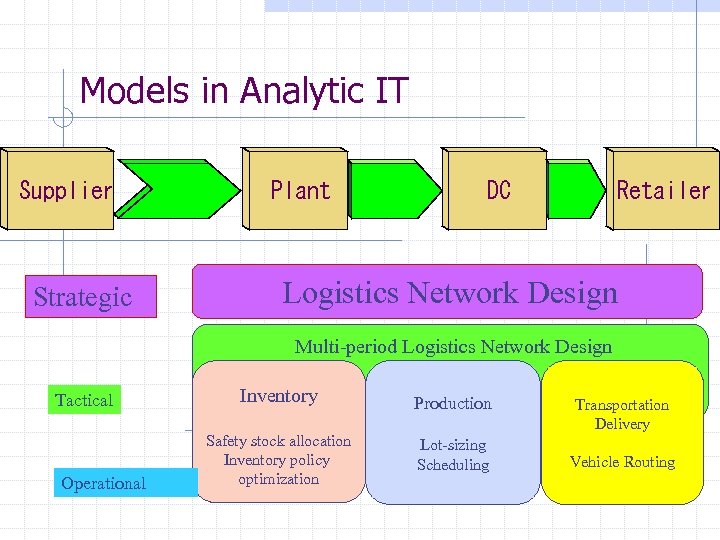 Models in Analytic IT Supplier Strategic Plant Retailer DC Logistics Network Design Multi-period Logistics Network Design Tactical Operational Inventory Safety stock allocation Inventory policy optimization Production Lot-sizing Scheduling Transportation Delivery Vehicle Routing
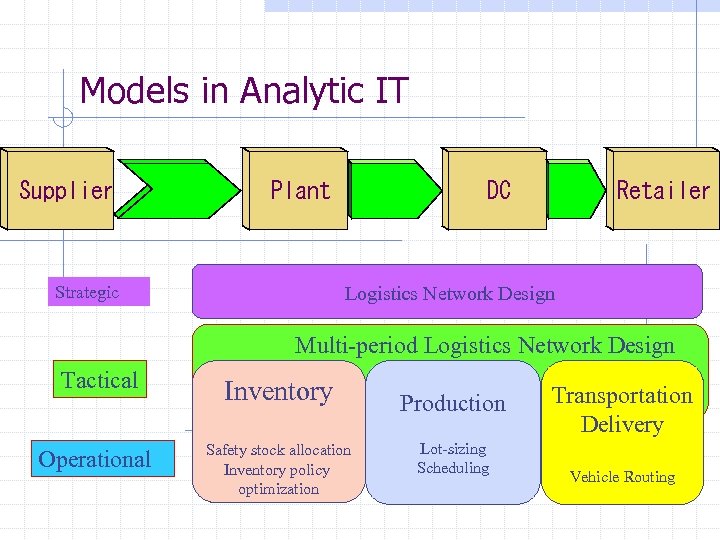 Models in Analytic IT Supplier Plant Retailer DC Logistics Network Design Strategic Multi-period Logistics Network Design Tactical Operational Inventory Safety stock allocation Inventory policy optimization Production Lot-sizing Scheduling Transportation Delivery Vehicle Routing
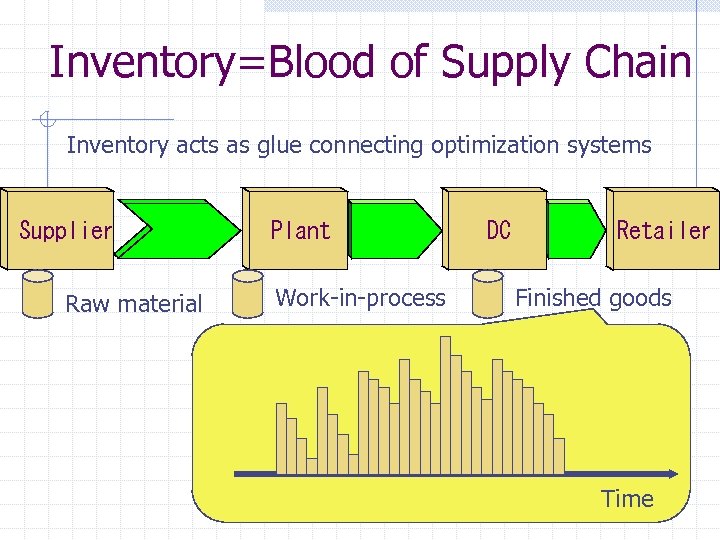 Inventory=Blood of Supply Chain Inventory acts as glue connecting optimization systems Supplier Raw material Plant Work-in-process DC Retailer Finished goods Time
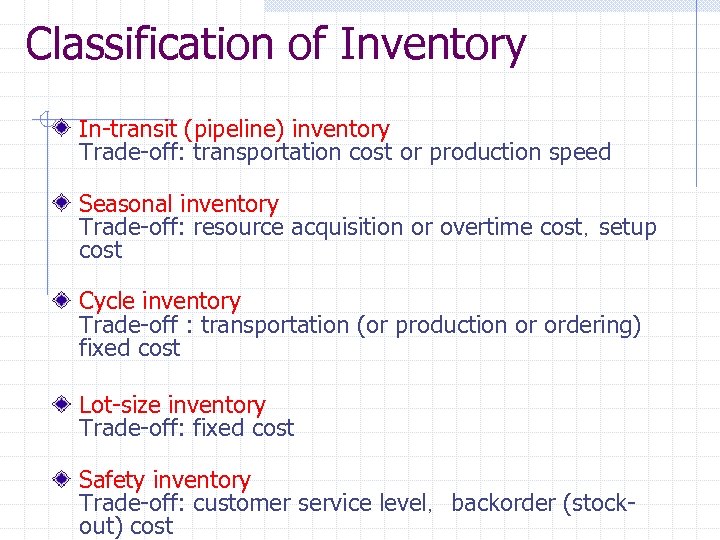 Classification of Inventory In-transit (pipeline) inventory Trade-off: transportation cost or production speed Seasonal inventory Trade-off: resource acquisition or overtime cost,setup cost Cycle inventory Trade-off : transportation (or production or ordering) fixed cost Lot-size inventory Trade-off: fixed cost Safety inventory Trade-off: customer service level, backorder (stockout) cost
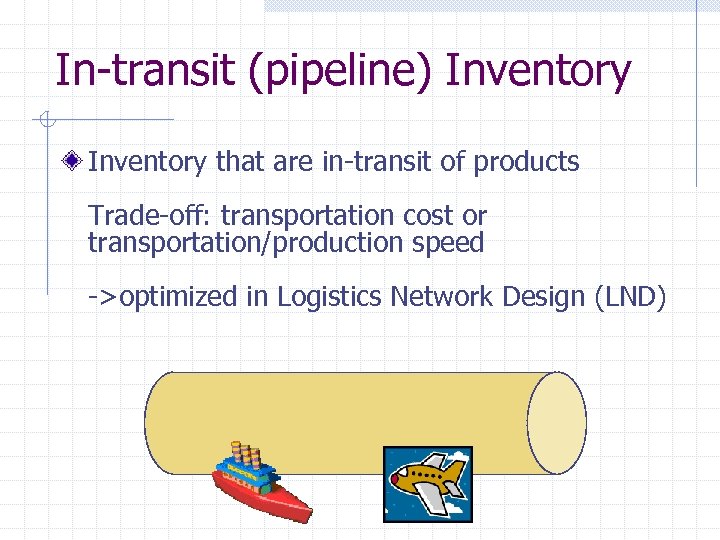 In-transit (pipeline) Inventory that are in-transit of products Trade-off: transportation cost or transportation/production speed ->optimized in Logistics Network Design (LND)
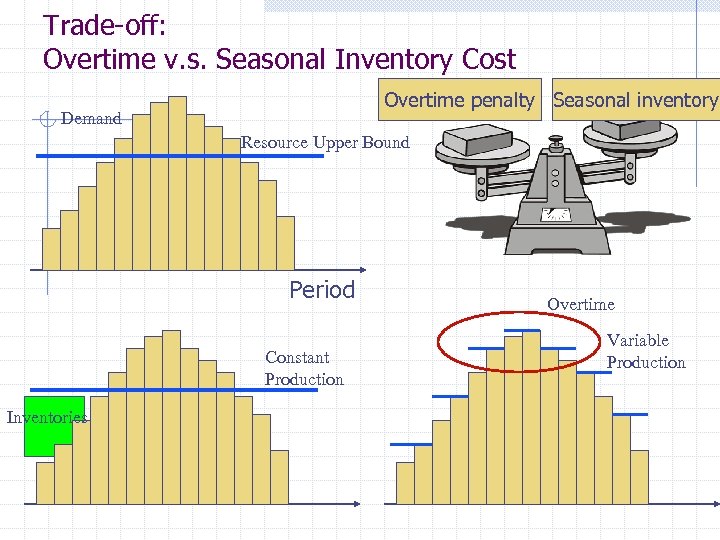
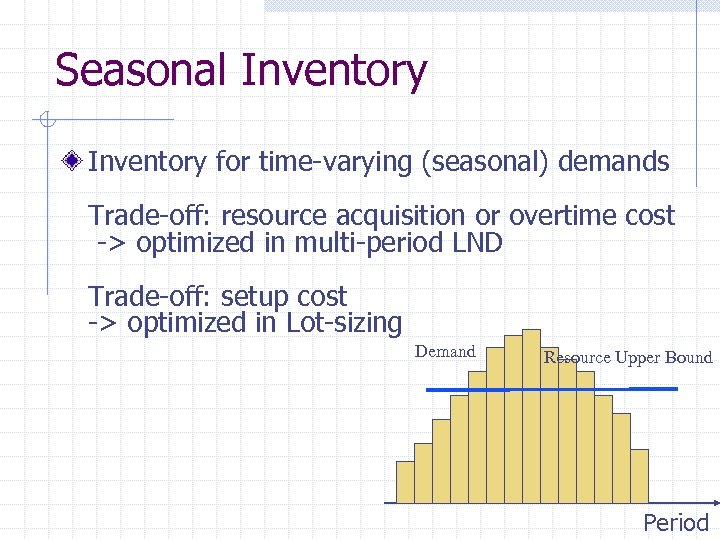 Seasonal Inventory for time-varying (seasonal) demands Trade-off: resource acquisition or overtime cost -> optimized in multi-period LND Trade-off: setup cost -> optimized in Lot-sizing Demand Resource Upper Bound Period
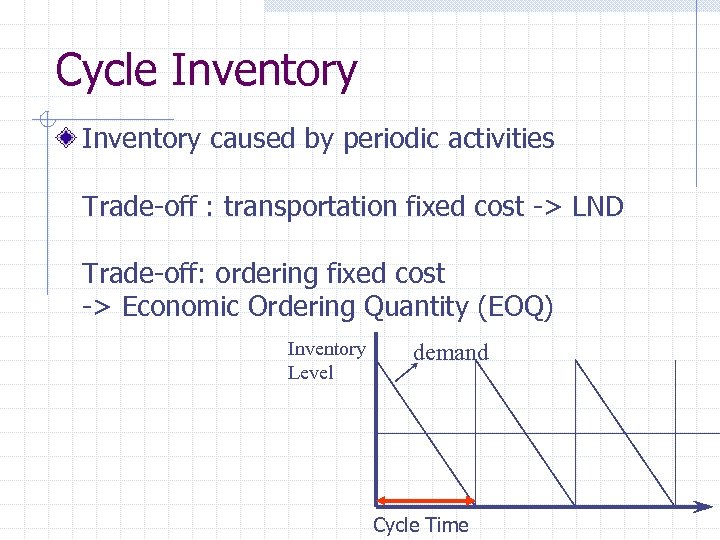 Cycle Inventory caused by periodic activities Trade-off : transportation fixed cost -> LND Trade-off: ordering fixed cost -> Economic Ordering Quantity (EOQ) Inventory Level demand Cycle Time
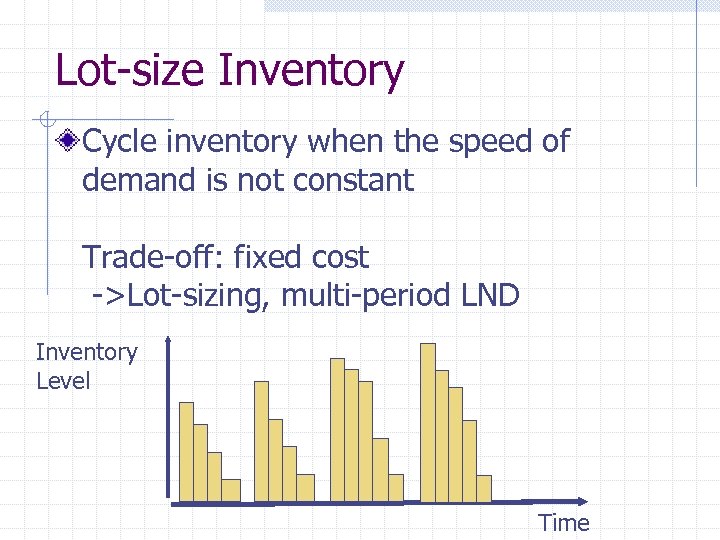 Lot-size Inventory Cycle inventory when the speed of demand is not constant Trade-off: fixed cost ->Lot-sizing, multi-period LND Inventory Level Time
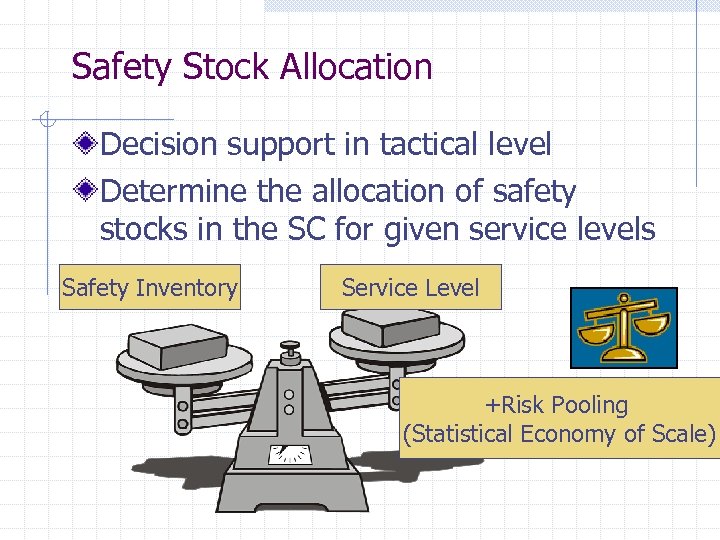
 Safety Inventory for the demand variability Trade-off: customer service level ->Safety Stock Allocation, LND Trade-off: backorder (stock-out) cost ->Inventory Policy Optimization
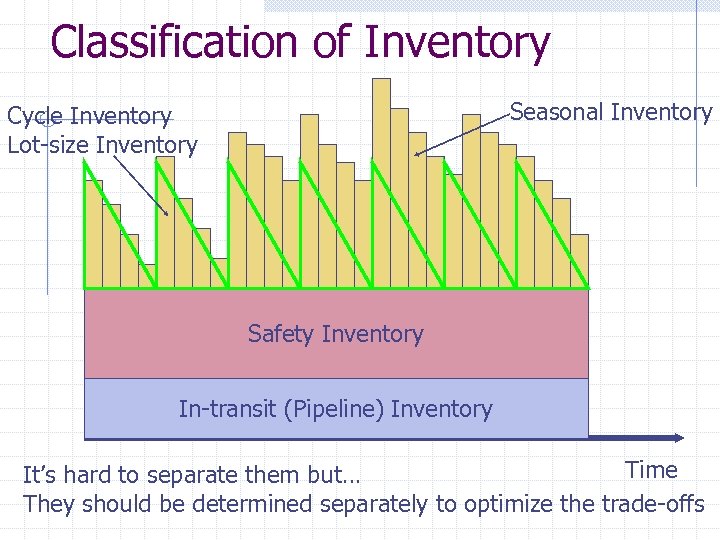 Classification of Inventory Seasonal Inventory Cycle Inventory Lot-size Inventory Safety Inventory In-transit (Pipeline) Inventory Time It’s hard to separate them but… They should be determined separately to optimize the trade-offs
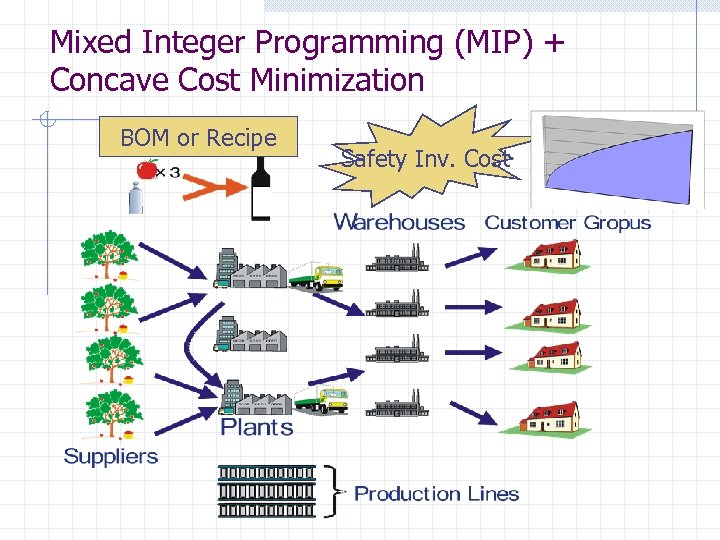
 Logistics Network Design Decision support in strategic level Total optimization of overall supply chains Example w Where should we replenish pars? w In which plant or on which production line should we products? w Where and by which transportation-mode should we transport products? w Where should we construct (or close) plants or new distribution centers?
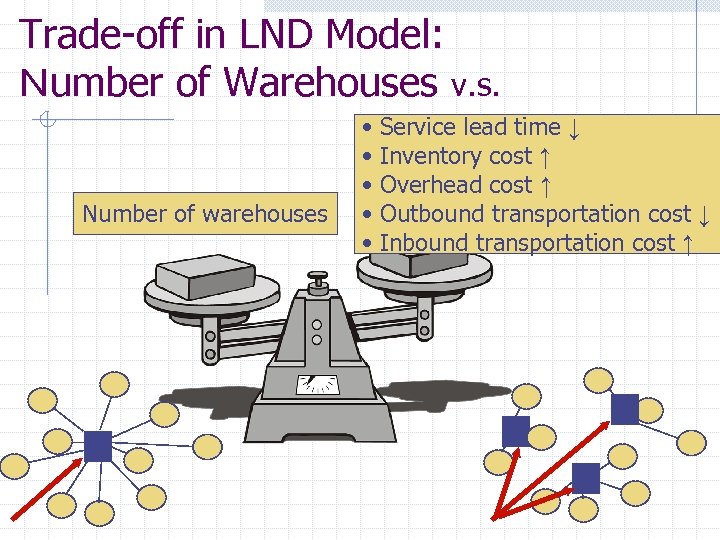 Trade-off in LND Model: Number of Warehouses v. s. Number of warehouses • • • Service lead time ↓ Inventory cost ↑ Overhead cost ↑ Outbound transportation cost ↓ Inbound transportation cost ↑
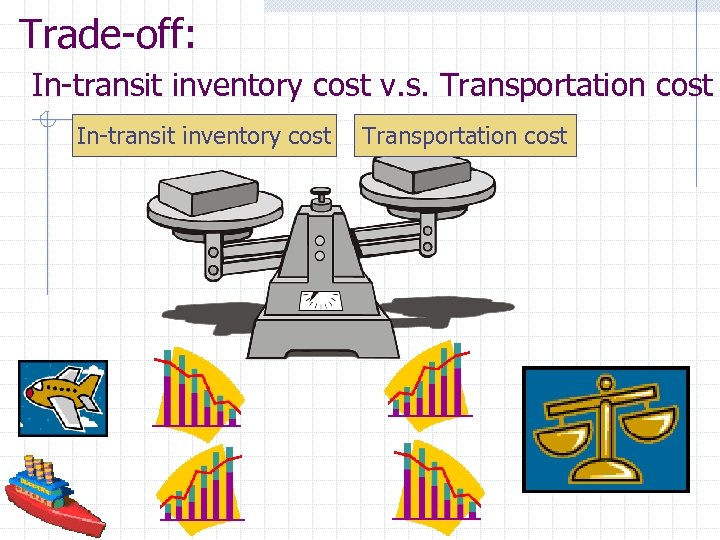 Trade-off: In-transit inventory cost v. s. Transportation cost In-transit inventory cost Transportation cost
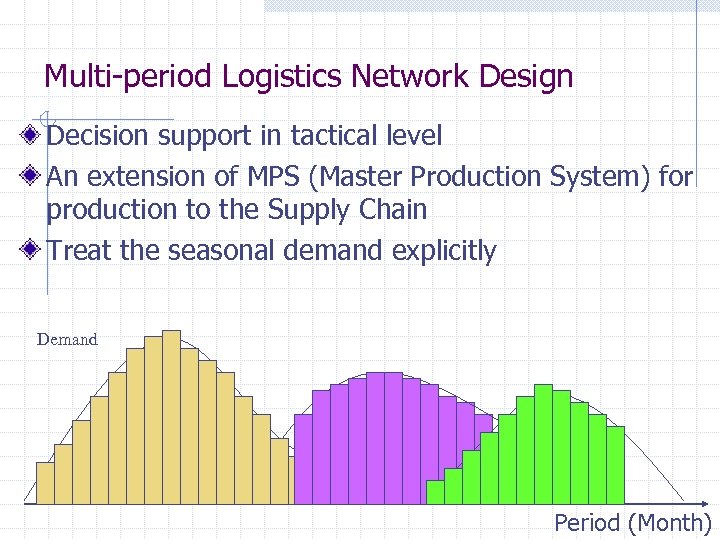 Multi-period Logistics Network Design Decision support in tactical level An extension of MPS (Master Production System) for production to the Supply Chain Treat the seasonal demand explicitly Demand Period (Month)
 Trade-off: Overtime v. s. Seasonal Inventory Cost Overtime penalty Seasonal inventory Demand Resource Upper Bound Period Constant Production Inventories Overtime Variable Production
 Mixed Integer Programming (MIP) + Concave Cost Minimization BOM or Recipe Safety Inv. Cost
 Safety Stock Allocation Decision support in tactical level Determine the allocation of safety stocks in the SC for given service levels Safety Inventory Service Level +Risk Pooling (Statistical Economy of Scale)
 Basic Principle of Inventory Economy of scale in statistics: gathering inventory together reduces the total inventory volume. -> Modern supply chain strategies n n n risk pooling delayed differentiation design for logistics Where should we allocate safety stocks to minimize the total safety stock costs so that the customer service level is satisfied.
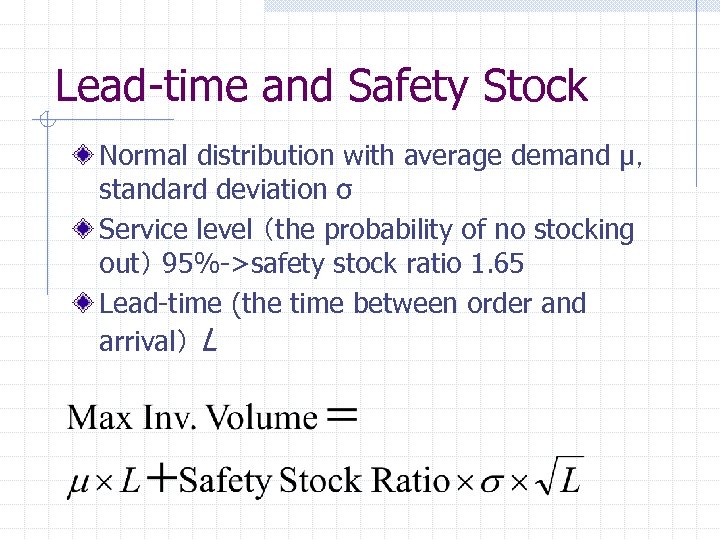 Lead-time and Safety Stock Normal distribution with average demand μ, standard deviation σ Service level (the probability of no stocking out) 95%->safety stock ratio 1. 65 Lead-time (the time between order and arrival) L
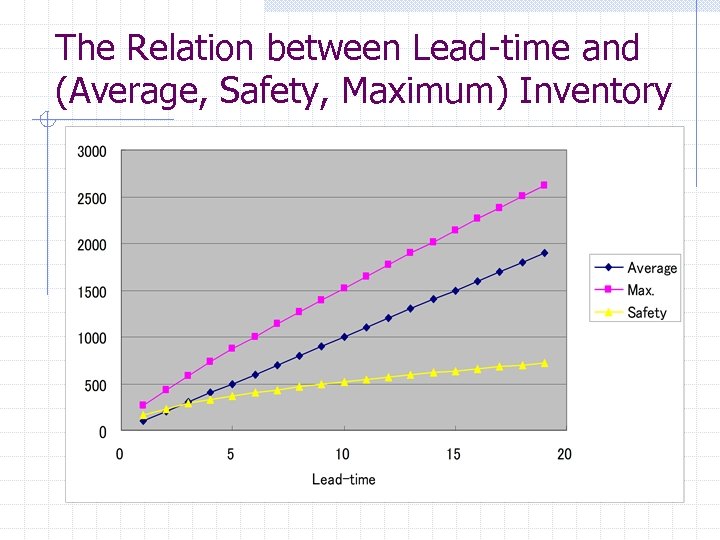 The Relation between Lead-time and (Average, Safety, Maximum) Inventory
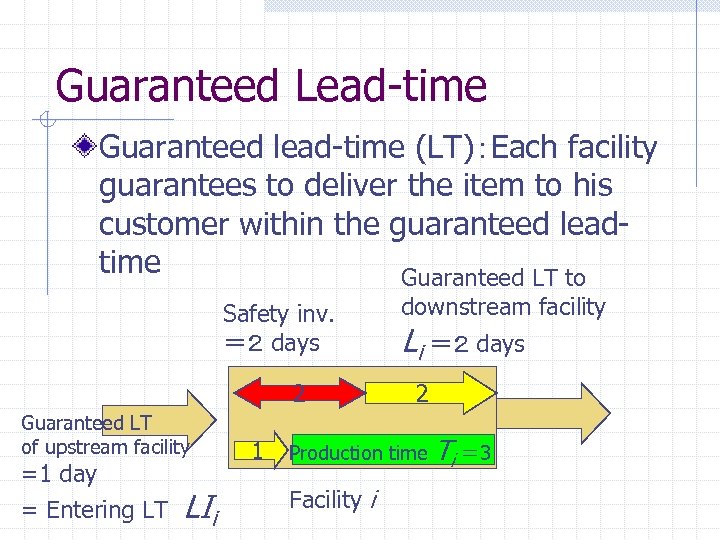 Guaranteed Lead-time Guaranteed lead-time (LT):Each facility guarantees to deliver the item to his customer within the guaranteed leadtime Guaranteed LT to Safety inv. =2 days 2 Guaranteed LT of upstream facility =1 day = Entering LT LIi 1 downstream facility Li =2 days 2 Production time Facility i Ti = 3
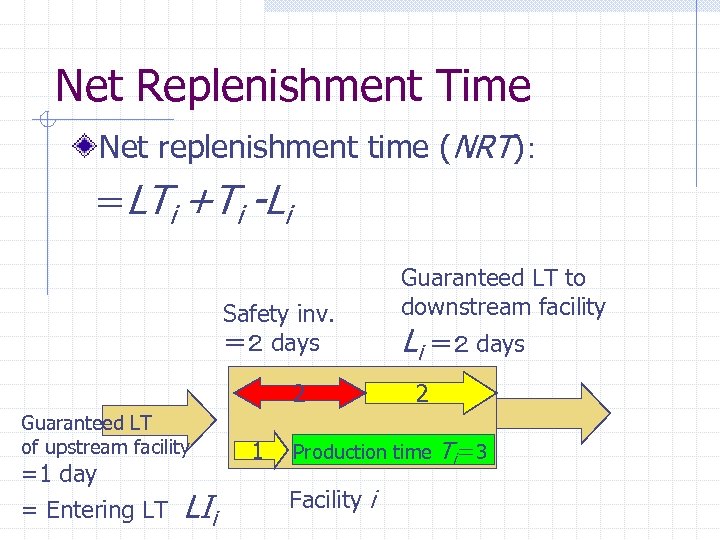 Net Replenishment Time Net replenishment time (NRT): =LTi +Ti -Li Safety inv. =2 days 2 Guaranteed LT of upstream facility =1 day = Entering LT LIi 1 Guaranteed LT to downstream facility Li =2 days 2 Production time Facility i Ti= 3
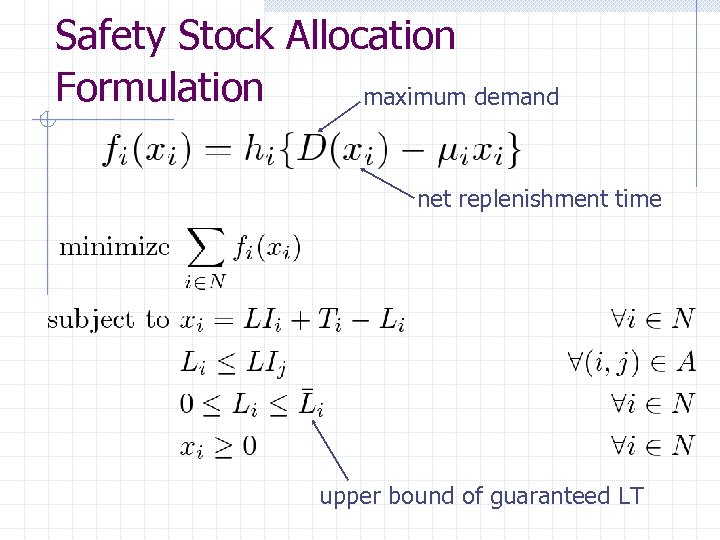 Safety Stock Allocation Formulation maximum demand net replenishment time upper bound of guaranteed LT
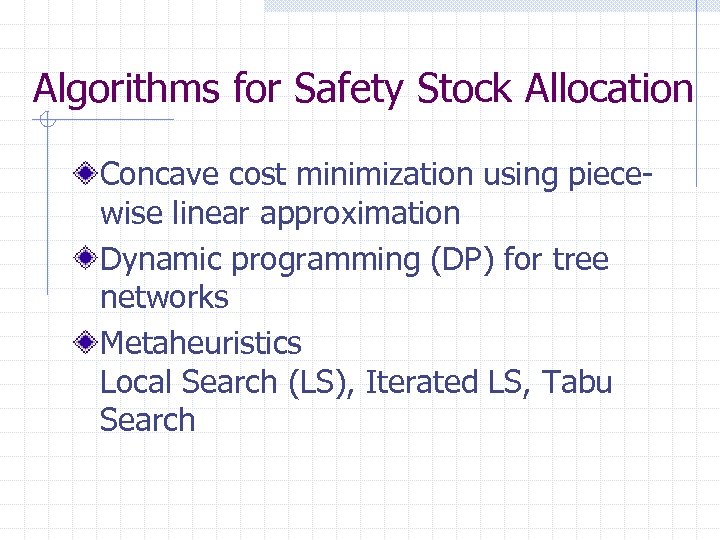 Algorithms for Safety Stock Allocation Concave cost minimization using piecewise linear approximation Dynamic programming (DP) for tree networks Metaheuristics Local Search (LS), Iterated LS, Tabu Search
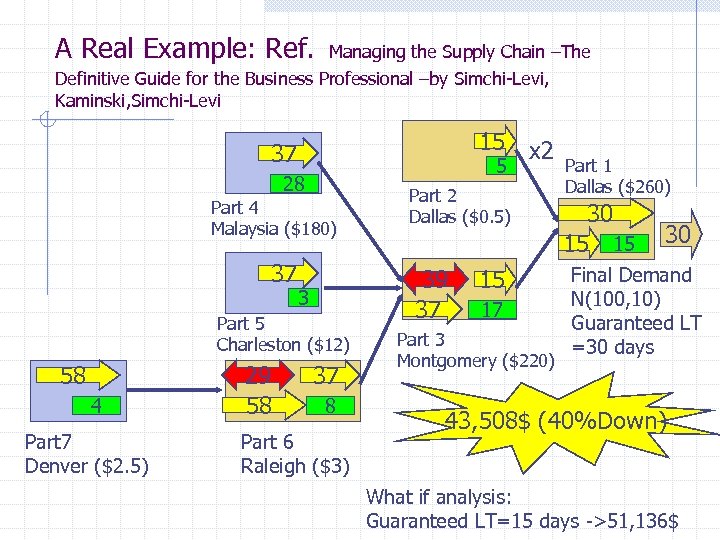 A Real Example: Ref. Managing the Supply Chain –The Definitive Guide for the Business Professional –by Simchi-Levi, Kaminski, Simchi-Levi 15 x 2 37 5 28 Part 4 Malaysia ($180) 37 3 Part 5 Charleston ($12) 58 4 Part 7 Denver ($2. 5) 29 58 37 8 Part 6 Raleigh ($3) Part 2 Dallas ($0. 5) 39 37 15 17 Part 3 Montgomery ($220) Part 1 Dallas ($260) 30 15 15 30 Final Demand N(100, 10) Guaranteed LT =30 days 43, 508$ (40%Down) What if analysis: Guaranteed LT=15 days ->51, 136$
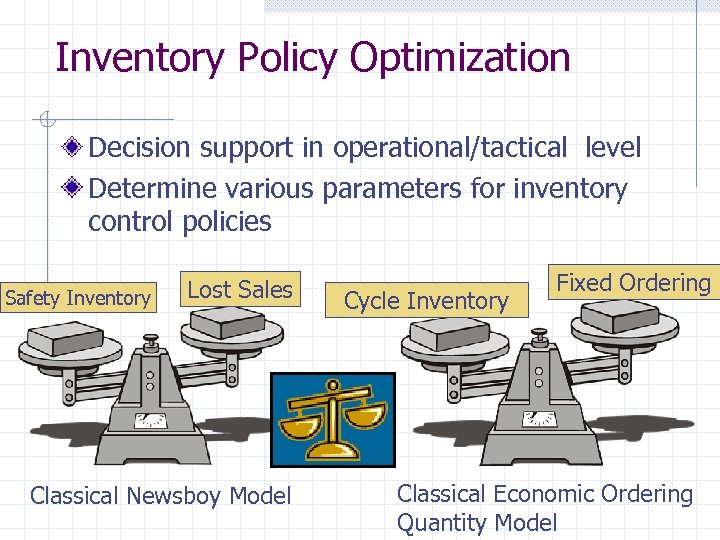 Inventory Policy Optimization Decision support in operational/tactical level Determine various parameters for inventory control policies Safety Inventory Lost Sales Classical Newsboy Model Cycle Inventory Fixed Ordering Classical Economic Ordering Quantity Model
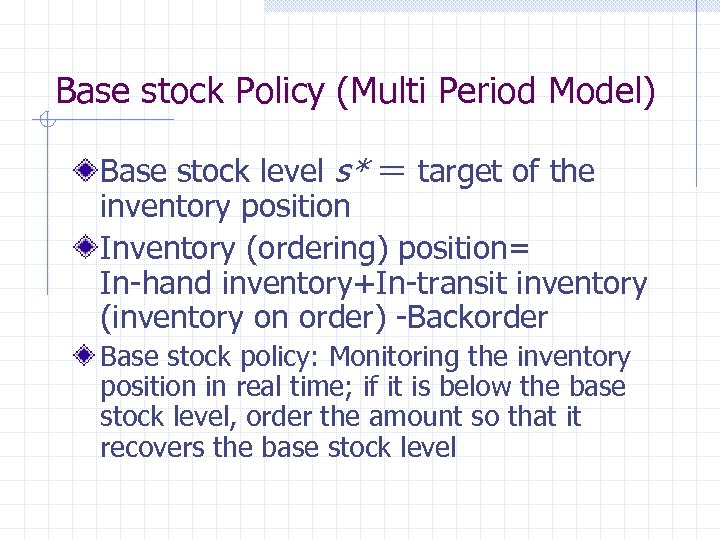 Base stock Policy (Multi Period Model) Base stock level s* = target of the inventory position Inventory (ordering) position= In-hand inventory+In-transit inventory (inventory on order) -Backorder Base stock policy: Monitoring the inventory position in real time; if it is below the base stock level, order the amount so that it recovers the base stock level
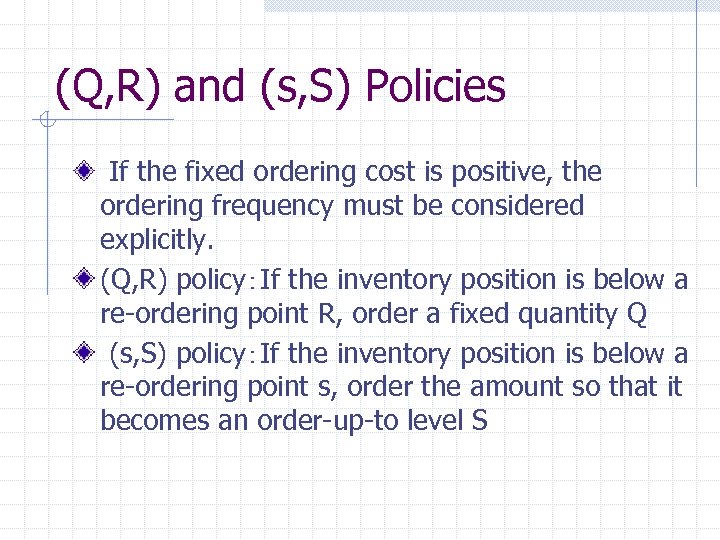 (Q, R) and (s, S) Policies If the fixed ordering cost is positive, the ordering frequency must be considered explicitly. (Q, R) policy:If the inventory position is below a re-ordering point R, order a fixed quantity Q (s, S) policy:If the inventory position is below a re-ordering point s, order the amount so that it becomes an order-up-to level S
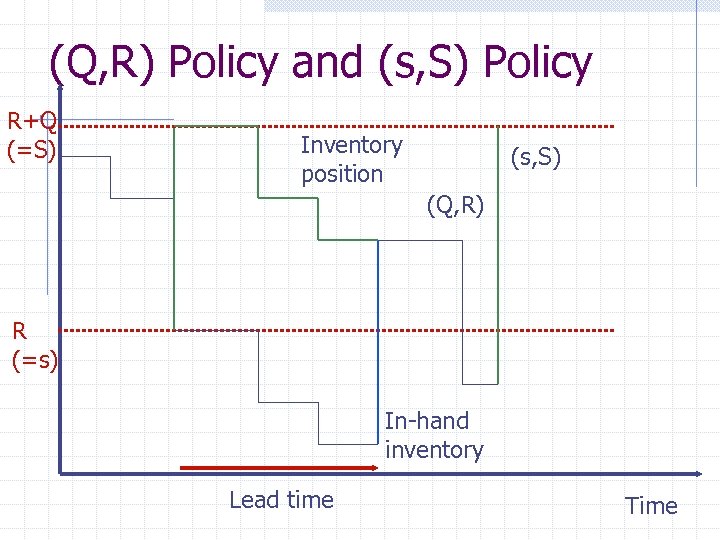 (Q, R) Policy and (s, S) Policy R+Q (=S) Inventory position (s, S) (Q, R) R (=s) In-hand inventory Lead time Time
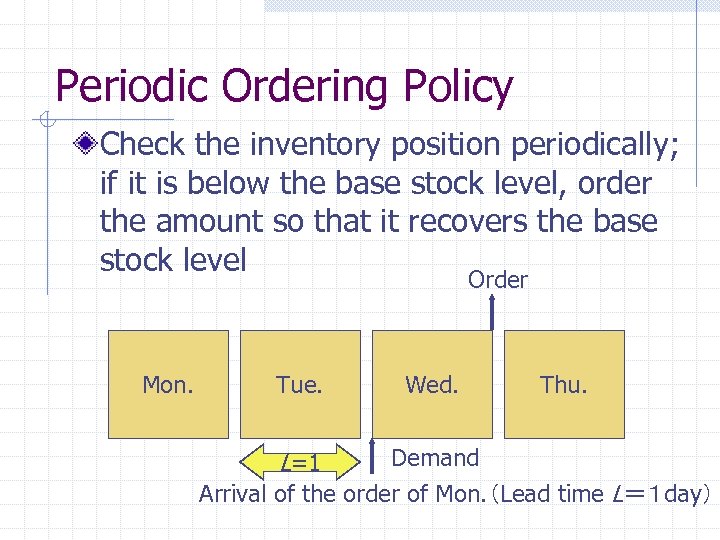 Periodic Ordering Policy Check the inventory position periodically; if it is below the base stock level, order the amount so that it recovers the base stock level Order Mon. Tue. Wed. Thu. Demand Arrival of the order of Mon. (Lead time L=1 day) L=1
 Algorithms for Inv. Policy Opt. base stock,(Q, R), and (s, S) policies ->Dynamic Programming Recursion Periodic ordering policy -> Infinitesimal Perturbation Analysis During simulation runs, derivatives of the cost function are estimated and are used in non-linear optimization
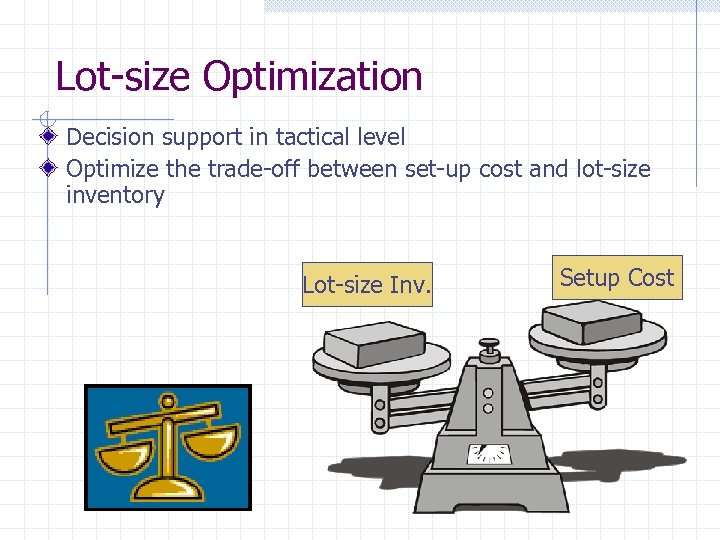 Lot-size Optimization Decision support in tactical level Optimize the trade-off between set-up cost and lot-size inventory Lot-size Inv. Setup Cost
 Algorithms for Lot-sizing MIP solver with strong forumulation (Meta)heuristics Metaheuristics using MIP solver n n n Relax and Fix Capacity scaling MIP based neighborhood local search
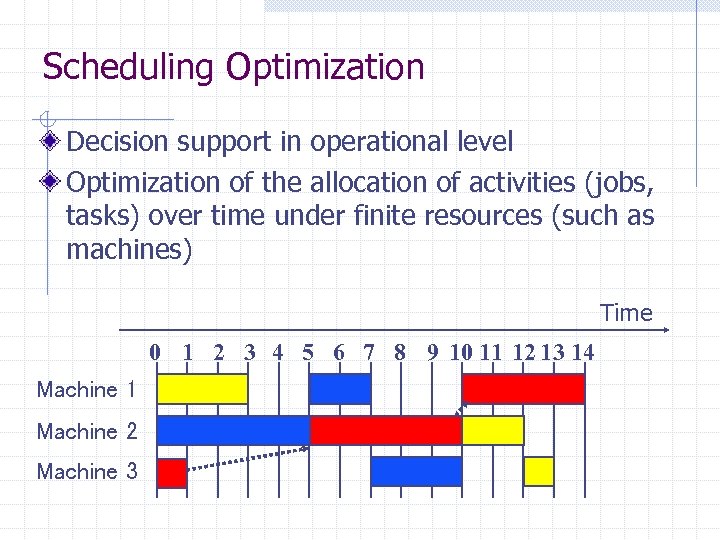 Scheduling Optimization Decision support in operational level Optimization of the allocation of activities (jobs, tasks) over time under finite resources (such as machines) Time 0 1 2 3 4 5 6 7 8 9 10 11 12 13 14 Machine 1 Machine 2 Machine 3
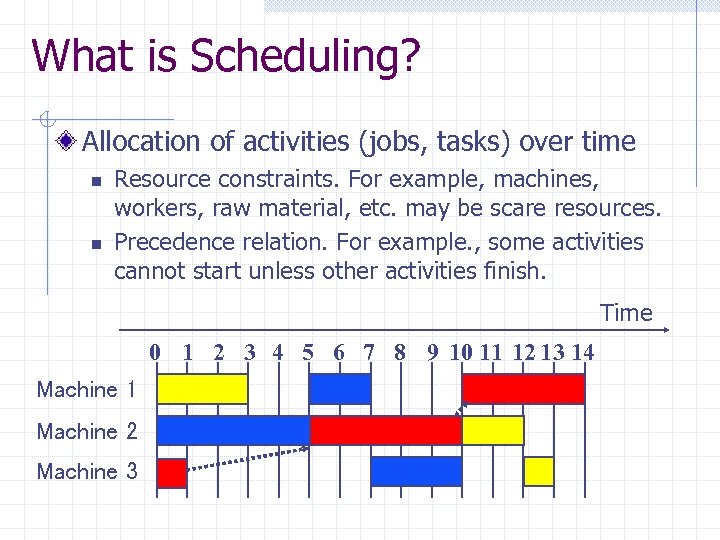 What is Scheduling? Allocation of activities (jobs, tasks) over time n n Resource constraints. For example, machines, workers, raw material, etc. may be scare resources. Precedence relation. For example. , some activities cannot start unless other activities finish. Time 0 1 2 3 4 5 6 7 8 9 10 11 12 13 14 Machine 1 Machine 2 Machine 3
 Solution Methods for Scheduling Myopic heuristics n n n Active schedule generation scheme Non-delay schedule generation scheme Dispatching rules Constraint programming Metaheuristics
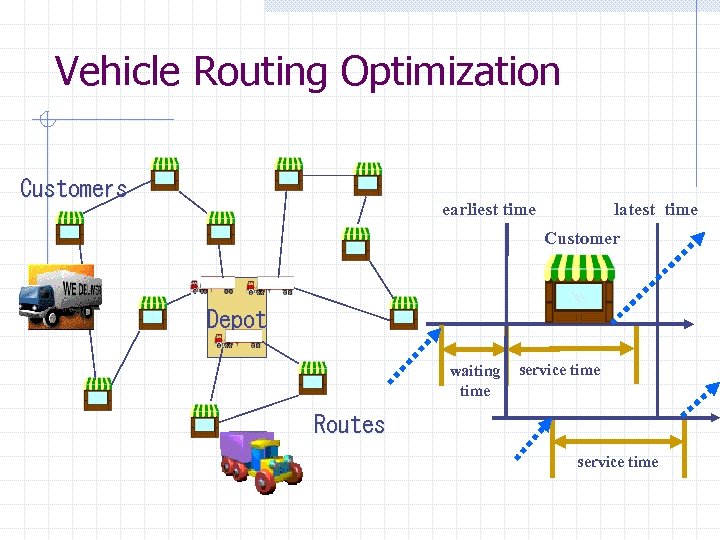 Vehicle Routing Optimization Customers earliest time latest time Customer Depot waiting time service time Routes service time
 Algorithms for Vehicle Routing Saving (Clarke-Wright) method Sweep (Gillet-Miller) method Insertion method Local Search Metaheuristics
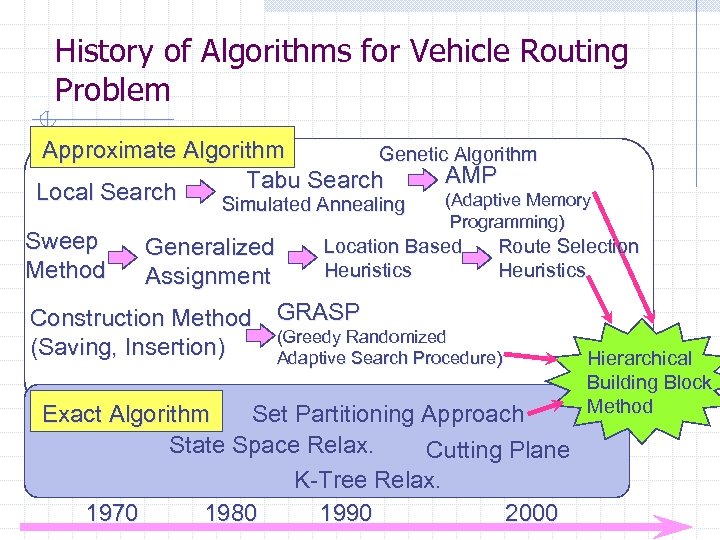 History of Algorithms for Vehicle Routing Problem Approximate Algorithm Genetic Algorithm AMP Tabu Search Local Search Simulated Annealing Sweep Method Generalized Assignment Construction Method (Saving, Insertion) (Adaptive Memory Programming) Location Based Heuristics Route Selection Heuristics GRASP (Greedy Randomized Adaptive Search Procedure) Exact Algorithm Set Partitioning Approach State Space Relax. Cutting Plane K-Tree Relax. 1970 1980 1990 2000 Hierarchical Building Block Method
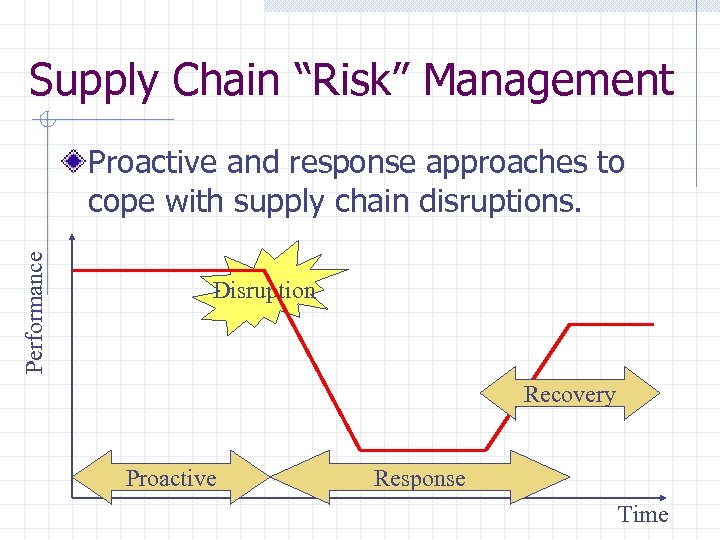 Supply Chain “Risk” Management Performance Proactive and response approaches to cope with supply chain disruptions. Disruption Recovery Proactive Response Time
 Importance of Supply Chain “Risk” Increase of disasters n n Natural disasters: earthquake, tsunami, SARS (Severe Acute Respiratory Syndrome), BSE (Bovine Spongiform Encephalopathy), hurricanes, cyclones and typhoons, floods, droughts, volcanic eruption, famine and food insecurity, etc. Man-made disasters: terrorist attack, CBRNE (Chemical Biological, Radiological, Nuclear, Explosive) disaster, war, strike, riot, etc. Lean supply chain: increases vulnerability. Globalization: induces long lead time, outsourcing.
 Related Area Risk Management Business Continuity Planning (BCP)/ Business Continuity Management (BCM) But, both did not work well … Humanitarian Logistics / Humanitarian Supply Chain
 Humanitarian Logistics / Humanitarian Supply Chain … is a branch of logistics which specializes in organizing the delivery and warehousing of supplies during natural disasters to the affected area and people. Decentralized No SCM unit nor trained staffs Everything is ad hoc No performance measure (fairness, speed, …) No information & communication technology Many players (government, NGOs)
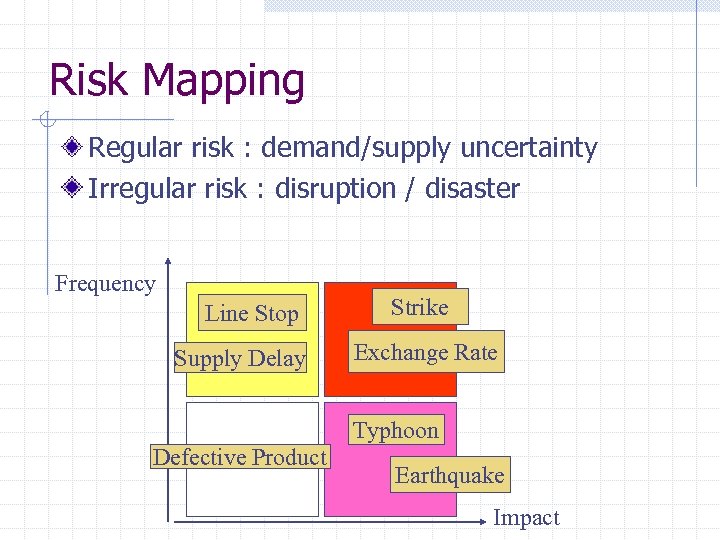 Risk Mapping Regular risk : demand/supply uncertainty Irregular risk : disruption / disaster Frequency Line Stop Supply Delay Strike Exchange Rate Typhoon Defective Product Earthquake Impact
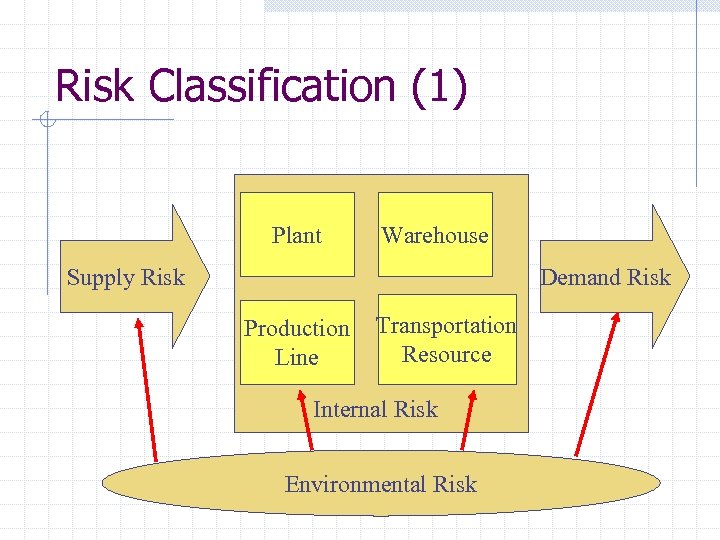 Risk Classification (1) Plant Warehouse Supply Risk Demand Risk Production Line Transportation Resource Internal Risk Environmental Risk
 Risk Classification (2) Disaster risk: natural and man-made disasters such as landslides, volcanic eruption, drought, asteroid impacts Political risk: contracts, laws, regulations Social risk: child labor / abuse Intellectual property risk: patents, trademarks, copyrights Financial risk, employment risk, reputation risk, . . .
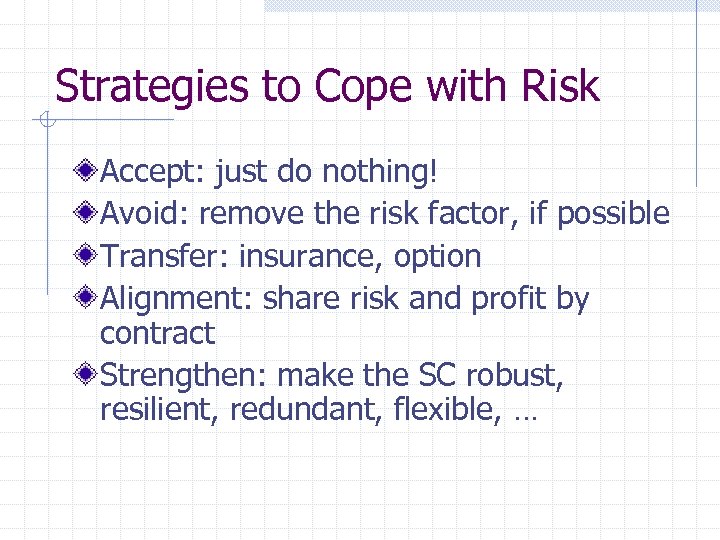 Strategies to Cope with Risk Accept: just do nothing! Avoid: remove the risk factor, if possible Transfer: insurance, option Alignment: share risk and profit by contract Strengthen: make the SC robust, resilient, redundant, flexible, …
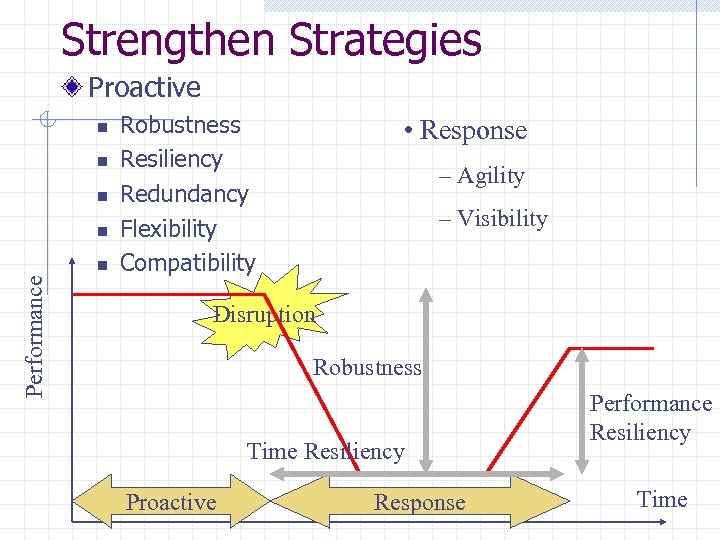 Strengthen Strategies Proactive n n Performance n Robustness Resiliency Redundancy Flexibility Compatibility • Response – Agility – Visibility Disruption Robustness Time Resiliency Proactive Response Performance Resiliency Time
 Redundancy -Strategic Inventory for supply (or production) disruptions. That is shared by many supply chain partners. We have to distinguish it with the safety stock to copy with demand uncertainty.
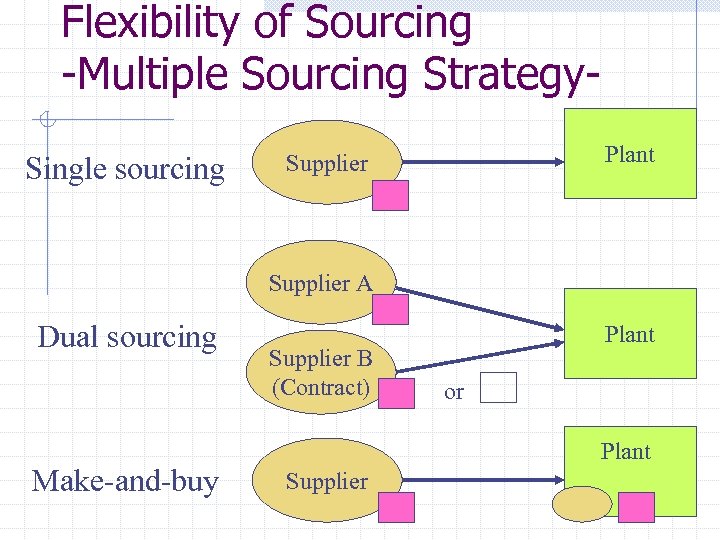 Flexibility of Sourcing -Multiple Sourcing Strategy. Single sourcing Plant Supplier A Dual sourcing Make-and-buy Supplier B (Contract) Plant or Plant Supplier
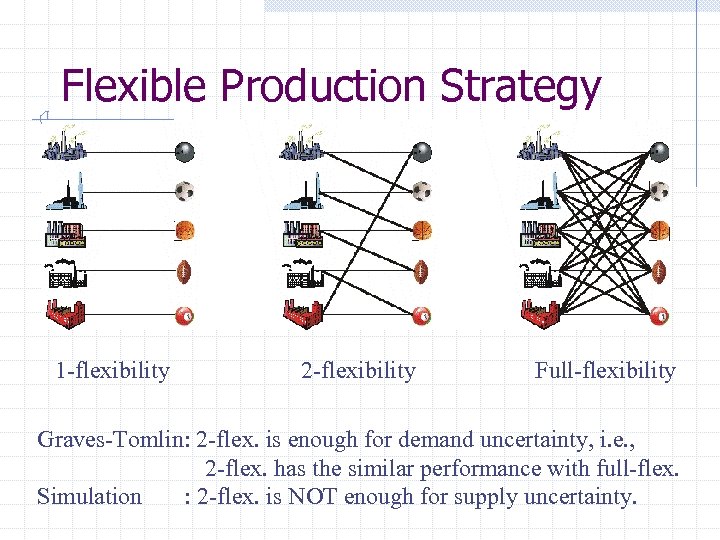 Flexible Production Strategy 1 -flexibility 2 -flexibility Full-flexibility Graves-Tomlin: 2 -flex. is enough for demand uncertainty, i. e. , 2 -flex. has the similar performance with full-flex. Simulation : 2 -flex. is NOT enough for supply uncertainty.
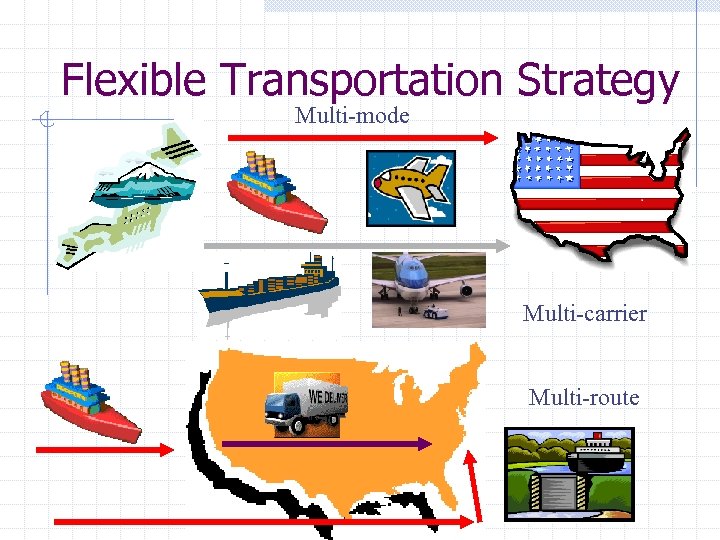 Flexible Transportation Strategy Multi-mode Multi-carrier Multi-route
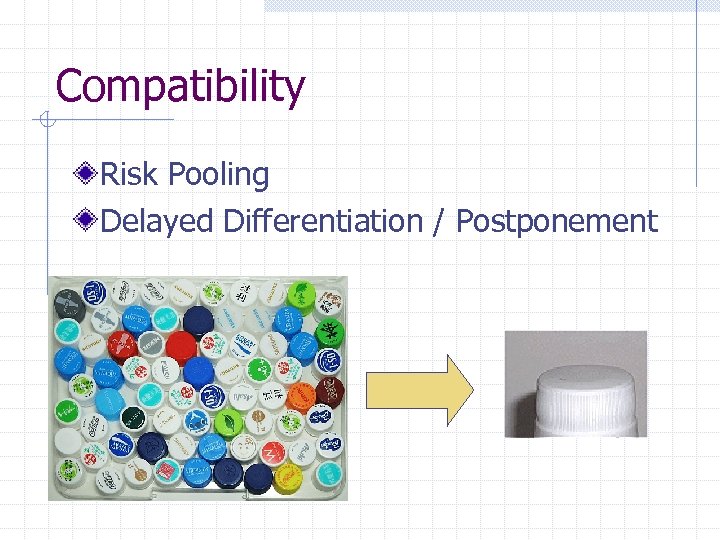 Compatibility Risk Pooling Delayed Differentiation / Postponement
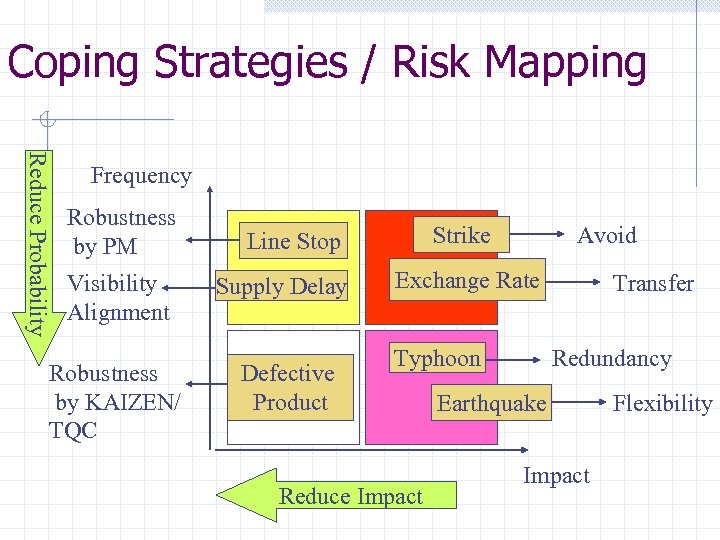 Coping Strategies / Risk Mapping Reduce Probability Frequency Robustness by PM Line Stop Visibility Alignment Supply Delay Robustness by KAIZEN/ TQC Defective Product Strike Avoid Exchange Rate Typhoon Reduce Impact Transfer Redundancy Earthquake Impact Flexibility
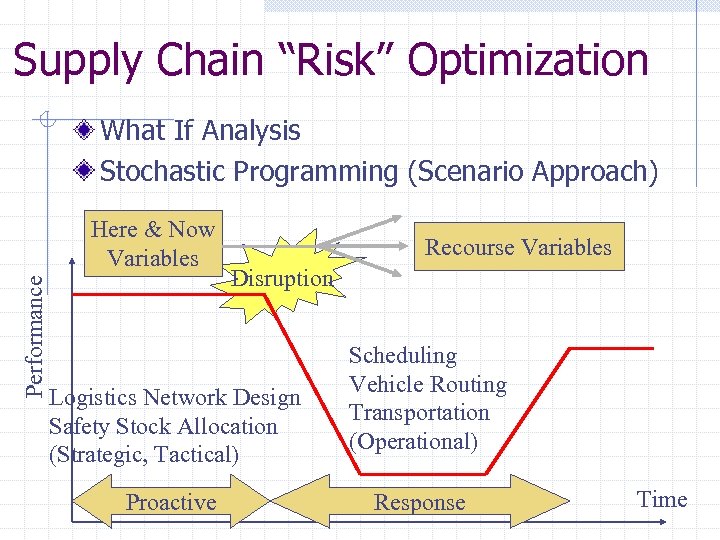 Supply Chain “Risk” Optimization What If Analysis Stochastic Programming (Scenario Approach) Performance Here & Now Variables Recourse Variables Disruption Logistics Network Design Safety Stock Allocation (Strategic, Tactical) Proactive Scheduling Vehicle Routing Transportation (Operational) Response Time
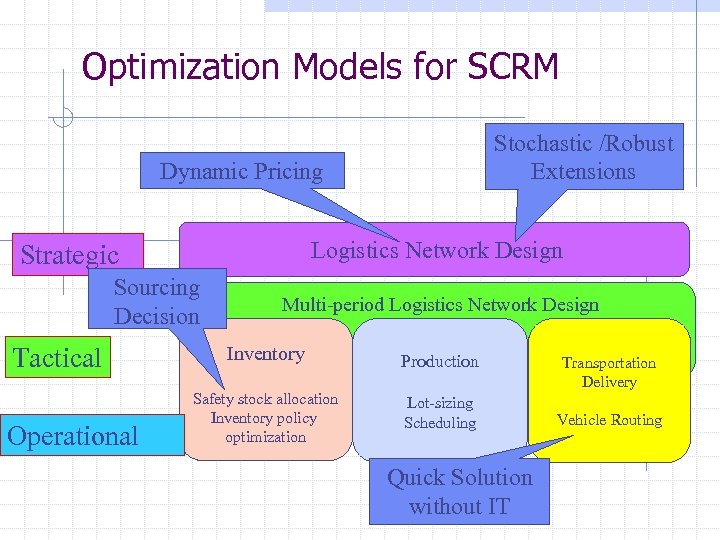 Optimization Models for SCRM Stochastic /Robust Extensions Dynamic Pricing Logistics Network Design Strategic Sourcing Decision Tactical Operational Multi-period Logistics Network Design Inventory Safety stock allocation Inventory policy optimization Production Lot-sizing Scheduling Quick Solution without IT Transportation Delivery Vehicle Routing