


 Скачать презентацию Treewidth Algorithms and Networks Overview Historic
d04be0ccc81868bb0d00073a4f80b30d.ppt
- Количество слайдов: 51
 Treewidth Algorithms and Networks
 Overview • Historic introduction: Series parallel graphs • Dynamic programming on trees • Dynamic programming on series parallel graphs • Treewidth • Dynamic programming on graphs of small treewidth • Finding tree decompositions 2 Treewidth
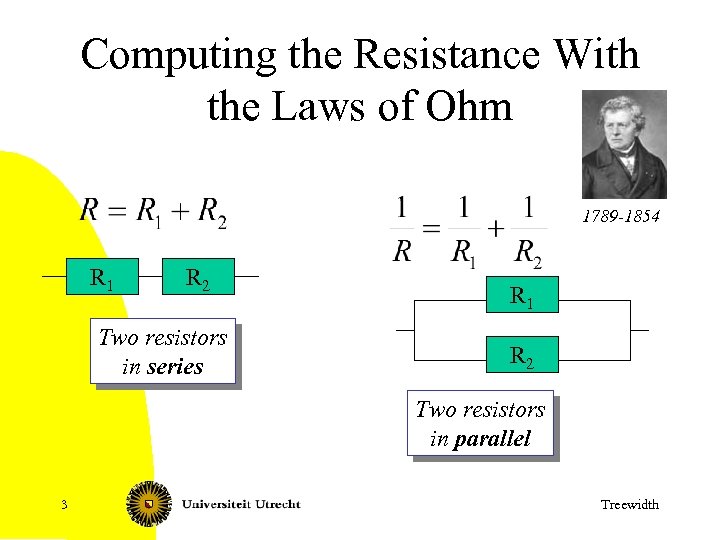 Computing the Resistance With the Laws of Ohm 1789 -1854 R 1 R 2 Two resistors in series R 1 R 2 Two resistors in parallel 3 Treewidth
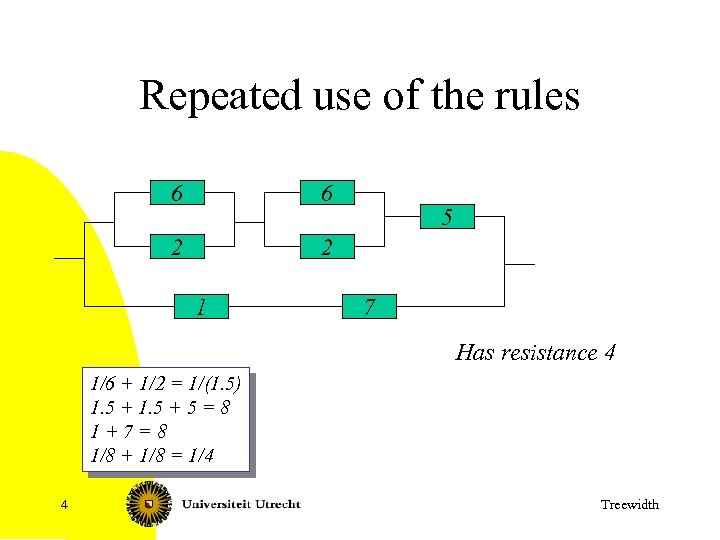 Repeated use of the rules 6 6 2 2 1 5 7 Has resistance 4 1/6 + 1/2 = 1/(1. 5) 1. 5 + 5 = 8 1+7=8 1/8 + 1/8 = 1/4 4 Treewidth
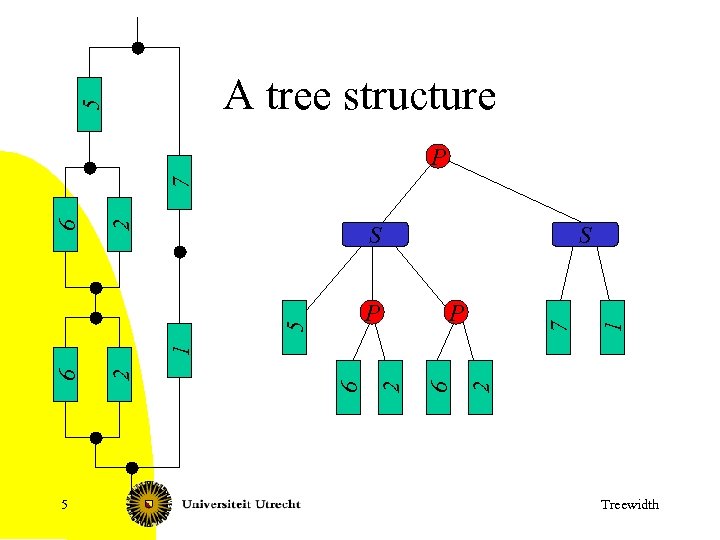 5 A tree structure S 7 P 5 2 6 2 6 1 5 P S 1 2 6 7 P Treewidth
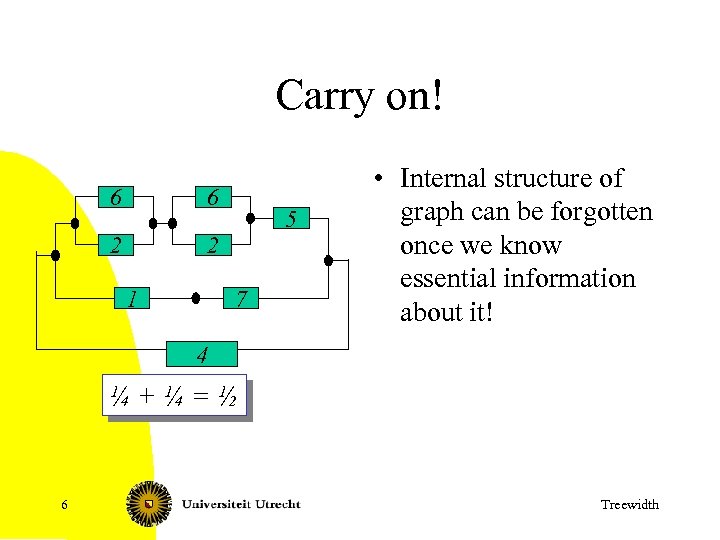 Carry on! 6 6 2 2 1 5 7 • Internal structure of graph can be forgotten once we know essential information about it! 4 ¼+¼=½ 6 Treewidth
 Using tree structures for solving hard problems on graphs 1 • Network is ‘series parallel graph’ • 196*, 197*: many problems that are hard for general graphs are easy for – Trees – Series parallel graphs e. g. : NP-complete • Many well-known problems Linear / polynomial time computable 7 Treewidth
 Weighted Independent Set • Independent set: set of vertices that are pair wise non-adjacent. • Weighted independent set – Given: Graph G=(V, E), weight w(v) for each vertex v. – Question: What is the maximum total weight of an independent set in G? • NP-hard 8 Treewidth
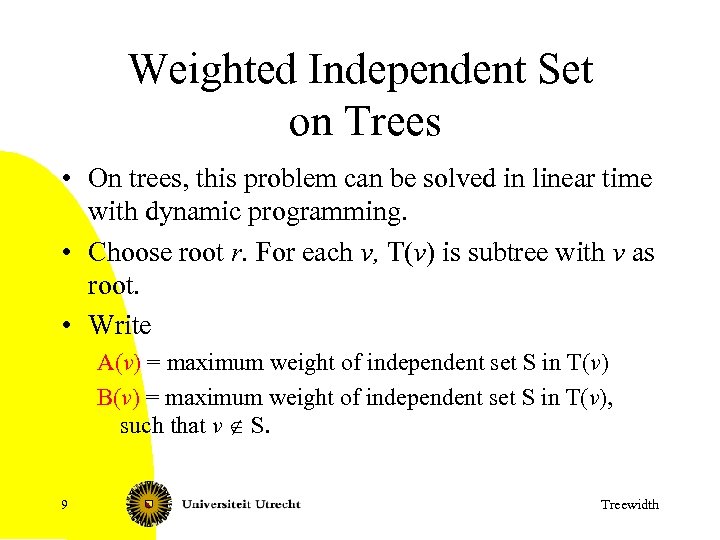 Weighted Independent Set on Trees • On trees, this problem can be solved in linear time with dynamic programming. • Choose root r. For each v, T(v) is subtree with v as root. • Write A(v) = maximum weight of independent set S in T(v) B(v) = maximum weight of independent set S in T(v), such that v Ï S. 9 Treewidth
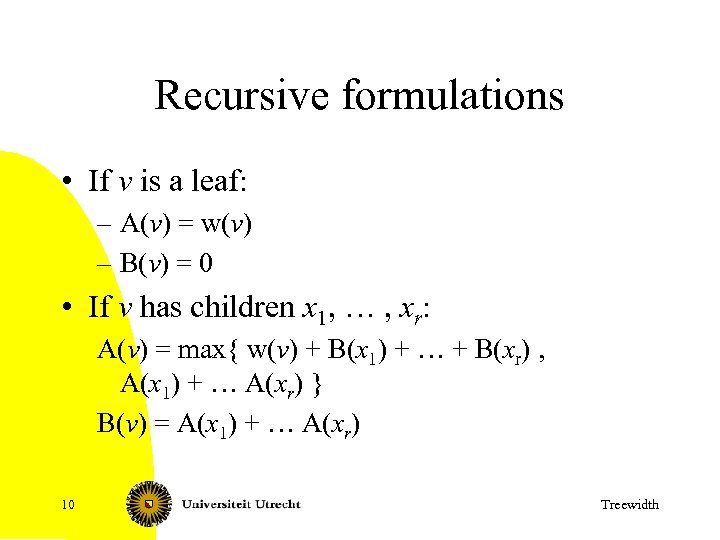 Recursive formulations • If v is a leaf: – A(v) = w(v) – B(v) = 0 • If v has children x 1, … , xr: A(v) = max{ w(v) + B(x 1) + … + B(xr) , A(x 1) + … A(xr) } B(v) = A(x 1) + … A(xr) 10 Treewidth
 Linear time algorithm • Compute A(v) and B(v) for each v, bottomup. – E. g. , in postorder • Constructing corresponding sets can also be done in linear time. 11 Treewidth
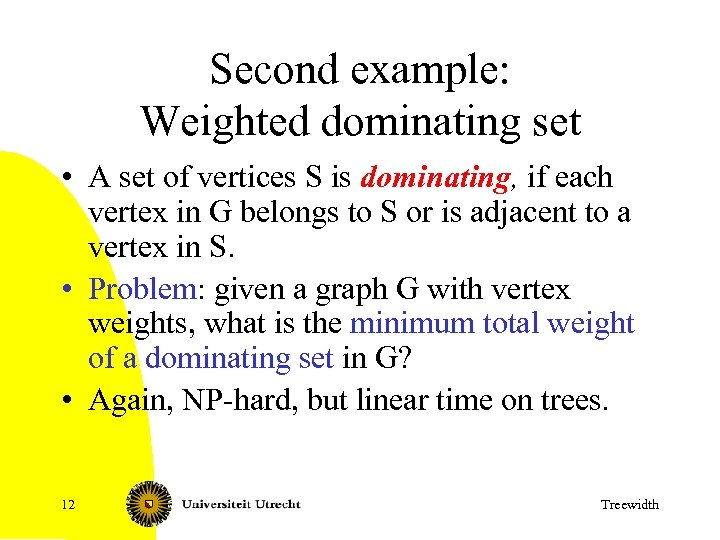 Second example: Weighted dominating set • A set of vertices S is dominating, if each vertex in G belongs to S or is adjacent to a vertex in S. • Problem: given a graph G with vertex weights, what is the minimum total weight of a dominating set in G? • Again, NP-hard, but linear time on trees. 12 Treewidth
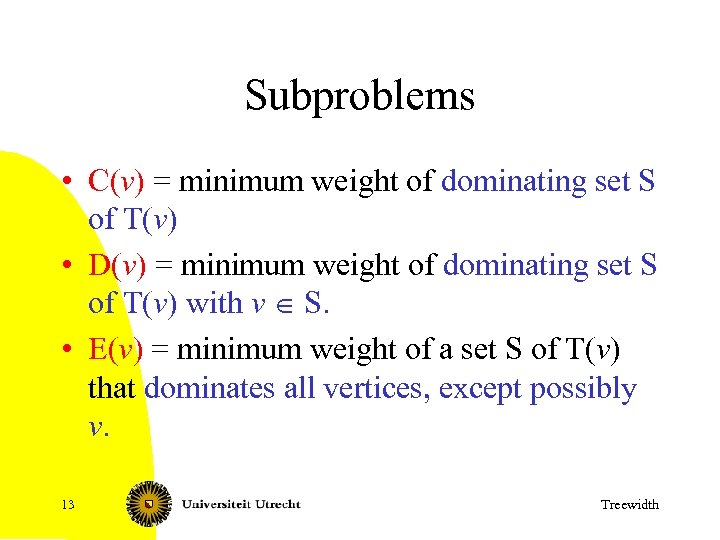 Subproblems • C(v) = minimum weight of dominating set S of T(v) • D(v) = minimum weight of dominating set S of T(v) with v Î S. • E(v) = minimum weight of a set S of T(v) that dominates all vertices, except possibly v. 13 Treewidth
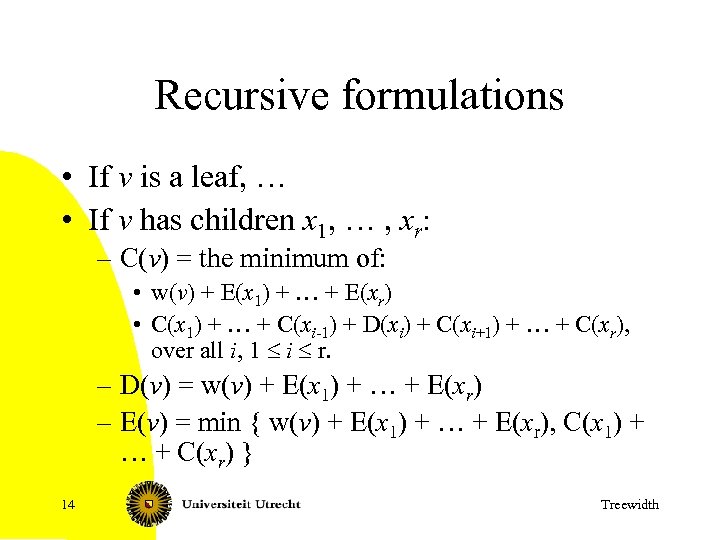 Recursive formulations • If v is a leaf, … • If v has children x 1, … , xr: – C(v) = the minimum of: • w(v) + E(x 1) + … + E(xr) • C(x 1) + … + C(xi-1) + D(xi) + C(xi+1) + … + C(xr), over all i, 1 £ i £ r. – D(v) = w(v) + E(x 1) + … + E(xr) – E(v) = min { w(v) + E(x 1) + … + E(xr), C(x 1) + … + C(xr) } 14 Treewidth
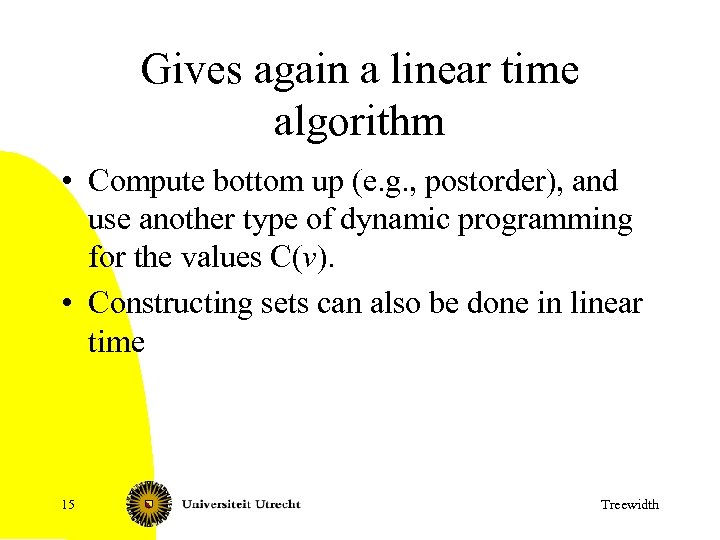 Gives again a linear time algorithm • Compute bottom up (e. g. , postorder), and use another type of dynamic programming for the values C(v). • Constructing sets can also be done in linear time 15 Treewidth
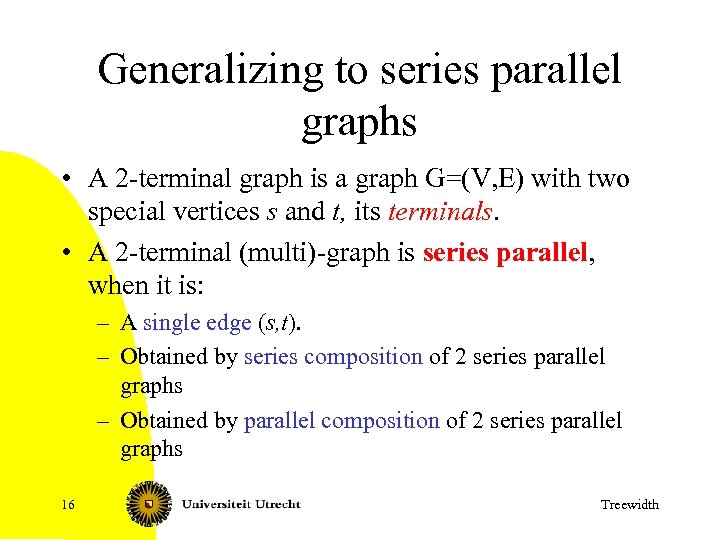 Generalizing to series parallel graphs • A 2 -terminal graph is a graph G=(V, E) with two special vertices s and t, its terminals. • A 2 -terminal (multi)-graph is series parallel, when it is: – A single edge (s, t). – Obtained by series composition of 2 series parallel graphs – Obtained by parallel composition of 2 series parallel graphs 16 Treewidth
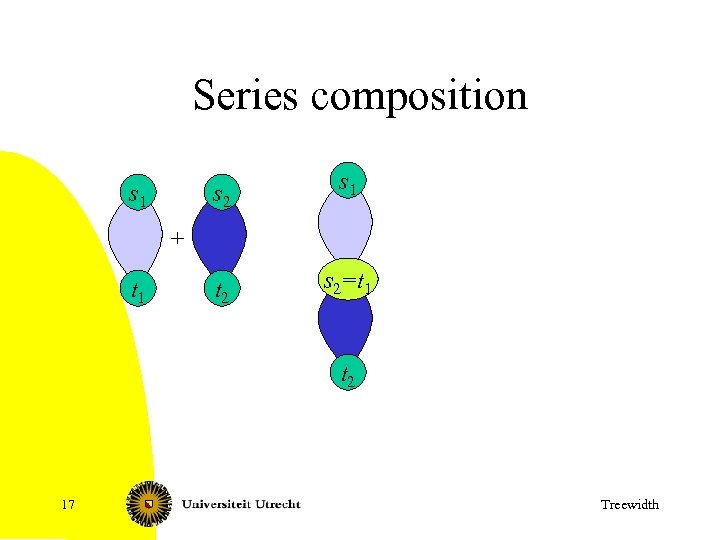 Series composition s 2 s 1 t 2 s 2 s 2 1 =t + t 1 t 2 17 Treewidth
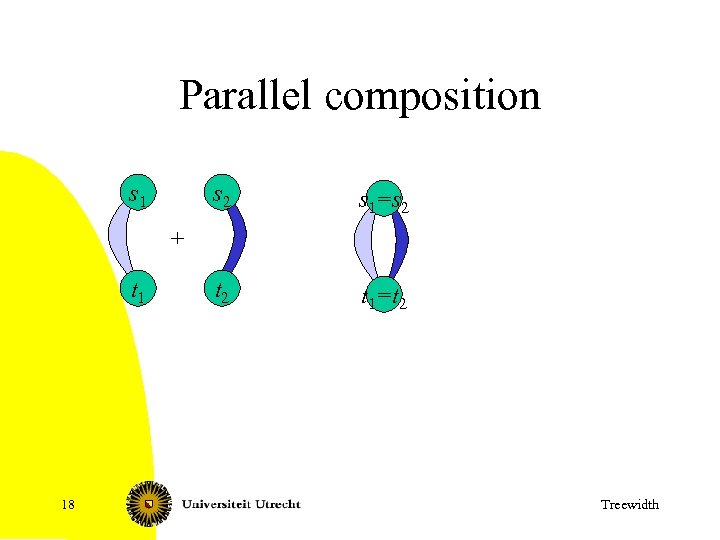 Parallel composition s 1 s 2 s 1 s 1 2 =s t 2 t 1 t 1 2 =t + t 1 18 Treewidth
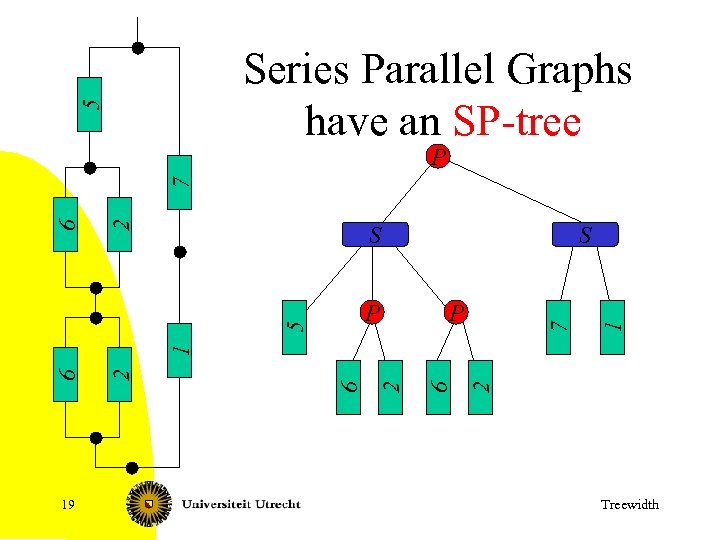 5 Series Parallel Graphs have an SP-tree S 7 P 19 2 6 2 6 1 5 P S 1 2 6 7 P Treewidth
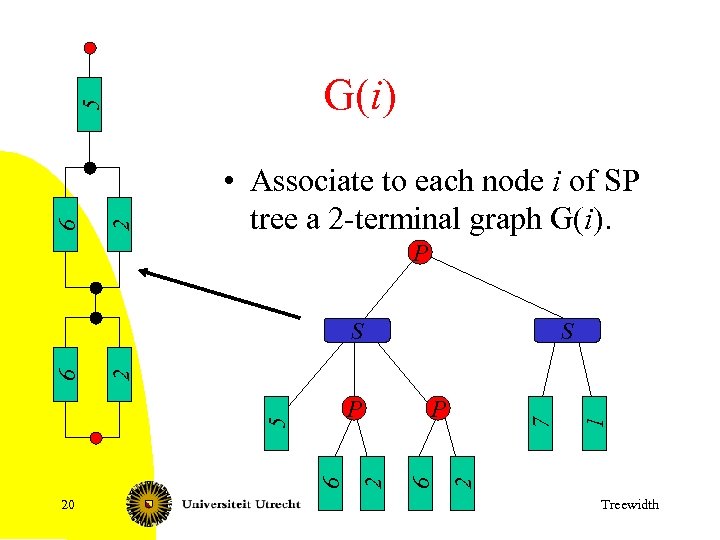 2 6 5 G(i) • Associate to each node i of SP tree a 2 -terminal graph G(i). P 1 2 7 P 6 6 2 P 5 20 S 2 6 S Treewidth
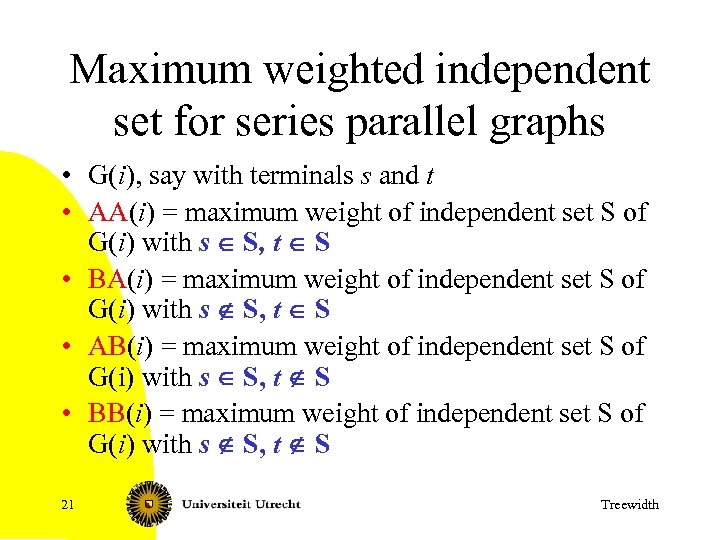 Maximum weighted independent set for series parallel graphs • G(i), say with terminals s and t • AA(i) = maximum weight of independent set S of G(i) with s Î S, t Î S • BA(i) = maximum weight of independent set S of G(i) with s Ï S, t Î S • AB(i) = maximum weight of independent set S of G(i) with s Î S, t Ï S • BB(i) = maximum weight of independent set S of G(i) with s Ï S, t Ï S 21 Treewidth
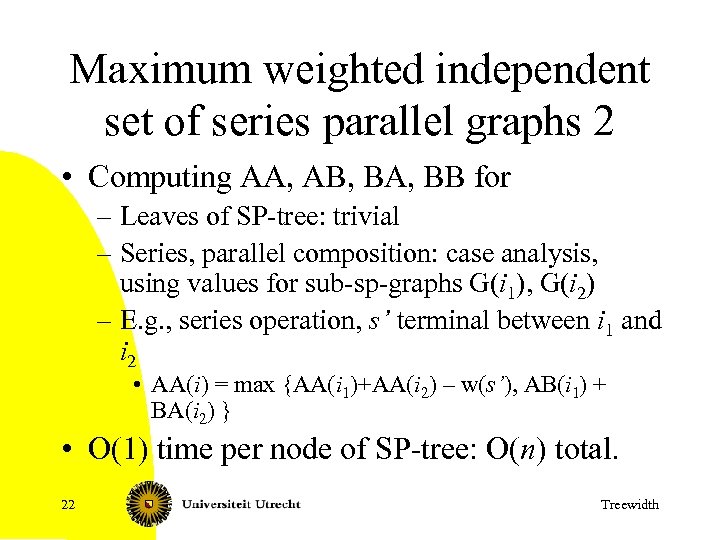 Maximum weighted independent set of series parallel graphs 2 • Computing AA, AB, BA, BB for – Leaves of SP-tree: trivial – Series, parallel composition: case analysis, using values for sub-sp-graphs G(i 1), G(i 2) – E. g. , series operation, s’ terminal between i 1 and i 2 • AA(i) = max {AA(i 1)+AA(i 2) – w(s’), AB(i 1) + BA(i 2) } • O(1) time per node of SP-tree: O(n) total. 22 Treewidth
 Many generalizations • Many other problems • Other classes of graphs to which we can assign a tree-structure, including – Graphs of treewidth k, for small k. 23 Treewidth
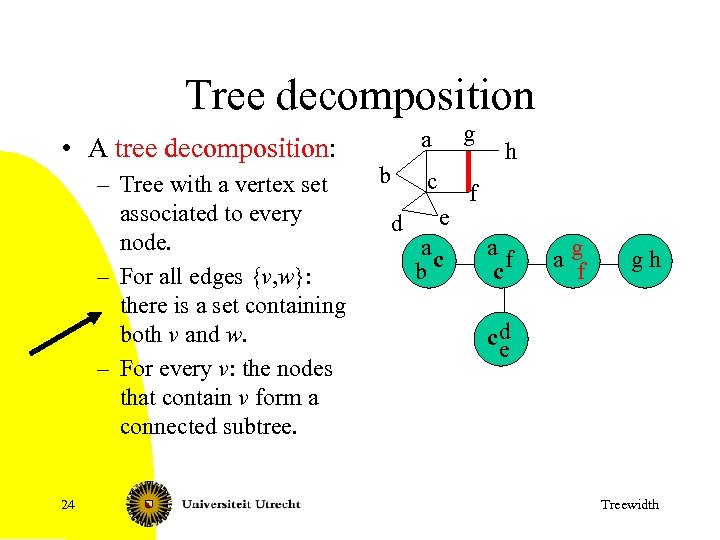 Tree decomposition • A tree decomposition: – Tree with a vertex set associated to every node. – For all edges {v, w}: there is a set containing both v and w. – For every v: the nodes that contain v form a connected subtree. 24 a c b d g f e ac b h af c ag f gh cd e Treewidth
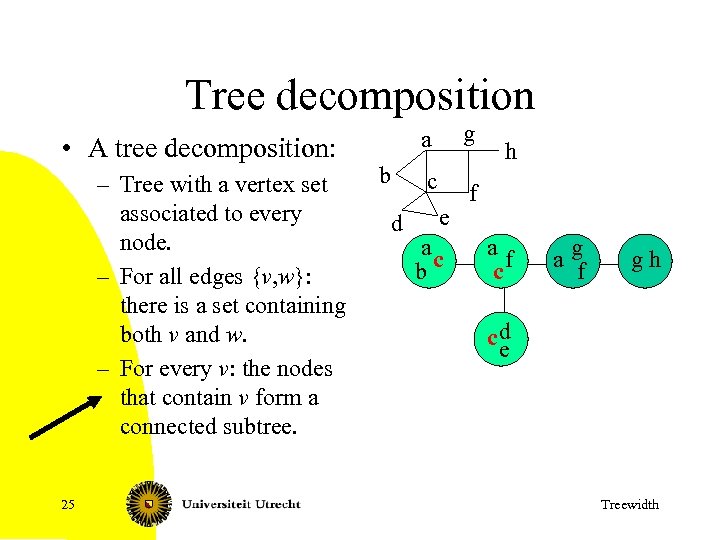 Tree decomposition • A tree decomposition: – Tree with a vertex set associated to every node. – For all edges {v, w}: there is a set containing both v and w. – For every v: the nodes that contain v form a connected subtree. 25 a c b d g f e ac b h af c ag f gh cd e Treewidth
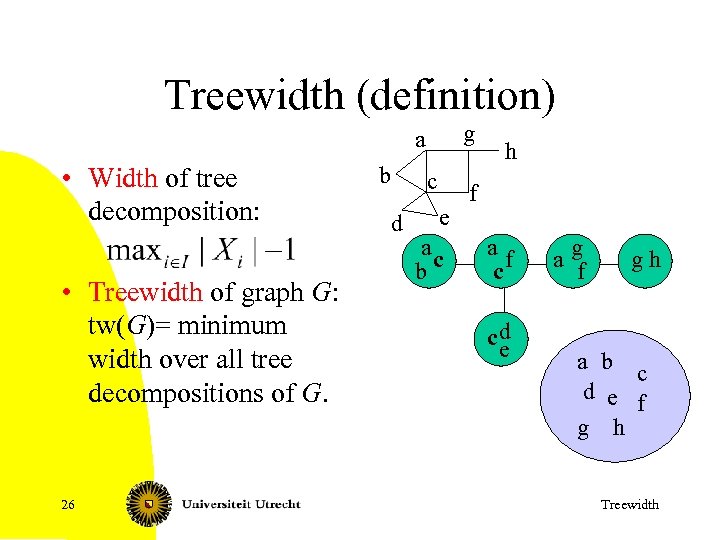 Treewidth (definition) g a • Width of tree decomposition: • Treewidth of graph G: tw(G)= minimum width over all tree decompositions of G. 26 b c d e ac b h f af c cd e ag f gh a b c d e f g h Treewidth
 Some graphs have small treewidth • Appearing in some applications (e. g. , probabilistic networks) • Trees have treewidth 1 • Series Parallel graphs have treewidth 2. • … 27 Treewidth
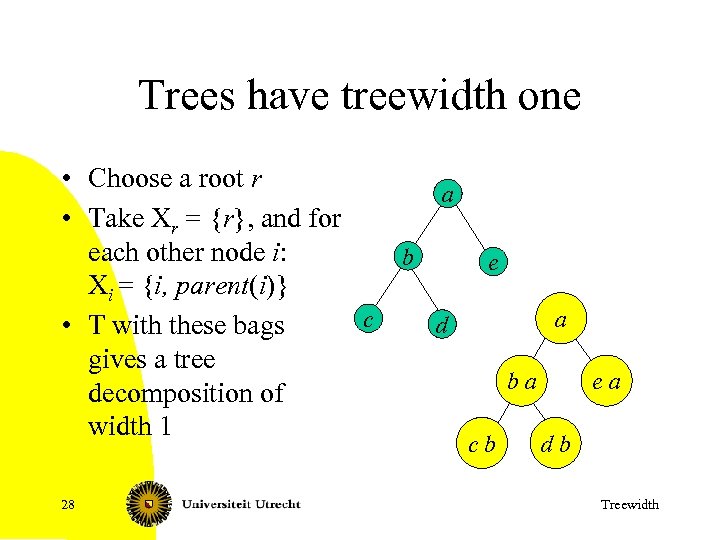 Trees have treewidth one • Choose a root r a • Take Xr = {r}, and for each other node i: b Xi = {i, parent(i)} c d • T with these bags gives a tree decomposition of width 1 28 e a ba cb ea db Treewidth
 Algorithms using tree decompositions • Step 1: Find a tree decomposition of width bounded by some small k. – Discussed later • Step 2. Use dynamic programming, bottomup on the tree. 29 Treewidth
 Determining treewidth • Treewidth problem (decision version): – Given: Graph G, integer k – Question: Is the treewidth of G at most k • Treewidth problem (construction version): – Given: Graph G – Question: construct a tree decomposition of G with minimum width • NP-complete (Arnborg, Proskurowski) • (n) time algorithm for fixed k (B. ) • Practical O(n) algorithms for k= 1, 2, 3 (Arnborg, Corneil, Proskurowski), k = 4 (Sanders; Hein and Koster) • Practical O*(2 n) algorithm for small graphs (B. et al. ) • Many (often good) heuristics • Sometimes by construction, or construction comes from application (trees, sp-graphs, planar graphs with small diameter, …) 30 Treewidth
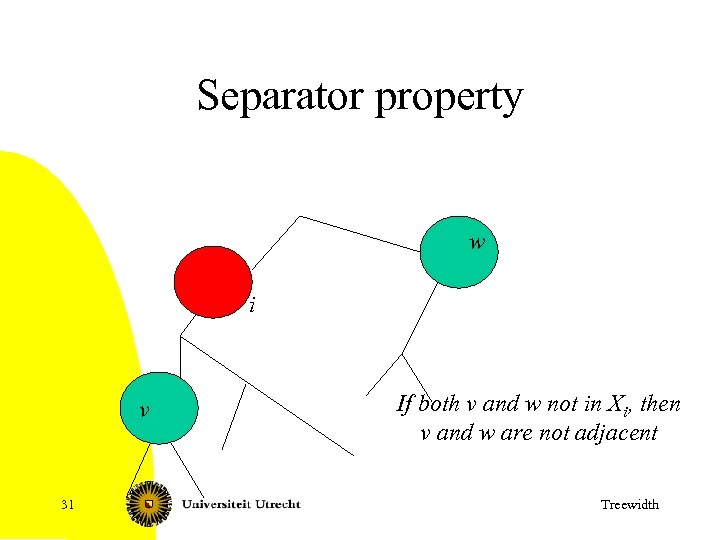 Separator property w i v 31 If both v and w not in Xi, then v and w are not adjacent Treewidth
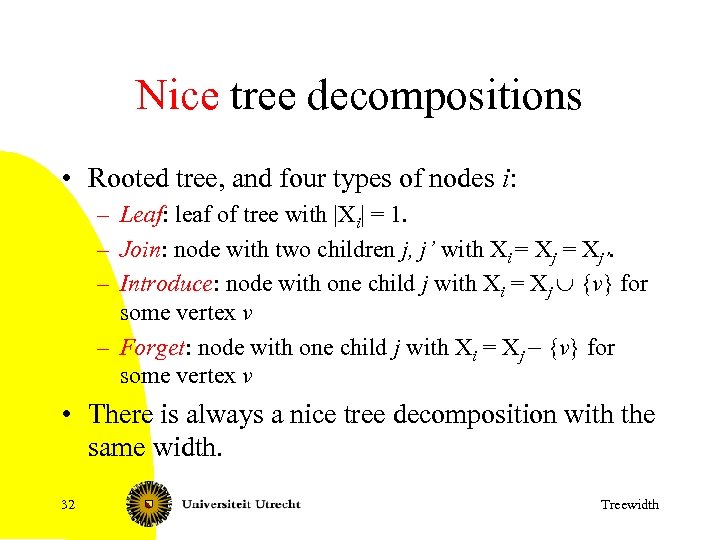 Nice tree decompositions • Rooted tree, and four types of nodes i: – Leaf: leaf of tree with |Xi| = 1. – Join: node with two children j, j’ with Xi = Xj’. – Introduce: node with one child j with Xi = Xj È {v} for some vertex v – Forget: node with one child j with Xi = Xj - {v} for some vertex v • There is always a nice tree decomposition with the same width. 32 Treewidth
 Define G(i) • Nice tree decomposition. • For each node i, G(i) subgraph of G, formed by all nodes in sets Xj, with j=i or j a descendant of i in tree. – Notate: G(i) = ( V(i), E(i) ). 33 Treewidth
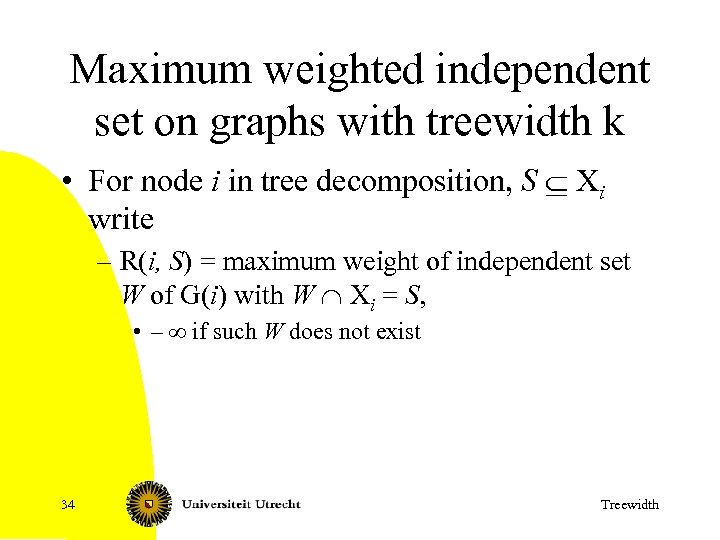 Maximum weighted independent set on graphs with treewidth k • For node i in tree decomposition, S Í Xi write – R(i, S) = maximum weight of independent set W of G(i) with W Ç Xi = S, • – ¥ if such W does not exist 34 Treewidth
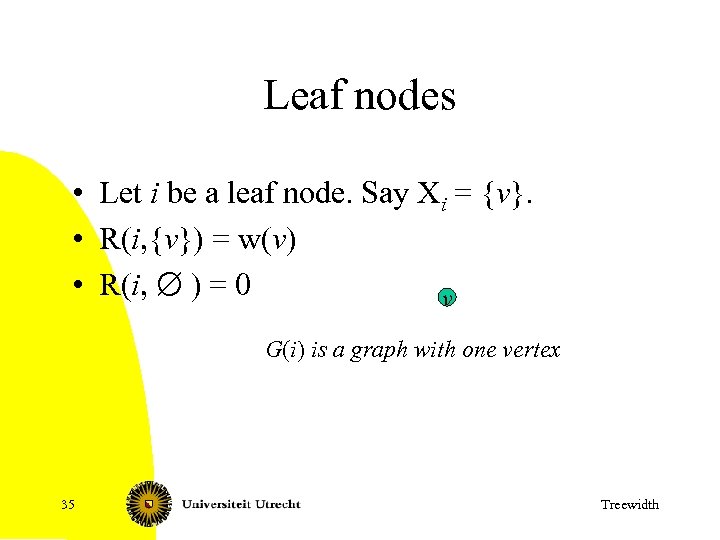 Leaf nodes • Let i be a leaf node. Say Xi = {v}. • R(i, {v}) = w(v) • R(i, Æ ) = 0 v G(i) is a graph with one vertex 35 Treewidth
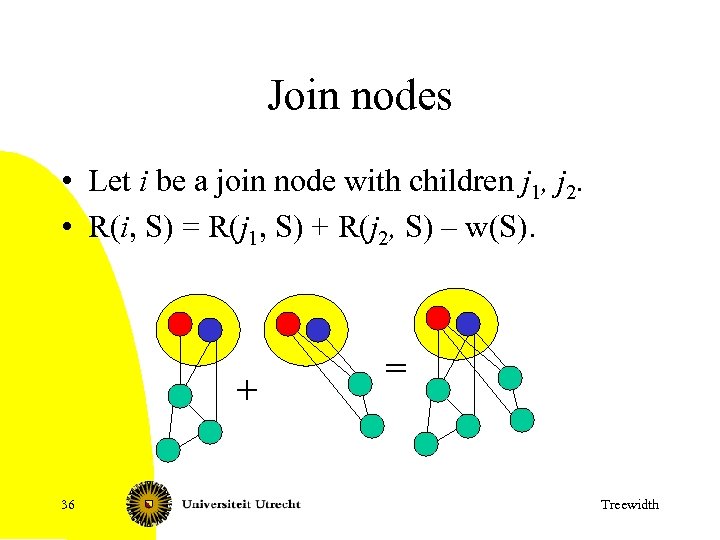 Join nodes • Let i be a join node with children j 1, j 2. • R(i, S) = R(j 1, S) + R(j 2, S) – w(S). + 36 = Treewidth
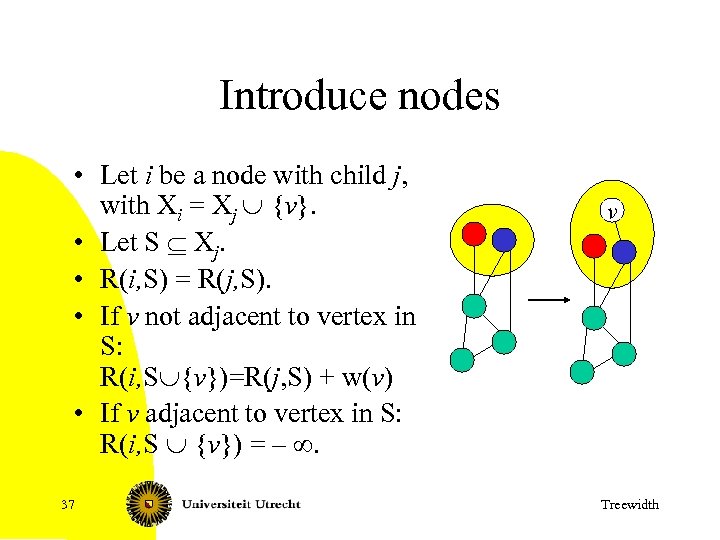 Introduce nodes • Let i be a node with child j, with Xi = Xj È {v}. • Let S Í Xj. • R(i, S) = R(j, S). • If v not adjacent to vertex in S: R(i, SÈ{v})=R(j, S) + w(v) • If v adjacent to vertex in S: R(i, S È {v}) = – ¥. 37 v Treewidth
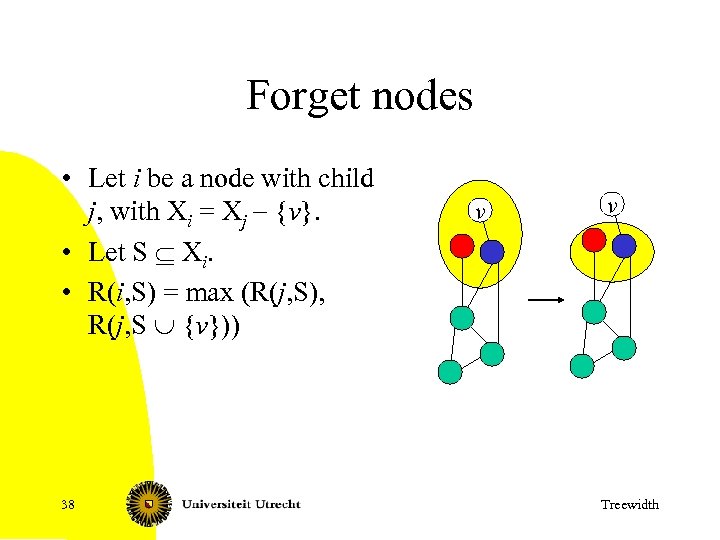 Forget nodes • Let i be a node with child j, with Xi = Xj - {v}. • Let S Í Xi. • R(i, S) = max (R(j, S), R(j, S È {v})) 38 v v Treewidth
 Maximum weighted independent set on graphs with treewidth k • For node i in tree decomposition, S Í Xi write – R(i, S) = maximum weight of independent set W of G(i) with W Ç Xi = S, – ¥ if such W does not exist • Compute for each node i, a table with all values R(i, …). • Each such table can be computed in O(2 k) time when treewidth at most k. • Gives O(n) algorithm when treewidth is (small) constant. 39 Treewidth
 Frequency assignment problem • Given: – Graph G=(V, E) – Frequency set F(v) Í N for all v Î V – Cost function • c(e, r, s) , e = {v, w}, r a frequency of v, s a frequency of w • Question – Find a function g with • For all v Î V: g(v) Î F(v) • The total sum over all edges e={v, w} of c(e, g(v), g(w)) is as small as possible 40 Treewidth
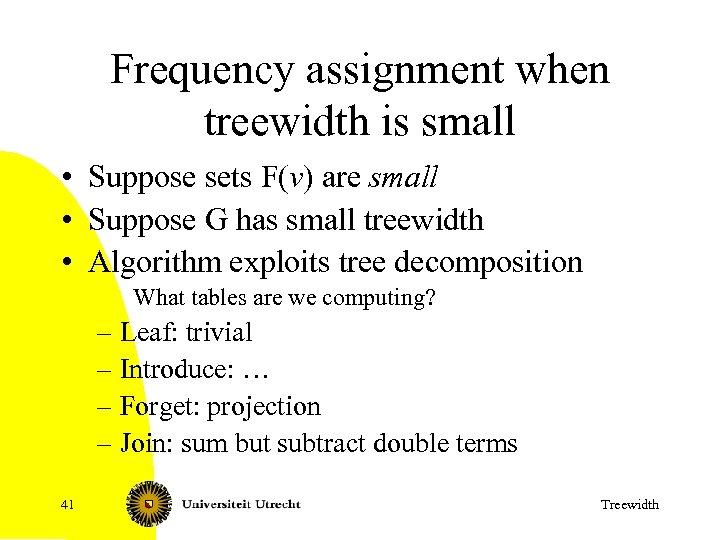 Frequency assignment when treewidth is small • Suppose sets F(v) are small • Suppose G has small treewidth • Algorithm exploits tree decomposition What tables are we computing? – Leaf: trivial – Introduce: … – Forget: projection – Join: sum but subtract double terms 41 Treewidth
 General method • Compute a tree decomposition – E. g. , with minimum degree heuristic – Make it nice – Use dynamic programming • Works for many problems – Courcelle: those that can be formulated in monadic second order logic – Practical: TSP, frequency assignment, problems on planar graphs like dominating set, probabilistic inference 42 Treewidth
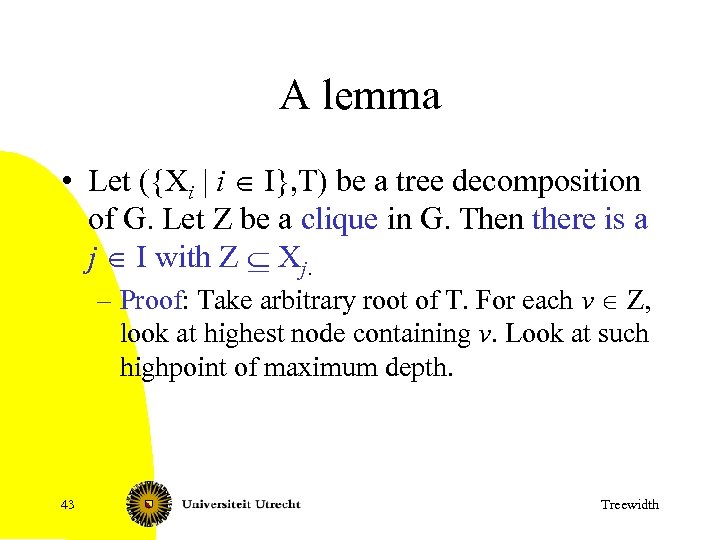 A lemma • Let ({Xi | i Î I}, T) be a tree decomposition of G. Let Z be a clique in G. Then there is a j Î I with Z Í Xj. – Proof: Take arbitrary root of T. For each v Î Z, look at highest node containing v. Look at such highpoint of maximum depth. 43 Treewidth
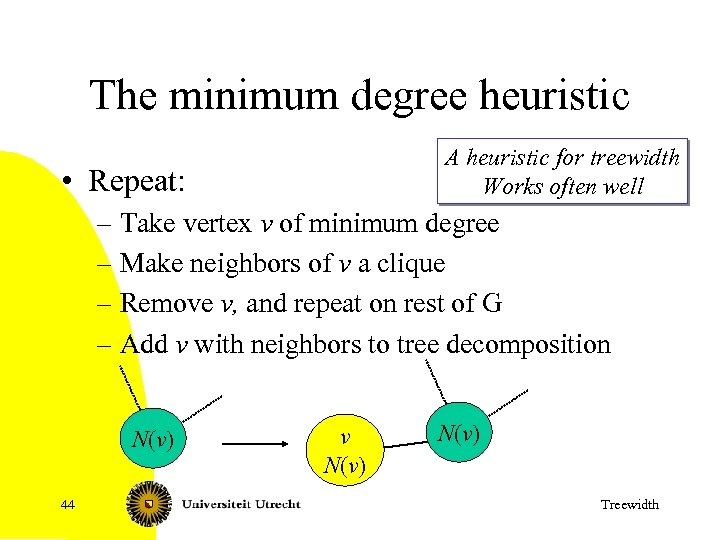 The minimum degree heuristic A heuristic for treewidth Works often well • Repeat: – Take vertex v of minimum degree – Make neighbors of v a clique – Remove v, and repeat on rest of G – Add v with neighbors to tree decomposition N(v) 44 v N(v) Treewidth
 Other heuristics • Minimum fill-in heuristic – Similar to minimum degree heuristic, but takes vertex with smallest fill-in: • Number of edges that must be added when the neighbours of v are made a clique • Other choices of vertices, refining, using separators, … 45 Treewidth
 Representation as permutation • A correspondence between tree decompositions and permutations of the vertices – Repeat: remove superfluous leaf bag, or take vertex that appears in 1 leaf bag and no other bag – Make neighbours of v = p(1) into a clique; recursively make tree decomposition of graph – v; add bag with v and neighbours • Used in heuristics, and local search methods (e. g. , taboo search, simulated annealing) and genetic algorithms 46 Treewidth
 Connection to Gauss eliminating • Consider Gauss elimination on a symmetric matrix • For n by n matrix M, let GM be the graph with n vertices, and edge (i, j) if Mij ¹ 0 • If we eliminate a row and corresponding column, effect on G is: – Make neighbors of v a clique – Remove v 47 Treewidth
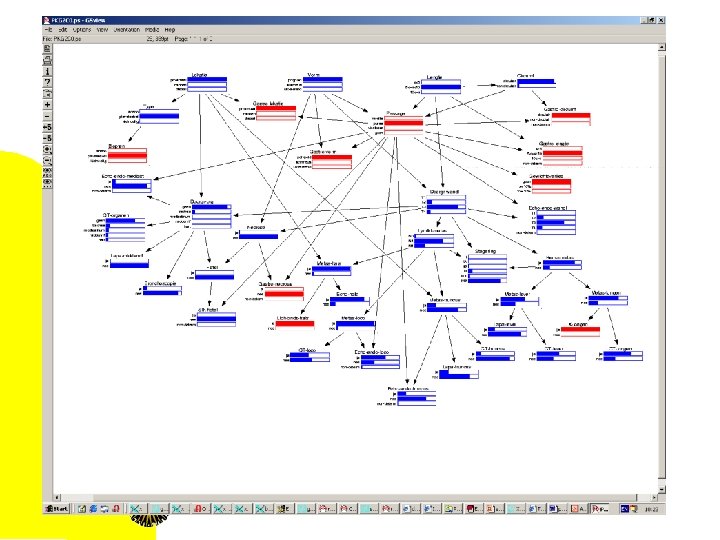
 Application: Probabilistic networks • Lauritzen-Spiegelhalter algorithm for inference on probabilistic networks (belief networks) uses a tree decomposition of the moralized form of the network • Underlying several modern decision support networks 48 Treewidth
 49 Treewidth
 Designing a DP algorithm • Methodology: 1. What are “partial certificates”? 2. What characterizes a partial certificate (essential for extending to full certificate)? Gives set of subproblems 3. Give recurrences for subproblems 4. Find order in which recurrences are evaluated; or use memorization 5. Give algorithm; possibly save memory or make construction version 50 Treewidth
 Conclusions • Dynamic programming for graphs with treelike structure • Works for a large collection of problems, as long as there is (and we can find) such a structure… 51 Treewidth