


 Скачать презентацию Treatment of GERD Main principles of treatment
Treatment of GERD.pptx
- Количество слайдов: 9
 Treatment of GERD
 Main principles of treatment: Lifestyle modification Drug therapy Surgical treatment
 Lifestyle Modifications in GERD Smoking cessation Weight Loss Head of Bed Elevation Avoidance of Late-Night Meals Breathing Exercises Dietary Influences Avoidance of alcohol
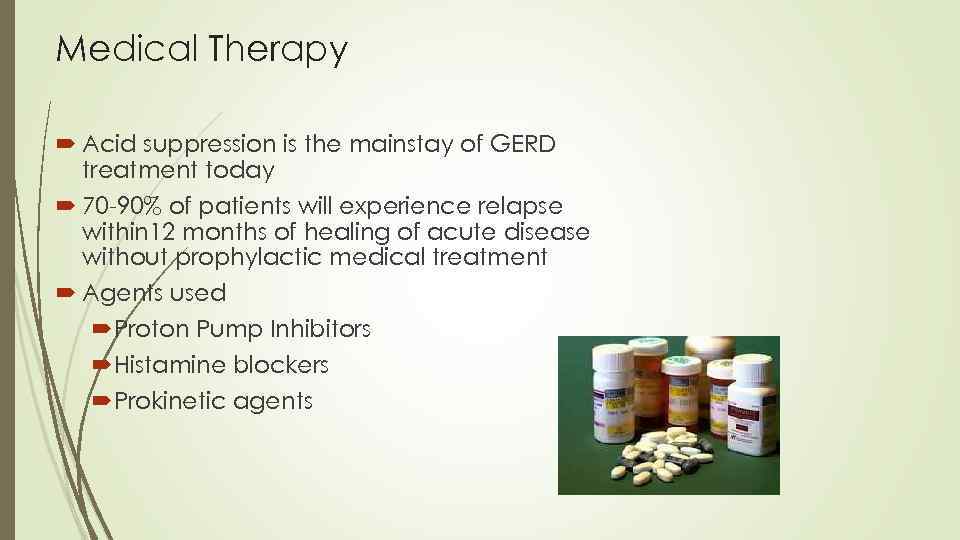 Medical Therapy Acid suppression is the mainstay of GERD treatment today 70 -90% of patients will experience relapse within 12 months of healing of acute disease without prophylactic medical treatment Agents used Proton Pump Inhibitors Histamine blockers Prokinetic agents
 Histamine blockers Reversible competitive blockade of H 2 receptors of the parietal cell Acid suppression by 70% Esophagitis healing rates up to 70% Healing rates dependent on dosage, treatment duration and severity of disease Ranitidine, cimetidine, famotidine, nizatidine
 Proton Pump Inhibitors (PPI) Most effective available pharmacologic agent for GERD Acid suppression by 99% Esophagitis healing rates 80 -100% Inhibit H+/K+ ATPase enzyme system on parietal cells Omeprazole, lansoprazole, rabeprazole, pantoprazole, esomeprazole
 Indications for surgery § Patients with incomplete symptom control or disease progression on PPI therapy § Patients with well-controlled disease who do not want to be on life-long antisecretory treatment § Patients with proven extra-esophageal manifestations of GERD like cough, wheezing, aspiration, hoarseness, sore throat, otitis media, or enamel erosion. § The presence of Barrett esophagus is a controversial indication for surgery
 Surgery Works by restoring the barrier function of the LES Careful selection of patients with well documented GERD is imperative Laparoscopic fundoplication is considered the gold standard in antireflux surgery Nissen and Toupet the most common Number of cases risen exponentially
 Goals of surgery Prevent significant reflux Improve quality of life Minimize complications (dysphagia)