


 Скачать презентацию Treatment for Geriatric Depression Ø All classes have
2db90240a92854cd61b232fcf649ba73.ppt
- Количество слайдов: 18
 Treatment for Geriatric Depression Ø All classes have proven efficacy in elderly patients l Yet, some evidence exists that antidepressants are less helpful in those over 75 • Likely due to the difficulty in general treating depression in the elderly l Role of cerebral vascular disease a factor • 8 to 12 weeks in younger adults may stretch to 12 -16 weeks in the elderly • More concern with adverse events l l More possible medications to interact with Slower metabolism, excretion
 How to Choose an Antidepressant Ø Approach to the patient l l l Fatigue, insomnia, poor appetite Pain, HTN, heart disease, renal disease, liver disease, diabetes Anxiety, psychosis, cognition Ø Approach to the drug l How metabolized • CYP 450 system and drug interactions
 Ø Fatigue l ¾ of patients with depression report fatigue • Serotonin-mediated l countered by adrenergic, dopaminergic agents • Effexor (venlafaxine), Cymbalta (duloxetine), Zoloft (sertraline), Prozac (fluoxetine) • Augmentation agents l Ritalin (methylphenidate), Provigil (modafinil) • Cognitive behavioral therapy, exercise l Make sure it is depression • OSA common and looks like depression • Especially if fatigue is the last resistant symptom
 Ø Insomnia l Common symptom in depression • Serotonin 5 HT 2 -mediated l l l If activated insomnia occurs • SSRIs, SNRIs If blocked sleepiness occurs • Remeron (mirtazapine) Other agents • Ambien (zolpidem) and Sonata (zaleplon) • Lunesta (eszopiclone) • Rozerem (ramelteon); M 1, M 2 receptor • Sleep journal, sleep hygiene, avoid naps l Make sure it is depression • Not a primary sleep disorder, medications, caffeine, exercise
 Ø Weight loss, poor appetite l l Common symptom of depression Many antidepressants cause weight gain • We often look drug-induced weight gain as serendipity rather than an adverse event l Remeron (mirtazapine) • Like sleep, this effect lost when dose is increased above 30 mg/d; comes as a dissolvable tablet for dysphagia l Nortriptyline • Histaminergic properties l SSRIs • Paxil (paroxetine)-most robust weight gaining SSRI • Prozac (fluoxetine) and Zoloft (sertraline)-less robust
 Ø Pain l Antidepressants do posses anti-pain properties • Mainly neuropathic pain l Peripheral neuropathy (PN), e. g. • Tricyclic antidepressants very helpful in pain l l Elavil (amitriptyline) used often as pain agent • Doses too low for effective treatment of mood Pamelor (nortriptyline) safer as an antidepressant • SNRIs l Cymbalta (duloxetine) and Effexor (venlafaxine) • SSRIs l Too selective for serotonin; TCAs and SNRIs have the right balance of serotonergic and noradrenergic reuptake activity • Wellbutrin (bupropion) l One positive study with PN
 Ø Hypertension (HTN) l There is a strong correlation between HTN and depression • Goes both ways l Main thesis is based on a hyperactive sympathetic nervous system for both • Variable evidence for TCAs, MAOIs • SSRIs have few HTN effects l Prozac (fluoxetine)and Zoloft (sertraline) increase autonomic tone/improve orthostasis • Effexor (venlafaxine) l l Dose-dependent HTN in 5% Above 300 mg/d it was 15% • However, no increased risk if you had previous HTN • 1/3 of patients experienced lower BP
 Ø Heart disease l Depression common in ischemic heart disease • Increases the risk of future events • 1/5 of those with an acute MI develop MDD l l If you develop MDD after MI you have 5 x the risk of a second MI in 6 mos. SSRIs are preferred • SNRIs, Remeron, Wellbutrin all used • TCAs are too cardio-toxic l l l Orthostasis Slowed conduction Tachycardia
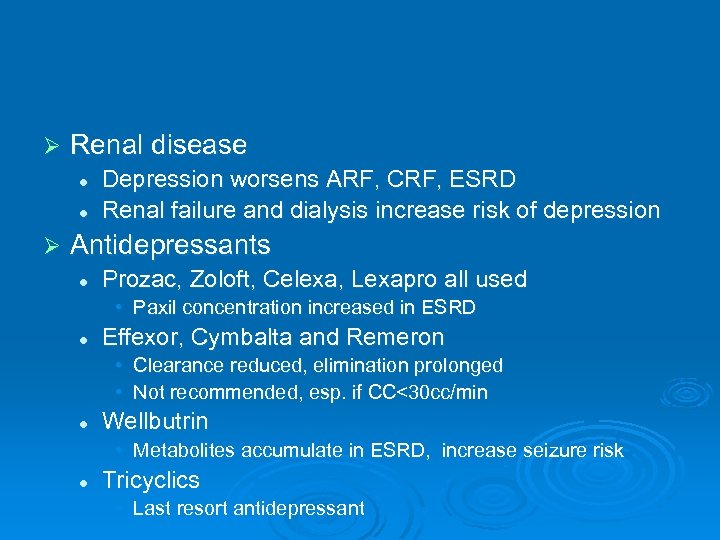 Ø Renal disease l l Ø Depression worsens ARF, CRF, ESRD Renal failure and dialysis increase risk of depression Antidepressants l Prozac, Zoloft, Celexa, Lexapro all used • Paxil concentration increased in ESRD l Effexor, Cymbalta and Remeron • Clearance reduced, elimination prolonged • Not recommended, esp. if CC<30 cc/min l Wellbutrin • Metabolites accumulate in ESRD, increase seizure risk l Tricyclics • Last resort antidepressant
 Ø Liver Disease l High prevalence of depression in cirrhosis, hepatitis • Interferon alpha carries a 33% risk of developing depression l All antidepressants are liver metabolized • All have cases of hepatotoxicity l Nefazodone carried risk of hepatic failure • SSRIs l l Celexa and Lexapro commonly used Gi bleeding noted in SSRIs • Avoid Effexor and Cymbalta • Remeron l Bone marrow suppression and agranulocytosis • Wellbutrin has been used
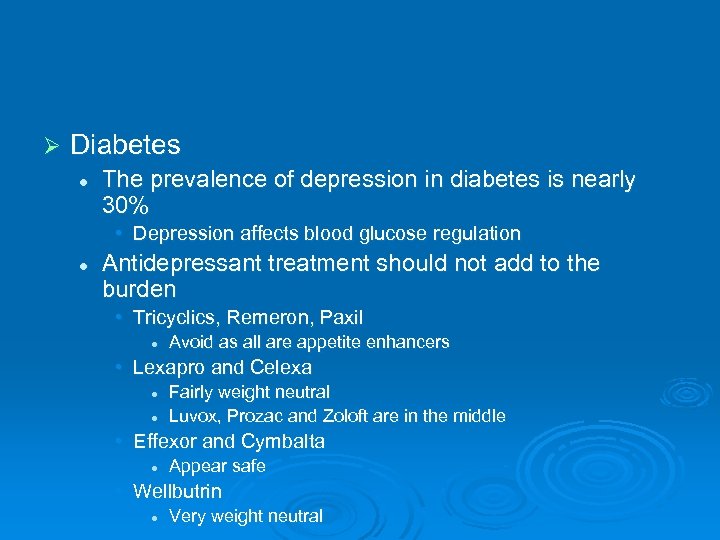 Ø Diabetes l The prevalence of depression in diabetes is nearly 30% • Depression affects blood glucose regulation l Antidepressant treatment should not add to the burden • Tricyclics, Remeron, Paxil l Avoid as all are appetite enhancers • Lexapro and Celexa l l Fairly weight neutral Luvox, Prozac and Zoloft are in the middle • Effexor and Cymbalta l Appear safe • Wellbutrin l Very weight neutral
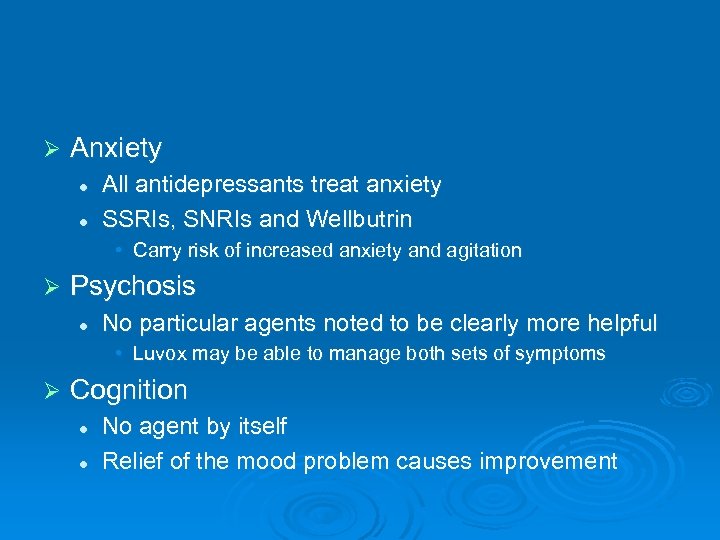 Ø Anxiety l l All antidepressants treat anxiety SSRIs, SNRIs and Wellbutrin • Carry risk of increased anxiety and agitation Ø Psychosis l No particular agents noted to be clearly more helpful • Luvox may be able to manage both sets of symptoms Ø Cognition l l No agent by itself Relief of the mood problem causes improvement
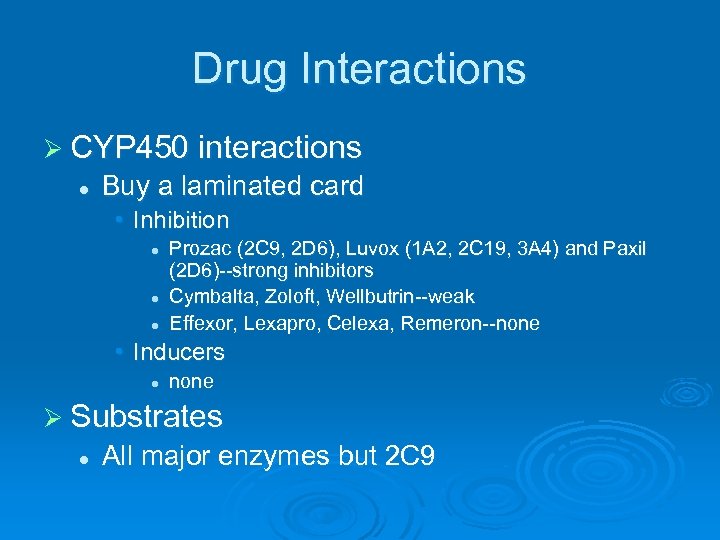 Drug Interactions Ø CYP 450 interactions l Buy a laminated card • Inhibition l l l Prozac (2 C 9, 2 D 6), Luvox (1 A 2, 2 C 19, 3 A 4) and Paxil (2 D 6)--strong inhibitors Cymbalta, Zoloft, Wellbutrin--weak Effexor, Lexapro, Celexa, Remeron--none • Inducers l none Ø Substrates l All major enzymes but 2 C 9
 Ø SSRIS l dextromethoraphan, tryptophan, MAOIs, TCAs, venlafaxine, mirtazapine • Serotonin syndrome • TCA toxicity • MAOI combinations are potentially lethal l warfarin (Coumadin) • Increased warfarin effects due to protein binding • Do not expect to see elevated warfarin concentration, except with fluvoxamine
 Ø Fluvoxamine (Luvox) l l theophylline, clozapine, warfarin, carbamazepine, diltiazem, thioridazine. Venlafaxine (Effexor) Haloperidol • Increases haloperidol concentration l Indinavir • Decreases protease inhibitor concentration
 Ø Bupropion (Wellbutrin) l Desipramine (likely other 2 D 6 substrates) • Increases concentration of desipramine • Elevated concentrations due to metabolic inhibition, with possible toxicity Ø Fluoxetine (Prozac) l carbamazepine, phenytoin • Elevated anticonvulsant concentration
 Ø Venlafaxine (Effexor) l Haloperidol • Increases haloperidol concentration l Indinavir • Decreases protease inhibitor concentration Ø Bupropion (Wellbutrin) l Desipramine (likely other 2 D 6 substrates) • Increases concentration of desipramine
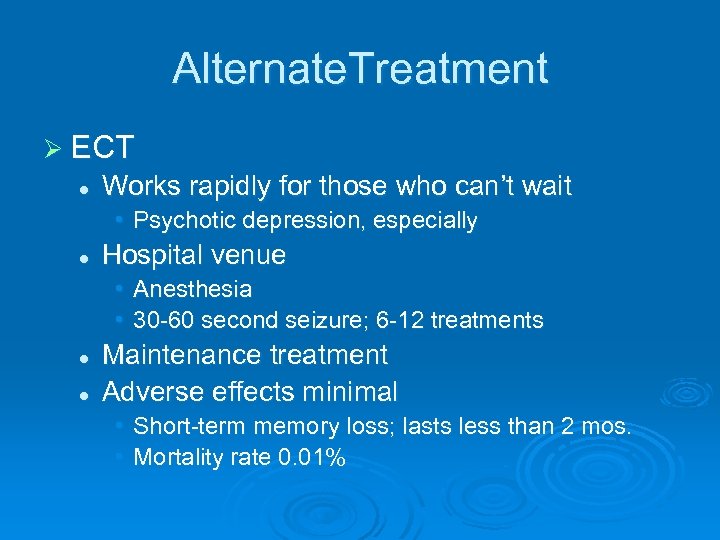 Alternate. Treatment Ø ECT l Works rapidly for those who can’t wait • Psychotic depression, especially l Hospital venue • Anesthesia • 30 -60 second seizure; 6 -12 treatments l l Maintenance treatment Adverse effects minimal • Short-term memory loss; lasts less than 2 mos. • Mortality rate 0. 01%