


 Скачать презентацию Trawling FOOD Finfish shellfish seaweed
51a29b2343e7da9d276e55a9b160b4d6.ppt
- Количество слайдов: 36
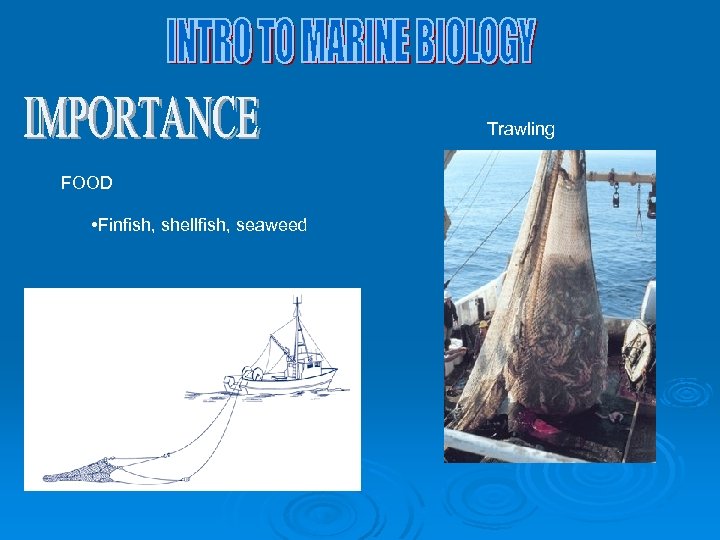 Trawling FOOD • Finfish, shellfish, seaweed
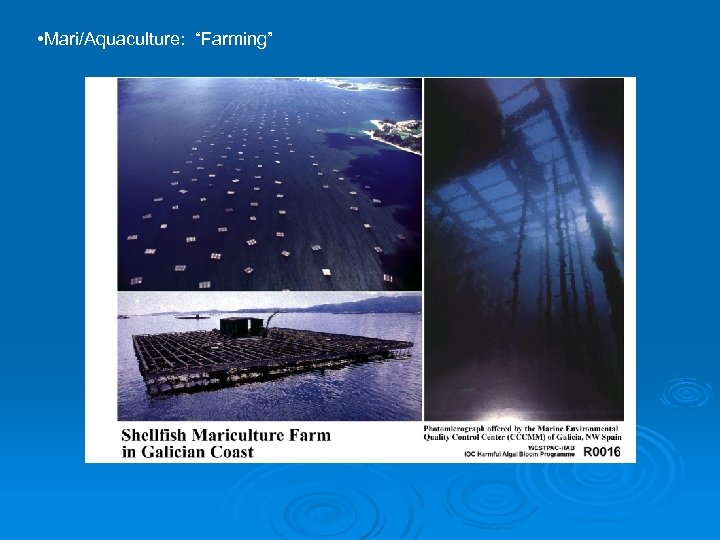 • Mari/Aquaculture: “Farming”
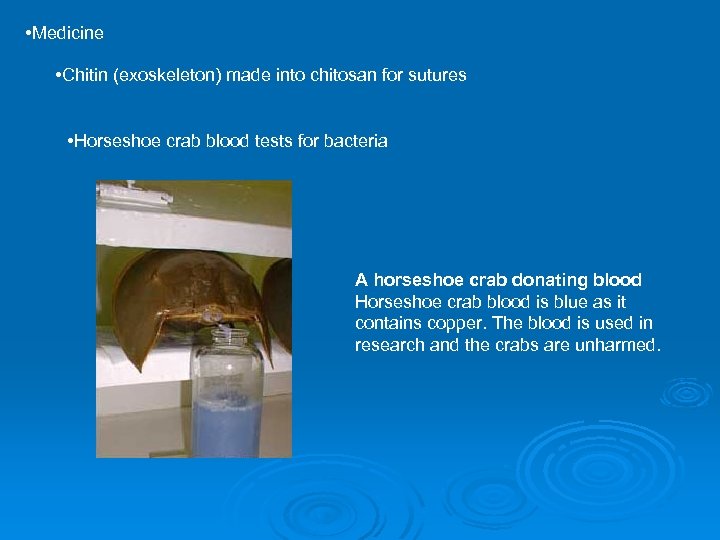 • Medicine • Chitin (exoskeleton) made into chitosan for sutures • Horseshoe crab blood tests for bacteria A horseshoe crab donating blood Horseshoe crab blood is blue as it contains copper. The blood is used in research and the crabs are unharmed.
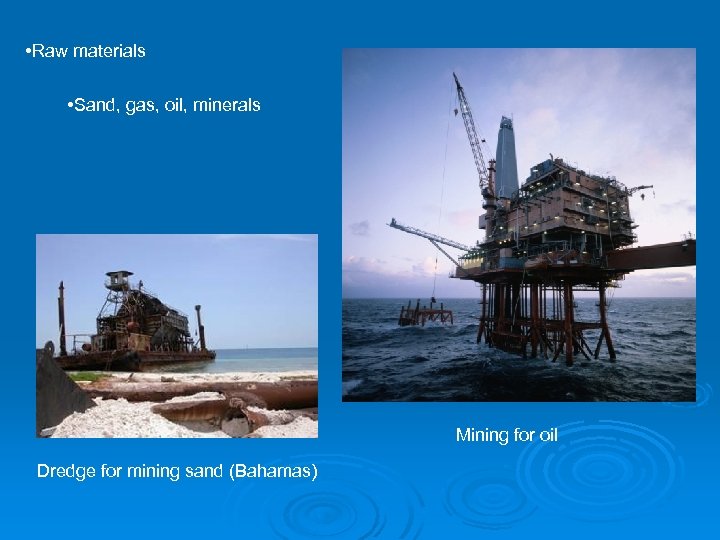 • Raw materials • Sand, gas, oil, minerals Mining for oil Dredge for mining sand (Bahamas)
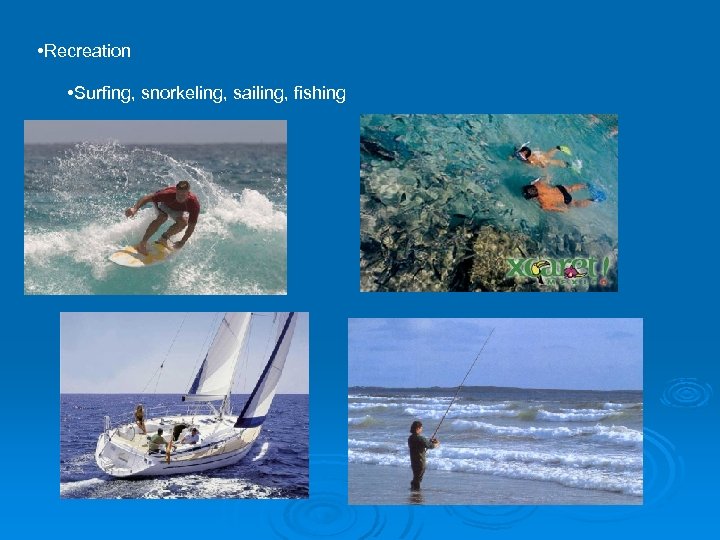 • Recreation • Surfing, snorkeling, sailing, fishing
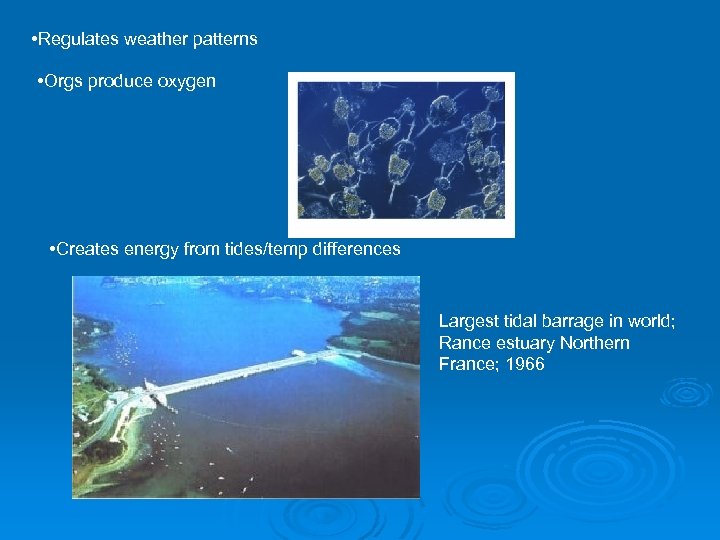 • Regulates weather patterns • Orgs produce oxygen • Creates energy from tides/temp differences Largest tidal barrage in world; Rance estuary Northern France; 1966
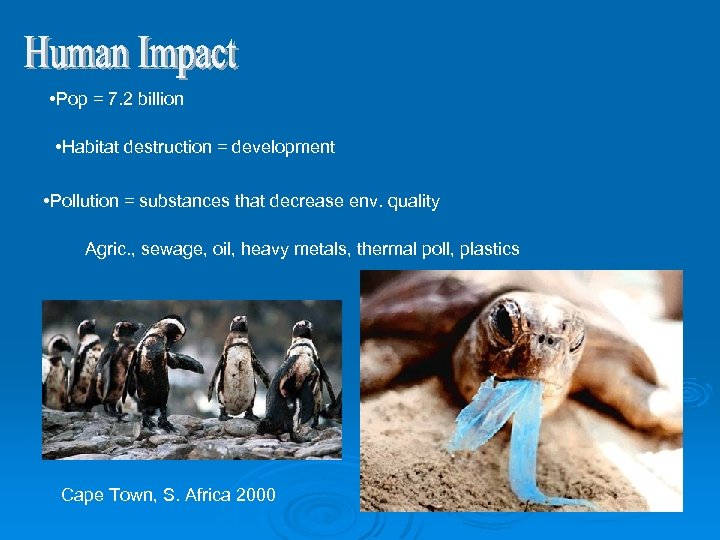 • Pop = 7. 2 billion • Habitat destruction = development • Pollution = substances that decrease env. quality Agric. , sewage, oil, heavy metals, thermal poll, plastics Cape Town, S. Africa 2000
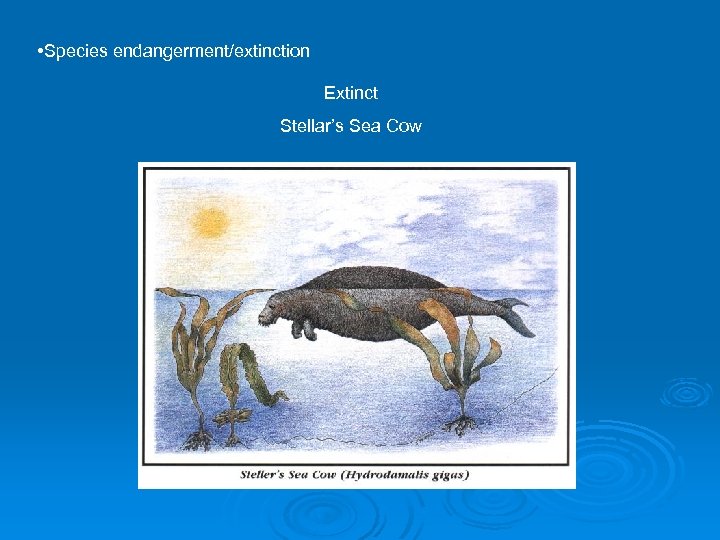 • Species endangerment/extinction Extinct Stellar’s Sea Cow
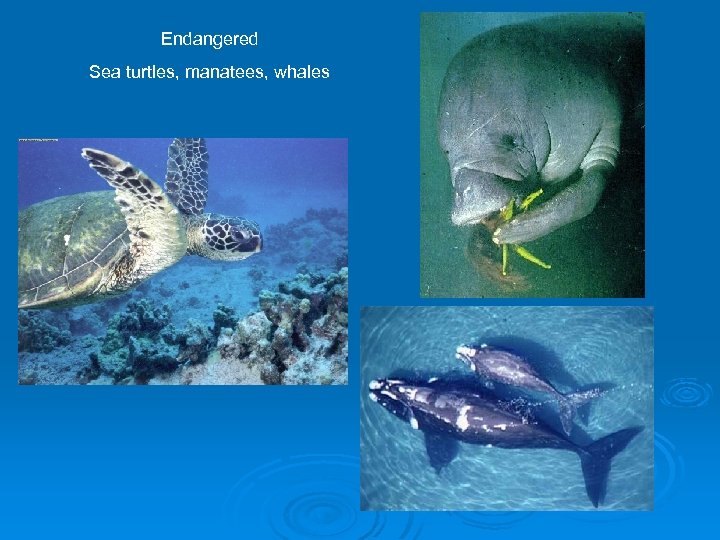 Endangered Sea turtles, manatees, whales
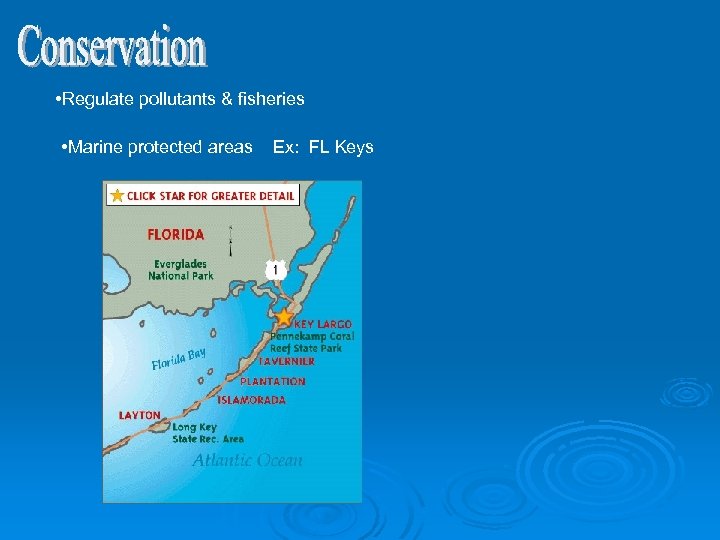 • Regulate pollutants & fisheries • Marine protected areas Ex: FL Keys
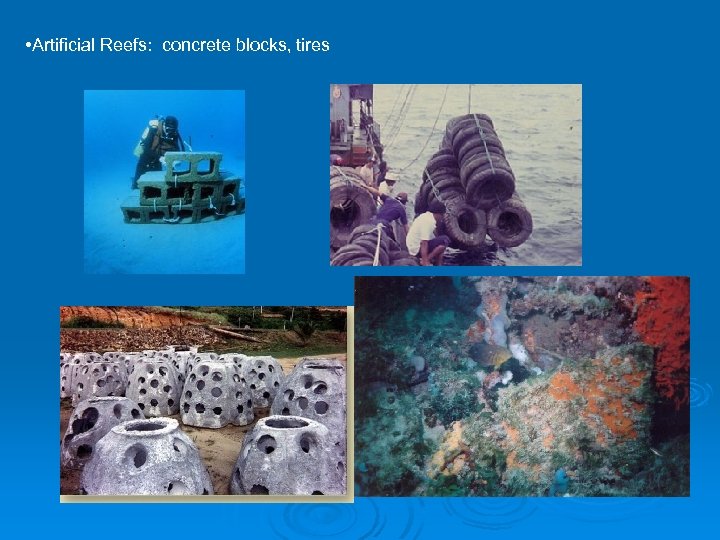 • Artificial Reefs: concrete blocks, tires
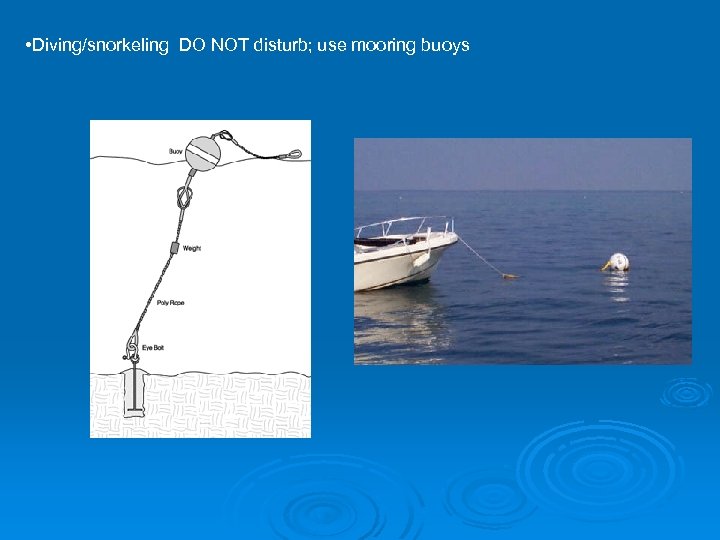 • Diving/snorkeling DO NOT disturb; use mooring buoys
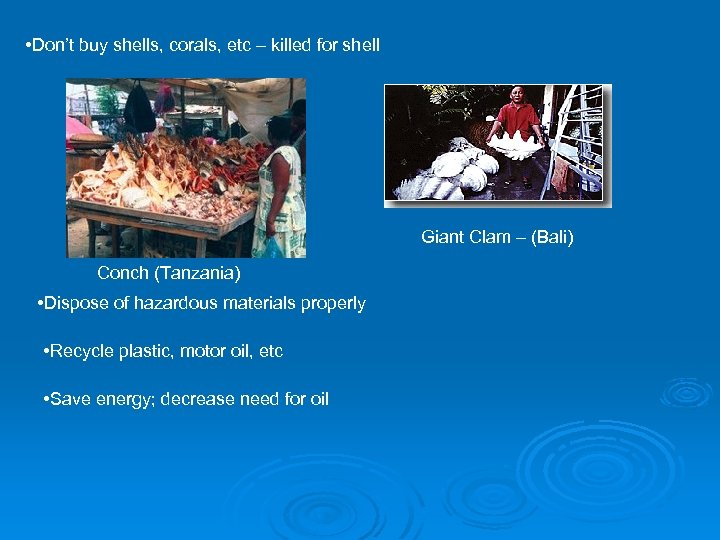 • Don’t buy shells, corals, etc – killed for shell Giant Clam – (Bali) Conch (Tanzania) • Dispose of hazardous materials properly • Recycle plastic, motor oil, etc • Save energy; decrease need for oil
 History of Marine Science Ø Early evidence of man’s contact with the sea: Marine life represents a vast source of food, medicines, raw materials and offers recreation to millions of people. People have explored and used the sea to provide tools for existence for centuries.
 1. Piles of clam shells dating back to the Stone Age- remains of ancient clambakes. 2. Ancient harpoons and simple fishhooks of bone or shell. 3. Tomb of Egyptian pharaoh warns against eating “pufferfish”- poisonous and evidence of early coastal people
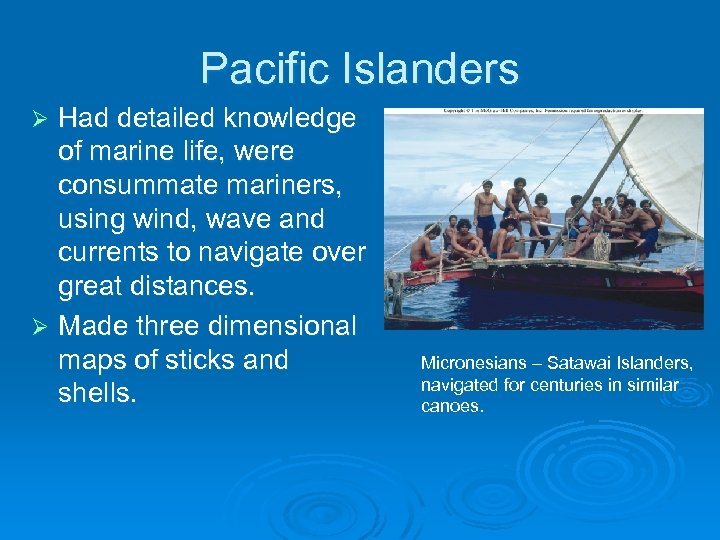 Pacific Islanders Had detailed knowledge of marine life, were consummate mariners, using wind, wave and currents to navigate over great distances. Ø Made three dimensional maps of sticks and shells. Ø Micronesians – Satawai Islanders, navigated for centuries in similar canoes.
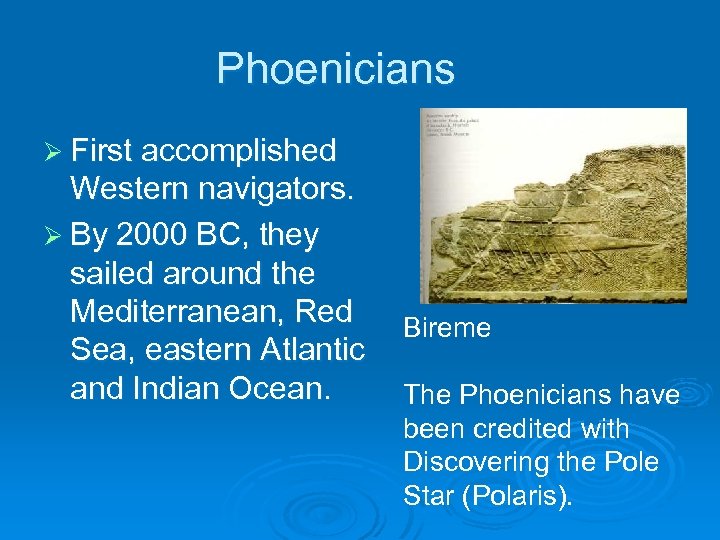 Phoenicians Ø First accomplished Western navigators. Ø By 2000 BC, they sailed around the Mediterranean, Red Sea, eastern Atlantic and Indian Ocean. Bireme The Phoenicians have been credited with Discovering the Pole Star (Polaris).
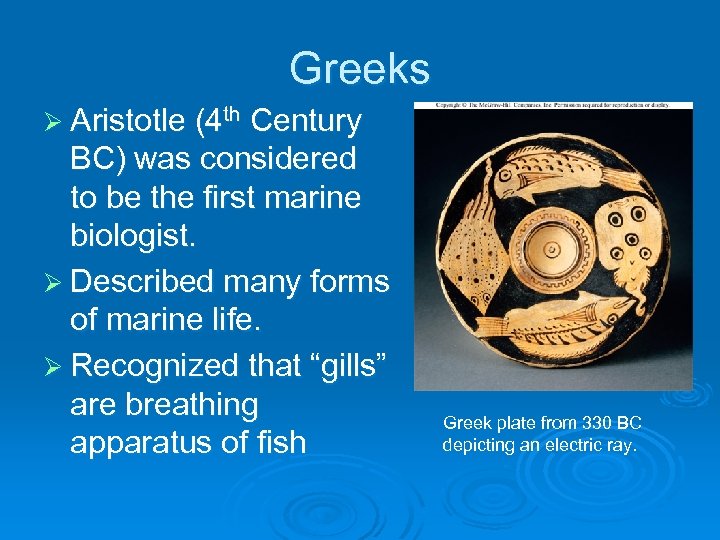 Greeks Ø Aristotle (4 th Century BC) was considered to be the first marine biologist. Ø Described many forms of marine life. Ø Recognized that “gills” are breathing apparatus of fish Greek plate from 330 BC depicting an electric ray.
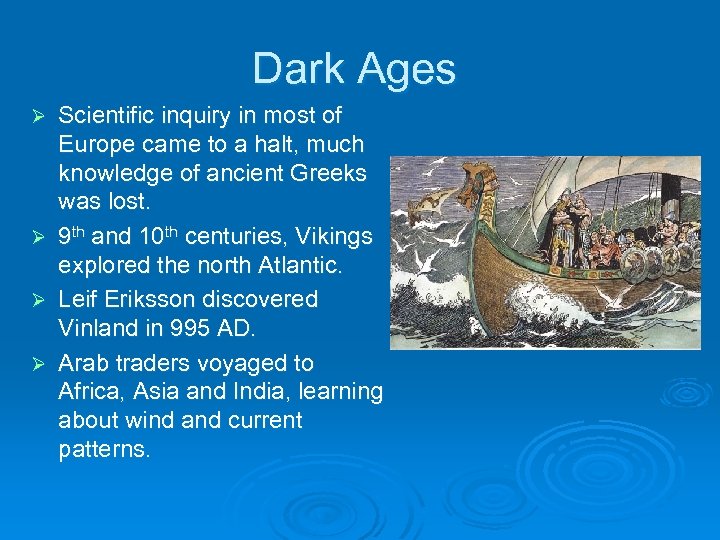 Dark Ages Ø Ø Scientific inquiry in most of Europe came to a halt, much knowledge of ancient Greeks was lost. 9 th and 10 th centuries, Vikings explored the north Atlantic. Leif Eriksson discovered Vinland in 995 AD. Arab traders voyaged to Africa, Asia and India, learning about wind and current patterns.
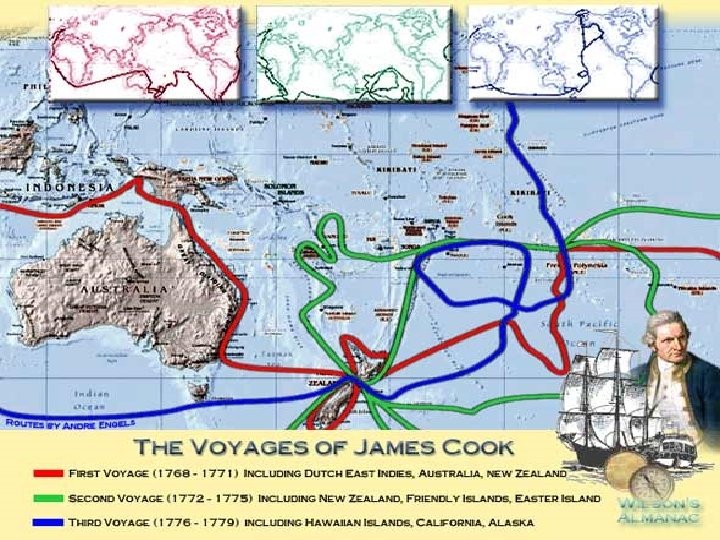
 Renaissance Ø Europeans began to investigate the world. Ø Columbus discovered the New World in 1492. Ø Magellan sailed around the globe in 1519 Ø James Cook made three great voyages beginning in 1768 exploring all the oceans. l First to make use of the chronometer which enabled him to determine longitude and prepare reliable charts.
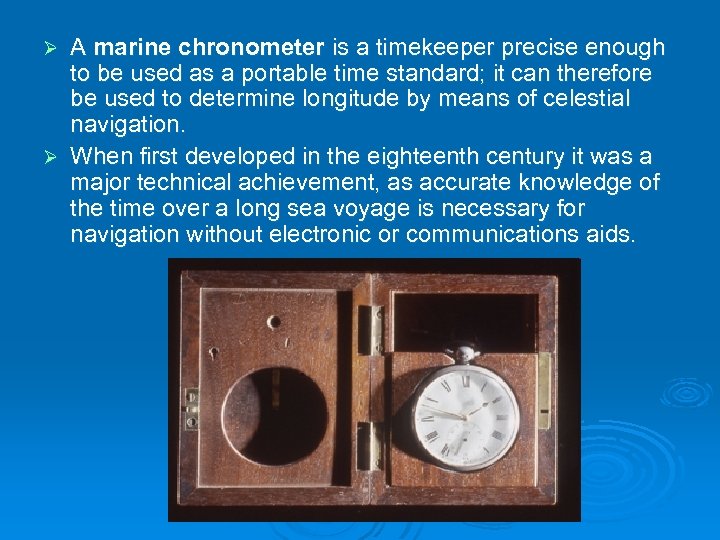 A marine chronometer is a timekeeper precise enough to be used as a portable time standard; it can therefore be used to determine longitude by means of celestial navigation. Ø When first developed in the eighteenth century it was a major technical achievement, as accurate knowledge of the time over a long sea voyage is necessary for navigation without electronic or communications aids. Ø
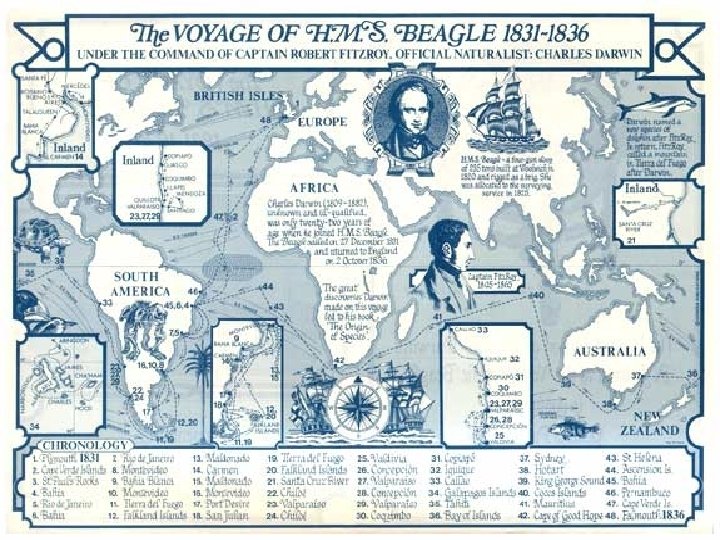
 Nineteenth Century Ø Vessels commonly took along a naturalist to collect and study life forms encountered. Ø Charles Darwin, in 1831, sailed around the world on HMS Beagle for 5 years. l l Primary mission was to map coastlines Basis for his theory of evolution Proposed theory on formation of atolls Used nets to capture plankton
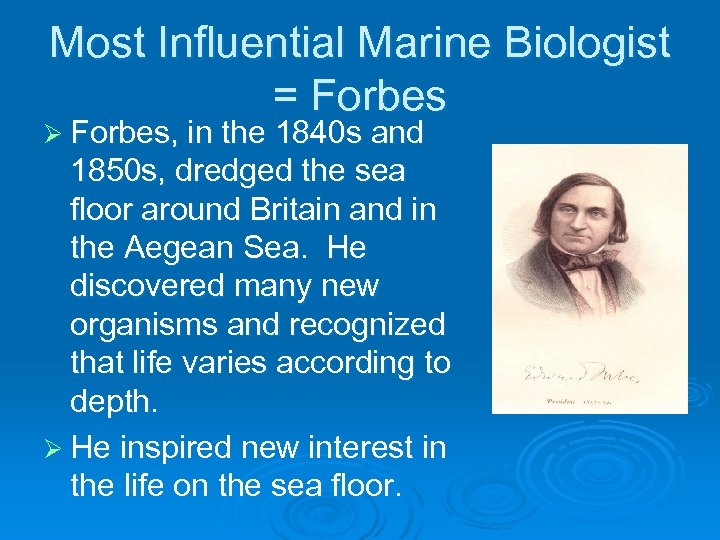 Most Influential Marine Biologist = Forbes Ø Forbes, in the 1840 s and 1850 s, dredged the sea floor around Britain and in the Aegean Sea. He discovered many new organisms and recognized that life varies according to depth. Ø He inspired new interest in the life on the sea floor.
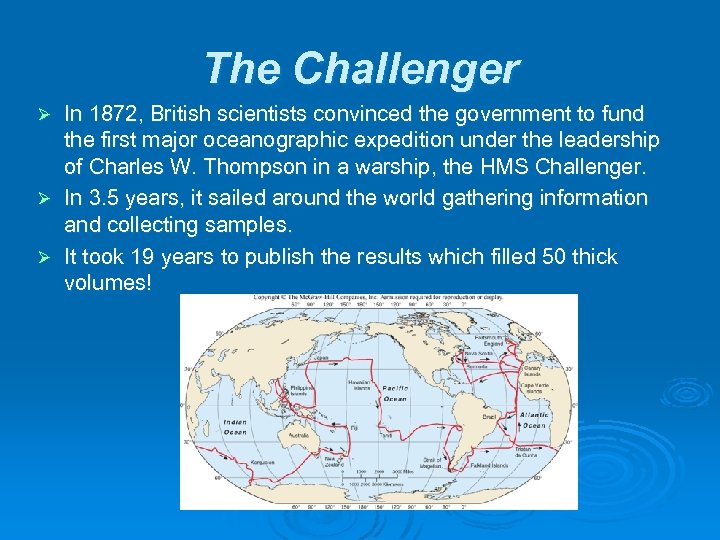 The Challenger In 1872, British scientists convinced the government to fund the first major oceanographic expedition under the leadership of Charles W. Thompson in a warship, the HMS Challenger. Ø In 3. 5 years, it sailed around the world gathering information and collecting samples. Ø It took 19 years to publish the results which filled 50 thick volumes! Ø
 Studies at the seashore Ø Henri Milne Edwards and Victor Andouin in 1826 began studying live organisms at the shore. Ø Permanent labs were finally established which allowed biologist to keep organisms alive over long periods.
 Famous Labs Stazione Zoologica – Naples, Italy Ø Marine Biological Society of the UK in Plymouth, England Ø Woods Hole, Mass Ø Lab on Cape Ann, Mass, extablished by Louis Agassiz Ø Hopkins Marine Station in CA Ø Scripps Institution of Oceanography in CA Ø Friday Harbor Marine Labs in WA Ø
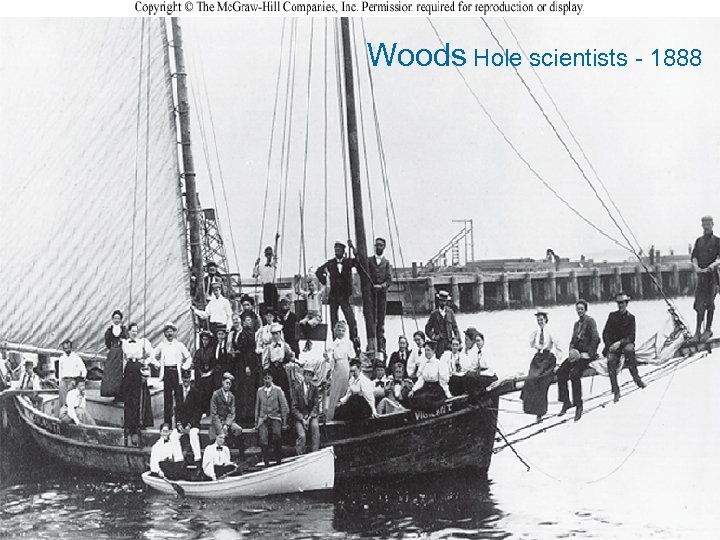 Woods Hole scientists - 1888
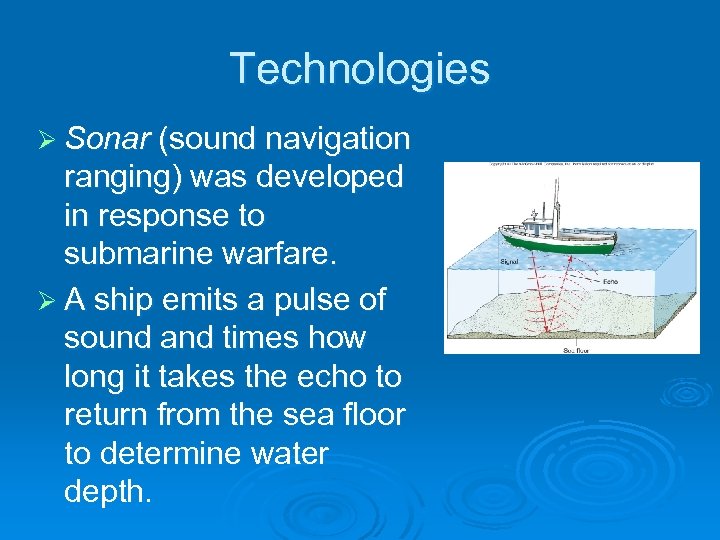 Technologies Ø Sonar (sound navigation ranging) was developed in response to submarine warfare. Ø A ship emits a pulse of sound and times how long it takes the echo to return from the sea floor to determine water depth.
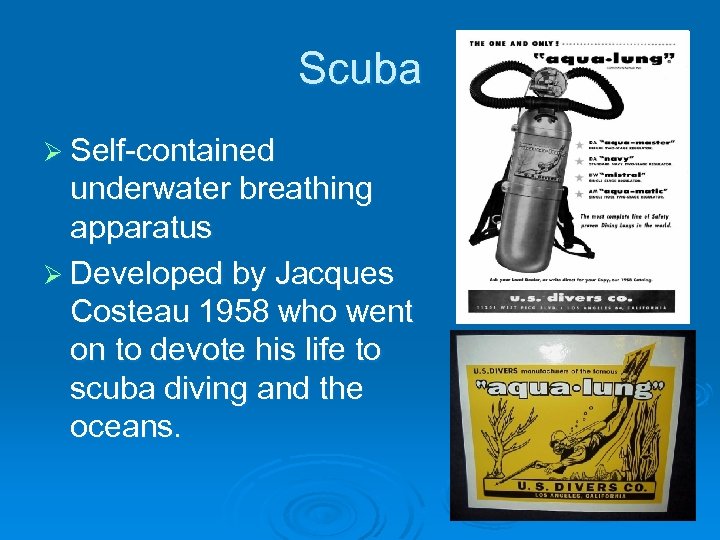 Scuba Ø Self-contained underwater breathing apparatus Ø Developed by Jacques Costeau 1958 who went on to devote his life to scuba diving and the oceans.
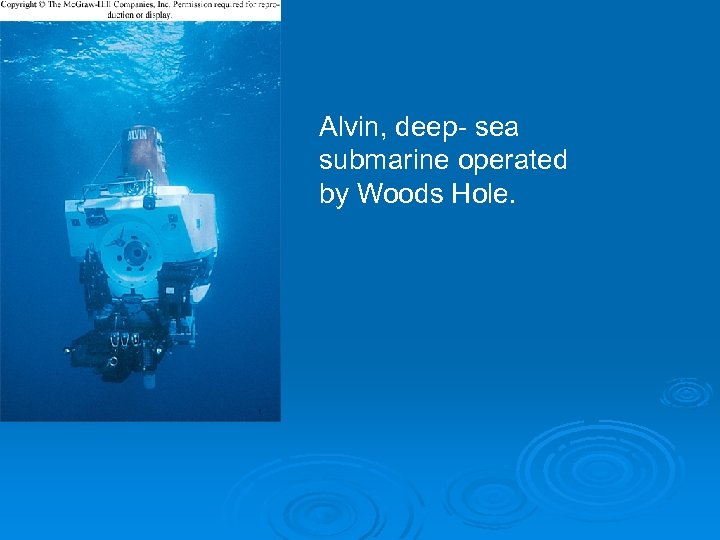 Alvin, deep- sea submarine operated by Woods Hole.
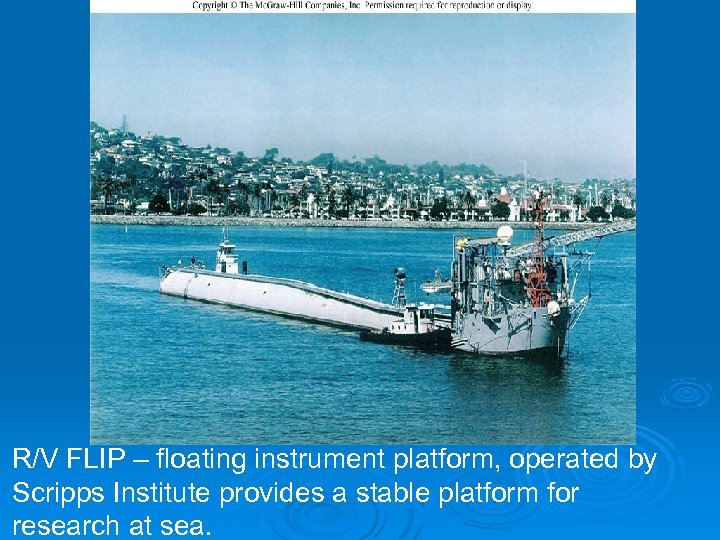 R/V FLIP – floating instrument platform, operated by Scripps Institute provides a stable platform for research at sea.
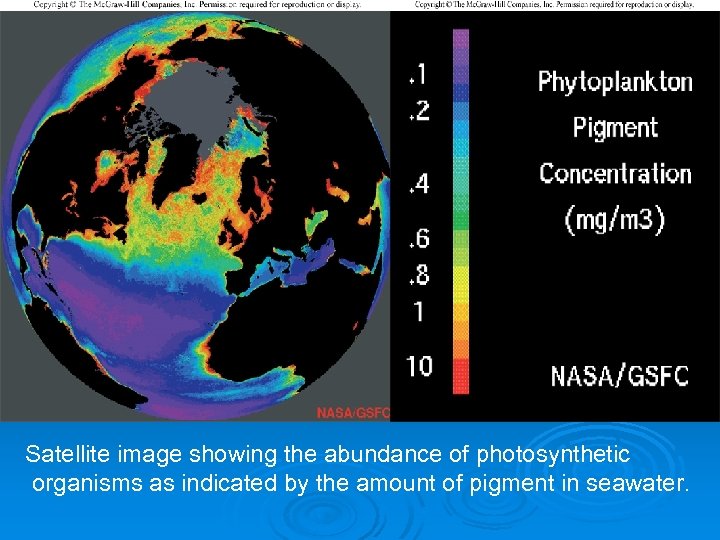 Satellite image showing the abundance of photosynthetic organisms as indicated by the amount of pigment in seawater.
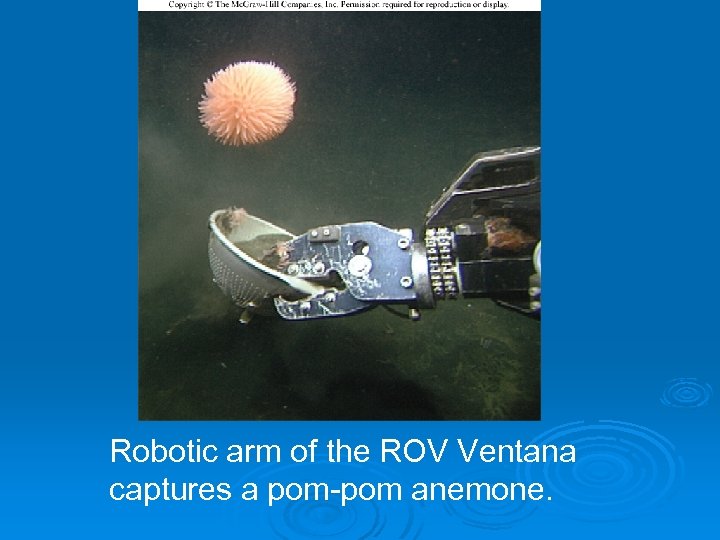 Robotic arm of the ROV Ventana captures a pom-pom anemone.
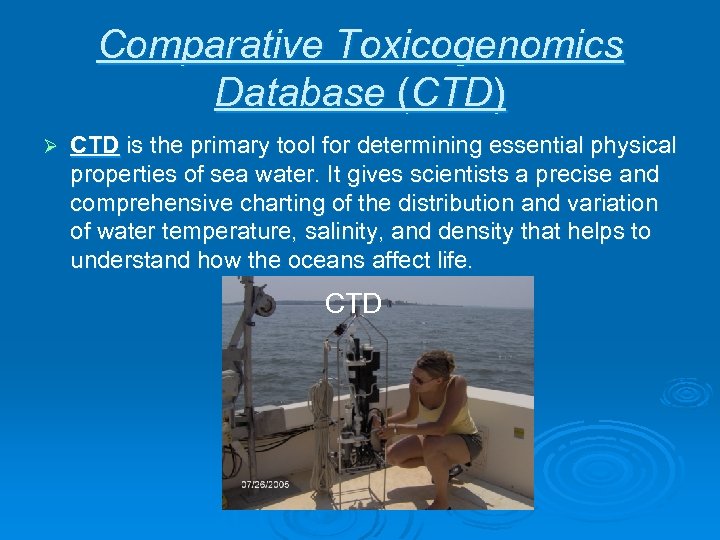 Comparative Toxicogenomics Database (CTD) Ø CTD is the primary tool for determining essential physical properties of sea water. It gives scientists a precise and comprehensive charting of the distribution and variation of water temperature, salinity, and density that helps to understand how the oceans affect life. CTD