


 Скачать презентацию Traumatic Injuries to the Teeth Scott A Schwartz
48432c59deb3c797e9cef99f77cadb85.ppt
- Количество слайдов: 114
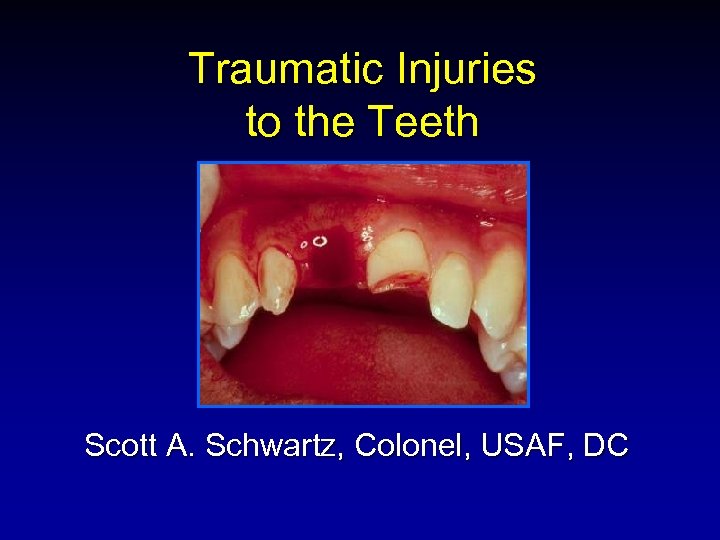 Traumatic Injuries to the Teeth Scott A. Schwartz, Colonel, USAF, DC
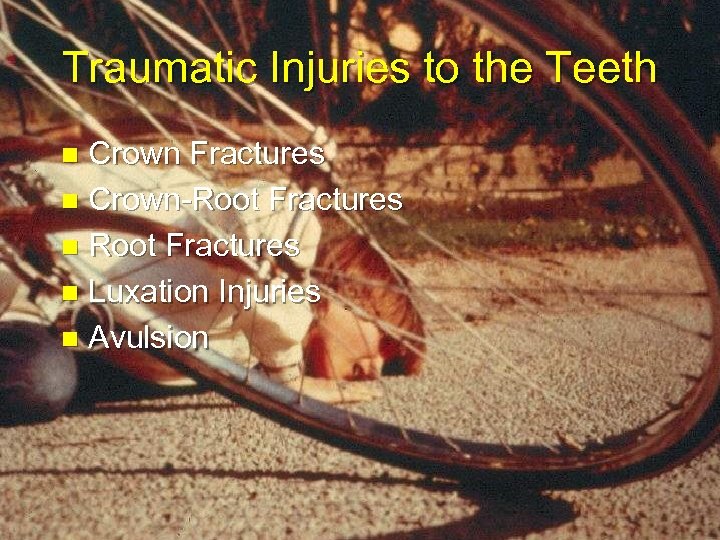 Traumatic Injuries to the Teeth Crown Fractures n Crown-Root Fractures n Luxation Injuries n Avulsion n
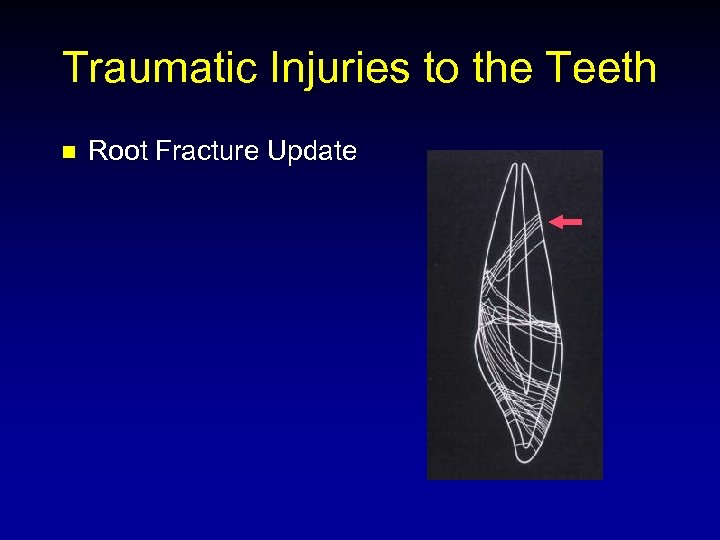 Traumatic Injuries to the Teeth n Root Fracture Update
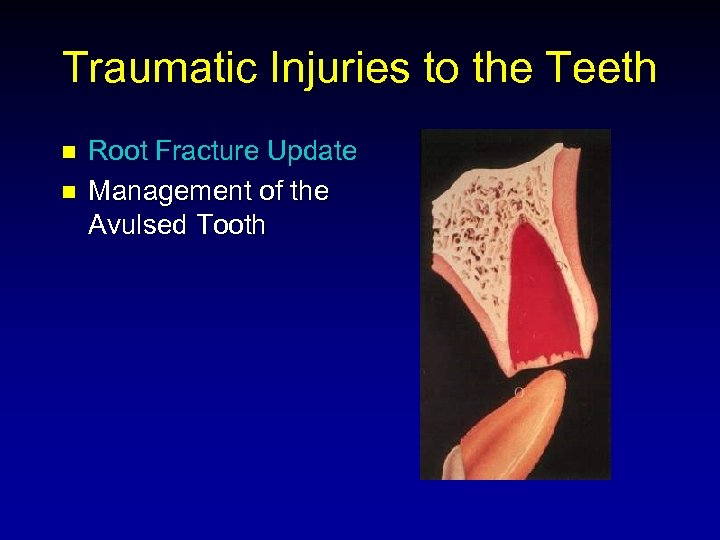 Traumatic Injuries to the Teeth n n Root Fracture Update Management of the Avulsed Tooth
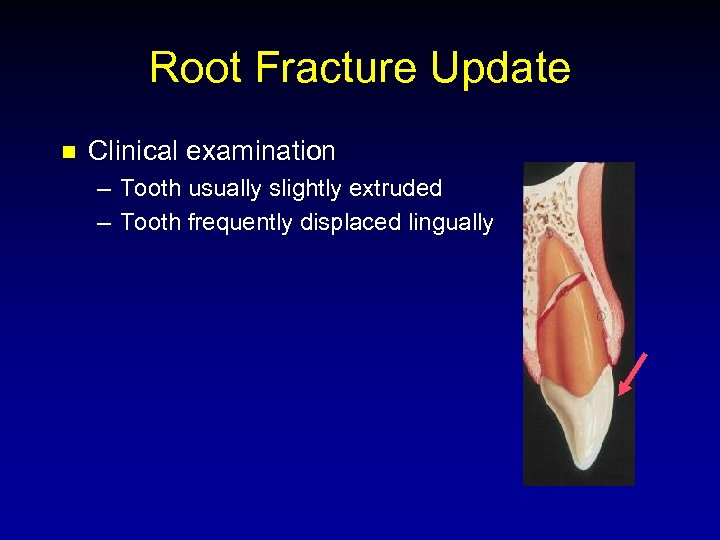 Root Fracture Update n Clinical examination – Tooth usually slightly extruded – Tooth frequently displaced lingually
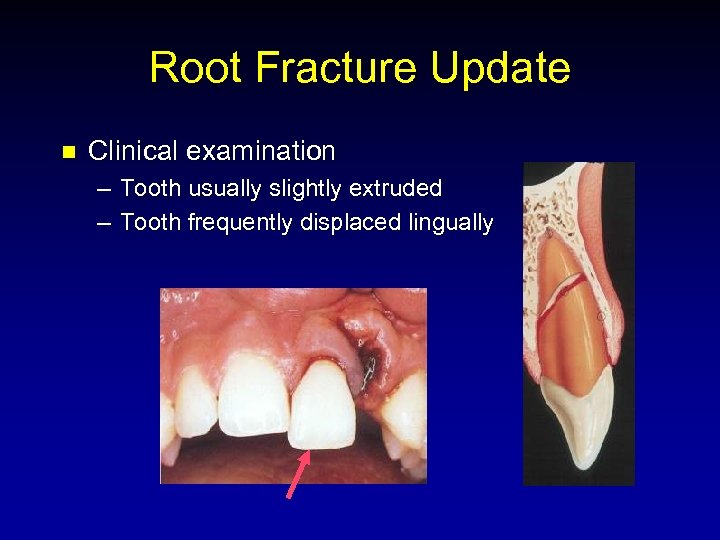 Root Fracture Update n Clinical examination – Tooth usually slightly extruded – Tooth frequently displaced lingually
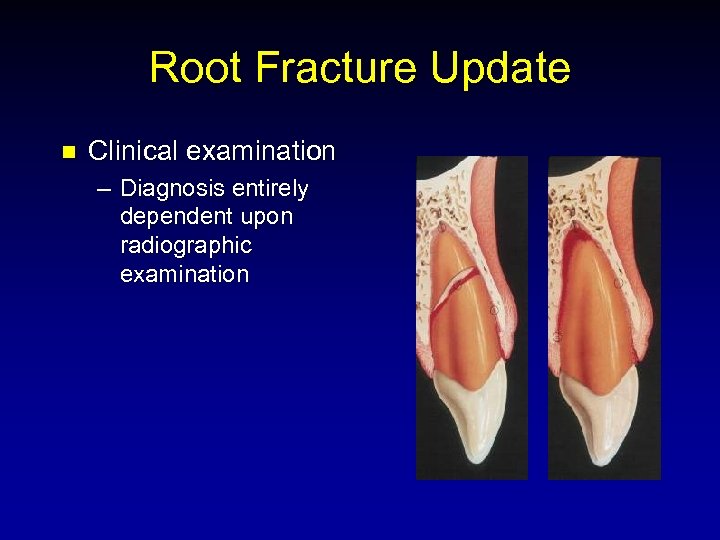 Root Fracture Update n Clinical examination – Diagnosis entirely dependent upon radiographic examination
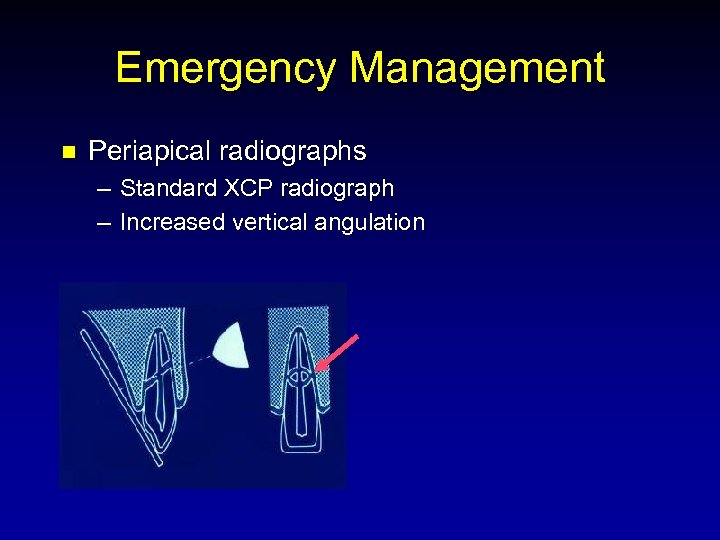 Emergency Management n Periapical radiographs – Standard XCP radiograph – Increased vertical angulation
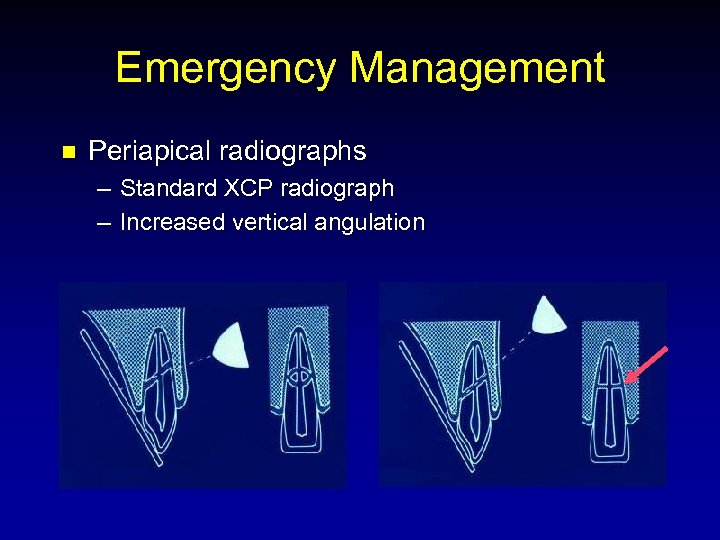 Emergency Management n Periapical radiographs – Standard XCP radiograph – Increased vertical angulation
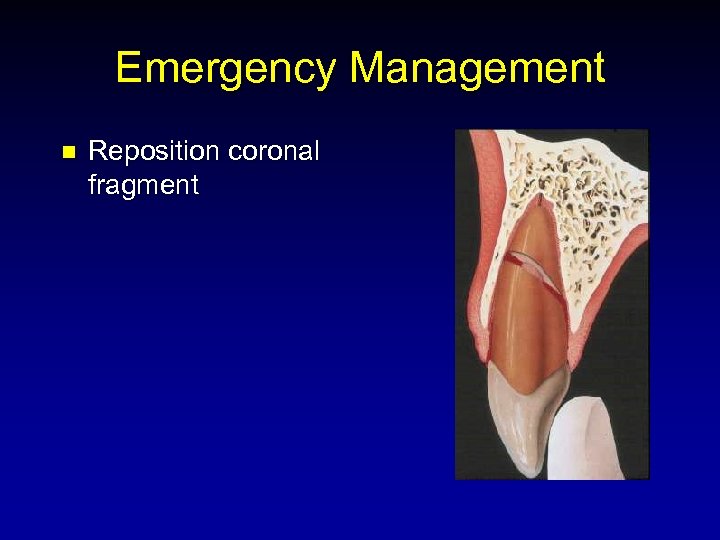 Emergency Management n Reposition coronal fragment
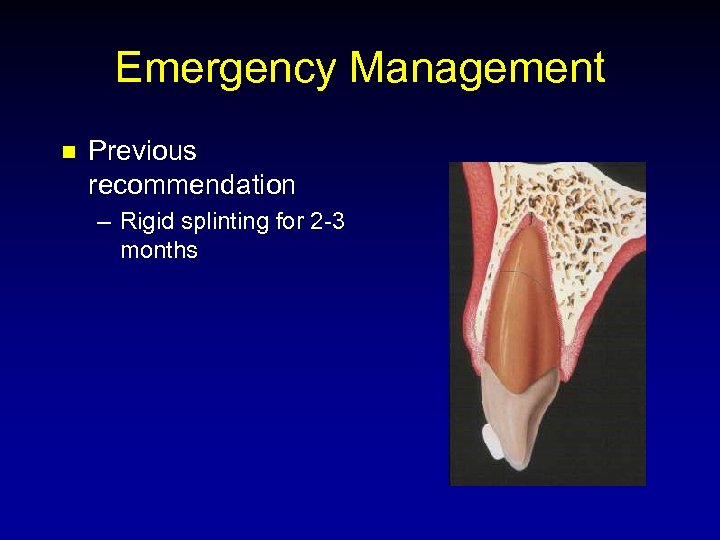 Emergency Management n Previous recommendation – Rigid splinting for 2 -3 months
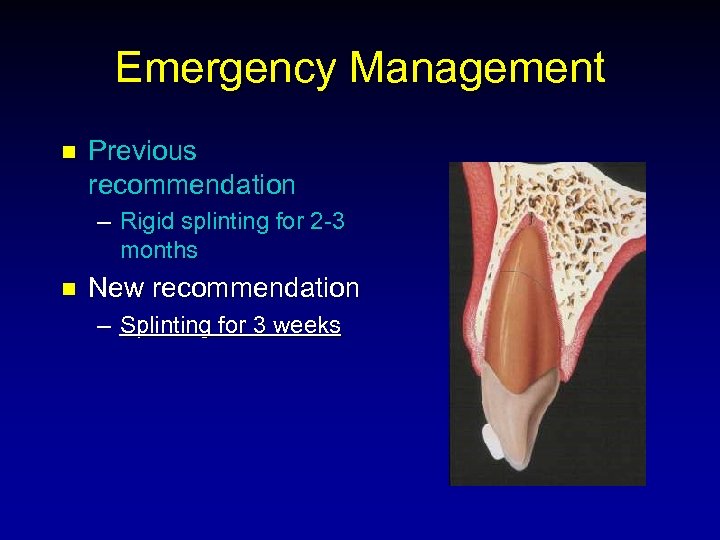 Emergency Management n Previous recommendation – Rigid splinting for 2 -3 months n New recommendation – Splinting for 3 weeks
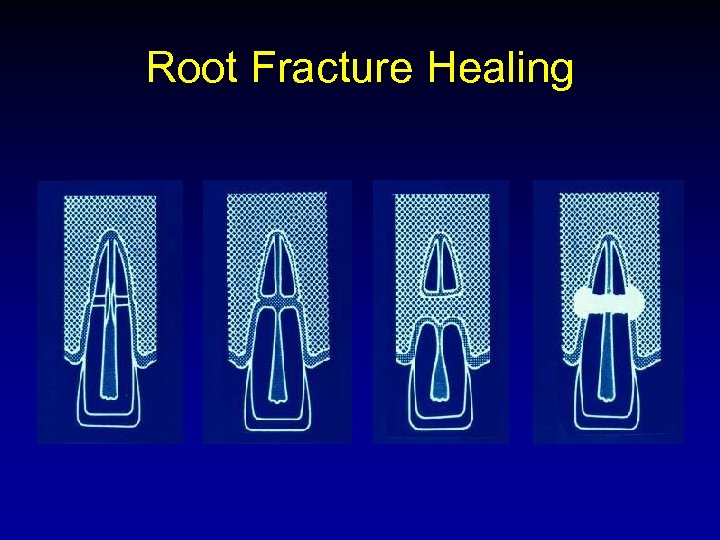 Root Fracture Healing
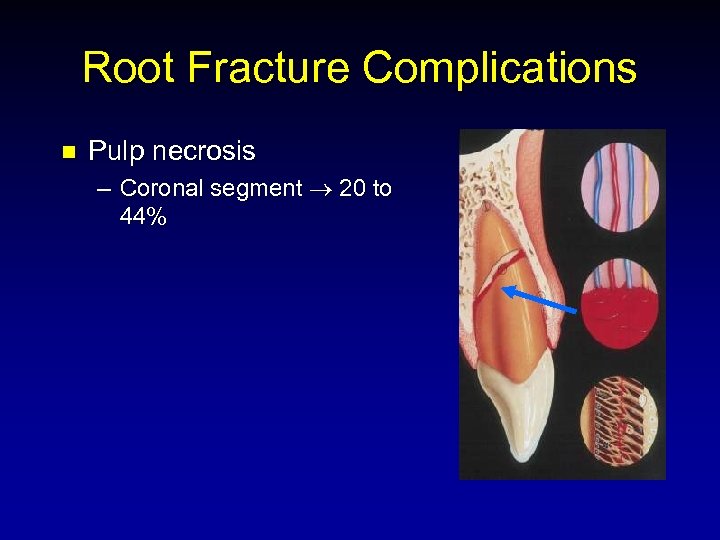 Root Fracture Complications n Pulp necrosis – Coronal segment 20 to 44%
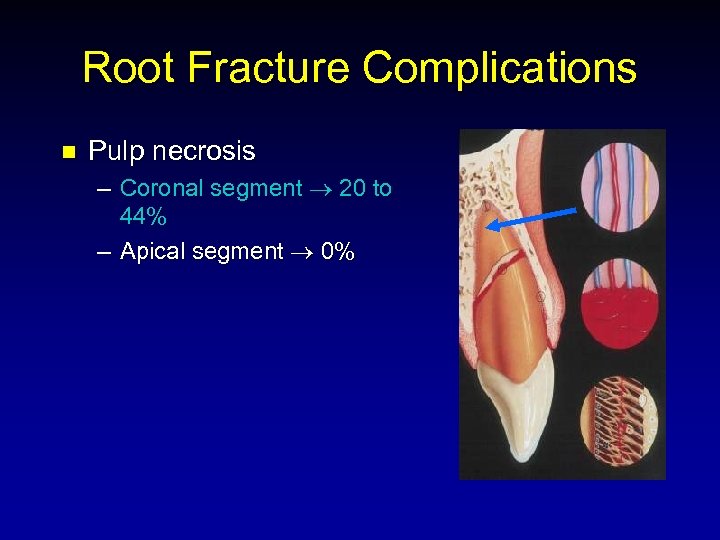 Root Fracture Complications n Pulp necrosis – Coronal segment 20 to 44% – Apical segment 0%
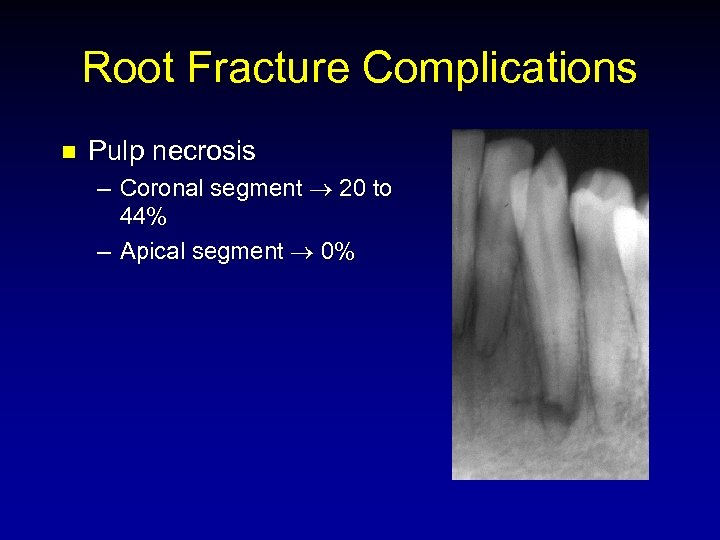 Root Fracture Complications n Pulp necrosis – Coronal segment 20 to 44% – Apical segment 0%
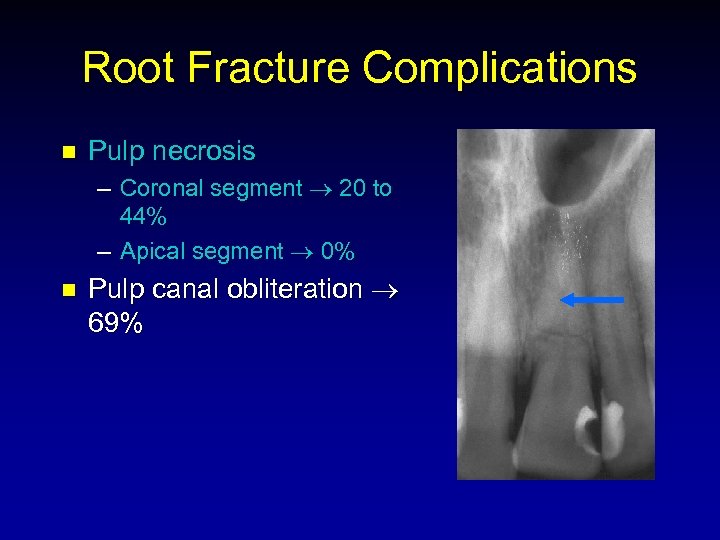 Root Fracture Complications n Pulp necrosis – Coronal segment 20 to 44% – Apical segment 0% n Pulp canal obliteration 69%
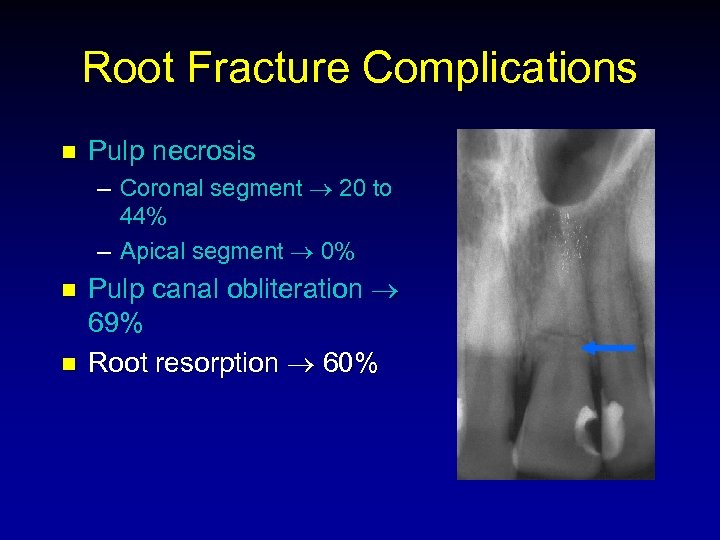 Root Fracture Complications n Pulp necrosis – Coronal segment 20 to 44% – Apical segment 0% n n Pulp canal obliteration 69% Root resorption 60%
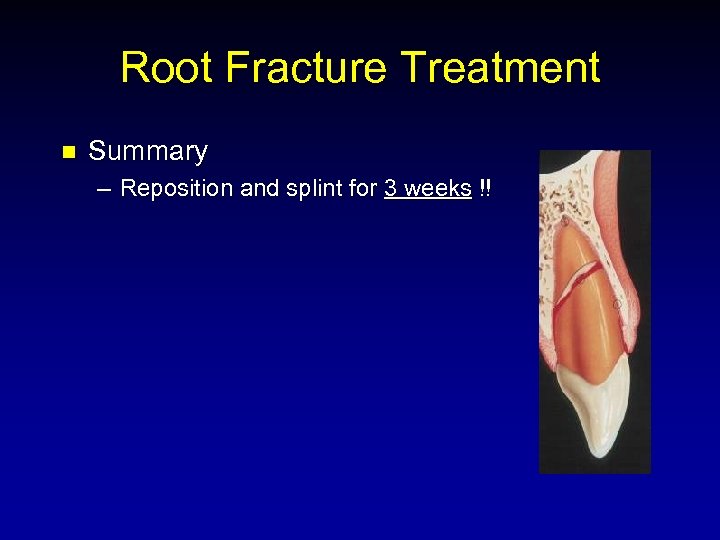 Root Fracture Treatment n Summary – Reposition and splint for 3 weeks !!
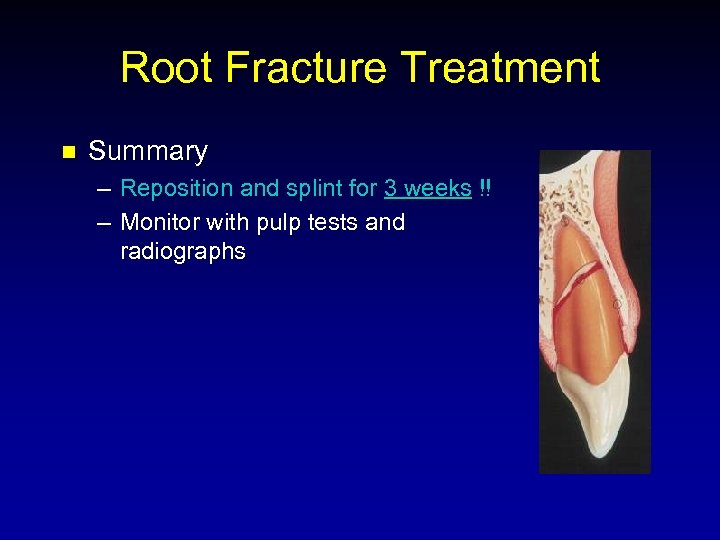 Root Fracture Treatment n Summary – Reposition and splint for 3 weeks !! – Monitor with pulp tests and radiographs
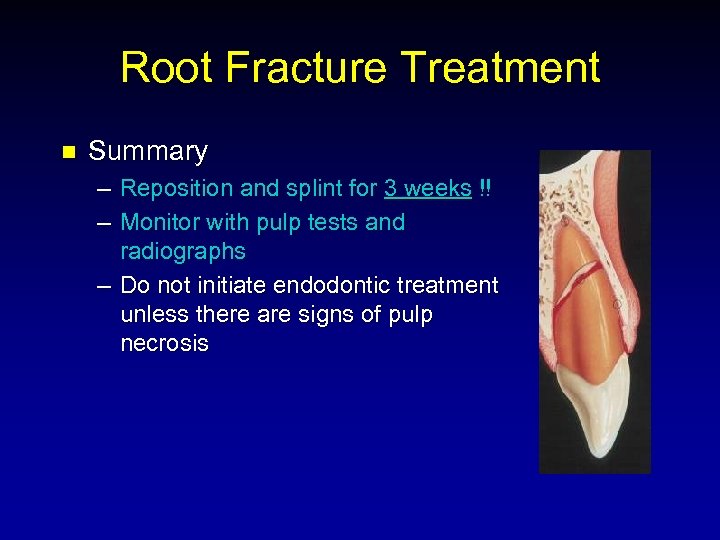 Root Fracture Treatment n Summary – Reposition and splint for 3 weeks !! – Monitor with pulp tests and radiographs – Do not initiate endodontic treatment unless there are signs of pulp necrosis
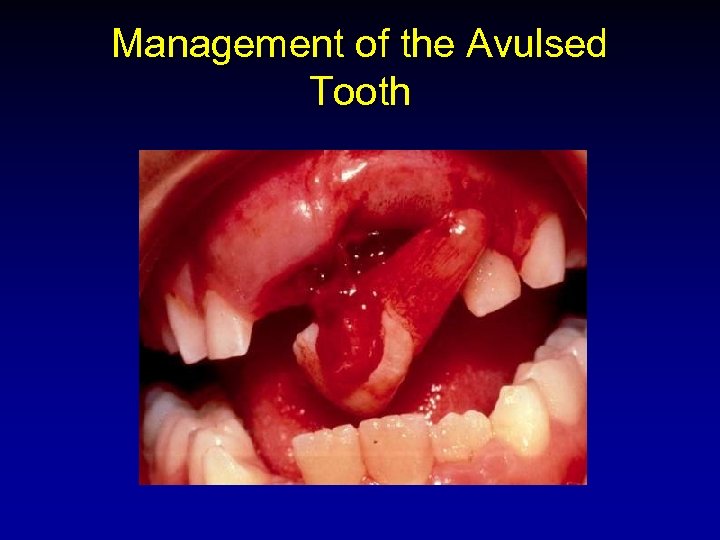 Management of the Avulsed Tooth
 Management of the Avulsed Tooth n n n Overview Periodontal Ligament Responses Treatment Considerations Pulpal Prognosis/ Endodontic Rationale Treatment Regimen
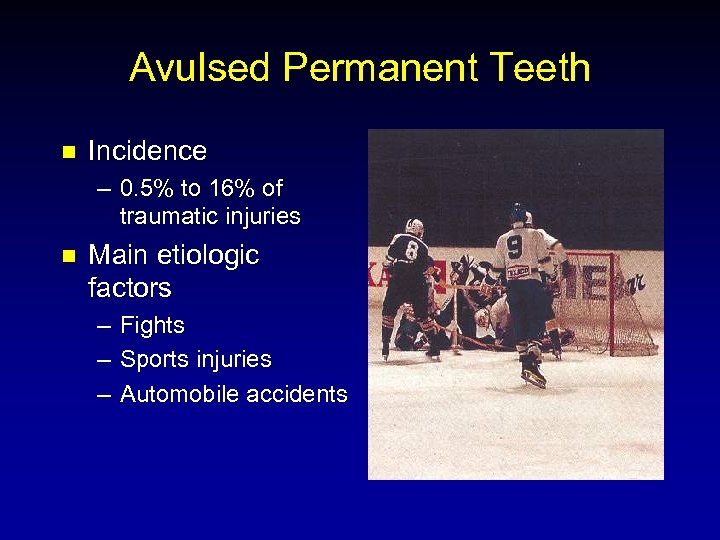 Avulsed Permanent Teeth n Incidence – 0. 5% to 16% of traumatic injuries n Main etiologic factors – – – Fights Sports injuries Automobile accidents
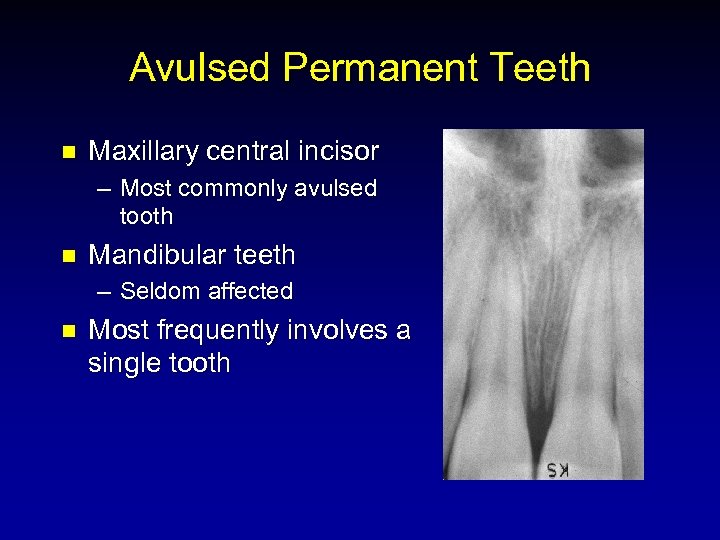 Avulsed Permanent Teeth n Maxillary central incisor – Most commonly avulsed tooth n Mandibular teeth – Seldom affected n Most frequently involves a single tooth
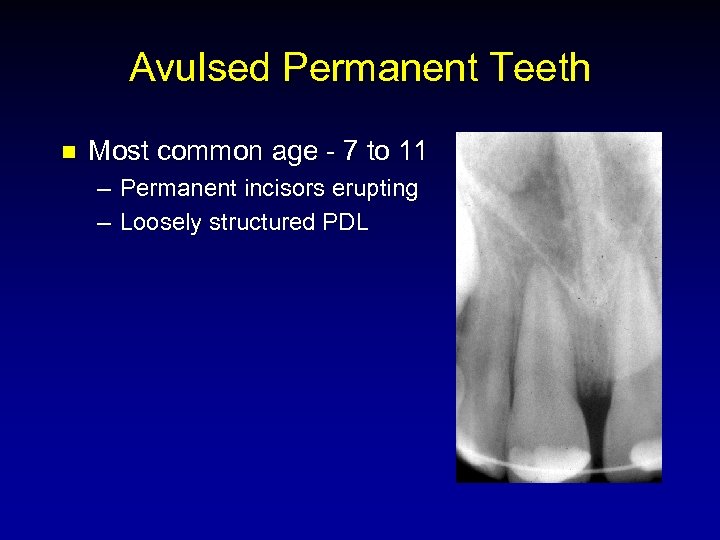 Avulsed Permanent Teeth n Most common age - 7 to 11 – Permanent incisors erupting – Loosely structured PDL
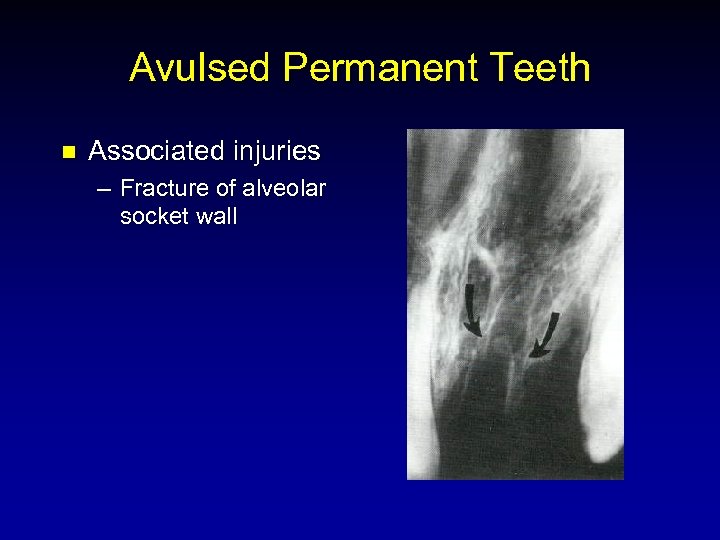 Avulsed Permanent Teeth n Associated injuries – Fracture of alveolar socket wall
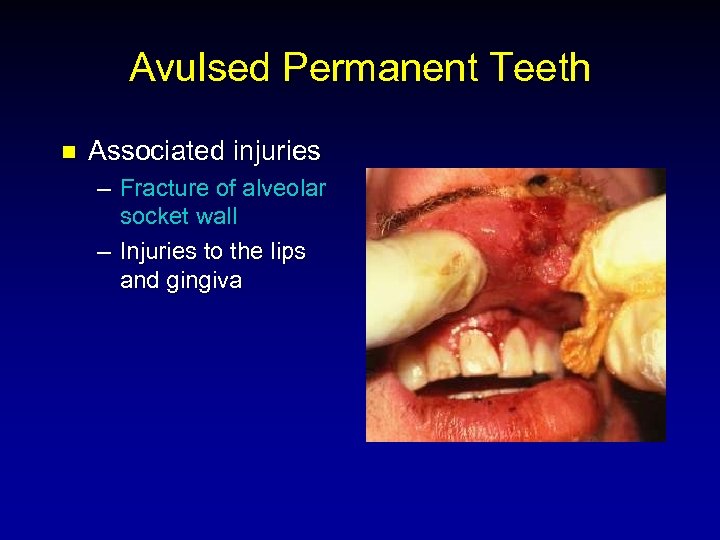 Avulsed Permanent Teeth n Associated injuries – Fracture of alveolar socket wall – Injuries to the lips and gingiva
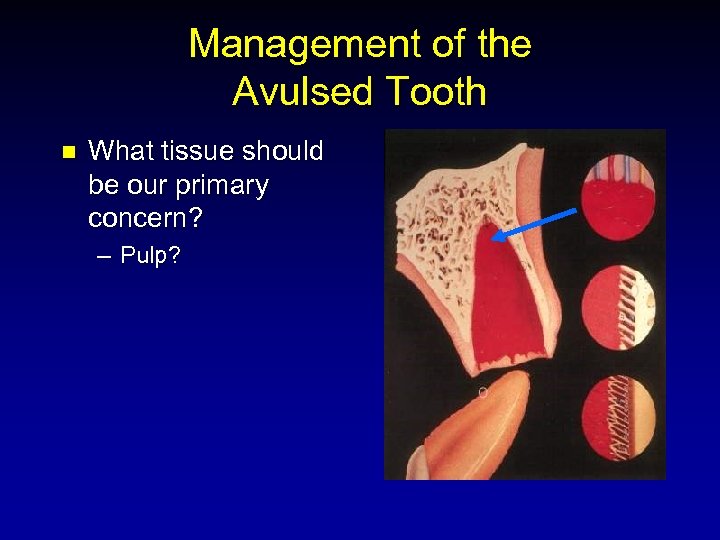 Management of the Avulsed Tooth n What tissue should be our primary concern? – Pulp?
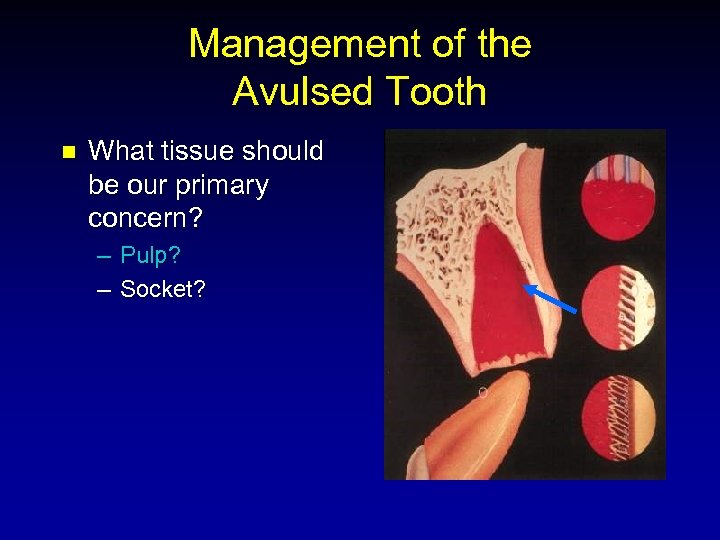 Management of the Avulsed Tooth n What tissue should be our primary concern? – Pulp? – Socket?
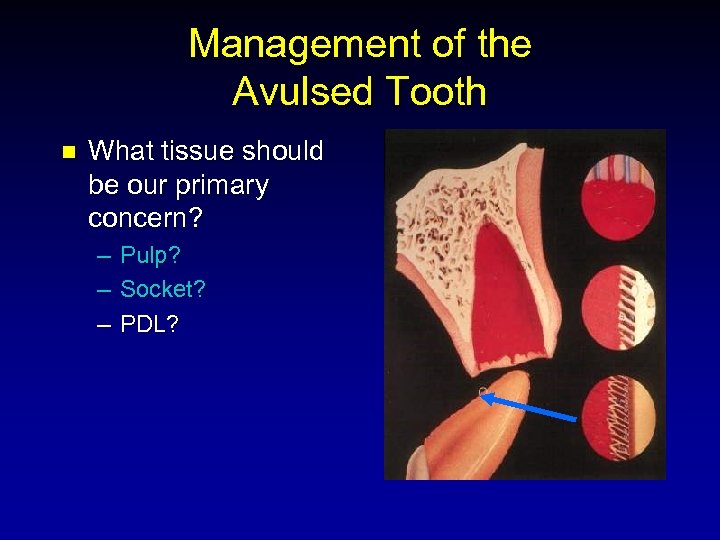 Management of the Avulsed Tooth n What tissue should be our primary concern? – – – Pulp? Socket? PDL?
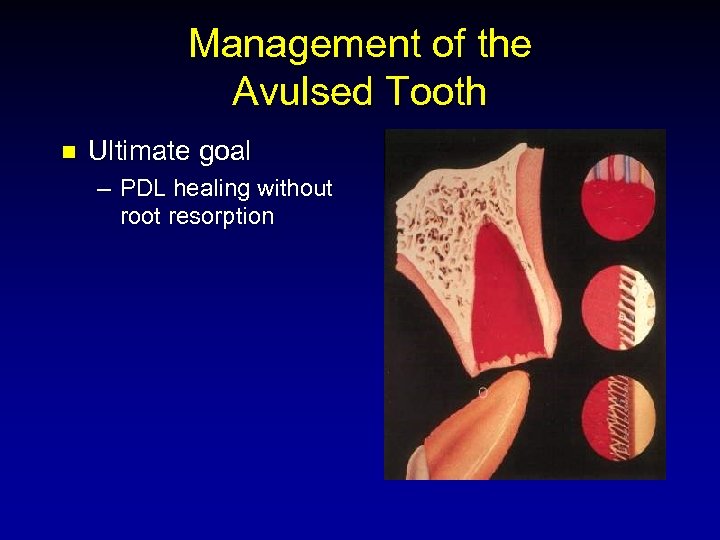 Management of the Avulsed Tooth n Ultimate goal – PDL healing without root resorption
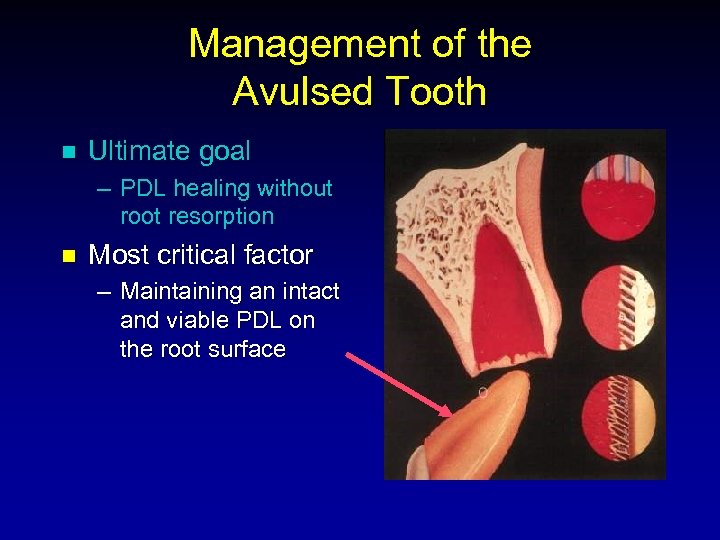 Management of the Avulsed Tooth n Ultimate goal – PDL healing without root resorption n Most critical factor – Maintaining an intact and viable PDL on the root surface
 Periodontal Ligament Responses n n n Surface Resorption Replacement Resorption (Ankylosis) Inflammatory Resorption Andreasen JO, Hjorting-Hansen E. Replantation of teeth II. Histological study of 22 replanted anterior teeth in humans. Acta Odontol Scand 1966; 24: 287 -306.
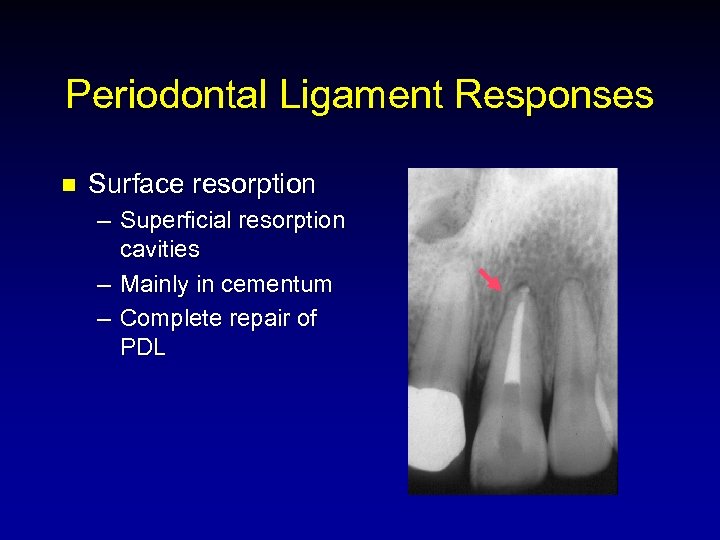 Periodontal Ligament Responses n Surface resorption – Superficial resorption cavities – Mainly in cementum – Complete repair of PDL
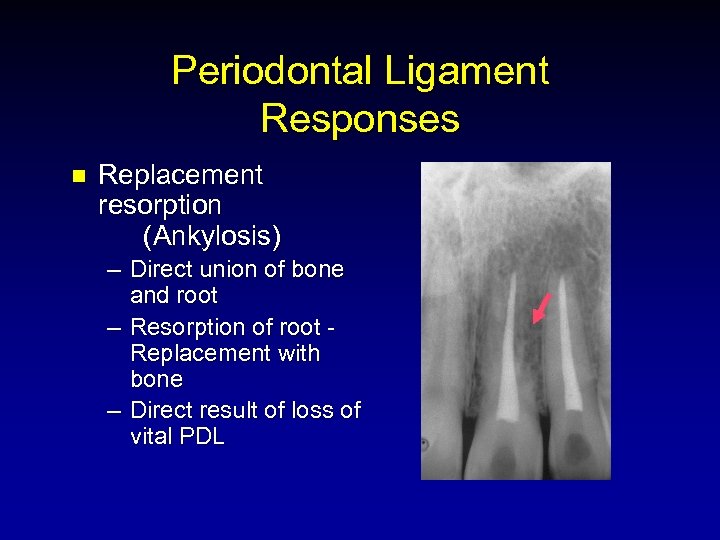 Periodontal Ligament Responses n Replacement resorption (Ankylosis) – Direct union of bone and root – Resorption of root Replacement with bone – Direct result of loss of vital PDL
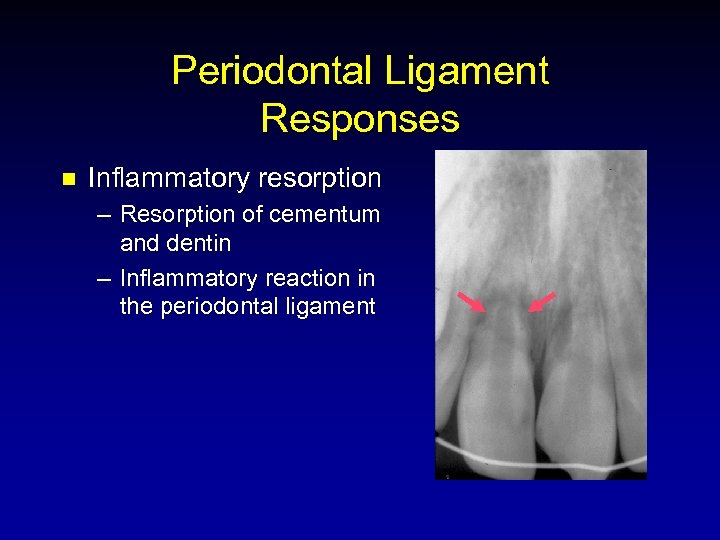 Periodontal Ligament Responses n Inflammatory resorption – Resorption of cementum and dentin – Inflammatory reaction in the periodontal ligament
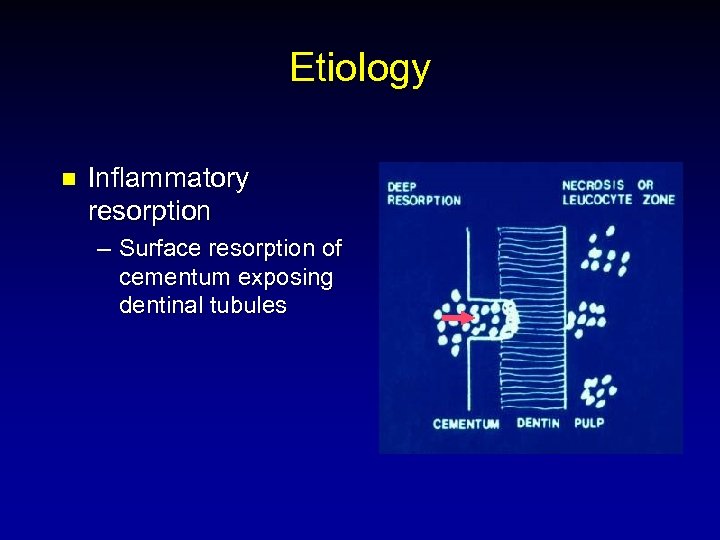 Etiology n Inflammatory resorption – Surface resorption of cementum exposing dentinal tubules
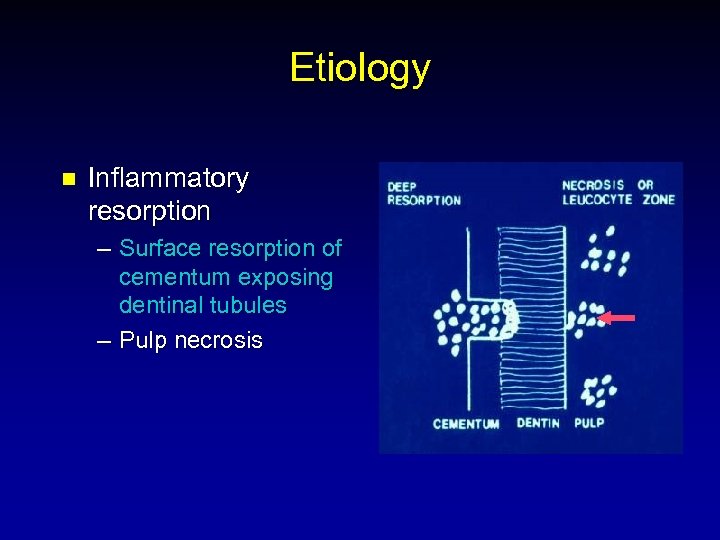 Etiology n Inflammatory resorption – Surface resorption of cementum exposing dentinal tubules – Pulp necrosis
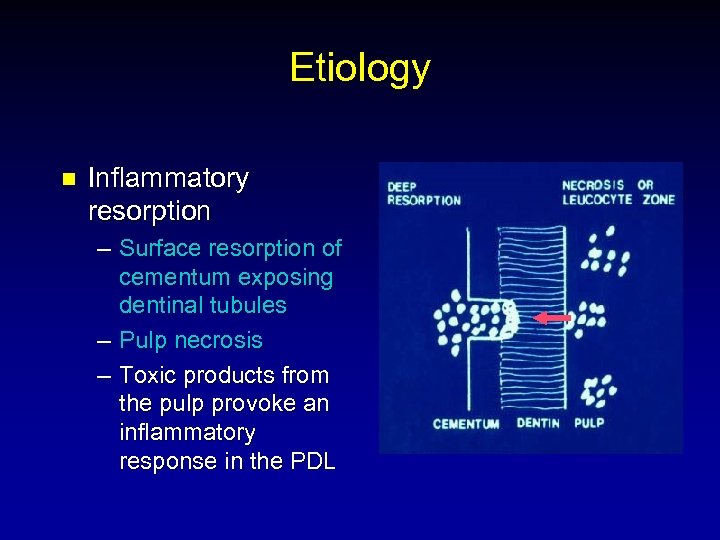 Etiology n Inflammatory resorption – Surface resorption of cementum exposing dentinal tubules – Pulp necrosis – Toxic products from the pulp provoke an inflammatory response in the PDL
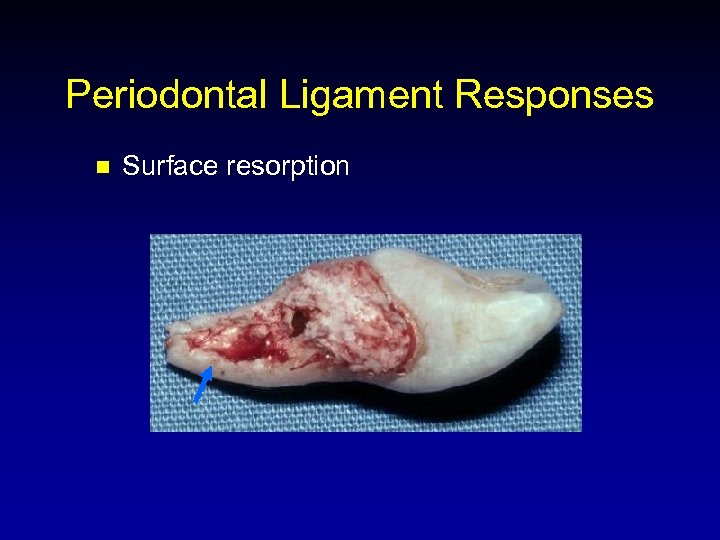 Periodontal Ligament Responses n Surface resorption
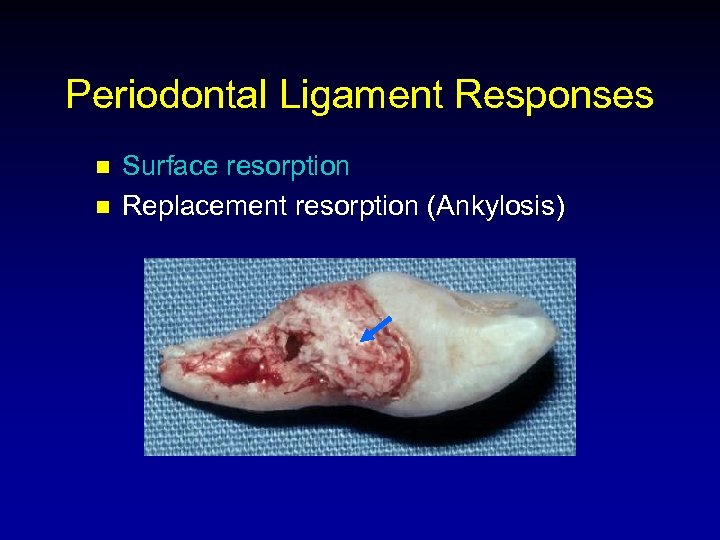 Periodontal Ligament Responses n n Surface resorption Replacement resorption (Ankylosis)
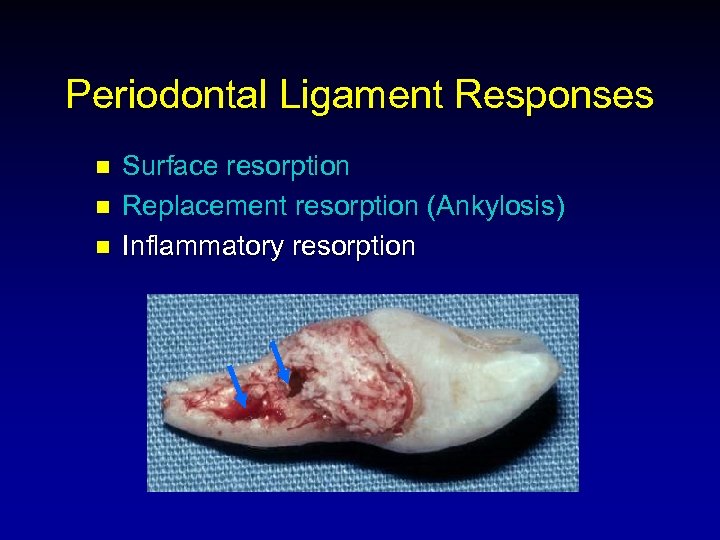 Periodontal Ligament Responses n n n Surface resorption Replacement resorption (Ankylosis) Inflammatory resorption
 Treatment Considerations n n n Extraoral time Extraoral environment Root surface manipulation Management of the socket Stabilization
 Extraoral Time n Shorter time = Better prognosis* < 30 min 10% resorption > 90 min 90% resorption Andreasen JO, Hjorting-Hansen E. Replantation of teeth I. Radiographic and clinical study of 110 human teeth replanted after accidental loss. Acta Odontol Scand 1966; 24: 263 -86.
 Extraoral Time n Shorter time = Better prognosis* < 30 min 10% resorption > 90 min 90% resorption *depending on storage medium Andreasen JO, Hjorting-Hansen E. Replantation of teeth I. Radiographic and clinical study of 110 human teeth replanted after accidental loss. Acta Odontol Scand 1966; 24: 263 -86.
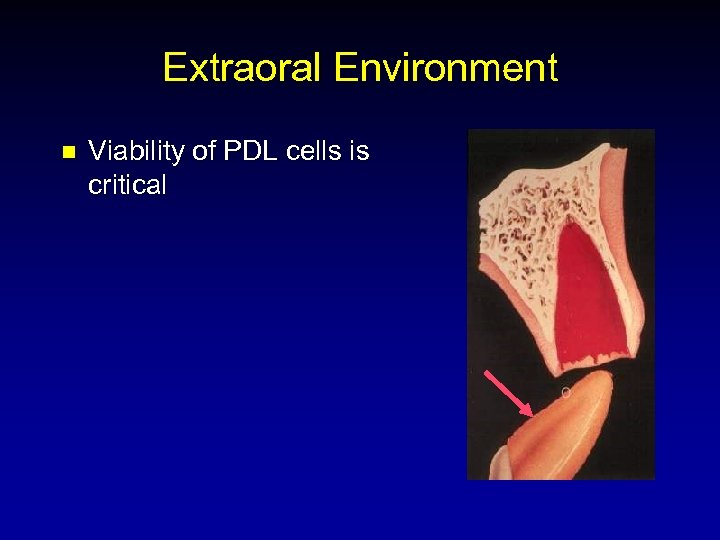 Extraoral Environment n Viability of PDL cells is critical
 Storage Media n n Tap Water Dry Saliva Saline Poor results Andreasen JO. Effect of extra-alveolar period and storage media periodontal and pulpal healing after replantation of mature permanent incisors in monkeys. Int J Oral Surg 1981; 10: 43 -53. upon
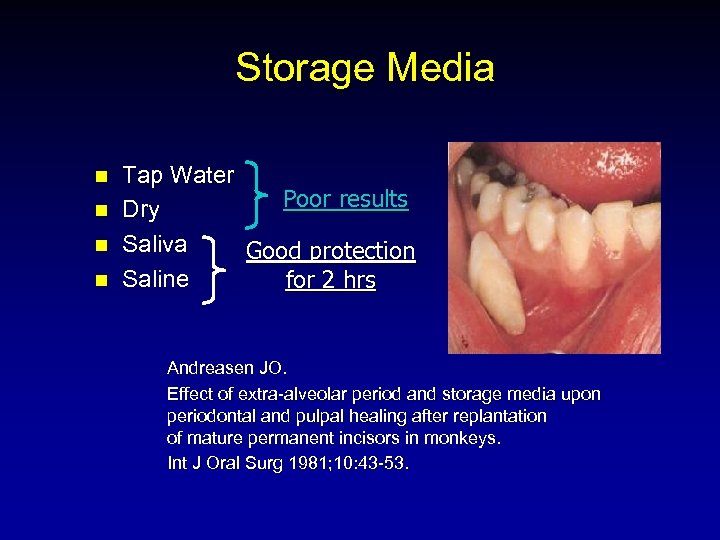 Storage Media n n Tap Water Poor results Dry Saliva Good protection Saline for 2 hrs Andreasen JO. Effect of extra-alveolar period and storage media upon periodontal and pulpal healing after replantation of mature permanent incisors in monkeys. Int J Oral Surg 1981; 10: 43 -53.
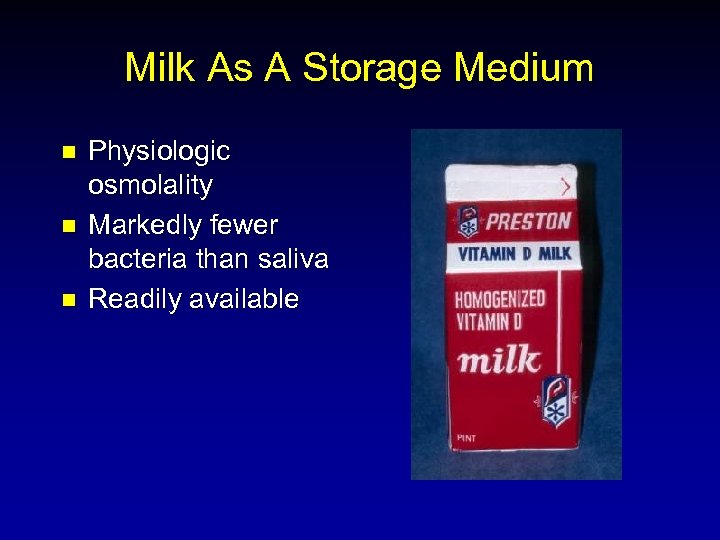 Milk As A Storage Medium n n n Physiologic osmolality Markedly fewer bacteria than saliva Readily available
 Storage Media - Milk vs. Saliva n Storage for 2 hrs – Periodontal healing almost as good as immediate replantation Blomlof L, et al. Storage of experimentally avulsed teeth in milk prior to replantation. J Dent Res 1983; 62: 912 -6.
 Storage Media - Milk vs. Saliva n Storage for 2 hrs – Periodontal healing almost as good as immediate replantation n Storage for 6 hrs – Saliva extensive replacement resorption – Milk healing almost as good as immediate replant Blomlof L, et al. Storage of experimentally avulsed teeth in milk prior to replantation. J Dent Res 1983; 62: 912 -6.
 Cell Culture Media n n Eagle’s Medium Hank’s Balanced Salt Solution
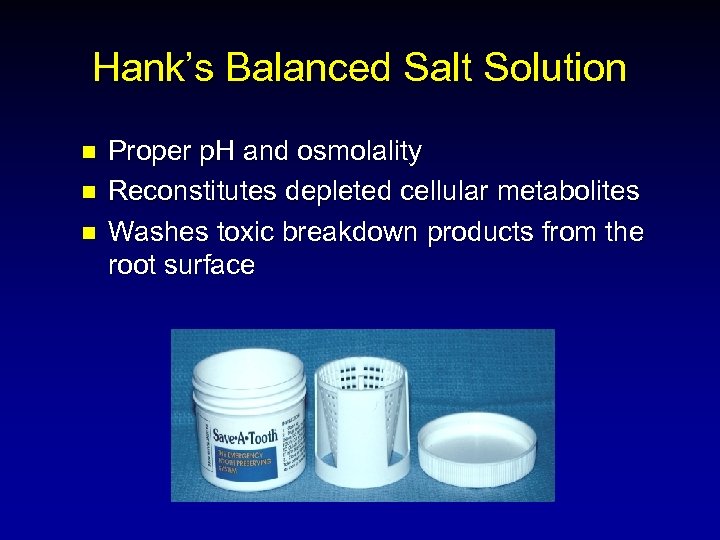 Hank’s Balanced Salt Solution n Proper p. H and osmolality Reconstitutes depleted cellular metabolites Washes toxic breakdown products from the root surface
 Organ Transplant Storage Media n Viaspan – Dramatically prolongs the storage of human organs – Expensive – Not readily available
 Storage Media Comparison n Viaspan – Complete healing after 6 and 12 hrs – Good for extended storage periods (72 and 96 hrs) Trope M, Friedman S. Periodontal healing of replanted dog teeth stored in Viaspan, milk and Hank’s balanced salt solution. Endod Dent Traumatol 1992; 8: 183 -8.
 Storage Media Comparison n Viaspan – Complete healing after 6 and 12 hrs – Good for extended storage periods (72 and 96 hrs) n Hank’s balanced salt solution – Healing results similar to Viaspan Trope M, Friedman S. Periodontal healing of replanted dog teeth stored in Viaspan, milk and Hank’s balanced salt solution. Endod Dent Traumatol 1992; 8: 183 -8.
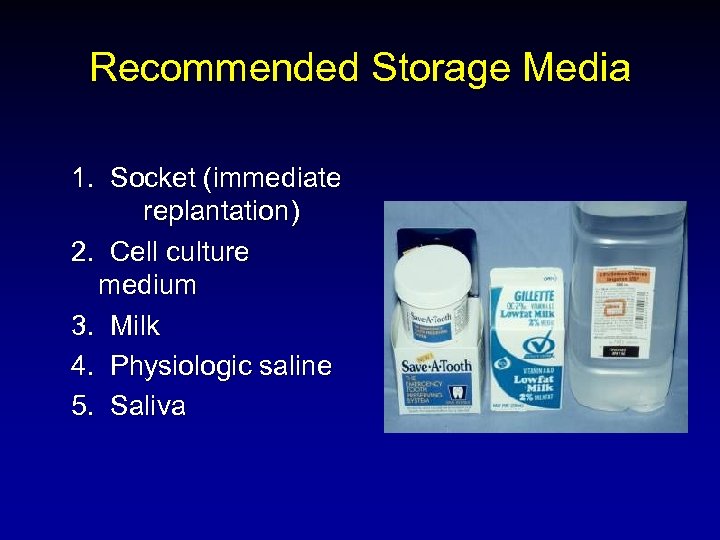 Recommended Storage Media 1. Socket (immediate replantation) 2. Cell culture medium 3. Milk 4. Physiologic saline 5. Saliva
 Root Surface Manipulation n Attempt to retain PDL cell viability – Do not curette root surface – Avoid caustic chemicals Van Hassel HJ, Oswald RJ, Harrington GW. Replantation 2. The role of the periodontal ligament. J Endodon 1980; 6: 506 -8.
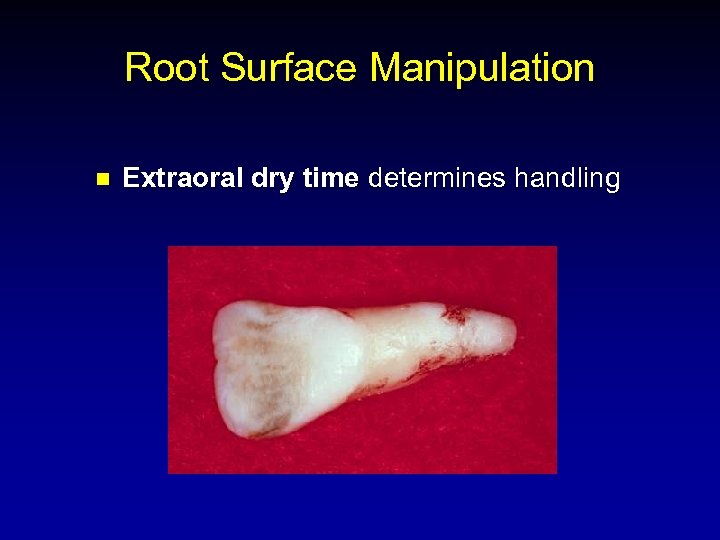 Root Surface Manipulation n Extraoral dry time determines handling
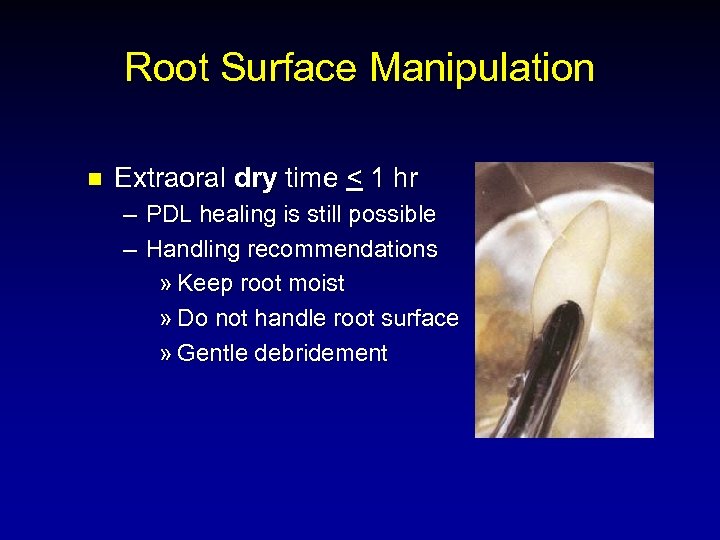 Root Surface Manipulation n Extraoral dry time < 1 hr – PDL healing is still possible – Handling recommendations » Keep root moist » Do not handle root surface » Gentle debridement
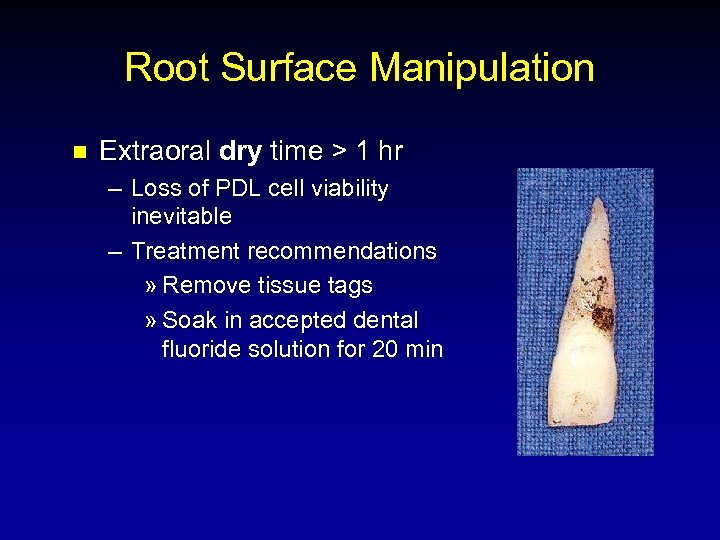 Root Surface Manipulation n Extraoral dry time > 1 hr – Loss of PDL cell viability inevitable – Treatment recommendations » Remove tissue tags » Soak in accepted dental fluoride solution for 20 min
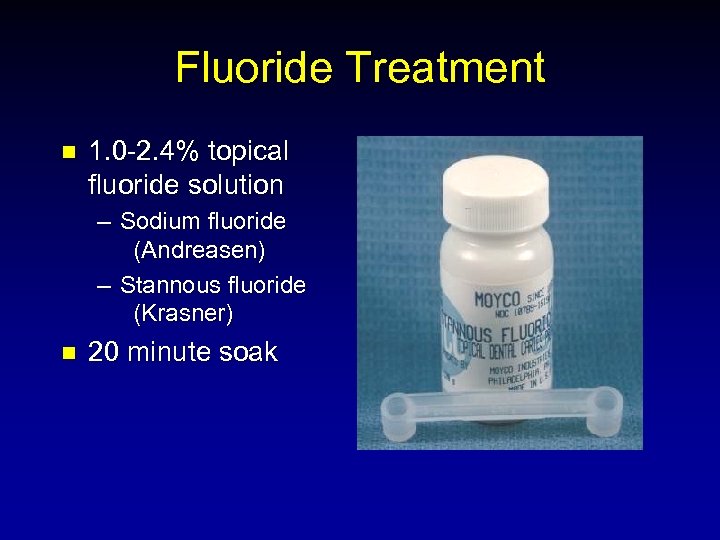 Fluoride Treatment n 1. 0 -2. 4% topical fluoride solution – Sodium fluoride (Andreasen) – Stannous fluoride (Krasner) n 20 minute soak
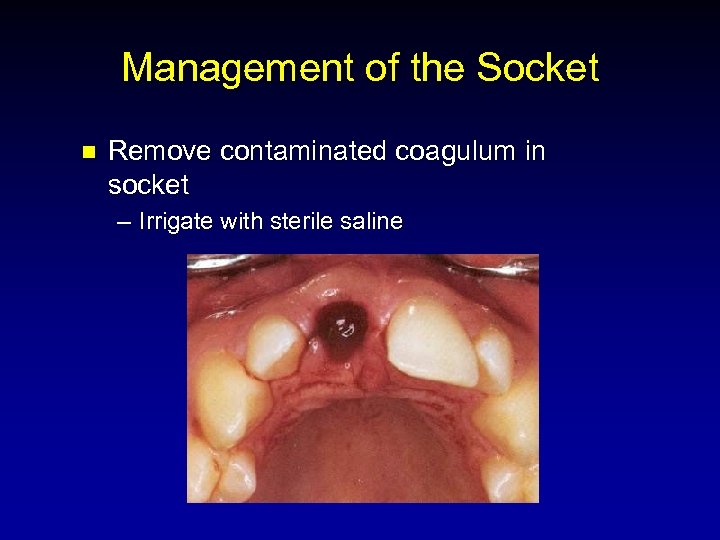 Management of the Socket n Remove contaminated coagulum in socket – Irrigate with sterile saline
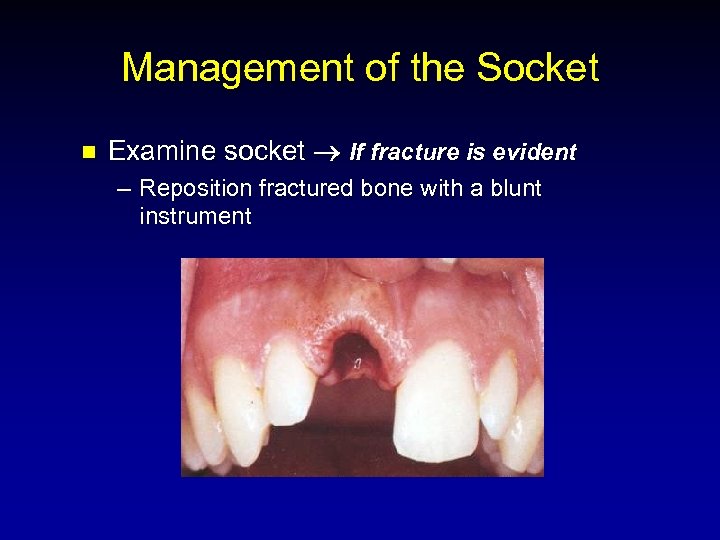 Management of the Socket n Examine socket If fracture is evident – Reposition fractured bone with a blunt instrument
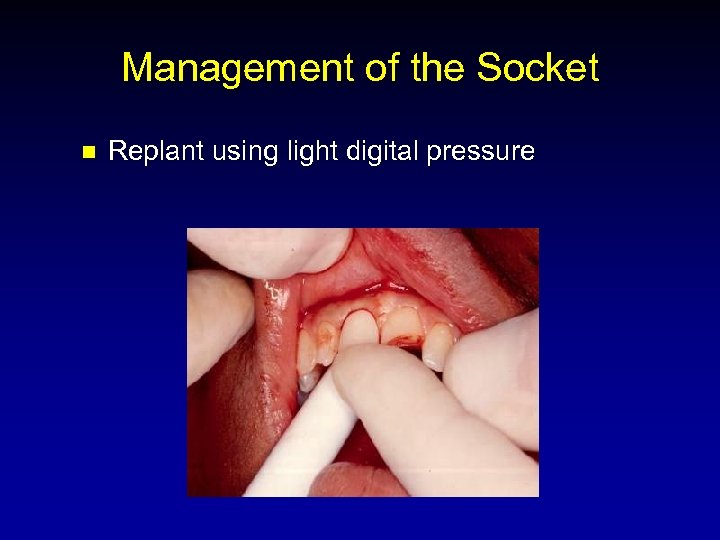 Management of the Socket n Replant using light digital pressure
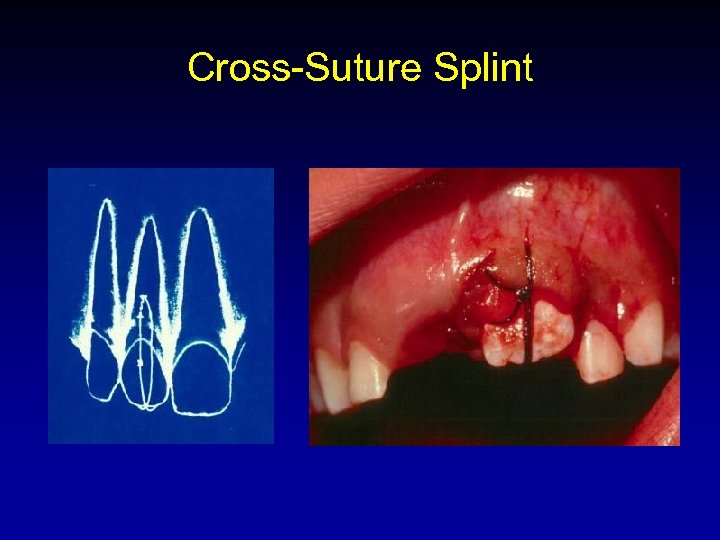
 Stabilization n Splint – Definition a rigid or flexible device used to support, protect, or immobilize teeth, preventing further injury – Types • Acid etch composite • Cross-suture
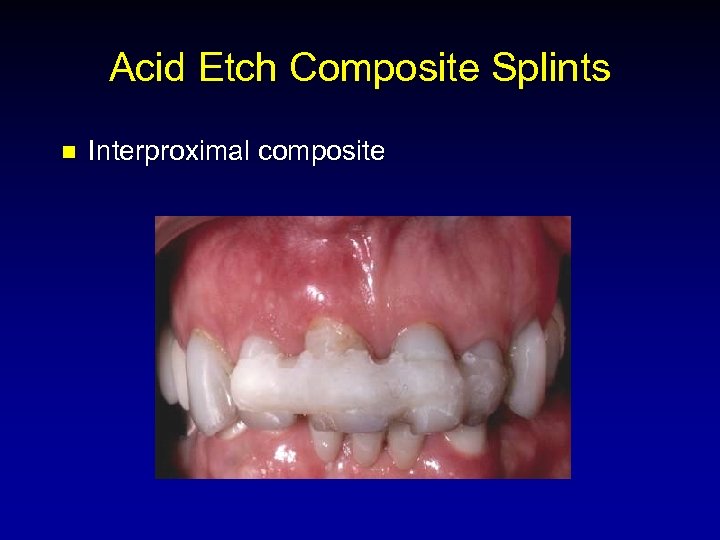 Acid Etch Composite Splints n Interproximal composite
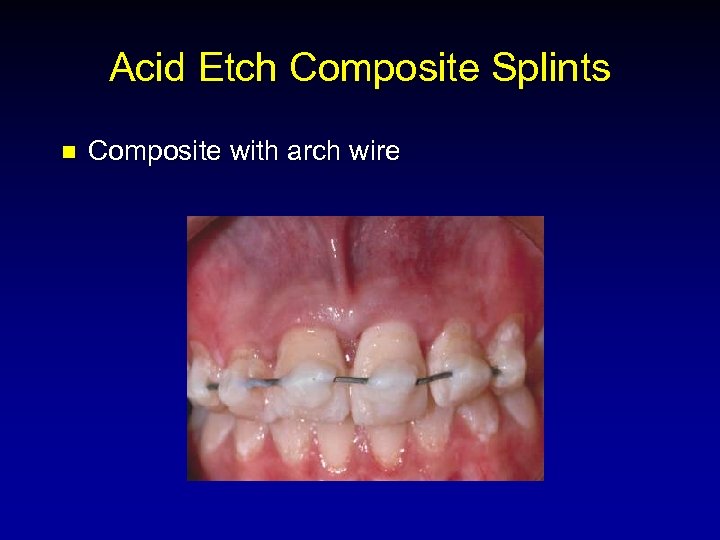 Acid Etch Composite Splints n Composite with arch wire
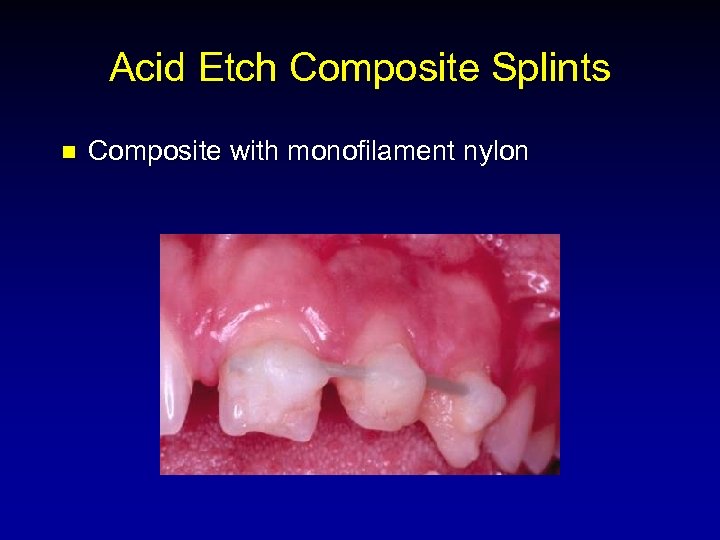 Acid Etch Composite Splints n Composite with monofilament nylon
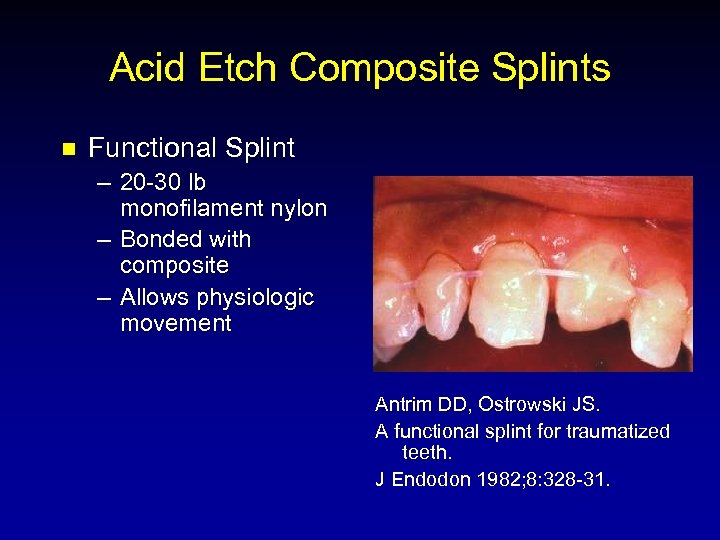 Acid Etch Composite Splints n Functional Splint – 20 -30 lb monofilament nylon – Bonded with composite – Allows physiologic movement Antrim DD, Ostrowski JS. A functional splint for traumatized teeth. J Endodon 1982; 8: 328 -31.
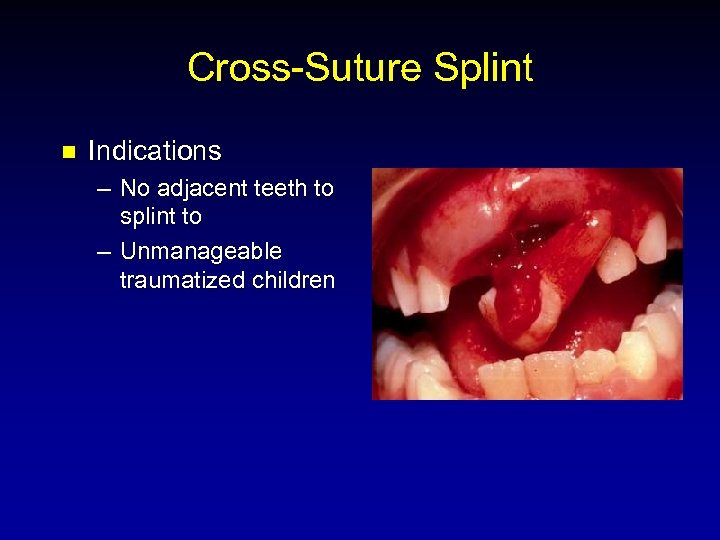 Cross-Suture Splint n Indications – No adjacent teeth to splint to – Unmanageable traumatized children
 Cross-Suture Splint
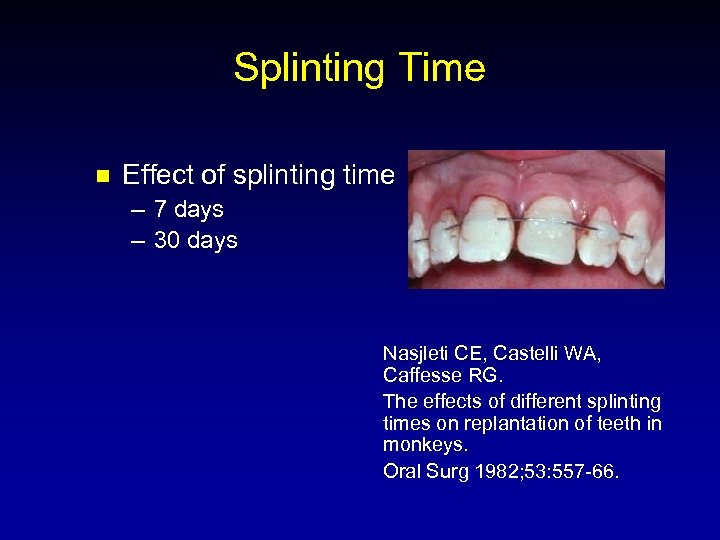 Splinting Time n Effect of splinting time – 7 days – 30 days Nasjleti CE, Castelli WA, Caffesse RG. The effects of different splinting times on replantation of teeth in monkeys. Oral Surg 1982; 53: 557 -66.
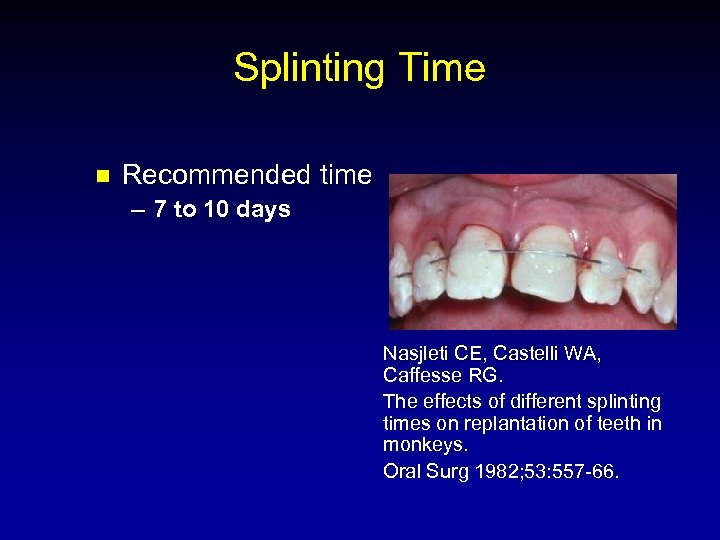 Splinting Time n Recommended time – 7 to 10 days Nasjleti CE, Castelli WA, Caffesse RG. The effects of different splinting times on replantation of teeth in monkeys. Oral Surg 1982; 53: 557 -66.
 Pulpal Prognosis n n Stage of root development Dry storage time Storage media Antibiotics
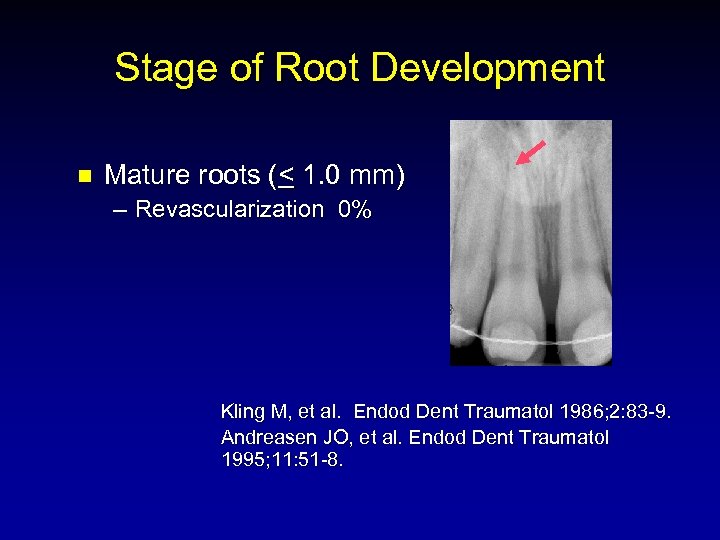 Stage of Root Development n Mature roots (< 1. 0 mm) – Revascularization 0% Kling M, et al. Endod Dent Traumatol 1986; 2: 83 -9. Andreasen JO, et al. Endod Dent Traumatol 1995; 11: 51 -8.
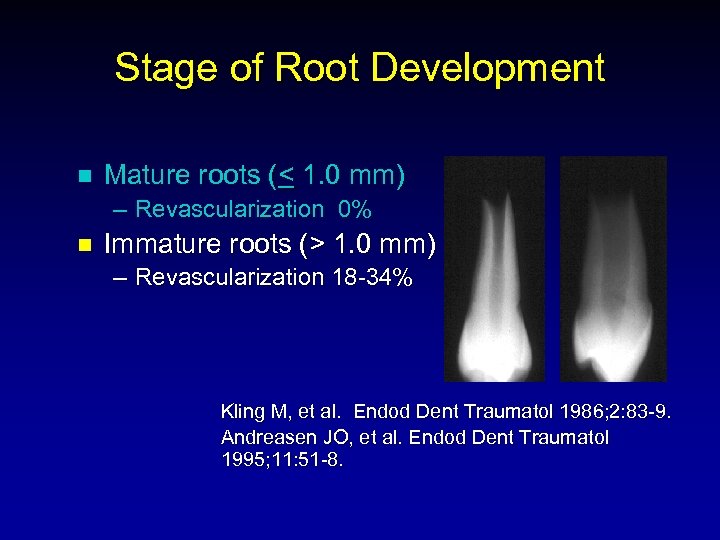 Stage of Root Development n Mature roots (< 1. 0 mm) – Revascularization 0% n Immature roots (> 1. 0 mm) – Revascularization 18 -34% Kling M, et al. Endod Dent Traumatol 1986; 2: 83 -9. Andreasen JO, et al. Endod Dent Traumatol 1995; 11: 51 -8.
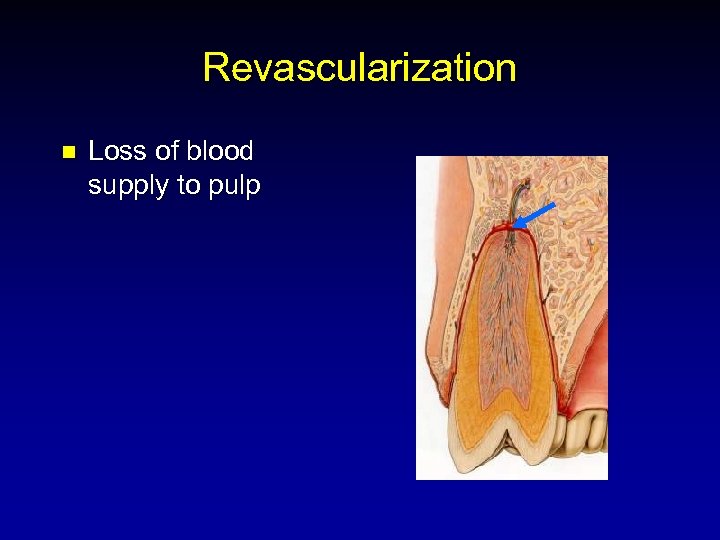 Revascularization n Loss of blood supply to pulp
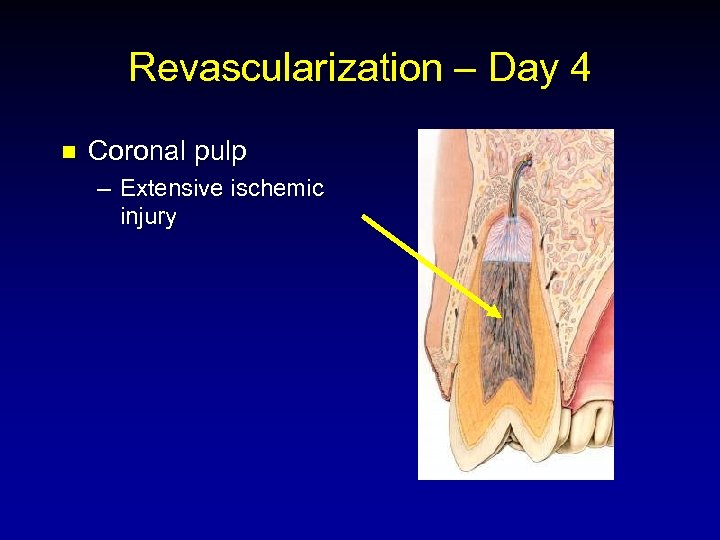 Revascularization – Day 4 n Coronal pulp – Extensive ischemic injury
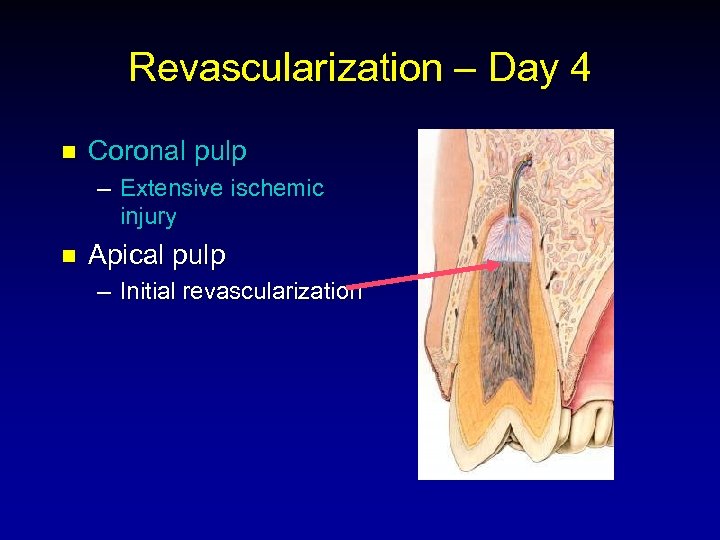 Revascularization – Day 4 n Coronal pulp – Extensive ischemic injury n Apical pulp – Initial revascularization
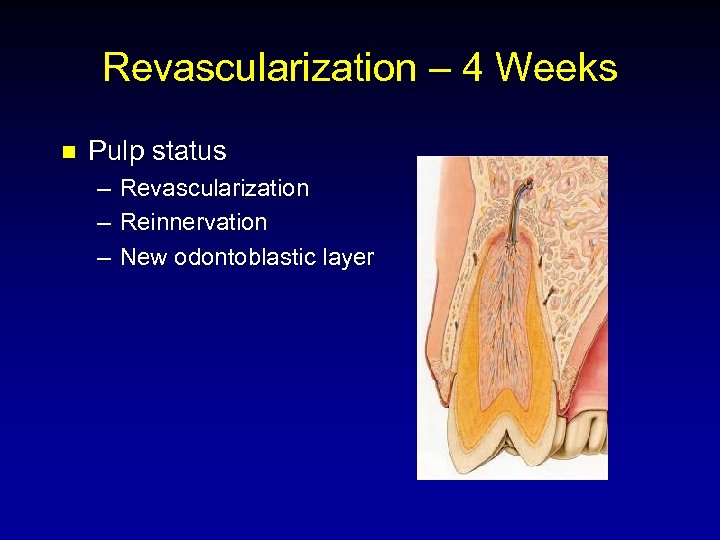 Revascularization – 4 Weeks n Pulp status – – – Revascularization Reinnervation New odontoblastic layer
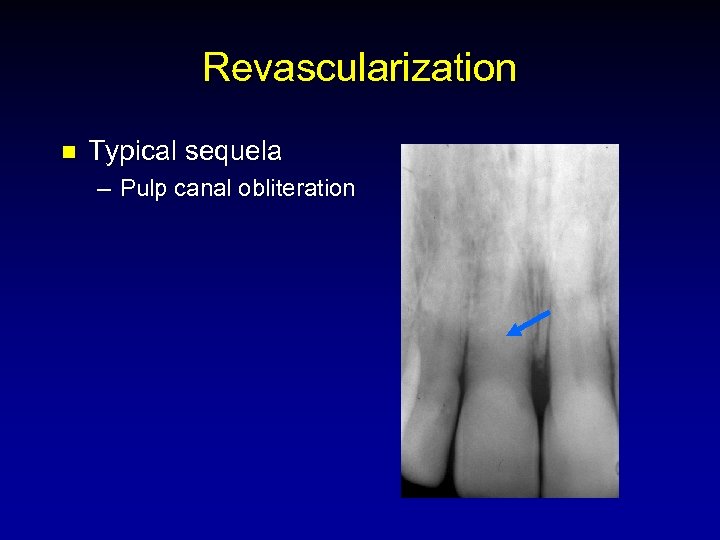 Revascularization n Typical sequela – Pulp canal obliteration
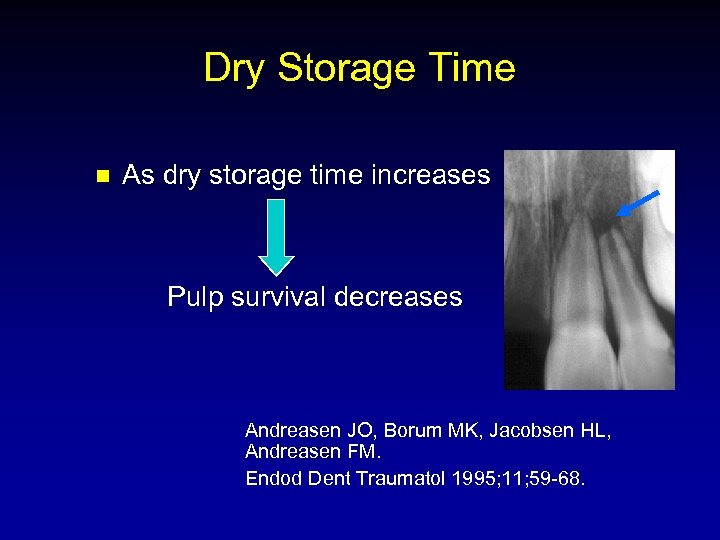 Dry Storage Time n As dry storage time increases Pulp survival decreases Andreasen JO, Borum MK, Jacobsen HL, Andreasen FM. Endod Dent Traumatol 1995; 11; 59 -68.
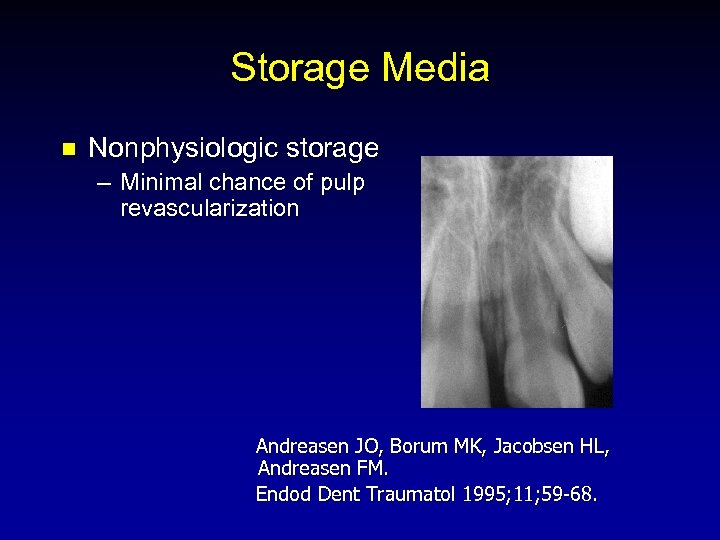 Storage Media n Nonphysiologic storage – Minimal chance of pulp revascularization Andreasen JO, Borum MK, Jacobsen HL, Andreasen FM. Endod Dent Traumatol 1995; 11; 59 -68.
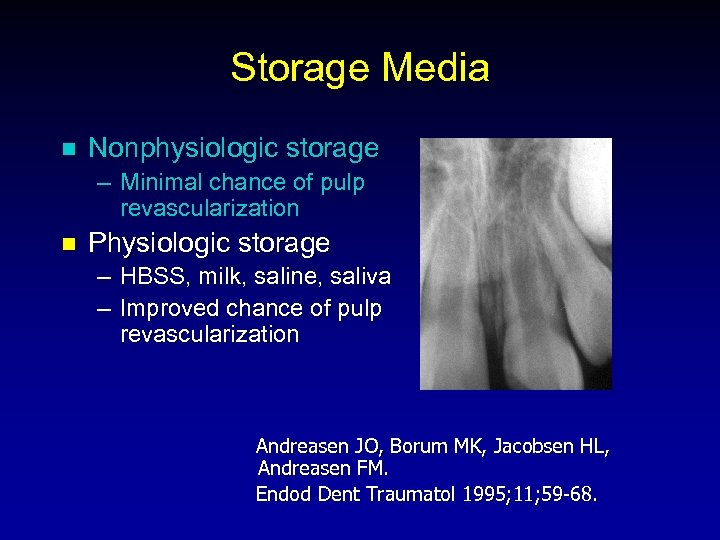 Storage Media n Nonphysiologic storage – Minimal chance of pulp revascularization n Physiologic storage – HBSS, milk, saline, saliva – Improved chance of pulp revascularization Andreasen JO, Borum MK, Jacobsen HL, Andreasen FM. Endod Dent Traumatol 1995; 11; 59 -68.
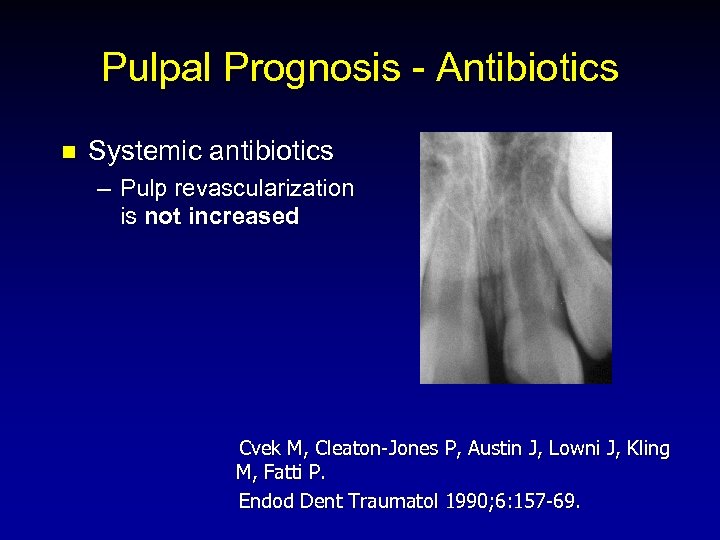 Pulpal Prognosis - Antibiotics n Systemic antibiotics – Pulp revascularization is not increased Cvek M, Cleaton-Jones P, Austin J, Lowni J, Kling M, Fatti P. Endod Dent Traumatol 1990; 6: 157 -69.
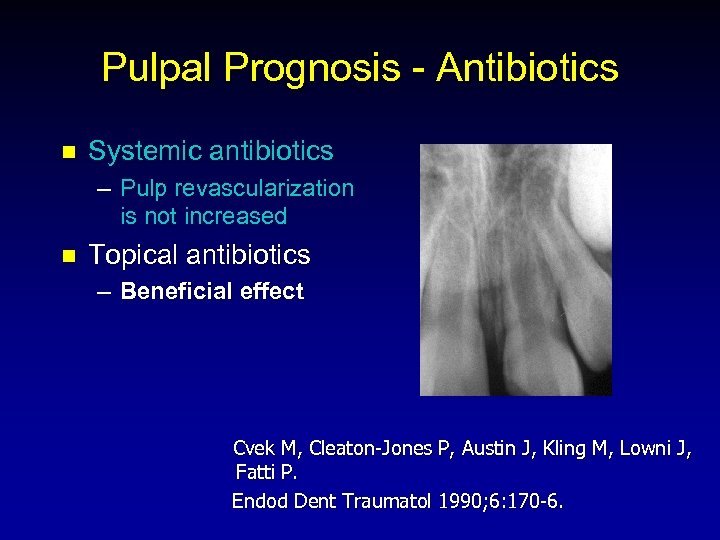 Pulpal Prognosis - Antibiotics n Systemic antibiotics – Pulp revascularization is not increased n Topical antibiotics – Beneficial effect Cvek M, Cleaton-Jones P, Austin J, Kling M, Lowni J, Fatti P. Endod Dent Traumatol 1990; 6: 170 -6.
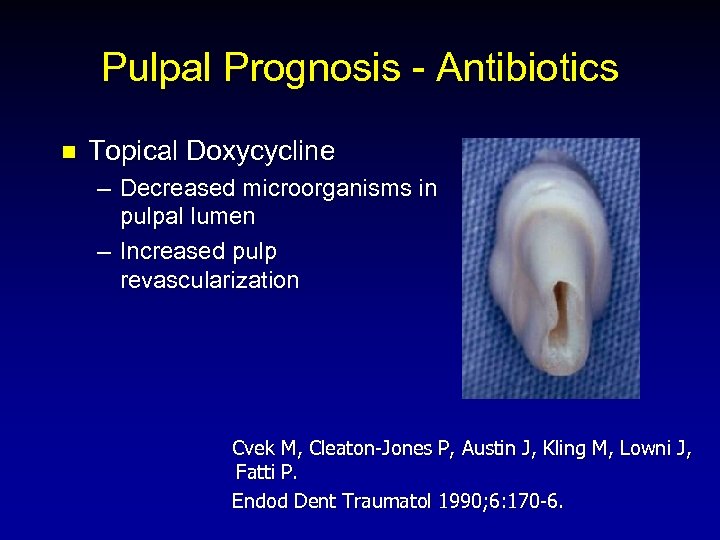 Pulpal Prognosis - Antibiotics n Topical Doxycycline – Decreased microorganisms in pulpal lumen – Increased pulp revascularization Cvek M, Cleaton-Jones P, Austin J, Kling M, Lowni J, Fatti P. Endod Dent Traumatol 1990; 6: 170 -6.
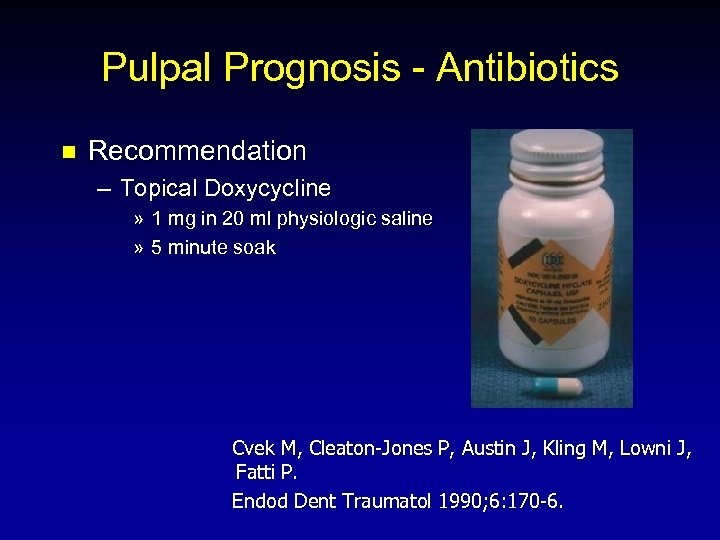 Pulpal Prognosis - Antibiotics n Recommendation – Topical Doxycycline » 1 mg in 20 ml physiologic saline » 5 minute soak Cvek M, Cleaton-Jones P, Austin J, Kling M, Lowni J, Fatti P. Endod Dent Traumatol 1990; 6: 170 -6.
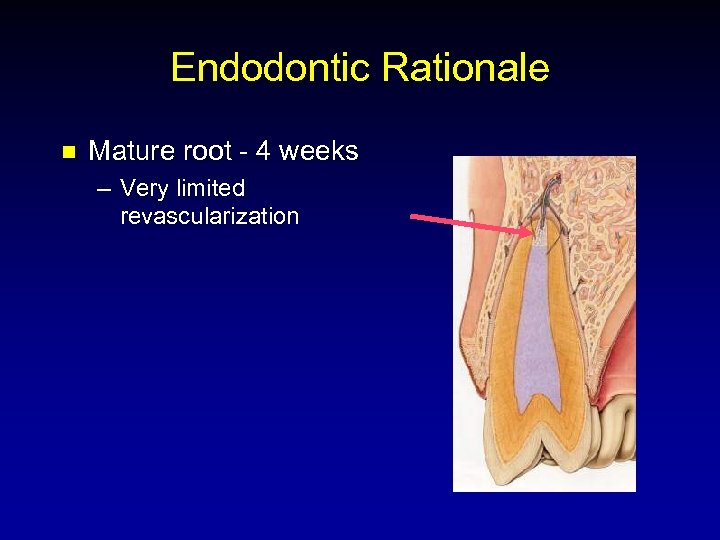 Endodontic Rationale n Mature root - 4 weeks – Very limited revascularization
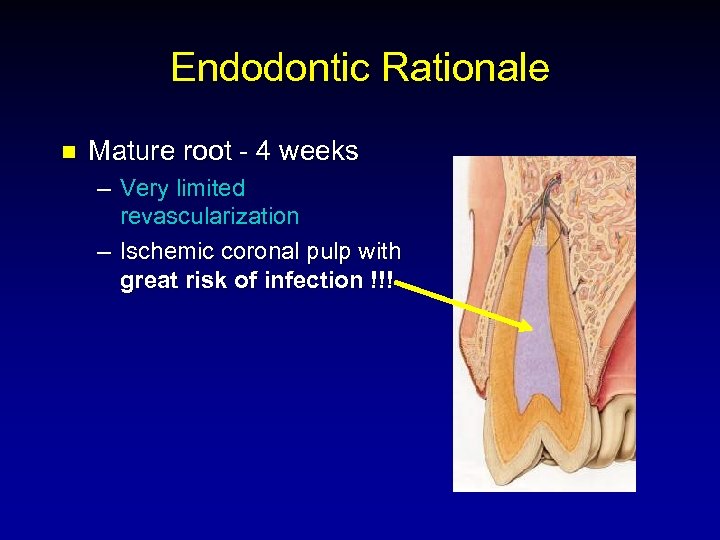 Endodontic Rationale n Mature root - 4 weeks – Very limited revascularization – Ischemic coronal pulp with great risk of infection !!!
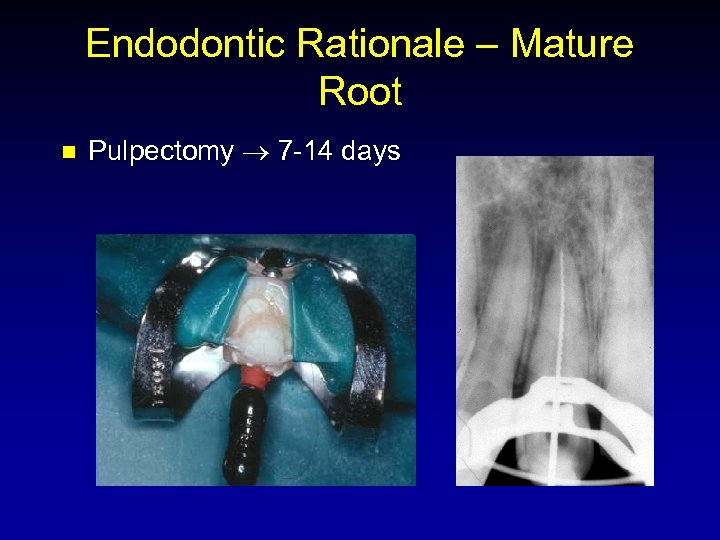 Endodontic Rationale – Mature Root n Pulpectomy 7 -14 days
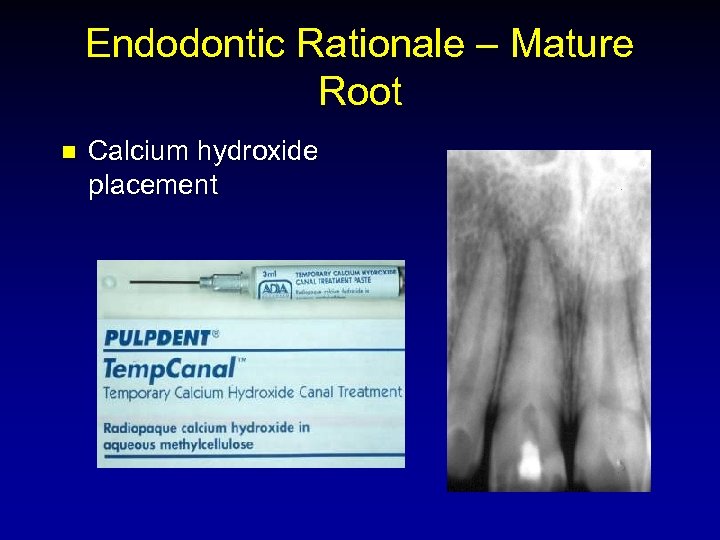 Endodontic Rationale – Mature Root n Calcium hydroxide placement
 Endodontic Rationale – Mature Root n Calcium hydroxide – – – Antibacterial Increases p. H in dentin Favors mineralization over resorption Tronstad L, Andreasen JO, et al. p. H changes in dental tissues after root canal filling with calcium hydroxide. J Endodon 1981; 7: 17 -21.
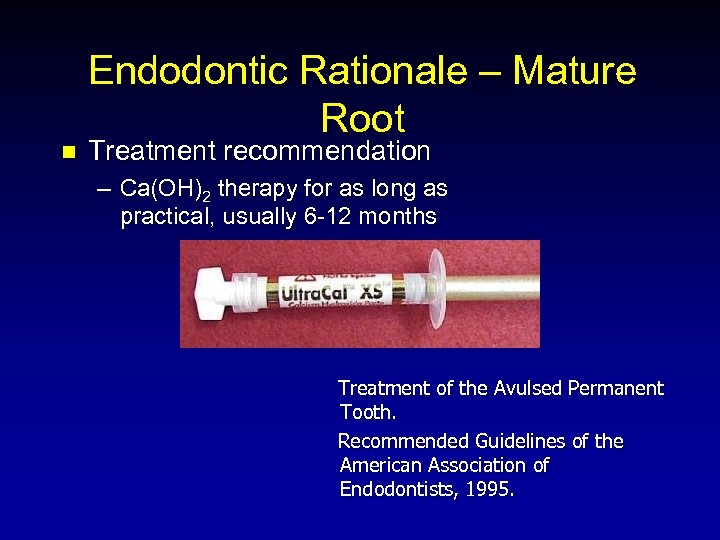 n Endodontic Rationale – Mature Root Treatment recommendation – Ca(OH)2 therapy for as long as practical, usually 6 -12 months Treatment of the Avulsed Permanent Tooth. Recommended Guidelines of the American Association of Endodontists, 1995.
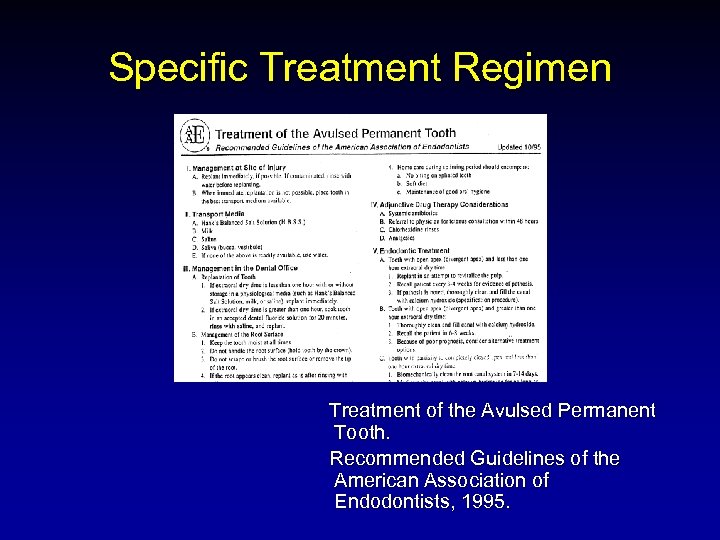 Specific Treatment Regimen Treatment of the Avulsed Permanent Tooth. Recommended Guidelines of the American Association of Endodontists, 1995.
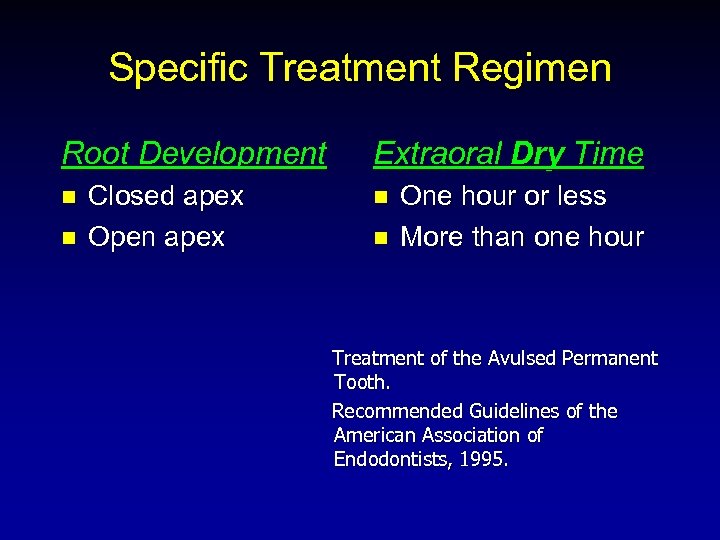 Specific Treatment Regimen Root Development n n Closed apex Open apex Extraoral Dry Time n n One hour or less More than one hour Treatment of the Avulsed Permanent Tooth. Recommended Guidelines of the American Association of Endodontists, 1995.
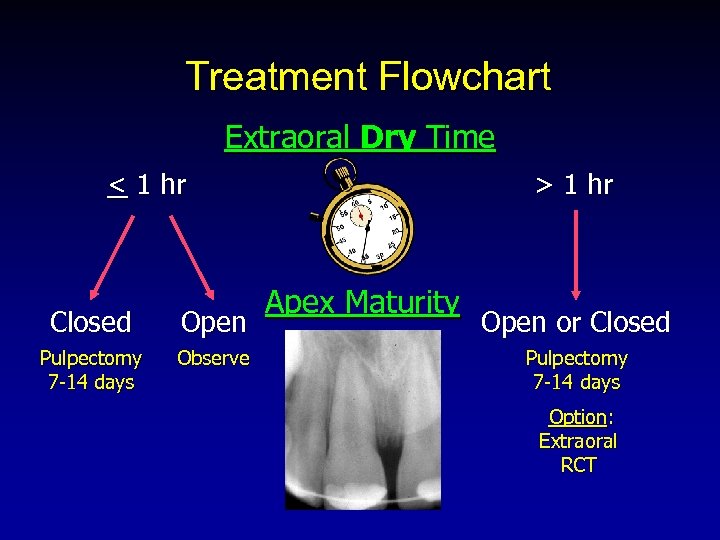 Treatment Flowchart Extraoral Dry Time < 1 hr Closed Open Pulpectomy 7 -14 days Observe > 1 hr Apex Maturity Open or Closed Pulpectomy 7 -14 days Option: Extraoral RCT
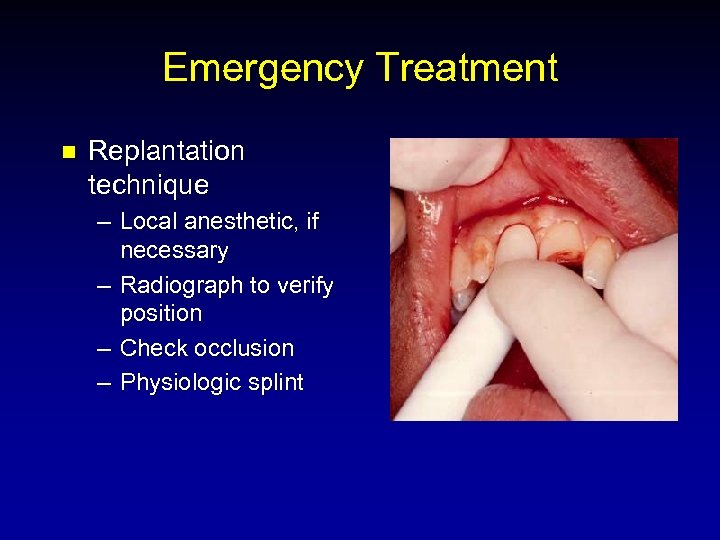 Emergency Treatment n Replantation technique – Local anesthetic, if necessary – Radiograph to verify position – Check occlusion – Physiologic splint
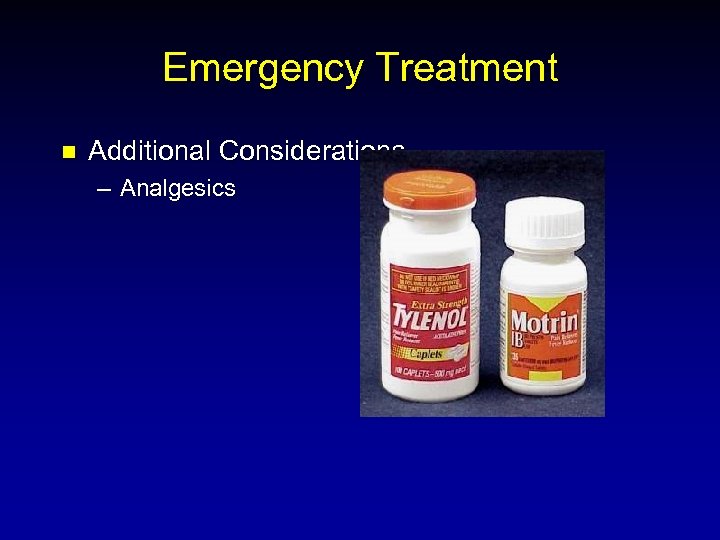 Emergency Treatment n Additional Considerations – Analgesics
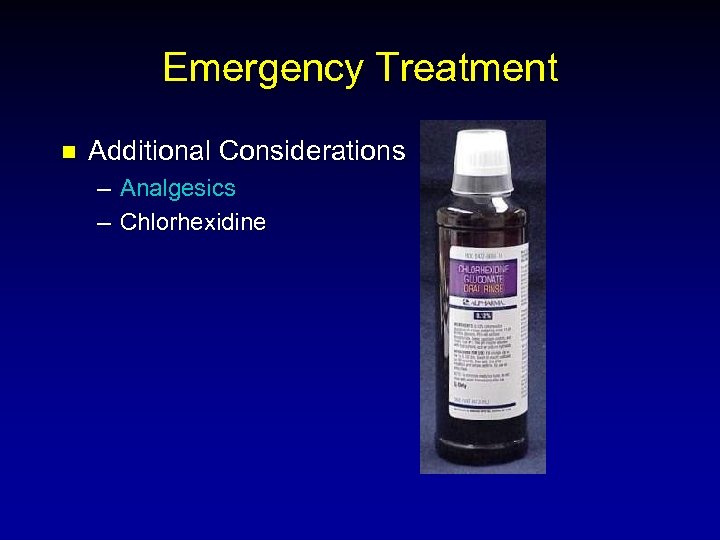 Emergency Treatment n Additional Considerations – Analgesics – Chlorhexidine
 Emergency Treatment n Additional Considerations – – – Analgesics Chlorhexidine Tetanus » Refer to physician for tetanus prophylaxis prn Rothstein RJ, Baker FJ. Tetanus: Prevention and treatment. J Am Med Assoc 1978; 240: 675 -6.
 Emergency Treatment n Additional Considerations – – Analgesics Chlorhexidine Tetanus Antibiotics
 Antibiotics n Penicillin – 500 mg qid for 4 -7 days Andreasen JO. Atlas of replantation and transplantation of teeth. Philadelphia: W. B. Saunders Co. , 1992; 5792.
 Antibiotics n Tetracycline vs. amoxicillin in a replacement resorption model – Tetracycline had better anti-resorptive properties Sae-Lim V, Wang CY, Choi GW, Trope M. The effect of systemic tetracycline on resorption of dried replanted dogs’ teeth. Endod Dent Traumatol 1998; 14: 127 -32.
 Antibiotics n Tetracycline vs. amoxicillin in an inflammatory root resorption model – Tetracycline had better anti-bacterial properties Sae-Lim V, Wang CY, Trope M. Effect of systemic tetracycline and amoxicillin on inflammatory root resorption of replanted dogs’ teeth. Endod Dent Traumatol 1998; 14: 216 -20.
 Antibiotics n Recommendation – “Tetracycline could be considered as an alternative to amoxicillin after avulsion injuries. ” Sae-Lim V, Wang CY, Trope M. Effect of systemic tetracycline and amoxicillin on inflammatory root resorption of replanted dogs teeth. Endod Dent Traumatol 1998; 14: 216 -20.
 Tetracycline Use In Young Children n Tetracycline staining – Not a problem since avulsed maxillary anteriors have already erupted and are not susceptible to staining – At worst, posterior teeth might be stained » Remote possibility with 7 -10 day prescription Sae-Lim V, Wang CY, Trope M. Effect of systemic tetracycline and amoxicillin on inflammatory root resorption of replanted dogs’ teeth. Endod Dent Traumatol 1998; 14: 216 -20.
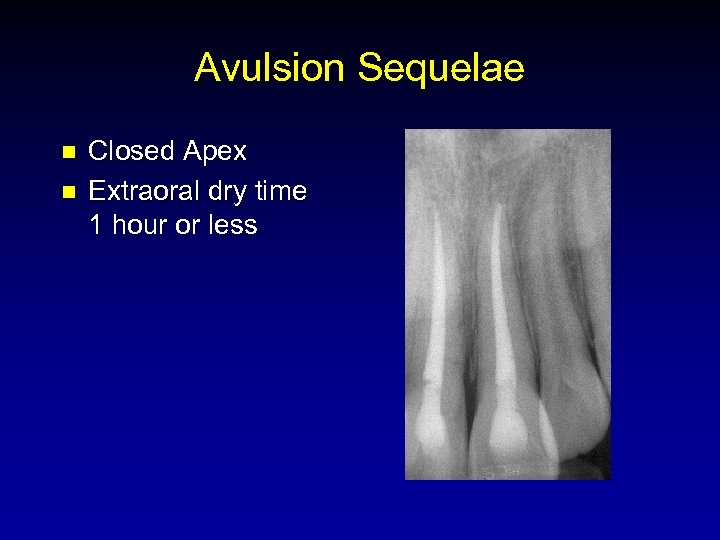 Avulsion Sequelae n n Closed Apex Extraoral dry time 1 hour or less
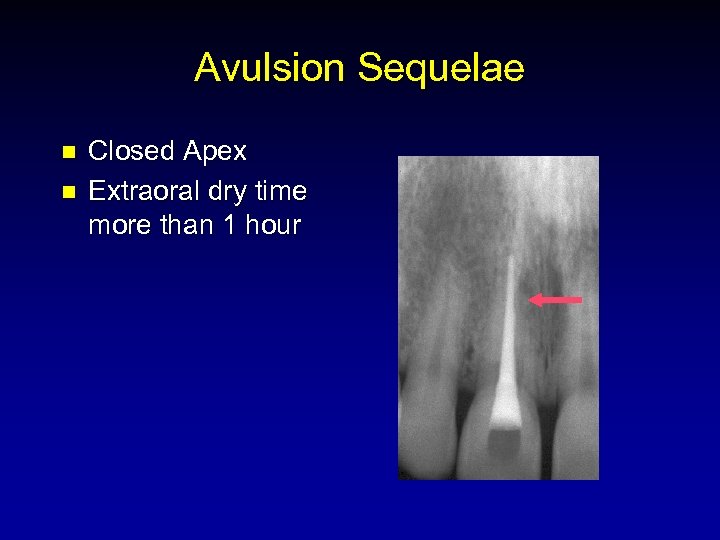 Avulsion Sequelae n n Closed Apex Extraoral dry time more than 1 hour
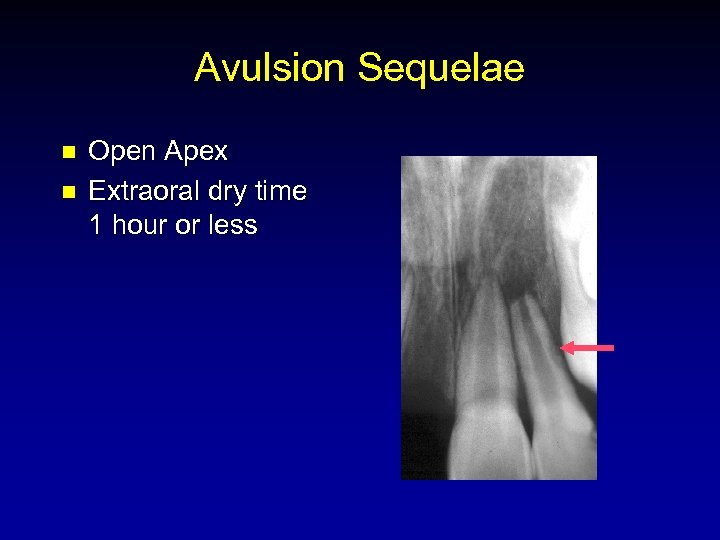 Avulsion Sequelae n n Open Apex Extraoral dry time 1 hour or less
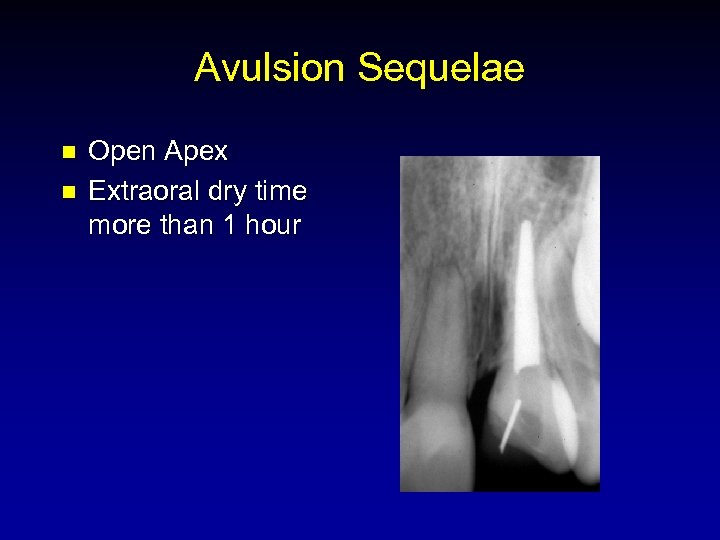 Avulsion Sequelae n n Open Apex Extraoral dry time more than 1 hour
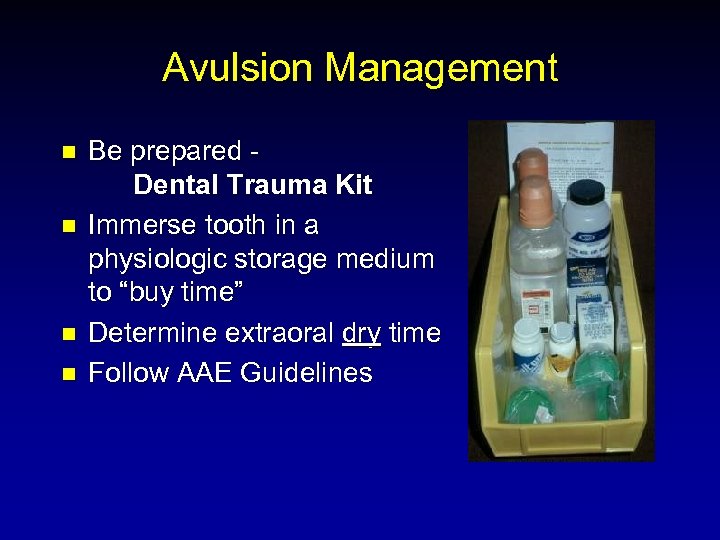 Avulsion Management n n Be prepared Dental Trauma Kit Immerse tooth in a physiologic storage medium to “buy time” Determine extraoral dry time Follow AAE Guidelines