


 Скачать презентацию Trauma and Cardiac Resuscitation Dr Paul Pageau Staff
818f021ed0fadfda8f88ba9ff07f5ed7.ppt
- Количество слайдов: 20
 Trauma and Cardiac Resuscitation Dr. Paul Pageau Staff Physician Assistant Fellowship Director EMUS Department of Emergency Medicine University of Ottawa The Ottawa Hospital
 Objectives n n General approach to Trauma/Resuscitation patients (A-B-C-D) Approach to patient with multisystem trauma (MVC, penetrating, and other) Approach to asystole/V-fib/STEMI patient and resuscitation, including drugs and therapeutic hypothermia Trauma code: Outline role of Emergency Physician, Emergency team, TTL, and other services
 General Principles of Resuscitation Preparation n Triage (multiple and mass casualties) n Teamwork n Leadership n Communication n Crisis Resource management n Situation awareness n
 Trauma A-B-C’s Primary Survey n A – Airway and C-spine n B – Breathing and Ventilation n C – Circulation and Hemorrhage control n D – Disability (Neuro) n E – Exposure and Environment control
 Adjuncts to Primary Survey Monitoring n Catheters n e. FAST n Consider transfer/ Trauma Code n
 Secondary Survey Head to Toe (finger or tube) n History and Physical examination n Continual reassessment of Vital signs n Complete Neuro exam n Specific radiologic evaluation (CT) n
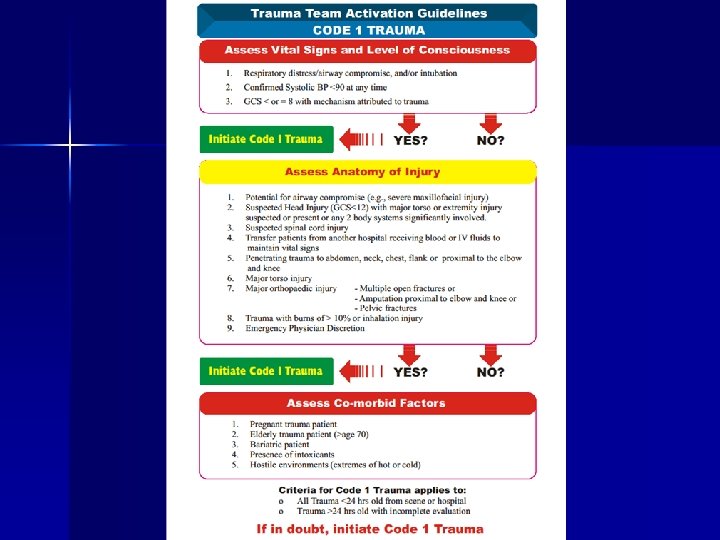
 Code One Trauma EP on duty +- Res/students, 3 RN’s (Chart, Action/Task) n Trauma Team Leader (Gen Surgery or Emerg staff) n Gen Surgery Sr Resident n Anaesthesia Resident n 2 Respiratory Therapists n 2 Patient Transport Workers n Advance care nurse practitioner – trauma n Clinical manager in ED n Trauma coordinator n Security n OR is notified n Trauma Dept is notified
 Code One Trauma n n n TTL is EP on duty until TTL on call arrives (<20 min) Gen Surg Resident may assume TTL role depending on Level of training Anaesthesia takes direction from TTL but mainly manages airway +- pain medication RN’s: IV catheters, monitoring, charting, other catheters, facilitating, anticipating RT’s: Airway assistance, Ventilation, monitoring
 Trauma Case 1 Hx: n 11 yo ATV no helmet, Collided with tree n Altered LOC, hematoma ant scalp, Ant chest contusion n EMS Vitals: HR 130, BP 80/60, Sats 90%RA, GCS=10, PERL n Long transport from Trail n IVF 1 L
 Trauma Case 1 n n n Boarded and collared wet clothes Vitals HR 120, BP 90/65, Sats 90% on O 2, RR 25, GCS=11, T 34. 8 tymp Vomitting Primary Survey: n Airway: moaning, emesis on face n Cspine protected n Decreased A/E on Right, dull percsn n Trachea midline n Decreased Cap refill n PERL n FAST pos pleural fluid, neg peritoneal fluid
 Trauma Case 1 n n n pt vomits just prior to ETT roll onto side and suction pt develops pulseless VF when rolling defibrillate 2 J/kg X 1 vitals return to baseline
 Trauma Case 1 Secondary Survey: n Right hemotympanum n Forehead abrasion and hematoma n Right chest contusion n Pelvis stable, Abdo soft Disposition: n Transfer to Tertiary care/ICU
 Trauma Case 2 Large Community Hospital. OB/Anaesthesia in house, Peds often in house n EMS presents unannounced with 35 yr female MVC, VSA, 30 wks + pregnant. Hx: n 35 yo female. 30 wks+ pregnant, Belted passenger, T-boned, . n EMS on site <5 min: VSA, CPR and epinephrine X 2, intubated, 1 L NS n Arrival to ED after 25 mins downtime n
 Trauma Case 2 Interventions? : n OB stat n Peds Primary Survey: n Intubated n Multiple right rib fractures – soft chest ? Air Entry on R n VSA – CPR in progress
 Trauma Case 2 Interventions? : n perimortem C/S n ? Chest tube R Secondary Survey: n Pupils fixed dilated n blood from L ear and visible brain matter R skull n Pregnant abdomen n Pelvis unstable
 Cardiac Arrest and Resuscitation Principles: Chain of survival: n Recognition and activation n Early CPR n Rapid defibrillation n Advanced life support n Integrated post-cardiac arrest care
 Cardiac arrest n n n n Call for help, Defibrillator, CPR Shockable rhythm? 200 J CPR Asystole/PEA CPR Epi 1 mg q 3 -5 min, Atropine 1 mg q 3 -5 min X 3 Check for shockable rhythm q 2 min CPR Treat contributing factors (H’s and T’s) Consider antiarrhythmics: amiodarone 300 mg, or Lidocaine 1 mg/kg, Consider magnesium 1 – 2 gms for torsades
 ROSC Evaluate for STEMI PCI/code STEMI n In comatose pts evaluate for therapeutic hypothermia n Stabilize, monitor, definitive care n
 Objectives n n General approach to Trauma/Resuscitation patients (A-B-C-D) Approach to patient with multisystem trauma (MVC, penetrating, and other) Approach to asystole/V-fib/STEMI patient and resuscitation, including drugs and therapeutic hypothermia Trauma code: Outline role of Emergency Physician, Emergency team, TTL, and other services