


 Скачать презентацию Transportation Geography Some Introductory Concepts Transportation Geography
d49c6bbcc9429e6a4670d3f1ba1c8dae.ppt
- Количество слайдов: 34
 Transportation Geography Some Introductory Concepts
 Transportation Geography • Transport geography separate discipline? • Primary concerns: • A. Networks- location, structure and evolution • B. Flows on networks : describing and predicting • C. Significance and impact of liberalization, cost changes, information and other technologies on movements and networks
 What is Transportation? • Movement? • Flow? • Physical only? • Useful to appreciate the French view • Circulation – very broad conceptualization of transportation • Means all forms of movement and communications
 Transportation Revolution (s)? • What comprises such a Revolution? • New and improved transport forms • Broader access to forms of transport • Basic ingredients? • Friction of Distance- decline in this value • Accessibility- ease and getting to and from • places Collapse or Telescoping of Travel Timesconcept of time-space convergence
 Second Transport Revolution? • Why? Transport in advanced capitalist • • economies entering a new era: technological innovation Advances in info technology are creating fresh opportunities Modernizing infrastructure: ERP and congestion pricing, intelligent systems Rethinking transport policies IT widely regarded as key to change in economy, environment and safety of all modes
 Two Revolutions? • Electronic revolution in control of vehicles and • • infrastructure and cargo Revolution in appreciation of assigning uses of space in urban areas (hubs) This next revolution will last well into 21 st Century Economic and social institutions must adapt to technological progress Policy makers already seeking guidance and information
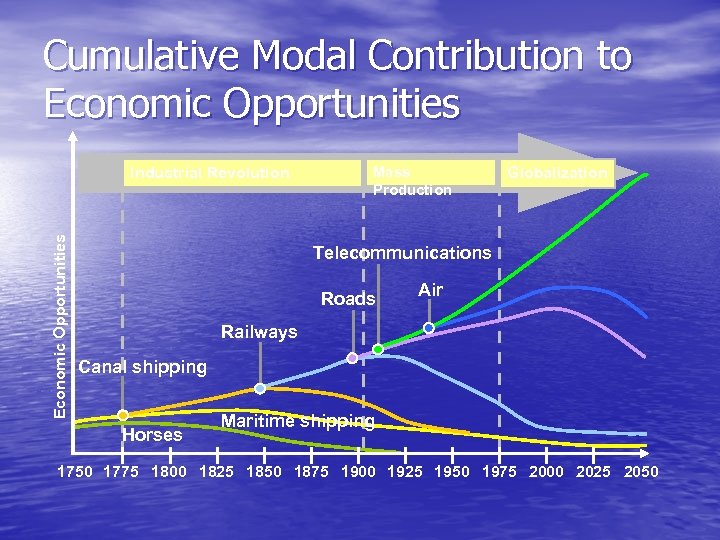 Cumulative Modal Contribution to Economic Opportunities Industrial Revolution Mass Production Globalization Telecommunications Roads Air Railways Canal shipping Horses Maritime shipping 1750 1775 1800 1825 1850 1875 1900 1925 1950 1975 2000 2025 2050
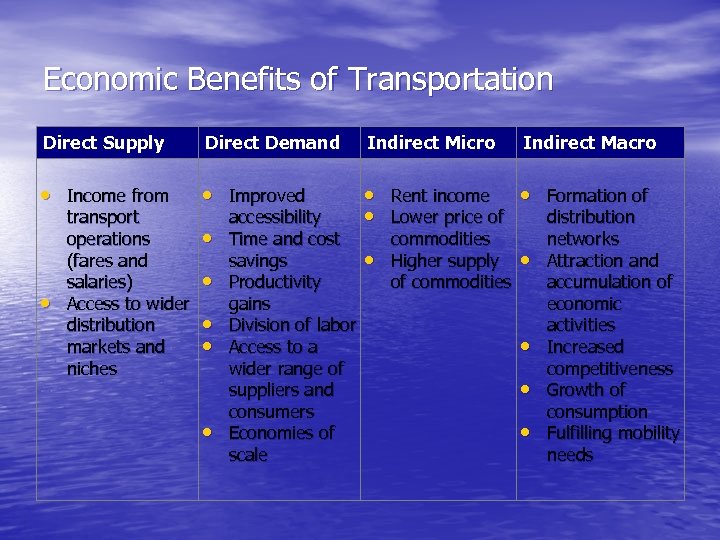 Economic Benefits of Transportation Direct Supply Direct Demand Indirect Micro • Income from • Improved • Rent income • Formation of • Lower price of distribution • transport operations (fares and salaries) Access to wider distribution markets and niches • • • accessibility Time and cost savings Productivity gains Division of labor Access to a wider range of suppliers and consumers Economies of scale • commodities Higher supply of commodities Indirect Macro • • networks Attraction and accumulation of economic activities Increased competitiveness Growth of consumption Fulfilling mobility needs
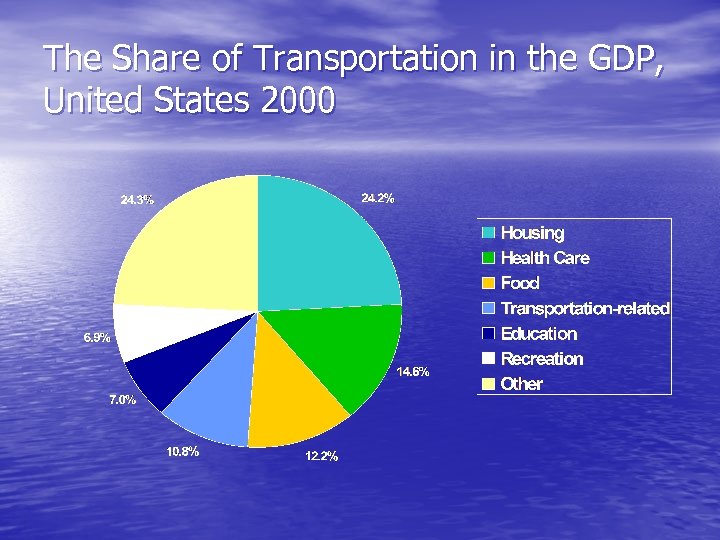 The Share of Transportation in the GDP, United States 2000
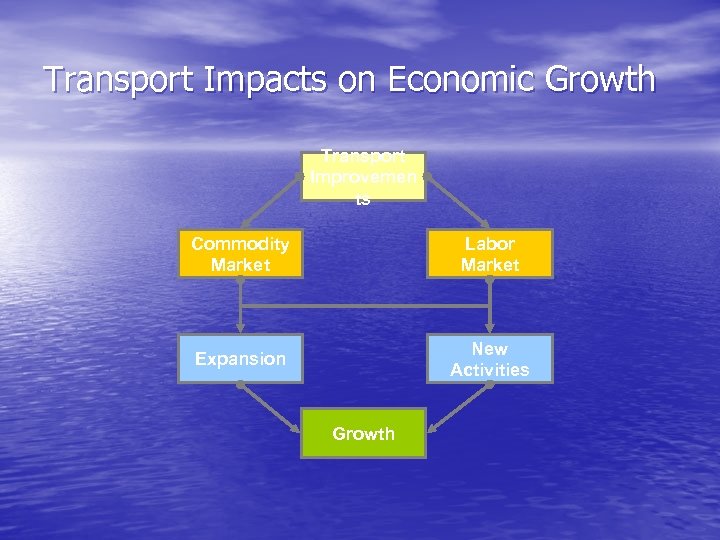 Transport Impacts on Economic Growth Transport Improvemen ts Commodity Market Labor Market Expansion New Activities Growth
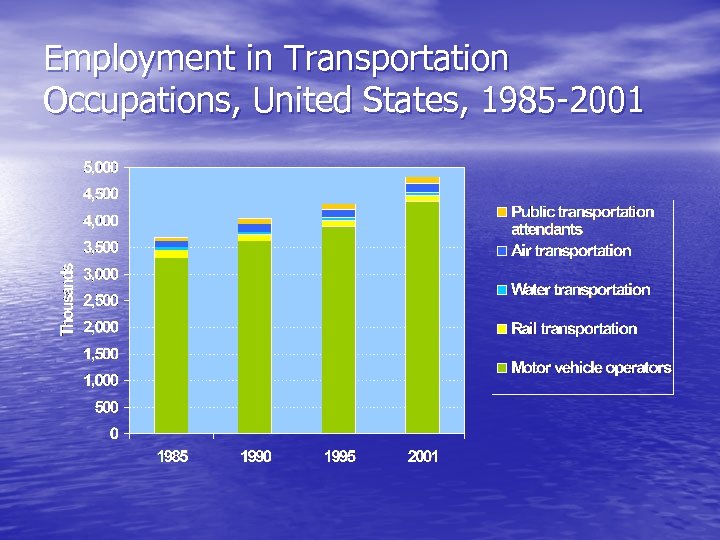 Employment in Transportation Occupations, United States, 1985 -2001
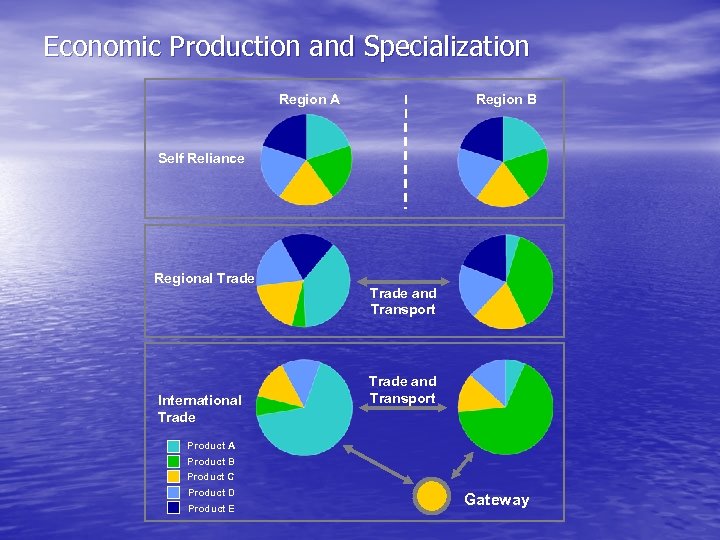 Economic Production and Specialization Region B Region A Self Reliance Regional Trade International Trade and Transport Product A Product B Product C Product D Product E Gateway
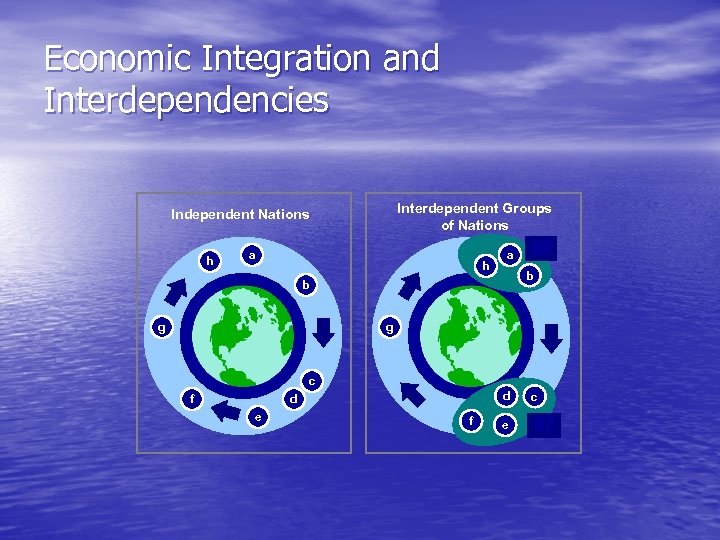 Economic Integration and Interdependencies Interdependent Groups of Nations Independent Nations h a b b g G 1 g c f d d e f c e G 2
 Effects of Improved Transportation • A. Areal specialization promoted by improved transport – 1. Allows producers to focus on particular forms of production – 2. Creation of larger areas of particular product tied to distant markets- example? • B. Improvement in transport is contradictory! – 1. Has made places more alike-share products, ideas, and services – 2. Simultaneously it has made areas diverse since specialization has been encouraged
 Additional Effects of Improved Transport • Access to resources and ability to market goods • • • that otherwise would have no market Access to raw materials and the stimulation of supplier development and outsourcing phenomenon Expands settlement spaces City building and supporting Political integration- binding together of diverse political units Social integration- allows stronger interpersonal communication and diffusion of information and ideas “Just as commodities flow over a network so too do ideas and information”
 Explaining Spatial Interaction • Improvements in transport not alone responsible for interaction • What are the conditions under which interaction develops? • Three factor model of Edward Ullman still relevant • Ingredients: complementarity, intervening opportunity and transferability
 Complementarity • Interaction is due to areal or regional or spatial • • differentiation But mere differences do not produce interaction Must be a demand supply of specific good – specific complementarity Toyota assembly in Georgetown and production of tires in Akron Complementarity so important that relatively low value bulk goods move across the globe: Australian iron ore, Venezuelan and Iraqi oil
 Intervening Opportunity • Complementarity generates interchange only if no intervening source exists • Where alternative source exists flow or spatial interaction will be interrupted • Examples: grocery shopping, forest products, etc • Occasionally IO might assist interaction by making construction of intermediate transport routes profitable
 Transferability • Measured in real time and costs • If distance between market and supply is too great and/or too costly to overcome, interaction will NOT take place despite perfect complementarity and absence of intervening opportunity • Tendency here to use alternate goods • Transform product into higher value so it can withstand cost of transport • Examples?
 Summary • Interaction based on three factors: • 1. Complementarity • 2. Intervening Opportunity • 3. Transferability • System applies to movement of physical goods but also people • Additional Corollaries Make This Concept Richer
 Corollaries of Spatial Interaction • Place Utility- added economic value of a commodity gained by transporting it from place where it has little value to place where it has more • Example: transporting coal from West Virginia or Kentucky into megalopolis • Negative place utility or disutility- pay to have something removed – reverse logistics!
 Corollaries of Spatial Interaction • Time Utility- transport enhances the ability of goods to satisfy human demandnot only WHERE they are needed but also WHEN • Some Products have short shelf life –fresh inventories needed periodically- fruits and vegetables; Maine lobsters or Hawaiian fish • Computer parts- ICs need air freight and other goods have a very brief product life cycle
 Distance Decay • Basic geographical concept • Tobler’s Law- “Everything is related to everything else but things that are closer together are more related” • The negative impact of distance upon the flow of information or goods or services between places • Linear and nonlinear functions • Spatial Elastic and Non-elastic functions
 Reasons for Distance Decay • What are impedance factors that cause a variable to decay over distance? • Economic reasons- cost and time • Non-economic reasons • Hold economic factor constant- first class mail- cannot use cost as an explanation • Information- more familiar with our immediate surroundings than with distant places • Intervening Opportunities
 Location and Distance Concepts • Geographers view space and location in several • • ways Absolute Location- position on conventional grid Relative Location- position with respect to other locations, i. e. really situation Absolute Distance- conventional distance in miles/kilometers between places Relative Distance- uses metric other than the above, e. g. cost, social contacts and time between places
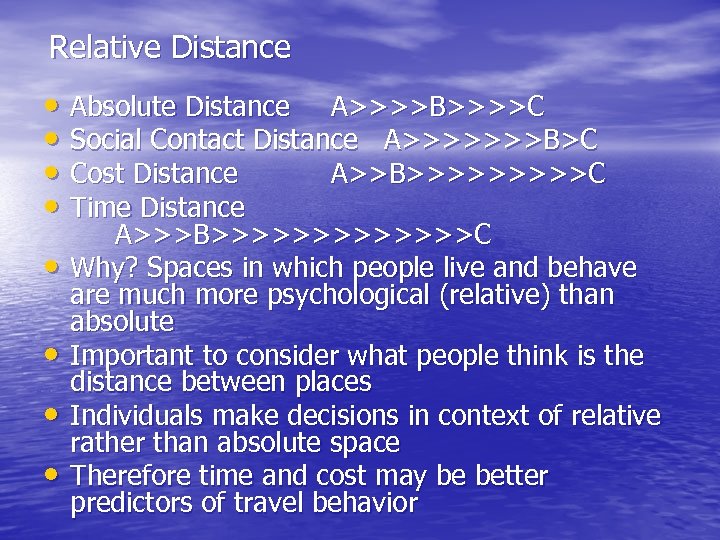 Relative Distance • Absolute Distance A>>>>B>>>>C • Social Contact Distance A>>>>>>>B>C • Cost Distance A>>B>>>>>C • Time Distance • • A>>>B>>>>>>>C Why? Spaces in which people live and behave are much more psychological (relative) than absolute Important to consider what people think is the distance between places Individuals make decisions in context of relative rather than absolute space Therefore time and cost may be better predictors of travel behavior
 Time-Space Convergence (TSC) • Absolute space has not changed over time • But relative space has changed greatly • Space adjusting techniques such as transport and communications enable us to restructure space by changing relative distances which separate places • TSC is way of measuring relative distance by measuring the rate at which places approach one another in time distance
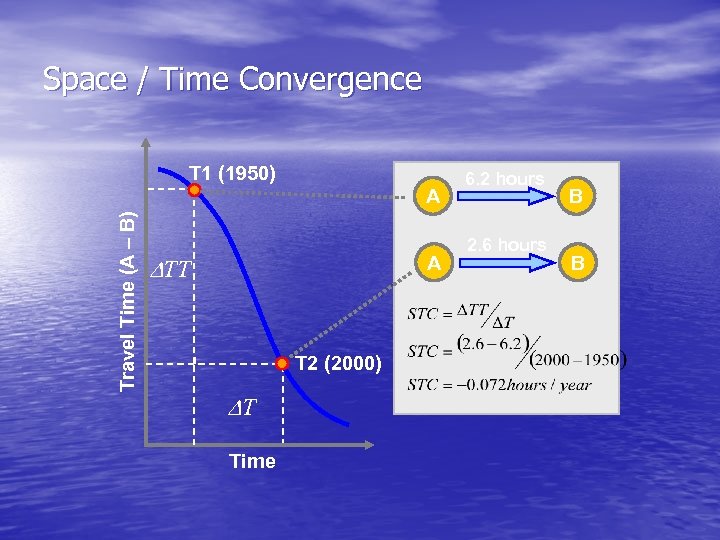 Space / Time Convergence T 1 (1950) Travel Time (A – B) A TT A T 2 (2000) T Time 6. 2 hours 2. 6 hours B B
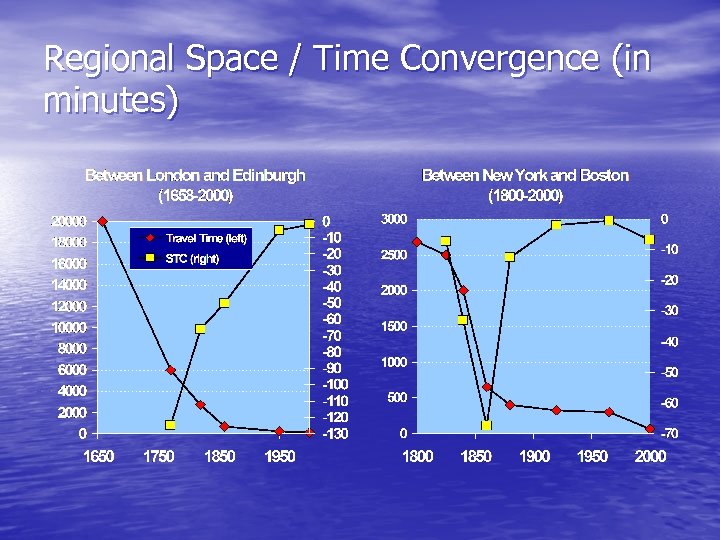 Regional Space / Time Convergence (in minutes)
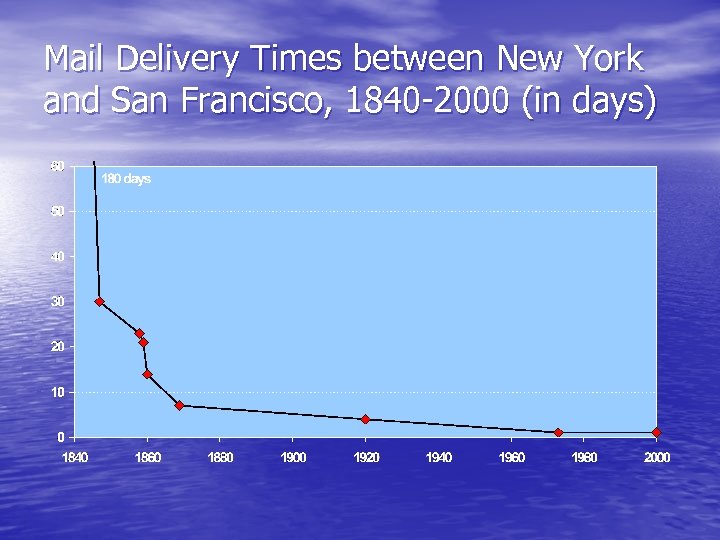 Mail Delivery Times between New York and San Francisco, 1840 -2000 (in days)
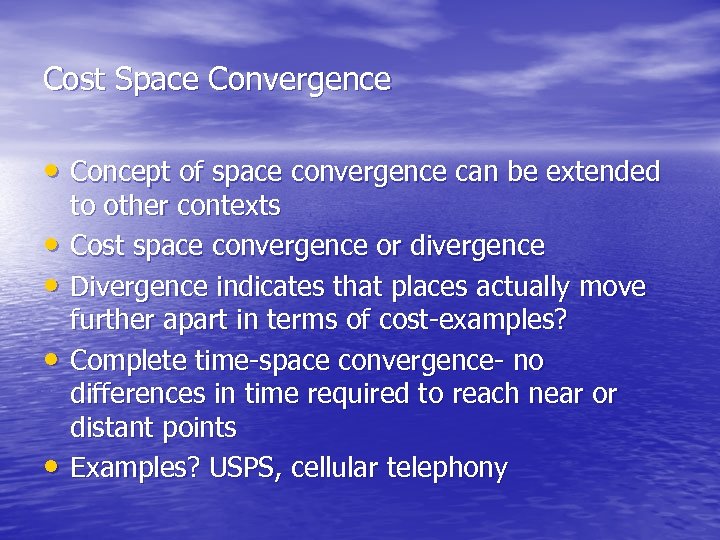 Cost Space Convergence • Concept of space convergence can be extended • • to other contexts Cost space convergence or divergence Divergence indicates that places actually move further apart in terms of cost-examples? Complete time-space convergence- no differences in time required to reach near or distant points Examples? USPS, cellular telephony
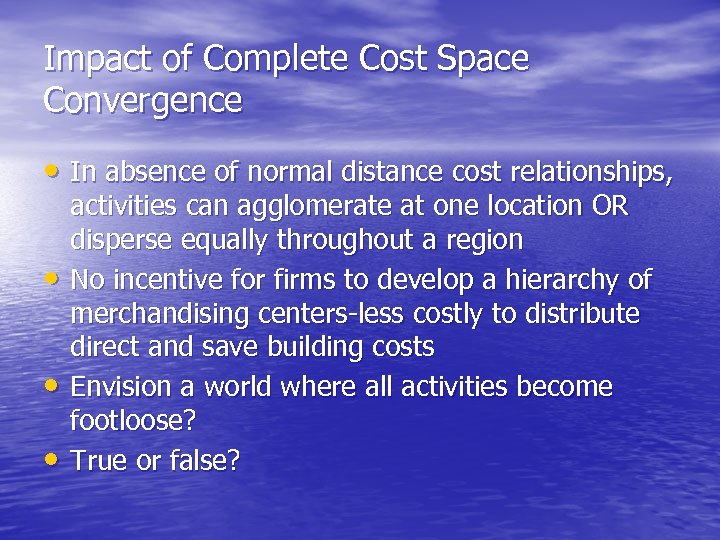 Impact of Complete Cost Space Convergence • In absence of normal distance cost relationships, • • • activities can agglomerate at one location OR disperse equally throughout a region No incentive for firms to develop a hierarchy of merchandising centers-less costly to distribute direct and save building costs Envision a world where all activities become footloose? True or false?
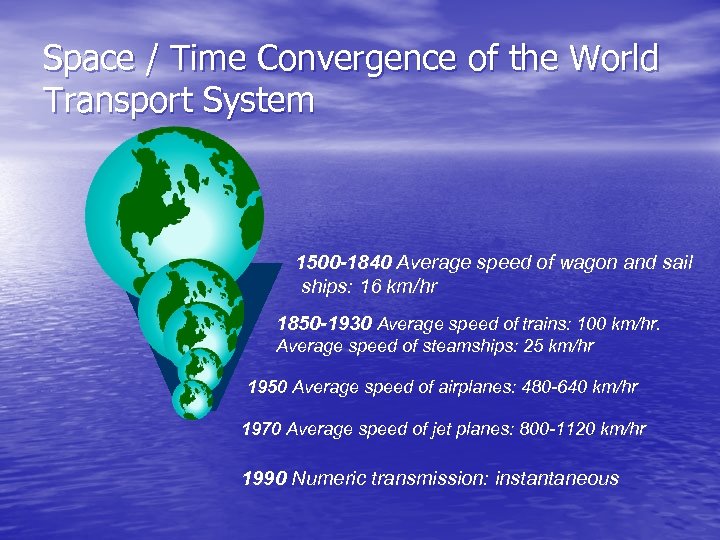 Space / Time Convergence of the World Transport System 1500 -1840 Average speed of wagon and sail ships: 16 km/hr 1850 -1930 Average speed of trains: 100 km/hr. Average speed of steamships: 25 km/hr 1950 Average speed of airplanes: 480 -640 km/hr 1970 Average speed of jet planes: 800 -1120 km/hr 1990 Numeric transmission: instantaneous
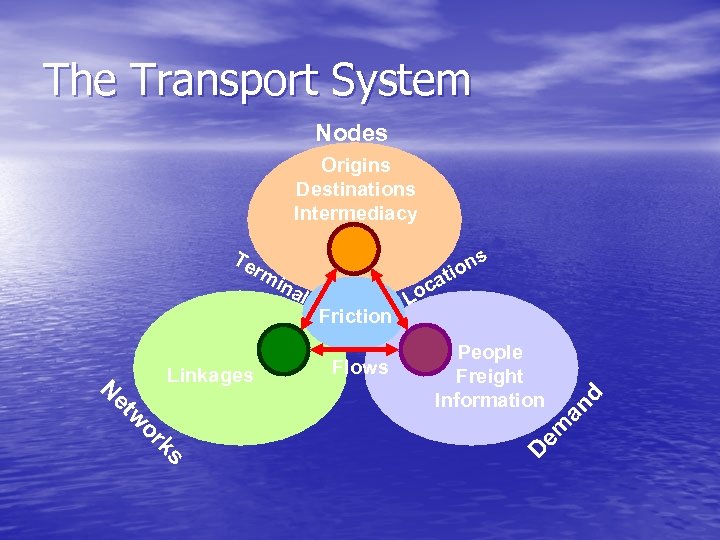 The Transport System Nodes Origins Destinations Intermediacy ns tio Linkages Friction Flows ks or w et N People Freight Information d ls a oc L an ina em rm D Te