


 Скачать презентацию Transport Theory for the Quark-Gluon Plasma V Greco
516efa0333121ae9192dd12661377da8.ppt
- Количество слайдов: 57
 Transport Theory for the Quark-Gluon Plasma V. Greco UNIVERSITY of CATANIA INFN-LNS Quark-Gluon Plasma and Heavy-Ion Collisions – Turin (Italy), 7 -12 March 2011
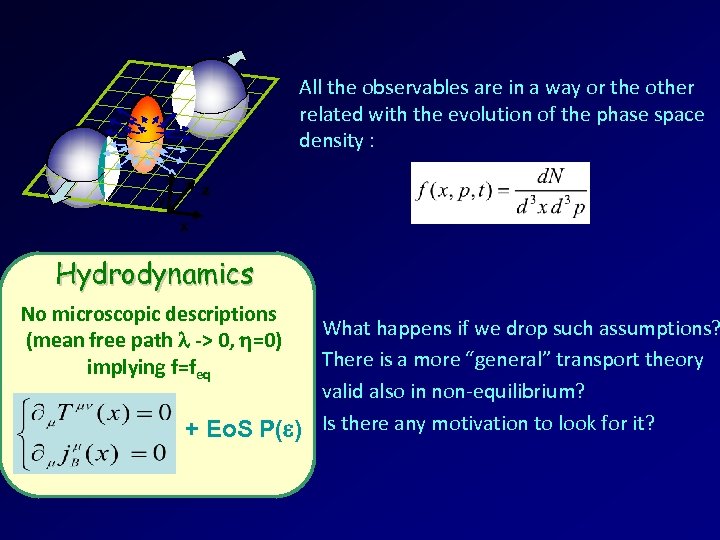 All the observables are in a way or the other related with the evolution of the phase space density : z y x Hydrodynamics No microscopic descriptions (mean free path -> 0, h=0) implying f=feq What happens if we drop such assumptions? There is a more “general” transport theory valid also in non-equilibrium? + Eo. S P( ) Is there any motivation to look for it?
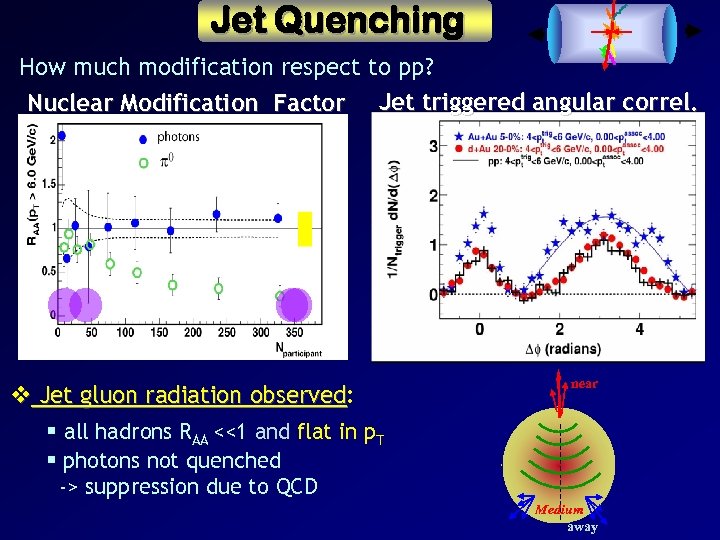
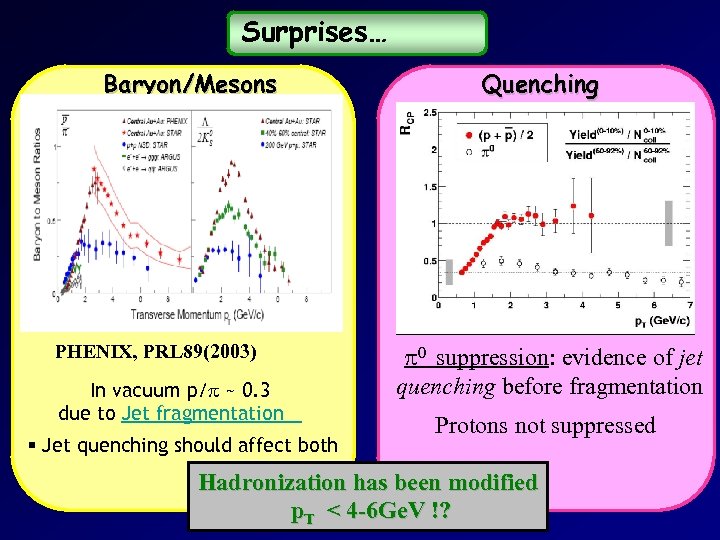
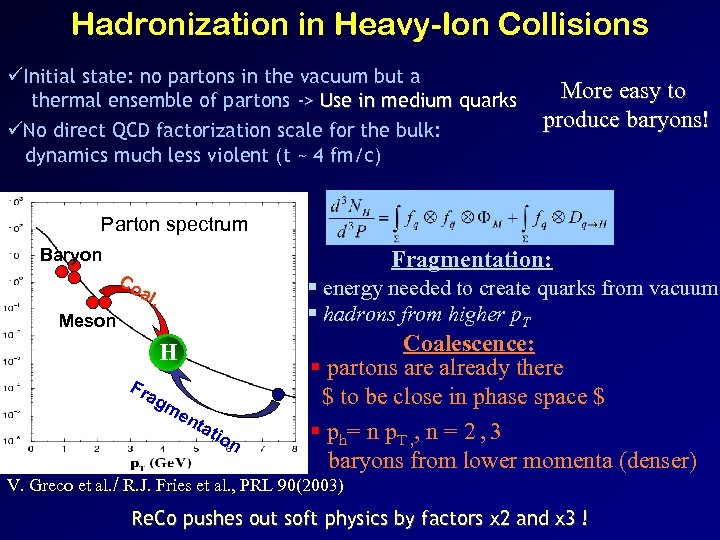
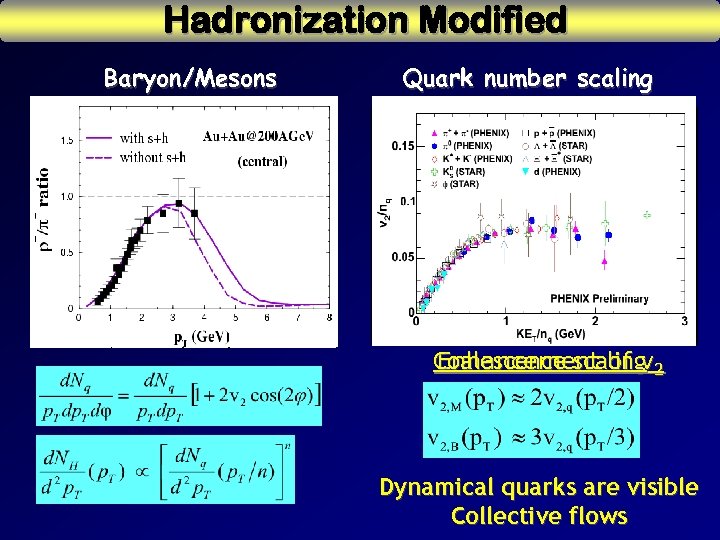
 Picking-up four main results at RHIC v Nearly Perfect Fluid, Large Collective Flows: Flows § Hydrodynamics good describes d. N/dp. T + v 2(p. T) with mass ordering § BUT VISCOSITY EFFECTS SIGNIFICANT (finite and f ≠feq) v High Opacity, Strong Jet-quenching: Jet-quenching § RAA(p. T) <<1 flat in p. T - Angular correlation triggered by jets pt<4 Ge. V § STRONG BULK-JET TALK: Hydro+Jet model non applicable at pt<8 -10 Ge. V v Hadronization modified, Coalescence: § B/M anomalous ratio + v 2(p. T) quark number scaling (QNS) § MICROSCOPIC MECHANISM RELEVANT v Heavy quarks strongly interacting: interacting § small RAA large v 2 (hard to get both) p. QCD fails: large scattering rates § NO FULL THERMALIZATION ->Transport Regime
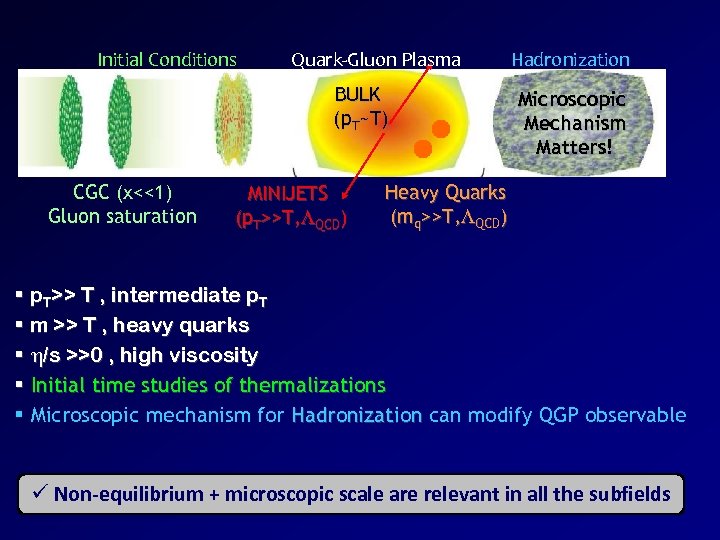 Initial Conditions Quark-Gluon Plasma BULK (p. T~T) CGC (x<<1) Gluon saturation MINIJETS (p. T>>T, LQCD) Hadronization Microscopic Mechanism Matters! Heavy Quarks (mq>>T, LQCD) § p. T>> T , intermediate p. T § m >> T , heavy quarks § /s >>0 , high viscosity § Initial time studies of thermalizations § Microscopic mechanism for Hadronization can modify QGP observable ü Non-equilibrium + microscopic scale are relevant in all the subfields
 Plan for the Lectures v Classical and Quantum Transport Theory - Relation to Hydrodynamics and dissipative effects - density matrix and Wigner Function v Relativistic Quantum Transport Theory - Derivation for NJL dynamics - Application to HIC at RHIC and LHC v Transport Theory for Heavy Quarks - Specific features of Heavy Quarks - Fokker-Planck Equation - Application to c, b dynamics
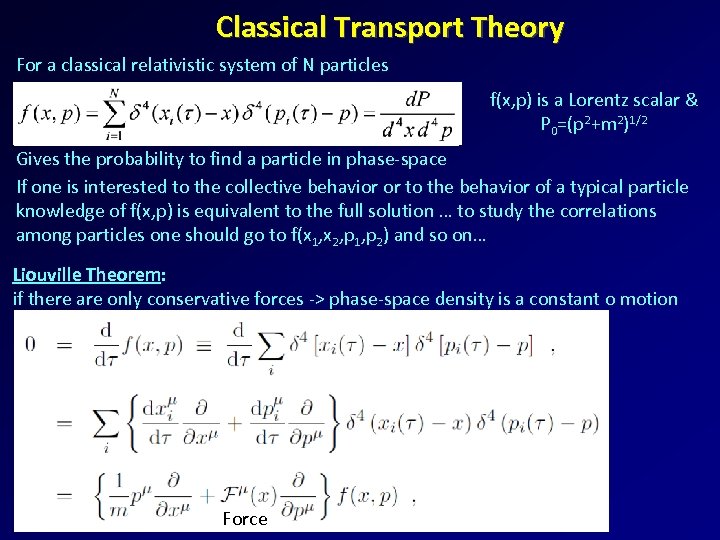 Classical Transport Theory For a classical relativistic system of N particles f(x, p) is a Lorentz scalar & P 0=(p 2+m 2)1/2 Gives the probability to find a particle in phase-space If one is interested to the collective behavior or to the behavior of a typical particle knowledge of f(x, p) is equivalent to the full solution … to study the correlations among particles one should go to f(x 1, x 2, p 1, p 2) and so on… Liouville Theorem: if there are only conservative forces -> phase-space density is a constant o motion Force
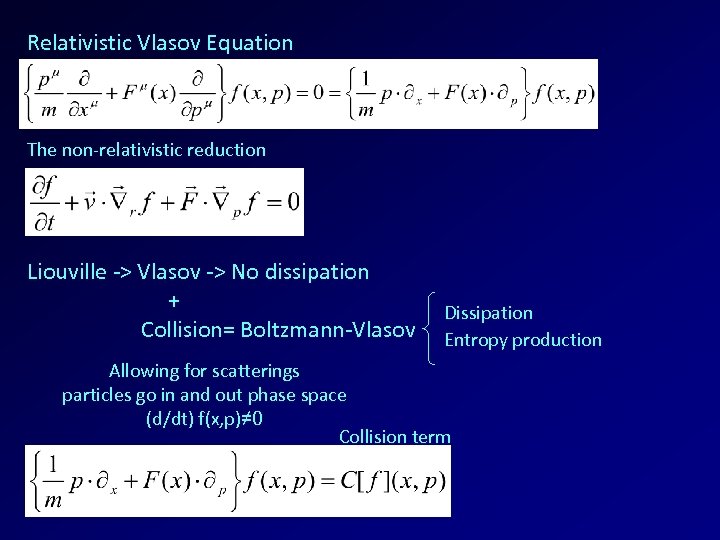 Relativistic Vlasov Equation The non-relativistic reduction Liouville -> Vlasov -> No dissipation + Collision= Boltzmann-Vlasov Dissipation Entropy production Allowing for scatterings particles go in and out phase space (d/dt) f(x, p)≠ 0 Collision term
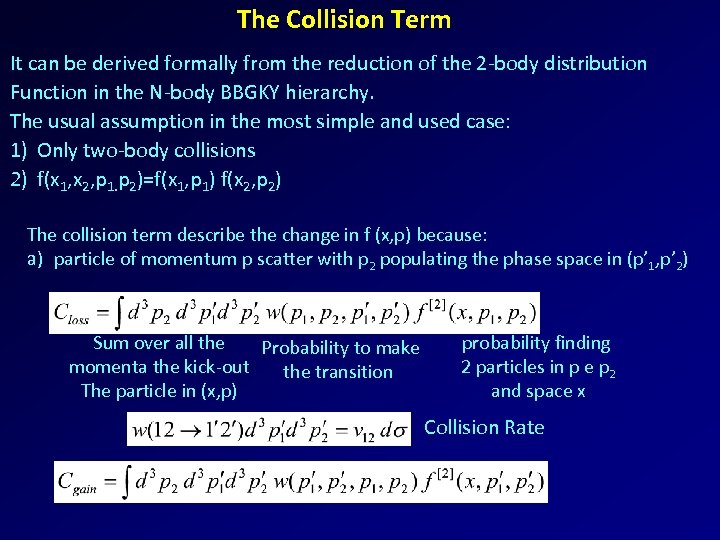 The Collision Term It can be derived formally from the reduction of the 2 -body distribution Function in the N-body BBGKY hierarchy. The usual assumption in the most simple and used case: 1) Only two-body collisions 2) f(x 1, x 2, p 1. p 2)=f(x 1, p 1) f(x 2, p 2) The collision term describe the change in f (x, p) because: a) particle of momentum p scatter with p 2 populating the phase space in (p’ 1, p’ 2) Sum over all the Probability to make momenta the kick-out the transition The particle in (x, p) probability finding 2 particles in p e p 2 and space x Collision Rate
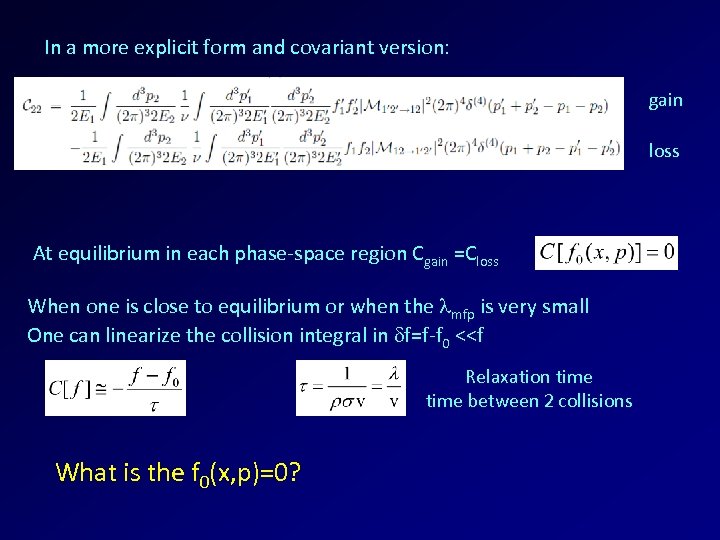 In a more explicit form and covariant version: gain loss At equilibrium in each phase-space region Cgain =Closs When one is close to equilibrium or when the mfp is very small One can linearize the collision integral in df=f-f 0 <
![Local Equilibrium Solution The necessary and sufficient condition to have C[f]=0 is Noticing that](https://present5.com/presentation/516efa0333121ae9192dd12661377da8/image-10.jpg "Local Equilibrium Solution The necessary and sufficient condition to have C[f]=0 is Noticing that") Local Equilibrium Solution The necessary and sufficient condition to have C[f]=0 is Noticing that p 1+p 2=p’ 1+p’ 2 such a condition is satisfied by the relativistic extension of the Boltzmann distribution: b=1/T temperature u collective four velocity chemical potential It is an equilibrium solution also with LOCAL VALUES of T(x), u(x), m(x) The Vlasov part gives the constraint and the relation among T, u, locally Main points: • Boltzmann-Vlasov equation gives the right equilibrium distributions • Close to equilibrium there can be many collisions with vanishing net effect
Local Equilibrium Solution The necessary and sufficient condition to have C[f]=0 is Noticing that p 1+p 2=p’ 1+p’ 2 such a condition is satisfied by the relativistic extension of the Boltzmann distribution: b=1/T temperature u collective four velocity chemical potential It is an equilibrium solution also with LOCAL VALUES of T(x), u(x), m(x) The Vlasov part gives the constraint and the relation among T, u, locally Main points: • Boltzmann-Vlasov equation gives the right equilibrium distributions • Close to equilibrium there can be many collisions with vanishing net effect
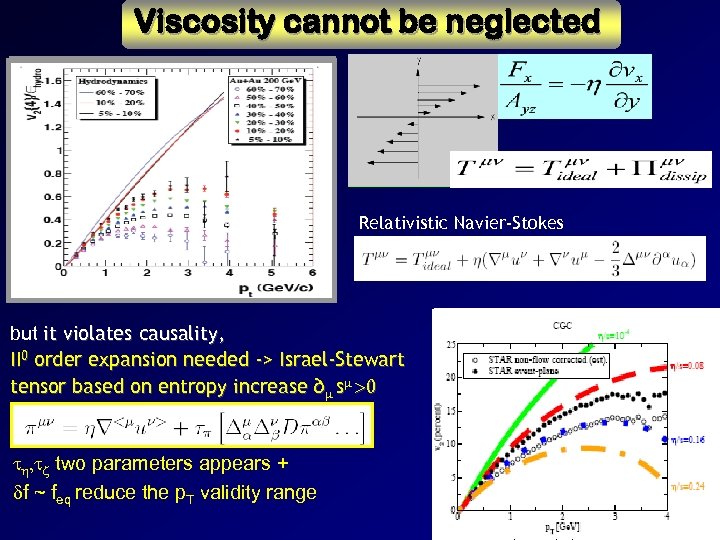
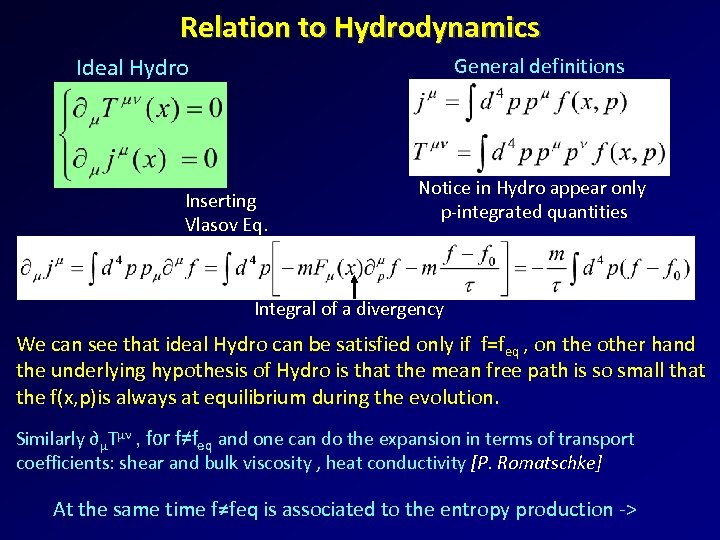 Relation to Hydrodynamics Ideal Hydro General definitions Inserting Vlasov Eq. Notice in Hydro appear only p-integrated quantities Integral of a divergency We can see that ideal Hydro can be satisfied only if f=feq , on the other hand the underlying hypothesis of Hydro is that the mean free path is so small that the f(x, p)is always at equilibrium during the evolution. Similarly ∂ T n , for f≠feq and one can do the expansion in terms of transport coefficients: shear and bulk viscosity , heat conductivity [P. Romatschke] At the same time f≠feq is associated to the entropy production ->
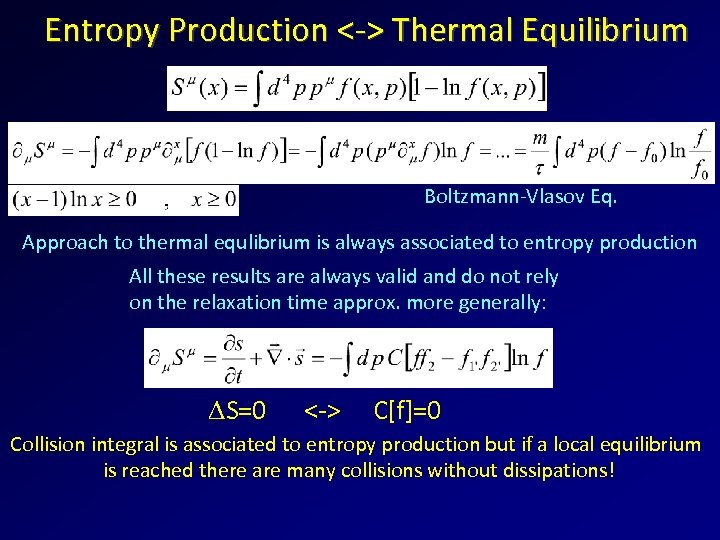 Entropy Production <-> Thermal Equilibrium Boltzmann-Vlasov Eq. Approach to thermal equlibrium is always associated to entropy production All these results are always valid and do not rely on the relaxation time approx. more generally: S=0 <-> C[f]=0 Collision integral is associated to entropy production but if a local equilibrium is reached there are many collisions without dissipations!
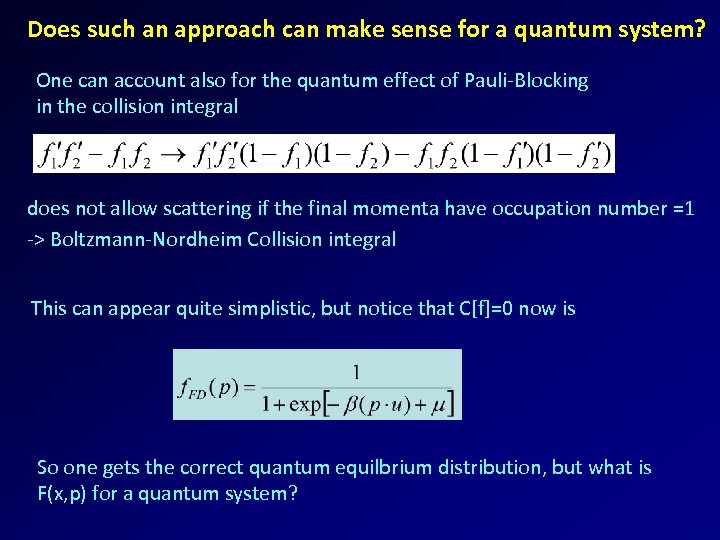 Does such an approach can make sense for a quantum system? One can account also for the quantum effect of Pauli-Blocking in the collision integral does not allow scattering if the final momenta have occupation number =1 -> Boltzmann-Nordheim Collision integral This can appear quite simplistic, but notice that C[f]=0 now is So one gets the correct quantum equilbrium distribution, but what is F(x, p) for a quantum system?
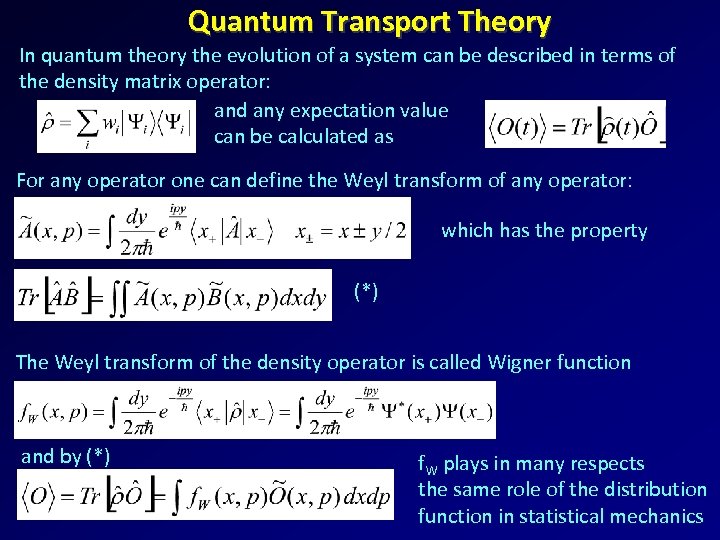 Quantum Transport Theory In quantum theory the evolution of a system can be described in terms of the density matrix operator: and any expectation value can be calculated as For any operator one can define the Weyl transform of any operator: which has the property (*) The Weyl transform of the density operator is called Wigner function and by (*) f. W plays in many respects the same role of the distribution function in statistical mechanics
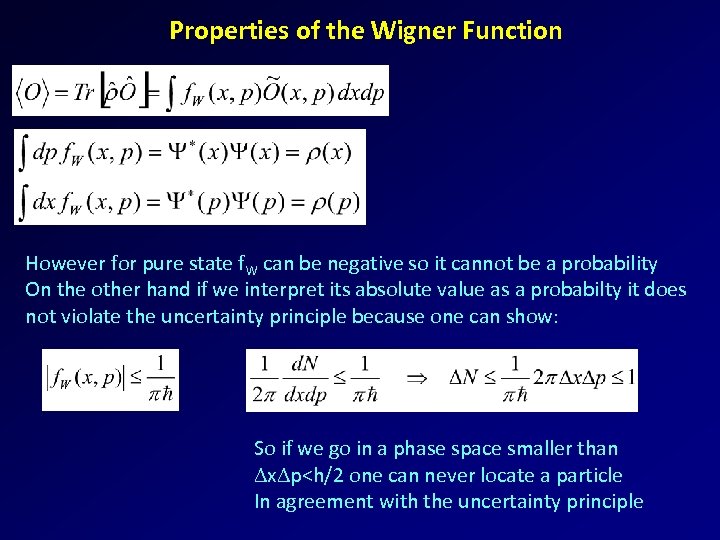 Properties of the Wigner Function However for pure state f. W can be negative so it cannot be a probability On the other hand if we interpret its absolute value as a probabilty it does not violate the uncertainty principle because one can show: So if we go in a phase space smaller than x p
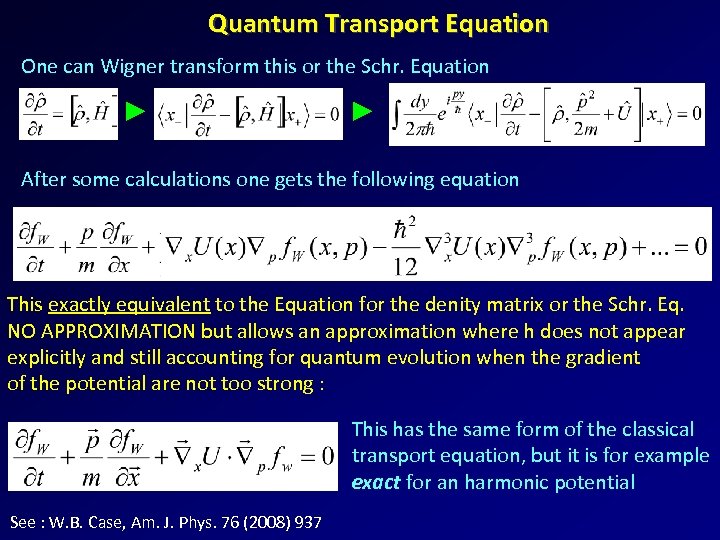 Quantum Transport Equation One can Wigner transform this or the Schr. Equation After some calculations one gets the following equation This exactly equivalent to the Equation for the denity matrix or the Schr. Eq. NO APPROXIMATION but allows an approximation where h does not appear explicitly and still accounting for quantum evolution when the gradient of the potential are not too strong : This has the same form of the classical transport equation, but it is for example exact for an harmonic potential See : W. B. Case, Am. J. Phys. 76 (2008) 937
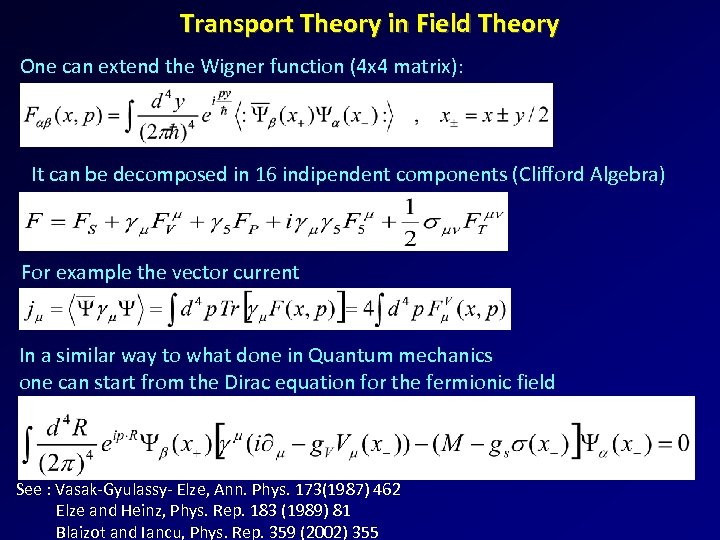 Transport Theory in Field Theory One can extend the Wigner function (4 x 4 matrix): It can be decomposed in 16 indipendent components (Clifford Algebra) For example the vector current In a similar way to what done in Quantum mechanics one can start from the Dirac equation for the fermionic field See : Vasak-Gyulassy- Elze, Ann. Phys. 173(1987) 462 Elze and Heinz, Phys. Rep. 183 (1989) 81 Blaizot and Iancu, Phys. Rep. 359 (2002) 355
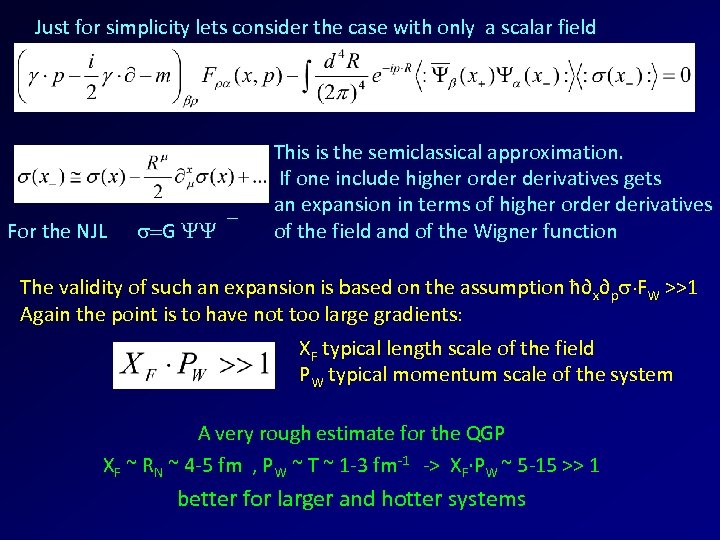 Just for simplicity lets consider the case with only a scalar field For the NJL =G YY This is the semiclassical approximation. If one include higher order derivatives gets an expansion in terms of higher order derivatives of the field and of the Wigner function The validity of such an expansion is based on the assumption ħ∂x∂p FW >>1 Again the point is to have not too large gradients: XF typical length scale of the field PW typical momentum scale of the system A very rough estimate for the QGP XF ~ RN ~ 4 -5 fm , PW ~ T ~ 1 -3 fm-1 -> XF·PW ~ 5 -15 >> 1 better for larger and hotter systems
 Substituting the semiclassical approximation one gets: There is a real and an imaginary part Which contains the in medium mass-shell Including more terms in the gradient expansion would have brougth terms breaking the mass-shell constraint Decomposing, using both real and imaginary part and taking the trace Vlasov Transport Equation in QFT This substitute the force term m. F (x) of classical transport Quantum effects encoded in the fields while f(x, p) evolution appears as the classical one.
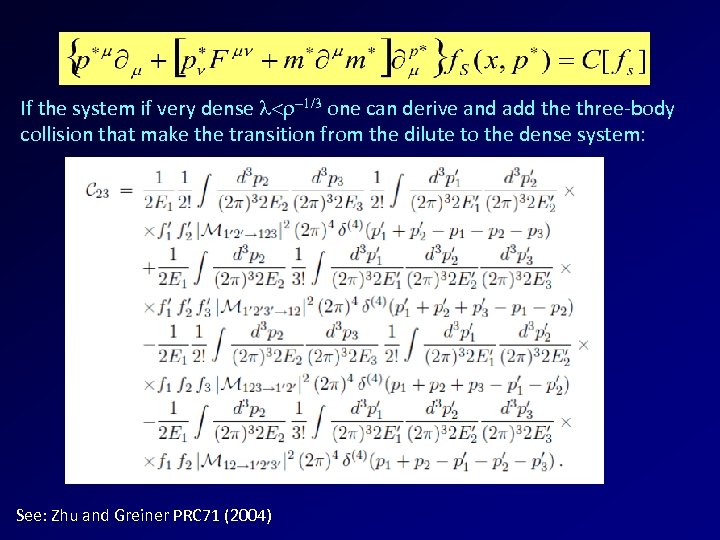
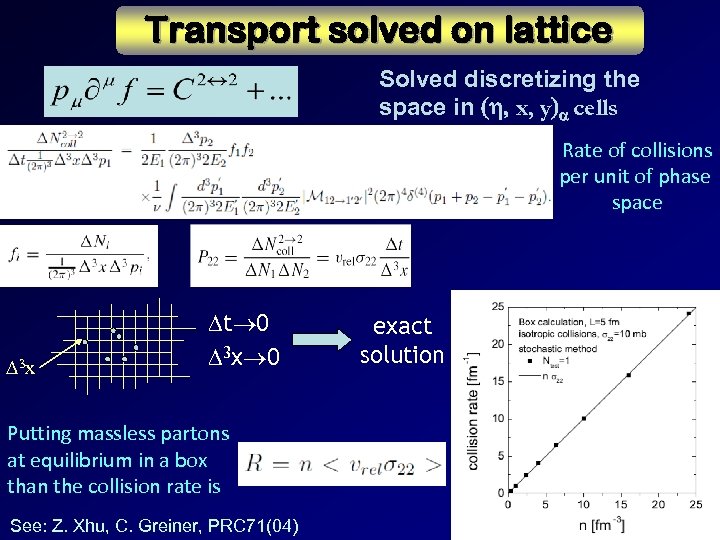 Transport solved on lattice Solved discretizing the space in (h, x, y)a cells Rate of collisions per unit of phase space 3 x t 0 3 x 0 Putting massless partons at equilibrium in a box than the collision rate is See: Z. Xhu, C. Greiner, PRC 71(04) exact solution
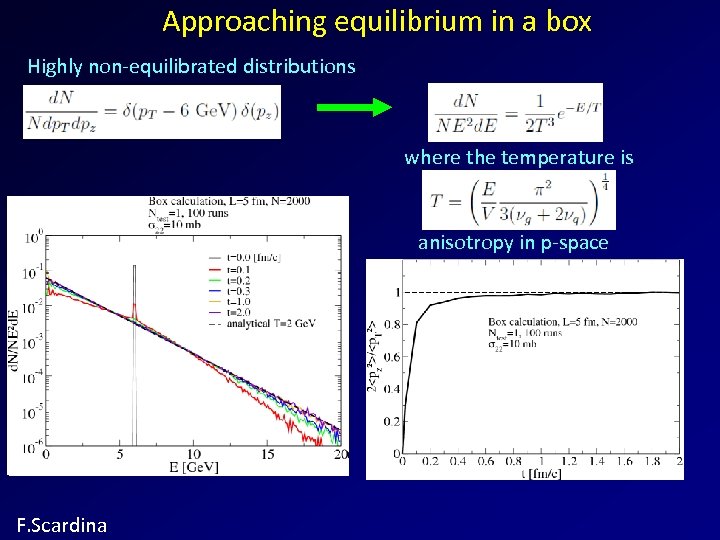 Approaching equilibrium in a box Highly non-equilibrated distributions where the temperature is anisotropy in p-space F. Scardina
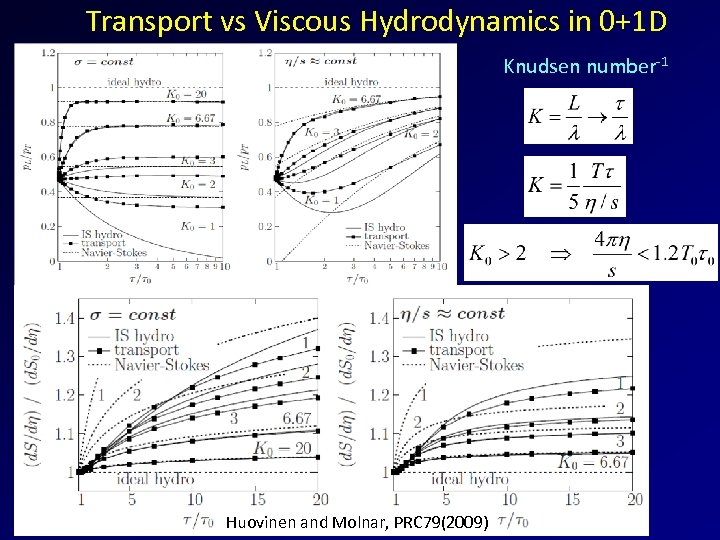 Transport vs Viscous Hydrodynamics in 0+1 D Knudsen number-1 Huovinen and Molnar, PRC 79(2009)
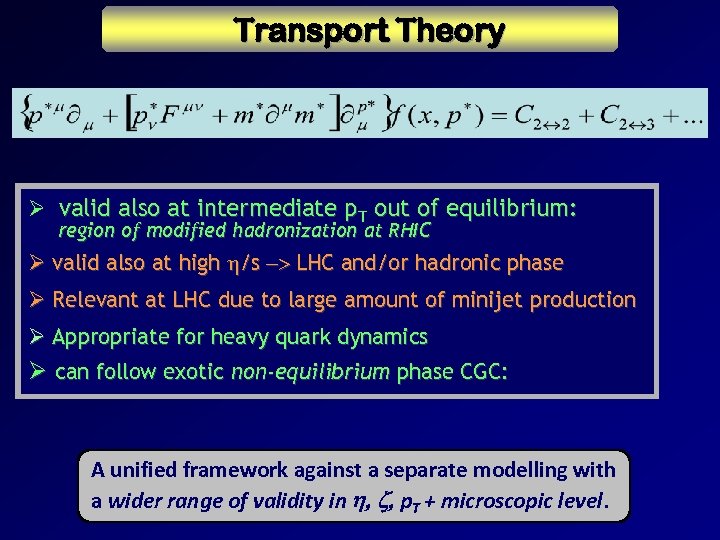 Transport Theory Ø valid also at intermediate p. T out of equilibrium: region of modified hadronization at RHIC Ø valid also at high /s -> LHC and/or hadronic phase Ø Relevant at LHC due to large amount of minijet production Ø Appropriate for heavy quark dynamics Ø can follow exotic non-equilibrium phase CGC: A unified framework against a separate modelling with a wider range of validity in h, z, p. T + microscopic level.
 Applications of transport approach to the QGP Physics - Collective flows & shear viscosity - dynamics of Heavy Quarks & Quarkonia
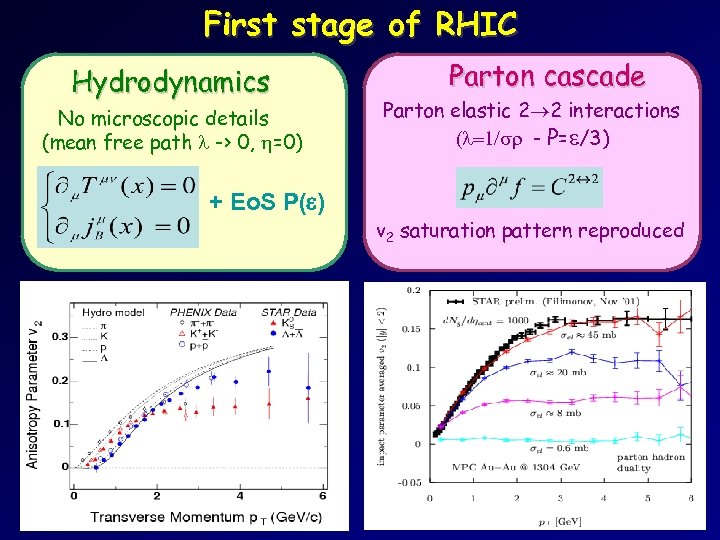 First stage of RHIC Hydrodynamics No microscopic details (mean free path -> 0, =0) + Eo. S P( ) Parton cascade Parton elastic 2 2 interactions ( =1/ r - P= /3) v 2 saturation pattern reproduced
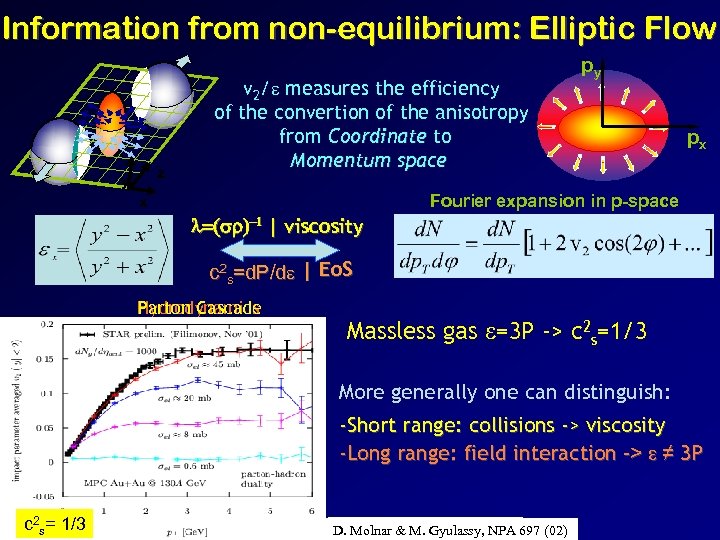 Information from non-equilibrium: Elliptic Flow z y v 2/ measures the efficiency of the convertion of the anisotropy from Coordinate to Momentum space py px Fourier expansion in p-space x =(sr)-1 | viscosity c 2 s=d. P/d | Eo. S Hydrodynamics Parton Cascade 2 v 2/ c 2 s= 0. 6 More generally one can distinguish: =0 c 2 s= 1/3 Massless gas =3 P -> c 2 s=1/3 c 2 s= 0. 1 Measure of P gradients time -Short range: collisions -> viscosity -Long range: field interaction -> ≠ 3 P Bhalerao & M. Gyulassy, NPA D. Molnaret al. , PLB 627(2005) 697 (02)
 If v 2 is very large P. Kolb More harmonics needed to describe an elliptic deformation -> v 4 To balance the minimum v 4 >0 require v 4 ~ 4% if v 2= 20% At RHIC a finite v 4 observed for the first time !
 Viscosity cannot be neglected Relativistic Navier-Stokes but it violates causality, II 0 order expansion needed -> Israel-Stewart tensor based on entropy increase ∂ s >0 t , tz two parameters appears + df ~ feq reduce the p. T validity range P. Romatschke, PRL 99 (07)
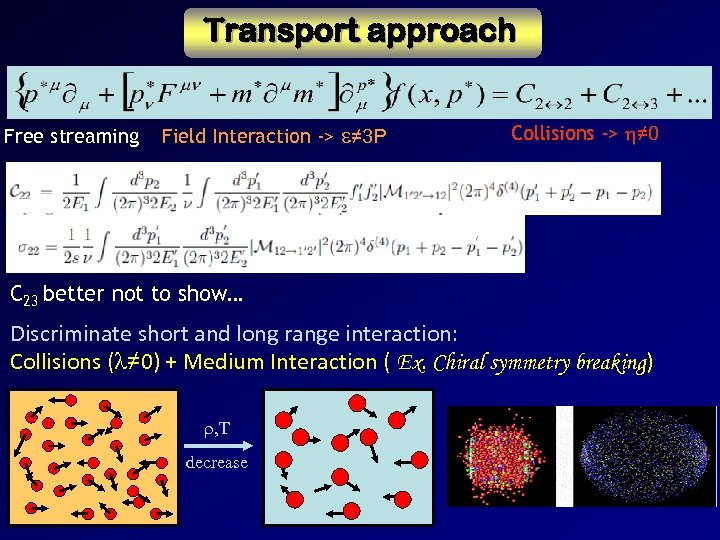 Transport approach Free streaming Field Interaction -> ≠ 3 P Collisions -> ≠ 0 C 23 better not to show… Discriminate short and long range interaction: Collisions ( ≠ 0) + Medium Interaction ( Ex. Chiral symmetry breaking) r, T decrease
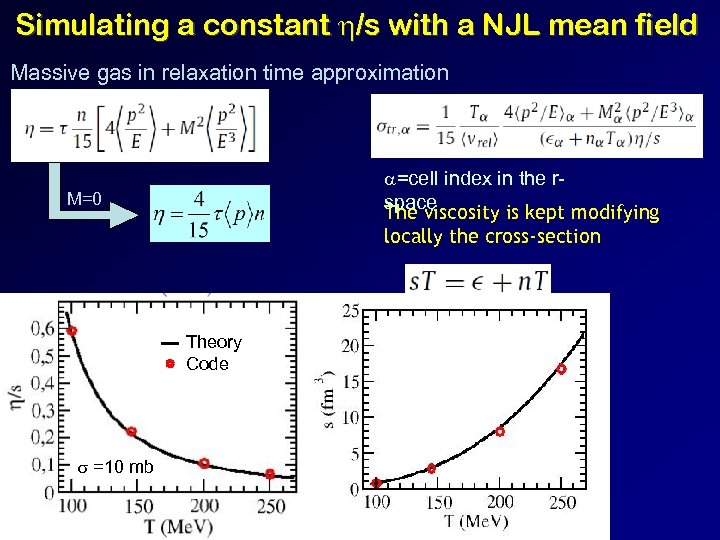
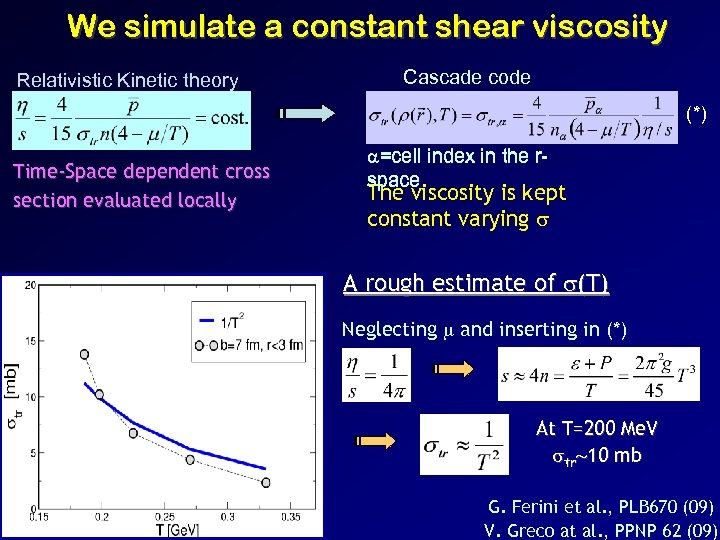 We simulate a constant shear viscosity Relativistic Kinetic theory Cascade code (*) Time-Space dependent cross section evaluated locally =cell index in the rspace The viscosity is kept constant varying A rough estimate of (T) Neglecting and inserting in (*) At T=200 Me. V tr 10 mb G. Ferini et al. , PLB 670 (09) V. Greco at al. , PPNP 62 (09)
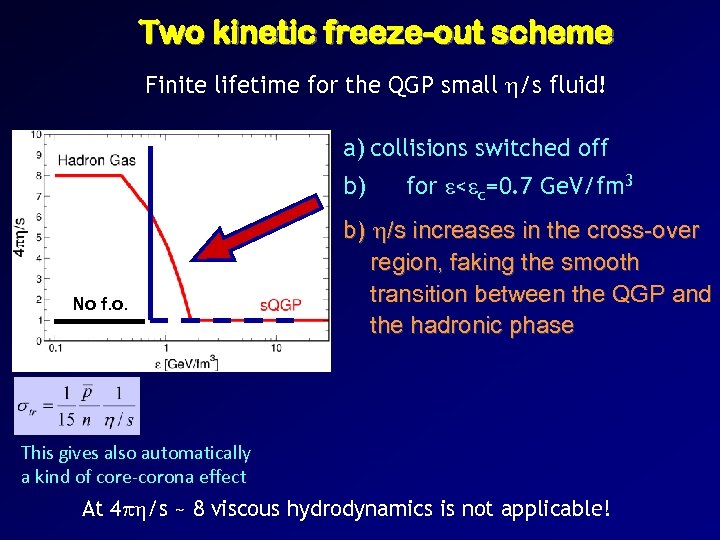 Two kinetic freeze-out scheme Finite lifetime for the QGP small /s fluid! a) collisions switched off b) No f. o. for < c=0. 7 Ge. V/fm 3 b) /s increases in the cross-over region, faking the smooth transition between the QGP and the hadronic phase This gives also automatically a kind of core-corona effect At 4 /s ~ 8 viscous hydrodynamics is not applicable!
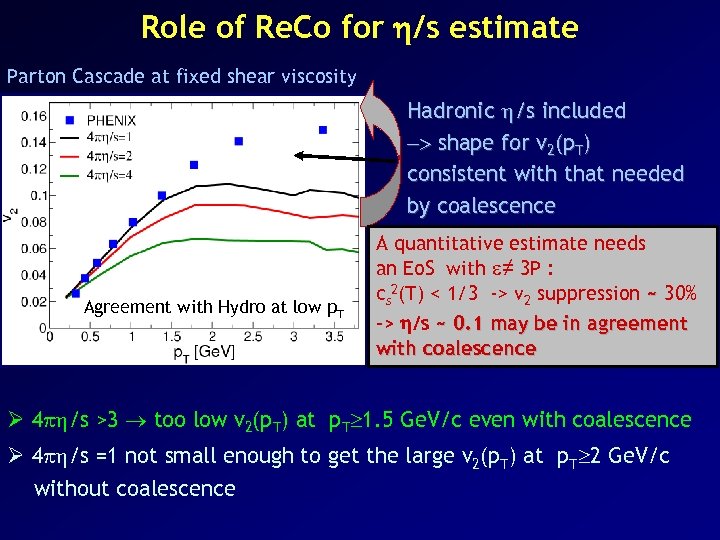 Role of Re. Co for h/s estimate Parton Cascade at fixed shear viscosity Hadronic /s included -> shape for v 2(p. T) consistent with that needed by coalescence Agreement with Hydro at low p. T A quantitative estimate needs an Eo. S with ≠ 3 P : cs 2(T) < 1/3 -> v 2 suppression ~ 30% -> h/s ~ 0. 1 may be in agreement with coalescence Ø 4 /s >3 too low v 2(p. T) at p. T 1. 5 Ge. V/c even with coalescence Ø 4 /s =1 not small enough to get the large v 2(p. T) at p. T 2 Ge. V/c without coalescence
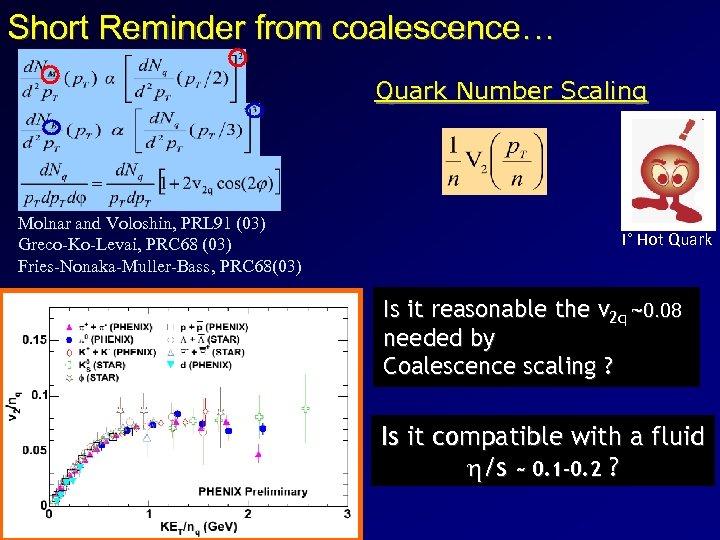 Short Reminder from coalescence… Quark Number Scaling Molnar and Voloshin, PRL 91 (03) Greco-Ko-Levai, PRC 68 (03) Fries-Nonaka-Muller-Bass, PRC 68(03) I° Hot Quark Is it reasonable the v 2 q ~0. 08 needed by Coalescence scaling ? Is it compatible with a fluid /s ~ 0. 1 -0. 2 ?
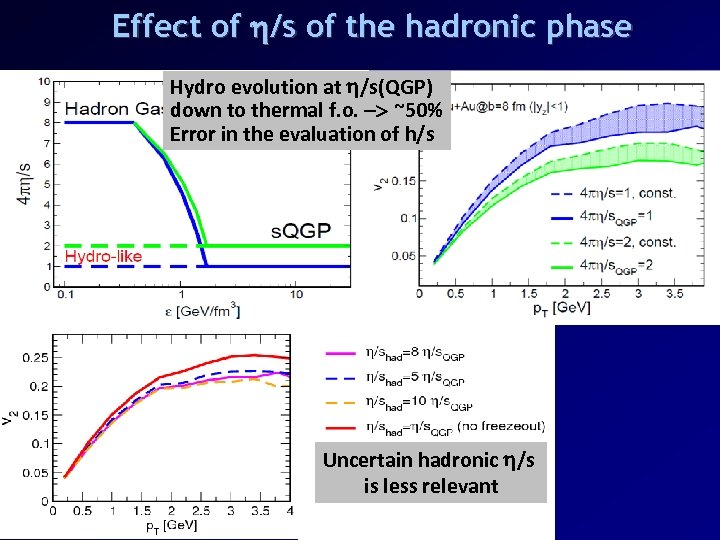 Effect of h/s of the hadronic phase Hydro evolution at h/s(QGP) down to thermal f. o. -> ~50% Error in the evaluation of h/s Uncertain hadronic h/s is less relevant
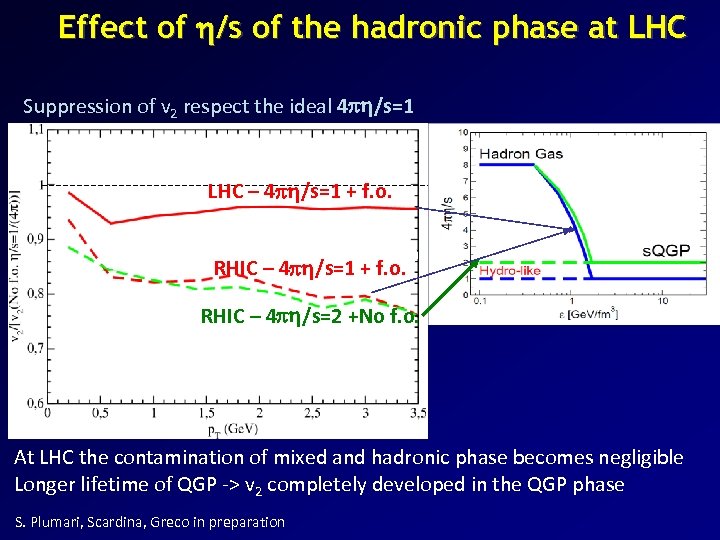 Effect of h/s of the hadronic phase at LHC Suppression of v 2 respect the ideal 4 ph/s=1 LHC – 4 ph/s=1 + f. o. RHIC – 4 ph/s=2 +No f. o. At LHC the contamination of mixed and hadronic phase becomes negligible Longer lifetime of QGP -> v 2 completely developed in the QGP phase S. Plumari, Scardina, Greco in preparation
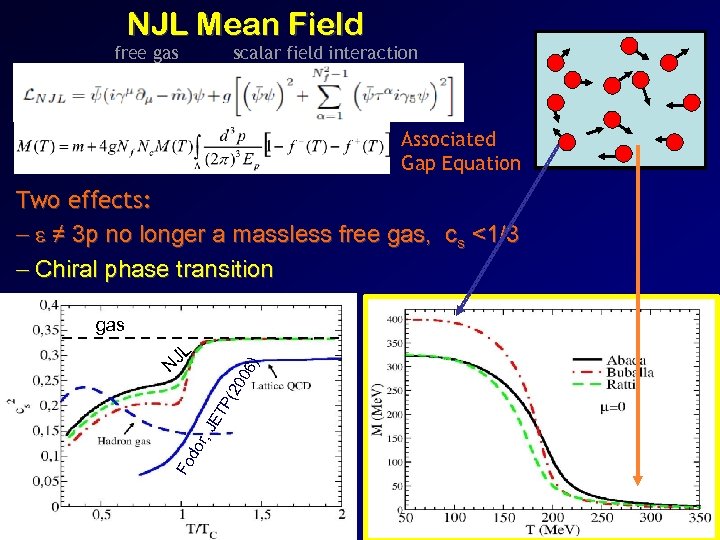
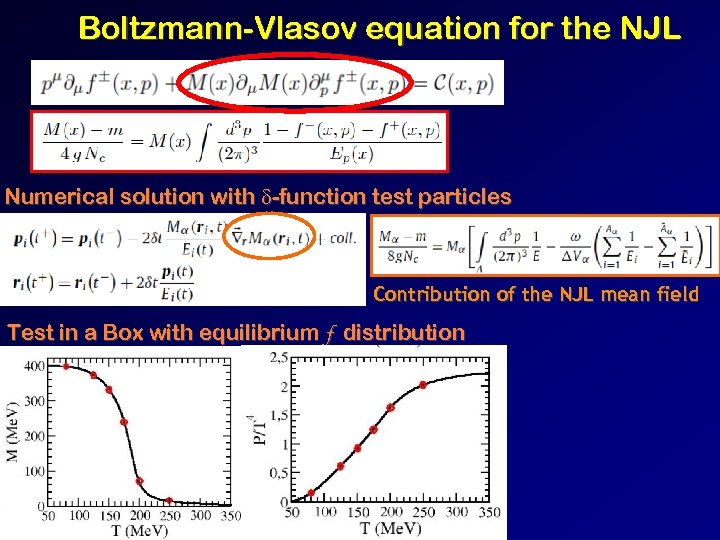
 Impact of the Mean Field and/or of the Chiral phase transition - Cascade -> Boltzmann-Vlasov Transport - Impact of an NJL mean field dynamics - Toward a transport calculation with a l. QCD-Eo. S
 NJL Mean Field free gas scalar field interaction Associated Gap Equation Two effects: - ≠ 3 p no longer a massless free gas, cs <1/3 - Chiral phase transition gas JL Fo do r, J ET P( 20 06 ) N
 Boltzmann-Vlasov equation for the NJL Numerical solution with d-function test particles Contribution of the NJL mean field Test in a Box with equilibrium f distribution
 Simulating a constant /s with a NJL mean field Massive gas in relaxation time approximation =cell index in the rspace The viscosity is kept modifying locally the cross-section M=0 Theory Code =10 mb
 Dynamical evolution with NJL Au+Au @ 200 AGe. V for central collision, b=0 fm.
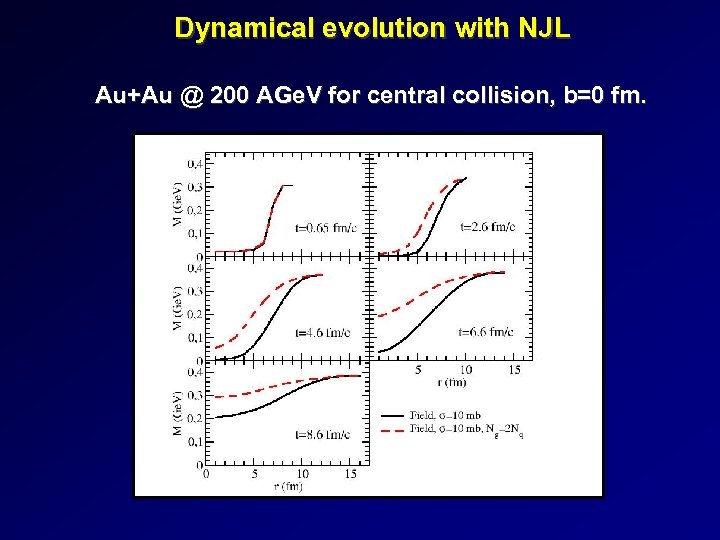
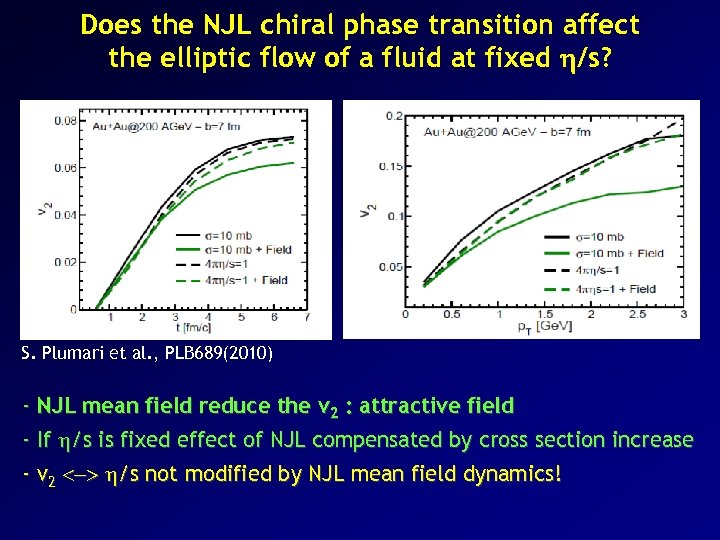 Does the NJL chiral phase transition affect the elliptic flow of a fluid at fixed h/s? S. Plumari et al. , PLB 689(2010) - NJL mean field reduce the v 2 : attractive field - If /s is fixed effect of NJL compensated by cross section increase - v 2 <-> /s not modified by NJL mean field dynamics!
![Next step - use a quasiparticle model with a realistic Eo. S [vs(T)] for](https://present5.com/presentation/516efa0333121ae9192dd12661377da8/image-44.jpg "Next step - use a quasiparticle model with a realistic Eo. S [vs(T)] for") Next step - use a quasiparticle model with a realistic Eo. S [vs(T)] for a quantitative estimate of h/s to compare with Hydro…
Next step - use a quasiparticle model with a realistic Eo. S [vs(T)] for a quantitative estimate of h/s to compare with Hydro…
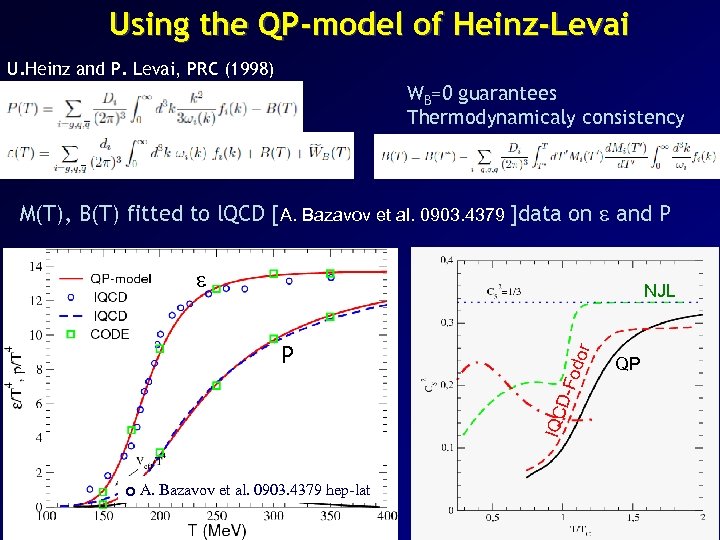 Using the QP-model of Heinz-Levai U. Heinz and P. Levai, PRC (1998) WB=0 guarantees Thermodynamicaly consistency M(T), B(T) fitted to l. QCD [A. Bazavov et al. 0903. 4379 ]data on and P ° A. Bazavov et al. 0903. 4379 hep-lat l. QC D-F odo P r NJL QP
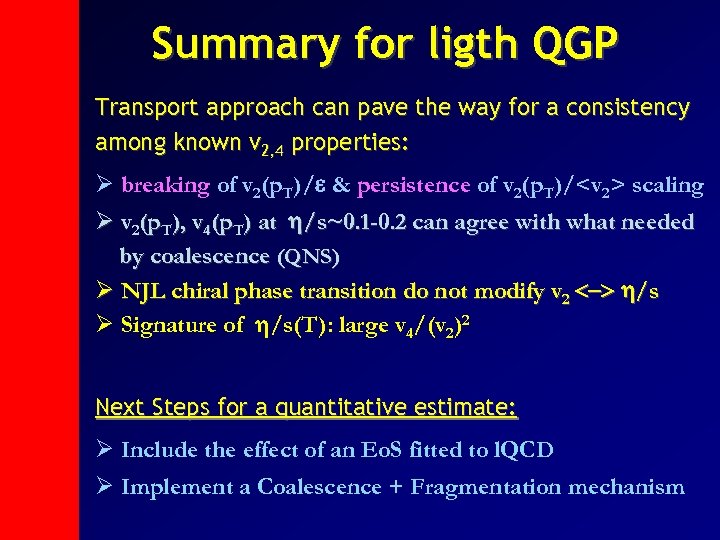 Summary for ligth QGP Transport approach can pave the way for a consistency among known v 2, 4 properties: Ø breaking of v 2(p. T)/ & persistence of v 2(p. T)/
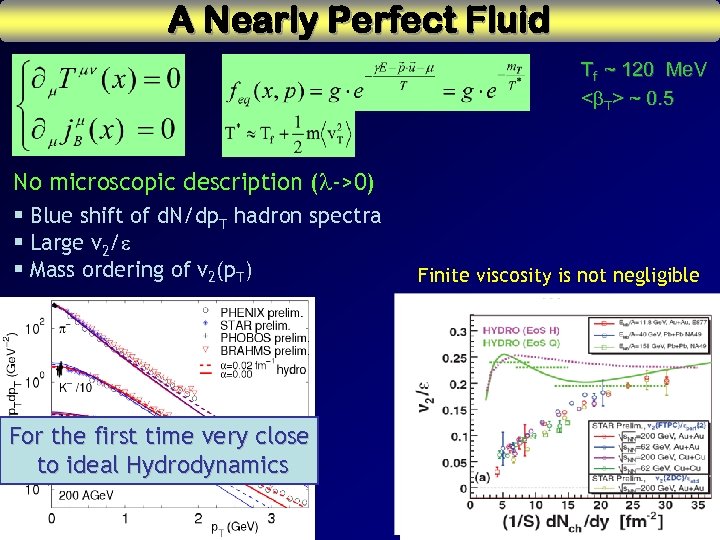 A Nearly Perfect Fluid Tf ~ 120 Me. V
 Jet Quenching How much modification respect to pp? Nuclear Modification Factor Jet triggered angular correl. v Jet gluon radiation observed: observed § all hadrons RAA <<1 and flat in p. T near § photons not quenched -> suppression due to QCD Medium away
 Surprises… Baryon/Mesons Quenching u u+A A p+p PHENIX, PRL 89(2003) In vacuum p/ ~ 0. 3 due to Jet fragmentation § Jet quenching should affect both 0 suppression: evidence of jet quenching before fragmentation Protons not suppressed Hadronization has been modified p. T < 4 -6 Ge. V !?
 Hadronization in Heavy-Ion Collisions üInitial state: no partons in the vacuum but a thermal ensemble of partons -> Use in medium quarks üNo direct QCD factorization scale for the bulk: dynamics much less violent (t ~ 4 fm/c) More easy to produce baryons! Parton spectrum Baryon Fragmentation: Co § energy needed to create quarks from vacuum § hadrons from higher p. T al. Meson H Fra gm en tat ion Coalescence: § partons are already there $ to be close in phase space $ § ph= n p. T , , n = 2 , 3 baryons from lower momenta (denser) V. Greco et al. / R. J. Fries et al. , PRL 90(2003) Re. Co pushes out soft physics by factors x 2 and x 3 !
 Hadronization Modified Baryon/Mesons Quark number scaling u u+A A p+p PHENIX, PRL 89(2003) v 2 q fitted from v 2 GKL Coalescence scaling 2 Enhancement of v Dynamical quarks are visible Collective flows
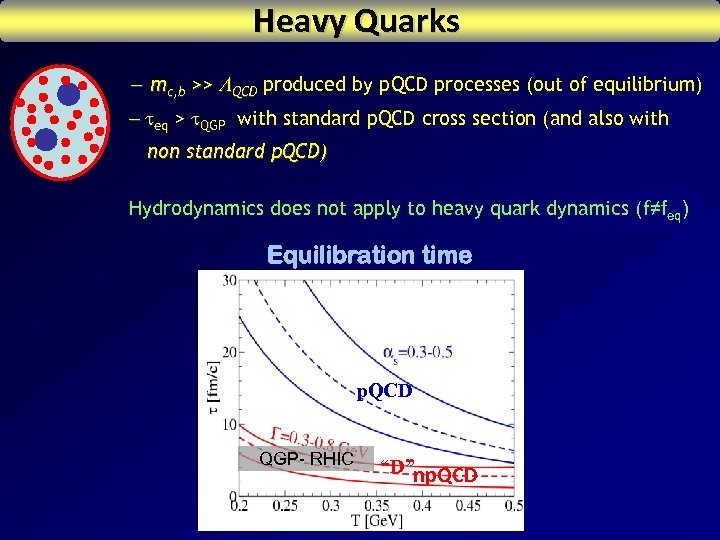 Heavy Quarks - mc, b >> LQCD produced by p. QCD processes (out of equilibrium) - teq > t. QGP with standard p. QCD cross section (and also with non standard p. QCD) Hydrodynamics does not apply to heavy quark dynamics (f≠feq) Equilibration time p. QCD QGP- RHIC “D”np. QCD
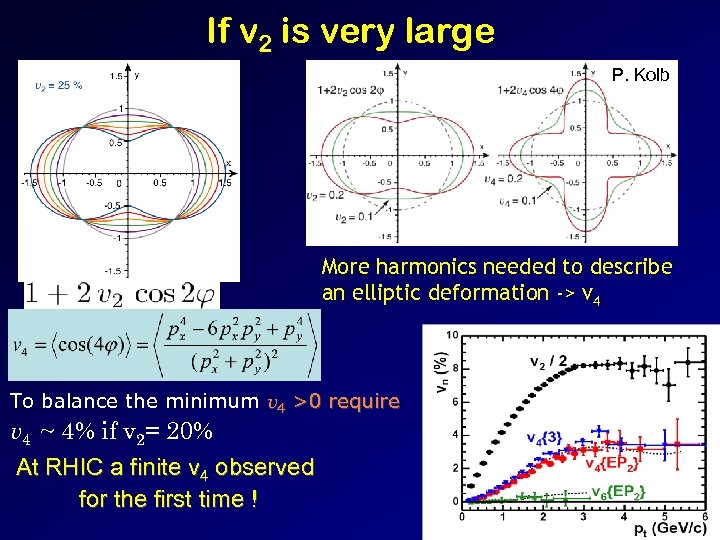
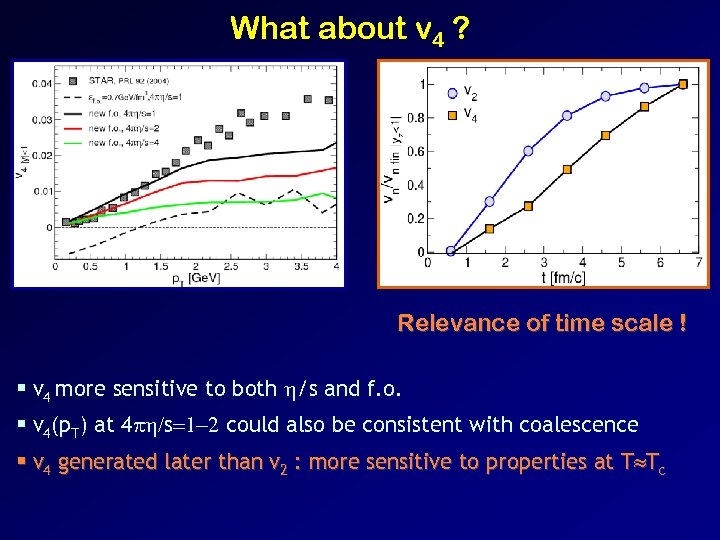 What about v 4 ? Relevance of time scale ! § v 4 more sensitive to both /s and f. o. § v 4(p. T) at 4 /s=1 -2 could also be consistent with coalescence § v 4 generated later than v 2 : more sensitive to properties at T Tc
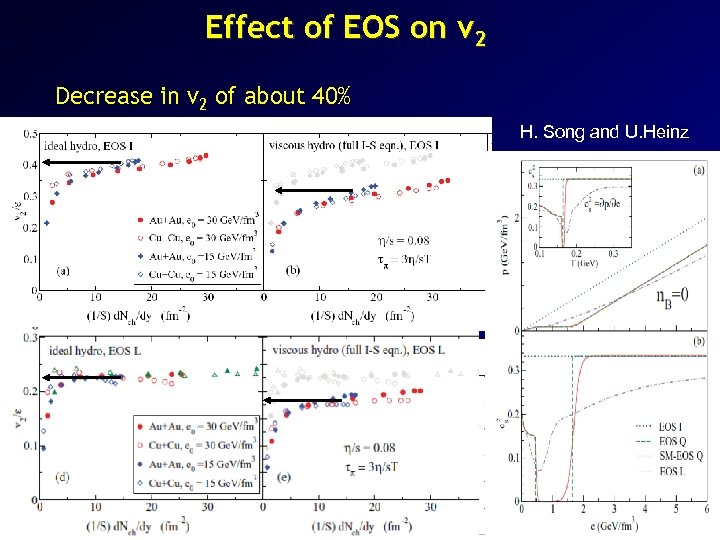 Effect of EOS on v 2 Decrease in v 2 of about 40% H. Song and U. Heinz
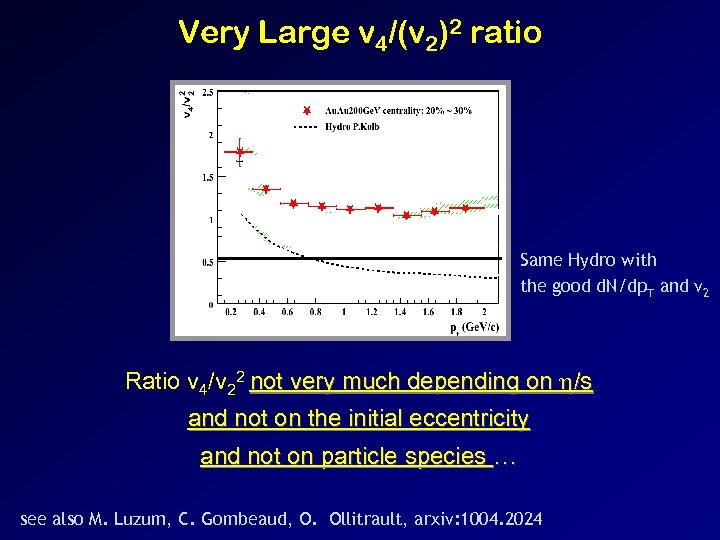 Very Large v 4/(v 2)2 ratio Same Hydro with the good d. N/dp. T and v 2 Ratio v 4/v 22 not very much depending on /s and not on the initial eccentricity and not on particle species … see also M. Luzum, C. Gombeaud, O. Ollitrault, arxiv: 1004. 2024
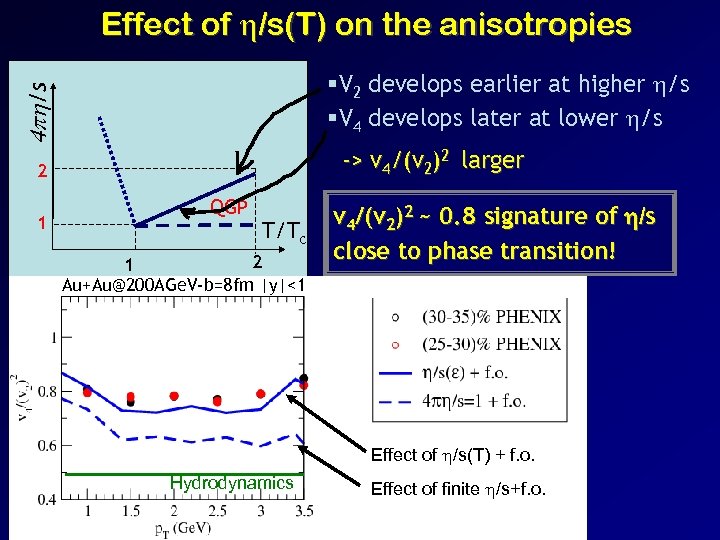 Effect of /s(T) on the anisotropies 4 ph/s §V 2 develops earlier at higher /s §V 4 develops later at lower /s -> v 4/(v 2)2 larger 2 1 QGP T/Tc 2 1 Au+Au@200 AGe. V-b=8 fm |y|<1 v 4/(v 2)2 ~ 0. 8 signature of h/s close to phase transition! Effect of /s(T) + f. o. Hydrodynamics Effect of finite /s+f. o.
 If the system if very dense