


 Скачать презентацию Transport Refrigeration of Northwest Arkansas Why Do
8254236b6580ebf6bb69b3c28370d79b.ppt
- Количество слайдов: 16
 Transport Refrigeration of Northwest Arkansas
 Why Do Truck Drivers Idle? 1. 2. 3. 4. 5. Driver comfort To keep batteries charged To warm engine for easy startups To provide hotel power in sleeper Out of Habit
 Why is Idling a Problem? 1. Environmental – Emissions, health Impact 2. Financial – Maintenance Costs (wear and tear of tractor engine) – Fuel consumption
 Anti-Idling Legislation - CARB announced that California aims to ban all truck idling by January 1, 2008. - 21 States and hundreds of municipalities regulate truckers with anti-idling laws - Current regulations limit idling from 0 to 15 minutes - Enforcement is increasing
 The Need for an APU • Fuel prices continue to rise and are a significant portion of the operating cost for a fleet. • Anti-idle laws that prohibit truck idling are growing in coverage and enforcement • Idling is done to keep drivers comfortable, engines warm, and batteries charged. • Idling has a significant cost – fuel, engine wear and maintenance.
 New Research Shows Excessive Idling Can Shorten Diesel-Engine Life up to 20% “One hour of idling causes the same amount of wear as two hours or 80 mi. to 120 mi. of driving” -Larry R. Johnson, Director of Argonne’s Center for Transportation Research
 Tri. Pac Unique Hybrid System • Diesel engine used for - Air Conditioning - Battery Charging - Heating Engine Block • Truck battery and inverter for accessory power. • Fuel Fired Heater uses Battery Voltage
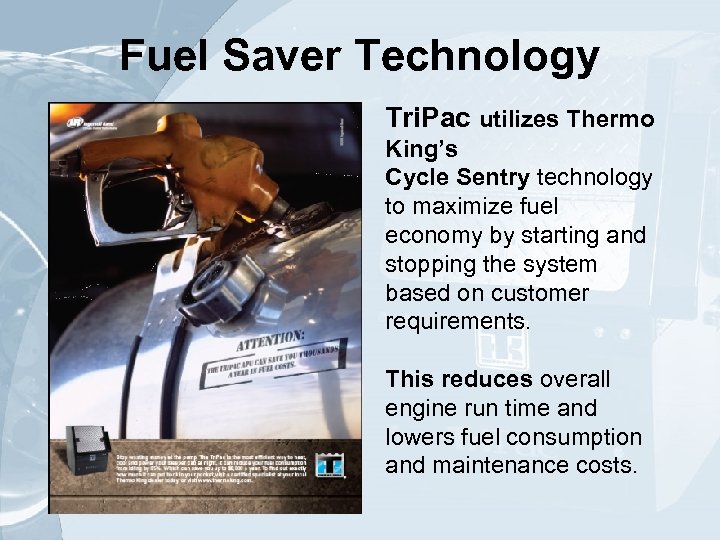 Fuel Saver Technology Tri. Pac utilizes Thermo King’s Cycle Sentry technology to maximize fuel economy by starting and stopping the system based on customer requirements. This reduces overall engine run time and lowers fuel consumption and maintenance costs.
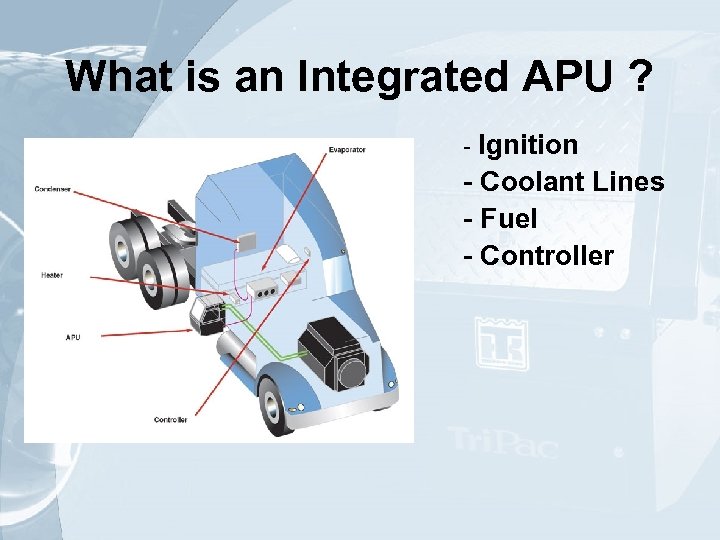 What is an Integrated APU ? - Ignition - Coolant Lines - Fuel - Controller
 Why Buy an Integrated APU ? • Lower overall cost of ownership – Lower diesel fuel consumption (APU versus tractor engine). – Reduced truck engine maintenance (reduced idle miles). • Driver retention – Truck cab sleeper compartment climate control and electric power. • Improve overall system reliability – Providing truck engine preheating – Provide truck battery charging • Better for the environment – Less fuel and emissions
 Tri. Pac Product Features • • • Sleeper heating and air-conditioning Battery charging Engine block heating Accessory power Easy driver operation
 Tri. Pac Major Components • • • TK 2. 70 M Tier II engine Fuel-fired heater TK air conditioning compressor 65 Amp 12 Volt alternator Programmable microprocessor controller
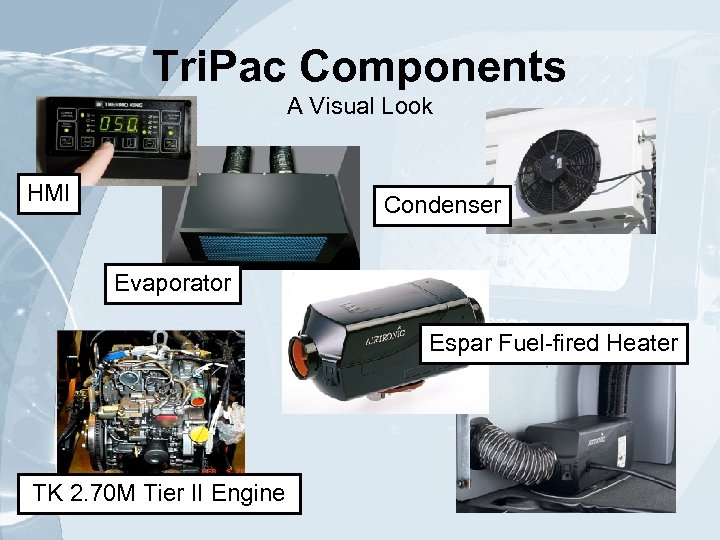 Tri. Pac Components A Visual Look HMI Condenser Evaporator Espar Fuel-fired Heater TK 2. 70 M Tier II Engine
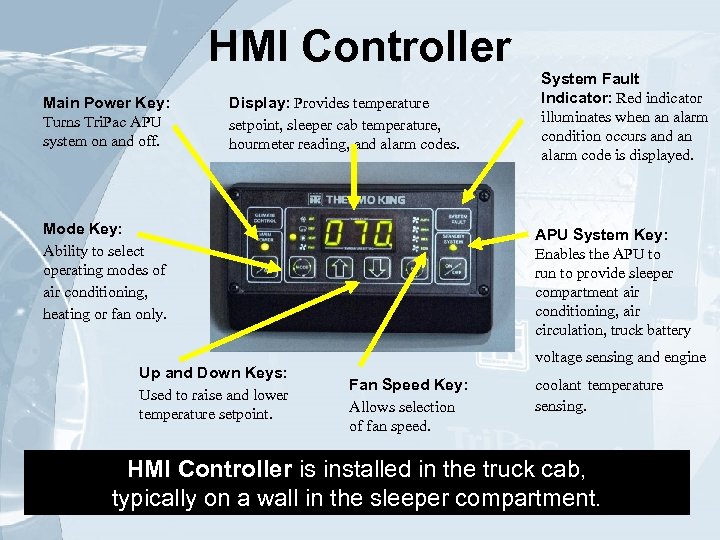 HMI Controller Main Power Key: Turns Tri. Pac APU system on and off. Display: Provides temperature setpoint, sleeper cab temperature, hourmeter reading, and alarm codes. Mode Key: Ability to select operating modes of air conditioning, heating or fan only. Up and Down Keys: Used to raise and lower temperature setpoint. System Fault Indicator: Red indicator illuminates when an alarm condition occurs and an alarm code is displayed. APU System Key: Enables the APU to run to provide sleeper compartment air conditioning, air circulation, truck battery voltage sensing and engine Fan Speed Key: Allows selection of fan speed. coolant temperature sensing. HMI Controller is installed in the truck cab, typically on a wall in the sleeper compartment.
 Tri. Pac APU A Wise Investment • Reduce unnecessary fuel consumption by over 85% while resting in comfort • Extend truck engine maintenance intervals • Reduce wear on truck engine • Comply with anti-idle laws
 For further information please contact Bill Dawson Transport Refrigeration of Northwest Arkansas 479 -659 -5318