 Скачать презентацию Transport-level and Web Security SSL TLS SSH
01ec969fac7f883762e895cbdc43d3d8.ppt
- Количество слайдов: 48



Transport-level and Web Security (SSL / TLS, SSH) Chapter 17 of Stallings
Web Security n HTTP is not a secure protocol – simple and stateless client/server application running over TCP/IP n Added security measures needed – we will see SSL (Secure Socket Layer) and TLS (Transport Layer Security) – HTTPS • Secure HTTP protocol n Actually SSL support is provided for several other TCP/IP applications as well – POP 3, SMTP, FTP, News, . . .
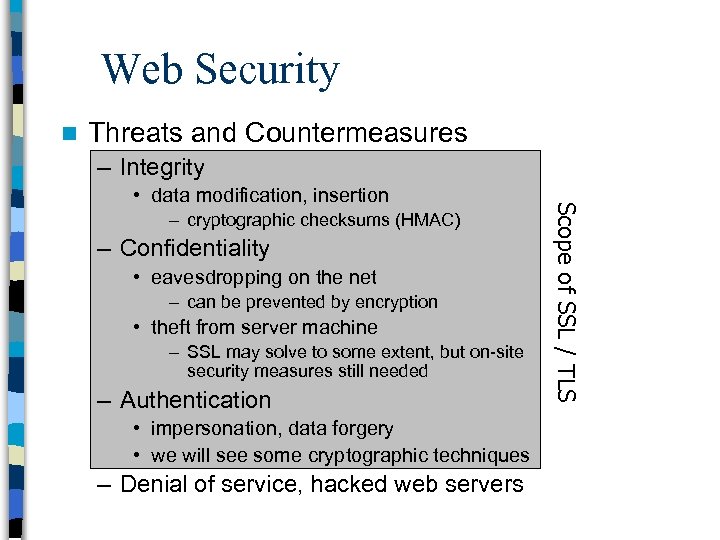
Web Security n Threats and Countermeasures – Integrity – cryptographic checksums (HMAC) – Confidentiality • eavesdropping on the net – can be prevented by encryption • theft from server machine – SSL may solve to some extent, but on-site security measures still needed – Authentication • impersonation, data forgery • we will see some cryptographic techniques – Denial of service, hacked web servers Scope of SSL / TLS • data modification, insertion
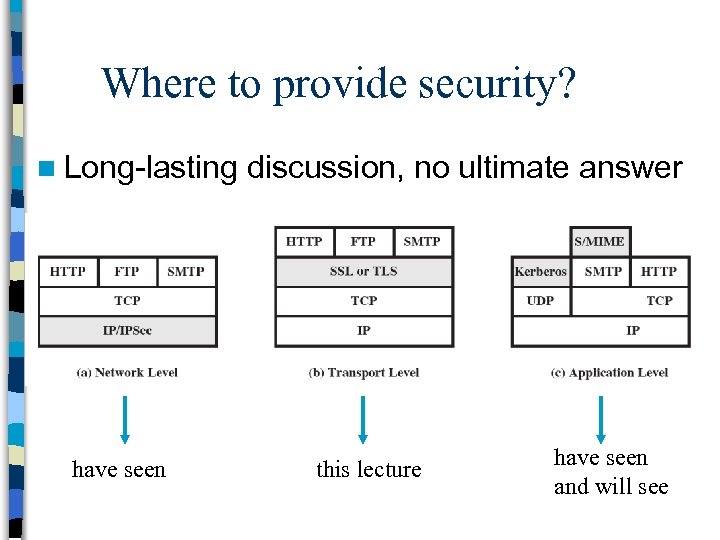
Where to provide security? n Long-lasting have seen discussion, no ultimate answer this lecture have seen and will see
SSL (Secure Socket Layer) n originally developed by Netscape n version 3 designed with public input n subsequently Internet standardization effort started at IETF – TLS (Transport Layer Security) working group established – TLS can be viewed as SSL v 3. 1 and compatible with SSL v 3 n Our book completely switched to TLS – But they are not that different anyway
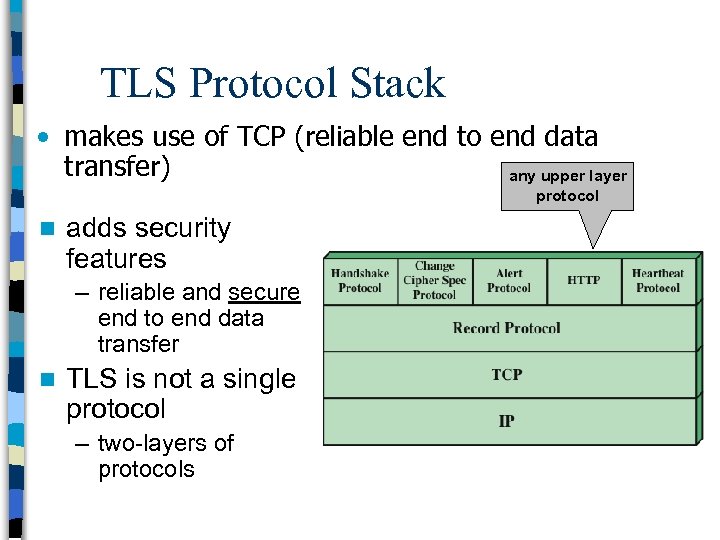
TLS Protocol Stack • makes use of TCP (reliable end to end data transfer) any upper layer protocol n adds security features – reliable and secure end to end data transfer n TLS is not a single protocol – two-layers of protocols
Two TLS concepts n TLS session – an association between client and server – define a set of cryptographic parameters created by the Handshake Protocol – may be shared by multiple TLS connections n TLS connection – a transient, peer-to-peer, secure communication link – associated with (derived from) a TLS session – A session is used several times to create connections n Session vs. Connection – Sessions are used to avoid expensive negotiation for crypto parameters for each connection n Both are characterized by several parameters – that define a session state or connection state
Session state parameters n Session identifier – chosen by server n Peer certificate – certificate of the peer entity (server’s if the entity is client, client’s if the entity is server) – may be null (which is the likely case for server) n Compression method (to be depreciated in TLS v 1. 3) – algorithm used for compression n Cipher Spec – bulk data encryption algorithm (AES, etc. ) - may be null (rarely) – hash algorithm used in MAC calculation (MD 5 or SHA-1 or SHA-2) n Master Secret – 48 -bytes secret shared between client and server n Is resumable – a flag that is set if the session can be used later for new connections
Connection State Parameters n Random numbers – server and client exchange – used as nonces during key exchange n MAC secret – secret key used for MAC operations n conventional encryption keys – Separate for server and client n initialization vector – if CBC mode is used
TLS Record Protocol n serves to TLS connections – uses connection parameters n provides confidentiality and integrity also fragments (into 214 bytes chunks) n optionally compresses data (in practice, no compression and this is going to be depreciated in the next version of TLS) n n confidentiality – AES, IDEA, DES, 3 DES, RC 4, etc. n message integrity – using HMAC with shared secret key – In SSL, the method was similar to HMAC but pads were concatenated rather than XORed
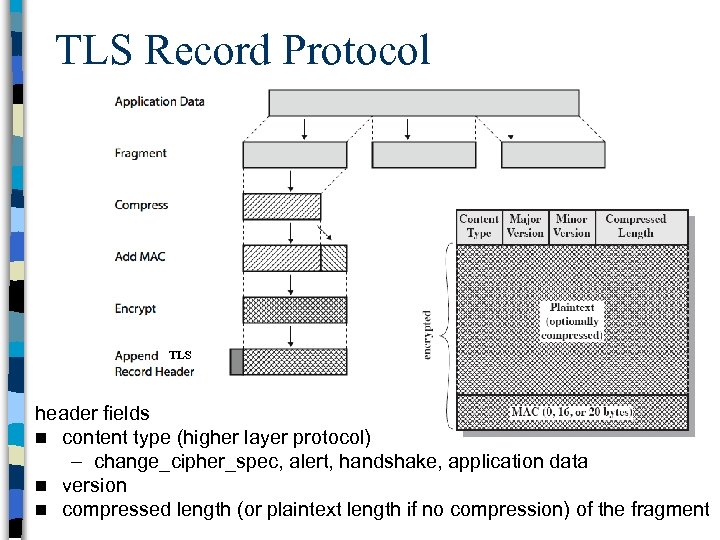
TLS Record Protocol TLS header fields n content type (higher layer protocol) – change_cipher_spec, alert, handshake, application data n version n compressed length (or plaintext length if no compression) of the fragment
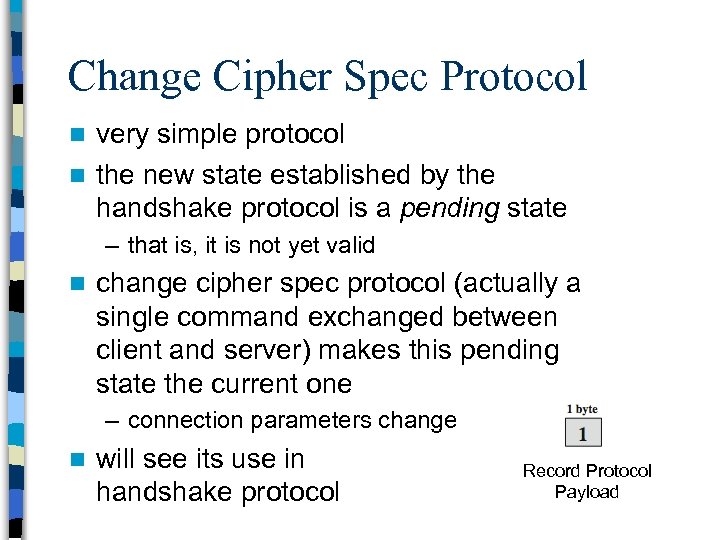
Change Cipher Spec Protocol very simple protocol n the new state established by the handshake protocol is a pending state n – that is, it is not yet valid n change cipher spec protocol (actually a single command exchanged between client and server) makes this pending state the current one – connection parameters change n will see its use in handshake protocol Record Protocol Payload
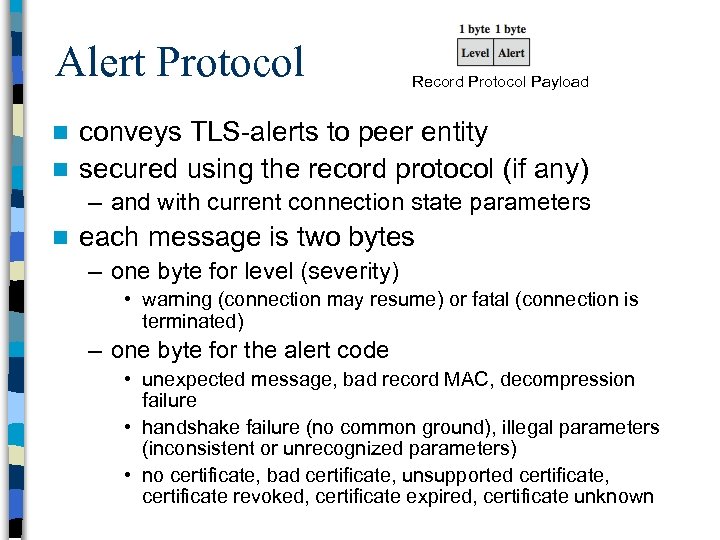
Alert Protocol Record Protocol Payload conveys TLS-alerts to peer entity n secured using the record protocol (if any) n – and with current connection state parameters n each message is two bytes – one byte for level (severity) • warning (connection may resume) or fatal (connection is terminated) – one byte for the alert code • unexpected message, bad record MAC, decompression failure • handshake failure (no common ground), illegal parameters (inconsistent or unrecognized parameters) • no certificate, bad certificate, unsupported certificate, certificate revoked, certificate expired, certificate unknown
Handshake Protocol The most complex part of TLS n Allows server and client: n – – n to authenticate each other to negotiate encryption and MAC algorithms to create cryptographic keys to be used in general, to establish a session and then a connection handshake is done before any data is transmitted – so cannot assume a secure record protocol
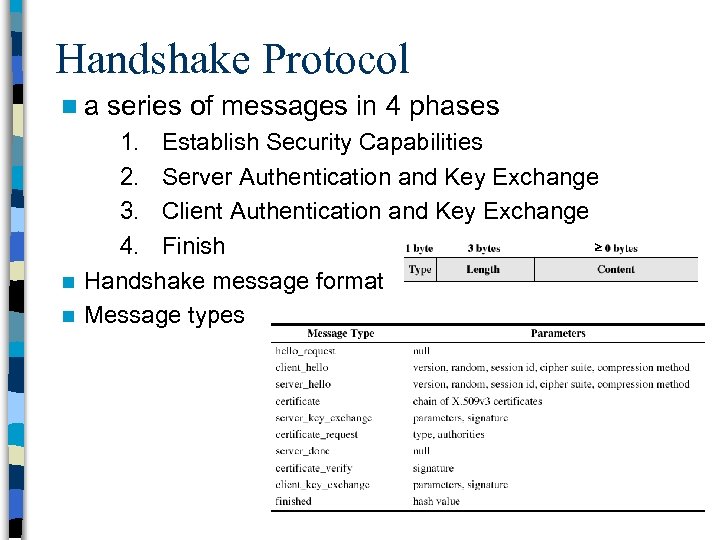
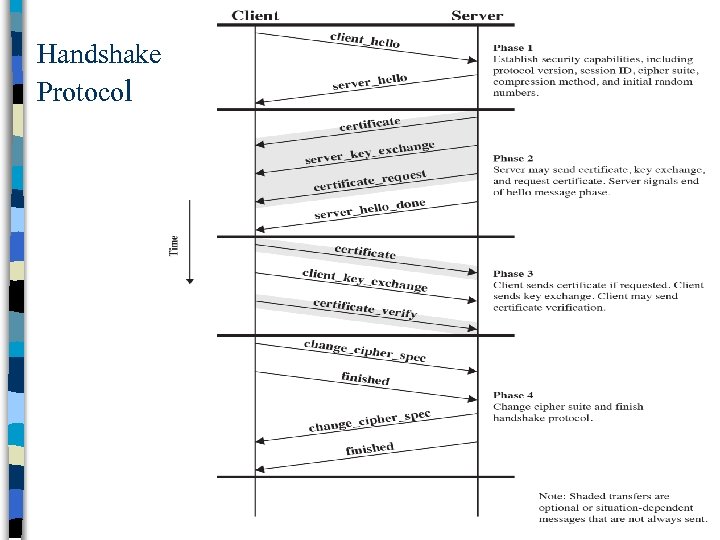
Handshake Protocol na series of messages in 4 phases 1. Establish Security Capabilities 2. Server Authentication and Key Exchange 3. Client Authentication and Key Exchange 4. Finish n Handshake message format n Message types
Handshake Protocol
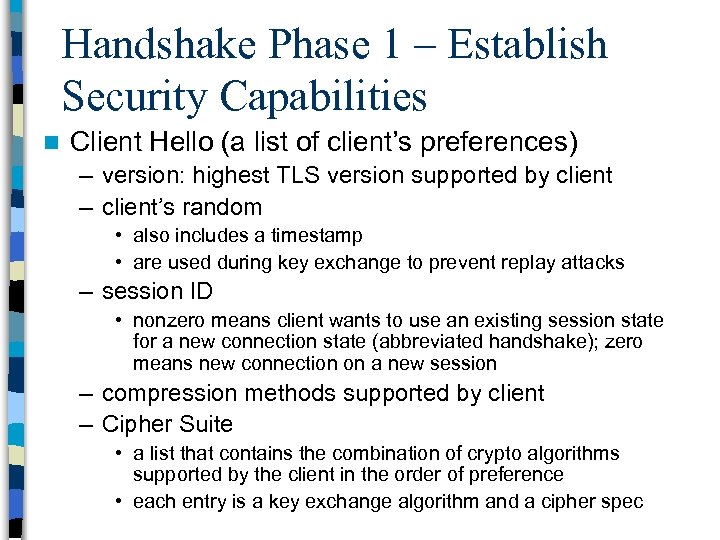
Handshake Phase 1 – Establish Security Capabilities n Client Hello (a list of client’s preferences) – version: highest TLS version supported by client – client’s random • also includes a timestamp • are used during key exchange to prevent replay attacks – session ID • nonzero means client wants to use an existing session state for a new connection state (abbreviated handshake); zero means new connection on a new session – compression methods supported by client – Cipher Suite • a list that contains the combination of crypto algorithms supported by the client in the order of preference • each entry is a key exchange algorithm and a cipher spec
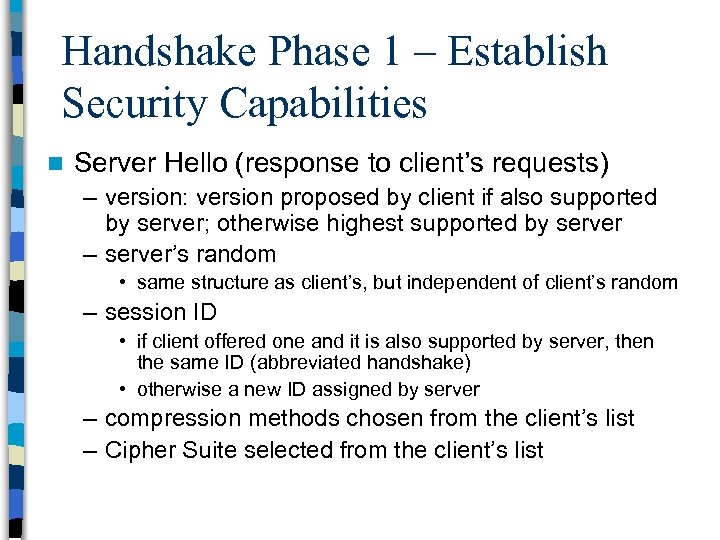
Handshake Phase 1 – Establish Security Capabilities n Server Hello (response to client’s requests) – version: version proposed by client if also supported by server; otherwise highest supported by server – server’s random • same structure as client’s, but independent of client’s random – session ID • if client offered one and it is also supported by server, then the same ID (abbreviated handshake) • otherwise a new ID assigned by server – compression methods chosen from the client’s list – Cipher Suite selected from the client’s list
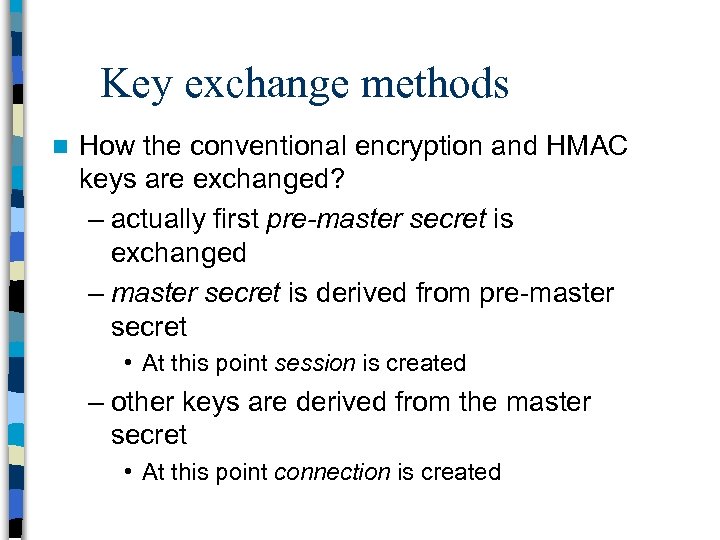
Key exchange methods n How the conventional encryption and HMAC keys are exchanged? – actually first pre-master secret is exchanged – master secret is derived from pre-master secret • At this point session is created – other keys are derived from the master secret • At this point connection is created
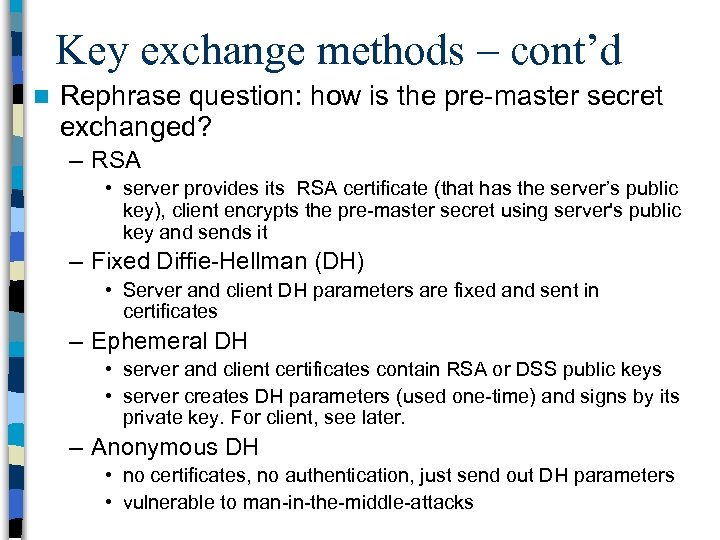
Key exchange methods – cont’d n Rephrase question: how is the pre-master secret exchanged? – RSA • server provides its RSA certificate (that has the server’s public key), client encrypts the pre-master secret using server's public key and sends it – Fixed Diffie-Hellman (DH) • Server and client DH parameters are fixed and sent in certificates – Ephemeral DH • server and client certificates contain RSA or DSS public keys • server creates DH parameters (used one-time) and signs by its private key. For client, see later. – Anonymous DH • no certificates, no authentication, just send out DH parameters • vulnerable to man-in-the-middle-attacks
Some Cipher Specs Fields n Cipher algorithm and key size – RC 4, RC 2, DES, 3 DES, DES 40 (40 -bit DES), IDEA, AES, etc. n Hash algorithm for HMAC – MD 5 or SHA-1 or others n Cipher type – stream or block n IV size – size of the init. vector for CBC mode
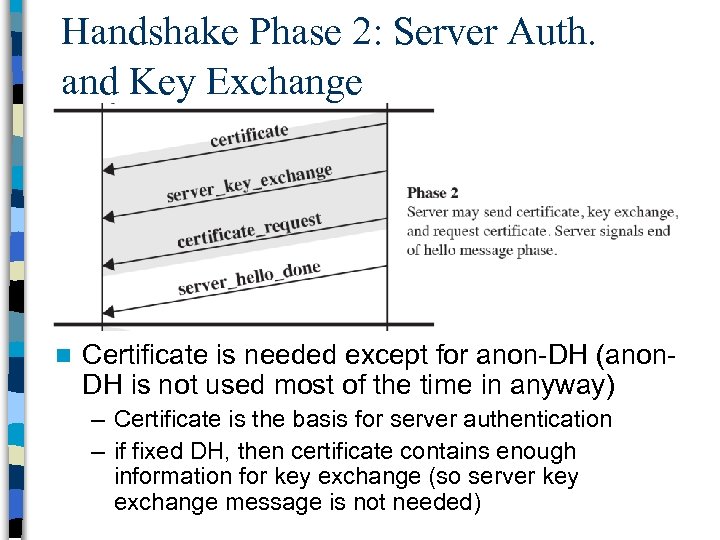
Handshake Phase 2: Server Auth. and Key Exchange n Certificate is needed except for anon-DH (anon. DH is not used most of the time in anyway) – Certificate is the basis for server authentication – if fixed DH, then certificate contains enough information for key exchange (so server key exchange message is not needed)
Handshake Phase 2: Server Auth. and Key Exchange n Server Key Exchange – not needed for • fixed DH and RSA key exchange – message content depends on the key exchange method agreed • Anon-DH – message contains public DH parameters and server’s DH public key • Ephemeral DH – same as anon-DH plus a signature on them – Signatures contain random values (that are exchanged in hello phase) to resist against replay attacks
Handshake Phase 2: Server Auth. and Key Exchange n Certificate Request Message – although not common in practice, server may request client to send its certificate • to authenticate the client – two fields: certificate type and acceptable CAs • a list of them – Certificate types • fixed DH (certificate may be signed with RSA or DSS) • signature only – Certificate may contain RSA or DSS key – Used for client authentication (see Phase 3) – Also used for signing ephemeral DH parameters n Server Hello Done message – server is finished and will wait for client’s response
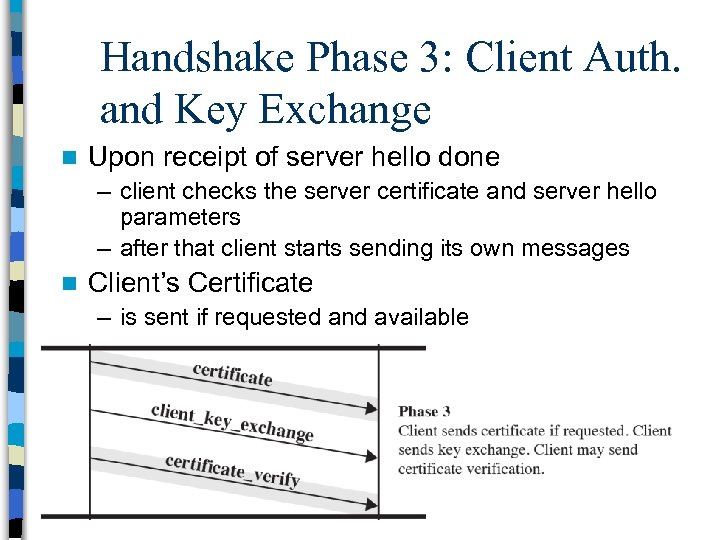
Handshake Phase 3: Client Auth. and Key Exchange n Upon receipt of server hello done – client checks the server certificate and server hello parameters – after that client starts sending its own messages n Client’s Certificate – is sent if requested and available
Handshake Phase 3: Client Auth. and Key Exchange n Client Key exchange message – content depends on the key exchange method agreed – RSA • 48 -byte pre-master secret is encrypted using server’s RSA key (obtained at phase 2) – fixed-DH • client DH parameters are in client certificate, so key exchange message is null – Anon or ephemeral DH • Client DH parameters and DH public key are sent • no signature even for ephemeral DH – no client authentication and authenticated key exchange so far (only key exchange)
Handshake Phase 3: Client Auth. and Key Exchange n Certificate Verify message – client is not authenticated via client key exchange message • anyone could send the key exchange message – the method for authentication is via the certificate verify message • client shows ownership of private key that corresponds to the public key in client certificate by signing a hash that contains the master secret and handshake messages • except for fixed DH that does not contain a signature key – what about authentication for fixed DH case? • no real authentication but the attacker cannot produce the premaster and master secrets since it does not know the DH private key (so there is a kind of an implied auth. )
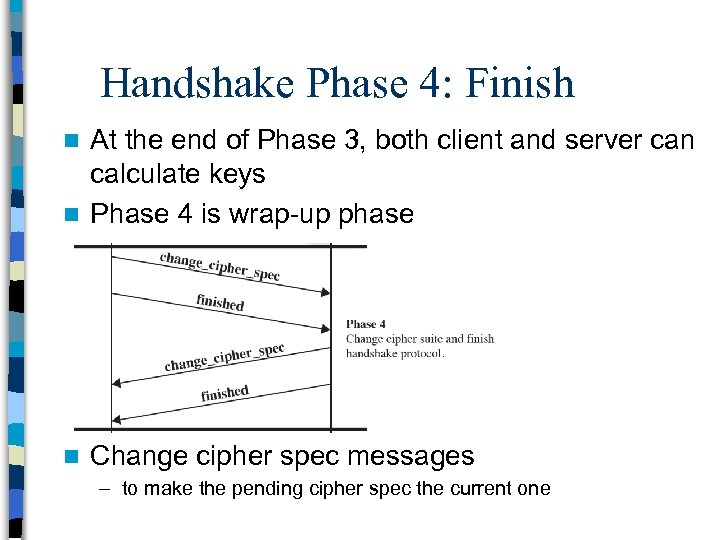
Handshake Phase 4: Finish At the end of Phase 3, both client and server can calculate keys n Phase 4 is wrap-up phase n n Change cipher spec messages – to make the pending cipher spec the current one
Handshake Phase 4: Finish n Finished message – a MAC on exchanged handshake messages using the master secret – to verify that handshake is successful and both parties have the same master secret – client’s finished is verified by server and vice versa – the connection state of the record protocol that encrypts and MACs the finished message is the new one • so this is also verification of all the keys that are recently created
Master Secret Creation n Master Secret – 48 -byte value generated for a session n two stage creation – pre-master secret is exchanged during handshake • if RSA, client creates, encrypts and sends; server decrypts • if DH, both calculates the same secret which is the premaster secret – master secret is calculated using pre-master secret and random nonces exchanged during handshake • by using a PRF (Pseudo Random Function) • Several levels of HMACs until 48 bytes have been generated
Generation of cryptographic parameters n Encryption keys, MAC secrets, IV are to be generated from a key block obtained from the master secret – again using a PRF based on several levels of HMACs • master secret is the key • random nonces are also used – variable length output, until enough output has been generated.
Abbreviated Handshake n We have said that a particular TLS session can serve to different TLS connections – Abbreviated handshake is the mechanism for that n During phase-1 if both parties agree on using an existing session ID, then that means they run abbreviated handshake – that session’s master secret (which is already stored) and new random nonces exchanged during phase-1 are directly used for the generation of the keys • Thus, phase 2 and 3 are skipped (that is why it is abbreviated) • Phase 4 is the same as full handshake
Heartbeat Protocol n Relatively a new extension of TLS – In 2012 (RFC 6250) In the context of computer networks, a heartbeat is a periodic signal or messages to probe the availability of the other party. n Heartbeat protocol runs on top of TLS protocol (part of upper layer of TLS) n – Simple periodic request-response pairs sent with a random payload and padding – Padding is needed to check the routing capability of intermediate routers
Heartbeat Protocol n Payload supports DTLS connections (Datagram TLS) – DTLS is connectionless, payload exchange is used to match the requests and responses • UDP does not help for this matching, so we need such a payload in heartbeat protocol n Two purposes of Heart. Beat Protocol – Sender assures that the recipient is still alive – Even if the real communication is idle, it generates traffic such that the firewalls, which do not tolerate idle times, do not cause connection closures
Attacks on TLS/SSL n Mostly based on implementation related bugs – On handshake and record protocols and the use of crypto during these protocol n Certificate related attacks – Fake certificates, fake authorities, certificate validation problems n Heartbleed attack (2014) – Due to a bug in the implementation of Heart. Beat protocol in Open. SSL (open source crypto lib. ) • The responder is not sending the received payload but a part of memory that the attacker wants – Has been fixed quickly but the propagation of the patch took some time and several websites got affected
TLSv 1. 3 n n n Still an Internet Draft, but pretty much matured Primary aim is to improve the security of TLS Significant changes from version 1. 2 – TLSv 1. 3 removes support for a number of options and functions; these deleted items are: • • • Compression (actually nobody was using it) Ciphers that do not offer authenticated encryption Static DH key exchange, (static) RSA key exchange 32 -bit timestamp as part of the Random parameter in the client_hello message Renegotiation (starting a new handshake negotiation inside of an existing secure session) • Change Cipher Spec Protocol • DSS and RC 4 support • Use of MD 5, SHA-1 and SHA-224 hashes with signatures – TLSv 1. 3 uses Diffie-Hellman or Elleptic Curve Diffie-Hellman for key exchange and does not permit RSA • For the sake of Perfect Forward Security (PFS); if an RSA private key is compromised all previous handsakes becomes compromised – TLSv 1. 3 allows for a “ 1 round trip time” handshake by changing the order of message sent with establishing a secure connection
HTTPS n HTTPS (HTTP over SSL/TLS) – combination of HTTP & SSL/TLS to secure communications between browser & web server • documented in RFC 2818 • no fundamental change using either SSL or TLS; both are referred as HTTPS n use https: // URL rather than http: // – use port 443 rather than 80 n encrypts – URL, document contents, form data, cookies, HTTP headers
HTTPS Connection Initiation n SSL/TLS handshake is first done – HTTP client (browser) acts as SSL/TLS client n After the handshake HTTP request(s) are sent – Actually all HTTP data should be sent through SSL/TLS record protocol
HTTPS Connection Closure n connection closure – have “Connection: close” in HTTP headers • which normally causes to close the TCP connection • but there is SSL/TLS protocols between HTTP and TCP • thus, SSL/TLS should control connection closure at TCP level – SSL/TLS level exchange close_notify alerts – can then close TCP connection
Secure Shell (SSH) n protocol for secure network communications – designed to be simple & inexpensive n SSH 1 provided secure remote logon facility – replace TELNET & other insecure schemes – also has more general client/server capability • Can be used for FTP, for example SSH 2 was documented in RFCs 4250 through 4254 n SSH clients & servers are widely available (even in OSs) n
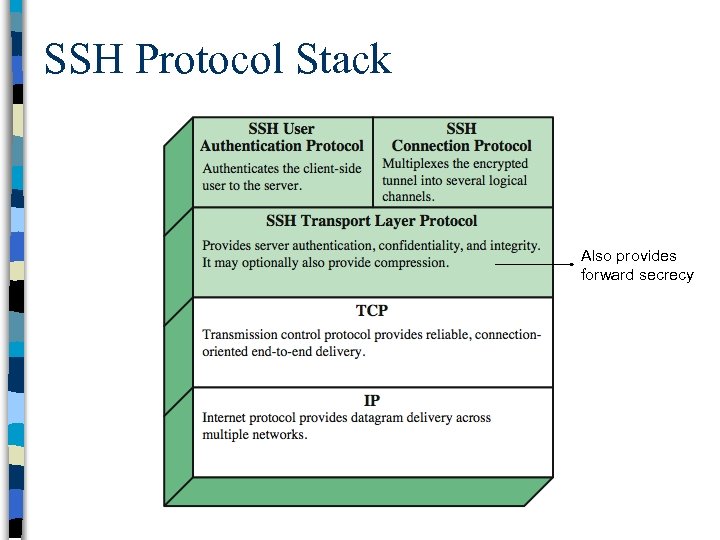
SSH Protocol Stack Also provides forward secrecy
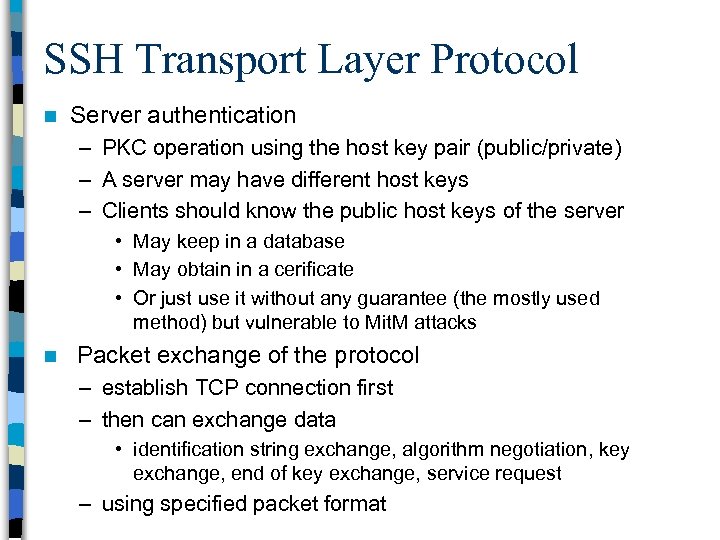
SSH Transport Layer Protocol n Server authentication – PKC operation using the host key pair (public/private) – A server may have different host keys – Clients should know the public host keys of the server • May keep in a database • May obtain in a cerificate • Or just use it without any guarantee (the mostly used method) but vulnerable to Mit. M attacks n Packet exchange of the protocol – establish TCP connection first – then can exchange data • identification string exchange, algorithm negotiation, key exchange, end of key exchange, service request – using specified packet format
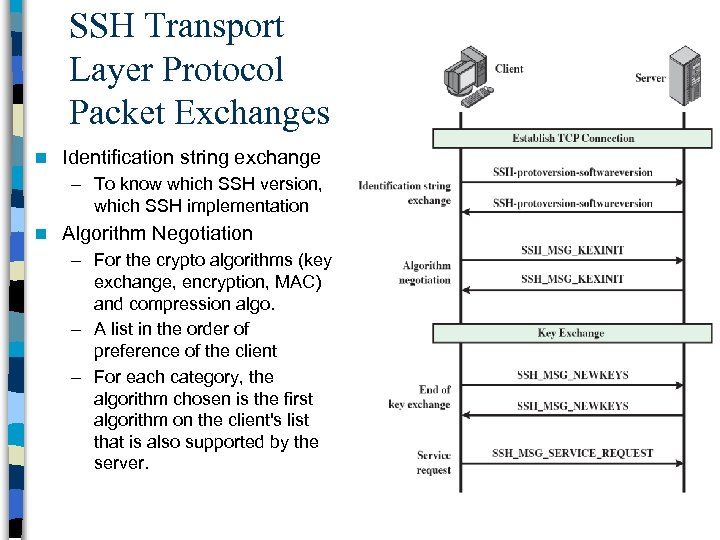
SSH Transport Layer Protocol Packet Exchanges n Identification string exchange – To know which SSH version, which SSH implementation n Algorithm Negotiation – For the crypto algorithms (key exchange, encryption, MAC) and compression algo. – A list in the order of preference of the client – For each category, the algorithm chosen is the first algorithm on the client's list that is also supported by the server.
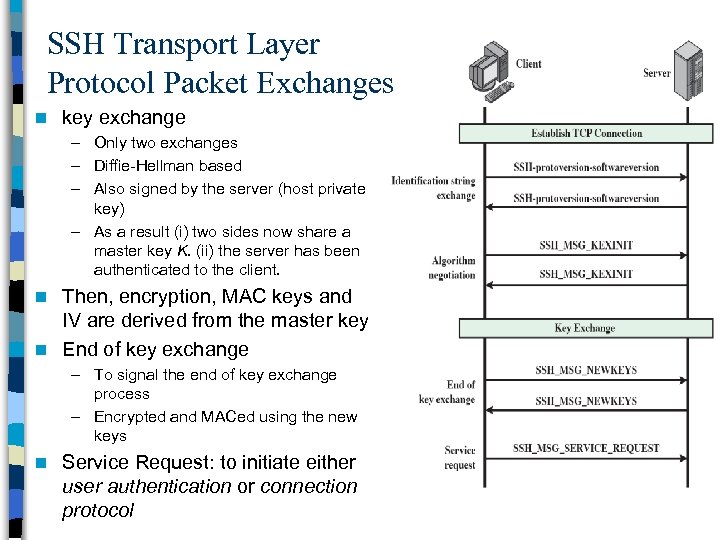
SSH Transport Layer Protocol Packet Exchanges n key exchange – Only two exchanges – Diffie-Hellman based – Also signed by the server (host private key) – As a result (i) two sides now share a master key K. (ii) the server has been authenticated to the client. Then, encryption, MAC keys and IV are derived from the master key n End of key exchange n – To signal the end of key exchange process – Encrypted and MACed using the new keys n Service Request: to initiate either user authentication or connection protocol
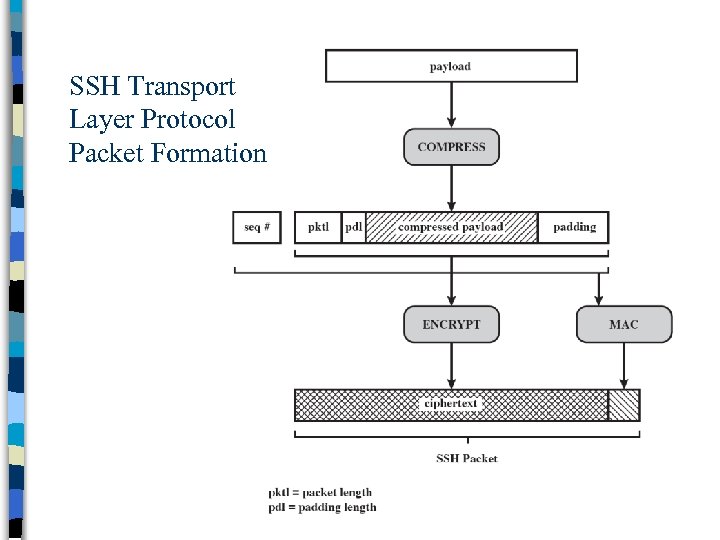
SSH Transport Layer Protocol Packet Formation
SSH User Authentication Protocol Authentication of client to server n First client and server agree on an authentication method n – Then a sequence of exchanges to perform that method – Several authentication methods may be performed one after another n authentication methods – public-key • Client signs a message and server verifies – password • Client sends pasword which is encrypted and MACed using the keys agreed
SSH Connection Protocol n runs on SSH Transport Layer Protocol n assumes secure authentication connection – which is called tunnel n used for multiple logical channels – SSH communications use separate channels – either side can open with unique id number – flow controlled via sliding window mechanism – have three stages: • opening a channel, data transfer, closing a channel
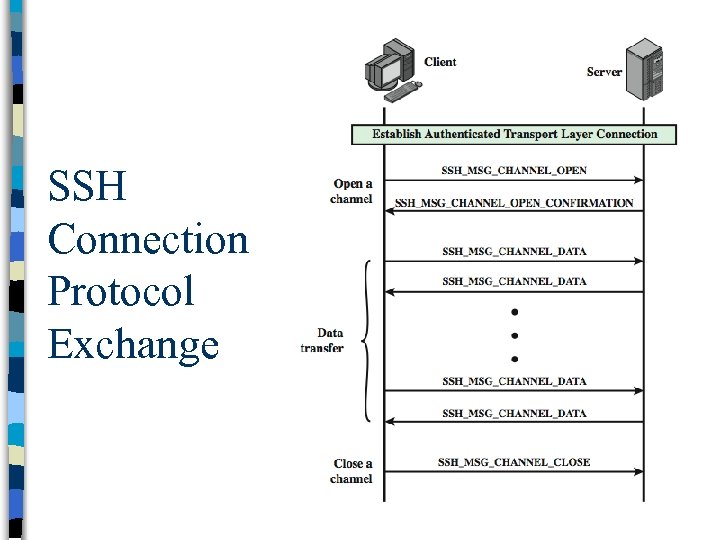
SSH Connection Protocol Exchange
Скачать презентацию Transport-level and Web Security SSL TLS SSH
01ec969fac7f883762e895cbdc43d3d8.ppt