


 Скачать презентацию Transparency and the Pricing of Market Timing Xin
88e4b0161b828c7b42f9add78582db8c.ppt
- Количество слайдов: 27
 Transparency and the Pricing of Market Timing Xin Chang Nanyang Technological University Zhihong Chen City University of Hong Kong Gilles Hilary INSEAD
 Research Questions • Can managers lower the cost of equity by actively timing the market when they issue external capital? • What is the role played by corporate transparency in this process?
 Can Firm Time The Market? • The “market timing theory” relies on the idea that managers know more about the fundamental value of their firm than outside investors, – Managers detect temporary mispricings. • Managers can try to take advantage of the mispricing by issuing or buying back capital.
 Can Firm Time The Market? • If new investors take the issuance of capital as a signal that a firm is overvalued, the price should adjust. (e. g. , Myers and Majluf, 1984). – If true, managers and current shareholders cannot take advantage of mispricings. • If quasi-rational investors buy the new capital at the inflated price, managers can transfer wealth from these new investors to current shareholders.
 Can Firms Time The Market? • There is a positive correlation between good market conditions and equity issuances (e. g. , Loughran et al. 1994, Graham and Harvey 2001). • It is not clear if this reflecting managers’ private information or something else such as time-varying investment opportunities (Schultz 2003, Baker, et al. 2007).
 Pricing of Market Timing • If current investors believe this is true, these issuance gains should be reflected in the firm valuation. • The price of successful market timers should be higher for a given level of expected earnings. – Equivalently, holding profitability and risk constant, the discount rate implied by a price and a given stream of expected earnings is lower.
 Market Timing Pricing • H 1: Firms that are expected to time the market when they issued or repurchased capital should have a lower expected cost of equity capital.
 Are SEOs overvalued on average? • Firm level (Ritter 2003) and aggregate level (Baker and Wurgler 2000) evidence on abnormal performance after SEOs. • But, all studies use ex-post returns and complex procedures to address associated econometric problems. • Ritter (2003) indicates that “the conclusions regarding abnormal performance are hotly debated and sensitive to the methodology employed and the sample used”.
 Broader View • We rely on the aggregate amount of capital issued by firms, rather than focusing on special and rare events such as IPOs or SEOs. • Takeuchi (2008) reports that – firms making SEOs represent only 6% of firms with net increases in equity – 18% of firms with net increases in equity of more than 10% of assets in a given year.
 Transparency • Transparency affects financial policy. – Poor accounting quality is associated with higher SEO issuance costs (Lee and Masulis (2009)). – Transparent firms have more flexibility to issue equity (rather than debt), have a greater control over the issuance size and are less influenced by market conditions (Chang et al. (2006, 2009)).
 Transparency • Transparent firms obtain a fair price when they issue equity in periods of low sentiment and capture excess value in periods of high sentiment. • Opaque firms “break-even” in periods of high sentiment and abstain from issuing equity in periods of low sentiment. • H 2: The effect of past market timing on the expected cost of capital should be stronger for transparent firms than for opaque firms.
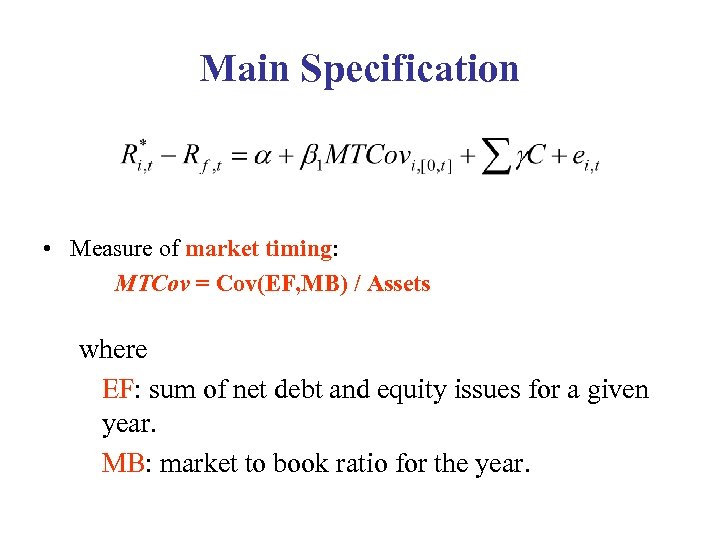 Main Specification • Measure of market timing: MTCov = Cov(EF, MB) / Assets where EF: sum of net debt and equity issues for a given year. MB: market to book ratio for the year.
 Estimate Implied Cost of Equity • Four implied cost of equity models • All based on dividends discount model but make different assumptions on future earnings growth. • Use the average of the four estimates to mitigate model-specific measurement errors.
 Why not ex post returns? • Market timing ability relies on the existence of quasirational investors and information asymmetry between different classes of investors. – Properties of market equilibrium models in this complex setting are not well-known. • Debatable whether the ex post return is an appropriate proxy for a firm’s cost of capital. – May reflect the shocks to a firm’s growth opportunities, expected growth rates or investors’ risk aversion. – Fama and French (1997) conclude that expected returns estimated by ex post returns are imprecise because of the uncertainty of factor premiums and factor loading estimates. • Firms may have a very active financing policy.
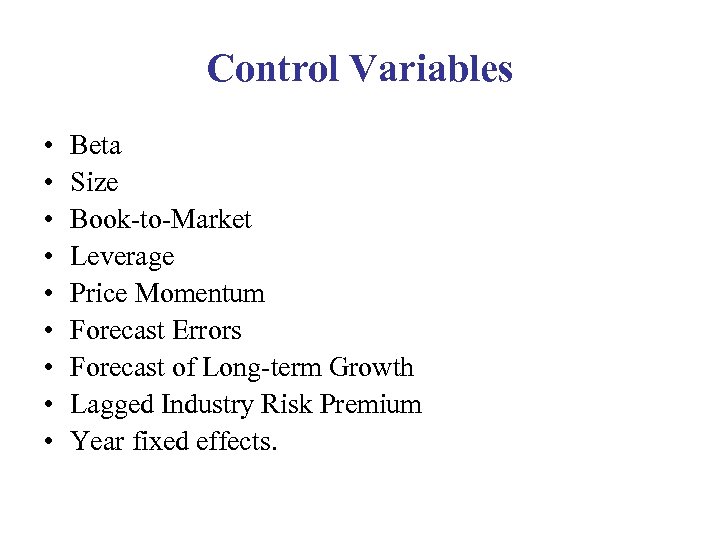 Control Variables • • • Beta Size Book-to-Market Leverage Price Momentum Forecast Errors Forecast of Long-term Growth Lagged Industry Risk Premium Year fixed effects.
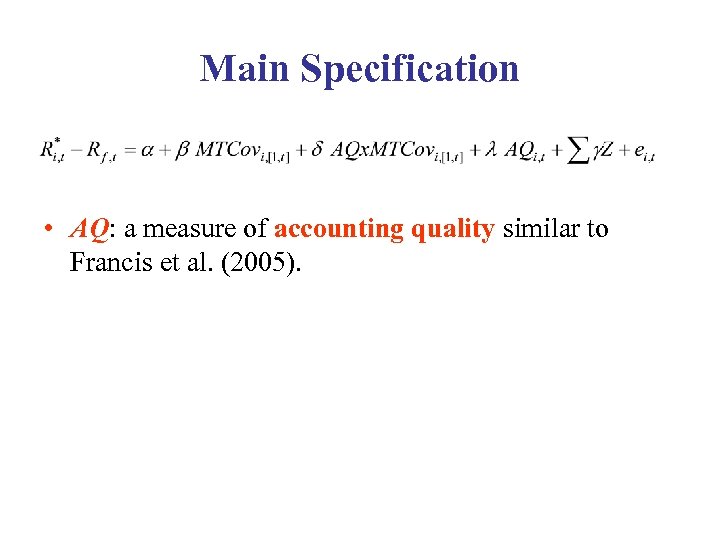 Main Specification • AQ: a measure of accounting quality similar to Francis et al. (2005).
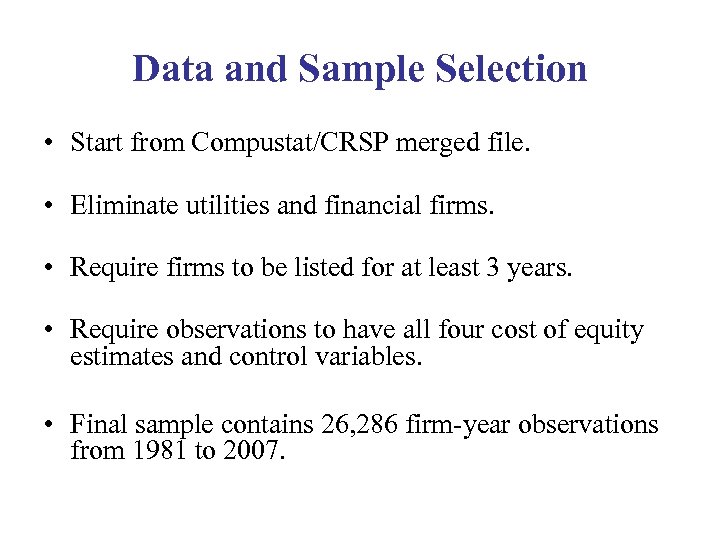 Data and Sample Selection • Start from Compustat/CRSP merged file. • Eliminate utilities and financial firms. • Require firms to be listed for at least 3 years. • Require observations to have all four cost of equity estimates and control variables. • Final sample contains 26, 286 firm-year observations from 1981 to 2007.
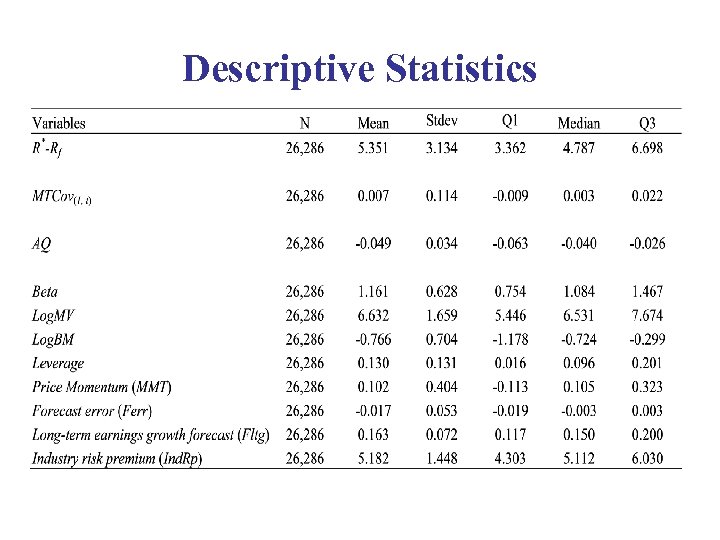 Descriptive Statistics
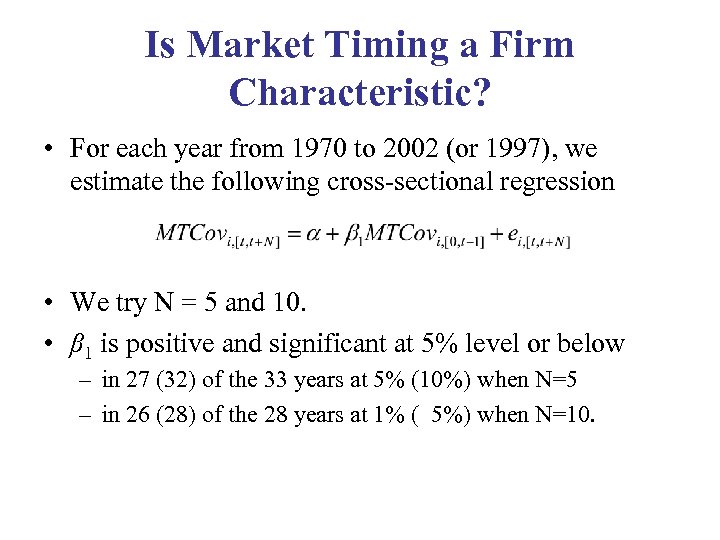 Is Market Timing a Firm Characteristic? • For each year from 1970 to 2002 (or 1997), we estimate the following cross-sectional regression • We try N = 5 and 10. • β 1 is positive and significant at 5% level or below – in 27 (32) of the 33 years at 5% (10%) when N=5 – in 26 (28) of the 28 years at 1% ( 5%) when N=10.
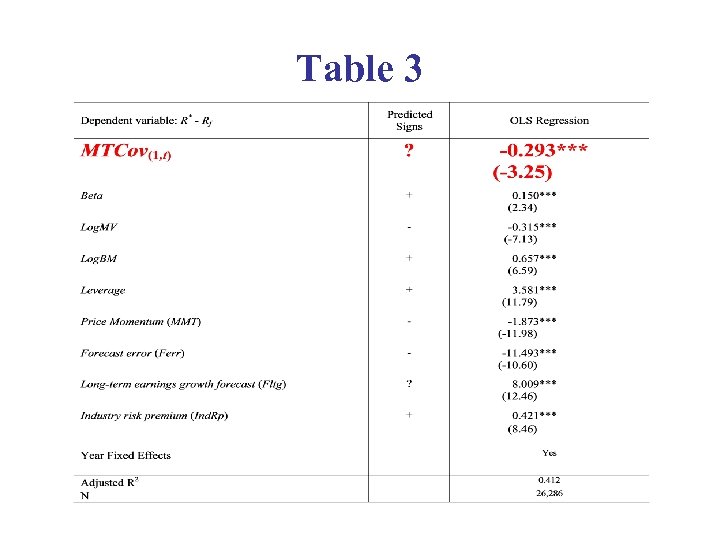 Table 3
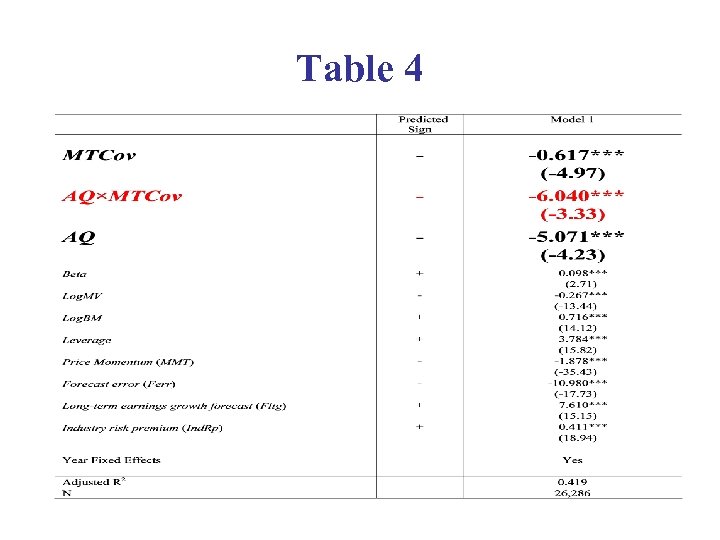 Table 4
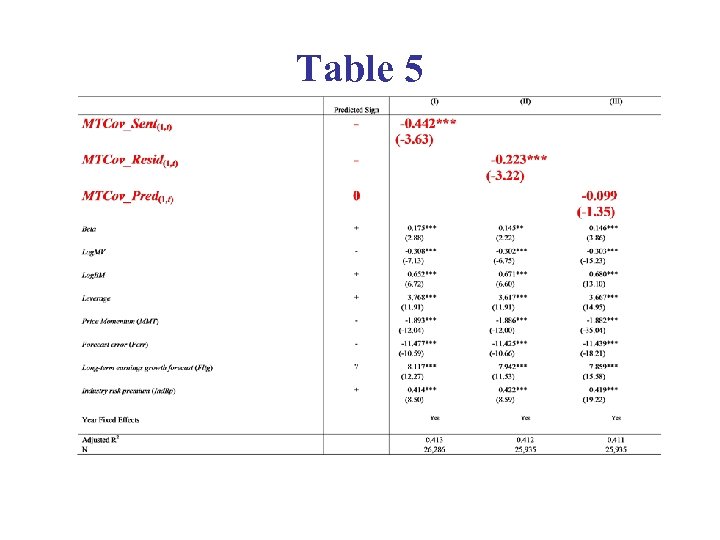 Table 5
 Robustness Tests • Estimation of cost of equity • Estimation of transparency • Estimation of market timing activity
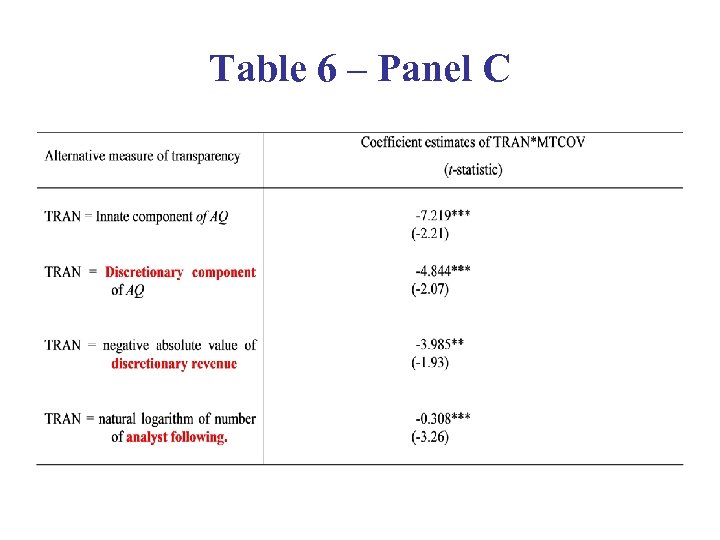 Table 6 – Panel C
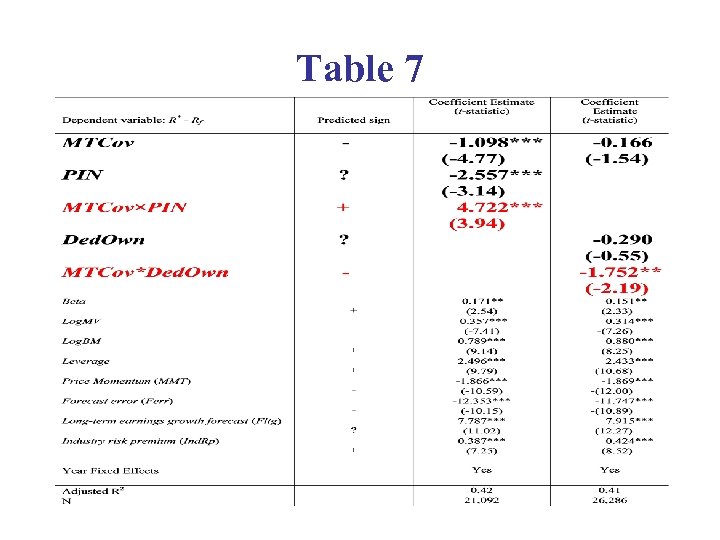 Table 7
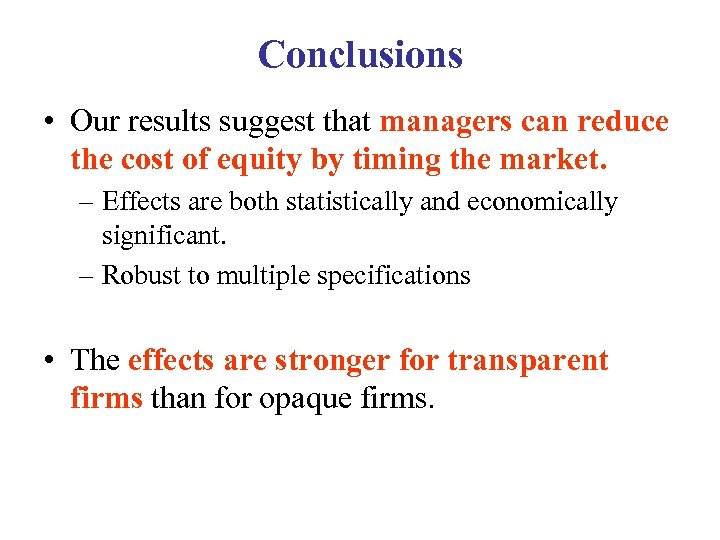 Conclusions • Our results suggest that managers can reduce the cost of equity by timing the market. – Effects are both statistically and economically significant. – Robust to multiple specifications • The effects are stronger for transparent firms than for opaque firms.
 Thank You