


 Скачать презентацию Transnational Affect and the Moral Economies of Temporary
6c6ad4abf93cd773400c0f476de2dd98.ppt
- Количество слайдов: 32
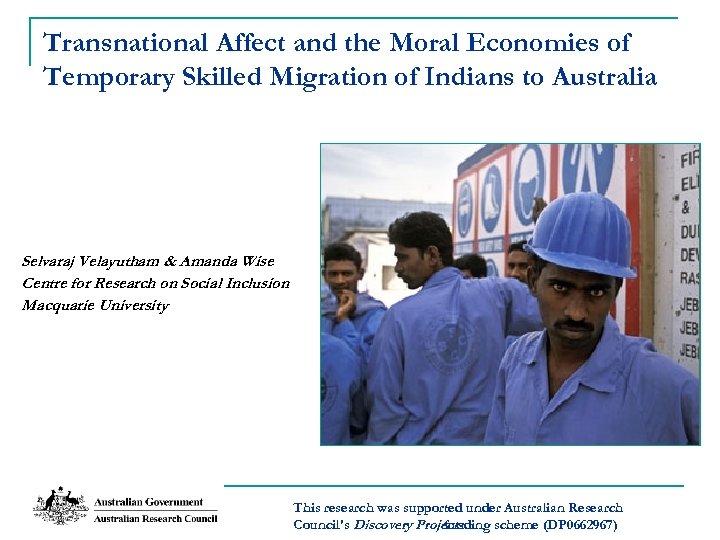 Transnational Affect and the Moral Economies of Temporary Skilled Migration of Indians to Australia Selvaraj Velayutham & Amanda Wise Centre for Research on Social Inclusion Macquarie University This research was supported under Australian Research Council's Discovery Projects funding scheme (DP 0662967)
 Key themes in our research n Motivations & Methods of Migration n The Moral Economy of Migration n Masculinity and Migration n The Ethics of Temporary Migration
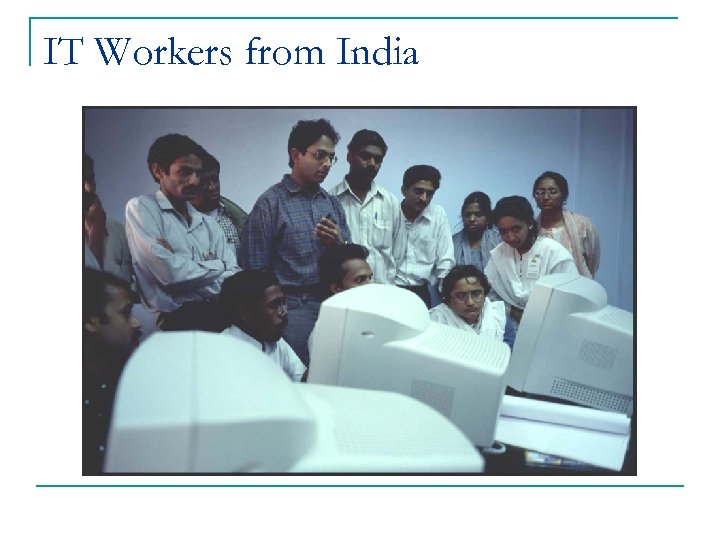 IT Workers from India
 IT Workers: Motivations for migration HIGHLY MOTIVATED, SOCIALLY MOBILE AND NETWORKED n Well travelled: often worked in more than 3 places over 5 years. n Mostly young, urban, … this makes a difference
 IT Workers: Motivations for migration n Money, Career, Adventure n Industry expectation and opportunities. Flow of friends doing the circuit n Family money helping n Often start out by working with Indian company and being sent abroad for short time.
 NARESH: Most of my peers have ventured overseas. In terms of attractive locations, the US is the number one destination, followed by Europe, particularly English speaking countries and then comes Japan. . Australia is not very attractive. One thing is because of the perception that the taxes are very high… potential for saving is not as good as the US or Europe. Money is the main motivator.
 IT Workers: Means of migrating n Professional agents operating multi-nationally n Employed directly by Indian companies which have an Australian base. They contract workers out to client companies. So no direct link of employment Implications: n q q q Relationships with colleagues minimal Horizontal movement rather than vertical promotion Lack of care for employee wellbeing
 IT Workers: Employment conditions n Uncertain length of tenure: Expect 3 years when they come, but companies needs change and can only be 3 months. Hard to settle. n Employed by Indian multinational based locally then sent to client companies on contract. Main base is the client organisation. n They are seen as simply consultants. No investment in their development as employees in the company or concern for their wellbeing. n Nor does their Indian (Australia based) employing company invest in any development of these workers. n Many feel their career progression stalls. n Many feel like they are in a bubble, caught between the two companies
 IT Workers: Integration Experiences n No reception or induction on arrival n No knowledge of day to day issues of living in Australia n No contact with work colleagues outside work. Feel like nothing in common
 NARESH: Other than cricket, I didn’t know anything about this place…when I arrived in Sydney, my friend came to receive me. . . not from the company…they don’t receive…you have to come on your own, even if you don’t know anybody here…. they’ll book you a hotel…that was it. Since my friend was there it was easy for me…without him, it would have been very difficult VIJAY: it has been difficult, in my current workplace, most of them are Australians (Caucasians)”…we seem to have different interests… nothing in common… as far as the professional interaction is concerned that’s fine but nothing social”.
 Reka (VIJAY’S WIFE): any get togethers we have are with other Indian friends and circles we met here… we don’t even know our neighbours. We don’t even know who’s staying next door. At times, we really wonder, what to do if we had an emergency…. we hardly even know. I think they are Chinese… next door…we say hi that’s it, don’t even know their names…”
 Spouse situation n Wives: q Feelings of exclusion and isolation. q Difficulty securing employment: n Discrimination, qualifications not recognised, n Temporary status: Employers mistakenly believe wives of 457 s not legally allowed to work n Has bearing on whether they want to stay here as a family long term.
 Reka: …. for the last about 8 months I have been applying for so many jobs…. out of that I have just been called for 2 interviews…. I would have at least applied til today for 6070 There was one incident. . it was so unfair. I have full working rights [as a spouse] on 457 visa. I mean there was a one day job at Franklin (supermarket) for which I enthusiastically applied. And they wrote back saying that I did not have working rights. I told them I do have working rights and they could cross-check with the Department of immigration and they replied saying they didn’t have the time to check such matters…
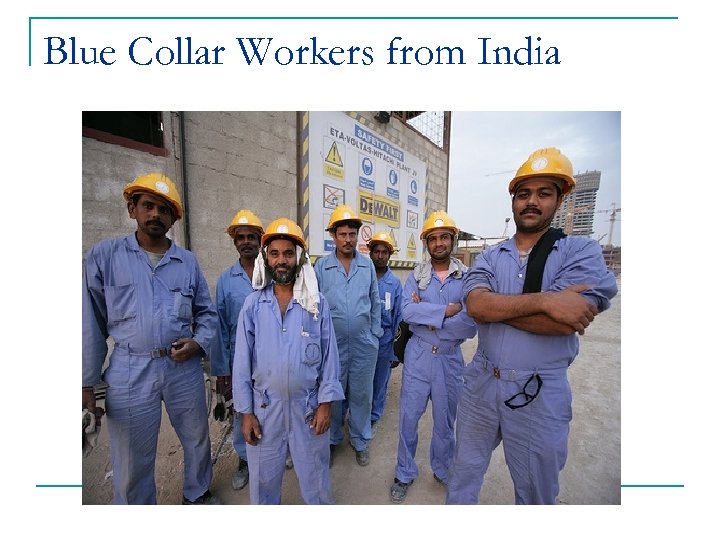 Blue Collar Workers from India
 Blue collar workers: Motivations q q Possibility of earning more money than they could in India or Singapore. More opportunities Although not initial motivation, many hoping to get Permanent Residence in Australia Few thought of Australia: not on the ‘network’. Places like Kuwait, Dubai, Singapore, Malaysia
 INTERVIEWER: When you finished your studies, did you get any opportunities in India? BALA: I had some but it was not good. I wanted to earn more money. So, I went to Singapore. But the money was not good. I can’t earn enough money there too. So I was looking for opportunities to work in Australia. Bala, 30 is from a rural village in Tamil Nadu. Middle caste. Family are coconut farmers Previously worked in Singapore for 9 years in shipping yard.
 GUNA: I am looking for better money and better life which why I came overseas like Australia. We have been looking for opportunities for quite a long time. But it was too hard for us to get the job. INTERVIEWER: Is it common for Indian foreign workers in Singapore to look for job overseas? GUNA: Yes. Plenty of people are looking for jobs to come to Australia. Everyone has been registering with emigration agent to come to Australia. GUNA: 28 years. Worked in Singapore 6 years as crane driver. From small town in Tamil Nadu (Tiruchi)
 Motivations: Kinship ties q Social norm (indeed pressure, expectation) to work overseas. Long history. q Most have cousins or siblings overseas q Family financial responsibilities; n n Helping parents out financially Funding the education of younger siblings Saving to pay dowry of sisters (up to $20 -30, 000 AUD) Paying back debts – their own and family
 Blue collar workers: Means of migrating q q q Blue collar workers come mostly through agents whom they pay. Very common pathway is through Singapore. Aggressive agents based there In Singapore the agent charges $12, 000. plus airfare & Visa costs.
 VIKRAM: Everyone has to pay the agent if they want to go through him. They have some Chinese and Indian agents. But mostly Chinese. They paste pamphlet and poster on the walls of bus stops and living areas. They have a phone number and we call them. We call them to ask about the jobs and the pay and how much we have to pay them and all the details? Interviewer: VIKRAM: How much? We have to pay $12000 in Singapore dollars to come over to Australia. The first payment I have to pay is $6000. Interviewer: VIKRAM: Did they explain what you are paying for? For finding the job only. Once the Australian government approve the visa, we have to pay for the visa and airfare.
 Means of migration …(cont. . ) q q q Funded by borrowing from family and friends (who charge interest on the loans) Some cases of employer (usually small business such as restaurants) going direct to villages in India to recruit. Further payment often demanded for renewal of visa. VIKRAM: When we come to Australia boss collected money from our salary. The second payment for $6000 they did it through our wages. The company, the immigration and the agent have a dealing. So the company is collecting the salary.
 KANNAN: The bosses driver went around to the villages. This driver knew my father and told him he was looking for chefs and cooks to bring to work in Australia. He said this employer was very kind hearted and helped many poor families in the past. 24 Year old village boy from Tamil Nadu. Recruited direclty from village by employer.
 Blue collar workers & co-ethnic exploitation q q Pattern of co-ethnic exploitation Employer (or manager) of Indian background leading the exploitative practices Justify on the basis that ‘this is what these workers are used to’. Cultural attitudes, caste and class relations get transnationalised in the global trade of labour.
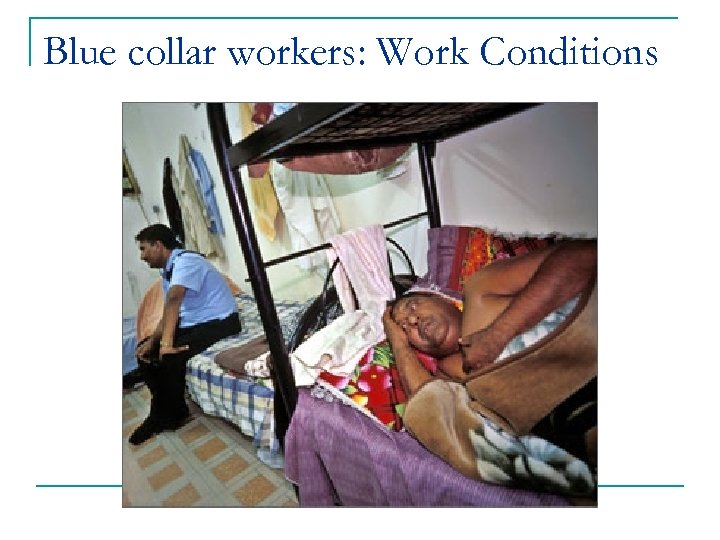 Blue collar workers: Work Conditions
 MANI: The company director during interview told us they are providing the accommodation. It was the first thing they mentioned. When we arrived we were put inside the company. We did not ask for anything. After one month, they forced us to sign the AWA. Because we already signed it before coming to Australia in Singapore. We refused. In the second AWA, they wrote a condition that we have to work for them anytime, anywhere they sent us. … And they said if I don’t like working for the company. They will terminate the contract without payment and I have to leave the country. So the first agreement never mentioned all this. Even the payment also. Mostly we are working on site for nearly 8 to 9 hours. After we have to come to work in the factory. So, we have to travel in between for about an hour.
 Accommodation GUNA: We were living inside the factory. That is an office which was converted – they put in 3 beds and there was a kitchen and laundry all attached. We slept together. 1 week later there was another two workers. After 14 days, another two arrived. Eight altogether
 Sick leave and entitlements MANI: As for sick leave, one of my friends took an Medical Certificate for two days. When he presented the receipt to the HR department, they did not paid for the sick leave. They deduct from the annual leave. He take two days Medical certificate, he has receipt also. But they deduct from the annual leave.
 Safety …. MANI: We arrived here at night. The following morning, they did some formalities such as opening a bank account and signing of superannuation forms. The next day, we started work straight away. They never mentioned about the safety rules or Australian standards. We were surprised at the people working in the factory. Nobody was wearing helmet. Everywhere there was lifting but no one wore any helmet. Even in Singapore, we have to wear the PPE (personal protection equipment), helmet, and gloves all the time. Once we arrived here, it totally changed. The company to save money, was doing such things.
 Blue Collar workers: Particular Vulnerabilities n Contractual and practical difficulties to find alternative employment n Fear of losing visa n Lack knowledge about rights n Limited support network n Family, money and kinship pressures
 General themes Issues that have emerged as common to both groups
 Some final observations n Differences between IT workers and Blue Collar Workers q q q Multinationals vs local employers Sub-contract vs local employer direct employment Local employers sub-divided into kinship vs other employers
 Continued… n Need to look beyond ‘ 457’ as a single group. n Need to look at differences in terms of profession, employer and contract type, ethnicity, national origin, transnational connections, cultural influences, urban or rural origin, and kinship issues n These all have implications for vulnerability to exploitation, decisions and experiences of settlement and hopes for permanent residency, integration into Australia and the workplace