 Скачать презентацию Transmitted by the representative of Korea Informal document
2dc4da99a99fe83c55a2370638b43703.ppt
- Количество слайдов: 10



Transmitted by the representative of Korea Informal document WP. 29 -162 -16 (162 nd WP. 29, 11 -14 March 2014, agenda item 20) MOLIT Ministry of Land, Infrastructure and Transport KATRI Korea Automobile testing & research Institute The Introduction of The Outcomes; Implementation of Vehicle Indoor Air Quality (VIAQ) Senior Deputy Director Woo Jeong Hoon MOLIT, The Republic of KOREA (Ministry of Land, Infrastructure and Transport) 1 p
MOLIT Contents Ministry of Land, Infrastructure and Transport 1. Background 2. Case Study in Korea 3. Results of Implementation of VIAQ Regulation 4. Conclusions 2 p KATRI Korea Automobile testing & research Institute
MOLIT Background Ministry of Land, Infrastructure and Transport KATRI Korea Automobile testing & research Institute l Increasing concerns about Vehicle Indoor Air Quality (VIAQ) Ø Various chemical materials to harmful to human body are emitted from vehicle interior materials l Researching & Managing vehicle indoor air quality by many countries Ø Netherlands, France, Sweden, Germany, Japan, USA, China, Korea Ø ISO Standard (12219 -1: 2012), China (GB/T 27630 -2011), Korea (Notification No. 2007 -539) Need to unified regulation on vehicle indoor air quality (VAIQ) to protect driver’s health and safe driving 3 p
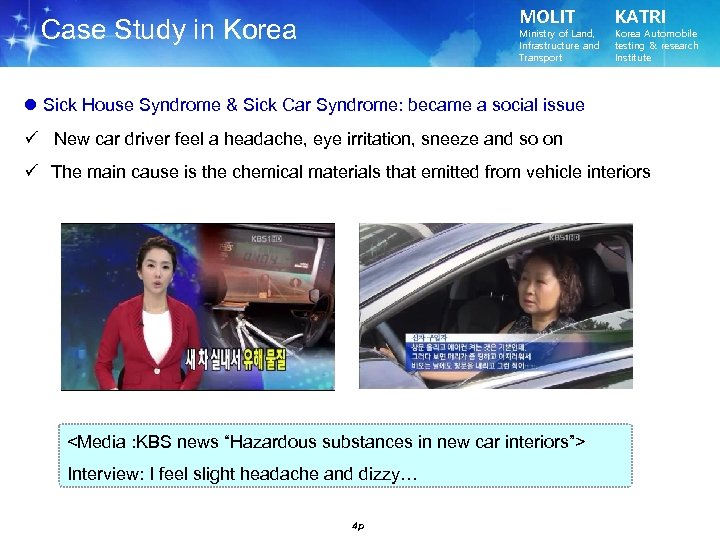
MOLIT Case Study in Korea Ministry of Land, Infrastructure and Transport KATRI Korea Automobile testing & research Institute l Sick House Syndrome & Sick Car Syndrome: became a social issue ü New car driver feel a headache, eye irritation, sneeze and so on ü The main cause is the chemical materials that emitted from vehicle interiors <Media : KBS news “Hazardous substances in new car interiors”> Interview: I feel slight headache and dizzy… 4 p
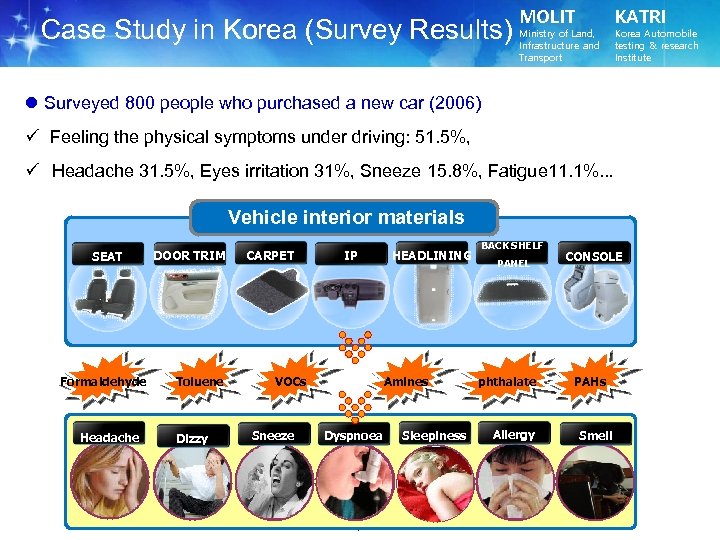
Case Study in Korea (Survey Results) MOLIT Ministry of Land, Infrastructure and Transport KATRI Korea Automobile testing & research Institute l Surveyed 800 people who purchased a new car (2006) ü Feeling the physical symptoms under driving: 51. 5%, ü Headache 31. 5%, Eyes irritation 31%, Sneeze 15. 8%, Fatigue 11. 1%. . . Vehicle interior materials SEAT Formaldehyde Headache DOOR TRIM Toluene Dizzy CARPET IP VOCs Sneeze HEADLINING Amines Dyspnoea 5 p Sleepiness BACK SHELF PANEL phthalate Allergy CONSOLE PAHs Smell
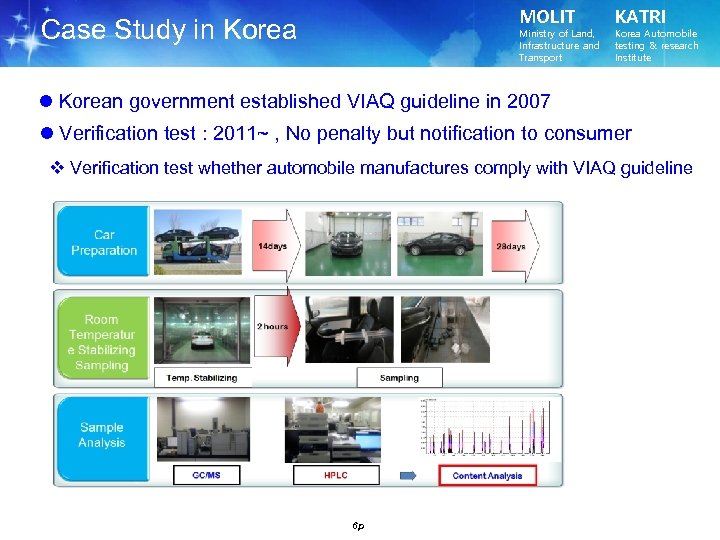
MOLIT Case Study in Korea Ministry of Land, Infrastructure and Transport KATRI Korea Automobile testing & research Institute l Korean government established VIAQ guideline in 2007 l Verification test : 2011~ , No penalty but notification to consumer v Verification test whether automobile manufactures comply with VIAQ guideline 6 p
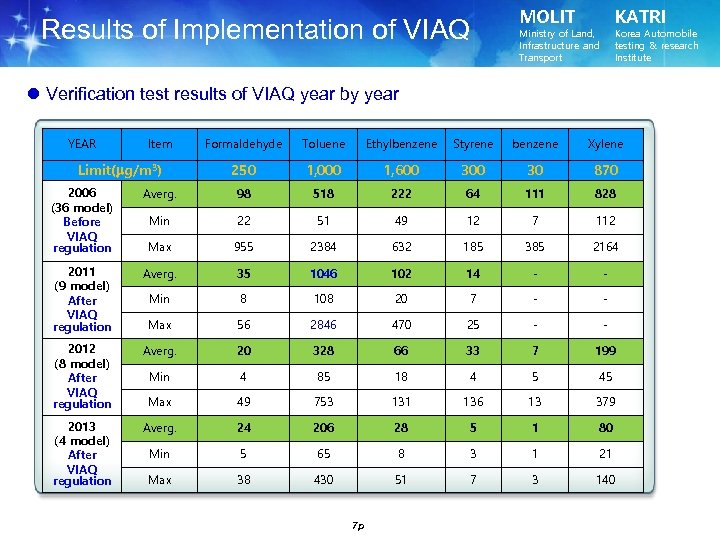
Results of Implementation of VIAQ MOLIT KATRI Ministry of Land, Infrastructure and Transport Korea Automobile testing & research Institute l Verification test results of VIAQ year by year YEAR Item Limit( g/m 3) Formaldehyde Toluene Ethylbenzene Styrene benzene Xylene 250 1, 000 1, 600 30 870 2006 (36 model) Before VIAQ regulation Averg. 98 518 222 64 111 828 Min 22 51 49 12 7 112 Max 955 2384 632 185 385 2164 2011 (9 model) After VIAQ regulation Averg. 35 1046 102 14 - - Min 8 108 20 7 - - Max 56 2846 470 25 - - 2012 (8 model) After VIAQ regulation Averg. 20 328 66 33 7 199 Min 4 85 18 4 5 45 Max 49 753 131 136 13 379 2013 (4 model) After VIAQ regulation Averg. 24 206 28 5 1 80 Min 5 65 8 3 1 21 Max 38 430 51 7 3 140 7 p
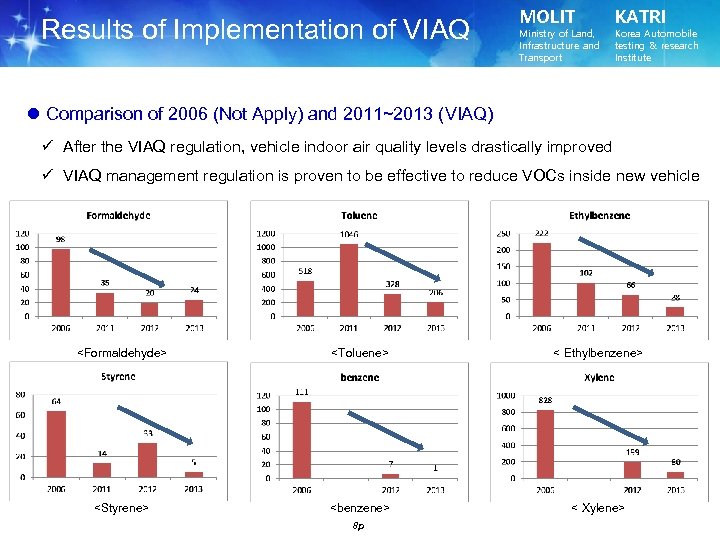
Results of Implementation of VIAQ MOLIT Ministry of Land, Infrastructure and Transport KATRI Korea Automobile testing & research Institute l Comparison of 2006 (Not Apply) and 2011~2013 (VIAQ) ü After the VIAQ regulation, vehicle indoor air quality levels drastically improved ü VIAQ management regulation is proven to be effective to reduce VOCs inside new vehicle <Formaldehyde> <Toluene> < Ethylbenzene> <Styrene> <benzene> < Xylene> 8 p
MOLIT Conclusions Ministry of Land, Infrastructure and Transport KATRI Korea Automobile testing & research Institute l To protect driver and passenger’s health and safe driving, Korea has been applied VIAQ regulation since 2011 l After applying the VIAQ regulation, vehicle indoor air quality levels have been improved rapidly. It has been proved that VAIQ is effective l Need to unified regulation on vehicle indoor air quality (VAIQ) to protect driver’s health and safe driving 9 p

MOLIT Ministry of Land, Infrastructure and Transport Thank you very much ! ! Senior Deputy Director Woo Jeong Hoon jongsoon@ts 2020. kr 10 p KATRI Korea Automobile testing & research Institute
Скачать презентацию Transmitted by the representative of Korea Informal document
2dc4da99a99fe83c55a2370638b43703.ppt